Tag: Agrees

  • $584M on the line as University of California agrees to negotiate with Trump administration

    $584M on the line as University of California agrees to negotiate with Trump administration

    This audio is auto-generated. Please let us know if you have feedback.

    Dive Brief: 

    • The University of California system agreed this week to enter negotiations with the Trump administration in an attempt to have $584 million in suspended federal funding restored to the University of California, Los Angeles. 
    • The funding cut came after the U.S. Department of Justice alleged last week that UCLA broke civil rights law by not doing enough to protect Jewish and Israeli students from harassment. The agency also launched a probe into whether the UC system discriminates against employees by allowing an antisemitic, hostile work environment. 
    • In announcing the negotiations Wednesday, UC President James Milliken called the UCLA cuts “a death knell for innovative work” and pushed back on the Trump administration’s justification for the revoked funding. These cuts do nothing to address antisemitism,” he said. “Moreover, the extensive work that UCLA and the entire University of California have taken to combat antisemitism has apparently been ignored.” 

    Dive Insight: 

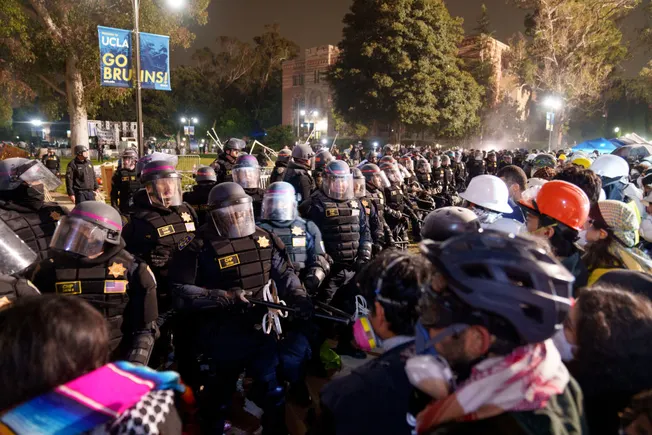
    Many of the Justice Department’s allegations against UCLA stem from a pro-Palestinian encampment erected on its campus in the spring 2024 term. 

    University leaders allowed the encampment to remain for nearly a week, citing a need to balance safety with free speech protections. They ultimately asked the Los Angeles Police Department to clear the encampment following a violent night in which counterprotesters attempted to tear down the encampment’s barricades, launched fireworks into it and hit pro-Palestinian demonstrators with sticks and other objects. 

    The pro-Palestinian protesters at times fought back, though video footage from the night shows few instances of them initiating confrontations, according to reporting from The New York Times. When police arrived — hours after violence first broke out — they didn’t step in immediately. 

    According to the Justice Department, at least 11 complaints were filed with UCLA alleging that students experienced discrimination based on race, religion or national origin from encampment protesters. 

    The agency also cited a UCLA task force report that found some encampment protesters formed human blockades to stop people — including students wearing the Star of David or those who refused to denounce Zionism — from freely moving throughout Royce Quad. 

    Milliken noted in his statement that UCLA has taken several steps since then to tighten campus protest policies and combat antisemitism. The university instituted a systemwide ban on encampments and launched a campus initiative in March to fight antisemitism, including through training and an improved system for handling complaints. 

    UCLA also agreed last month to pay $6 million to settle a lawsuit brought by three Jewish students and a Jewish professor who alleged the university violated their civil rights by allowing the encampment protesters to impede their access to the campus. Over one-third of the settlement payment will go toward organizations that fight antisemitism, The Associated Press reported. 

    Meanwhile, the university is facing a separate lawsuit brought by about three dozen pro-Palestinian students, faculty and others who allege that UCLA’s leaders didn’t protect them from the counterprotesters and failed to uphold their right to free expression. The lawsuit also names the counterprotesters as defendants. 

    Their lawsuit says UCLA police merely “stood and watched” for hours while counterprotesters “ruthlessly attacked” the encampment demonstrators, alleging the group broke their bones, burned their eyes with chemicals, and hit them with metal rods and other weapons. 

    The next day, the LAPD and the California Highway Patrol cleared the encampment at the request of university leaders. According to the lawsuit, law enforcement hurled flashbangs, shot powerful kinetic impact projectiles at peoples’ heads and faces, and used excessive physical force against and falsely arrested students, faculty, and concerned community members.” 

    Police arrested over 200 people while clearing the encampment. Those detained faced “invasive searches, false arrests, sexual assaults, and prolonged detentions,” and hijab-wearers were forced to remove their head coverings “infringing on their religious practices,” the lawsuit alleged.

    The pro-Palestinian plaintiffs suing UCLA are seeking damages and for the judge to declare the clearing of the encampment illegal, among other measures.

    Source link

  • Michigan district agrees to reform seclusion and restraint policies

    Michigan district agrees to reform seclusion and restraint policies

    This audio is auto-generated. Please let us know if you have feedback.

    Dive Brief:

    • Michigan’s Montcalm Area Intermediate School District is ending the practice of secluding students, reforming its restraint policies and making other improvements to special education services, according to an agreement between the school system and the U.S. Department of Justice.
    • DOJ, in a July 3 statement, said the district “used seclusion and restraint improperly, including using emergency crisis responses as punishment for normal classroom discipline issues,” leading to a violation of Title II of the Americans with Disabilities Act. The district, in a June 27 statement, said it had begun taking steps to improve its restraint and seclusion practices prior to the agreement.  
    • Federal investigations into schools’ restraint and seclusion practices over the past few years have led to reforms across the country as school systems work to balance student safety with their civil rights protections.

    Dive Insight:

    Montcalm Area ISD is an educational service agency that includes seven local districts, a public school academy and one virtual school. It serves about 12,000 students collectively, including about 1,800 students with disabilities.

    DOJ’s investigation found that students with disabilities in the district were restrained or secluded more than 2,400 times between the 2020-21 and 2022-23 school years.

    Under the agreement, the district will:

    • End seclusion for addressing student behaviors.
    • Halt the use of school rooms or other facilities for seclusion purposes.
    • Appoint a district-level intervention coordinator as a liaison between school principals and the superintendent, among other duties.
    • Create classroomwide behavior management plans for all classrooms in the district’s special education program to document consistent and developmentally appropriate rules, routines and techniques.
    • Ensure that restraint is only used to protect staff and students and only after all appropriate de-escalation techniques have failed.
    • Review whether students who were restrained or secluded are eligible for compensatory services and counseling.

    “Students with disabilities should never be discriminated against by experiencing the trauma of seclusion or improper restraint,” said Harmeet Dhillon, assistant attorney general of DOJ’s Civil Rights Division, in the July 3 statement.

    The week before, in a June 27 statement, Katie Flynn, superintendent of Montcalm Area ISD, said the district is “committed to providing a safe, nurturing, and welcoming learning environment.”

    According to the U.S. Department of Education’s Civil Rights Data Collection, about 105,700 public school students were physically restrained, mechanically restrained or placed in seclusion at schools across the country during the 2021-22 school year, the most recent year for which national data is available.

    Nationally, students with disabilities are disproportionally restrained and secluded in schools. Although students who qualify for special education services under the Individuals with Disabilities Education Act comprised 14% of the K-12 student enrollment in 2021-22, they represent 28% of students who were mechanically restrained, 68% of those who were secluded, and 76% who were physically restrained, according to the CRDC.

    Guidance issued in 2016 by the Education Department emphasizes that schools should never use restraint or seclusion for disciplinary purposes and that the practices should only be used if there is “imminent danger of serious physical harm to self or others.”

    The guidance also said if a student’s behavioral challenges lead to an emergency use of restraint or seclusion, it could be a sign of a disability that is interfering with the student’s progress in school, and therefore they should be evaluated to see if they qualify for special education services.

    Additional guidance issued earlier this year by the Education Department urged districts to take a more proactive approach to student behaviors by supporting students’ social, emotional, physical and mental health needs through multi-tiered systems of support that provide individualized interventions based on students’ needs for students with and without disabilities.

    Source link

  • Penn Agrees to Trump’s Demands, Will Strip Trans Athlete’s Awards

    Penn Agrees to Trump’s Demands, Will Strip Trans Athlete’s Awards

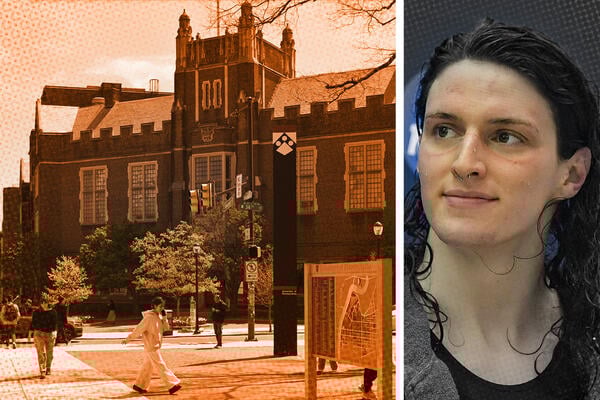
    Photo illustration by Justin Morrison/Inside Higher Ed | Kyle Mazza/Anadolu/Getty Images | Rich von Biberstein/Icon Sportswire/Getty Images

    The University of Pennsylvania will concede to the Trump administration’s demands that the university “restore” swimming awards—and send apology notes—to female competitors who lost to a trans athlete, the Department of Education’s Office for Civil Rights announced Tuesday.

    The department previously found that Penn violated Title IX for allowing a trans woman to compete on a women’s sports team—presumably referring to Lia Thomas, who rose to national attention while competing on Penn’s women’s swim team three years ago.

    To end the investigation, the administration demanded in part that Penn apologize to cisgender women whose swimming awards and honors were “misappropriated” to trans women athletes. Multiple Title IX advocates lambasted the department’s demands, arguing the agency was misusing the landmark gender-equity law to punish trans students and their institutions.

    Penn is one of multiple higher education institutions and K–12 schools that the administration has targeted for allowing trans women to play on women’s sports teams, in accordance with NCAA policy at the time. But it appears to be the first institution of higher education to reach a resolution agreement over the issue since Trump took office.

    “Penn remains committed to fostering a community that is welcoming, inclusive, and open to all students, faculty, and staff,” Penn president J. Larry Jameson said in a statement Tuesday. “I share this commitment, just as I remain dedicated to preserving and advancing the University’s vital and enduring mission. We have now brought to a close an investigation that, if unresolved, could have had significant and lasting implications for the University of Pennsylvania.”

    Separate from the department’s investigation, the White House paused $175 million in funding to the university because Penn “infamously permitted a male to compete on its women’s swimming team,” an official said in March. It’s not clear if the funding will be restored or when.

    Jameson stressed in the statement that the university was in compliance with Title IX and all NCAA guidelines at the time that Thomas swam for Penn’s women’s team from 2021 to 2022. But, he said, “we acknowledge that some student-athletes were disadvantaged by these rules. We recognize this and will apologize to those who experienced a competitive disadvantage or experienced anxiety because of the policies in effect at the time.”

    Title IX advocates have emphasized that trans athletes are not, in fact, explicitly forbidden from playing on women’s sports teams under the current Title IX regulations, which were finalized under the previous Trump administration and are the same ones that were in effect when Thomas was competing.

    In addition to stripping Thomas’s awards, Penn agreed to ED’s demands to make a public statement that people assigned male at birth are not allowed in Penn’s women’s athletic programs or its bathrooms and locker rooms, according to the department’s news release. The institution must also promise to adopt “biology-based definitions for the words ‘male’ and ‘female’ pursuant to Title IX” and Trump’s February executive order banning trans athletes from playing on the team that aligns with their gender.

    That statement also went up Tuesday. In it, the university promised to follow Trump’s trans athlete ban, as well as the executive order he signed that withdraws federal recognition of transgender people, with regard to women’s athletics.

    In the department’s announcement, Paula Scanlan, one of Thomas’s former teammates who has since led the crusade against trans women athletes, said she was “deeply grateful to the Trump Administration for refusing to back down on protecting women and girls and restoring our rightful accolades. I am also pleased that my alma mater has finally agreed to take not only the lawful path, but the honorable one.”

    Shiwali Patel, senior director of safe and inclusive schools at the National Women’s Law Center, criticized the agreement in a statement Tuesday as a “devastating and shameful outcome.” She blamed Penn’s “utter failure” as well as the department’s “continued manipulation of Title IX.”

    “The Trump administration’s attacks on civil rights protections, including Title IX, and obsession with undermining bodily autonomy is the real harm to women and girls, unlike transgender athletes who want to compete in sports alongside their peers and pose no threat to women’s sports, contrary to Trump’s lies,” Patel said in the statement. “In fact, their inclusion benefits all women and girls. We will continue to support Lia Thomas and her peers and their right to compete.”

    Source link

  • Education Dept. Agrees to Send Career Ed Programs to Labor

    Education Dept. Agrees to Send Career Ed Programs to Labor

    Before a federal judge blocked its plans, the Education Department reached a deal with the Department of Labor to hand over some of its career, technical and adult education grants, according to court records.

    Under the agreement, reached May 21, the Labor Department would administer about $2.7 billion in grants, including the Perkins Grant program, which funds career and technical education at K–12 schools and community colleges, Politico first reported. But that plan is now on hold, as is an agreement with the Treasury Department regarding student loan collections, according to a status update in New York’s lawsuit challenging mass layoffs at the agency and President Donald Trump’s executive order to dismantle the department.

    The Trump administration has asked the Supreme Court to overturn the lower court’s injunction so officials can proceed with the layoffs and other plans. 

    The department didn’t publicly announce the handover, which appears to be a first step toward Trump’s endgame of shutting down the agency. Education Secretary Linda McMahon has acknowledged repeatedly that only Congress can legally shutter the department, but she’s also made clear that she can transfer some responsibilities to other agencies. In addition to administering the funds, Labor officials agreed to oversee the implementation of career education programs and to monitor grant recipients for compliance. 

    Advance CTE and the Association for Career and Technical Education criticized the plan, saying the agreement “directly circumvents existing statutory requirements” related to the Perkins program and would cause confusion.

    “We strongly oppose any efforts to move CTE administration away from the U.S. Department of Education given the disruption this would cause to the legislation’s implementation and services to students in schools across the country,” they said in a statement released Wednesday evening.

    Source link

  • Education Dept. Agrees to Push DEI Compliance Deadline

    Education Dept. Agrees to Push DEI Compliance Deadline

    State education agencies are no longer bound to certify their compliance with President Donald Trump’s executive orders and guidance memos banning diversity, equity and inclusion programs in order to continue receiving federal funds—at least for now.

    K-12 school districts were originally required to prove they had met the president’s standard by April 14. But now, as the result of an agreement reached Thursday in a lawsuit, the Department of Education cannot enforce that requirement or enact any penalties until April 24. The move to require school systems to certify their compliance was one of the department’s first actions since releasing the Feb. 14 Dear Colleague letter that declared all race-conscious student programming, resources and financial aid illegal.

    The National Education Association challenged that letter in a lawsuit and then moved for a temporary restraining order to block the certification requirement. (The department notified state educational agencies of the deadline April 3.)

    In addition to not enforcing the certification requirement, the Education Department also agreed not to take any enforcement action related to the Feb. 14 guidance until April 24, though that doesn’t cover any other investigations based on race discrimination.

    The plaintiffs, represented by the American Civil Liberties Union, still want to block the Dear Colleague letter entirely. But they see the agreement as a positive step.

    “This pause in enforcement provides immediate relief to schools across the country while the broader legal challenge continues,” the plaintiffs said in a news release.

    A judge will hold a hearing April 17 to consider the NEA’s motion for a preliminary injunction, which could block the guidance entirely.

    For more information on this case and others, check out Inside Higher Ed’s lawsuit tracker here.

    Source link

  • Columbia Agrees to Trump’s Demands

    Columbia Agrees to Trump’s Demands

    Acquiescing to demands from the Trump administration to address alleged antisemitism on campus, Columbia University has agreed to overhaul disciplinary processes, ban masks at protests, add 36 officers with the authority to make arrests and appoint a new senior vice provost to oversee academic programs focused on the Middle East, among other changes.

    The decision, announced Friday afternoon, is the latest move in Columbia’s ongoing face-off with the federal government over last year’s pro-Palestinian protests, which spawned the nationwide encampment movement. Columbia yielded despite concerns about the legality of the demands, as well as of an associated effort by the Trump administration to strip the university of $400 million in research funding.

    “We have worked hard to address the legitimate concerns raised both from within and without our Columbia community, including by our regulators, with respect to the discrimination, harassment, and antisemitic acts our Jewish community has faced in the wake of October 7, 2023,” university officials said in a Friday statement.

    The acknowledgment is a rare admission of antisemitism on campus, despite the fact that a Title VI investigation by the Department of Education has not yet been completed.

    Columbia announced additional efforts that the Trump administration didn’t request, including advancing the university’s Tel Aviv Center (though initial details are sparse) and creating a K-12 curriculum “focused on topics such as how to have difficult conversations, create classrooms that foster open inquiry, dialogue across difference and topics related to antisemitism.” That curriculum will be free for schools.

    Columbia did not place the Middle East, South Asian and African Studies Department into “academic receivership” for a minimum of five years, as the Trump administration demanded, but the parties appeared to reach a compromise. A new senior vice provost will review a broader range of programs, expanding beyond the department targeted by Trump to include “the Center for Palestine Studies; the Institute for Israel and Jewish Studies; Middle Eastern, South Asian, and African Studies; the Middle East Institute; the Tel Aviv and Amman global hubs; [and] the School of International and Public Affairs Middle East Policy major,” according to the university.

    The new senior provost, who has not yet been named, will review programs “to ensure the educational offerings are comprehensive and balanced” and evaluate “all aspects of leadership and curriculum” among other changes, which may include academic restructuring.

    The full list of changes can be found here.

    Interim president Katrina Armstrong announced the move in a statement titled “Sharing Progress on Our Priorities,” calling it “a privilege to share our progress and plans” after a difficult year of protests and scrutiny.

    “At all times, we are guided by our values, putting academic freedom, free expression, open inquiry, and respect for all at the fore of every decision we make,” Armstrong wrote in the message posted Friday afternoon, which she signed, “Standing together for Columbia.”

    Critics, however, have argued that yielding to the Trump administration undermines academic freedom and urged Columbia to fight the demands.

    Legal scholars at Columbia and in conservative circles have noted that the Trump administration’s demands were likely unlawful. However, it seemed the university had no desire for a protracted legal fight.

    After the news broke—first reported by The Wall Street Journal—many critics panned the move.

    In a Friday press call, American Association of University Professors President Todd Wolfson blasted Columbia for failing to stand up to Trump.

    “This is not the outcome we wanted to see we wanted to see Columbia stand up for their rights for academic freedom and freedom of speech on their campus and we did not expect for them to not only capitulate to the demands of the federal government but actually go beyond the initial demands as far as we can tell,” Wolfson said.

    “This is an unprecedented intervention into academic freedom—never before in Columbia’s 250+ years has the federal government tried to exert control over a department before. And Trump et al. are only getting started,” Columbia history professor Karl Jacoby wrote on Bluesky.

    Outside experts pointed to the likelihood that more universities will give in to Trump’s threats now that Columbia has yielded.

    “Trump gets exactly what he wants from Columbia. Next up: most of the big-name institutions in American higher education. This is a turning point in the history of our industry,” Robert Kelchen, a professor of education and head of the Department of Educational Leadership and Policy Studies at the University of Tennessee at Knoxville, wrote in a Bluesky post.

    (Ryan Quinn contributed to this report.)

    Source link