Tag: AIPowered

  • AI-Powered Data for Community College Student Success

    AI-Powered Data for Community College Student Success

    Colleges and universities sit on a large wealth of data, ranging from student attendance and interactions with learning management systems to employment and earnings data for graduates. But uniting legacy systems and having responsive data remains a wicked problem for many institutions.

    This year, Central New Mexico Community College is deploying a new AI-powered predictive analytics tool, CampusLens, part of CampusWorks, to improve data visibility in student retention, early alerts and career outcomes.

    In the latest episode of Voices of Student Success, host Ashley Mowreader speaks with Tracy Hartzler, president of Central New Mexico Community College, to discuss the risks with taking on new tools, the college’s approach to change management and the need for more responsive data.

    An edited version of the podcast appears below.

    Q: Can you introduce yourself, your role and your institution?

    Tracy Hartzler, President of Central New Mexico Community College

    A: My name is Tracy Hartzler. I’m president of Central New Mexico Community College. We’re located in Albuquerque, New Mexico. We serve three counties around us, and our population is about 900,000 residents in our area, so it’s about half the state of New Mexico who lives in our service area, but it’s an incredibly diverse area.

    We have a significant population of Hispanic, Latino students. We have a large population of Indigenous students, as well. We are the largest undergraduate institution in the state, and that’s distinct because we only issue or grant certificates and associate degrees. We are not a bachelor’s degree–granting institution, so our focus really is on those students who are seeking entry into college—whether that’s our dual credit students who are still in high school—but also those who are returning for upskilling. They’ve already earned their bachelor’s degree or degrees, and they’re coming back for some hands-on or applied skills, or those who are getting back into education and training because they’re looking for greater financial stability.

    Like so many other colleges, we know we want to learn from others, and so we’re really proud that we work with many of our other colleges across the state of New Mexico, but we certainly engage in conversations with leaders and schools who participate in American Association of Community Colleges who are part of the global community college leader network.

    But we’re really pleased and we’ve been really pushed by our peers who are members of the Alliance for Innovation and Transformation—group of higher education institutions, there’s about 60 of us—with some other thought partners to really help us think how we can best leverage technology and change our processes and deliver better education and training for our students and better serve our employers.

    We also are relying on lessons learned from those outside of higher education, so whether it’s in hospitality, healthcare, manufacturing and others. So while we know we have great work to do in New Mexico, and we are incredibly fortunate to work with strong partners who tell us what they want and how we can best serve them, we certainly look to other schools and other organizations to help us make those transitions faster so we can better serve our community.

    Q: From my vantage point, it seems community colleges are often some of the most nimble when it comes to learning from other institutions.

    A: Absolutely. You know, it’s great to be scrappy. I think we and here at CNM, we certainly punch above our weight. We are excited to take on new challenges. We are, frankly, fortunate to be able to move faster. So, if something doesn’t work, we can pivot away from it entirely or continue to revise it. And frankly, the urgency to do so is really placed on us by our employer partners, our community partners and our students. They really are pressing us to be responsive to them because they don’t have time to waste, and they certainly don’t have resources to waste. So, we really step in. And again, I don’t think CNM is unique in that we all respond to the need as quickly and as best we can.

    Q: We’re talking today about a new AI-powered predictive analytics tool that you all implemented. Historically, what has been the college’s retention and persistence strategy? What are some of the challenges you have seen when supporting students?

    A: Before the pandemic, we were able to and we were participating in a lot of futures work: What do students need? What do they need now? What do employers need in the future? Which, at that time, seemed so far off, and so we were already on a journey again, whether it was working with AFIT or others to help us better identify what we needed to do and how we needed to change to better meet our student and our employer needs.

    We knew that that would include certainly technology and leveraging technology, but we also knew it would mean changing how we do things, how we schedule, how we use the data in our systems. And we also knew we have a tremendous amount of information. We have a lot of data, but like so many other places, it’s in seven legacy systems. And we have over 100 applications that help our data systems talk to each other, to generate reports that our staff use, and it’s incredibly challenging to wrangle this data in a way that is useful, that helps us drive and drive change again.

    Most of the data is legacy data. It’s what happened last year, and how do we think that’s going to improve? What are we doing now to then improve performance a year ahead, and then we hope that what we do over the next year meets the need, but it takes us too long to really react.

    So, we were looking for ways to take the assets we have—which includes our incredible faculty and a number of our leaders and our office of data strategy and some of our contractors, like CampusWorks and consultants—to help us wrangle this data in a way that helps us be data informed in a time-sensitive way.

    We had a lot of processes in place that were helping us to do that. A lot of our steps were manual and creating reports, and it really slowed down what our frontline advisers and navigators and employment advisers really were able to do, because we were requiring them to do so much manipulation with the data then to be able to identify what they should do once they got this great report.

    So, we were looking for ways to leverage technology. And again, the pandemic happens. We’re increasingly dependent on our systems, using them to greater degrees than we had before, including our learning management system. We are also undertaking a transition conversion from our old student information system to a new student information systemin Workday. We’re making all these changes and upgrading technology, and frankly, AI is coming along that’s really dramatically changing how we work, or could change how we work. We’re trying to figure out a better way to wrangle all these opportunities.

    We were so excited to learn about CampusWorks and their product, CampusLens, because we think that tool will help us leapfrog, not only the tool but the experts that that CampusWorks brings to the table to help us to analyze data and develop tools that will help our frontline staff much more quickly and easily identify how they can help students. To register from class A to B, to help them identify all the predictors that say, if the student’s missing one assignment or they haven’t attended class, here are the automatic prompts for you as an adviser or navigator—or if you choose to automate that process you can. But really, how can we help individuals—our employees—still help and better connect with students to keep them on the track of success?

    It certainly can also help us schedule, help our faculty and all of our associate deans who do incredible jobs trying to figure out ways to schedule our incredible programming to be most effective for students. Some of this information that we’ve had in different places, when it comes together in a product like CampusLens, will help us generate these tools so that we can we can more quickly assess our situation and better adapt, test, try and iterate ways to better, like I said, schedule classes, schedule our work-based experiences, help our employers predict the number of graduates who are going to come out of our programs at any given time.

    When we have employers come to us with dramatic needs, you know, they need 1,000 technicians over three years, well, what do we need to do to scale and ramp up our programming to meet that need?

    I’m excited that we have a tool that will help us do that, instead of the army of staff and technical staff that I would have to try to find to help us do that in an efficient way. That’s why a product and a team, a quality, curious and an innovative team at CampusWorks to help us work through some of these projects.

    Q: How does the tool work logistically? What are you excited about when it comes to the capabilities of CampusWorks and CampusLens?

    A: It helps us better, frankly, use staff time to keep students and others on the right track—on the track that they’ve chosen, by the way.

    What is most exciting, at least for us with CampusLens, is their Career Lens. So all institutions, all community colleges, are focused on many phrases, but all go to the federal emphasis, or your statewide emphasis on return on investment. What is the value that a learner gets from your program that can be defined a lot of ways. It could be defined by wages, wages a year out, it could be defined for many years out from completing a certificate or degree. It looks at what’s your job in a particular program. We know the federal government, whether when they’re leading the rules around rule-making for Workforce Pell, we know that those regulations are going to help us require that we analyze our programs for results. Will these programs allow students to be eligible for federal assistance?

    We know that we can use all of this data and CampusLens is going to be able to help us identify which programs are eligible for Workforce Pell, what are the wages? It’ll help us report out the successes of our programs, or, frankly, identify those programs where wages are not at the median level. What do we need to do, then, to repackage or reschedule or build up some of our programs to meet the wage requirements that we want individuals to accomplish, to achieve and earn, but also that will meet some of our federal standards?

    So, I’m really excited about the workforce component of this, which is really what we’re all looking for. All of us [higher education leaders] want, I’d say, a silver bullet when it comes to unifying this data and being able to tell the story and being able to design programming is responsive and frankly to be able to tell our stakeholders, whether they’re legislators or federal government agencies giving us funding for workforce training, what are the outcomes? That’s so important that we’re able to show and tell the story with really valuable data? And I’m excited that CampusLens allows us to achieve that.

    Q: How have you all been thinking about AI as a tool on campus, what are those conversation looking like with your staff and employees?

    A: I want to start with our governing board. CNM is governed by a seven-member elected governing board, and our governing board represents geographic areas in our community. They are focused on how we are best serving our students, our employers and our community members and what does that mean for technology? Is the college investing in programming and the right tools? Are we getting the greatest benefit from the tools we’ve purchased? That also includes the question of, how are our faculty and staff using the tools to better help our learners?

    We talked about retention and persistence and how we use data, but it takes training and professional development to be able to use the tools to the greatest advantage. And of course, this is all in service to our learners and our employers. So it starts with our leadership, and then it flows through.

    I don’t think we’re any different than a lot of other colleges. We’ve looked at our policies, and we’ve built on our existing academic integrity policies around AI use, and we have faculty policies on how they describe and expect use, or have authorized use, if you will, approved use, embedded use of AI in their coursework, in their programs. We have policies in place.

    We also have done some pilot work. We’ve created a fund for individuals to come to a group around data, frankly, out of our data governance team and our IT team to be able to pitch ideas for three-month sprints or pilots, and they report back. What was the result? What did we learn? Is it something we should scale

    I will say many of those pilots are both on the business side or the operation side of the college, but also on the student and teaching and learning side. So that’s really interesting. We look forward to some of those first official pilots coming forward in the next month or so.

    What I’m most excited about, though, is the systemic use of AI across the institution. I appreciate the pilots get us excited and interested. It gets people familiar with tools as they evolve and change. But how do we embed AI into our systems work? That’s why I’m excited about CampusLens.

    You can only have so many pilots and scale up pilots, and you can read how many articles that tell you and advice pieces from Gartner to McKinsey to whatever source you may choose that help you try to identify how to scale up pilots. But I wanted something that was going to help us leapfrog that, and frankly, CampusLens allows us to do that with a multi-year co-development opportunity to help us focus on the student journey, but really in a systemic way, look at all of our data sources and our use and all of even our new systems like Workday that help us to leverage a tool that sits above our data sources. We’ll learn the operational side of this as we go on. But I’m really focused on students, and this was the easiest way to take a risk at a systemic change with a trusted partner who has incredible expertise, as we’ve known for years, and our relationship with them to help us take that leap, to help us implement a system-wide approach to using AI and how that can change and enhance all the human work that we do with our students.

    It’s not necessarily about eliminating the human touch to what we do. It’s about helping our advisers and our navigators and our faculty members and our intern placement officers, helping them do their work more successfully, always evaluated by student satisfaction, student placement, employer satisfaction and the like.

    I appreciate pilots, there’s a great role for them. And I really appreciate that we are able to take a systemic swing at this work.

    Q: You used the work risk earlier applied to taking on this system, what do you consider the risks or challenges of this process?

    A: There’s always a risk in the investment you’re making initially and the ongoing risk. The risk is not only the contract for the service, hiring the expertise and hiring a partner who’s been affiliated and connected to higher education for decades, who understands students, understands institutional requirements and for compliance and integrity and data governance and permissible uses. Working with a partner that has that basic understanding is critical. That mitigates your risk immediately.

    The financial risk is always: Are we chasing AI attachments to every system we have, or are we helping to right size those to be able to leverage a holistic or a system-wide, comprehensive AI-aided business analytics or business intelligence tool? That’s a very different approach then again, enhancing all of the six legacy systems I have, plus using one system or one tool to be able to do that intelligence work. That’s a risk, and that’s something different that we’ve had to navigate.

    I don’t underestimate the time and challenge and excitement of staff in using technology, that can be seen as a risk. There’s a real temptation, and I see it almost daily, to just lift what we do currently in our old systems and shift it to a new system and just be satisfied with going faster or generating a nicer looking report. It’s not what we wanted and that is so not what we can do in higher ed. We are called to be more innovative and to really use our information differently. And this tool will allow us to do that in terms of really getting to the intelligence side of predictive analytics.

    That’s always seen as almost a holy grail for us, and to see that it’s within reach now, that’s worth the risk for us. We’ll be able to see the analytics and the predictive analytics that we were at one time working on a project, and we thought we might get there in two or three years. The fact that I can probably do this by the end of this academic year is really important for us. And by the way, not just see some results at the end of this academic year, but know that it’s going to be iterative and evolve, so that we’re going to continue to see growth and change and adaptation and be a part of that shaping is really important to us.

    I think I mean the risk is time, resources, and security, and we face those all the time. But I will dare say the risk is also not doing anything. If we aren’t moving in this direction, you are risking putting resources, and particularly too much money and technologies that you still have to reconcile in some way. You risk, frankly, burning out your staff by adding another dashboard they’ve got to learn instead of one that’s much more comprehensive. You’re still going to have them look at 10 different screens to come up with all the information they need to advise one student. So, you don’t want to burn out your staff. You actually need them to be more efficient and effective and spend time with the student in a different way.

    The risks of not taking a step like this are substantial, because the world will continue. Students will still demand more, and they always demand more to make their work easier, which means our work can be a little bit harder, and employers are expecting us to be responsive. So if you don’t act and take certain risks, you’re either irrelevant or your students are unprepared for the world that they’re going to be entering, and we just don’t have time for that. That’s just not an option.

    Q: I appreciated your comment on the risks of using a new tool to do the exact same thing. We know that faculty and staff are often crunched for time and ensuring that we’re creating new systems that are evolutionary and actually creating efficiencies for everyone involved is important.

    A: Yeah, and that’s scary. It does mean that we will be changing how we work. It means we will be removing some of the guesswork of whether our efforts will work. We can see whether, if I move certain levers in a student journey, does this really make the difference? Does it really move the needle, not only for that student, but maybe very similarly situated students?

    It’s really important. This will change how we work. We’ll be asking our employees, my colleagues, to think differently and do their work differently, because they’ll have more information available to them with suggestions on how to act, so they don’t have to always consider and frankly, reinvent the wheel. That’s really important, but I don’t underestimate what that change looks like, because when you have expertise in old systems or even evolving systems, and that expertise can be threatened or seem to be threatened, then we have to navigate that, and again, always make sure we’re serving our students and doing it the best way we can.

    This technology, the tools, the guidance and the continued evolution will, I think, go a long way toward mitigating that fear. When I brought this option for CampusLens to my team, I made sure my team kicked the tires. This wasn’t a president’s folly. It was sincere, deliberate vetting by many individuals across the college to say, is this the right approach? What are our questions? What are our fears? What’s my role? Will it really better serve our students, and what does that look like with professional development? How do I use this team of experts that I’m not used to working with? How are they going to integrate and challenge us and help us do our work? So there were a number of challenges in the five or six months that it took us to ascertain whether this is the right approach for us, and I appreciate that it’s a collaborative effort, and that that is continuing as we talk about change management and the work that we have to test the tool and move it out in the college.

    Q: Where are you all at in this change process? What are you looking forward to as the next step?

    A: We’re still early in our stages of implementing CampusLens. Much of what we hope for centers arounds adoption and effectiveness and we really hope for a long-term operational integration. Again, my interest is not only in pilots, but in helping us make systemic change and better leveraging all the legacy data sources that we have.

    What we are hoping to see in the next 12 months would be how we move from tracking legacy data and focusing on what has happened to helping us think about what is likely to happen based on the data we see. So again, shift in mindset from always reporting out past data, old data, lagging data to what do we think will happen? And then how do we change behavior to improve what we think will happen or change the trajectory, if that’s what we want to do? I think it’s really important for our community, for us to continue to test the model, the tool and the logic, so it’s going to continue to be refined. I know that as we go through over time, we will continue to improve, refine, revise the model so that it better reflects what our community here in Central New Mexico needs and what our students need.

    We’re early in the stages. What I’ve seen so far is exciting, and it’s what we wanted to accomplish, and this tool is going to help us accomplish it, I think, sooner, and to be able to test our work sooner.

    We bet your colleague would like this article, too. Send them this link to subscribe to our newsletter on Student Success.

    Source link

  • Top Hat Unveils AI-Powered Content Enhancer to Fuel Title II Accessibility Compliance

    Top Hat Unveils AI-Powered Content Enhancer to Fuel Title II Accessibility Compliance

    New capabilities in Top Hat Ace enable educators to quickly and easily transform static course materials into accessible, interactive content.

    TORONTO – October 28, 2025 – Top Hat, the leader in student engagement solutions for higher education, today announced the launch of a powerful new accessibility tool in its AI-powered assistant, Ace. Ace Content Enhancer gives faculty the ability to upload existing course materials into Top Hat and receive actionable guidance to meet WCAG 2.1 AA accessibility standards with minimal effort.

    Following the U.S. Department of Justice’s 2024 Title II ruling, public colleges and universities must ensure all digital content meets WCAG 2.1 AA standards as early as April 2026, depending on institution size. But for most professors, the path to compliance is anything but clear. The rules are highly technical, and without dedicated time or training, it can be challenging to ensure materials are fully compliant. Ace Content Enhancer removes this burden by scanning materials in Top Hat in seconds, identifying issues, and providing recommendations to help content meet the standards for accessibility outlined under Title II.

    “We’re helping educators meet this moment by simplifying compliance and making it easier to create learning experiences that serve all students,” said Maggie Leen, CEO of Top Hat. “More than meeting a mandate, this is an opportunity to create content that’s more engaging, and ultimately more effective in supporting student success.”

    A faster, simpler path to compliant courseware

    With Ace’s AI-powered Content Enhancer, faculty can:

    • Scan materials for accessibility issues instantly. Uploaded or existing content in Top Hat is analyzed in seconds, with specific accessibility concerns in text and images flagged for quick review.
    • Remediate with ease. Recommendations and features like auto-generated alt-text remove guesswork and save time.
    • Improve clarity for all learners. Suggested tone helps make content easier to understand and more effective.
    • Make content more relevant. Use Ace to generate real-world examples tailored to students’ interests, academic goals, or backgrounds to boost engagement.
    • Reinforce learning through practice. Ace will suggest interactive, low-stakes questions to deepen understanding and support active learning.

    “Educators retain full control of their content, while Ace eliminates the guesswork, making accessibility improvements fast, intuitive, and aligned with instructional goals,” said Hong Bui, Chief Product Officer at Top Hat. “We’re providing a guided path forward so that accessibility doesn’t come at the expense of interactivity, creativity, or sound pedagogy.”

    The launch of Ace Content Enhancer reflects Top Hat’s broader commitment to accessibility. It builds on existing capabilities—like automatic transcription of slide content—and reinforces the company’s focus on ensuring all student-facing tools and experiences, across web and mobile, meet WCAG 2.1 AA standards, including readings, assessments, and interactive content.

    About Top Hat

    As the leader in student engagement solutions for higher education, Top Hat enables educators to employ evidence-based teaching practices through interactive content, tools, and activities in in-person, online and hybrid classroom environments. Thousands of faculty at more than 1,500 North American colleges and universities use Top Hat to create personalized, engaging and accessible learning experiences for students before, during, and after class. To learn more, please visit tophat.com.

    Source link

  • ICEF launches new AI-powered compliance platform

    ICEF launches new AI-powered compliance platform

    The platform has been designed to:

    • provide five layers of compliance checks; regulatory, financial social media monitoring, physical verifications and liveness detection
    • monitor selected agent activity 24 hours a day using AI scanning software set to provide real-time risk alerts
    • enable institutions to perform due diligence on agent partners – and vice versa, as agents research private institutions they may seek to represent in market.

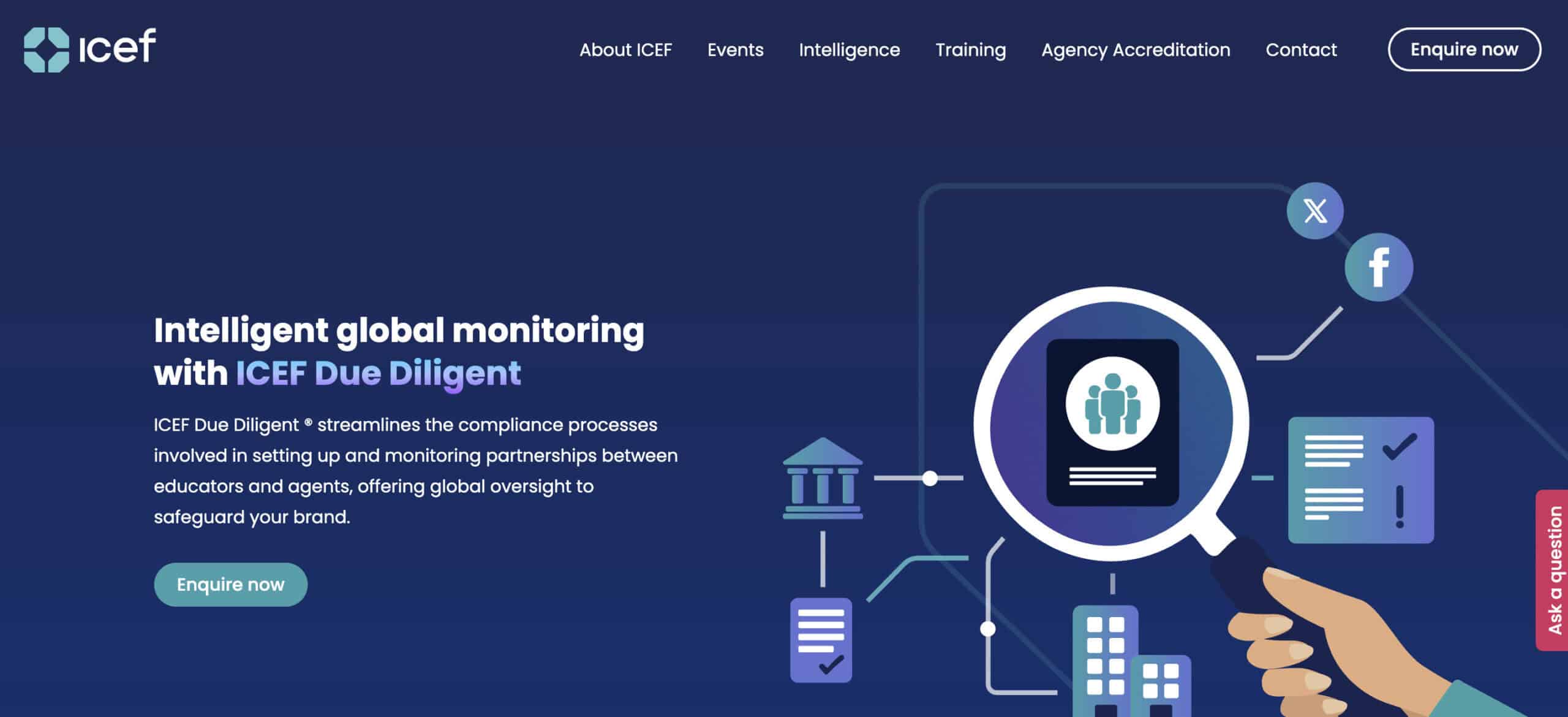
    ICEF has launched a new platform called Due Diligent, a system that it describes as “the first AI-powered tool designed to ensure ethical, transparent and compliant educator-agency partnerships”.

    It aims to improve the transparent monitoring of agent finances, representatives, social media and in-country marketing.

    The company already accredits over 2,300 agents and has trained more than 140,000 counsellors, enabling them to become certified through the ICEF Academy.

    The new platform promises to provide both educators and agents with real-time information about one another in a reciprocal way, including financial and regulatory checks as well as social media listening.

    Scaled by using the latest wave of artificial intelligence technology, the ICEF software constantly scans agent activity based on an institution’s own approved list, creating regular reports of social media messaging happening in each market to ensure it is on brand and compliant.

    Unapproved use of branding or incorrect information can also be flagged, allowing institutions better visibility of the long tail of subagent networks.

    Due Diligent has also been designed to search for information on the individuals who operate and own agencies, including financial checks and media coverage. The aim is to identify bad actors who may reappear again in another agency.

    Speaking to The PIE News, ICEF’s chief visionary officer, Tony Lee, said: “Most importantly, the new platform is looking at the individuals behind an agency. It’s about that transparency of knowing who those agencies are, so it’s not just a random company name in a random country – it’s knowing who’s behind that company as an individual.

    “We’ve also been able to use the next generation of social media listening software and crawling software so that we can hear and see what those individuals are saying in the public spaces,” continued Lee.

    Most importantly, the new platform is looking at the individuals behind an agency
    Tony Lee, ICEF

    The launch of ICEF Due Diligent is part of ICEF’s wider ‘Together for Transparency’ campaign, which is championing professional standards and greater trust between educators, recruitment agencies and students worldwide.

    “ICEF has been working in the agent space for 30 years,” continued Lee. “But we’re not judge or jury. We’re giving the framework for the entire sector to be effectively the ones that judge what is good or bad practice, we’re simply turning the lights on [to help make a considered decision].

    The platform was developed in consultation with over 400 industry stakeholders. One of the main frustrations expressed by the sector has been the burden of annually auditing large agent networks.

    It is hoped that the use of a continual AI-powered monitoring tool can relieve that burden and free up more time for strategic training, counselling and recruitment support.

    Markus Badde, CEO of ICEF, explained: “In today’s competitive and increasingly regulated environment, trust is everything. ICEF Due Diligent gives educators, agencies and stakeholders the confidence that their partners meet the highest professional and ethical standards, continuously.”

    Source link

  • How Marketers are Winning With AI-Powered Search

    How Marketers are Winning With AI-Powered Search

    Search Has Changed. Has Your Strategy?

    Paid search marketing has always played a central role in how students find and engage with colleges and universities. But how students search and what they expect from the experience has fundamentally changed. Today’s Modern Learners are digital-first and highly discerning, which raises the stakes for any higher education marketing strategy, especially when it comes to search visibility. Modern Learners are not just typing in keywords; they’re asking complex questions and increasingly expect fast, relevant answers that feel tailored to their individual goals.

    In this new reality, search is no longer just a tool; it is your institution’s reputational front door. For many students, the first impression comes from your search presence—whether your institution appears at all, and what shows up when it does. This moment shapes how they perceive your brand and can influence their decision to engage further.

    With advancements such as Google’s AI Overview and AI Mode, the line between paid and organic results is disappearing. These features pull from multiple sources to deliver a single, curated response designed to satisfy intent rather than merely match keywords. This means your search strategy can no longer operate in silos. Paid and organic efforts must work in tandem, and both need to be structured around how students actually search, not how institutions are used to marketing.

    Yet, many institutions still rely on legacy paid search strategies that are fragmented and overly focused on isolated keywords. These outdated tactics often miss the nuance of modern search behavior, leading to underperformance and missed opportunities.

    This is especially critical during a time when marketing budgets are under pressure and visibility is harder to earn. To remain competitive, higher ed marketers need to reimagine paid search not as a list of bid terms or ad placements, but as a strategic channel that influences both enrollment outcomes and institutional reputation. What’s at stake isn’t just performance. It’s how your brand is perceived in the channels that matter most.

    Intent Is the New Currency of Paid Search 

    Paid search has long been valued for its ability to deliver results quickly and cost-effectively. But in today’s environment, true efficiency means more than just driving volume through simply targeting the right keywords. Today, successful campaigns are built around understanding and aligning with the why behind a student’s search, not just the what.

    That’s where intent becomes essential. Intent reveals what a prospective student is trying to accomplish, what stage of the decision process they’re in and what they expect from their educational experiences. With today’s AI-powered platforms, marketers can now interpret and respond to this intent with greater precision than ever before.

    Modern tools like Performance Max—Google’s fully automated, goal-based ad campaign—and Broad Match—its flexible keyword matching option—draw from a range of real-time signals like device type, browsing behavior, location, and time of day. These platforms use that context to determine not just who to reach, but how and when to deliver the most relevant message.

    This shift is especially important when engaging adult and online learners. These prospective students often search in short, focused bursts across devices and platforms. Intent-based targeting helps ensure your message appears at the right moment, when a prospective student is most open to taking the next step.

    The benefit goes beyond smarter targeting. Institutions that embrace intent-based strategies often see improved efficiency, stronger lead quality and a higher return on investment. More importantly, they’re creating a search experience that meets students where they are.

    For higher education marketers, this requires a mindset shift. Paid search is no longer about chasing keywords or building lengthy lists of terms. It’s about reading behavior, responding with context and building relevance. Those who adapt to this new model will be better positioned to influence outcomes and build lasting brand reputations.

    Why Over-Segmentation Hurts AI Performance 

    Aligning with student intent requires more than new tools—it requires rethinking how campaigns are structured. That’s where over-segmentation becomes a critical barrier. Not long ago, higher education marketing professionals found success by keeping campaigns tightly focused. You’d build detailed audience segments, carefully tailor your messaging and control every aspect of targeting. It worked well in a time when more control often meant better results.

    That playbook doesn’t hold up in today’s AI-driven paid media environment. In fact, over segmentation actively holds your campaigns back.

    AI performs best when it’s given space to learn and optimize. It needs strong signals, such as first-party data, clear conversion goals and smart bidding strategies, to work effectively. Overly narrow targeting and rigid parameters create inefficiencies and limit performance.

    That’s why marketers should focus less on segmentation and more on supplying clear, meaningful data that helps AI reach the right students and drive outcomes like increased inquiries and stronger application intent. 

    At the same time, student journeys have changed. Modern Learners aren’t moving through the funnel in linear paths. Ther research process is fast-paced and shaped by real-life pressures like work schedules, finances and family responsibilities.  

    Prospective students don’t just want more content—they want information that’s relevant to their needs and arrives when it matters most. Modern paid media strategies must move beyond simple demographics to focus on behaviors, intent and how students search. 

    Transforming Strategy Into Results

    As search evolves, so too must the role of the higher ed marketer. In today’s AI-driven landscape, students are exploring their options in more nuanced ways. To keep pace, marketing strategies must shift from keyword-first thinking to approaches that prioritize context, content and the student journey. Here’s how forward-thinking teams are putting that into action:

    Smarter, Simpler Campaign Structures for Effective Paid Search Strategy

    AI works best when it has strong signals to learn from. That means it’s often more effective to group campaigns by intent rather than breaking them up by individual programs or markets. For example, grouping similar programs together can help your budget go further by focusing on where there’s actual search demand, even if it means less control over specific program-level results.

    Content That Works Harder

    When you’re working in a keywordless environment, your content does the targeting. Search platforms rely on your landing pages, headlines and descriptions to understand what you offer and who you want to reach. That’s why clear, relevant content is critical.  The schools seeing the best results are the ones creating content that aligns with what students are actually searching for. 

    Making the Most of First-Party Data 

    Performance Max campaigns are especially powerful when they’re fueled by high-quality first-party data. Feeding in enrollment signals, audience segments and behavioral insights allows AI to deliver more personalized outreach across platforms. This enhances reach and efficiency without compromising targeting precision.

    Scaling with AI Max and Broad Match 

    New tools like AI Max are opening doors to even more automation. AI Max combines broad match, keywordless targeting and AI-generated creative to help schools reach students in AI-driven placements. Paired with the right paid search strategy, Broad Match helps your content appear in the natural, conversational queries students actually use. 

    Aligning Paid and Organic Strategies  

    The strongest higher education marketing strategies bring paid search marketing and organic search marketing under one roof. When teams align on landing pages, keywords and messaging, both channels amplify each other—driving more qualified traffic, improving conversions and boosting visibility across search results. This gives AI clearer context and helps create a smoother experience for students. 

    Continuous Testing and Learning 

    AI doesn’t mean putting things on autopilot. The best results come when marketers stay involved—testing creative, improving landing pages and updating their audience signals. All of that helps the AI learn and get better over time. 

    When campaigns are built around clear intent and fueled by rich data and relevant content, AI moves beyond automation—it becomes a strategic partner. This empowers institutions to reach the right students with precision, reduce wasted spend and create meaningful connections that drive enrollment success. 

    Harness AI to Amplify Your Team’s Impact 

    AI isn’t here to replace your marketing team. Instead, it helps them work smarter and focus on what really matters. AI tools take care of the routine tasks like adjusting bids, testing creative and targeting audiences in real time. This gives your marketers more time to concentrate on strategy, keeping your brand consistent, understanding student journeys and improving conversions.

    This partnership between marketers and AI is the future of higher ed marketing. Adapting your strategy to today’s search landscape helps strengthen both your enrollment pipeline and your brand foundation.

    At EducationDynamics, we think differently about AI’s potential to power higher education marketing teams by combining creativity, data-driven insight and technology to drive meaningful growth.

    This is more than just a new way to run campaigns. It’s a shift toward meeting students more effectively—aligning enrollment and brand goals in a way that builds trust, boosts visibility and drives lasting success.

    Source link

  • AI-Powered Teaching: Practical Tools for Community College Faculty – Faculty Focus

    AI-Powered Teaching: Practical Tools for Community College Faculty – Faculty Focus

    Source link

  • AI-Powered Teaching: Practical Tools for Community College Faculty – Faculty Focus

    AI-Powered Teaching: Practical Tools for Community College Faculty – Faculty Focus

    Source link

  • From Feedback to Feedforward: Using AI-Powered Assessment Flywheel to Drive Student Competency – Faculty Focus

    From Feedback to Feedforward: Using AI-Powered Assessment Flywheel to Drive Student Competency – Faculty Focus

    Source link

  • A Year of AI-Powered Progress: RNL’s Product Evolution

    A Year of AI-Powered Progress: RNL’s Product Evolution

    The last year has been one of significant strides for RNL. We embarked on a journey to enhance our existing tools, aiming to provide our partners with even more powerful and effective solutions. This commitment has driven us to develop a suite of AI-powered tools designed to strengthen your connections with students and donors.

    A focus on data-driven decisions and user-friendly solutions

    Our primary goal was to create AI tools that are not only secure but also user-friendly and insightful. We aimed to provide you with a comprehensive view of your data, empowering you to make informed decisions and develop winning strategies. We understand the importance of ease of use, ensuring that our tools are accessible to everyone, regardless of their technical expertise.

    Key achievements: RNL Insights, Compass, and RNL Answers

    • RNL Insights: This AI-powered data management platform revolutionizes how you work with your data. By integrating data from various sources, including your enrollment CRM, financial aid modeling tool, and marketing analytics, Insights provides a unified view for informed decision-making. Its intuitive conversational interface allows you to ask questions and receive immediate answers, uncovering valuable insights you might have otherwise missed.
    • RNL Compass: Our AI-powered digital assistant, Compass, streamlines communication and enhances efficiency. By automating responses to common student and parent inquiries, Compass frees up your admissions team to focus on more strategic tasks. Integrated with your CRM, Compass provides personalized answers, ensuring each interaction is tailored to the individual’s needs.
    • RNL Answers: This AI copilot leverages your institution’s private data to provide valuable insights and support. Whether it’s crafting compelling marketing messages, assisting traveling admissions officers, or building robust knowledge bases for new team members, RNL Answers offers a secure and reliable AI-powered solution.

    Beyond technology: Empowering partners with AI expertise

    We recognize the importance of responsible AI adoption. To this end, we have introduced AI Governance and Education Consulting Services. These services provide guidance on integrating AI into your institution, including:

    • AI Education: Training leadership teams, faculty, and staff on the fundamentals of AI.
    • AI Governance Frameworks: Assisting in the development of frameworks that ensure ethical and responsible AI usage.

    Collaboration and continuous improvement

    To ensure our solutions remain aligned with your evolving needs, we have established the Leadership AI Council and the Product Advisory Council. These groups, comprised of our valued partners, provide valuable feedback and insights, shaping the future of our AI-powered solutions.

    Looking ahead: A future of innovation

    We have also began migrating some of the outbound communication tools our agents use to deliver your omnichannel outreach services to our new all-in-one platform—RNL Reach. While as a partner, your involvement in transitioning to RNL Reach is very minimal, but you will feel the benefit of the solution because your agents will be able to be more efficient in how they execute your campaigns and provide stronger analytics and reporting. This is the first step to making the new solutions and services we have planned in 2025 possible!

    In 2025, we are committed to building upon the strong foundation we’ve established this year. We will leverage our expertise in consulting, data analysis, and AI to develop innovative solutions that address your unique challenges and help you achieve your goals.

    A note of gratitude

    We extend our sincere gratitude to all our partners for their trust and collaboration. We are honored to work alongside you and contribute to your success. We look forward to a continued partnership in the years to come.

    Discover RNL Edge, the AI solution for higher education

    RNL Edge is a comprehensive suite of higher education AI solutions that will help you engage constituents, optimize operations, and analyze data instantly—all in a highly secure environment that keeps your institutional data safe. With limitless uses for enrollment and fundraising, RNL Edge is truly the AI solution built for the entire campus.

    Ask for a Discovery Session

    Source link