This audio is auto-generated. Please let us know if you have feedback.
Dive Brief:
A group of faculty and students at Alabama public collegeson Monday appealed a ruling keeping in placethe state’s law barring public colleges and K-12 schoolsfrom sponsoring diversity, equity and inclusion programs or having DEI offices.
In their lawsuit against Alabama Gov. Kay Ivey and the University of Alabama’s trustees, the plaintiffs argued the 2024 law violatestheir free speech rights and undermines due process because it is too ambiguous for them to know what is prohibited.
The appeal, filed with the 11th U.S. Circuit Court of Appeals, is necessary because the law “continues to undermine academic freedom and the integrity of higher education in Alabama,”according to Dana Patton, a political science professor at the University of Alabama and one of the plaintiffs.
Dive Insight:
Since Oct. 2024, Alabama law has prohibited public colleges and K-12 schools from offering any programming, training or events that base attendance on “race, sex, gender identity, ethnicity, national origin, or sexual orientation.”
The law, SB 129, also requires these institutions to designate multiple occupancy bathrooms based on “biological sex”and prohibits them from promoting or endorsing “divisive concepts.”
The legislation’s examples of such concepts include that “meritocracy or traits such as a hard work ethic are racist or sexist”and that people are “inherently racist, sexist, or oppressive, whether consciously or subconsciously” based on their federally protected personal characteristics.
Colleges can teach or discuss divisive concepts if they do so objectively and “without endorsement as part of a larger course of academic instruction,” the law says.
In January, Alabama public college faculty and students, along with the NAACP’s Alabama State Conference, sued to end the law. In addition to being too ambiguous, the legislation places viewpoint-based restrictions on what students and professors say, the lawsuit alleged.
U.S. District Judge R. David Proctor declined the plaintiffs’ request to block the new law in August, ruling that public colleges could “reasonably control” the content of their classes. He also disagreed with their argument that the law’s language is impermissibly vague.
The plaintiffs, represented by the nonprofit Legal Defense Fund and the American Civil Liberties Union of Alabama, appealed that decision on Monday.
Patton and the other professor plaintiffs argued in their appeal that Proctor had misconstrued the First Amendment by ruling that public college instructors have no right “to teach free of viewpoint discrimination,” according to a Monday press release.
“This law has created a climate of fear on campus that narrows what students can learn and what educators can teach,” Patton said in a Monday statement.
Patton reported censoring herself and changing the curriculum in “a freshman honors course that she has taught, without incident, for numerous years” following a university investigation and a threat from a state lawmaker to pull back funding for the honors program, according to the appeal.
The student plaintiffs also pushed back on Proctor’s conclusion that they hadn’t been sufficiently harmed to necessitate a preliminary injunction, arguing he had overlooked important facts and incorrectly applied the law.
“SB 129 continues to harm my campus community in the months since it went into effect, and that’s why this appeal is so important,” Sydney Testman, a student plaintiff studying at University of Alabama at Birmingham, said in a statement.
Prior to SB 129, Testman served as finance coordinator for her campus’s Social Justice Advocacy Council, according to the appeal.After the law took effect, the university closed the multicultural diversity center that had funded the council and the stipend for Testman’s position.
The University of Alabama at Birmingham cited SB 129 when eliminating funding for the council and at least one other student group, but its leaders “failed to identify which divisive concept or component” motivated the cut, Monday’s appeal said.
“I have watched our campus change overnight, as students are afraid to speak, opportunities for thoughtful engagement have disappeared, and students’ shared sense of belonging has eroded,” Testman said Monday.
The University of Alabama has ended two student magazines, citing “legal obligations.”
Carmen K Sisson/iStock/Getty Images
The University of Alabama has ended publication of two student-run magazines, one focused on women and the other on Black students, in order to comply with legal obligations, officials say.
Local and student media reported that Steven Hood, the university’s vice president for student life, said that because the magazines target specific groups, they’re what the Department of Justice considers “unlawful proxies” for discrimination. Both publications received university funding.
The women’s magazine, [Alice], just celebrated its 10th anniversary last month, while Nineteen Fifty-Six, named after the year the first Black student enrolled in the university, says it was created in 2020. [Alice] managing editor Leslie Klein told Inside Higher Ed that university officials told her magazine’s editor in chief Monday that the magazines were being canceled because they’re identity-based.
“I think it is ridiculous,” Klein said. She said it seems like a decade of history is being “put down the drain.”
The university pointed to a July memo from Pam Bondi, in which the U.S. attorney general provided “non-binding best practices” to avoid “significant legal risks.” She wrote that “facially neutral criteria” that “function as proxies for protected characteristics” are illegal “if designed or applied” to intentionally advantage or disadvantage people based on race or sex.
But Bondi’s memo didn’t specifically say that a media outlet focusing on an audience it defines by race or sex is illegal. DOJ spokespeople didn’t respond to Inside Higher Ed’s questions Tuesday about whether the department considers the Alabama magazines unlawful.
Marie McMullan, student press counsel for the Foundation for Individual Rights and Expression, said in an email that the university’s “unlawful proxy” claim is “nonsense.”
“These publications have the First Amendment right to be free of viewpoint-based discrimination, but UA is explicitly citing their viewpoints to justify killing their publications,” McMullan said. “No federal antidiscrimination law authorizes the university to silence student media it dislikes.”
Mike Hiestand, senior legal counsel for the Student Press Law Center, said he knows of no other university that has used the memo to target a student publication. He said anyone is allowed to write for these magazines.
“A student publication is not a DEI program,” Hiestand said. He said the memo says “absolutely nothing about denying students the right to talk about topics that are important to them” and “I don’t know what the university is thinking here.”
“That looks a lot like viewpoint discrimination to me, which the Supreme Court has said repeatedly is off-limits,” he said.
The university didn’t provide Inside Higher Ed an interview Tuesday or answer multiple written questions. In an emailed statement, the university said the magazines’ editors and contributors “were informed of the decision to suspend the magazines effective immediately, with the Fall 2025 issue as the final issue.” It added that “staff hope to work with students to develop a new publication that features a variety of voices and perspectives to debut in the next academic year.”
“The University remains committed to supporting every member of our community and advancing our goals to welcome, serve, and help all succeed,” the university said. “In doing so, we must also comply with our legal obligations. This requires us to ensure all members of our community feel welcome to participate in programs that receive University funding from the Office of Student Media.”
This was Klein’s fourth year with [Alice]. “It really just breaks my heart,” she said.
Tionna Taite, who founded Nineteen Fifty-Six, said in a statement to The Alabama Reflector that both magazines are pivotal to the minority experience at the university.
“I am beyond disappointed in the regression UA has made since I created 1956 Magazine,” Taite said. “In 2020, UA made promises to be more diverse, inclusive and equitable. Five years later, I do not see any progress and their decision regarding both magazines confirms this.”
These magazines aren’t the first university student publications that administrators have curtailed in 2025. Purdue University said it would no longer distribute papers for The Purdue Exponent, an independent student newspaper, or allow it to use the word “Purdue” for commercial purposes. The university said it’s inconsistent with “freedom of expression, institutional neutrality and fairness to provide the services and accommodations” to “one media organization but not others.”
Indiana University also fired Director of Student Media Jim Rodenbush and canceled printing of the Indiana Daily Student newspaper before relenting and again allowing a print edition. Rodenbush remains separated from the university.
Oakwood University supports the Trump administration’s controversial compact for higher education that would require signatories to make changes to their policies in order to receive a potential edge in federal funding, Religion News Service (RNS) reported.
The historically Black university in Alabama wrote a Nov. 18 letter to the Education Department about its interest in the compact. Oakwood is the second HBCU to show interest in signing on. Like the other HBCU, Saint Augustine’s University, Oakwood officials say the compact needs to change for them to actually sign it.
Of concern for the HBCUS are provisions that would cap undergraduate international student enrollment at 15 percent, require a five-year tuition freeze and limit the use of race in admissions and other decisions.
Most Popular
“While we strongly support the Compact’s overarching goals, several provisions of the draft framework raise important concerns that, if left unaddressed, could unintendedly hinder HBCUs’ ability to participate fully or effectively,” Oakwood President Gina Brown wrote in the letter, according to RNS. “Absent a mission-based exemption, HBCUs would face an untenable choice between compliance and fulfilling their congressionally mandated purpose.”
Oakwood is affiliated with the Seventh Day Adventist Church, and RNS noted that faith-based institutions would still be able to consider religion in admissions and hiring.
The Trump administration invited nine universities to give feedback on the proposed compact. Most of that group declined outright to sign it, saying that federal funding should be based on merit, not adherence to a president’s priorities. Since then, New College of Florida, Valley Forge Military College and Saint Augustine’s have indicated interest in joining the compact.
This audio is auto-generated. Please let us know if you have feedback.
Dive Brief:
A federal judge declined to temporarily block the enforcement of a state law that bans public colleges from funding diversity, equity and inclusion programsand from compelling students to affirm certain “divisive concepts.”
Earlier this year, a group of students and faculty members sued the state’s governor and the University of Alabama’s trustees over the new law,arguing that it violates their free speech rights by placing viewpoint-based restrictions on what can be taught in the classroom. They also contended that the law undermines due process by being so ambiguous that instructors and students don’t know what is prohibited.
U.S. District Judge R. David Proctor— a George W. Bush appointee —pushed back on those arguments in his 146-page ruling Wednesday. Proctor denied their request for a preliminary injunction, writing that public colleges could reasonably control curricular contentand rejecting assertions that the law’s language is impermissibly vague.
Dive Insight:
Last year, Alabama Gov. Kay Ivey signed a law known asSB 129,which bans public colleges and K-12 schools from having DEI initiatives.It defined those efforts as programs, training or other events where attendance is based on “race, sex, gender identity, ethnicity, national origin, or sexual orientation.”
PEN America noted last yearthat while this language doesn’t outright ban all DEI initiatives, the attendance restrictions could bar public colleges from activities like creating programming specifically for international students or recognizing a Black student union.
The law also barred public colleges from requiring students to affirm or adhere to a list of so-called divisive concepts.
Under the law, one of the concepts is that individuals “are inherently responsible for actions committed in the past by other members of the same race, color, religion, sex, ethnicity, or national origin.”Another is that people are “inherently racist, sexist, or oppressive, whether consciously or subconsciously” based on their personal characteristics.
The law also contains carve-outs.It says that the language does not bar public colleges from teaching or discussing divisive concepts “in an objective manner and without endorsement as part of a larger course of academic instruction.”
According to court documents, faculty members who sued over the measure said that while they do not require students to affirm or adhere to these concepts, they worry that their instruction on race and gender could be viewed as running afoul of the law — even with the carve-outs for teaching.
“I do not know what it means to discuss a divisive concept ‘in an objective manner’ and ‘without endorsement,’” plaintiff Cassandra Simon, a social work professor at University of Alabama, said in court documents.“There is robust empirical evidence of implicit bias, white privilege, and the absence of a colorblind meritocracy. I am unable to determine whether continuing to present these scholarly findings, and assigning readings on these subjects, would violate SB 129.”
One of Simon’s class assignments — that students select a social issue of their choice and advocate for it — was abruptly canceled due to the law, according to court documents.
Her students chose to hold a sit-in to protest SB 129 for their project. The day of the sit-in, however, the social work dean told Simon to cancel the assignment in part over concerns that it would compel students to agree with one of the banned divisive concepts.
Another plaintiff raised concerns over teaching about topics such as structural racism, employment discrimination and health disparities by race. And another voiced concerns that the law potentially limits his ability to teach about eugenics.
However, Proctor wrote in his ruling that the law doesn’t prohibit the teaching of divisive concepts and pointed to the carve-outs provided.
The judge also cited an appeals court case that found a public college could “reasonably control the content of its curriculum, particularly that content imparted during class time.”
“There is no legal basis for concluding that the First Amendment protects a university professor’s academic freedom in the way the Professors suggest,” Proctor wrote.
Referring to the canceled sit-in, Proctor wrote that it was “a reasonable exercise of control over course curriculum to ensure that students would not feel coerced into advocating for a belief with which they disagreed.”
Proctor also dismissed Ivey as a defendant in the case, ruling that plaintiffs’ alleged injuries aren’t traceable to her.
The plaintiffs in the case slammed the decision on Thursday.
“SB129 created a culture of fear that has severely hindered the ability of professors to provide comprehensive instruction in our areas of expertise,” Dana Patton, a University of Alabama professor and plaintiff in the case, said in a statement.“The law infringes on our academic freedom and our duty to students to provide a truthful and comprehensive education.”
Alabama state Sen. Will Barfoot, the sponsor of the legislation, didn’t immediately respond to a request for comment.
This audio is auto-generated. Please let us know if you have feedback.
Dive Brief:
This fall, an Alabama initiative will begin offering interested high school students direct admissions to 16 of the state’sfour-year institutions and 23 of its community colleges based on their transcripts.
Under the newly announced Alabama Direct Admission Initiative,high school seniors mustupload their transcripts to an online portal to receive automatic admissions offers. The process will neither charge students application fees nor require them to upload additional materials like essays or recommendation letters.
States have increasingly turned to direct admissions as a way to reach out to students who may not have considered higher education or don’t view themselves as college material.
Dive Insight:
The direct admissions portal is set to open to students on Aug. 26. To participate in the first round of offers, interested students must upload their transcripts by Sept. 23 to receive their acceptances by Oct. 6.
The participating colleges are primarily public institutions, like Alabama State University,the University of Montevallo and the state’s community colleges.The list also includes some historically Black institutions, such as Alabama A&M University and the private Tuskegee University. The University of Alabama, the state’s flagship, and Auburn University are not participating.
Many participating colleges will include merit-based scholarships with their offers, according to the initiative’s website.
“The goal is to make college more affordable from the start,” it said.
Students will also have the opportunity to indicate interest in acceptance notifications from out-of-state institutions, per the website. Those offers would come later in October, it said.
In a Thursday statement, Alabama Gov. Kay Iveycalled the initiative “a smart, student-centered solution” that demonstrates the state’s focus on educational opportunities and workforce readiness.
Alabama Possible,a nonprofit that’s focused on educational attainment and economic opportunity in the state, is leading the direct admissions initiative in partnership with the Alabama Department of Education and the state community college system. The student-college matching software, Appily Match, is a product of education company EAB.
Chandra Scott, executive director of Alabama Possible,said Thursday that direct admissions supports thestate’s workforce and economic mobility goals.
“Direct admissions eliminates uncertainty and sends a clear message to Alabama students: you are college-ready and you belong,” Scott said in a statement.
One of the earliest statewide direct admissions programs, started by Idaho in 2015, raised first-time undergraduate enrollment by a little over 8%, according to a 2022 study.
Since Idaho, several other states have pursued direct admissions programs to both boost college attendance among residents and increase enrollment at public institutions.
One of Alabama’s neighbors similarly invested in direct admissions this summer. Last month, Tennessee announced it would launch a direct admissions pilot this November, automatically offering college acceptance to students based on their academic records and their completion of the Tennessee Promise application.
The Tennessee pilot, which includes students from a randomly selected pool of high schools, will also provide roughly half of the recipients with personalized financial aid information to see if that increases their chances of enrolling in college.
Last year, The Common Application expanded its direct admissions program to send automatic acceptance letters from 116 colleges to first-generation and low- and middle-income students.
And Utah launched a similar acceptance program last year, offering the state’s high school students guaranteed admissions to at least one of its public colleges.While direct admissions offers students college acceptances without an application, guaranteed admissions promises eligible students that they will be accepted if they apply.
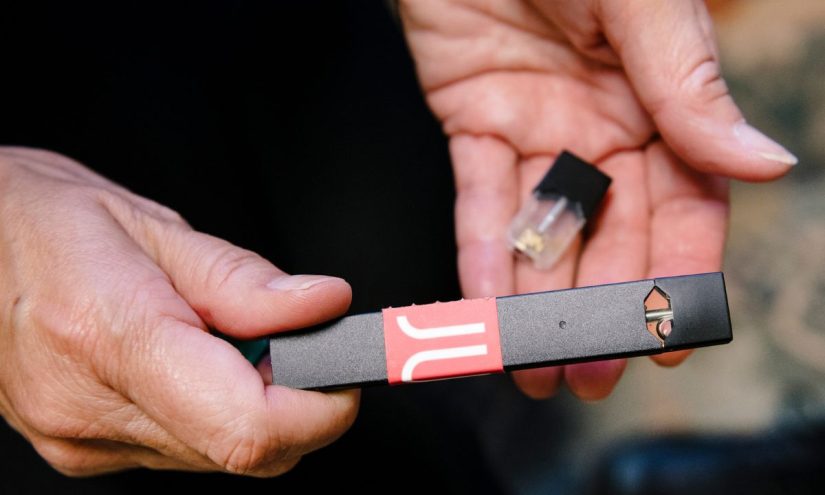
Alabama schools are set to implement a new system to prevent vaping by public school students in the coming academic year.
HB 8, sponsored by Rep. Barbara Drummond D-Mobile, requires the Alabama State Board of Education to create a model policy for local boards of education to adopt by November.
“[Drummond] wanted an anti-vaping law, so we were able to work with her on something that’s not too overwhelming for the districts, but they are all going to have an anti-vaping policy,” State Board of Education Superintendent Eric Mackey told members of the board in a meeting on Tuesday.
Under the proposed policy, students who are caught vaping once will have their parents contacted and students who are caught vaping twice will have to take a state approved vaping awareness, education and prevention class which includes a curriculum created in collaboration with the Drug Education Council.
The topics covered in the proposed curriculum presented to board members include health consequences, peer pressure, nicotine and addiction, resources to quit vaping and common misconceptions about vaping among others.
According to the Children’s of Alabama newsroom, the media branch for the Children’s of Alabama hospital, nearly 20% of high school students in 2023 said they had vaped.
Some board members at Tuesday’s meeting questioned the need for the vaping law.
“As an educator, parent and grandparent, I don’t quite understand the focus on this and bifurcating or separating from the other common concerns in every discipline policy,” said Wayne Reynolds, who represents District 8 on the board. “Why would you separate what you’re doing to a child caught vaping and contacting the parents than any other child in the discipline policy?”
District 1 Representative Jackie Zeigler raised concerns about children moving onto other drugs like Fentanyl and Xylazine or tranq and pushed for broader language in the law to prevent having to add resolutions to add other specific items such as marajuana into the law.
“I don’t think by labeling it does any justice,” she said. “We need to make it broader so these things fit into it so we don’t have to come back and say, ‘now we have [THC] gummies, and now we have vaping.’”
Mackey agreed that the law is more specific than most Alabama Department of Education policies, but because it’s the law they have to follow it and said the board is “being no more restrictive than the law requires.”
The Alabama State Board of Education will vote on the model policy for the law next month.
Alabama Reflector is part of States Newsroom, a nonprofit news network supported by grants and a coalition of donors as a 501c(3) public charity. Alabama Reflector maintains editorial independence. Contact Editor Brian Lyman for questions: [email protected].
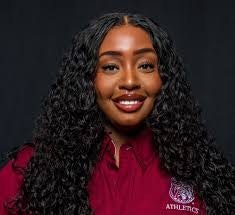
Thai FloydAlabama A&M University has broken new ground in collegiate sports broadcasting by appointing Thai Floyd as the first woman to serve as the football team’s full-time play-by-play announcer. The historic appointment also makes Floyd the first woman to hold this position at any Historically Black College and University (HBCU) nationwide.
Floyd will serve as the voice of the Bulldogs throughout the 2025 season at the Huntsville, Alabama institution, which competes in the Southwestern Athletic Conference (SWAC). Her appointment represents a significant milestone in diversifying sports broadcasting at the collegiate level.
A Florida A&M University alumna, Floyd brings broadcasting experience to her new role. She previously worked as a digital media specialist for Alabama A&M athletics and has covered sporting events across high school, college, and professional levels. Her portfolio includes work as a sideline reporter and play-by-play commentator for ESPN+ and ESPNU, with assignments covering FBS bowl games and the Celebration Bowl.
Floyd’s work has been featured across major media platforms including NBC Sports Philadelphia, HBCU Legends on Sports Illustrated, and ESPN’s Andscape, establishing her as a respected voice in sports journalism.
Floyd’s path to the broadcast booth was influenced by her father, William Floyd, a Super Bowl champion with the San Francisco 49ers who transitioned to broadcasting after his NFL career.
“I grew up watching my dad work as a broadcaster after he retired from the NFL, so I’ve been around the game and the business my whole life,” Floyd said.
Her long-term aspirations extend beyond her current role.
“I’d love to call college football on TV one day — that’s definitely the goal. Just staying focused, learning, and trusting the process,” she said.
Floyd’s appointment comes at a time when female representation in play-by-play announcing remains limited. Research indicates that women comprise approximately nine percent of play-by-play announcers in sports broadcasting. Notable pioneers include Beth Mowins, who became the first woman to call a nationally televised NFL game, and Tiffany Greene, the first African American woman to serve as a play-by-play commentator for college football on a major network.
Floyd views her role as part of a broader movement toward inclusivity in sports media.
“Having a seat at the table means making space for every Black woman who’s ever been overlooked or told she didn’t belong in this industry,” she said. “I’m just blessed to be walking in purpose and hoping my journey reminds the next Black woman that we’re not here to fit in — we’re here to take up space and change the game.”
BIRMINGHAM, Ala. — In a corner of Huffman High School, the sounds of popping nail guns and whirring table saws fill the architecture and construction classroom.
Down the hall, culinary students chop and saute in the school’s commercial kitchen, and in another room, cosmetology students snip mannequin hair to prepare for the state’s natural hair stylist license.
Starting this fall, Alabama high school students can choose to take these classes — or any other state-approved career and technical education courses — in place of upper level math and science, such as Algebra 2 or chemistry.
Alabama state law previously required students to take at least four years each of English, math, science and social studies to graduate from high school. The state is now calling that track the “Option A” diploma. The new “Option B” workforce diploma allows students to replace two math and two science classes with a sequence of three CTE courses of their choosing. The CTE courses do not have to be related to math or science, but they do have to be in the same career cluster. Already, more than 70 percent of Alabama high school students take at least one CTE class, according to the state’s Office of Career and Technical Education/Workforce Development.
The workforce diploma will give students more opportunities to get the kind of skills that can lead to jobs right after high school, legislators said. But there’s a cost: Many universities, including the state’s flagship University of Alabama, require at least three math credits for admission. The workforce diploma would make it more difficult for students on that track to get into those colleges.
The law passed in 2024 alongside a spate of bills aimed at boosting the state’s labor participation rate, which at 58 percent as of January remained below the national rate of 63 percent. Simply put, Alabama wants to get more of its residents working.
Alabama is giving high school students a new pathway to a high school diploma: fewer math and science classes in exchange for more career and technical education courses. Credit: Tamika Moore for The Hechinger Report
The new diploma option also comes at a time when public perception of college is souring: Only 36 percent of U.S. adults have a lot of confidence in higher education, according to a 2024 Gallup poll. Just 43 percent of Alabama high schoolers who graduated in 2023 enrolled in one of the state’s public colleges the following fall.
“The world of higher education is at a crossroads,” said Amy Lloyd, executive director of the education advocacy nonprofit All4Ed and former assistant secretary for the Office of Career, Technical, and Adult Education at the U.S. Department of Education. “Americans are questioning the value of the return on their investment: Is it worth my money? Is it worth my time?”
Related: A lot goes on in classrooms from kindergarten to high school. Keep up with our free newsletter on K-12 education.
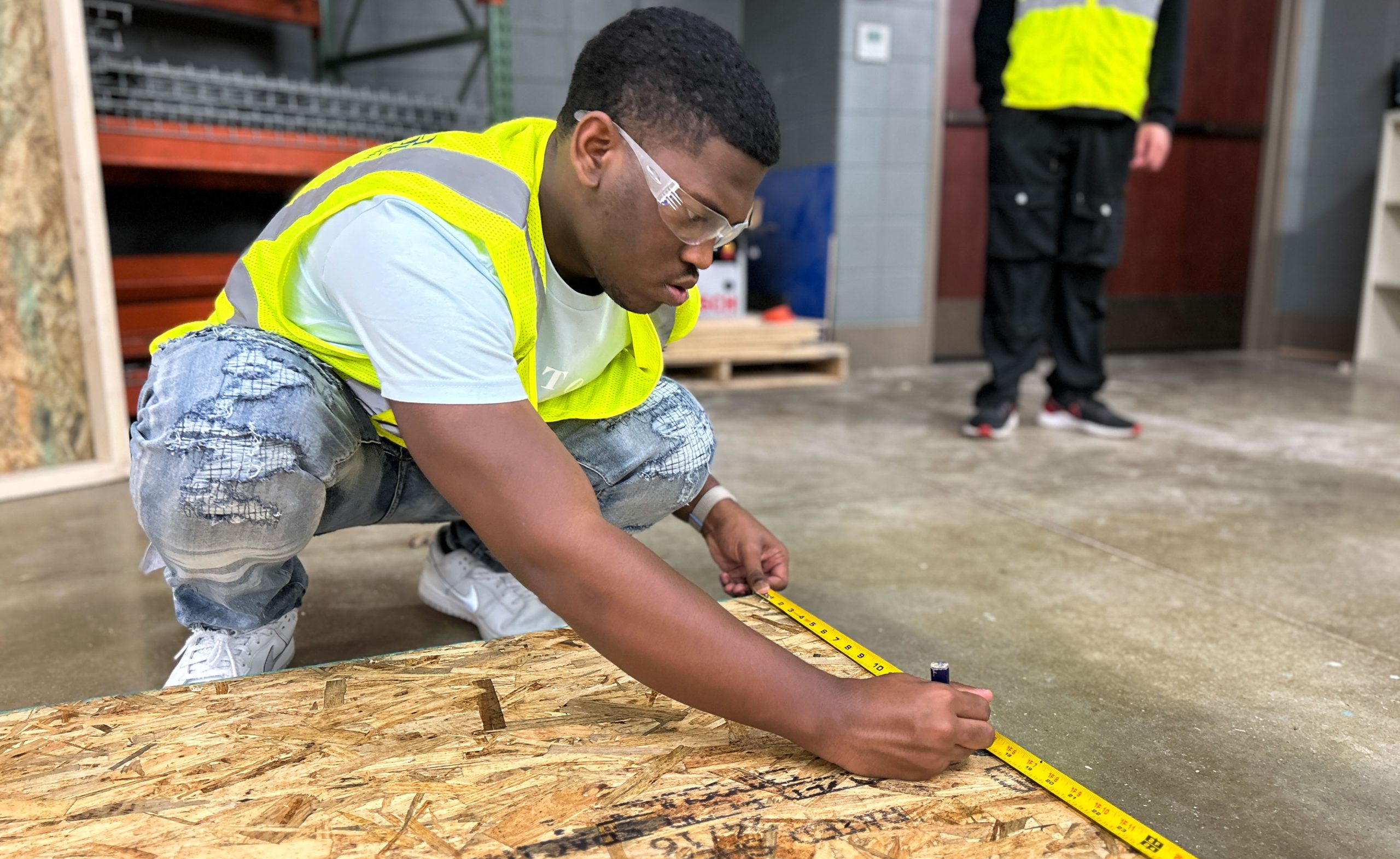
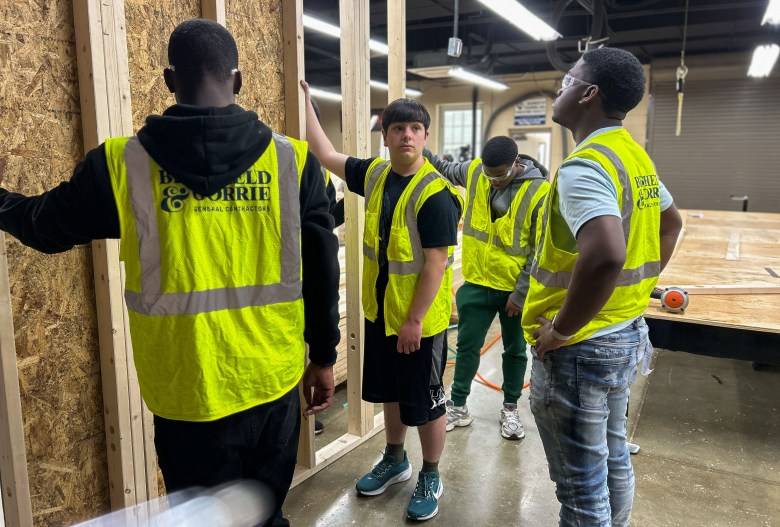
One recent afternoon in Huffman High School’s architecture class, a few students in bright yellow safety vests were measuring a wall they had built. At the end of the semester, the project will culminate in a tiny home.
Lucas Giles, a senior, started taking architecture his sophomore year as a way to “be able to fix things around the home without having to call other people,” he said. The new workforce diploma option won’t apply to him since he’s graduating this year, but he said he likely would have opted for it to fit more architecture classes into his schedule — that is, until he learned it would make it harder for him to attend college and study engineering.
“I wouldn’t have the credits,” Giles realized.
Students who earn a workforce diploma and end up wanting to go to college after all can enroll in community colleges, or aim for state colleges that have less stringent admissions requirements, said Alabama education chief Eric Mackey. The key to the new diploma will be ensuring school counselors are properly advising students, he added.
“That’s where the counselor comes in and says, ‘If you want to be a nurse, then yes, you need the practical stuff at the career tech center — taking blood pressure and trauma support — but you also need to be taking biology, physiology, chemistry and all those things, too,’” Mackey said.
Because the diploma only makes sense for a specific subset of students — those who do not plan to go to a four-year college that requires more math or science and who cannot otherwise fit CTE classes in their schedule — counselors have a huge role to play in guiding students. As of 2023, there were 405 students for every counselor in Alabama’s public schools, well over the recommended ratio of 250 to 1.
Mackey said the state added career coaches in recent years to ease the counseling workload, but in many districts there is just a single coach, who rotates among schools.
Samantha Williams, executive director of the nonprofit Birmingham Promise, fears the workforce diploma may shut off students’ options too early. Birmingham Promise helps students in Birmingham City Schools pay college tuition and connects them to internship opportunities while in high school.
“Do you really think that all of our school districts are preparing students to know what they want to do” by the time they’re in high school, Williams asked.
Williams also worries that lower-performing students might be steered to this diploma option in order to boost their schools’ rankings.
Students who opt for the workforce diploma will not have their ACT test scores included in their schools’ public reports. Legislators decided that schools should not have to report standardized test scores for students who did not have to take the requisite math and science classes.
“The concern a lot of people voiced was ‘Hey, isn’t everyone just going to place the kids who are underperforming in the workforce diploma so their ACT scores don’t bring down the whole?’” Williams said. “There’s a strong perverse incentive for people to do that.”
Speaking to the state’s Board of Education last fall, Mackey warned the “furor of the state superintendent will come down on” anyone who tries to redirect students toward the workforce diploma because of low ACT scores.
At Headland High School in rural Henry County, Alabama, every student takes at least one CTE course, according to Principal Brent Maloy. The most popular classes, he said, are financial management and family consumer science.
“We don’t force them in — everybody registers themselves, they pick their own classes,” Maloy said. “But there’s just about a zero percent chance that a kid’s not going to have a career tech class when they graduate.”
The school has hosted information sessions for parents and students about the new diploma option ahead of next school year. In a poll of rising juniors and seniors, 20 percent said they would like to pursue a workforce diploma, and another 30 percent said they might be interested. Maloy is anticipating about 25 percent of students will actually opt in to the pathway.
Most graduates of Headland enroll in a two-year school after graduation anyway, Maloy said, and the workforce diploma won’t hinder that. But the high school has only one counselor for its 450 students, and making sure students fully understand this diploma pathway — and its limitations — is likely to add pressure and extra responsibilities on counselors with heavy workloads.
Students hold up the wall of a tiny home they’re building in a career and tech architecture class at Huffman High School in Birmingham, Alabama. Credit: Ariel Gilreath/The Hechinger Report
“There’s so much pressure on our secondary counselors already just to make sure that all of the boxes are checked before graduation. It’s going to put an extra box for them to check,” Maloy said.
Ultimately, state businesses and industries want this change, said Mackey, who started his career as a middle and high school science teacher.
“They were saying, ‘We really need students with skills over, say, calculus,’” Mackey said. “That doesn’t mean some students don’t need calculus — we want to still offer those higher math courses and higher science courses.”
But, reflecting on his own experience as a high school science teacher, “I can tell you that every student doesn’t need high school chemistry,” Mackey said.
The chamber of commerce in Mobile, Alabama, is one group that advocated for the workforce diploma. Career tech classes are a good way for students to better learn what they want to do before graduating high school, and they are also an avenue for students to get skills in high wage industries prevalent in Alabama, said Kellie Snodgrass, vice president of workforce development at the Mobile Chamber.
Less than half of high school graduates in the region end up enrolling in college after graduation, Snodgrass said, and only 20 percent of high-wage jobs in Mobile require a college degree. A large chunk of jobs in the state, and in Mobile in particular, are in manufacturing.
“It’s terrible when a student goes away to college and comes back and can’t find a job, when we have thousands of open jobs here,” Snodgrass said.
In an emailed statement, Trevor Sutton, the vice president of economic development at the Birmingham Business Alliance, said the diploma option was a “win for the state of Alabama” that would allow students a chance to learn both “hard and soft skills like communication and time management.”
At least 11 states have embraced policies that give students flexibility to use career tech courses for core academic credits, according to a review from the Education Commission of the States.
Like Alabama, Indiana also made changes to its diploma requirements in 2024. After more than a year of public debate, the state created three graduation pathways that are meant to lead to college admissions, the workforce, or enlistment in the military. Those changes will be effective for students in the class of 2029, or current eighth graders.
Having industry buy-in on career tech programs is important, said Lloyd with All4Ed, because most students will need either an industry or post-secondary credential to land a job with a comfortable wage.
“The reality is a high school diploma is not enough in today’s labor market to have a guaranteed ticket to the middle class,” Lloyd said.
The problem, Lloyd said, is most K-12 industry credentials have little use to employers. Only 18 percent of CTE credentials earned by K-12 students in the U.S. were in demand by employers, according to a 2020 report from the Burning Glass Institute.
The key in Alabama will be ensuring students are going into career pathways that line up with job demand, Snodgrass said. Out of the more than 33,000 CTE credentials Alabama high school students earned in 2023, only 2 percent were in manufacturing, which is one of the state’s highest need areas.
Still, attitudes toward high school CTE courses — once largely thought of as classes for students who struggled academically — have improved significantly over the years. And many schools offer CTE programs like aerospace, robotics or conservation that could help students get into high-demand undergraduate programs at universities.
“We’re increasingly blurring the lines between what has been historically siloed in people’s minds in terms of career education versus academic education,” Lloyd said. “Those are very often one and the same.”
This story about Alabama high school requirements was produced by The Hechinger Report, a nonprofit, independent news organization focused on inequality and innovation in education. Sign up for the Hechinger newsletter
The Hechinger Report provides in-depth, fact-based, unbiased reporting on education that is free to all readers. But that doesn’t mean it’s free to produce. Our work keeps educators and the public informed about pressing issues at schools and on campuses throughout the country. We tell the whole story, even when the details are inconvenient. Help us keep doing that.
Immigration and Customs Enforcement has detained a University of Alabama doctoral student and Iranian native. A spokesperson told Inside Higher Ed in an email that the student “posed significant national security concerns” but didn’t clarify what those concerns were.
The Crimson White student newspaper and other media previously identified the student as Alireza Doroudi. As of Thursday evening, the ICE website listed Doroudi as in ICE custody but didn’t note where he was.
“ICE HSI [Homeland Security Investigations] made this arrest in accordance with the State Department’s revocation of Doroudi’s student visa,” a Department of Homeland Security spokesperson said in an email to Inside Higher Ed Thursday. The department, which includes ICE, didn’t provide an interview.
It’s unclear whether the detention is part of the Trump administration’s targeting of international students for alleged participation in pro-Palestinian protests, with immigration officers raiding their dorm rooms and revoking their visas.
The Crimson White said Doroudi was “reportedly arrested by ICE officers” at his home around 5 a.m. Tuesday. A statement from the university said the student, whom the university didn’t name, was detained off campus. The Crimson White also reported that—according to a message in a group chat including Iranian students—Doroudi’s visa was revoked six months after he came to the U.S., but the university’s International Student and Scholar Services arm said he could stay in the country as long as he maintained his student status.
The university didn’t provide Inside Higher Ed an interview Thursday or answer multiple written questions. Its emailed statement said, “Federal privacy laws limit what can be shared about an individual student.”
“International students studying at the University are valued members of the campus community, and International Student and Scholar Services is available to assist international students who have questions,” the statement said. “UA has and will continue to follow all immigration laws and cooperate with federal authorities.”