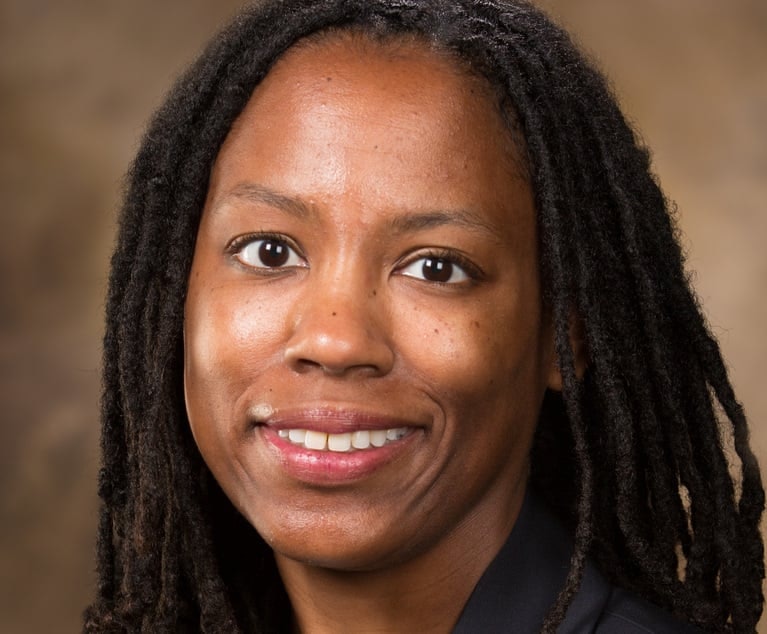
Alena AllenAlena Allen, who broke barriers in 2023 as the first Black person and woman to serve as dean of Louisiana State University’s Paul M. Hebert Law Center, will step down from her leadership role against her wishes, citing racial and gender discrimination.
LSU announced Allen’s departure in an internal email dated August 29, stating she would transition to a full-time faculty position at the Baton Rouge institution. However, Allen maintains she did not voluntarily resign and may pursue legal action for alleged whistleblower retaliation.
The controversy began when Allen raised concerns about financial “irregularities” she discovered in the law school’s budget—problems that predated her appointment. When she attempted to address these gaps and implement reforms, Allen alleges LSU leadership unfairly blamed her for the pre-existing issues.
“I am the first woman and the first person of color to serve as the permanent dean of the Paul M. Hebert Law Center. That fact is not incidental—it is central to what follows,” Allen wrote in her response to auditors. “I find it deeply troubling, and frankly difficult to ignore, that I appear to be held to a standard far more exacting than that applied to my white, overwhelmingly male predecessors.”
Allen’s attorney claims the LSU Board of Supervisors “engaged in systematic discrimination and retaliatory conduct” against her, arguing that her predecessors had “oversaw and entrenched the very practices” she questioned and began reforming.
Allen’s forced departure adds to a concerning pattern of Black leadership exits at LSU. The university recently lost its first Black president, Dr. William Tate, who left on June 30 to become president of Rutgers University. Several other Black administrators have also announced departures from the institution.
After Allen requested an investigation into the alleged racial and gender discrimination, university leaders informed her during a meeting that the law school would move in a “different direction” without her leadership.
Allen will continue serving as dean through the end of the spring 2026 semester while LSU conducts a national search for her replacement. Interim LSU Provost Dr. Troy Blanchard is overseeing the search process.
This audio is auto-generated. Please let us know if you have feedback.
Dive Brief:
The U.S. Department of Education’s Office for Civil Rights alleged Friday that Virginia’s George Mason University has violated civil rights law by illegally using race and other protected characteristics in its hiring and promotion practices.
Craig Trainor, the office’s acting assistant secretary for civil rights, accused George Mason President Gregory Washington of waging a “university-wide campaign to implement unlawful DEI policies that intentionally discriminate on the basis of race.”
Under the Trump administration, Trainor and other officials have set their sights on diversity, equity and inclusion programs and other policies that were designed to help historically disadvantaged groups.
The most recent allegations from the Education Department, announced just six weeks after it opened the probe, said the agency determined that the university violated Title VI.The civil rights law bars federally funded institutions from discriminating based on race, color or national origin.
The agency gave George Mason, which is located near Washington, D.C., 10 days to agree with the Trump administration’s proposal to voluntarily resolve the alleged violations.
Under the proposed agreement, Washington would have to release a statement saying the university’s hiring and promotion practices will comply with Title VI and explaining the steps for submitting a discrimination complaint.
The university would also have to review its employment policies, conduct annual training for all employees involved in hiring and promotion decisions,and maintain and share records with the federal government upon request to prove compliance.
The agreement would also require Washington to apologize to the university community “for promoting unlawful discriminatory practices in hiring, promotion, and tenure processes,” the Education Department said.
In a Friday statement, George Mason’sgoverning board said the Education Department notified it of the violation, and it will review the proposed resolution and fully respond to government inquiries.
“Our sole focus is our fiduciary duty to serve the best interests of the University and the people of the Commonwealth of Virginia,” the board said.
The Education Department said it opened the investigation following a complaint from multiple George Mason professors who alleged that university leadership has implemented policies that give preferential treatment to underrepresented groups since 2020.
In it, Washington said that leaders wanted staff and faculty to reflect the diversity of the student population. “This is not code for establishing a quota system,” he added. “It is a recognition of the reality that our society’s future lies in multicultural inclusion.”
He noted that a majority of George Mason’s students weren’t White, yet only 30% of the university’s faculty were part of a ethnic minority group, were multi-ethnic or came from international communities.To achieve the university’s vision, officials should focus on both professional credentials and lived experiences when recruiting employees, he said.
“If you have two candidates who are both ‘above the bar’ in terms of requirements for a position, but one adds to your diversity and the other does not, then why couldn’t that candidate be better, even if that candidate may not have better credentials than the other candidate?” Washington said at the time.
On Friday, the Education Department also cited several George Mason policies it said violated Title VI, including one it said appeared on the university’s website in 2024. The policy said officials could forgo a competitive search process for faculty members when “there is an opportunity to hire a candidate who strategically advances the institutional commitment to diversity and inclusion,” the agency said.
Washington, George Mason’s first Black president, pushed back on the Education Department’s allegations when it first opened the investigation. In a July 16 statement, he said that the university’s promotion and tenure policies don’t give preferential treatment based on race or other protected characteristics.
He also pointed to a “profound shift in how Title VI is being applied.”
“Longstanding efforts to address inequality — such as mentoring programs, inclusive hiring practices, and support for historically underrepresented groups — are in many cases being reinterpreted as presumptively unlawful,” he said.
The U.S. Department of Justice has also opened several investigations into George Mason, including one over its hiring and promotion practices.
Another DOJ probe is looking into the university’s Faculty Senate after its members approved a resolution supporting Washington and the diversity initiatives following the federal investigations, according to The New York Times.The agency has demanded internal communications from the Faculty Senate as part of its investigation.
Todd Wolfson, president of the American Association of University Professors slammed the probe shortly after it was announced.
“Let’s call this what it is: a gross misuse of federal power to chill speech, silence faculty members, and undermine shared governance,” he said in a July statement. “It is an attack on academic freedom, plain and simple.”
The U.S. Department of Justice alleged Tuesdaythat the University of California, Los Angelesviolated civil rights lawby failing to do enough to protect Jewish and Israeli students from harassment.
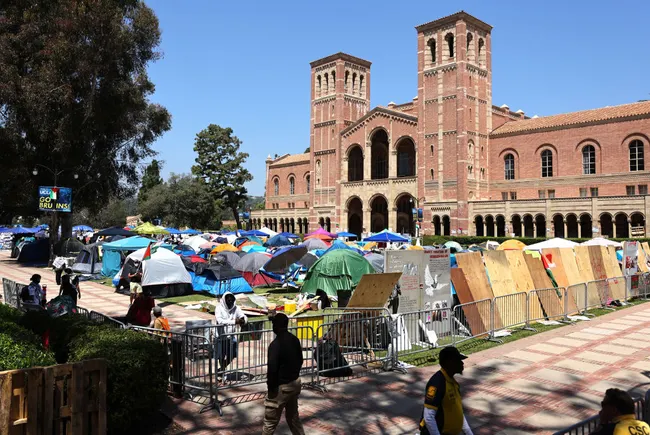
The findings stem from UCLA’s approach to a pro-Palestinian encampment that students erected on the university’s campus in the spring 2024 term.UCLA officials declined to disband the encampment for nearly a week, citing the need to balance free speech protections with student and employee safety.
In a letter to Michael Drake, president of the University of California system,Justice Department officials said they would seek to enter a voluntary resolution with UCLA to “ensure that the hostile environment is eliminated.”
Dive Insight:
The Justice Department is also investigating the entire University of California system over similar allegations. That systemwide probe found “concerning evidence of systemic anti-Semitism at UCLA that demands severe accountability,” U.S. Attorney General Pamela Bondi said in a Tuesday statement.
“DOJ will force UCLA to pay a heavy price for putting Jewish Americans at risk and continue our ongoing investigations into other campuses in the UC system,” Bondi said.
Justice Department officials gave UCLA leaders until Aug. 5 to reach out about entering a voluntary resolution. They threatened the university with a lawsuit by Sept. 2 if they don’t believe they can strike an agreement with the institution.
The Justice Department investigation focused on the pro-Palestinian encampment erected on UCLA’s campus on April 25, 2024. Encampment demonstrators demanded that the university divest from companies with ties to Israel’s military.
On the same day it was erected, a university spokesperson told the campus community that officials were monitoring the situation to balance the “right to free expression while minimizing disruption” to the institution’s teaching and learning mission.
However, several days into the protest, some demonstrators formed human blockades to prevent some people on campus from moving freely throughout Royce Quad, including students wearing a Star of David or those who refused to denounce Zionism, according to an internal report from a university task forcereleased last October.
The task force also found the encampment violated university rulesand that the blockades disparately impacted Jewish people.
The Justice Department’s letter to UCLA heavily cited the university’s own task force report,as well as 11 complaints the university received alleging that encampment protesters discriminated against them based on their race, religion or national origin.
“UCLA’s documentation established that it did not outright ignore these complaints; however, the University took no meaningful action to eliminate the hostile environment for Jewish and Israeli students caused by the encampment until it was disbanded,” the letter states.
Violence broke out at the site on the night of April 30, 2024, when counterprotesters attempted to dismantle the encampment’s barricade, The New York Times reported.
The counterprotesters attacked those within the encampment,including by launching fireworks into the encampment and hitting the pro-Palestinian protesters with sticks, according to the publication. Some of the pro-Palestinian protesters also fought back.
Police arrived hours later, though they did not immediately break up the violence. The next day, UCLA officials made the call to have police break up the encampment, resulting in over 200 arrests.
“In the end, the encampment on Royce Quad was both unlawful and a breach of policy,” then-UC Chancellor Gene Block said in a statement. “It led to unsafe conditions on our campus and it damaged our ability to carry out our mission. It needed to come to an end.”
In their letter, Justice Department officials criticized university leaders, alleging they knew that protesters were “engaging in non-expressive conduct unprotected by the First Amendment” and were denying“Jewish and Israeli students access to campus resources” days before they moved to disband the encampment.
UCLA did not immediately respond to a request for comment.
The Justice Department findings come the same day the university settled a lawsuit from Jewish students and a Jewish professor, who alleged their civil rights were violated because UCLA allowed protesters to block their campus access.
The agency’s letter mentioned the lawsuit’s filings, though it did not refer to the settlement.
As part of that agreement, UCLA agreed to pay about $6 million,with the funds going directly toward the plaintiffs and their legal fees, as well as to Jewish groups and a campus initiative to combat antisemitism.
A former Title IX investigator at Liberty University is suing the private evangelical institution, alleging he was fired for reporting sexual harassment within the office to his superiors, USA Today reported.
Peter Brake, a former investigator in Liberty’s Title IX office from 2019 to 2024 (including a three-and-a-half-year leave of absence for active military duty), alleges he was fired in June after he raised concerns about “multiple violations of law” to his supervisor and reported instances of sexual harassment of coworkers by another investigator, according to a copy of the lawsuit.
Brake also alleged that the same investigator, Nathan Friesema, was inappropriately directing the outcome of Title IX cases, including asking leading questions and embellishing complaints.
(Friesema did not respond to a request for comment from Inside Higher Ed sent via LinkedIn.)
Brake’s lawsuit alleges that Friesema subjected a coworker in the Title IX office to inappropriate jokes, including about sexual assault. Brake eventually brought the concerns to Liberty University president Dondi Costin in late 2023 and to his supervisor, Ashley Reich. However, Brake alleges that he was then “interrogated” by LU’s human resources department and fired.
“Liberty University has received news of this lawsuit by a former employee, and we are reviewing details of the case. Liberty takes all allegations of wrongdoing seriously and has impartial measures in place to assure the fair and equal treatment of all employees. While we will not respond to these allegations in the media at this time, we disagree with the lawsuit’s claims and are prepared to defend ourselves in court,” a Liberty spokesperson wrote by email.
The lawsuit comes less than a year after the U.S. Department of Education determined that LU failed to comply with federal campus crime–reporting requirements and officials discouraged victims from coming forward, weaponizing LU’s code of conduct against sexual abuse survivors.
Liberty was hit with a $14 million fine for various violations last March and is required, per an agreement with ED, to spend $2 million on campus safety and compliance improvements. The university is also on postreview monitoring through April 2026 to ensure it enacts improvements.