Tag: Alliance

  • Alliance for Higher Education in Prison Responds

    Alliance for Higher Education in Prison Responds

    Dear Editor,

    As the national organization for higher education in prison in the United States, we at the Alliance for Higher Education in Prison feel it our responsibility to challenge the framing and conclusions of the Jan. 12 article “Prison Education May Raise Risk of Reincarceration for Technical Violations,” as well as the study it references. The article uses a misleading and sensationalist headline, elevates an unpublished study relying on limited data, and omits crucial context, all of which have very real implications for incarcerated learners and the field.

    Despite the claim made in the article title, the cited study by Romaine Campbell and Logan Lee—“A Second Chance at Schooling? Unintended Consequences of Prison Education” (July 1, 2025), which is an unpublished working paper—does not find that prison education causes an increase in reincarceration. In fact, as stated in the study’s abstract, there is “no relationship between education and reincarceration after we control for release type.” Instead, the observed increase in reincarceration in the study is related to work-release and technical violations. 

    The study authors themselves caution against interpreting the findings as evidence that education is harmful (p. 20, Campbell & Lee, 2025), and identify systemic supervision and release practices as the key drivers of observed outcomes. They also find evidence that education may improve postrelease employment outcomes (p. 31, Campbell & Lee, 2025).

    The underlying framework of the study around the “unintended consequences” of prison education is nevertheless problematic. The study’s findings do not demonstrate “unintended consequences” of higher education in prison. Rather, they reflect outcomes of release placement and supervision level that are associated with increased risk of technical violations and reincarceration. These outcomes are not caused by participation in educational programming; they result from the structuring of re-entry and supervision systems. 

    Connecting the findings in this working paper to outcomes of higher education programs is misleading. Doing so perpetuates negative public narratives that many within the field (including students and alumni) work hard to combat and fails to capture the potential policy implications of the study. The study authors themselves emphasize that the policy focus should be around how education is considered in release decisions and how supervision intensity increases risk of recidivism (p. 5, Campbell & Lee, 2025). The study does raise important questions about how education affects release placement, supervision level and technical violation risk. Thus, the appropriate provocation of the study is to rethink technical violations as well as supervision and release decision-making, which so often sets people who are re-entering society up for failure rather than success. 

    The editorial decision to elevate unpublished research in such a way that it contradicts an established body of evidence is additionally concerning. Decades of research across multiple states have demonstrated that participation in higher education–in–prison programming is associated with improved outcomes. It is noteworthy that the study uses administrative data from a single state (Iowa) to draw its broad conclusions. Presenting early-stage research without thorough evidentiary framing has the potential to distort public understanding with misleading conclusions.

    Indeed, a large body of research has consistently shown that participation in higher education while incarcerated is directly correlated with positive outcomes, including significantly lower recidivism rates. It is also important to note that recidivism alone is a flawed and incomplete metric for evaluating the success of higher education in prison programs. Recidivism is often shaped by supervision level, conditions of release and enforcement practices that vary from region to region. Overreliance on recidivism as a performance metric can obscure other, potentially more important outcomes (and also, critical gaps in service) such as employment, educational attainment, civic engagement, family reunification and financial stability. Higher education in prison can and should be evaluated using a broad dataset to reflect the real landscape of opportunity and well-being possible after people have access to these opportunities. The article omits all of this context, which is crucial to understanding the body of research and the study’s place within it. 

    How research findings are framed matters, especially when research enters public discourse. Headlines circulate widely and are often consumed without context. The framing of this article could very well have unintended consequences of its own. This article reinforces the problematic narrative that educational opportunities for people in prison are risky and that system-impacted people are to blame rather than overly punitive supervision and release practices. Sensationalist articles with misleading headlines like this one prioritize clicks and undermine decades of hard-won progress expanding access to college in prison. 

    Alliance for Higher Education in Prison

    Source link

  • What’s Actually Working for Small Colleges – Edu Alliance Journal

    What’s Actually Working for Small Colleges – Edu Alliance Journal

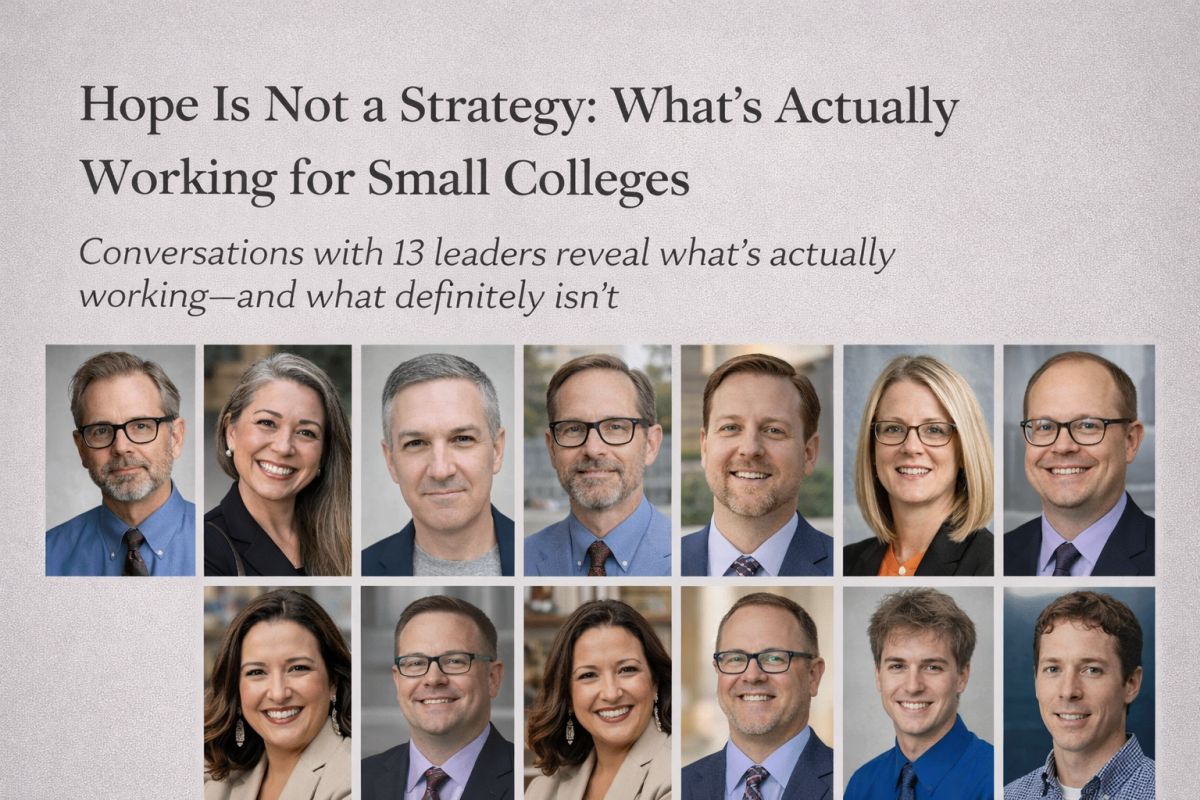
    Editor’s Note By Dean Hoke: This winter, Small College America completed its most ambitious season yet—13 conversations with presidents, consultants, and association leaders who are navigating the most turbulent period in higher education history. What emerged wasn’t theory or wishful thinking. It was a working playbook of what’s actually succeeding on the ground. This article synthesizes the five insights that matter most.

    When Hope Meets Reality

    Jeff Selingo doesn’t mince words.

    “Hope is not a strategy,” he said bluntly in Season 3 of Small College America.

    Jeff Selingo, a Best Selling Author and higher education advisor, named what every small college leader knows but hates to admit: the old playbook is dead. The demographic cliff isn’t coming—it’s here. Traditional enrollment models are broken. And no amount of wishful thinking about “riding out the storm” will change that.

    But here’s what surprised me across 13 conversations this season: nobody was sugarcoating reality, yet the conversations weren’t depressing.

    They were energizing.

    From Frank Shushok describing how Roanoke College built a K-12 lab school that creates a pipeline from kindergarten forward, to Teresa Parrott explaining why Grinnell took over a failing daycare center instead of issuing a mission statement about community engagement, from Gary Daynes doubling down on Salem College’s women’s mission when conventional wisdom said to go co-ed, to Kristen Soares navigating 2,500 California bills every legislative session—Season 3 captured something rare.

    Leaders who have moved past denial and into action.

    What emerged wasn’t abstract strategy consulting. It was concrete, operational intelligence from people doing the work. Here are the five insights that separate institutions that will thrive from those that won’t.

    1. Stop Marketing, Start Building Pipelines

    The traditional enrollment model—recruit high school seniors, get them to visit campus, send them glossy viewbooks, hope they choose you over 47 other colleges—is dead. Small colleges know this. But most are still acting like better marketing will solve it.

    It won’t.

    As Selingo pointed out, “At some point you have to come up with another segment of students if you’re tuition dependent because there just aren’t enough of those students to go around.”

    Translation: You cannot market your way out of a demographic crisis.

    The institutions seeing results aren’t the ones with slicker viewbooks or better social media strategies. They’re the ones building actual infrastructure for new student populations.

    What does that look like in practice?

    At Roanoke College, President Frank Shushok has approached enrollment not as a marketing problem, but as a pipeline design problem.

    Roanoke’s lab school creates a K–12 pathway while simultaneously solving a community need. Students who attend the lab school encounter the college early, come to trust it, and see it as part of their educational journey long before senior year. That’s not recruitment—that’s ecosystem building.

    The same logic shows up in Roanoke’s employer partnerships. The T-Mite Scholars program flips the traditional internship model: students complete two internships, receive a guaranteed job interview upon graduation, and receive tuition support from the employer. That’s not workforce development with a side of enrollment. That’s workforce development with enrollment as the byproduct.

    This pipeline mindset also appears at scale in California, as described by Kristen Soares, President of the Association of Independent California Colleges and Universities. California’s Associate Degree for Transfer (ADT) program creates guaranteed, transparent pathways from community colleges into four-year institutions—no credit games, no hidden requirements, no “we’ll evaluate your transcript and get back to you.” Just clear bridges that actually work for the students who need them most.

    Notice what these examples have in common: they aren’t marketing campaigns. They are operational partnerships designed to reduce friction and create consistent flows of students.

    As Shushok observed, “I think what you’re starting to see is some incredibly creative, adaptive, and agile institutions—because it requires a level of courage and resilience and tenacity.”

    The bottom line is straightforward: if your enrollment strategy is still primarily marketing-driven, you’re playing the wrong game. Build infrastructure. Create pipelines. Solve real community problems.
    The students will follow.

    2. Is Your Mission Statement Hurting You

    Teresa Parrott, Principal TVP Communications dropped what might be the most important insight of the entire season: small colleges need to shift “from mission to impact.”

    What she means matters right now.

    Most small college websites lead with mission statements like “We develop well-rounded citizens who think critically and serve their communities.”

    It’s lovely. It’s inspiring to people who already work at the college. And it’s entirely unpersuasive to everyone else.

    Legislators don’t care about your mission. Prospective students’ parents don’t care about your mission. Community members wondering why they should support you don’t care about your mission.

    They care about what you actually do.

    Compare generic mission language to Grinnell College’s approach. When their town’s daycare center was failing, Grinnell didn’t release a statement about their commitment to the community. They took over the daycare center. When the community golf course struggled, they stepped in to sustain it.

    As Parrott put it, “They are so embedded in their community that they really are almost a second arm of the government.”

    That’s not rhetoric. That’s concrete, documentable community impact.

    Or take Gary Daynes, President of Salem College insight about resource sharing at Salem: “It makes zero cents to build a football field. Seems like you could share with the local high school.”

    Simple. Obvious. Rarely done.

    But when colleges actually do it—by sharing theaters, athletic facilities, cultural resources, and programming—they become infrastructure their communities can’t imagine losing. They become politically and economically essential.

    The shift is this: Stop leading with what you believe. Start leading with what you do.

    Not “We believe in service.” Try “We trained 45% of the nurses in this region.”

    Not “We value community.” Try “We operate the only daycare center in town.”

    Not “We develop leaders.” Try “Our graduates run 23 local businesses and employ 400 people.”

    The institutions sufficiently community-embedded to make these claims are politically protected. The ones still leading with inspirational language become vulnerable the moment budgets get tight.

    The takeaway: Your communications team shouldn’t be writing mission statements. They should be documenting measurable community impact and leading with it everywhere.

    3. Lean Into What Makes You Different

    Selingo said it most directly: “There is more differentiation in higher education than we care to admit, but the presidents haven’t leaned into that enough.”

    Translation: You’re already different. You’re just afraid to say it loudly.

    Daynes decided to reaffirm its commitment to educating girls and women. That’s not chasing the market—it’s the opposite. But Daynes explained they looked at their data and realized the women’s college identity was a strength, not a liability they needed to downplay.

    Faith-based institutions are deepening their religious identities rather than treating them as mere historical affiliations that make the college vaguely Methodist or nominally Catholic.

    Health-focused campuses are building employer pipelines instead of trying to be liberal arts generalists who happen to have a nursing program.

    The pattern is clear: institutions trying to be less distinctive are struggling. Institutions doubling down on what makes them unique are finding traction.

    But here’s the critical part Daynes emphasized: distinctiveness has to be operational, not just marketing.

    If you’re a “community-engaged college,” you need actual programs embedded in the community—shared facilities, pipeline programs, workforce partnerships—not just a tagline on your website.

    If you’re “career-focused,” you need employer partnerships with real job placement data and students who can point to specific outcomes.

    If you’re faith-based, that identity needs to shape curriculum, student life, residential programs, and institutional decisions in ways students and families can see and experience.

    When distinctiveness is only branding, students and families see through it immediately. When it’s operational, it becomes your competitive advantage.

    The takeaway: Generic positioning is a slow death. Find what makes you genuinely different, operationalize it across your institution, and communicate it relentlessly.

    4. Real Partnerships vs. Press Releases

    Shushok nailed the mindset shift small colleges need to make: “Partnerships are everything in this moment. And once you get past that you’re competing with any of these entities, you start to realize, no, these are partners.”

    K-12 schools. Community colleges. Employers. Local governments. Hospitals. These aren’t competitors or nice-to-haves anymore. They’re essential infrastructure for institutional survival.

    But Daynes offered the crucial warning: “It’s easy to sign MOUs. It’s harder to sustain them.”

    Read that again.

    Translation: Your partnership announcements don’t mean anything.

    What matters is actual student flow. What matters is shared staffing. What matters is programs that operate year after year, not photo ops at signing ceremonies where everyone shakes hands and nobody follows through.

    Ask yourself right now: Do you know how many students transferred in from your community college “partners” last year? Do you have dedicated staff managing those relationships, or is it an extra duty for someone already overwhelmed?

    If you don’t know those numbers or don’t have dedicated staff, you don’t have partnerships. You have press releases.

    The partnerships that work have dedicated staffing to manage relationships and smooth student transitions, clear metrics measuring student flow rather than signed agreements, operational integration where partner institutions actually share resources, and financial skin in the game from all parties.

    Roanoke’s “Directed Tech” program with Virginia Tech counts the senior year as both undergraduate completion and the first year of a master’s degree. That’s not a partnership; that’s structural integration that changes the economics and value proposition for students.

    California’s ecosystem, where UC, CSU, community colleges, and independent institutions work together on workforce development, isn’t an inspirational collaboration story. It’s an economic necessity backed by 2,500+ pieces of legislation every two years, as Soares noted.

    When the state is writing hundreds of bills requiring coordination, you can’t fake it with a handshake and a press release.

    The bottom line: Count your partnerships that produce actual student flow and resource sharing. If that number is zero or close to it, stop announcing new partnerships and start making the ones you have actually work.

    5. Liberal Arts is Workforce Development (Stop Being Defensive About It)

    The false choice between liberal arts and workforce preparation came up in nearly every conversation. And every single guest rejected it.

    Shushok’s framing was the clearest: “Technical skills get you the first job. Human capacity skills enable 15 career reinventions.”

    Think about that.

    In a world where AI can write code, analyze data, generate reports, and automate technical tasks, what becomes more valuable—technical skills that become obsolete in five years, or the ability to adapt, think critically, communicate clearly, work across differences, and solve novel problems?

    As Shushok put it, “We might find that the liberal arts, the humanities, the small colleges, if we allow ourselves to be shaped by this moment, are exactly what the doctor ordered for the 21st century.”

    The problem: small colleges are still communicating defensively about the liberal arts instead of offensively.

    Stop saying “The liberal arts are ALSO important for careers.”

    Start saying, “The liberal arts are the ONLY preparation for a 40-year career in an unpredictable economy.”

    Stop apologizing for not being pre-professional.

    Start explaining why pre-professional education is increasingly obsolete in an age of AI and constant technological disruption.

    And most importantly: build the bridges so students can actually see the connection.

    That means boards that understand finance, politics, and operations—not just fundraising. CFO leadership that addresses structural challenges honestly. Political engagement that mobilizes entire institutions, not just government relations staff. And communications teams that function as impact documenters, not mission statement writers.

    Kristen Soares noted that 92% of California’s clinical workforce is trained at private colleges. That’s not despite the liberal arts foundation—it’s because of it.

    Nurses need critical thinking to make life-and-death decisions in ambiguous situations.

    Mental health counselors need empathy and adaptability to serve diverse communities.

    Teachers need communication skills and the ability to think on their feet.

    The liberal arts aren’t tangential to workforce needs. They’re central. But you have to stop defending them and start operationalizing the connection in ways students, families, and employers can see.

    The takeaway: The liberal arts are perfectly suited for workforce needs. Stop defending. Start operationalizing. Build the bridges.

    So what do you actually DO with all this?

    Season 3 didn’t just surface problems—it revealed a working playbook. Here’s what leaders who are successfully navigating this moment have in common:

    • They’re building infrastructure for new student populations instead.
    • They’re documenting measurable community impact and leading with it.
    • They’re deepening what makes them genuinely distinctive.
    • They’re measuring student flow and resource sharing.
    • They’re operationalizing the connection to careers.

    Shushok’s insight about “recalibration versus balance” might be the most critical leadership lesson of the season. As he put it, “Balance is not a destination, but constant recalibration.”

    Small college leadership today isn’t about finding the right strategy and executing it for five years. It’s about continuous adjustment based on what’s actually working.

    That means:

    • Boards that understand finance, politics, and operations—not just fundraising

    • CFO leadership that addresses structural challenges honestly

    • Political engagement that mobilizes entire institutions, not just government relations staff

    • Communications teams that function as impact documenters, not mission statement writers

    As Daynes reflected, “I love small colleges. There are folks of intense gifts amongst the faculty and staff who have chosen to be the places that they are.”

    That’s the source of optimism throughout Season 3.

    Not naive hope that things will get better on their own.

    But grounded confidence in devoted people willing to do hard, creative work.

    Jeff Selingo’s blunt assessment—”Hope is not a strategy”—wasn’t meant to demoralize. It was meant to liberate.

    Small colleges that thrive in the next decade will  be the ones that:

    • Build operational infrastructure for new student populations

    • Document and communicate measurable community impact

    • Operationalize distinctiveness throughout the institution

    • Create partnerships that produce actual student flow

    • Connect liberal arts to career outcomes without defensiveness

    • Recalibrate constantly based on what’s working

    The leaders in Season 3 aren’t waiting for permission or hoping for a miracle. They’re building lab schools. They’re taking over daycare centers. They’re sharing facilities with high schools. They’re creating guaranteed pathways to graduate programs. They’re documenting their impact and leading with it.

    They’re doing the work.

    And they’re proving that hope—real, grounded hope based on action rather than wishful thinking—comes from building things that work.

    Looking Forward: Three Conversations to Start This Week

    If you’re a president, provost, trustee, or senior leader, here are three conversations you can start right now if you haven’t already done so :

    1. With your enrollment team: Ask them to map every actual pipeline you have for new students—not marketing campaigns, but structural pathways that produce consistent student flow. If the list is short or non-existent, that’s your answer. Start building infrastructure, not marketing plans.

    2. With your communications team: Ask them to document your measurable community impact in the last 12 months. Not what you believe or aspire to do—what you actually did. How many jobs did you create? How many nurses did you train? What facilities do you share? What problems did you solve? If the answer is vague or mission-statement-heavy, you have work to do.

    3. With your board: Present them with a simple question: “If we could only communicate three things about our institution to prospective students, legislators, and community members, what would they be?” If the answers are about mission and values rather than concrete impact and distinctive programs, you need to shift the conversation.

    These aren’t theoretical exercises. They’re diagnostic tools that reveal whether your institution is still operating from the old playbook or building the new one.

    Selingo was right: hope is not a strategy. But action, infrastructure, partnerships, impact, and constant recalibration is a playbook that works.

    Season 3 of Small College America featured conversations with 13 leaders in the field of higher education. Thanks to everyone who participated, and especially my co-host Kent Barnds and my Producer and lovely wife Nancy Hoke.

    • Raj Bellani, Chief of Staff, Denison College
    • Gary Daynes, President, Salem College
    • Josh Hibbard, Vice President of Enrollment Management, Whitworth University
    • Dean McCurdy, President, Colby Sawyer College
    • Jon Nichols, Faculty member and author
    • Teresa Parrott, Principal TVP Communications
    • Karen Petersen, President, Hendrix College
    • Michael Scarlett, Professor of Education, Augustana College
    • Jeff Selingo, Best Selling Author and higher education advisor
    • Frank Shushok, President, Roanoke College
    • Kristen Soares, President, Association of Independent California Colleges and Universities
    • Gregor Thuswaldner, Provost, La Roche University
    • Jeremiah Williams, Professor of Physics, Wittenberg University

    The conversations continue.

    Small College America returns in February with a new season featuring candid discussions with presidents, faculty, and leaders navigating the most consequential moment in higher education.

    Hosted by Dean Hoke and Kent Barnds, the series explores the evolving role of small colleges, their impact on communities, and the strategies leaders are using to adapt and endure.

    Listen or watch past episodes on Apple, Spotify, YouTube, and many others, or preview what’s coming next, and follow the series at www.smallcollegeamerica.net.

    Source link

  • How Can Small Colleges Survive in an Era of Consolidation? – Edu Alliance Journal

    How Can Small Colleges Survive in an Era of Consolidation? – Edu Alliance Journal

    January 5, 2026Editor’s Note: Last week we published a synthesis of insights from Small College America’s 2025 webinar series, featuring voices from seven leaders navigating change, partnerships, and strategic decisions. Here, two expert panelists from the December webinar on mergers and partnerships provide a deeper analytical examination of the economic forces and partnership models reshaping small colleges.

    By Dr. Chet Haskell and Dr. Barry Ryan. During a recent national webinar titled Navigating Higher Education’s Existential Challenges: From Partnerships and Mergers to Reinvention, in which we served as panelists, we were struck by both the familiarity and the seriousness of the questions raised by senior higher education leaders—particularly those concerning the growing consideration of mergers and partnerships. Most were no longer asking whether change is coming, but which options remain realistically available.

    This article builds on conversations from that webinar and complements the recent synthesis of insights shared by our fellow panelists and the college presidents who participated in Small College America’s fall webinar series. Here we examine more systematically the economic forces and partnership models small colleges must now navigate. This article represents our attempt to step back from that conversation and examine more deliberately the forces now reshaping higher education.

    Anyone involved with higher education is both aware and concerned about the struggles of small, independent colleges and the challenges to their viability. Defined as having 3000 or fewer students, more than 90% of these institutions lack substantial endowments and other financial assets and thus are at risk.

    For many of these institutions, the risk is truly existential. Many simply are too small, too under-financed, too strapped to have any reasonable path to continuity. The result is the almost weekly announcement of a closure with all the pain and loss that accompanies such events.

    Why is all this happening? Most of the problems are well known and openly discussed. Since almost all of these institutions are tuition revenue dependent, the biggest threat is declining enrollments. Demographic changes leading to fewer high school graduates are central, a situation exacerbated in many cases by Federal policy changes that discourage international students. But there are many others: excessive tuition discounting leading to reduced net tuition revenue, rising operating costs for everything from facilities to insurance to employee salaries, changes in state and Federal policies, especially student aid policies and restrictions on international students are just some examples.

    The reality is that higher education is in a period of consolidation. After decades of growth beginning after the Second World War, the basic economic drivers of the private, non-profit residential undergraduate institutions are slowing down or even reversing. There simply are not enough traditional students to make all institutions viable. The basic financial model no longer works. If it did work, one could expect to see new institutions springing up. This has not happened except in the for-profit sphere, a totally different model known mostly for its excesses and failures. While there is a place for the for-profit approach, it is not in the small liberal arts college world. This is true for the same reason that the small institutions are under stress: the economics do not work.

    One crucial challenge is simple scale or, rather, lack thereof. Small institutions have fewer opportunities for achieving economies of scale. Unlike larger public institutions (that have different challenges of their own) these colleges cannot have large classes as a significant characteristic of their modes of delivery. Their basic model assumes a relatively comprehensive curriculum provided through small classes, giving a wide variety of choices and pathways to a degree for undergraduates. But the broader the curriculum, the fewer students per program, almost always without commensurate faculty reductions. The economic inefficiency of the current model is clear.

    And there are certain base personnel costs beyond the faculty. Every institution needs a range of administrative personnel (often required by accreditors) regardless of size. Attracting experienced personnel to such institutions is neither easy nor inexpensive.

    The undergraduate residential model is both a key element in the American higher education ecosystem and a beloved concept for those fortunate enough to have experienced it. These schools are often cornerstones of small communities. They have produced an inordinate number of future professors and scholars. For example, a 2022 NCSES study provided evidence of doctoral degree attainment being at higher ratios for graduates of baccalaureate arts and science institutions than for baccalaureate graduates of R1 research universities.* The basic matter of scale is central to the liberal arts institutions’ attractiveness for students who may go on to doctoral study: small classes with high levels of faculty interaction; a focus on teaching instead of research; the sense of intimacy and a clear mission.

    With proper planning and courage, some of these colleges may yet find ways to survive through some form of merger with – or acquisition by – a larger and stronger institution. Further, with sufficient foresight, many other seemingly more solid colleges may find ways to assure survival through other forms of partnerships.

    However, the fact is that only the wealthiest 10% of institutions are not at immediate risk, even though prudence would suggest even they should be considering possible changes in their paths.

    What can be done?

    There have been multiple efforts to reimagine higher education. Some have been based on technology and have led to the growth of various distance or remote models, some quite successful, other less so. MOOCs were going to take over education generally, but have faded. For-profit models have all too often led to abuses, especially of poorer students. Artificial intelligence is at the forefront of current change concepts, but it is too early to assess outcomes. But small residential colleges have resisted such innovations, in part because they are clear about their education model and in part because they often lack the expertise or the resources to take advantage of change.

    Some institutions have sought to mitigate the impacts of their scale limitations through consortia arrangements with other institutions. While significant savings may be achieved through the sharing of administrative costs, such as information technology systems or certain other “back office” functions, these savings are unlikely to be more than marginal in impact.

    Other impacts for a consortium may come from cost sharing on the academic side. Small academic departments (foreign languages, for example) may permit modest faculty reductions while providing a wider range of choices for students. Athletic facilities and even teams may be shared, as well as some academic services such as international offices or career services operations. In the case of two of the most successful consortia, the Claremont Colleges and the Atlanta University Center, the schools share a central library. Access to electronic databases certainly creates an easier and less expensive pathway to increased economically efficient use of critical resources.

    While the savings in expenses may be considered marginal, the true potential in such arrangements is the chance to grow collective student enrollments by offering more options and amenities than would be possible for a single institution.

    However, there are other challenges to the consortium model. A primary one relates to location. Institutions near each other likely can find more ways to take advantage of the contiguity than those widely separated. Examples might be the Five Colleges in Western Massachusetts, the previously noted Claremont Colleges or the Atlanta University Center that links four HBCU institutions in the same city. New examples of cooperation include the recently announce CaliBaja Higher Education Consortium, a joint effort of both private and public institutions reaching across the border in the San Diego/Baja California region.

    A different kind of sharing arrangement is represented by initiatives to share academic programs though arrangements where one institution provides courses and programs to others through licensing agreements and the like. An example would be Rize Education, an initiative that seeks to enable undergraduate institutions to expand and enhance academic offerings through courses designed elsewhere that can be readily integrated into existing curricula, thus avoiding the costs of time and money needed to build new programs.

    At the other end of the spectrum are straightforward mergers and acquisitions. One institution takes over another. Sometimes this is accomplished in ways that preserve at least parts of the acquired school, even if only for political reasons related to alumni, but the reality is that one institution swallows another.

    Another version is a true merger of rough equals. There are numerous examples, one of the best known being Case Western Reserve University in Ohio. In this situation, two separate institutions decided they could both be better together and, over time, they have built an integrated university of quality. A recent example may be the announced merger of Willamette University and Pacific University in Oregon. Such arrangements are quite complex, but may provide a model for certain institutions.

    A third model might be the new Coalition for the Common Good. Initially a partnership of two independent universities, Antioch and Otterbein Universities, the Coalition is built on three principles: symbiosis, multilateralism and mission. The symbiosis involves Antioch taking on and expanding Otterbein’s graduate programs for the shared benefit of both institutions. Multilateralism refers to the Coalition basic concept of being more than two institutions as the goal: a collection of similar institutions. Mission is central to the Coalition. The initial partners share long histories of institutional culture and mission, as reflected in the name of the Coalition itself.

    Other partnership models are possible and should be encouraged. While it is rare to see a partnership of true equals, as one partner is usually dominant, this middle ground between a complete merger or acquisition and consortia should be fertile ground for innovation for forward thinking institutions not in dire straits. Since there is no single approach to such structures, the benefits to participating partners should be at the core of the approach. These partnerships may be able to address the challenge of scale and provide opportunities for shared costs. Properly presented, they should be attractive to potential students and provide a competitive edge in a highly competitive environment.

    The importance of mission and culture

    While the root cause of most college declines and failures is economic in nature, it is all too easy to forget the role of an institution’s mission and culture. Many colleges look alike in terms of academic offerings, yet institutions usually have a carefully defined and defended mission or purpose. These missions are important because they help define the college as more than just a collection of courses. Education can serve many different missions and thus mission clarity is crucial to institutional identify. And identity is one way for institutions to differentiate themselves from competition, while also helping to attract students.

    Mission is also tied to institutional culture. Colleges have different subjective cultures that serve to attract certain students, as well as faculty and staff members. Spending four years of one’s life ought not to be spent in an impersonal organizational setting. There are multiple individual personal reasons for attending one institution instead of another. Most of these reasons are not entirely objective, but instead depend on an individual’s sense of ‘fit’ in the college setting.

    What should institutions be doing?

    The stark reality is that for many smaller institutions the alternative to some sort of partnership is likely to be closure. But closure is not to be taken lightly. The impact of these institutions is far-reaching and the human, educational and community costs are very real.

    All institutions, regardless of financial assets, should be openly discussing their futures in a changing world. As noted, a few may be able to simply proceed with what they have been doing for years. But this luxury (or blindness) is not a viable or attractive option for most.

    Every institution should be looking into the future at its basic model. Is there a realistic path to assuring enrollment and revenue growth in excess of expenses over time? Is there a budget model that provides regular surpluses that can provide a cushion against unanticipated challenges or can enable investment in new initiatives? Are there alternative paths to revenues that can augment tuition, such as fundraising, auxiliary enterprises or the like? And in looking at such questions, an institution should be asking how it can be better off over time with a partner or partners.

    Even institutions that examine such matters and conclude it would be advantageous to engage a partner are faced with daunting challenges. First is determining what is desired in a partner and then identifying one. Some colleges feel bound by geography, so can only think about like institutions nearby. Others are more creative, looking to use technology to enable a more widely dispersed partnership.

    Once a partner is identified, the path to an agreement is arduous, complex, lengthy and costly. Accreditors, the Department of Education, state boards of higher education, alumni, and all manner of other interested parties must be addressed. This requires external legal and financial expertise. This process is excessively demanding of an institution’s leaders, especially presidents, provosts and chief financial officers. Boards must be deeply involved and internal constituencies of faculty and staff must be brought along.

    And once a final agreement is reached, signed and approved, the work has only begun. The implementation of any partnership is also arduous, complex, lengthy and costly. Furthermore, implementation involves deep human factors, as institutional cultures must be aligned and new personal professional partnerships must be developed.

    The fact is that many institutions will either enter into some form of partnerships in the coming years, as the alternative will be closure. Unfortunately, the clock is ticking, and unnecessary delays create limitations on available options and increase risks. Every institution’s path into partnerships will vary, as will the particulars of each arrangement. It is incumbent upon boards of trustees and institutional leaders to face such facts realistically and to devise practical plans to move forward. Not doing so would be a dereliction of duty.


    Dr. Chet Haskell is an experienced higher education consultant focusing on existential challenges to smaller nonprofit institutions. and opportunities for collaboration. Dr. Haskell is a former two-time president and, most recently, a provost directly involved in three significant merger acquisitions or partnership agreements. including the coalition. for the common good, the partnership of Antioch and Otterbein University.

    Barry Ryan is an experienced leader and attorney. has served as a president and provost for multiple universities. He helped guide several institutions through mergers, acquisitions, and accreditation. Most recently, he led Woodbury University through its merger. with the University of Redlands. He also serves on university boards and is a commissioner for WASC.

    Haskell and Ryan are the Co-Directors of the Center for College Partnerships and Alliances, launched by Edu Alliance Group in late 2025. It is dedicated to helping higher education institutions explore and implement college partnerships, mergers, and strategic alliances designed to strengthen sustainability and mission alignment.


    Source link

  • What College Leaders Learned About Change, Culture, and Strategic Partnerships – Edu Alliance Journal

    What College Leaders Learned About Change, Culture, and Strategic Partnerships – Edu Alliance Journal

    December 29, 2025 Editor’s Note by Dean Hoke: This fall, Small College America convened two significant webinars bringing together college presidents, merger experts, and strategic advisors to discuss the challenges and opportunities facing small institutions. What emerged were not just conversations, but frameworks, insights, and patterns that deserve close attention. This article synthesizes what seven leaders shared across both sessions.

    Insights from Small College America’s Fall 2025 Webinar Series

    Featuring conversations with seven leaders navigating the most critical decisions facing small colleges today

    When Tarek Sobh arrived at Lawrence Technological University as provost in September 2020, he had a plan. He was going to transform the institution. He had ideas, energy, and expertise from his previous roles.

    And then he did something counterintuitive: he stopped.

    “The tendency of leaders, in any kind of position, to effect changes immediately is, in my opinion, the wrong decision,” Sobh told participants in Small College America’s “Guiding Through Change” webinar this past August. Instead, he spent his first semester meeting with every single colleague on campus—literally hundreds of people. “Learning the culture of the institution was immensely important and crucial.”

    Eighteen months later—not three months, not six, but eighteen—Sobh became president of Lawrence Tech. And because he had listened first, he knew exactly what needed to change and what needed to stay the same.

    This isn’t just one leader’s story. It’s a pattern—and a warning—for every college president, provost, and trustee navigating today’s enrollment pressures, financial constraints, and partnership decisions. The institutions that will survive aren’t the ones making the fastest decisions. They’re the ones making the most informed ones. And that takes time, most colleges think they don’t have.

    That eighteen-month timeline wasn’t just personal wisdom. It’s a pattern that emerged across two webinars hosted by Small College America this fall—one featuring college presidents navigating uncertainty, the other bringing together experts who’ve guided dozens of institutions through mergers and partnerships.

    What they revealed is that small colleges aren’t just facing challenges; they’re facing them in a way that’s unique to them. They’re learning to navigate them with a sophistication and strategic clarity that larger institutions might envy.

    The State of Play: No Surprises Allowed

    “There should be no surprises. Not in this business, there should be no surprises.”

    Dr. Chet Haskell has seen enough college budgets to know when an institution is headed for trouble. As a former two-time president and provost directly involved in three significant mergers or acquisitions, he’s learned to read the warning signs.

    During Small College America’s December webinar on mergers and partnerships, Haskell laid out the early indicators with the precision of a surgeon: enrollment declines, graduation rate declines, multiple years of unbalanced budgets, the need to dip into unrestricted endowments to make budgets work, declining net tuition revenue, and expenses increasing faster than revenue.

    All well-known data points. The problem? Too often, leaders avoid confronting their implications.

    “At the end of the day, no matter what you’re trying to do, the financials do matter,” Haskell explained. “Too often, I would argue, a balanced budget—revenue equals expense—is defined as success.”

    But that’s not success. That’s survival. Barely.

    “You don’t have a margin, you don’t have a mission,” Haskell continued. “You need resources for investment in new initiatives. You need resiliency in the face of external factors like COVID or recessions.”

    He offered a sobering example: two well-regarded Midwest colleges, each with endowments exceeding $1 billion. One has had eight successive years of operating deficits in the order of $8 to $10 million annually. The other has consistently generated surpluses.

    “A billion dollars can last a long time,” Haskell noted. “It’s still a finite number.”

    Which would you rather lead?

    The Composite Score Deception

    Stephanie Gold, head of the higher education practice at Hogan Lovells and a veteran of nearly three decades guiding colleges through transformative transactions, added a critical warning about regulatory metrics.

    The U.S. Department of Education calculates a composite score (between 1.5 and 3.0) that’s supposed to measure financial viability, liquidity, capital resources, borrowing capacity, and profitability.

    “I have seen institutions with passing scores that ultimately are not financially sustainable and are in a place where they will soon be unable to make payroll,” Gold said flatly.

    The real indicator? Cash flow problems. When an institution is struggling to pay its operating expenses, that’s the red flag that matters.

    The lesson is clear: constant vigilance, not wishful thinking. Know your numbers. All of them. And don’t wait for regulatory metrics to tell you there’s a problem.

    The Four R’s: A Framework for Strategic Thinking

    While financial vigilance is essential, it’s not sufficient. The August webinar featuring three college presidents—all of whom started their roles post-COVID—revealed how successful institutions are thinking holistically about their challenges.

    Dr. Andrea Talentino, president of Augustana College in Illinois, described her institution’s strategic planning process as driven by what they call “the Four R’s”: Recruitment, Retention, Revenue, and Results.

    Talentino explained how they use this framework across campus: “We try to kind of preach that around campus to get everybody thinking about the Four R’s and really use them to drive strategic planning and enrollment goals.”

    It’s a deceptively simple framework. But its power lies in integration. Recruitment isn’t just the admissions office’s problem. Retention isn’t just student affairs’ responsibility. Revenue isn’t just the CFO’s concern. Results aren’t just the provost’s metric.

    Everyone owns all four R’s.

    This matters because, as Talentino discovered to her surprise, institutional thinking doesn’t happen naturally.

    “I think I really overestimated the extent to which people have awareness and appreciation for institutional needs,” she admitted. “Focus on self and focus on own department rather than institutional-wide awareness was a little bit of a surprise to me.”

    She’d come from “pretty open departments that were quite supportive.” The reality at many institutions? People are siloed, focused on their immediate concerns rather than the big picture.

    Building that institutional awareness—getting everyone to think about the Four R’s—is leadership work. It doesn’t happen by accident.

    COVID’s Long Tail and the Transfer Opportunity

    The presidents also spoke candidly about enrollment realities that data alone doesn’t fully capture.

    Dr. Anita Gustafson, the first female president in Presbyterian College’s 144-year history, described what she calls “COVID’s long tail.”

    “Our class of 2025 was a very small class,” she explained. “They were seniors in high school when we had a full year of COVID, and hence we never recruited well, or maybe they didn’t even attend college in large numbers.”

    That class just graduated. And Presbyterian is finally seeing enrollment growth—about 8 to 10 percent—as that COVID cohort cycles through.

    But the recovery isn’t automatic. It requires strategic adaptation.

    For Presbyterian, located in growing South Carolina, that’s meant focusing on a population they’d historically neglected: transfer students.

    “That’s a population we have not really targeted in the past,” Gustafson said. “A lot of that is hard with the traditional liberal arts education program, because we have very robust general education requirements.”

    So they’re working with faculty to be “more transfer friendly”—adjusting requirements, smoothing pathways, removing unnecessary barriers.

    It’s the kind of strategic adaptation that requires both data and cultural sensitivity. You can’t just mandate that faculty change requirements. You have to build an understanding of why it matters and bring them along.

    Which brings us back to culture, and to the eighteen-month rule.

    Eighteen Months to Know an Institution

    The December webinar on mergers and partnerships brought together an unusual panel: Chet Haskell, the consultant and former president; Dr. Barry Ryan, an attorney who’s served as president and provost at multiple universities and most recently led Woodbury University through its merger with the University of Redlands; AJ Prager, Managing Director at Hilltop Securities and an investment banker focused on higher education M&A; and Stephanie Gold, the regulatory attorney.

    Together, they’ve seen hundreds of institutions consider partnerships, dozens pursue them, and enough fail to know what separates success from disaster.

    And they kept returning to the same timeline: eighteen months.

    Haskell emphasized that meaningful partnerships require substantial time—typically around eighteen months—to really understand another institution’s culture, operations, and true compatibility.

    Not six months. Not a year. Eighteen months minimum.

    Why so long?

    Because culture can’t be rushed. Because trust takes time. Because what institutions say about themselves and what they actually are can be very different things.

    “Building that trust between the people, the leadership in both institutions—it takes some time to get to know each other,” Barry Ryan explained. “And then you find out, maybe you find out that you have a lot more in common, and this becomes a much easier process to take.”

    Ryan has seen it work both ways. He’s been involved in mergers between faith-based institutions that seemed very different on the surface but discovered deep commonalities. He’s also seen deals fail because “they just couldn’t get over the fact that, I’m sorry, you are different than we are. We have our 39 points, and you have your 16, and it’s just not going to work.”

    The difference? Time spent building relationships and understanding culture before committing to a deal.

    AJ Prager, an investment banker who helps institutions find and evaluate potential partners, emphasized that this isn’t just about mission alignment—it’s about cultural fit.

    “We always look at transactions through the lens of mission and accelerating mission execution,” Prager said. “And so oftentimes there is mission alignment between faith-based institutions and non-faith-based institutions.”

    The real question is how cultures align. And that takes eighteen months of conversations, campus visits, joint meetings, shared meals, and honest dialogue to discover.

    The Hidden Costs Nobody Talks About

    When institutions consider mergers or major partnerships, they typically calculate direct costs, including legal fees, consulting expenses, system integration, and facility modifications.

    What they don’t budget for—and what can sink even well-planned partnerships—are the hidden costs.

    “Management time, in our experience, is the biggest hidden cost of a transaction,” Prager said. “These types of transactions are all-encompassing. They require significant, significant employee time.”

    Management time is the most valuable resource an institution has. And mergers consume it voraciously—pulling presidents, provosts, CFOs, deans, and senior staff into endless meetings, planning sessions, due diligence reviews, and stakeholder communications.

    “Whether to pursue or not to pursue a transaction is a really critical decision,” Prager continued, “because you’re tying up, if you are going to be pursuing, you’re going to be tying up your most valuable resource for a considerable amount of time.”

    And here’s the paradox: passing on opportunities can also be risky. Which is why Prager recommends that institutions prepare before opportunities arise—assessing their position, understanding their options, educating their boards with hypothetical scenarios.

    One liberal arts institution on the West Coast recently conducted an exercise with its board: it presented three hypothetical partner institutions and asked, “Would you merge with these institutions?”

    “It was very fascinating to see how the board responded,” Prager said. “But it was, I would say, an innocuous exercise to help educate the board to say, here’s what’s happening in the sector, and these are the types of transactions that might be coming your way, and how would you respond to it?”

    That kind of preparation —doing strategic thinking before you’re in crisis mode—can make all the difference.

    But there’s another hidden cost that’s even harder to quantify.

    “Despite being the lawyer, I think there’s a lot of emotional cost associated with these matters,” Stephanie Gold said. “These are very stressful situations for students, for faculty.”

    Students worry they won’t graduate from the institution they expected. Faculty wonder about job security. Staff fear restructuring. Alumni mourn the loss of identity.

    “I think I am constantly needing to remind myself as the lawyer who’s just working on the deal documents to get the deal done that there are a lot of humans behind this,” Gold continued. “And it is a cost on them.”

    Managing those emotional costs requires something lawyers and investment bankers can’t provide: exceptional, continuous, transparent communication.

    The Communication Imperative

    Early in the December webinar, the panel addressed a question that haunts every institution considering a partnership: when do you tell people?

    The instinct is often to wait—to avoid creating anxiety until you have something definite to announce.

    That’s wrong.

    Gold emphasized the critical importance of managing stakeholder expectations through clear, consistent communication—distinguishing between exploratory discussions and finalized agreements, and being transparent about timelines and potential outcomes throughout the process.

    Tell people early. Tell them you’re “having discussions.” Tell them the timeline will be long. Tell them nothing is decided. Tell them what you know and what you don’t know.

    And keep telling them, consistently, throughout the process.

    The alternative—trying to keep major strategic discussions secret until announcing a deal—creates exactly the kind of anxiety and distrust that makes the emotional costs unbearable.

    This communication imperative extends beyond potential mergers. It’s central to the daily work of leading change.

    Back at the August webinar, Tarek Sobh—who became president of Lawrence Tech after just eighteen months as provost—spoke about the importance of helping every employee understand their role.

    “What is most important, I think, is having all of our leaders ensure that every employee on campus understands her or his role in how the campus runs and how important what they do is to the well-being of the whole campus and its students and its budget and its reputation, and so on and so forth.”

    This isn’t feel-good rhetoric. It’s strategic communication.

    “The whole concept of somebody coming in at any level to an educational institution to get a paycheck is not what is going to make eminent institutions of higher education thrive or survive,” Sobh said bluntly.

    Every custodian, every admissions counselor, every IT specialist, every faculty member needs to understand how their work connects to institutional success. And leaders at every level—not just the president—need to articulate that connection.

    Proving Value With Data

    Communication isn’t just about process and connection. It’s also about demonstrating value, to prospective students, current students, alumni, donors, legislators, and the community.

    And in 2025, that means data.

    Sobh has learned to articulate Lawrence Tech’s value proposition with precision: “97% of my students continue on and are employed at this level, and they are guaranteed a job, and 85% live locally.”

    That’s not abstract mission language. That’s quantifiable impact.

    “Articulating your student outcomes, articulating your impact on the community from an economic impact point and social impact point of view, keeping all of your channels open and continuing to clearly articulate your value proposition is the balancing argument or statement that is desperately needed for institutions in this time and day to prove their worth,” Sobh said.

    Economic impact. Social impact. Student outcomes. Employment rates. Local retention. These are the metrics that matter to legislators deciding on state funding, to donors considering major gifts, to families evaluating whether tuition is worth it.

    The Partnership Spectrum

    One of the most valuable contributions from the December webinar was Chet Haskell’s articulation of the partnership spectrum.

    Not every collaboration needs to be a merger. In fact, most shouldn’t be.

    Haskell outlined four levels:

    1. Consortium Arrangements: Shared services like libraries, bookstores, and food services. These reduce costs without requiring deep integration. They’re relatively easy to implement and maintain.

    2. Alliances: Academic program sharing, cross-registration, joint research initiatives. These require more coordination but preserve institutional independence.

    3. Affiliations: Closer integration around specific strategic goals. More commitment than alliances, but still stopping short of a merger.

    4. Full Mergers/Acquisitions: Complete integration, with one institution typically absorbing another or creating an entirely new entity.

    The key is matching the level of partnership to institutional needs and readiness.

    Haskell distinguished between crisis-driven partnerships—where institutions wait until they’re running out of money—and strategic partnerships, where institutions proactively explore collaborations that could benefit both parties. The latter, he argued, is far preferable.

    But strategic partnerships require something crisis-driven ones don’t have: resources in reserve. You can’t negotiate from desperation. You need time, financial capacity, and leadership bandwidth to explore options thoughtfully.

    Which means the best time to start building partnership relationships is before you need them.

    Remember the eighteen-month rule? If you wait until a crisis to start talking to potential partners, you won’t have eighteen months. You’ll have eighteen weeks, maybe eighteen days.

    Start the conversations now. Build the relationships. Understand the cultures. Then, when opportunity or necessity arises, you’re ready.

    State Demographics and Local Adaptation

    The August webinar also surfaced an important reality: national enrollment trends matter less than state demographics.

    Presbyterian College, in growing South Carolina, is seeing enrollment growth. Augustana College, in declining Illinois, faces different challenges.

    “South Carolina is a state that’s growing, and so that does help us,” Gustafson noted. About 60% of Presbyterian’s students come from South Carolina. “But we have to be very vigilant because we can’t guarantee that that will happen another year.”

    Meanwhile, Talentino at Augustana is adapting to Illinois realities by adding multilingual enrollment counselors, working with community-based organizations in urban areas, and creating summer bridge programs to support student success.

    Lawrence Tech, in Michigan, focused on developing three new graduate programs in high-demand areas—strategic program development based on market analysis rather than faculty interests.

    Each institution is adapting to its local context. There’s no one-size-fits-all solution.

    But there are common principles: know your market, track your data, be willing to change, and move before crisis forces your hand.

    The Board Challenge: Governance in Crisis

    Throughout both webinars, a consistent theme emerged that none of the panelists explicitly stated, but all of them circled back to: boards aren’t prepared for the strategic decisions facing small colleges today.

    This surfaced most starkly in the December Q&A session, when one participant observed that “colleges and universities cultivate irrational loyalty to the institution, which runs counter to the thought of mergers and partnerships and alliances.”

    Read that again: irrational loyalty.

    It’s the same emotional attachment that makes alumni generous donors and passionate advocates. But when an institution faces existential decisions—whether to merge, how to restructure, which programs to cut—that loyalty can become a liability.

    Another participant noted that “board members oftentimes don’t know how to act or ask the right questions, given the way that higher education oftentimes designs and recruits their board of trustees.”

    This is the structural problem: most small college boards are composed primarily of alumni who love their institution. They’re selected for their capacity to give and their willingness to advocate. They’re rarely selected for their expertise in finance, operations, technology, strategic restructuring, or M&A.

    Which means that when a president brings forward a partnership proposal or a CFO presents financial projections, the board often lacks the framework to evaluate what they’re hearing.

    They ask questions like, “Will we keep our name?” What about our traditions? How will this affect our identity?

    These are reasonable emotional questions. But they’re not the strategic questions that determine whether a partnership will work: What are the combined revenue projections? How will academic programs integrate? What’s the governance structure? What happens to debt obligations? Where are the synergies and where are the conflicts?

    The panel’s recommendation was consistent: board education before a crisis.

    Run hypothetical merger scenarios when there’s no actual deal on the table. Present three possible partner profiles and ask: Would we consider this? Why or why not? What questions would we need answered?

    Help boards understand financial metrics that matter beyond the composite score. Teach them to ask hard questions about cash flow, operating margins, and strategic positioning.

    And consider diversifying board composition—not to diminish alumni representation, but to complement it with specific expertise the institution needs: finance professionals who can read balance sheets, technology executives who understand digital transformation, healthcare or corporate leaders who’ve navigated mergers.

    Because when crisis arrives—and for many small colleges, it will—you need a board that can think strategically, ask sophisticated questions, and make difficult decisions based on institutional sustainability rather than emotional attachment alone.

    The eighteen-month rule applies here too: you can’t educate a board in six weeks when a partnership opportunity appears. You need to start now.

    The Bottom Line

    When Tarek Sobh arrived at Lawrence Technological University in September 2020, he could have started changing things immediately. He had the expertise. He had the mandate. He had ideas.

    Instead, he spent eighteen months listening.

    And when he finally became president and began implementing changes, he did so from a position of deep cultural understanding. He knew which changes would be embraced and which would face resistance. He knew whose support he needed and how to earn it. He knew what the institution was and what it could become.

    That’s not just one president’s wisdom. It’s the pattern that emerged across both webinars—from college presidents navigating daily challenges to experts guiding institutions through transformative partnerships.

    Know your numbers. Build your relationships. Understand your culture. Communicate transparently. Prove your value with data. Give yourself time.

    And remember: there should be no surprises.

    The challenges facing small colleges are real. The demographic cliff is arriving. Financial pressures are mounting. Political scrutiny is intensifying.

    But the leaders in these webinars aren’t panicking. They’re planning. They’re adapting. They’re building partnerships. They’re preparing their boards. They’re quantifying their value. They’re listening to their cultures before trying to change them.

    They’re giving themselves eighteen months to get it right.

    That’s not paralysis. That’s wisdom.

    And it might be exactly what saves small college America.

    Looking Forward: Proactive, Not Reactive: Three Conversations to Start This Week

    If you’re a president, provost, CFO, or trustee, here are three conversations you can start right now—before crisis forces them:

    1. With your board: Schedule a working session on hypothetical partnerships. Present three different institutional profiles (a larger regional university, a peer liberal arts college, a specialized technical institution) and ask: “If each approached us about a partnership, what questions would we need answered? What would make us say yes? What would be dealbreakers?” Don’t wait for an actual proposal to discover your board can’t evaluate one.

    2. With your leadership team: Review your financial indicators beyond the composite score. Do you know your real cash flow position? What is your operating margin trend over five years? Your net tuition revenue per student? If a crisis emerged in twelve months, what partnerships or changes would you need to have been building toward now? Move before you have to.

    3. With peer institutions: Identify 2-3 colleges (whether potential partners or not) and start building authentic relationships with their leadership. Not transactional networking—genuine understanding of their challenges, culture, and strategic direction. The eighteen-month rule means those relationships need to start today.

    These conversations won’t solve every problem. But they’ll position you to make better decisions when opportunity or necessity arrives.

    And they’ll help you build the institutional muscle memory for strategic thinking—the kind of thinking that distinguishes colleges that thrive from colleges that merely survive.

    Small College America’s webinar series is moderated by Dean Hoke of Edu Alliance Group, Kent Barnds of Augustana College and featured Dr. Anita Gustafson (Presbyterian College), Dr. Andrea Talentino (Augustana College), Dr. Tarek Sobh (Lawrence Technological University), Dr. Chet Haskell (higher education consultant), Dr. Barry Ryan (university leader and attorney), AJ Prager (Hilltop Securities), and Stephanie Gold (Hogan Lovells). For more information about Small College America, visit http://www.smallcollegeamerica.net.


    Source link

  • Why Small Private Colleges Matter More Than Ever – Edu Alliance Journal

    Why Small Private Colleges Matter More Than Ever – Edu Alliance Journal

    Opinion Piece by Dean Hoke — Small College America and Senior Fellow, The Sagamore Institute

    A Personal Concern About the Future of Public Education

    It’s impossible to ignore the rising level of criticism directed at our nation’s public schools. On cable news, social media channels, political stages, and in school board meetings, teachers and administrators have become easy targets. Public schools are accused of being ineffective, mismanaged, outdated, or, in some corners, ideologically dangerous. Some commentators openly champion the idea of a fully privatized K–12 system, sidelining the public institutions that have educated the vast majority of Americans for generations.

    For those of us who have spent our lives in and around education, this rhetoric feels deeply personal. Public schools aren’t an abstraction. They are the places where many of us began our education, where our children discovered their strengths, where immigrants found belonging, where students with disabilities received support, and where caring adults changed the trajectory of young lives.

    Behind every one of those moments stood a teacher.

    Amid this turbulence, there is one group of institutions still quietly doing the hard work of preparing teachers: small private nonprofit colleges.

    Small Private Colleges: An Overlooked Cornerstone of Teacher Preparation

    Despite the noise surrounding public education, small private colleges remain committed to the one resource every school depends on: well-prepared, community-rooted teachers.

    They rarely make national headlines. They don’t enroll tens of thousands of students. But they are woven into the civic and human infrastructure of their regions—especially in the Midwest, South, and rural America.

    This reality became even clearer during a recent episode of Small College America, in which I interviewed Dr. Michael Scarlett, Professor of Education at Augustana College. His insights provide an insider’s view into the challenges—and the opportunities—facing teacher preparation today. Note to hear the entire interview click here https://smallcollegeamerica.transistor.fm/28

    I. The Teacher Shortage: A Structural Crisis

    Much has been written about the teacher shortage, but too often the conversation focuses on symptoms rather than causes. Here are the forces shaping the crisis.

    1. Young people are turning away from teaching

    Data from the ACT show that only 4% of students express interest in becoming teachers—down from 11% in the late 1990s. Bachelor’s degrees in education have fallen nearly 50% since the 1970s. Surveys show that fewer than 1 in 5 adults would recommend teaching as a career.

    The message is clear: Teaching is meaningful, but many no longer see it as sustainable.

    As Dr. Scarlett told us: “The pipeline simply is not as wide as it needs to be.”

    Recent data offers a glimmer of hope: teacher preparation enrollment grew 12% nationally between 2018 and 2022. However, this modest rebound is almost entirely driven by alternative certification programs, which increased enrollment by 20%, while traditional college-based programs grew by only 4%. This disparity underscores a critical concern: the very programs that provide comprehensive, relationship-based preparation—including those at small colleges—are not recovering at the same rate as faster, less intensive alternatives.

    2. Burnout and attrition have overtaken new entrants

    The pandemic accelerated an already-existing national trend: teachers are leaving faster than new ones are entering.

    Reasons include:

    • Student behavior challenges
    • Standardized testing pressure
    • Emotional fatigue
    • Inequities across districts
    • Lack of respect
    • Political and social media hostility

    As Scarlett notes, these realities weigh heavily on early-career teachers: “What new teachers face today goes far beyond content knowledge. They face inequities, discipline issues, emotional exhaustion… and they’re expected to do it all.”

    3. Alternative certification can’t fill the gap

    Alternative routes help—but they cannot replace the traditional college-based pipeline. Many alt-cert teachers receive less pedagogical training and leave sooner.

    Scarlett captures the trend: “Teaching has always attracted people later in life… we’ve definitely seen an uptick.”

    And while alternative routes have seen growth in recent years—increasing 20% between 2018 and 2021—this expansion has not translated into solving the shortage. As of 2025, approximately 1 in 8 teaching positions nationwide remains either unfilled or filled by teachers not fully certified for their assignments. The shortcut approach cannot substitute for comprehensive preparation.

    “The national teacher shortage is real… and retention is just as big a challenge as recruitment.” — Dr. Michael Scarlett

    II. The Quiet Backbone: How Small Private Colleges Sustain the Teacher Workforce

    Small private colleges graduate fewer teachers than large public institutions, but their impact is disproportionately large—especially in rural and suburban America.

    1. They prepare the teachers who stay

    About 786 private nonprofit colleges offer undergraduate education degrees—representing roughly 20% of all teacher preparation institutions in the United States. Together, they produce approximately 25,119 graduates per year, an average of 32 per institution.

    These numbers may seem modest, but these graduates disproportionately:

    • Student-teach locally
    • Earn licensure in their home state
    • Take jobs within 30 miles of campus
    • Stay in the profession longer

    Public schools desperately need these ‘homegrown’ teachers who understand the communities they serve.

    2. Small colleges excel at the one thing teaching requires most: mentoring

    Teacher preparation is not transactional. It is relational. And this is where private colleges excel. Scarlett put it plainly: “Close relationships with our students, small classes, a lot of direct supervision… we nurture them throughout the program.” In a profession that relies heavily on modeling and mentorship, this matters enormously.

    3. Faculty—not adjuncts—supervise student teachers

    One of the most striking differences: “Full professors… working with the students in the classrooms and out in field experiences. Other institutions outsource that.”

    This is not a trivial distinction. Faculty supervision affects:

    • Preparedness
    • Confidence
    • Classroom management
    • Retention

    Where larger institutions rely on external supervisors, small colleges invest the time and human capital to do it right.

    4. They serve the regions hit hardest by shortages

    Rural districts have the highest percentage of unfilled teaching positions. Many rural counties rely almost exclusively on a nearby private college to produce elementary teachers, special education teachers, and early childhood educators.

    When a small college stops offering education degrees, it often leaves entire counties without a sustainable teacher pipeline.

    5. They diversify the educator workforce

    Small colleges—especially faith-based, minority-serving, or mission-driven institutions—often enroll first-generation students, students of color, adult career-changers, and bilingual students. These educators disproportionately fill shortage fields.

    “What we have here is special… students understand the value of a small college experience.” — Dr. Michael Scarlett

    III. Should Small Colleges Keep Offering Education Degrees? The Economic Question

    Let’s be direct: Teacher preparation is not a high-margin program.

    Costs include:

    • Intensive field supervision
    • CAEP or state accreditation
    • High-touch advising
    • Small cohort sizes

    Education majors also often have lower net tuition revenue compared to business or STEM.

    So why should a small college continue offering a program that is expensive and not highly profitable?

    Because the alternative is far worse—for the institution and for the region it serves.

    1. Cutting teacher-prep weakens a college’s identity and mission

    Many private colleges were founded to prepare teachers. Teacher education is often central to institutional mission, community trust, donor expectations, and alumni identity.

    Removing education programs sends the message that the college is stepping away from public service.

    2. Teacher-prep strengthens community partnerships

    Education programs open doors to:

    • District partnerships
    • Dual-credit pipelines
    • Grow Your Own initiatives
    • Nonprofit and state grants
    • Alumni involvement

    These relationships benefit the entire institution, not just the education department.

    3. Education majors support other academic areas

    Teacher-prep indirectly strengthens:

    • Psychology
    • English
    • Sciences
    • Social sciences
    • Music and arts

    When teacher education disappears, these majors often shrink too.

    4. The societal mission outweighs the limited revenue

    There are moments when institutional decisions must be driven by mission, not margins. Producing teachers is one of them.

    5. Addressing concerns about program quality and scale

    Some critics question whether small programs can match the resources and diversity of perspectives available at large universities. This is a fair concern—and the answer is that small colleges offer something different, not lesser.

    Graduation and licensure pass rates at small private colleges consistently match or exceed those of larger institutions. What smaller programs may lack in scale, they compensate for through personalized mentorship, faculty continuity, and deep community integration. These are not peripheral benefits—they are the very qualities that predict long-term teacher retention.

    IV. Why Students Still Choose Teaching—and Why Small Colleges Are Ideal for Them

    Despite all the challenges, students who pursue teaching are deeply motivated by purpose.

    Scarlett described his own journey: “I wanted to do something important… something that gives back to society.”

    Many education majors choose the field because:

    • A teacher changed their life
    • They want meaningful work
    • They value community and service
    • They thrive in supportive, intimate learning environments

    This makes small colleges the natural home for future teachers.

    V. What Small Colleges Can Do to Strengthen Their Programs

    Below are the strategies that are working across the country.

    1. Build Grow Your Own (GYO) teacher pipelines

    Districts increasingly partner to:

    • Co-fund tuition
    • Support paraeducator-to-teacher pathways
    • Provide paid residencies
    • Guarantee interviews for graduates

    2. Develop dual-credit and “teacher cadet” high school programs

    Scarlett sees this as a major reason for hope: “We’re seeing renewed interest in teaching through high school programs… This gives me hope.”

    3. Offer specialized certifications (ESL, special ed, early childhood, STEM)

    These areas attract students and meet district needs.

    4. Create 4+1 BA/M.Ed pathways

    Parents and students love the value.

    5. Provide flexible programs for career-changers

    The rise of adult learners presents a major opportunity for private colleges. “We prepare our students for the world that exists.” — Dr. Michael Scarlett

    VI. Why Small Colleges Must Stay in the Teacher-Prep Business

    If small private colleges withdraw from teacher preparation, the consequences will be immediate and dramatic:

    • Rural and suburban schools will lose their primary source of new teachers.
    • Teacher diversity will shrink.
    • More underprepared teachers will enter classrooms.
    • Districts will become more dependent on high-turnover alternative routes.
    • Student learning will suffer.

    And the profession will lose something even more important: the human-centered preparation that small colleges provide so well.

    • The teacher shortage will not be solved by legislation alone.
    • It will not be solved by fast-track certification mills.
    • It will not be solved by online mega-universities.
    • It will not be solved by market forces.
    • It will be solved in the classrooms, hallways, and mentoring relationships of the small colleges that still believe in the promise of teaching.

    If we want public schools to remain strong, we must support the institutions that prepare the teachers who keep them alive. Small private colleges aren’t just participants in the teacher pipeline—they are its foundation.

    When these colleges thrive, they produce educators who stay, who care, and who transform communities. That’s not just good for education—it’s essential for American democracy.


    Dean Hoke is Managing Partner of Edu Alliance Group, a higher education consultancy firm. He formerly served as President/CEO of the American Association of University Administrators (AAUA). Dean has worked with higher education institutions worldwide. With decades of experience in higher education leadership, consulting, and institutional strategy, he brings a wealth of knowledge on colleges’ challenges and opportunities. Dean is the Executive Producer and co-host for the podcast series Small College America and a Senior Fellow at the Sagamore Institute based in Indianapolis, Indiana.

    Source link

  • Donor Engagement in College Mergers – Edu Alliance Journal

    Donor Engagement in College Mergers – Edu Alliance Journal

    November 2, 2025, By Dean Hoke — When Sweet Briar College’s trustees voted to close in 2015, they framed the decision as a financial necessity. Alumnae mounted an extraordinary campaign—raising $28.5 million in 110 days—and, through a state-brokered settlement, the college reopened under new governance. By 2023, donors had contributed well over $133 million since the crisis. What looked like an inevitable failure became one of higher education’s most remarkable turnarounds.

    Sweet Briar is not only a story of crisis response; it exposes a recurring miscalculation in today’s merger conversations: the assumption that boardroom consensus equals donor legitimacy. Trustees speak for donors in a fiduciary sense—they hold legal responsibility for institutional assets—but not in the communal sense that captures sentiment, legacy, and trust. When colleges announce merger talks, headlines dwell on enrollment curves and debt ratios. Yet behind every deal stands a quieter, decisive constituency: major donors, family foundations, and planned-giving benefactors whose confidence (or loss of it) can determine whether the combined institution thrives—or limps forward under the weight of broken relationships.

    This article reframes mergers as philanthropic integration projects. The legal mechanics matter, but durable success is won in the design phase: early engagement with philanthropic stakeholders, explicit safeguards for identity and donor intent, transparent transition planning, and a mission-first case that invites continued—and new—investment. When leaders bring donors and alumni into the architecture of the merger rather than the press release, they convert anxiety into commitment and preserve the institutional DNA that constituents care about most.

    We’ll see this principle in contrasting cases: mission-advancing acquisitions that attracted significant philanthropic support, integrations that prioritized identity and donor intent from the outset, and lessons from failed or contested processes. The throughline is simple: treat philanthropy as a core workstream—not an afterthought—and the odds of a credible, sustainable merger rise dramatically.

    The stakes have never been higher. Survey data from Ruffalo Noel Levitz’s 2025 National Alumni Survey, which surveyed more than 50,000 alumni, reveals that donor relationships with higher education are already strained. While 81% of alumni report that being philanthropic is important to them personally and 77% make charitable donations, their connection to their alma mater has weakened dramatically. Only 31% of alumni who donate to any charity gave to their alma mater last year, dropping to just 19% among Millennials and 10% among Gen Z graduates.

    Even more troubling: 59% of alumni who never donate to their alma mater actively support other causes, as do 83% of lapsed donors. They have not stopped giving—they have simply redirected their philanthropy elsewhere. This suggests that alumni disengagement reflects institutional failure rather than generational selfishness.

    Satisfaction drives everything. Alumni who report being ‘very satisfied’ with their student experience are 18 times more likely to donate than neutral respondents and 73 times more likely than dissatisfied graduates. Yet only 42% of Gen Z alumni report feeling ‘very satisfied’ with their experience, compared to 72% of Silent Generation graduates.

    Mergers test already-fragile relationships. When institutions announce consolidation, donors who felt lukewarm about their undergraduate experience see confirmation that their alma mater is failing. A merger framed solely as a financial necessity will not inspire them. But a merger presented as advancing mission-driven impact—expanding access, strengthening programs that address social challenges, or preserving an educational model under threat—can mobilize support from the very alumni who have drifted away.

    As Millett (1976) noted, successful integrations often ‘show structure, not just sentiment’—for example, Case Western Reserve kept a distinct Case Institute identity, and Carnegie Mellon created a Carnegie Institute of Engineering and a Mellon Institute of Science to carry legacies forward.

    A half-century ago, John D. Millett’s 1976 analysis of U.S. college mergers examined a range of cases—from research institutes to liberal arts colleges—and distilled lessons that remain strikingly current. Four observations deserve renewed attention today:

    1. Endowments transfer; relationships do not. In many mergers, endowments and restricted funds move to successor institutions through standard legal pathways. The mechanics are manageable. The harder work is relational: ensuring donors can see how their original intent will be honored in the new configuration, and that the program or ethos they loved will not be erased.

    2. Alumni skepticism is predictable—and manageable. Leaders should not assume alumni approval, especially when the smaller institution is absorbed. Visible steps to cultivate and retain legacy alumni—keeping familiar staff contacts for a transitional period, acknowledging a distinct identity, and offering tangible ways to shape the merged future—go a long way.

    3. Governance approval is not donor legitimacy. Even when boards vote, state bodies concur, and presidents sign, philanthropic legitimacy remains a separate test. Communities expect to be consulted; they often oppose mergers if they learn about them too late. Participation must be planned early, not added later.

    4. Language and structure matter more than sentiment. Labels and explanations—federation versus absorption, mission expansion versus rescue—shape how alumni and donors interpret the outcome. Leaders who explain clear educational benefits and who visibly protect identity through formal structures earn trust faster.

    Historical Examples: Structure, Not Just Sentiment

    After the Case Institute of Technology and Western Reserve University merger, the successor Case Western Reserve University continued the designation of Case Institute of Technology as an organizational component. At Carnegie Mellon University, leaders created a Carnegie Institute of Engineering and a Mellon Institute of Science—formal structures that carried legacy identities forward within the new entity.

    The Bellarmine-Ursuline (Louisville) merger (1968-1971) offers another instructive example. The combined institution briefly used the Bellarmine-Ursuline name before reverting to Bellarmine College in 1971, but Bellarmine has continued to honor Ursuline identity through durable structures—explicitly including Ursuline alumnae in alumni awards and honors and recognizing the Ursuline legacy through commemorations and alumni programming. These are structural signals that preserve identity even when the combined name does not persist.

    Millett also notes that successor institutions often made special effort to cultivate and retain alumni of the absorbed college, including keeping an alumni-relations officer from the legacy institution and providing a special alumni designation or status—practical ways to keep traditions and community intact during transition.

    Crisis-Reactive: What Not to Do

    Planning is done privately, the announcement is abrupt, and donors are asked to accept a fait accompli. Mills College’s merger with Northeastern University proceeded despite alumni resistance, prompting legal challenges over donor intent. The Alumnae Association spent hundreds of thousands in legal fees opposing the merger, and a class action lawsuit resulted in a $1.25 million settlement. The litigation divided alumnae and consumed resources that could have been invested in the merged institution’s success.

    Even when the legal mechanics are sound, the community verdict is that identity has been erased. The result: backlash, donor-intent disputes, and years of costly trust repair.

    Compliance-Only: Necessary but Insufficient

    Teams carefully inventory restricted funds, ensure transfers align with donor intent, and communicate the basics. This prevents disasters but rarely generates enthusiasm or new investment. Survey data reveals that 70% of alumni need to believe their gift amount matters, and 66% rate the ability to see how their gift is used as critical. When a college merges, donors worry their legacy has been erased—regardless of legal assurances that funds will be protected.

    The compliance model maintains existing donors but does not mobilize new support for the merged institution’s expanded mission. The message is ‘We will comply,’ not ‘Here is a better future you can help build.’

    Strategic Partnership: The Target State

    Donors and foundations are treated as co-creators from Day 0. Leaders conduct quiet briefings with major benefactors pre-announcement, frame the merger as mission expansion, and embed structural commitments to legacy preservation. This model doesn’t eliminate hard feelings, but it channels energy toward shared outcomes.

    Delaware State University–Wesley College (2020–21). DSU—an HBCU—acquired Wesley and framed the move as mission advancement, launching the Wesley College of Health & Behavioral Sciences to expand pathways in nursing and allied health for underserved students. Financing combined philanthropy and prudence: a $20M unrestricted gift from MacKenzie Scott (with a portion—reported as roughly one-third of the $15M total—applied to transition costs) and a $1M Longwood Foundation grant for the acquisition. The case shows how a mission-first narrative can catalyze major-donor and foundation support.

    By tying dollars to a new health‑workforce pipeline—rather than balance‑sheet triage—leaders converted donor anxiety into visible, restricted impact.

    Ursuline College–Gannon University (ongoing). From the outset, both institutions engaged stakeholders publicly and affirmed philanthropy principles: “Honoring donor intent is important to Gannon University,” and donors will be able to designate gifts to the Pepper Pike campus. Ursuline will retain its identity as the Ursuline College Campus of Gannon University after the transition, and the Ursuline Sisters of Cleveland have voiced support for the merger—signals aimed at preserving community trust and legacy while the integration proceeds through 2026. These commitments, paired with the HLC’s Change-of-Control approval, frame the merger as continuity-minded rather than absorptive.

    University of Tennessee Southern (formerly Martin Methodist College).

    University of Tennessee Southern (formerly Martin Methodist College)
    When Martin Methodist joined the University of Tennessee System in 2021, leaders prioritized transparent, compassionate communication—“a liminal space” requiring a strong plan, as President Mark La Branche put it. They also set aside portions of the legacy endowment (via the Martin Methodist College Foundation) to protect signature programs, showing that integration need not erase institutional identity.

    Public commitments to donor intent and the campus naming convention did early legitimacy work that legal filings can’t.

    When a stronger institution absorbs a struggling one, leaders often assume donor concerns belong primarily to the acquired institution. This is a strategic error. The acquiring institution’s donors also have a stake in the outcome—and their continued support is essential to merger success.

    Major donors to the acquiring institution may question why resources should be directed toward absorbing another college. They may worry that the acquired institution’s struggles will tarnish their alma mater’s reputation, or that merger costs will compete with planned campus improvements. These concerns are legitimate and require proactive engagement.

    Frame the Merger as a Strategic Opportunity

    The narrative for acquiring institution donors must emphasize strategic opportunity rather than charitable rescue. Several frames can be effective:

    Geographic expansion: The merger creates a presence in a new market, expanding the institution’s reach and visibility.

    Program complementarity: The acquired institution brings academic strengths that fill gaps in the acquiring institution’s portfolio.

    Mission advancement: The merger expands capacity to serve students and fulfill the educational mission on a greater scale.

    Competitive positioning: In an era of consolidation, the merger strengthens the institution’s competitive position and long-term sustainability.

    Rather than waiting for resistance to emerge, acquiring institution leaders should brief major donors before public announcement. These confidential conversations acknowledge donors’ legitimate interest in institutional strategy, allow leaders to address concerns directly, and create opportunities for donors to become merger advocates.

    Legal clarity: When restricted funds cannot be used as originally intended post‑merger, pursue a cy‑près modification early—advancement and counsel should partner on donor communication before any filing to preserve trust.

    You can brief a small set of major donors pre‑announcement under strict NDAs without privileging them over faculty governance or regulators. Use a defined rubric for who is briefed (e.g., top 10% of lifetime commitments and active pledgors), disclose no nonpublic counterparties’ terms, and limit to mission rationale, identity safeguards, and timeline. Record each briefing in counsel’s log.

    Before Announcement (Day 0 Work)

    Philanthropic due diligence—parallel to financial. Inventory endowed and restricted funds, bequests in the pipeline, and active foundation grants. Identify potential cy-près risks and draft stewardship language now. Treat this as a distinct workstream with advancement, finance, and counsel at the table from the start.

    Quiet briefings with top donors and foundations on both sides. Under confidentiality, preview the rationale, surface donor-intent questions, and invite advice. Ask for early champions willing to speak publicly when the time comes.

    Identity protections by design, not promise. Prepare a naming plan (e.g., ‘[Legacy] College at [Acquirer]’), preserve scholarship and reporting lines, and keep alumni-relations continuity for 12-24 months. Publish a short ‘Identity & Intent’ brief on day one that shows, in plain language, how donor purposes are carried forward.

    At Announcement

    Mission-driven case for support. Lead with the educational value only possible together: new academic pathways, access expansions, regional partnerships, research synergies. Avoid rescue framing. Make the case specific and concrete, tied to programs and outcomes donors care about.

    Dedicated ‘Legacy to Impact’ funds with challenge matches. Create visible vehicles that convert anxiety into investment—restricted funds for scholarships, program launches, and student success tied to the integrated entity.

    Community-benefit specificity. Spell out local benefits and stakeholder wins (clinics, teacher pipelines, innovation hubs). When people can ‘see’ the upside, they are likelier to invest in it.

    First 12-24 Months

    Quarterly transparency. Report enrollment in merged programs, first scholarship cohorts, renewed or new foundation grants, and capital milestones. Transparency reduces rumors and builds credibility.

    Recognition symmetry. Offer parity for legacy and acquirer donors—naming walls, digital honor rolls, endowed-fund dashboards, and joint stewardship events.

    Two-sided cultivation. Brief the acquirer’s major donors so they see strategic growth rather than a charitable drain. Ask two or three to seed a matching pool restricted to merger priorities; matches signal confidence and reduce perceived risk.

    Because reliable analytics on donor behavior in mergers are sparse, leaders should build their own lightweight evidence base. For each merger, track three years pre- and post-integration for: total private support; alumni participation (where available); number of $1M+ gifts; and the mix of restricted versus unrestricted giving.

    Pair quantitative metrics with a qualitative log: Was identity preserved in naming? Did a Legacy Alumni structure exist? Were there donor-intent disputes? Did the acquirer launch dedicated legacy funds? How soon were KPIs reported?

    Even a simple dashboard, updated quarterly, changes the conversation with trustees and donors. It shows momentum (or lack thereof), prompts targeted stewardship, and gives leaders permission to make mid-course corrections. It also validates the core claim of this article: philanthropy works best when it is built into planning, not bolted on after the fact.

    The most fundamental error in merger planning is treating donors as communications targets rather than strategic partners. Donors are not merely sources of revenue to be managed; they are partners whose investments reflect belief in institutional mission and values.

    Mergers that succeed treat donors, foundations, and alumni as planning inputs, not a downstream audience for PR. Millett’s 1976 study reminds us that while the legal mechanics of endowment transfers are straightforward, the human mechanics are not. Alumni skepticism is predictable; identity needs visible protection through formal structures, not just promises; language and framing carry unusual weight.

    When leaders internalize those lessons—and create structures that honor donor intent, invite co-creation, and make the mission upside measurable—legacy becomes leverage rather than liability. Higher education’s financial pressures are real, but so is the reservoir of goodwill that donors and alumni hold for institutions that respect them.

    The Sweet Briar alumnae who raised $133 million did not do so because they were told the college would comply with donor intent. They did so because they were invited to co-create a future worth investing in. That is the lesson for every merger: bring philanthropic stakeholders into the room early, build identity protections into the design, launch vehicles that convert anxiety into investment, and report steadily and transparently on what their support makes possible.

    That is how two proud legacies become one stronger future—and how the ‘silent stakeholders’ find their voice in shaping it.

    Sources (selected): institutional FAQs and press releases (Ursuline–Gannon; DSU–Wesley; UT Southern), RNL Alumni Giving Data 2025 (for participation/attitudes), and Millett, J.D. (1976) ED134105 on college mergers.

    Dean Hoke is Managing Partner of Edu Alliance Group, a higher education consultancy. He formerly served as President/CEO of the American Association of University Administrators (AAUA). Dean has worked with higher education institutions worldwide. With decades of experience in higher education leadership, consulting, and institutional strategy, he brings a wealth of knowledge on colleges’ challenges and opportunities. Dean is the Executive Producer and co-host for the podcast series Small College America.


    Source link

  • Edu Alliance Group Launches the Center for College Partnerships and Alliances – Edu Alliance Journal

    Edu Alliance Group Launches the Center for College Partnerships and Alliances – Edu Alliance Journal

    October 27, 2025, By Dean HokeAs many of you know, I am deeply committed to helping small and mid-sized colleges find sustainable paths forward. That’s why I’m proud to announce the launch of the Edu Alliance Group Center for College Partnerships and Alliances, dedicated to helping institutions explore partnerships, mergers, and strategic alliances that strengthen their mission and impact.

    The Center will be led by newly appointed partners Dr. Chet Haskell and Dr. Barry Ryan, two distinguished higher education leaders with deep experience in governance, accreditation, and institutional transformation. Together, they bring a wealth of expertise in guiding colleges and universities through complex transitions while preserving mission integrity and academic excellence.

    The Center’s framework draws on insights presented in A Guide to College Partnerships, Mergers, and Strategic Alliances for Boards and Leadership: From Awareness to Implementation,” authored by Dr. Chet Haskell, Dr. Barry Ryan, and Edu Alliance Managing Partner Dean Hoke. The guide outlines a five-stage model: Recognize, Assess, Explore, Negotiate, and Implement. It emphasizes mission integrity, transparency, and trust as the foundation for success.

    “Our goal is to help college leaders and boards move from awareness to action with clarity, confidence, and compassion,” said Dr. Haskell. “Partnerships and alliances can preserve institutional identity while creating new opportunities for students and communities.”

    “Edu Alliance has long supported institutions navigating change,” added Dean Hoke, Co-Founder and Managing Partner. “With the launch of the Center, we’re expanding our ability to help presidents and boards design solutions that are both visionary and pragmatic.”

    About the Leadership

    Dr. Chester (Chet) Haskell recently completed six and a half years as Vice Chancellor for Academic Affairs and University Provost at Antioch University, where he played key roles in integrating the institution academically and structurally, as well as in creating the Coalition for the Common Good with Otterbein University, where he was Vice President for Graduate Programs. He previously held senior positions at Harvard University—including Associate Dean of the Kennedy School of Government—and later served as Dean of the College at Simmons College (Boston). Dr. Haskell went on to serve as President of both the Monterey Institute of International Studies (now part of Middlebury College) and Cogswell Polytechnical College, leading both institutions through successful mergers. He holds DPA and MPA degrees from the University of Southern California, an MA from the University of Virginia, and an AB cum laude from Harvard University.

    Dr. Barry Ryan has served as President of five universities and as Provost and Chief of Staff at three others, spanning state, private nonprofit, and private for-profit institutions. A Supreme Court Fellow in the chambers of Chief Justice William H. Rehnquist, Dr. Ryan is a member of several federal and state bars and has held two terms as Commissioner for WASC (WSCUC). He has led institutions through mergers, acquisitions, and affiliations that preserved academic quality, expanded access, and strengthened long-term viability. His leadership is characterized by transparency, shared governance, and a deep commitment to stakeholder engagement. Dr. Ryan earned his Ph.D. from the University of California, Santa Barbara, his J.D. from the University of California, Berkeley, and a Dipl.GB in international business from the University of Oxford.

    Upcoming Webinar

    As part of the launch, Edu Alliance will host a free national webinar on December 3, 2025, at 1 PM Eastern time titled “Navigating Higher Education’s Existential Challenges: From Partnerships and Mergers to Reinvention.” To register, go to https://admissions.augustana.edu/register/?id=838202a3-c7a7-4ce0-8dc1-11c7979fe27c

    The session will feature a distinguished panel of experts discussing practical strategies for independent colleges and universities.
    Panelists include

    • Dr. Chet Haskell and Dr. Barry Ryan, Partners and Co-Directors of Edu Alliance’s Center for College Partnerships and Alliances;
    • A.J. Prager, Managing Director at Hilltop Securities, specializing in Higher Education Mergers & Acquisitions and Strategic Partnerships;
    • Stephanie Gold, Partner and Head of the Higher Education Practice at Hogan Lovells.

    The program will be moderated by Dean Hoke and Kent Barnds, co-hosts of Small College America.

    Source link

  • A Conversation with Author Jon Nichols – Edu Alliance Journal

    A Conversation with Author Jon Nichols – Edu Alliance Journal

    By Dean Hoke, October 21, 2025

    🎧 Listen to the full podcast episode: https://smallcollegeamerica.transistor.fm/25
    📺 Watch the video on YouTube: https://youtu.be/5e7TmyDxBWo

    In the newest episode of Small College America, my co-host Kent Barnds and I speak with Jon Nichols, author of Requiem for a College: The Troubling Trend of College Closures in the United States. Nichols’ book offers a deeply personal and reflective look at the 2017 closure of Saint Joseph’s College, an institution intertwined with his family for three generations—his father, Dr. John Nichols, taught there for five decades, and his brother Michael continues to teach at Purdue University.

    The Story of Saint Joseph’s College

    Founded in 1889 by the Missionaries of the Precious Blood, Saint Joseph’s College in Rensselaer, Indiana, was a small Catholic liberal arts institution known for its close-knit community, rigorous Core Curriculum, and dedication to service. For more than a century, it served as both an educational and cultural anchor for Rensselaer and surrounding Jasper County, educating generations of teachers, business leaders, and clergy. At its peak in the 1970s, the college enrolled more than 1,500 students and earned national recognition for its innovative Core Program, which blended history, philosophy, and theology in an interdisciplinary approach to learning.

    Despite its enduring mission and loyal alumni base, Saint Joseph’s faced mounting financial pressures and declining enrollment, leading to the suspension of operations in 2017. By that year, the college’s enrollment had declined to about 900 students, a sharp drop from its earlier decades of strength. The closure reverberated throughout the region, symbolizing a growing crisis among small, tuition-dependent private colleges across the United States.

    About Jon Nichols

    Jon Nichols is an author, educator, and observer of the changing higher education landscape. A graduate of Saint Joseph’s College and longtime member of its academic community, Nichols witnessed firsthand the personal and institutional struggles that informed Requiem for a College: The Troubling Trend of College Closures in the United States. His work combines narrative storytelling with research and reflection, capturing both the emotional and systemic dimensions of college closures. Today, Nichols teaches English at Waubonsee Community College in Illinois, where he continues to write and speak about the sustainability challenges facing small colleges and the communities they serve.

    Nichols captures the profound emotional and social toll of a college closure—on faculty, students, alumni, and the surrounding town. His narrative reminds readers that when a college closes, it is not just an institution that disappears, but a community, a sense of purpose, and a shared legacy.

    Our conversation explores a range of topics, including the warning signs that should have been taken more seriously—both at Saint Joseph’s and across higher education—and how his book captures not only institutional failure but also human loss: the erasure of identity, community, and legacy. Nichols also reflects on what sustainable models of higher education might look like in the years ahead and what long-term effects the closure has had on former students, faculty, and the Rensselaer community.


    Small College America is a podcast series that shines a spotlight on the powerful impact of small colleges across the nation. Hosted by Dean Hoke and Kent Barnds, the podcast brings listeners inside the world of small colleges through candid conversations with higher education leaders, policy experts, and innovators. Each episode explores how these institutions are adapting, thriving, and continuing to deliver a personal, high-quality education.


    Source link

  • San Diego Colleges Create Equitable AI Alliance

    San Diego Colleges Create Equitable AI Alliance

    While generative artificial intelligence tools have proliferated in education and workplace settings, not all tools are free or accessible to students and staff, which can create equity gaps regarding who is able to participate and learn new skills. To address this gap, San Diego State University leaders created an equitable AI alliance in partnership with the University of California, San Diego, and the San Diego Community College District. Together, the institutions work to address affordability and accessibility concerns for AI solutions, as well as share best practices, resources and expertise.

    In the latest episode of Voices of Student Success, host Ashley Mowreader speaks with James Frazee, San Diego State University’s chief information officer, about the alliance and SDSU’s approach to teaching AI skills to students.

    An edited version of the podcast appears below.

    Q: Can you give us the high-level overview: What is the Equitable AI Alliance? What does it mean to be equitable in AI spaces?

    James Frazee, chief information officer at San Diego State University

    A: Our goal is simple but ambitious: to make AI literacy and access available as opportunities to all of our students, and I mean every student, whether they started at a community college, a California State University like ours or at a University of California school. We want to make sure they all have that same foundation to understand and apply AI responsibly in their lives, in their careers and during their academic journey.

    Through this alliance, we’re trying to align resources and expand access to institutionally supported AI tools. So when people are using the free tools, they’re not free, right? They’re paying for them with their privacy, with their intellectual property. We want to make sure that they have access, not only to the training they need to use these tools responsibly, but also to the high-quality tools that are more accurate and that have commercial data protection so that they can rest assured that their intellectual property isn’t being used to train the underlying large language models.

    Q: The alliance strives to work across institutions, which is atypical in many cases in higher ed. Can you talk about that partnership and why this is important for your students?

    A: The Equitable AI Alliance emerged from survey results. We have this listening infrastructure we’ve created here at San Diego State—we launched an AI survey in 2023, within months of ChatGPT going public. We really wanted to establish a baseline and determine what tools our students were using, what opinions did they have about AI and maybe, most importantly, what did they expect from us institutionally in order to help them meet the moment?

    During the analysis of those survey findings, we discovered evidence of a growing digital divide. For instance, we asked students about how many devices they had. If you have a smartphone, a tablet, a desktop and a laptop, you would have four smart devices.

    What we found was more devices led to people being more likely to say that AI had positively affected their education, and more devices meant that they were more likely to be paying for the paid versions of these tools. We also saw in the open-ended responses … people being concerned about fee increases as a result of AI, people being concerned about students who didn’t have access to these tools or fluency with these tools being disadvantaged.

    People were saying, “The people who are using these have an unfair advantage,” right? Students were asking questions about, is everybody going to be able to afford what they need in order to keep up with AI? So that really was a key driver in forming this alliance.

    Q: When it comes to consolidating those resources or making sure that students have access, what does that look like? And how do you all share?

    A: The Equitable AI Alliance is really two things. First, it’s a consortium that’s all about saving time and saving money and having universities and colleges come together to really look at ways to form these partnerships to democratize access to these high-quality tools. And also to provide the training that people need. So that’s kind of the first part of it, and that’s much larger than the regional consortium.

    But we have a regional consortium between our San Diego Community College District, San Diego State University and the University of California at San Diego, which is also dubbed the Equitable AI Alliance. And the mission there is to ensure that every student, no matter where they begin their journey, has access to AI literacy, to those high-quality tools and opportunities to leverage those to help them succeed, both inside and outside of the classroom.

    It’s really, ultimately about responding to the workforce needs that we’re seeing. Employers today are demanding students come to them with fluency using these tools, and if they don’t have that fluency, they’re not going to get that internship or that job interview. So it’s really important. That’s where those microcredentials that we’re sharing across our institutions are really powerful, because they can put that badge on their LinkedIn profile, which may make the difference between them getting the interview or not, just having that little artifact there that demonstrates that they have some skills and knowledge can really make an impact.

    Q: What is the microcredential? How are students engaging with that?

    A: The microcredentials themselves are really powerful because they’re basically mini courses in our learning management system. We try and make them bite-size enough to where people actually get through them.

    There are five modules. The first module is really kind of demystifying AI—this is not some dark art. We try to explain, at a high level, how does AI work?

    The second module, which is arguably the most important one, is all about responsible use. The fact that these models are built on information from human beings, which is inherently biased. How to be critical consumers of that information, the environmental costs, the human costs, talking about how to cite the use of these tools in your work, both academically and professionally.

    Then there’s a module on what AI can do for you. And so we have different microcredentials, a microcredential for faculty, there’s microcredentials for students. For instance, in the microcredential for students, it’s focusing on using AI to find jobs, prepare for jobs, tailor your résumé for a particular job or internship, how to do role-playing—to practice for an interview, let’s say.

    And then there’s finding apps, finding generative AI tools, how to do that, because there’s different AI tools you might want to use for certain things, like maybe you want to create some sort of graphic—you might want to use Midjourney or DALL-E, or whatever it might be.

    And then there’s the activities. Part of the idea with the activities, which they have to do in order to earn the badge, is that we’re designing activities that try and keep the microcredential evergreen. So for instance, when we first rolled out the microcredential, nobody had heard of DeepSeek, because it didn’t exist. So now we have an activity that has people going out and looking for the latest large language models that are emerging. Every day, there’s some new model, it seems—that is something to be aware of.

    And then bringing it back to again, why it’s important for them to be able to be in the loop, pointing out the fact that these models are often very sycophantic, right? They want to tell you what they think you want to hear. And so you really have to go back and forth and ideate with the tools, which requires a little practice, a little coaching, and you have to fact-check everything. And so that’s a really big part of this idea of, what does it mean to be literate when it comes to using these tools?

    Q: When it came to developing the microcredential, who were the stakeholders at the table?

    A: We have a long history of engaging with faculty and providing fellowships to faculty. That’s a way for us to incentivize engagement with faculty.

    That manifests itself in the form of course release. So, in other words, we provide them with reassigned time, buy them out of teaching a course, so that they can come and work with us and consult with us. We have a long history of doing that, and this goes back decades, first helping us with faculty development around moving courses online.

    We wanted that to be done by faculty for faculty. Yes, we have instructional designers who are staff, but we really wanted the faculty to be driving that. We identified in 2023 our first AI faculty fellows, and we got a faculty member from information systems and a faculty member from anthropology—very different in terms of their skill sets and their orientation to research. One a qualitative ethnographic researcher, another more of a quantitative machine learning focus. Very complementary in terms of just balancing each other out.

    Twenty twenty-three was the first time we had ever provided fellowships to students. We provided fellowships to two students. One was an engineering student and another was an Africana studies student. Again, very different in terms of the academic domain and the discipline they were in, but again, very balanced.

    So those two AI student fellows and the two AI faculty fellows helped us design the survey instrument, get the IRB [institutional review board] approvals, launch the survey, promote the survey. I really want to give credit where credit is due: We got an incredible response rate. We’re lucky if we usually get like a 3 percent response rate from a student survey. We got a 21 percent response rate in 2023; 7,811 students responded to that survey.

    The credit for that goes to Associated Students, our student government. The president of Associated Students that year ran on a platform of getting students high-paying jobs, and he knew for students to get high-paying jobs, they needed to be conversant with AI. So he helped us promote that survey, and the whole campaign was around “your voice matters.” So thanks to his help and the help of these AI student fellows, we got this incredible response from our students.

    So anyway, the students and the faculty fellows helped us analyze those results and then use that data to build these microcredentials. So very much involving faculty and students and our University Senate, our library. I mean, the library knows a thing or two about information literacy, right? They absolutely have to be at the table. Our Center for Teaching and Learning, which is responsible for providing faculty with professional development on campus, they were also very involved from the very outset, so very much of a collaborative effort.

    Q: I wanted to ask about culture and creating a campus culture that embraces AI. How are you all thinking about engaging stakeholders in these hard conversations and bringing different disciplines to the playing field?

    A: I think it’s really important. That’s what the data has done for us. It’s really created space for these conversations, because faculty will respond to evidence. If you have data that is from their students, who they care about deeply, that creates space for these conversations.

    For instance, one of the things that emerged from the survey findings was inconsistency. In the same course, maybe taught by different instructors, there would be different expectations and policies with regard to AI.

    In multiple sections of Psychology 101—and that’s not a real example, I’m just using that as a fictitious example—one instructor might completely forbid the use of AI and another one might require it, and that’s stressful for students because they didn’t know what to expect.

    In fact, one of the comments that really resonated with me from the survey was, and this is a verbatim quote, “Just tell us what you expect and be clear about it.” Students were getting mixed messages.

    So that led to conversations with our University Senate about the need to be clear with our students. I’m happy to report, just this past May, our University Senate unanimously passed a policy that requires an AI … statement in every syllabus. That was an important step in the right direction.

    The University Senate also created guidelines for the use of generative AI in assessments and deliverables. You know, it’s important that you not be prescriptive with your faculty. You need to provide them with lots of examples of language that they can use or tweak, because they own the curriculum, and knowing that you don’t have to take a one-size-fits-all approach.

    Maybe one assignment, it’s restricted; in another assignment, it’s unrestricted, right? You can do that. And they’re like, “Oh yeah, I can do that.” Giving them examples of language they can use, and also encouraging them to use this as an opportunity to have a conversation with their students.

    The students want more direction on how to use these tools appropriately. And I think if you race to a policy that’s all about academic misconduct, it’s frankly insulting to the students, to just assume everybody’s cheating, and then when they leave here and go into their place of business, they’re going to be expected to use these tools. So, really powerful conversations.

    That’s been key here—just talking about [AI]. I mean, it’s this seismic kind of epistemic shift for our faculty and how knowledge is created, how we acquire knowledge, how we represent knowledge, how we assess knowledge. It’s a stressful time for our faculty—they need to be able to process that with other faculty, and that’s super important.

    Q: It’s also important that you’re having that conversation collegewide, because if this is a career competency and students do need AI skills, it needs to happen in every classroom, or at least be addressed in every classroom.

    A: That’s a really good point, Ashley. In fact, we’re launching a program this year that we’re calling the AI-ready course design workshop, and the idea for that is that we’re identifying a faculty member from every major and we are paying them—and this is super important, too: It’s really a sign of respect, in terms of acknowledging the labor required to reimagine an assignment, to weave AI into the fabric of that assignment.

    The goal is to have a faculty member from every major who teaches a required course in that major at least two times. We want to make sure that they have an opportunity to do this and then refine it and do it again. They’re being paid over break this winter to reimagine an assignment that leverages AI, and it is a deliverable. They will produce a three- to five-minute introspective video where they reflect on what they did, why they did it and what were the learning outcomes, both for them and for their students.

    That is great because we will have an example from every major of how you can use AI in the fabric of your teaching. And I think that’s what faculty need right now. Again, they need lots of examples, and we’re incentivizing that through this program. We already have something we call the “AI in action” video series, so we already have some examples, but we don’t have examples from every major.

    For us right now, I think you’re seeing a lot of engagement from faculty in engineering and sciences. We’re concerned that our humanities faculty need to engage; we need to engage the political scientists. We need to engage the philosophers and the historians. They can’t just sit this out. They’re really going to be key players in moving this forward, to prepare our students, regardless of major, for this AI-augmented world that we’re living in.

    Q: What are some of the lessons that you’ve learned that you hope higher education can learn from? How do you all hope to be a model to your peers across the sector?

    A: I think key is the importance of data and using data to inform the choices you’re making, whether it’s in the classroom, whether it’s in the cabinet. I report to the president, and using data to really drive those conversations, and using that to make sure that you’re engaging all of those stakeholders.

    For instance, we’re looking at the survey data. That survey that we did in 2023 and repeated in 2024, we’ve now scaled up to the entire California State University system, and that is underway right now. In fact, I was just looking at the latest response rates. We have had, as of this morning, 77,714 people responding to the survey … which is about a 15 percent response rate. We’ve got half a million students in the CSU, so it’s a big number.

    I was looking at [the data] with the council of vice presidents and my colleague … the provost, and I said, “When you look at the numbers for San Diego State, we’ve had 10,682 responses from students. We’ve had 406 responses from faculty and 556 responses from staff. But relative to the students, the response rate from faculty is pretty low.” So I talked with [the provost] about sending a message out to our academic leaders—the deans and the department chairs and the school directors—encouraging their faculty to respond to the survey, so that we have a balanced perspective.

    Everybody has a voice. That is certainly something that I want to encourage; this whole idea of incentivizing faculty engagement, I think, is important. I think you really need to provide that encouragement for faculty to experiment, to show off, and then to really use that as an opportunity to recognize those faculty and celebrate them. That does a couple things. One, it honors them for taking the risk to do this work. Then it might inspire another faculty [member] to build on that work, or have coffee with that person and talk about what they wish they would have known that they could advise this person on who maybe is early career and would appreciate their advice. I think that idea of incentivizing faculty engagement is another thing that I would encourage the audience to consider.

    Q: What’s next for you all? Are there other cool interventions or programs that are coming out?

    A: That survey data is going to do quite a few things for us. It’s going to help us to not only refine the microcredentials and the work we’re doing with the microcredentials, but it’s also going to allow us to scaffold conversations with industry and our industry partners in terms of being responsive to the competencies they’re going to need in their industry.

    I think it’s something like 35 out of the top 50 AI companies are housed here in California, but they can’t find the talent they need in California, let alone the United States, so they’re having to go abroad to get the people they need to continue to innovate. So using this as an opportunity to work with our industry partners to make sure we’re preparing this workforce that they need to continue to innovate, that’s a key element of it, and then using this data also to help us get additional resources and use that data to say, “Hey, here’s a gap we’ve identified. We need to fill this gap,” and using that data to make the case for that investment.

    Source link

  • ACUE and ACE Deepen Alliance, Marking Nearly a Decade of Transforming Faculty Development and Advancing Excellence in Higher Education

    ACUE and ACE Deepen Alliance, Marking Nearly a Decade of Transforming Faculty Development and Advancing Excellence in Higher Education

    ACE and the Association of College and University Educators (ACUE) have reaffirmed our long-standing collaboration to continue driving transformative change in faculty development and elevate teaching excellence across higher education. For more information about the updates to this nearly decade-long alliance, click here.

    To learn more and register for an Oct. 29 webinar that will feature ACE President Ted Mitchell and ACUE Chairman and CEO Andrew Hermalyn, click here.


    If you have any questions or comments about this blog post, please contact us.

    Source link