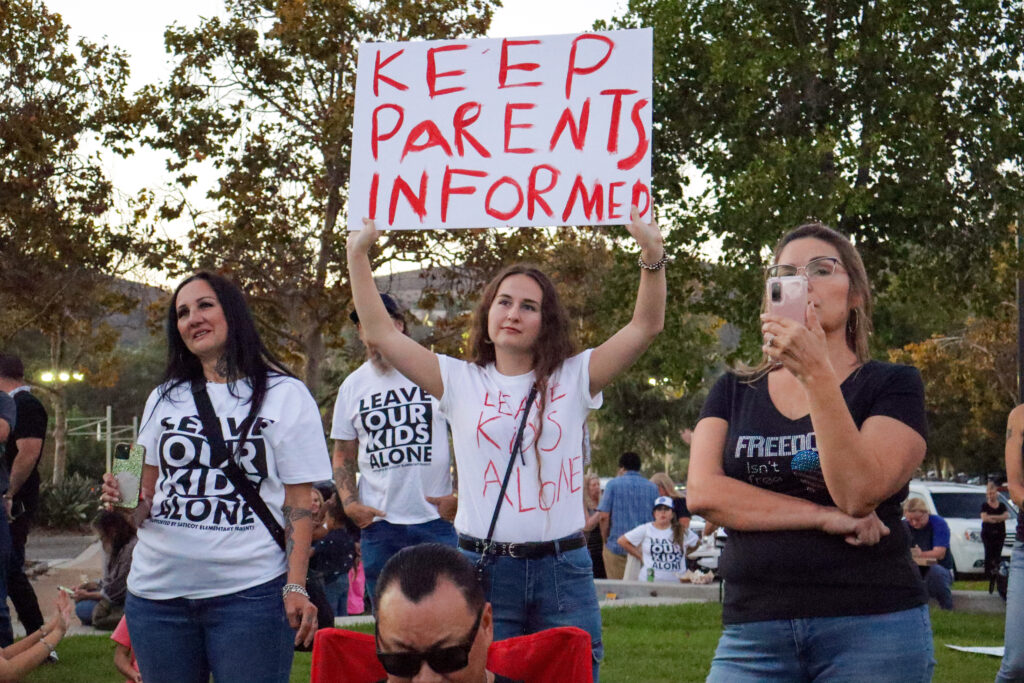
Parents rights supporters attend a rally in Simi Valley on Sept. 26, 2023.,the night before a Republican presidential primary debate.
Credit: Courtesy of Rebecca Holz / California Policy Center
Top Takeaways
- A judge ruled parents have the right to know if a student expresses gender incongruence.
- California Attorney General Rob Bonta’s office applied to stay the court’s injunction.
- The ruling may ultimately be appealed to the U.S. Supreme Court.
A federal judge issued a ruling Monday that strikes down California school policies aimed at preventing schools from revealing a student’s gender identity to their parents.
The class action suit, filed by California teachers and parents, hinges on whether TK-12 educators can breach a student’s confidentiality and tell parents that students are using a name or pronoun other than what they have been assigned at birth.
U.S. District Judge Roger Benitez, of San Diego, ruled in favor of two Escondido Union School District teachers, Elizabeth Mirabelli and Lori Ann West, who claimed that district policies “flatly prohibit teachers from respecting parents’ wishes.” The middle school teachers named district officials in the suit and said district policies violated the teachers’ constitutional free speech and religious rights.
Benitez, a George W. Bush appointee, wrote in his order granting summary judgment that California’s public schools “place a communication barrier between parents and teachers.” The judgment applies to all California public schools, not just the original North San Diego County district.
“Parents and guardians have a federal constitutional right to be informed if their public school student child expresses gender incongruence,” Benitez wrote. “Teachers and school staff have a federal constitutional right to accurately inform the parent or guardian of their student when the student expresses gender incongruence.”
The suit, filed in April 2023, named California state officials, including State Superintendent Tony Thurmond, the State Board of Education and Attorney General Rob Bonta.
Benitez’s ruling references guidance that the California Department of Education shared with school districts, including an FAQ that has since been deleted, as well as cultural competency training. But he stated that this case is not about California Assembly Bill 1955, which prohibits forcing teachers to disclose the gender identity of their students.
The Support Academic Futures and Educators for Today’s Youth, or SAFETY Act, was signed by Gov. Gavin Newsom in July 2024, in response to more than a dozen California school boards proposing or passing parental notification policies that required school staff to inform parents if a child asks to use a name or pronoun different from the one assigned at birth.
A statement from the California Legislative LGBTQ Caucus says that Benitez’s ruling “deliberately injects confusion into the public understanding” of the SAFETY Act and “signals an alarming willingness to undermine long-standing constitutional rights to privacy and nondiscrimination protections across California law.”
Bonta’s office on Monday filed a brief seeking to stay the court’s injunction. A spokesperson for Bonta said the district court misapplied the law and that the decision will ultimately be reversed on appeal.
“We are committed to securing school environments that allow transgender students to safely participate as their authentic selves while recognizing the important role that parents play in students’ lives,” said a statement from Bonta’s office.
Benitez referenced the U.S. Supreme Court decision this summer in Mahmoud v. Taylor, which granted public school parents the right to withdraw from materials and discussions that conflict with their sincerely held religious beliefs.
A statement from the Thomas More Society, the Chicago-based conservative Catholic law firm that took on the case, called the judge’s decision a “landmark class-action ruling.”
“Today’s incredible victory finally, and permanently, ends California’s dangerous and unconstitutional regime of gender secrecy policies in schools,” said Paul M. Jonna, special counsel at Thomas More Society and a partner at LiMandri & Jonna.
The American Civil Liberties Union said in a statement that this ruling puts transgender and gender-nonforming students at risk of being outed.
“A culture of outing harms everyone — students, families, and school staff alike — by removing opportunities to build trust. LGBTQ+ students deserve to decide on their own terms if, when, and how to come out, and to be able to be themselves at school,” said Christine Parker, senior staff attorney with the ACLU Foundation of Southern California.
An attorney for the Escondido Union School District argued in court documents that both the California Constitution and the state education code protect the privacy rights of students in many contexts. For instance, the California Supreme Court has held that children have the right to an abortion without state notification of their parents. And school counselors are barred from disclosing confidential information if the counselor believes that it would result in a danger to the health or safety of the student.
Legal experts said the case is likely to reach the U.S. Supreme Court.
When the case came up during a panel at the California School Boards Association conference in Sacramento earlier this month, Anthony De Marco, a partner at the firm Atkinson, Andelson, Loya, Ruud & Romo, which represents school districts, called it a “direct attack” on California education.
“It crosses a line,” De Marco said, while speaking to board members about important legal issues they may be facing. “Certified employees should not be able to opt out.”
Jeff Freitas, president of the California Federation of Teachers, called the court decision “an attack on the safety of our students and educators.” He said that as a math teacher, he witnessed students who were struggling with issues that they wanted to keep private from their parents.
“Students more often go to their parents than their teachers,” Freitas said. “If they’re not going to their parents, there’s probably a reason why.”
EdSource reporter Thomas Peele contributed to this report.