Amazon removed several James Bond posters last month after fans noticed that Bond’s iconic Walther PPK pistol had been airbrushed out of each one. Sean Connery and Pierce Brosnan were left standing in various awkward poses, raising their empty hands.
The posters, which Prime Video had put up for Global James Bond Day on Oct. 5, were later replaced with “safer” film stills, most of which still omitted firearms.
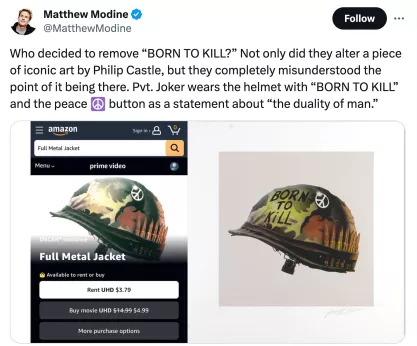
If the edit felt eerie, it also felt familiar. Last year, Prime Video displayed Philip Castle’s Full Metal Jacket poster. But the words “Born to Kill,” which originally appeared next to a peace sign in reference to the film’s core theme of the duality of man, were notably absent from Private Joker’s helmet. After actor Matthew Modine objected, and Warner Bros. intervened, Amazon restored the original artwork. But no explanation followed.
These edits aren’t one-offs. They follow Amazon’s own rules. Prime Video’s artwork requirements tell partners to “avoid adult or profane language” in titles, “keep text to a minimum,” and “avoid images of . . . guns, or other weapons.” If a realistic firearm appears, it cannot be dominant, aimed, in use, or pointed at the viewer. A companion Graphic Assets Guide adds, “We avoid using violence in Amazon promotions.”
From a corporate perspective, such guidelines serve practical aims: Amazon cites maintaining brand safety and optimizing user interfaces as reasons for these rules. As a private entity, Amazon can prioritize those goals above third-party expressive interests; the company has its own First Amendment right to exercise editorial discretion about what it posts online. Amazon has no legal obligation to carry every title or preserve every poster exactly as originally designed.
Yet when Amazon treats works like the iconic Full Metal Jacket poster as expendable marketing collateral, editing them for risk management rather than preserving them as legacy art, the result is cultural bowdlerization. In a Bond poster, a pistol is not merely decorative — it’s essential to the franchise’s aesthetic.
After the opening credits, what’s Bond’s first move? He breaks the fourth wall by shooting the viewer. In Full Metal Jacket, “Born to Kill” isn’t just a slogan — it embodies the film’s thesis that there are no good or bad people, but that inclinations toward peace and violence run through each of us. Removing these elements doesn’t make the images safer. It makes them artistically compromised, less reflective of their cinematic and literary sources.
Bond and Private Joker aren’t the only victims either. In recent years, Prime Video has removed, demoted, or delayed a number of controversial films — often without a clear rationale. In 2019, Amazon removed several anti-vaccine documentaries, hours after Rep. Adam Schiff wrote an open letter asking Amazon CEO Jeff Bezos to curb such content. Private platforms can decide how to treat third-party content they publish, but doing so based on government pressure is to succumb to a form of censorship-by-proxy known as “jawboning” — which, as FIRE Legal Director Will Creeley recently told the Senate Commerce Committee, violates the First Amendment.
During Black History Month in 2021, the documentary Created Equal: Clarence Thomas in His Own Words disappeared from Amazon’s catalog without explanation — and returned only after media coverage of its removal. Amazon’s self‑distribution portal initially rejected conservative writer Shelby Steele’s documentary What Killed Michael Brown? before it later appeared on Prime Video. In late 2023, Amazon removed the Russiagate documentary The Plot Against the President. A source told Newsweek the takedown wasn’t political, but Amazon didn’t elaborate. In 2024, filmmaker Robby Starbuck said Prime Video banned his documentary The War on Children. Months later, it was available on Amazon again.
Even where calling something a “ban” is overstated, the optics create a chilling pattern: clumsy decisions first and clarity later, but only when pressed. Early coverage of FIRE’s own documentary, The Coddling of the American Mind, even asked whether Amazon would carry it. It’s now rentable on Prime Video, but Amazon’s distribution lagged behind the premiere.
Globally, Amazon often adjusts content to satisfy illiberal governments. A Citizen Lab study of Amazon’s U.S. storefront found 17,050 products — mainly books — restricted from shipment to certain regions. The clusters weren’t random either. LGBT topics, Christianity, erotica, the occult, and health/wellness were overrepresented, and users were rarely told why. In the United Arab Emirates in 2022, under government pressure, Amazon restricted searches for LGBT‑related terms and removed certain items, including books, from local sale. In China, Amazon’s site disabled ratings and reviews on a book of Xi Jinping’s speeches — at Beijing’s request.
It’s not tidying the user interface. It’s repainting the past, affecting our cinematic and literary heritage.
Threaded together, a pattern emerges. Amazon doesn’t bowdlerize in the old sense. It sanitizes — quietly, sometimes briefly, and rarely with a paper trail. Its poster guidelines nudge against weapons and text, its film platform sometimes disappears politically touchy work, its book storefront can demote titles under political pressure or restrict shipments by region, and its foreign subsidiaries comply with illiberal laws.
Again — none of this is unconstitutional for an American company. Private companies have First Amendment rights to curate their platforms however they want. But what’s legal isn’t always wise.
When a company edits Bond’s gun out of a poster or scrubs Private Joker’s motto, it’s not tidying the user interface. It’s repainting the past, affecting our cinematic and literary heritage. When it removes a title without explanation and restores it only after fuss, it signals that cultural expression is disposable and subservient to political and corporate interests.
What is your major malfunction, Amazon?
Prime Video bowdlerizes “Full Metal Jacket” movie poster, removing the phrase “Born to Kill” written on the helmet.
Amazon says on its own website, “We approach our technology design with a focus on privacy, safety, security, access to information, and free expression.” That’s a fine start. But if Amazon truly wants to honor that promise, it should bring sunlight and accountability to its moderation practices. Amazon should report country-by-country restrictions, and if it must edit an image, tag it “Modified for Prime Video artwork standards” with a link to uniform rules. On its website, Amazon further states:
We understand that what one person considers offensive may not necessarily be offensive to others and that views can change over time. As a store, we’ve chosen to offer a very broad range of viewpoints … We strive to maximize selection for all customers, even if we don’t agree with the message or sentiment of all of the products.
But on that very same page, Amazon “prohibit[s] the sale of products that promote, incite, or glorify hatred, violence, racial, sexual, or religious intolerance or promote organizations with such views.” These claims appear to contradict each other.
Amazon would be doing the culture of free expression a great service if it embraced the same principle that made the open internet possible in the first place: the belief that people can think for themselves.
Art exists to confront us, not flatter us. Bond’s pistol and Private Joker’s helmet offer such confrontations. Violent, racial, and sexual content can disturb, but these are also core themes in art. A platform that smooths those edges may follow corporate best practices, but it imposes a heavy cultural cost on us all — one we should refuse to pay.