This audio is auto-generated. Please let us know if you have feedback.
The U.S. Department of Education canceled two grant competitions for fiscal year 2025 meant to improve career opportunities for Native American and Native Hawaiian students, according to notices published in the Federal Register earlier this month.
The competitions were canceled because they do not “align with the objectives established by the Trump Administration while fostering consistency across all grant programs.” The department also said in its notices that canceling the competition for the fiscal year is part of “enhancing the economic effectiveness of Federal education funding.”
Instead of continuing the competitions, the department will dedicate available funds to support current recipients of the grants.
In total, the grants provided nearly $21.6 million for the Native American Career and Technical Education Program and the Native Hawaiian Career and Technical Education Program, according to the Education Department’s Office of Career, Technical and Adult Education. It provided nearly $18 million in Native American opportunities and $3.6 million for Native Hawaiians on an annual basis, according to the department.
The competitions were originally announced in the Federal Register on Jan. 7, prior to the inauguration of President Donald Trump, who has proposed a much slimmer Education Department budget that would cut its total funding by 15%. The administration has also already slashed a handful of other education grant programs.
In previous years, the Native American and Native Hawaiian grants have supported colleges, schools and tribes in establishing postsecondary career pathways.
For example, in fiscal year 2021, the department awarded 39 grants under the NACTEP program and nine grants under the NHCTEP program.
A NACTEP grant awarded to Chief Leschi Schools, a Native American tribal school located in Washington, allowed for work-based learning related to fisheries, medical facilities, schools and other careers.
“The tribal connections of pathways embrace and honor the culture and identity of students and families and provide students a connection to their heritage along with a path to a successful future,” the program description states.
In Castle High School in Hawaii, the NHCTEP program prepared students for a medical career pathway.
“The project will provide culture-based education to Native Hawaiian students and foster a community where relationships are formed, and learning is connected to the context of students’ lives applied to the real world,” the description states.
In 2021-22, there were more than 8.1 million high school CTE participants out of 11.5 million participants nationwide, according to the Association for Career and Technical Education. Nationally, about 109,000 were American Indian or Alaska Native and 43,000 were Native Hawaiian or Other Pacific Islander.
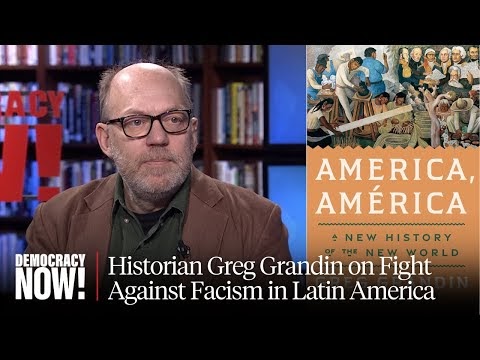
We spend the hour with acclaimed historian Greg Grandin discussing his new book, America, América: A New History of the New World, which spans five centuries of North and South American history since the Spanish conquest, including the fight against fascism in the 1930s. He examines the U.S.-Latin American relationship under Trump, with a focus on El Salvador, Panama, Ecuador and Cuba. Grandin also has a new piece for The Intercept that draws on the book, headlined “The Long History of Lawlessness in U.S. Policy Toward Latin America.” “If the United States really has given up its role as superintending a global liberal order and the world is reverting back to these kind of spheres of power competitions, then Latin America becomes, essentially, much more important,” says Grandin. We also continue to examine the legacy of the late Pope Francis, the son of Italian immigrants to Argentina and the first pope from Latin America. Grandin shares how the Catholic Church’s involvement in the conquest and colonization of the continent impacted the pope’s beliefs.
Democracy Now! is an independent global news hour that airs on over 1,500 TV and radio stations Monday through Friday. Watch our livestream at democracynow.org Mondays to Fridays 8-9 a.m. ET.
This essay was originally published by The Gazette on April 17, 2025.
My grandpa was a World War II veteran and a proud American. After the war, he returned to his Melcher farm and became a Marion County supervisor. Although he died months before my birth, my 98-year-old grandma shared stories about him that guide my moral compass.
One of my favorites is that grandpa would tell folks who gave him a hard time, “Merry Christmas!” and move along to consider their feedback on his public duties. When you’re in charge of plowing the roads in Iowa, folks can get mad at you occasionally.
A farm in Marion County, Iowa, December 1957
Decatur County officials should heed my grandpa’s advice and stop harassing citizens for questioning the Decatur County Board of Supervisors.
As Iowa Freedom of Information Council Executive Director Randy Evans reported, Decatur County Attorney Alan Wilson sent Van Wert resident Rita Audlehelm a cease and desist letter. Why? She wrote to the Leon Journal-Reporter criticizing the board for not acting against a supervisor she believed was out of the county for several weeks. After she asserted that the supervisor attended only one of 17 meetings in person, Audlehelm asked, “My questions are: Why are you not attending BOS meetings and the committee meetings assigned to you?”
It’s a valid question and the First Amendment fully protects it.
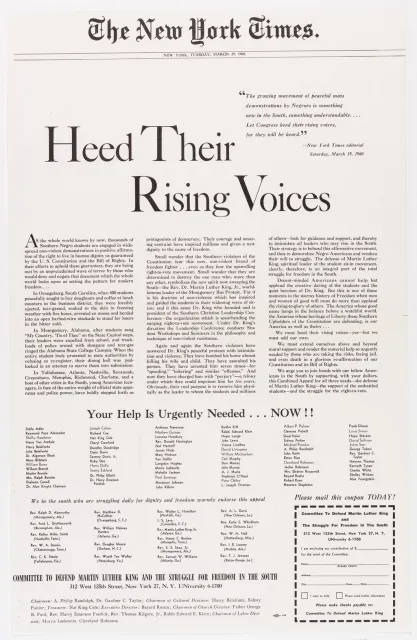
The advertisement published in The New York Times on March 29, 1960, that led to Sullivan’s defamation lawsuit.
Wilson claimed this question was defamatory and demanded that Audlehelm “Cease and Desist from making any future false, misleading, or defamatory statements against any elected official of Decatur County.” However, the Supreme Court made clear in N.Y. Times Co. v. Sullivan that the First Amendment gives citizens breathing room to comment on public affairs because inaccurate statements are inevitable in free debate. Since Sullivan, the court has repeatedly upheld our “profound national commitment to the principle that debate on public issues should be uninhibited, robust, and wide-open, and that it may well include vehement, caustic, and sometimes unpleasantly sharp attacks on government and public officials.”
So, even if she is incorrect, Wilson cannot prevent Audlehelm — or any of us — from voicing good-faith criticism of public officials.
My grandpa taught me that accepting criticism of public duties is part of receiving a taxpayer-funded paycheck. This lesson motivates my work as a First Amendment attorney at the Foundation for Individual Rights and Expression (FIRE).
For me, this is personal.
Unfortunately, Wilson’s attempt to silence debate reflects a trend of politicians intimidating journalists and citizens. Here in Iowa, FIRE asked a court to dismiss President Donald Trump’s lawsuit against our client, pollster J. Ann Selzer, and in Mississippi, FIRE came to the defense of a newspaper sued by a mayor for libel.
Censorship is spreading rapidly, and Americans should urge public officials to address criticism openly rather than resort to lawsuits and threats.
It is an insult to the sacrifices of my grandpa’s generation for public officials to try to silence critics rather than hear folks out.
American foreign policy is vast, complex, and can change by the hour. The First Amendment protects our right to support, challenge, protest, or question the policy of the United States and every other government around the world.
But in seeking deportations of some legal residents in the United States, federal officials are claiming to target immigrants for expression that could, in their view, impact American diplomacy — and the implications for free expression are profound.
This broad justification effectively means any legal immigrant in the United States cannot speak his or her mind about any political issue without risking deportation, lest their words in some way implicate present or future foreign policy matters.
That’s the thing about broad justifications for censorship: They invite broad application.
In the case of Badar Khan Suri — an Indian citizen, Georgetown University postdoctoral fellow, and recent deportation target — The New York Times reported last week that “an official familiar with Dr. Suri’s case” asserted that “the State Department justified his deportation by arguing that he engaged in antisemitic activity that would undermine diplomatic efforts to get Israel and Hamas to agree to a cease-fire.”
Suri is a fellow at Alwaleed Bin Talal Center for Muslim-Christian Understanding at Georgetown’s Edmund A. Walsh School of Foreign Service. In a statement, the school said Suri “has committed no crime.” His father-in-law, Ahmed Yousef, was “a former adviser to Hamas” over a decade ago and “for his part, has criticized the Oct. 7, 2023, attack on Israel.” The ACLU of Virginia, which is serving on Suri’s legal team, asserts that his deportation is “in direct retaliation for his speech in support of Palestinian rights and his family’s ties to Gaza.”
And on Friday, Secretary of State Marco Rubio posted that he “will continue to cancel the visas of those whose presence or activities have potentially serious adverse foreign policy consequences for our country.”
This justification should set off a warning bell for anyone concerned about protecting freedom of expression in the U.S. There is effectively no limiting principle around speech that would allegedly “undermine diplomatic efforts.”
Can legal immigrants in the United States discuss human rights violations in Xinjiang or Hong Kong, even though doing so could theoretically imperil tariff talks or trade negotiations with China? What about criticism of the notion that Canada should become the “51st state”? Can Ukrainian immigrants criticize the actions of President Vladimir Putin while the U.S. is involved in talks between Russia and Ukraine?
That’s the thing about broad justifications for censorship: They invite broad application.
And that’s why, last week, FIRE filed a “friend of the court” brief along with a coalition of civil liberties groups contesting the federal government’s detention of lawful permanent resident Mahmoud Khalil.
The brief challenged the administration’s use of a statute empowering the secretary of state to deport a lawful non-citizen resident if the secretary determines their “presence or activities” has a “potentially serious” effect on American foreign policy.
As FIRE explains, none of the many immigrants in the U.S., including the million-plus on campus, “will feel safe criticizing the American government of the day — in class, scholarship, or on their own time — if a current or future secretary of state may, whenever he chooses and at his unreviewable discretion, deem them adverse to American foreign policy and have them deported.”
Noncitizens lawfully in the United States may lose their residency for many reasons, like criminal activity or overstaying beyond the authorized date.
Exercising the freedoms protected by our First Amendment should not be one of them.
This essay was originally published in Jewish Telegraphic Agency on March 14, 2025.
We can’t make antisemitism go away by censoring antisemites.
Nevertheless, the Trump administration has said it is combating antisemitism at Columbia University by canceling $400 million in funding and detaining a former student over what the president has vexingly called “illegal protests” against Israel. It is also making a host of additional demands of the university.
Some Jewish groups are applauding the effort. But as an American Jew and free speech lawyer, I can tell you that protest alone isn’t illegal — and that giving the government the power to punish hateful speech will only erode our own right to speak out against hate.
In the wake of the Oct. 7, 2023, attack led by Hamas on Israeli civilians and Israel’s military response, protests erupted on campuses nationwide. Some of the activities by student protesters were unlawful, like blocking fellow students from entering parts of campus or occupying buildings. But many students engaged in pure speech by marching, displaying signs, or shouting slogans. These are protected and celebrated forms of protest in our country. Whether in support of Israel, Palestine, or even Hamas, the First Amendment prevents the government from punishing or censoring them.
As a historically persecuted population, Jews have a vested interest in ensuring American civil rights protections remain in full force. The First Amendment guarantees not only the freedom to practice our religion in this country, but our ability to speak out when our rights and lives are in danger.
Our institutions of higher education are supposed to be a marketplace of ideas. Even if you think those ideas are bad, protecting all speech means your speech is protected, too.
In 1943, 400 rabbis marched on Washington to draw attention to the mass murder of European Jews, helping lead to the creation of an American War Refugee Board that saved thousands of Jewish lives. In 1963, American Jewish leaders like German-born Rabbi Joachim Prinz marched again, this time with Martin Luther King Jr. Speaking just before Dr. King’s “I Have a Dream” speech, Rabbi Prinz lamented that his former countrymen “remained silent in the face of hate” and pleaded that “America must not become a nation of onlookers. America must not remain silent.”
But we endanger the ability to speak out when we allow the government to erode our First Amendment protections. That’s why White House statements this week threatening punishment for anti-Israel speech should have all Americans concerned — even those of us who would appear, at first blush, to benefit.
Regarding the arrest of Palestinian protester Mahmoud Kahlil by U.S. Immigration and Customs Enforcement, President Trump said, “We will find, apprehend, and deport these terrorist sympathizers from our country — never to return again.” Secretary of State Marco Rubio posted an advisory from the Department of Homeland Security saying that Khalil had “led activities aligned to Hamas,” and has also claimed the power to deport a legal resident whose activities “would have potentially serious adverse foreign policy consequences for the United States.” But those justifications could merely describe Khalil’s on-campus protests, including his protected speech.
Threatening to deport Khalil without accusing him of any crimes chills speech. And that threat extends to everyone, no matter what side of the Israeli-Palestinian debate you are on, or whether you are promoting or combatting antisemitism. Would a green-card-holding Jew feel free to criticize special government employee Elon Musk for publicly supporting the far-right, German-nationalist AfD party, knowing our government could deem such criticism creates “adverse foreign policy consequences”? That standard is just too vague to risk deportation, and it permits the government to punish speech it just doesn’t like.
The Trump administration’s pledge to remove “pro-Hamas” students, coupled with Khalil’s arrest, make it hard to see the administration’s actions this week against Columbia and other institutions of higher education as anything other than attempts to police and punish campus speech.
To be sure, it has been a difficult year for Jewish college students, and there have been documented instances of bad actors preventing them from getting to class, or even assaulting them. Title VI requires colleges and universities that receive federal funding to ensure discriminatory harassment does not deprive Jewish students of an education, and it is possible Columbia has failed that obligation.
But protest alone is not grounds by itself for a Title VI violation. And the government did not make sure it was punishing only actionable misconduct before canceling Columbia’s funding, like it is supposed to. The Supreme Court rightly set a high bar for conduct that amounts to discriminatory harassment that is supposed to ensure pure speech rarely rises to that level.
And with good reason: Our institutions of higher education are supposed to be a marketplace of ideas. Even if you think those ideas are bad, protecting all speech means your speech is protected, too.
I’m no stranger to fear of the recent public increase in antisemitism. Last year, given online antisemitism approaching the anniversary of Oct. 7, my wife and I chose to keep our daughter home from her Chabad preschool that day. The current political moment terrifies me. Antisemitism is coming from both sides of the political spectrum, and it feels like there is nowhere to run. So instead, I think we should fight.
But allowing the government to ignore our rights to free speech would only deprive us of our most powerful weapon.
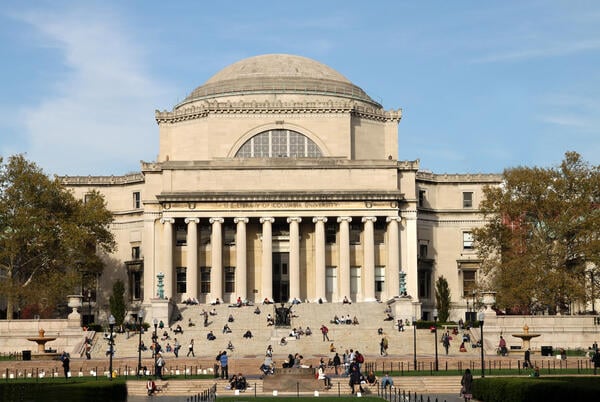
March 13 was a watershed day in the annals of American higher education and the history of America’s commitment to freedom and limited government. On that day, the Trump administration issued an edict telling Columbia University, a private institution, how to function.
The people who founded the American republic must be turning over in their graves.
Such a bold assertion of government power would be more familiar to people in many other nations. But in the United States, this is a shocking development and a warning of what is in store, not just for higher education, but for the entire country.
What is happening at Columbia is an initial test of the Trump administration’s ambition to curb institutional autonomy, limit and punish dissent, and make life miserable for anyone who does not toe their line. That’s why each of us, whether or not we work in higher education, has a stake in Columbia University’s fate.
Let’s face it: Universities are what people in the Departments of Defense or Homeland Security might call “soft targets.” Soft targets are easily accessible, relatively unprotected and therefore vulnerable to attack.
Like the successful, decades-long right-wing campaign to take over the courts in this country, which has wreaked havoc in the lives of ordinary Americans, the campaign against Columbia will, if similarly successful, prove costly well beyond that New York City campus.
What is unfolding there is a testing ground for efforts in other sectors of American life.
Acting in a high-handed and arbitrary manner in its dealings with Columbia paves the way for the government to carry out similar abuses of power elsewhere. Attacking academic freedom is a stalking horse for attacking freedom of speech and other freedoms.
It is important to recall that Trump’s campaign against Columbia didn’t start on March 13. It began earlier with the cancellation of $400 million in federal grants and contracts and the move by Immigration and Customs Enforcement to arrest and detain Mahmoud Khalil, a green card holder and recent graduate who helped lead pro-Palestinian protests on campus.
The first thing to note about that letter was that it came from officials in the Departments of Education and Health and Human Services and the General Services Administration. They joined not only in asserting their right to intervene at Columbia under Titles VI and VII of the 1964 Civil Rights Act but to remind the university of the Trump administration’s power to cripple it financially.
Title VI prohibits discrimination on the basis of race, color or national origin in programs and activities receiving federal financial assistance. Title VII makes it unlawful for employers to discriminate based on race, color, religion, sex or national origin.
Since the act’s passage, it has been clear that alleged violators of Title VI must be afforded due process before federal funds can be withheld. That guarantees fairness and impartiality in investigations and ensures that enforcement actions will not be precipitous.
The March 13 letter, with its demand for “immediate next steps that we regard as a precondition for formal negotiations regarding Columbia University’s continued financial relationship with the United States government,” is a chilling reminder of what happens when a government seeks to wield its formidable power without respecting the due process rights of those it targets.
And if it gets away with practicing what one commentator calls “regulation by intimidation” at Columbia, the administration will be emboldened to do more of the same, and not just in higher education.
The March 13 letter touches on matters colleges and universities routinely determine for themselves. For example, it demands that the university complete disciplinary proceedings against students who were involved in taking over a campus building last year and who participated in encampments in support of Palestinians. And it specifies that penalties of “expulsion or multi-year suspension” should be imposed.
The same day it received the Trump administration’s letter, the university announced that it was expelling or suspending some students involved in the Hamilton Hall takeover and temporarily revoking the diplomas of other students who had since graduated.
In addition, the March 13 letter directs Columbia to “Abolish the University Judicial Board (UJB) and … empower the Office of the President to suspend or expel students.”
The intrusiveness of the letter extends to telling Columbia that it must ban the wearing of masks on campus and “formalize, adopt, and promulgate a definition of antisemitism” (it specifically cites the definition used in Trump’s Executive Order 13899). It even demands that Columbia’s Department of Middle East, South Asian and African Studies be put into “academic receivership” so that its faculty can no longer make hiring and curriculum decisions.
That is the administration’s way of forcing the university to punish the department, some of whose faculty supported the encampment movement. Receivership means someone from outside the department would be appointed to make decisions for its faculty. It is a rarely used and nuclear response to departmental dysfunction.
If Columbia were to do what the March 13 letter asks, it would be waving the white flag of surrender to any pretense that it will respect and protect academic freedom, the most prized and essential aspect of teaching and research in higher education. That would send a powerful and chilling signal about the administration’s ability to ensure freedom means the freedom to say and do what it prescribes.
Taken together, the provisions in the March 13 letter amount to an effort to put the entire university into a kind of receivership. Beyond the world of higher education, receivership involves a court appointing “an independent ‘receiver’ or trustee to manage all aspects of a troubled company’s business. The company’s principals remain in place, but they have little authority over the company for the duration of the receivership.”
The March 13 letter signals that intention when it calls for the development of a plan of “long-term structural reforms that will return Columbia to its original mission of innovative research and academic excellence.”
“Innovation” and “excellence” are the watchwords for colleges and universities, businesses, artistic enterprises and individuals seeking to lead a free life. But since the founding of the republic, this country has been guided by the belief that the government would not be in the business of saying what could count as innovative and excellent in private life.
If Americans stay on the sidelines as the current administration tries to bring Columbia to its knees, we will not only be damaging higher education, we will also be turning the founders’ vision of the relationship between the government and the people on its head.
Austin Sarat is the William Nelson Cromwell Professor of Jurisprudence and Political Science at Amherst College.
David John Baer McNicholas’s first novella is inspired by a darkly comedic poem he once wrote about a town that outlawed canned food and built a massive trebuchet, or catapult, to hurl the cans into the distance — only to receive thank-you notes tied to bricks hurled back at them.
Lately, McNicholas has been entangled in a real-life plot eerily similar to his writing. At the Institute of American Indian Arts in Santa Fe, New Mexico, food pantries were empty despite a $50,000 grant meant to support them. When student publication The Young Warrior printed criticisms of school officials for these failures and the Associated Student Government began investigating, administrators swiftly retaliated — kicking students out of housing, putting them on probation, and even threatening them with lawsuits.
This may sound like the plot of a neo-noir film bleak enough to rival “Chinatown,” but for McNicholas, a creative writing student at IAIA and the founder and editor of The Young Warrior, it’s reality.
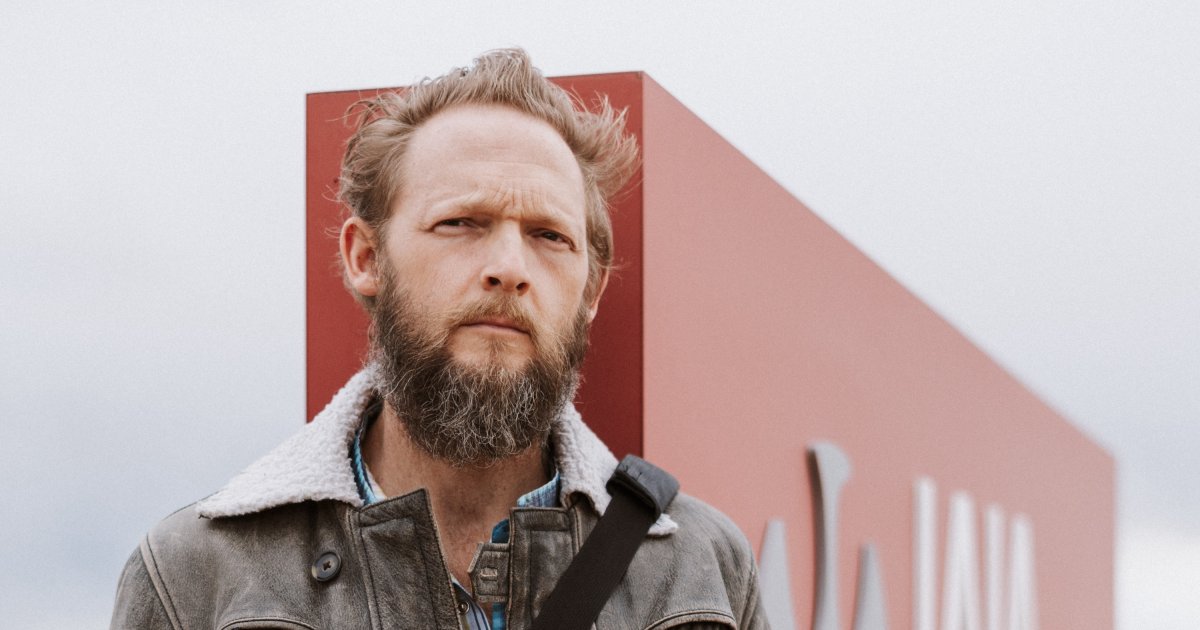
Young Warrior editor David McNicholas recalls, “Oh shit, they’re going to throw everything at me” for exposing the administration. (Ponic Photography)
McNicholas connects IAIA’s pattern of silencing dissent to broader institutional failures. He recounts how during a faculty meeting with the Board of Trustees, a sculpture professor once dared to mention an academic paper written by a former IAIA department head. The paper showed that even conservative estimates put IAIA’s staff turnover rate at about 30%. McNicholas says when the professor brought it up, “everyone in the meeting clammed up, and later they came down on him hard. They told him he embarrassed the dean of students and demanded he write a public apology and retraction. He wrote a coerced apology and quit the next day.”
The Young Warrior published the academic paper before quickly being told to retract it.
“We want better,” says McNicholas. “Student retention is 50%. Graduation is 25% . . . The faculty, staff, and students here are top-notch people, but the administration just supports the rising stars and lets everyone else evaporate.”
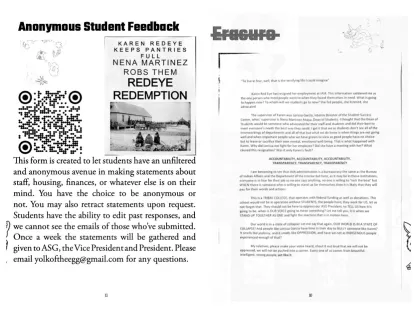
McNicholas’s own showdown with the administration began when he published an anonymous student letter and flyer accusing the dean of students of bullying and suggesting food-pantry funds had been misappropriated. The letter and flyer resonated with the student body, according to McNicholas, and many came forward to thank him and to offer support.
I love this school. I love the community. I love the students and the faculty. I struggle with the administration after this, but I think that that struggle was there long before I came along. I just kind of exposed it.
When McNicholas published the anonymous letter and flyer, he says students were being forced to buy meal plans they couldn’t always use while the dean of students, McNicholas says, dismissed the need for food pantries altogether, claiming, “Students have meal plans; they don’t need food pantries.”
This explanation rang hollow for McNicholas who, like many of his peers, falls below the poverty line and relies on food pantries to survive.
After the letter and flyer came out, the administration promptly accused McNicholas of “bullying” staff with his publication, and IAIA Provost Felipe Colón put him under investigation.
“They came down on me primarily, but also on a peer who had made an Instagram post, of all things,” he recalls. “I said, ‘Oh shit, they’re going to throw everything at me.’”
Anticipating housing sanctions, McNicholas preemptively left campus and lived out of his van.
“It sucked, because I wasn’t prepared for it. I had to go sleep in a friend’s driveway,” he remembers. The forcefulness of the school’s response only made McNicholas more suspicious, bringing to mind Shakespeare’s famous line, “The lady doth protest too much.”
Institute of American Indian Arts Can’t Ignore the First Amendment
Page (Two-Column)
Tell the Institute of American Indian Arts to lift sanctions against David McNicholas and revise its anti-bullying policy.
The situation escalated when the administration denied that the grant even existed during a meeting with McNicholas and other members of the Associated Student Government who had taken an interest in the matter. Despite the administration’s denials, an anonymous source provided McNicholas with a photocopy of a grant award letter for the rumored $50,000. Armed with this evidence, McNicholas and the ASG president confronted the administration, only to face threats of legal action.
The administration’s behavior took an emotional toll on students, according to McNicholas. One day, the ASG called a meeting to discuss the situation — just ASG members, since advisors employed by the college couldn’t be trusted — and the ASG president showed up in tears. She had just come from a meeting with IAIA President Robert Martin, who delivered a shocking ultimatum.
“She said that he told her the school was seriously considering suing ASG — and her — because of the bad publicity,” McNicholas says. “She came to us and said, ‘They told me to fix it.’ She was in tears, you know, and that made me mad.”
When they confronted the provost with the grant award letter, he changed his tune.
“He showed up at the next meeting and said, ‘Oh, you know what? I did some looking, I researched it, and I think I found the grant that you guys were talking about, and I’d like to come and explain how it was spent,’” McNicholas recalls. “I was like, yeah, I bet you do.”
Meanwhile, Provost Colón’s investigation of McNicholas for publishing the student critiques found him responsible for violating the school’s unconstitutional anti-bullying policy. Exhausted and beaten down, he was unable to attend the meeting where the provost attempted to explain the grant’s expenditures. McNicholas says, “I got the sheet he handed out, which showed budget-to-actual figures, but when pressed to release the ledger, he claimed bank statements might not go back that far. We’re talking a year, maybe two at most. I think he thought you could say that because he was with a room full of like 19, 20 year olds. But if I had been in that room, I would have pushed back.”
Though McNicholas later successfully appealed the housing sanctions and recovered about $2,000 in lost fees, he remains outraged at how other students were treated.
McNicholas never did accept IAIA’s “as little as possible” philosophy, in which truth had no place, power thrived on silence, and the ones who dared to ask questions were the first to pay the price.
“What I really can’t stand is that they did the same thing to a 19-year-old freshman for making an Instagram post. That person didn’t move out on their own accord. They lost all their housing and meal plan money. They lost $2,000,” McNicholas says. “They kicked that person out, kept their money, and made a 19-year-old student homeless. As far as I’m concerned, that’s unconscionable.”
Not only did the sanctions against McNicholas affect his ability to participate in campus life, they also threatened his employment opportunities, including a federal work-study opportunity that should have been protected from administrative interference.
“I was hired to be an orientation mentor at the end of last summer,” he says “And the day before I was going to start, I got a call from the director of that program who said, ‘Yeah, you can’t participate because you’re on institutional probation.’”
Finding himself ruthlessly targeted by the administration, McNicholas turned to the press. Teaming up with a few peers, they went to the Santa Fe Reporter, and the article that followed — which detailed the administration’s retaliatory actions against him — made an immediate impact.
“When that article came out, both the interim director and dean of students were gone within days,” he says. “Like, they were gone.”
Anticipating housing sanctions, Young Warrior editor David McNicholas preemptively left campus and lived out of his van. “It sucked, because I wasn’t prepared for it. I had to go sleep in a friend’s driveway.” (Ponic Photography)
After the Santa Fe Reporter exposé and leadership shakeup, the food pantry miraculously transformed. A 20-foot-long conference table in the Student Success Center, once filled with nothing but cans of tomatoes that no one was using, suddenly became a bounty of groceries.
Last semester, McNicholas delved into the intersection of journalism and free speech through an independent study. His research included works like Dean Spade’s “Mutual Aid” and FIRE’s “Guide to Free Speech on Campus,” laying the groundwork for his evolving understanding of rights and responsibilities.
This semester, McNicholas has already published a new issue of The Young Warrior, which reflects his growing interest in matters of free expression. The issue includes a letter from FIRE written on his behalf and a personal acknowledgment of his own rights and responsibilities as a journalist.
“Yes, the school violated my rights and they need to be held accountable, but also, I could have been a better journalist. And there’s room to talk about that,” he says with characteristic humility. The issue also strikes a lighter tone with a comic poking fun at the provost — because, as McNicholas says with a grin, “why not?”
The intersection of art, politics, and personal freedom is a driving force for McNicholas. “My work is very personal,” he explains. “I live in a political morass metaphorically surrounded by people on both sides of a binary who think censorship is fine as long as it’s censoring the other guy. I’m a non-binary thinker. I’m an anarchist. For an artist like me to make art, I can’t be worried about who I will offend. I can’t tailor my work to thread between all these idiots who can’t think for themselves, who can’t be critical without taking sides. If I worried about that, I couldn’t get up in the morning. I couldn’t be an artist.”
McNicholas never did accept IAIA’s “as little as possible” philosophy, in which truth had no place, power thrived on silence, and the ones who dared to ask questions were the first to pay the price. Nevertheless, he speaks with deep affection about IAIA.
“I love this school. I love the community. I love the students and the faculty. I struggle with the administration after this, but I think that that struggle was there long before I came along. I just kind of exposed it.”
South Dakota public schools would be required to teach a specific set of Native American historical and cultural lessons if a bill unanimously endorsed by a legislative committee Tuesday in Pierre becomes law.
The bill would mandate the teaching of the Oceti Sakowin Essential Understandings. The phrase “Oceti Sakowin” refers to the Lakota, Dakota and Nakota people. The understandings are a set of standards and lessons adopted seven years ago by the South Dakota Board of Education Standards with input from tribal leaders, educators and elders.
Use of the understandings by public schools is optional. A survey conducted by the state Department of Education indicated use by 62% of teachers, but the survey was voluntary and hundreds of teachers did not respond.
Republican state Sen. Tamara Grove, who lives on the Lower Brule Reservation, proposed the bill and asked legislators to follow the lead of Sisseton Wahpeton Oyate Chairman J. Garret Renville. He has publicly called for a “reset” of state-tribal relations since the departure of former Gov. Kristi Noem, who was barred by tribal leaders from entering tribal land in the state.
“What I’m asking you to do today,” Grove said, “is to lean into the reset.”
Joe Graves, the state secretary of education and a Noem appointee, testified against the bill. He said portions of the understandings are already incorporated into the state’s social studies standards. He added that the state only mandates four curricular areas: math, science, social studies and English-language arts/reading. He said further mandates would “tighten up the school days, leaving schools with much less instructional flexibility.”
Members of the Senate Education Committee sided with Grove and other supporters, voting 7-0 to send the bill to the full Senate.
The proposal is one of several education mandates that lawmakers have considered this legislative session. The state House rejected a bill this week that would have required posting and teaching the Ten Commandments in schools, and also rejected a bill that would have required schools to post the state motto, “Under God the People Rule.”
South Dakota Searchlight is part of States Newsroom, a nonprofit news network supported by grants and a coalition of donors as a 501c(3) public charity. South Dakota Searchlight maintains editorial independence. Contact Editor Seth Tupper for questions: [email protected].
Criticism of government and public officials is at the core of First Amendment protections. But the Institute of American Indian Arts in New Mexico is ironically using its anti-bullying policy to browbeat student critics into silence.
Last spring, David McNicholas, senior editor of the Young Warriorstudent magazine, published two student submissions reacting to recent news of the abrupt resignation of Karen Redeye, a beloved student success advisor at IAIA.
The first submission was an anonymous editorial urging students to speak up against IAIA’s “oppression” and accusing Redeye’s supervisors of bullying her to the point that “good people have no choice but to leave or sacrifice their own mental, emotional well-being.” The second submission, also from an anonymous student, was an image of a flyer referencing rumors that Nena Martinez Anaya, the dean of students, misappropriated grant money meant for food aid. The flyer read, “Karen Redeye keeps pantries full[.] Nena Martinez robs them[.] Redeye Redemption[.]”
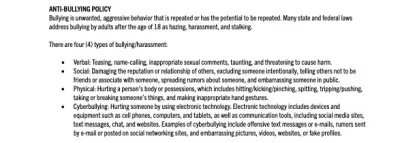
Immediately after the magazine’s publication, IAIA Provost Felipe Colon told McNicholas he was being investigated over complaints that the publication constituted bullying. Specifically, he was told that the “damaging and defamatory content” and “derogatory and unfounded misinformation” violated IAIA’s expansive anti-bullying policy — which bars everything from “teasing, name-calling” and “taunting,” to “telling others not to be friends . . . with someone” and “offensive text messages or emails.”
A third complaint, filed by Lorissa Garcia, interim director of the Student Success Center, echoed the others but added a new accusation. Namely, that in his role as public relations officer for the student government, McNicholas used its Instagram account to “promote and distribute derogatory and unfounded misinformation and rumors” concerning Garcia’s role in Redeye’s resignation.
Garcia based this allegation on the claim that the student government’s account “liked” a student’s post sharing an image of the “Redeye Redemption” flyer.
Colon found McNicholas responsible for bullying, placed him on probation through the end of the 2024–25 school year, suspended him from student housing, and ordered him to issue written public apologies to Garcia and Martinez Anaya — and publish retractions in the Young Warrior and on the student government Instagram account.
Redeye then emailed IAIA President Robert Martin to explain that she had indeed resigned from IAIA due to “maltreatment” and “bullying from direct supervisors.” Despite Redeye corroborating the editorial’s factual assertions, an appeals panel lifted the other sanctions but upheld the probation.
FIRE wrote IAIA last month, urging it to rescind the remaining sanctions and revise its overbroad and vague anti-bullying policy:
The First Amendment protects the freedom of the press to publish vehement criticism of government officials (including college administrators) like that contained in the anonymous editorial submissions printed in the Young Warrior. In fact, such criticism is at the core of the Constitution’s guarantee of expressive rights. . . . As the Supreme Court has explained, “debate on public issues should be uninhibited, robust, and wide-open, and . . . may well include vehement, caustic, and sometimes unpleasantly sharp attacks on government and public officials.”
IAIA cannot ban “teasing” and “offensive text messages” simply by labeling them bullying. In order for so-called “bullying” speech to be punishable, it must rise to the level of actionable harassment — that is, it must discriminate based on protected status and be severe, pervasive, and objectively offensive, among other criteria. An anti-bullying policy expansive enough to cover “taunting” and “telling others not to be friends . . . with someone” is unconstitutional.
But IAIA refused to rescind the sanctions or amend its policy. According to the school, its actions did not violate the First Amendment:
Mr. McNicholas was not disciplined because he published critical commentary about IAIA officials, as you state; he was disciplined for publishing harmful, hurtful, unsubstantiated and damaging statements about the persons and reputations of members of the IAIA community. There is a big difference between critical commentary and the spreading of unsubstantiated and injurious statements claiming illegal activity.
Contrary to IAIA’s assertion, constitutional protection for speech and the press extends to criticism that is “harmful” or “hurtful.” The Supreme Court has been clear: “Criticism of [public officials’] official conduct does not lose its constitutional protection merely because it is effective criticism and hence diminishes their official reputations.”
Nor does the published material lose First Amendment protection simply because it contains unproven claims. Even false or misleading statements are protected unless the expression meets the high standard for unprotected defamation. Here, that means IAIA would need to show that the published claims about Garcia and Martinez were not only false, but that McNicholas published them despite knowing — or with a “high degree of awareness” — they were false.
IAIA cannot do so. Despite throwing around a lot of terms like “misinformation,” “libelous,” “defamation,” and “slander,” IAIA has not offered any evidence to show the allegations are false, let alone that McNicholas knew they were false. Indeed, the available evidence shows he had good reason for believing the truth of the published allegations.
FIRE defends the rights of students and faculty members — no matter their views — at public and private universities and colleges in the United States. If you are a student or a faculty member facing investigation or punishment for your speech, submit your case to FIRE today. If you’re faculty member at a public college or university, call the Faculty Legal Defense Fund 24-hour hotline at 254-500-FLDF (3533). If you’re a college journalist facing censorship or a media law question, call the Student Press Freedom Initiative 24-hour hotline at 717-734-SPFI (7734).