Tag: Americans

  • Most Americans Believe in the Effectiveness of Childhood Vaccines — But There’s a Catch – The 74

    Most Americans Believe in the Effectiveness of Childhood Vaccines — But There’s a Catch – The 74


    Get stories like this delivered straight to your inbox. Sign up for The 74 Newsletter

    This story was originally reported by Barbara Rodriguez of The 19th. Meet Barbara and read more of their reporting on gender, politics and policy.

    Although a majority of Americans are confident that childhood vaccines are highly effective against serious illness, Republicans’ trust in vaccine safety and support of school requirements is dropping, according to new polling from Pew Research Center.

    Sixty-three percent of Americans are extremely or very confident in the effectiveness of childhood vaccines, according to a survey published Tuesday. But Democrats and those who lean Democrat are much more likely than Republicans and Republican-leaners to hold that view — 80 percent versus 48 percent.

    And while the majority of Americans believe in the safety of vaccines — 53 percent believe childhood vaccines have been tested enough for safety and 51 percent agree that the childhood vaccine schedule is safe — there is significantly more uncertainty among Republicans. For Democrats, 74 percent show high confidence in the safety testing of vaccines and 71 percent believe the childhood vaccine schedule is safe. For Republicans, those numbers are 35 percent and 32 percent, respectively.

    “Both things can be true, that people believe in vaccines’ effectiveness overall and the confidence is a little softer on safety,” said Eileen Yam, director of science and society research at Pew who was part of the primary research team. “But writ large, that’s been pretty stable to see confidence in vaccines. But at the same time, when it comes to things like school requirements, or ‘telling me what to do,’ or requiring me to do something — that’s where you see the bristling on the Republican side.”

    Americans have become more skeptical of requiring that children get the measles-mumps-rubella (MMR) vaccine to attend public school. Sixty-nine percent support it, a decline from 82 percent in 2016. Most of the drop can be attributed to Republicans — with just 52 percent believing in the requirement, compared to 79 percent in 2016. For Democrats, that support was 83 percent in 2016 and actually climbed to 86 percent this year.

    This all comes amid a major measles outbreak in the United States that started in Texas and has spread to multiple other states. And while students are required in each state to get the MMR vaccine to attend public school, officials in Florida have indicated a willingness to drop that requirement.

    Pew found broad and consistent support for the MMR vaccine: 84 percent believe its benefits outweigh its risks (of which there are minor side effects). When Pew first started asking about this in 2016, support was at 88 percent. Yam said the findings show some agreement on the benefits of the MMR vaccine. While 92 percent of Democrats believe the benefits of the vaccine outweigh the risks, 78 percent of Republicans do, too.

    Health and Human Services Secretary Robert F. Kennedy, an anti-vaccine activist who has revamped a key panel that helps decide vaccine policy, has questioned the safety of the MMR vaccine without evidence. He has the backing of President Donald Trump, who has perpetuated misinformation this year about childhood vaccines.

    Pew surveyed parents and found a majority with minor children (57 percent) say they are extremely or very confident in childhood vaccines’ effectiveness. Republican parents are far less likely than Democratic parents to have that confidence (45 percent versus 71 percent), belief in safety testing (29 percent versus 63 percent) and the childhood vaccine schedule (27 percent versus 58 percent).

    Democrats are more likely than Republicans to say medical scientists should have a major role in decisions about childhood vaccines (85 percent vs. 62 percent). There are more partisan fissures on the role of parents: 71 percent of Republicans say that parents of young children should have a major role in policy decisions about childhood vaccines. For Democrats, it’s 46 percent.

    “That speaks to just a divergence in trust in science that we’ve been tracking since before the pandemic,” Yam said. “Just Republicans since the pandemic, their confidence in scientists, the way they look at the CDC has just dropped off much more than on the Democrat side. Democrats have had fairly stable views on scientists and on the CDC, in contrast to Republicans.”

    Pew also examined how recent Centers for Disease Control and Prevention recommendations have influenced Americans’ decisions around getting a COVID-19 shot. The agency recently agreed with Kennedy’s new vaccine panel to stop recommending the shot to everyone and to instead leave the choice up to people. Forty-four percent say they have heard nothing at all about the CDC’s changes to recommendations. Among those who have heard at least a little, 63 percent say it has had no influence on whether they got an updated vaccine.

    “The one big takeaway there is that policies really can’t influence behaviors if people haven’t heard about the policies or the recommendations,” Yam said. “And in this case, a lot of people haven’t heard about it, and some when they have, their minds were made up. They’ve already kind of decided, and it really didn’t influence their behavior one way or the other.”

    This story was originally published on The 19th.


    Did you use this article in your work?

    We’d love to hear how The 74’s reporting is helping educators, researchers, and policymakers. Tell us how
    Source link

  • NEW HIGH: 3/4 of Americans say free speech is headed in the wrong direction

    NEW HIGH: 3/4 of Americans say free speech is headed in the wrong direction

    PHILADELPHIA, Nov. 13, 2025 — A new poll from the Foundation for Individual Rights and Expression finds that a record number of Americans now believe that freedom of speech in the country is headed in the wrong direction.

    The quarterly National Speech Index tracks changing attitudes toward free speech among the American public over time. Since its inception in January 2024, the NSI has asked respondents, “When it comes to whether people are able to freely express their views do you think things in America are heading in the RIGHT or WRONG direction?”

    A staggering 74% of Americans in the October edition of the NSI responded that things are headed in the wrong direction for free speech, compared to only 26% who believe things are headed in the right direction. This represents a 10-point jump since the previous July survey.

    Notably, drops in confidence across all political parties contributed to the record-levels of pessimism. From July of this year, Democrats who think things are heading in the right direction fell from 17% to 11%, Independents fell from 31% to 19%, and Republicans fell from 69% to 55%.

    “In the last three months, America watched as Charlie Kirk was murdered for simply debating on a college campus, followed immediately by a wave of censorship of those who opposed his views,” said FIRE Research Fellow & Polling Manager Nathan Honeycutt. “It’s no surprise that a record number of Americans of all parties now think that it’s a dire time for free speech in America.”

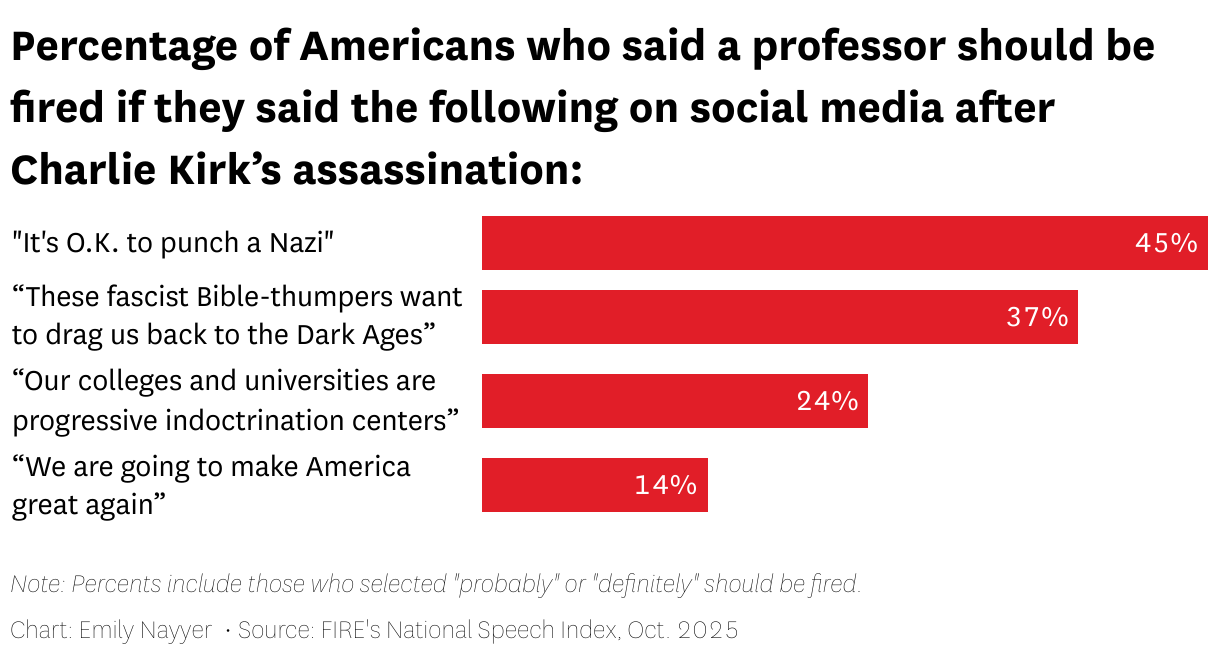
    To test support for academic freedom in the aftermath of the Kirk shooting, the October NSI also asked respondents about four politically charged — but constitutionally protected — remarks made by a professor on social media following the shooting. For each statement, majorities of Americans said the professor should not be fired. But their level of support varied by the statement, and substantial minorities in each case reported that the professor “probably” or “definitely” should be fired.

    • 45% say a professor who posted “It’s O.K. to punch a Nazi” should probably or definitely be fired from their job.
    • 37% say a professor who posted “These fascist Bible-thumpers want to drag us back to the Dark Ages” should probably or definitely be fired from their job.
    • 24% say a professor who posted “Our colleges and universities are progressive indoctrination centers” should probably or definitely be fired from their job.
    • 14% say that a professor who posted “We are going to make America great again” should probably or definitely be fired from their job.
    Percentage of Americans who said a professor should be fired if they said the following on social media after Charlie Kirk’s
assassination: (Bar Chart)

    “Americans were most divided on the statement supporting political violence, but it’s heartening that most Americans correctly backed academic freedom,” said FIRE Chief Research Advisor Sean Stevens. “On the other hand, it’s deeply concerning that we intentionally included some rather tame political statements — including the winning slogan of the last presidential election — and vocal minorities still called for the professor’s firing.”

    Overall, Americans view political violence as a problem across the ideological spectrum, with only modest differences in responses when asked about different ideologies. 57% of respondents said they agreed at least somewhat with the statement “Political violence is a problem among progressives.” But 56% said the same of conservatives, and 58% said they agreed at least somewhat that political violence was a problem across all political groups.

    “Americans seem to recognize that political violence isn’t a partisan problem — it’s a national one,” said Honeycutt. “Our polling suggests that the public is less interested in pointing fingers and more interested in fixing the toxic culture of hostility in our politics.”

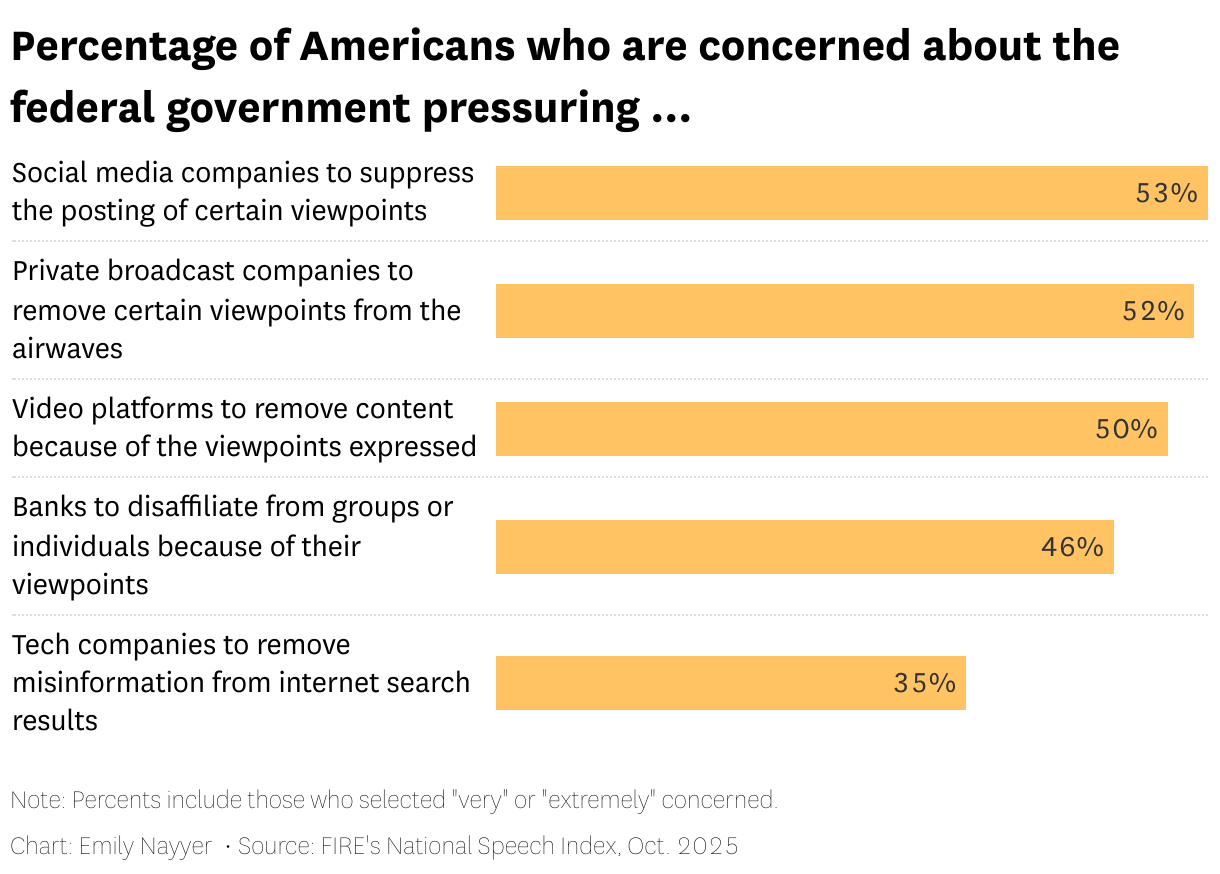
    FIRE also asked for the first time several questions about “jawboning,” the unconstitutional practice in which the government censors by pressuring private actors to silence speech. Around half of Americans said they were “very” or “extremely” concerned about the government pressuring social media companies (53%), video platforms (50%), or private broadcast companies (52%) to remove content based on the ideology expressed.

    Slightly less, 46%, said they were very or extremely concerned about the federal government pressuring banks to disaffiliate with groups or individuals because of their viewpoints, a practice also known as “debanking.” 35% said they were very or extremely concerned about the federal government pressuring tech companies to remove misinformation from internet search results.

    Percentage of Americans who are concerned about the federal government pressuring ... (Bar Chart)

    “Americans are deeply concerned about jawboning — and they’re right to be,” said FIRE Legislative Director Carolyn Iodice. “Both parties have been guilty in recent years of using government pressure to silence speech. This isn’t a partisan issue; it’s a constitutional one.”

    The National Speech Index is a quarterly poll designed by FIRE and conducted by the Dartmouth Polarization Research Lab to capture Americans’ views on freedom of speech and the First Amendment, and to track how Americans’ views change over time. The October 2025 National Speech Index sampled 1,000 Americans and was conducted from October 20 to 28. The survey’s margin of error is +/- 3.0%.


    The Foundation for Individual Rights and Expression (FIRE) is a nonpartisan, nonprofit organization dedicated to defending and sustaining the individual rights of all Americans to free speech and free thought — the most essential qualities of liberty. FIRE educates Americans about the importance of these inalienable rights, promotes a culture of respect for these rights, and provides the means to preserve them.

    The Polarization Research Lab (PRL) is a nonpartisan collaboration between faculty at Dartmouth College, Stanford University and the University of Pennsylvania. Its mission is to monitor and understand the causes and consequences of partisan animosity, support for democratic norm violations, and support for partisan violence in the American Public. With open and transparent data, it provides an objective assessment of the health of American democracy.

    CONTACT:

    Alex Griswold, Communications Campaign Manager, FIRE: 215-717-3473; [email protected]

    Source link

  • Shut your app: How Uncle Sam jawboned Big Tech into silencing Americans

    Shut your app: How Uncle Sam jawboned Big Tech into silencing Americans

    This prepared statement was delivered before the U.S. Senate Committee on Commerce, Science, and Transportation on Oct. 29, 2025.


    Chairman Cruz, Ranking Member Cantwell, and honorable members of the Committee,

    Good morning, and thank you for the opportunity to testify today. My name is Will Creeley, and I am the legal director of FIRE — the Foundation for Individual Rights and Expression, a nonpartisan nonprofit dedicated to defending the rights of all Americans to free speech and free thought, the essential qualities of liberty.

    I’ve spent nearly 20 years defending the First Amendment rights of speakers from every point on the ideological spectrum. At FIRE, we have one rule: If speech is protected, we’ll defend it.

    Typically, the censorship we fight is straightforward: The government punishes a speaker for saying things the government doesn’t like. That’s a classic First Amendment violation, a fastball down the middle. Unfortunately, that kind of textbook censorship isn’t the only way government actors silence disfavored or dissenting speech.

    FIRE Legal Director Will Creeley testifies before the Senate Commerce Committee on Oct. 29, 2025.

    Far too often, government officials from both sides of the partisan divide engage in “jawboning” — that is, they abuse the actual or perceived power of their office to threaten, bully, or coerce others into censoring speech. This indirect censorship violates the First Amendment just as surely as direct suppression.

    What is jawboning? And does it violate the First Amendment?

    Indirect government censorship is still government censorship — and it must be stopped.


    Read More

    This isn’t new law. The First Amendment’s prohibition against coerced censorship dates back decades, to the Supreme Court’s 1963 ruling in Bantam Books v. Sullivan. In that case, the Court confronted a Rhode Island state commission that sent threatening letters, “phrased virtually as orders,” to booksellers distributing “objectionable” titles — with follow-up visits from police, to ensure the message had been received.

    The Court held the commission’s “operation was in fact a scheme of state censorship effectuated by extra-legal sanctions; they acted as an agency not to advise but to suppress.” And in the decades since, courts have consistently heeded Bantam Books’ call to “look through forms to the substance” of censorship, and to remain vigilant against both formal and informal schemes to silence speech.

    But government officials regularly abuse their power to silence others, so the lesson of Bantam Books bears repeating. And in deciding National Rifle Association of America v. Vullo last year, the Supreme Court unanimously and emphatically reaffirmed it.

    In Vullo, New York State officials punished the NRA for its views on gun rights by threatening regulatory enforcement against insurance companies that did business with the group and offering leniency to those who stopped. New York’s backdoor censorship was successful — and unlawful.

    This regulatory carrot-and-stick approach was designed to chill speech, and the Court reiterated that “a government official cannot do indirectly what she is barred from doing directly: A government official cannot coerce a private party to punish or suppress disfavored speech on her behalf.”

    A government official cannot do indirectly what she is barred from doing directly.

    To be sure, the government may speak for itself, and the public has an interest in hearing from it. But it may not wield that power to censor. As Judge Richard Posner put it: The government is “entitled to what it wants to say — but only within limits.” Under no circumstances may our public servants “employ threats to squelch the free speech of private citizens.”

    So the law is clear: Government actors cannot silence a speaker by threatening “we can do this the easy way or we can do this the hard way,” as the chairman of the Federal Communications Commission did last month. Nevertheless, recent examples of jawboning abound: against private broadcasters, private universities, private social media platforms, and more. The First Amendment does not abide mob tactics.

    Despite the clarity of the law, fighting back against jawboning is difficult. Targeted speakers can’t sue federal officials for monetary damages for First Amendment violations, removing a powerful deterrent. And as a practical matter, informal censorship is often invisible to those silenced.

    That’s particularly true in the context of social media platforms, as demonstrated by another recent Supreme Court case, Murthy v. Missouri.

    Jawboning betrays our national commitment to freedom of expression.

    Murthy involved coercive demands by Biden administration officials to social media platforms about posts related to Covid-19, vaccines, elections, and other subjects, resulting in the suppression of speech the administration opposed. But the Court held the plaintiffs lacked standing to sue, because the causal link between their deleted posts and the administration’s pressure wasn’t sufficiently clear.

    Murthy illustrates a severe information disparity: Users whose speech is suppressed have no way to know if government actors put their thumb on the scale. Only the government and the platforms have that knowledge, and usually neither want to share it. 

    That’s why FIRE authored model legislation that would require the government to disclose communications between federal agencies and social media companies regarding content published on its platform, with limited exceptions. But transparency is not enough. Federal officials must be meaningfully deterred from jawboning, and held accountable when they do.

    Jawboning betrays our national commitment to freedom of expression. Congress should take action to stop it.

    Thank you for your time. I welcome your questions.

    View FIRE’s full testimony with briefs before the U.S. Senate Committee on Commerce, Science, and Transportation on October 29, 2025

    Source link

  • 70% of Americans say feds shouldn’t control admissions, curriculum

    70% of Americans say feds shouldn’t control admissions, curriculum

    This audio is auto-generated. Please let us know if you have feedback.

    Dive Brief: 

    • Most polled Americans, 70%, disagreed that the federal government should control “admissions, faculty hiring, and curriculum at U.S. colleges and universities to ensure they do not teach inappropriate material,” according to a survey released Wednesday by the Public Religion Research Institute. 
    • The majority of Americans across political parties — 84% of Democrats, 75% of independents and 58% of Republicans — disagreed with federal control over these elements of college operations. 
    • The poll’s results come as the Trump administration seeks to exert control over college workings, including in its recent offer of priority for federal research funding in exchange for making sweeping policy changes aligned with the government’s priorities. 

    Dive Insight: 

    The poll from the nonpartisan PRRI isn’t the first survey to suggest that large swaths of Americans disagree with the Trump administration’s approach to higher education policy. 

    Slightly more than half of Americans, 56%, said they disapproved of how President Donald Trump was handling higher education-related issues, a May poll from The Associated Press and NORC at the University of Chicago found. 

    However, the AP-NORC poll found a stark political divide, with 90% of Democrats disapproving of Trump’s approach and 83% of Republicans approving of it. 

    More specifically, 73% of Democrats said at the time that they disapproved of the withholding of colleges’ federal funds for not complying with the government’s political goals. Conversely, 51% of Republicans approved of that approach. 

    Another poll — this one of Jewish Americans conducted by Ipsos and researchers from the University of Rochester and the University of California —  found in September that 58% said they disagree with the Trump administration pausing or canceling vast sums of federal research funding to Harvard University and the University of California, Los Angeles.

    In both cases, the Trump administration has accused the universities of not doing enough to address antisemitism on campus and demanded sweeping policy changes. However, federal judges have largely blocked the government’s attempted suspension of their research funding. 

    In the Ipsos poll, 72% of Jewish Americans said they were concerned about antisemitism on college campuses. But the same share said they believed the Trump administration was “using antisemitism as an excuse to penalize and tax college campuses.” 

    The Trump administration has so far cut deals with four colleges: three Ivy League institutions and, most recently, the University of Virginia, the first public institution to strike such an agreement. 

    More deals could be coming down the pike. 

    Earlier this month, the Trump administration offered priority research funding to nine colleges if they signed a compact dictating certain policies impacting their tuition, admissions and academics. Those provisions spanned from adopting a five-year tuition freeze to potentially dissolving campus units that “purposefully punish” and “belittle” conservative ideas. 

    While most of the colleges rejected the compact, Trump appeared to open up the deal to any interested institution. Additionally, two of the initial nine colleges — the University of Texas at Austin and Vanderbilt University — haven’t yet said publicly if they will sign or reject the compact. 

    Vanderbilt Chancellor Daniel Diermeier said he would provide feedback on the compact, adding that he looked forward to “continuing the conversation,” according to The Vanderbilt Hustler

    Meanwhile, UT-Austin officials have been silent on the compact lately, though the chair of the UT System initially said it was “honored” its flagship received the proposal.

    Source link

  • Rural Americans support more government spending on child care

    Rural Americans support more government spending on child care

    Hello! This is Christina Samuels, the early education editor here at Hechinger.

    By now, I hope you’ve had a chance to read my colleague Jackie Mader’s story about the important role that Head Start plays in rural communities. While Jackie set her story in western Ohio, she also interviewed Head Start parents and leaders in other parts of the country and collected their views for a follow-up article.

    In a fortunate bit of timing, the advocacy group First Five Years Fund published the results of a survey it commissioned on rural Americans and their feelings on child care access and affordability. Like the people Jackie interviewed, the survey respondents, more than half of whom identified as supporters of President Donald Trump, said they had very positive views of Head Start. The federally funded free child care program received positive marks from 71 percent of rural Republicans, 73 percent of rural independents and 92 percent of rural Democrats.

    The survey also found that 4 out of 5 respondents felt that finding quality child care is a major or critical problem in their part of the country. Two-thirds of those surveyed felt that spending on child care and early education programs is a good use of taxpayer dollars, and a little more than half said they’d like to see more federal dollars going to such programs.

    First Five Years Fund was particularly interested in getting respondents to share their thoughts on Head Start, said Sarah Rubinfield, the managing director of government affairs for First Five Years Fund. The program has been buffeted by regional office closures and cuts driven by the administration’s Department of Government Efficiency. 

    “We recognize that these are communities that often have few options for early learning and care,” Rubinfield said.

    In the survey, rural residents said they strongly supported not just the child care offered by Head Start, but the wraparound services such as healthy meals and snacks and the program’s support for children with developmental disabilities. Though Head Start programs are federally funded, community organizations are the ones in charge of spending priorities.

    “Rural voters want action. They support funding for Head Start and for child care. They want Congress to do more,” Rubinfield said. Though the “big beautiful bill” signed into law in July expands the child care tax credit for low-income families, survey respondents “recognized that things were not solved,” she added.

    The First Five Years Fund survey was released just a few days before a congressional standoff led to a government shutdown. The shutdown is not expected to touch Head Start immediately, said Tommy Sheridan, the deputy director of the National Head Start Association, in an interview with The New York Times. The 1,600 Head Start programs across the country receive money at different points throughout the calendar year; eight programs serving about 7,500 children were slated to receive their federal funding on Oct. 1, Sheridan told the Times. All should be able to continue operating, as long as the shutdown doesn’t last more than a few weeks, he said. 

    “We’re watching with careful concern but trying not to panic,” Rubinfield said. “We know the impacts may not be immediate, but the longer this goes on, the harder the impacts may be for families and programs.”

    This story about rural Americans was produced by The Hechinger Report, a nonprofit, independent news organization focused on inequality and innovation in education. Sign up for the Hechinger newsletter.

    The Hechinger Report provides in-depth, fact-based, unbiased reporting on education that is free to all readers. But that doesn’t mean it’s free to produce. Our work keeps educators and the public informed about pressing issues at schools and on campuses throughout the country. We tell the whole story, even when the details are inconvenient. Help us keep doing that.

    Join us today.

    Source link

  • AI can be a great equalizer, but it remains out of reach for millions of Americans; the Universal Service Fund can expand access

    AI can be a great equalizer, but it remains out of reach for millions of Americans; the Universal Service Fund can expand access

    In an age defined by digital transformation, access to reliable, high-speed internet is not a luxury; it is the bedrock of opportunity. It impacts the school classroom, the doctor’s office, the town square and the job market.

    As we stand on the cusp of a workforce revolution driven by the “arrival technology” of artificial intelligence, high-speed internet access has become the critical determinant of our nation’s economic future. Yet, for millions of Americans, this essential connection remains out of reach.

    This digital divide is a persistent crisis that deepens societal inequities, and we must rally around one of the most effective tools we have to combat it: the Universal Service Fund. The USF is a long-standing national commitment built on a foundation of bipartisan support and born from the principle that every American, regardless of their location or income, deserves access to communications services.

    Without this essential program, over 54 million students, 16,000 healthcare providers and 7.5 million high-need subscribers would lose internet service that connects classrooms, rural communities (including their hospitals) and libraries to the internet.

    Related: A lot goes on in classrooms from kindergarten to high school. Keep up with our free weekly newsletter on K-12 education.

    The discussion about the future of USF has reached a critical juncture: Which communities will have access to USF, how it will be funded and whether equitable access to connectivity will continue to be a priority will soon be decided.

    Earlier this year, the Supreme Court found the USF’s infrastructure to be constitutional — and a backbone for access and opportunity in this country. Congress recently took a significant next step by relaunching a bicameral, bipartisan working group devoted to overhauling the fund. Now they are actively seeking input from stakeholders on how to best modernize this vital program for the future, and they need our input.

    I’m urging everyone who cares about digital equity to make their voices heard. The window for our input in support of this vital connectivity infrastructure is open through September 15.

    While Universal Service may appear as only a small fee on our monthly phone bills, its impact is monumental. The fund powers critical programs that form a lifeline for our nation’s most vital institutions and vulnerable populations. The USF helps thousands of schools and libraries obtain affordable internet — including the school I founded in downtown Brooklyn. For students in rural towns, the E-Rate program, funded by the USF, allows access to the same online educational resources as those available to students in major cities. In schools all over the country, the USF helps foster digital literacy, supports coding clubs and enables students to complete homework online.

    By wiring our classrooms and libraries, we are investing in the next generation of innovators.

    The coming waves of technological change — including the widespread adoption of AI — threaten to make the digital divide an unbridgeable economic chasm. Those on the wrong side of this divide experienced profound disadvantages during the pandemic. To get connected, students at my school ended up doing homework in fast-food parking lots. Entire communities lost vital connections to knowledge and opportunity when libraries closed.

    But that was just a preview of the digital struggle. This time, we have to fight to protect the future of this investment in our nation’s vital infrastructure to ensure that the rising wave of AI jobs, opportunities and tools is accessible to all.

    AI is rapidly becoming a fundamental tool for the American workforce and in the classroom. AI tools require robust bandwidth to process data, connect to cloud platforms and function effectively.

    The student of tomorrow will rely on AI as a personalized tutor that enhances teacher-led classroom instruction, explains complex concepts and supports their homework. AI will also power the future of work for farmers, mechanics and engineers.

    Related: Getting kids online by making internet affordable

    Without access to AI, entire communities and segments of the workforce will be locked out. We will create a new class of “AI have-nots,” unable to leverage the technology designed to propel our economy forward.

    The ability to participate in this new economy, to upskill and reskill for the jobs of tomorrow, is entirely dependent on the one thing the USF is designed to provide: reliable connectivity.

    The USF is also critical for rural health care by supporting providers’ internet access and making telehealth available in many communities. It makes internet service affordable for low-income households through its Lifeline program and the Connect America Fund, which promotes the construction of broadband infrastructure in rural areas.

    The USF is more than a funding mechanism; it is a statement of our values and a strategic economic necessity. It reflects our collective agreement that a child’s future shouldn’t be limited by their school’s internet connection, that a patient’s health outcome shouldn’t depend on their zip code and that every American worker deserves the ability to harness new technology for their career.

    With Congress actively debating the future of the fund, now is the time to rally. We must engage in this process, call on our policymakers to champion a modernized and sustainably funded USF and recognize it not as a cost, but as an essential investment in a prosperous, competitive and flourishing America.

    Erin Mote is the CEO and founder of InnovateEDU, a nonprofit that aims to catalyze education transformation by bridging gaps in data, policy, practice and research.

    Contact the opinion editor at [email protected].

    This story about the Universal Service Fund was produced by The Hechinger Report, a nonprofit, independent news organization focused on inequality and innovation in education. Sign up for Hechinger’s weekly newsletter.

    The Hechinger Report provides in-depth, fact-based, unbiased reporting on education that is free to all readers. But that doesn’t mean it’s free to produce. Our work keeps educators and the public informed about pressing issues at schools and on campuses throughout the country. We tell the whole story, even when the details are inconvenient. Help us keep doing that.

    Join us today.

    Source link

  • Americans Who Tell The Truth

    Americans Who Tell The Truth

    A fun-filled evening for individuals and families to create art and music

    Get tickets here

    Come join us at 5:30 p.m. on August 27, 2025, for an evening filled with creativity and music at Bagaduce Music in Blue Hill, Maine!

    Whether you’re into making portraits, activism, listening to live music, or singing along, there’s something for everyone at this event. Get ready to be inspired and have a great time surrounded by fellow activists and art enthusiasts.

    Bagaduce Music’s Bennett Konesni will bring a collection of “Songs For What Feels Important In This World,” featuring his own list of originals and classics that are great for singing along, including sea-shanties calling out tyrannical captains, meditative chants, good-food hollers, and songs for marching and organizing. 

    Try out your artistic talents and create a self or family portrait with guidance from AWTT founding artist Rob Shetterly

    Food and shaved ice will be available for purchase. Don’t miss out on this exciting opportunity to learn more and support Americans Who Tell the Truth and Bagaduce Music, and fund exciting scholarship opportunities for both organizations!

    Get tickets here


    Source link

  • Americans Recognize Nuances of Higher Ed’s Value

    Americans Recognize Nuances of Higher Ed’s Value

    While the Trump administration has painted a bleak picture of the higher education sector as a costly enterprise that burdens taxpayers and pushes leftist ideologies, new survey data shows that most Americans—regardless of their political leanings—still value it.

    “Increasingly, higher ed is being cast as elite, expensive and not connected with everyday Americans,” said Sophie Nguyen, senior policy manager with the higher education team at New America, the left-leaning think tank that published its annual Varying Degrees survey on Wednesday. “There’s a significant disconnect in the narrative about what higher ed is” and how it’s perceived.

    Capturing the American public’s views on the purpose of higher education drove many of the questions Nguyen and her colleagues asked 1,631 respondents in March for the ninth iteration of the survey.

    After reaching a low point last year, the data shows that satisfaction with higher education is on the rise: 40 percent of respondents—including 42 percent of both Republicans and Democrats—reported that higher education is “fine as it is,” compared to 36 percent who said the same last year.

    “We see a lot of alignment between Democrats and Republicans, something we haven’t heard a lot about,” Nguyen said, describing such data points as “the common ground” colleges can tap into when defending their worth to both consumers and lawmakers.

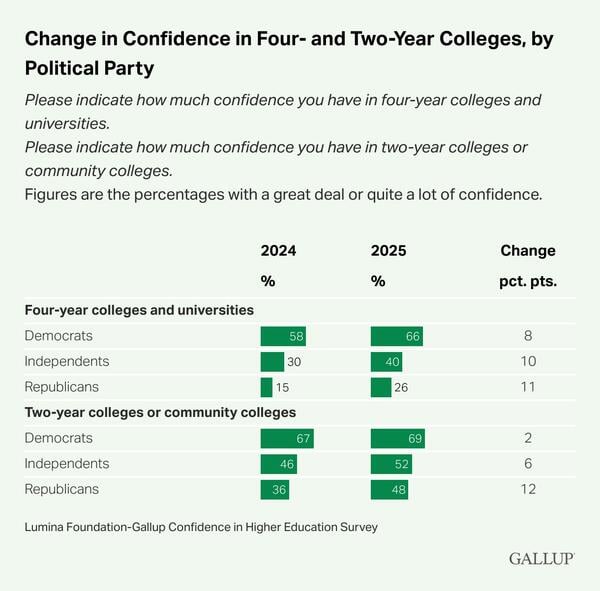
    New America’s findings are in line with a poll Gallup also released Wednesday in partnership with the Lumina Foundation, which shows that 42 percent of Americans surveyed said they have a “great deal” or “quite a lot” of confidence in higher education, compared to a low of 36 percent in 2024 and 2023—though it’s still far from the nearly 60 percent confidence peak in 2015. The share of people who reported “very little” or no confidence is also on the decline, falling from 32 percent last year to 23 percent this year. Although Democrats reported much higher confidence in higher education institutions, Republican confidence in both four- and two-year colleges rose by 11 and 12 percentage points, respectively, compared to last year.

    Data visualization of change in confidence in four- and two-year colleges, by political party.

    Respondents cited the economic and social benefits of higher education, its standing at the forefront of innovation, the quality of education and training—both for jobs and exposure to different viewpoints—as drivers of the uptick in their confidence.

    The Trump administration’s war on higher ed may have played a role, said Courtney Brown, Lumina’s vice president of impact and planning.

    “It is possible that we are seeing people in support of the sector because they see so many attacks,” she said. Whatever the reason, she said the new data is positive, and if institutions want to restore confidence to 2015 levels they should consider “how they can build on this moment and show up for students and ensure they’re getting value.”

    Like Gallup’s report, New America’s survey revealed partisan divides as well as agreements. Sixty percent of Republicans said colleges are having a negative impact on the country, while 75 percent of Democrats said they’re having a positive impact. But respondents from both parties were much more aligned on questions about specific aspects of higher ed’s value and purpose.

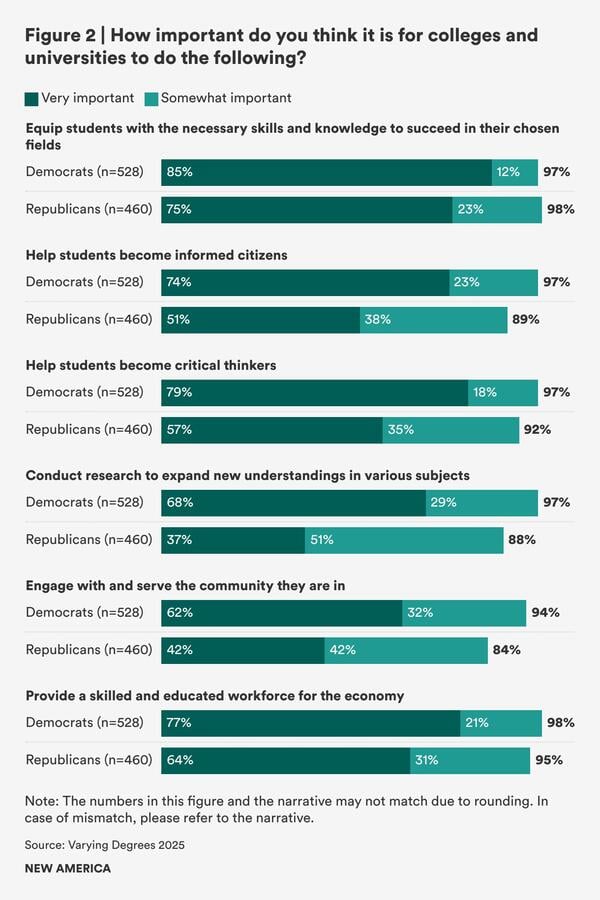
    While Republican lawmakers pressure universities into proving their return on investment, the vast majority of Americans, including both Republicans and Democrats, believe higher education should function as more than a transaction. They say it should not only equip students with the skills and knowledge to succeed in their chosen fields (97 percent of Democrats; 98 percent of Republicans), but also help students become informed citizens (97 percent of Democrats; 89 percent of Republicans) and critical thinkers (97 percent of Democrats; 92 percent of Republicans).

    “The rhetoric coming from Washington tends to be a caricature of what are some real issues facing college campuses and the sector in general,” Beth Akers, a senior fellow at the right-leaning American Enterprise Institute who focuses on the economics of higher education, said at a media briefing about New America’s survey. While “there’s room for improvement … it’s unfortunate that the rhetoric is empowering misinformation about what institutions are doing.”

    Bar chart of responses to the question "How important do you think it is for colleges and universities to do the following?" Responses are detailed earlier in thes tory.

    Even as Trump and his political allies move to dramatically cut federal funding for university research—which advocates say will devastate university budgets, local economies and progress toward lifesaving research—88 percent of Republicans and 97 percent of Democrats believe it’s important to some degree that colleges and universities conduct research to expand understanding in various subjects.

    Despite political rhetoric that suggests otherwise, American higher education has delivered an array of personal and societal benefits for decades, Lynn Pasquerella, president of the American Association of Colleges and Universities, said during a news briefing on the report.

    “Higher ed continues to be the single most powerful socioeconomic catalyst in America, which is associated not only with higher earnings, but longer productive lives, better physical and mental health, resilience, adaptability, and personal development and fulfillment,” she said. “At the societal level, education drives long-term economic growth for local communities and the nation.”

    More broadly, it “strengthens our democracy,” because it “tends to mitigate or tame authoritarian tendencies” and “reduces individuals’ sensitivities to potential triggers by providing them with psychological protection in the form of self-esteem, personal security and autonomy,” she said. “It fosters a moral imagination—imagining what it’s like to be in the shoes of another, different from oneself—and interpersonal trust.”

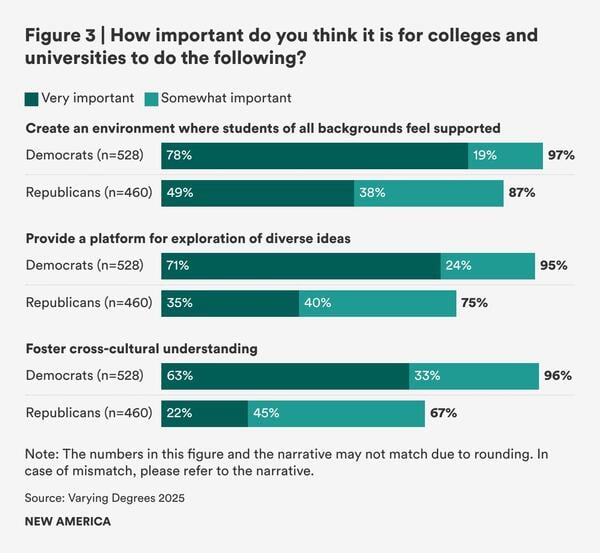
    Despite the Trump administration and its allies’ attacks on diversity, equity and inclusion initiatives, the survey data shows that an overwhelming majority of Republicans and Democrats agree that higher education should create an environment where students of all backgrounds feel supported, provide a platform for exploration of diverse ideas and foster cross-cultural understanding.

    Bar chart showing responses to the question "How important do you think it is for colleges and universities to do the following" including "create an environment where students of all backgrounds feel supported" and "provide a platform for exploration of diverse ideas."

    Although New America’s survey suggests that most Americans recognize the layered value of higher education, Republican lawmakers have increasingly focused on both controlling the subjects colleges can teach and research and making it harder for students and colleges to access federal funding.

    The sweeping policy bill Trump signed into law earlier this month requires colleges to show that their graduates earn more than an adult with only a high school diploma or risk losing access to federal loans. Trump has also proposed billions of dollars in cuts to education funding, including eliminating all federal support for college-access programs that have long helped low-income, first-generation and students with disabilities navigate higher education.

    While Republicans and Democrats are divided on who they think should be primarily responsible for paying for college—76 percent of Democrats believe the government should; 67 percent of Republicans believe students should—respondents from both parties cited cost as the single biggest barrier to enrolling in or finishing college.

    At the same time, 75 percent of respondents over all (91 percent of Democrats and 58 percent of Republicans) said the federal government should spend more on making college more affordable.

    Hironao Okahana, vice president and executive director of the Education Futures Lab at the American Council on Education, said this data offers a ray of optimism for the higher education sector navigating an onslaught of partisan attacks from Republican policymakers.

    “The public is seeing higher education as a sector beyond some of the sound bites we’re hearing,” he said. “They’re seeing that it has more nuance and texture, and that there’s not just one way higher education can contribute to society.”

    Source link

  • Moral resources for Americans who know we’ve been betrayed (William Barber & Jonathan Wilson-Hartgrove)

    Moral resources for Americans who know we’ve been betrayed (William Barber & Jonathan Wilson-Hartgrove)

    Civil Rights Movement and Wayside Theatre photographs, Student Nonviolent Coordinating Committee (SNCC).

    On America’s 249th anniversary of declaring freedom from tyranny, a would-be king will celebrate Independence Day by signing a budget bill that Americans oppose 2 to 1.

    This Big Ugly Bill that was passed by Republicans in Congress this week will make the largest cuts to healthcare and nutrition assistance in our nation’s history to pay for tax cuts for people who do not need them and an assault on our communities by masked men who are disappearing our neighbors to concentration camps. The dystopian scene is enough to make any true believer in liberty and equality question whether they can celebrate Independence Day at all. But it would be a betrayal of our moral inheritance to not remember the true champions of American freedom on this day. Indeed, to forget them would mean losing the moral resources we need to revive American democracy.

    As bad as things are, we cannot forget that others faced worse with less resources than we have. We are not the first Americans to face a power-drunk minority in public office, determined to hold onto power at any cost. This was the everyday reality of Black Americans in the Mississippi Delta for nearly a century after the Klan and white conservatives carried out the Mississippi Plan in the 1870s, erasing the gains of Reconstruction and enshrining white supremacy in law.

    When Ms. Fannie Lou Hamer decided to join the freedom movement in Sunflower County, Mississippi, she knew two things: the majority of people in Sunflower County despised the policies of Senator James O. Eastland and Eastland’s party had the votes to get whatever they wanted written into law. The day she dared attempt to register to vote, Ms. Hamer lost her home. When she attended a training to learn how to build a movement that could vote, she was thrown into the Winona Jail and nearly beaten to death. Still, Ms. Hamer did not bow.

    Instead, she leaned into the gospel blues tradition that had grown out of the Delta, spreading the good news that God is on the side of those who do not look away from this world’s troubles but trust that a force more powerful than tyrants is on the side of the oppressed and can make a way out of no way to redeem the soul of America. “This little light of mine, I’m gonna let it shine,” she sang, and a generation of college student volunteers came to sing with her during Freedom Summer. Their mission was to register voters and teach the promises of democracy to Mississippi’s Black children in Freedom Schools.

    On July 4, 1964, Ms. Hamer hosted a picnic for Black and white volunteers who’d dedicated their summer to nonviolently facing down fascism on American soil. They celebrated the promise that all are created equal even as they faced death for living as if it were true. Those same young people who were at Hamer’s July 4th picnic went on to launch the Mississippi Freedom Democratic Party and take their challenge all the way to the Democratic National Convention in Atlantic City that August. “I question America,” Ms. Hamer said in her testimony that aired on the national news during coverage of the convention. “Is this America, the land of the free and the home of the brave where we have to sleep with our telephones off of the hooks because our lives be threatened daily because we want to live as decent human beings, in America?”

    Hamer and the MFDP didn’t win the seats they demanded at the 1964 convention, but Atlantic City would be the last convention to seat an all-white delegation from Mississippi. Just a year later, as part of the War on Poverty, Congress passed the Medicare and Medicaid Act, expanding access to healthcare to elderly and low-income Americans – an expansion that Trump is rolling back half a century later in an immoral betrayal of the very people he promised to champion in his fake populist appeal to poor and working people.

    There’s nothing un-American about questioning a fascism that defies the will of the people to terrorize American communities and assert total control. It has been the moral responsibility of moral leaders from Frederick Douglass, who asked, “what to the slave is the 4th of July?” to those who are asking today how Americans are supposed to celebrate when their elected leaders sell them out to billionaires and send masked men to assault their communities. Ms. Hamer is a vivid reminder of the moral wisdom that grows out of the Mississippi Delta. It teaches us that those who question America when we allow fascists to rule are not un-American. They are, in fact, the people who have helped America become more of what she claims to be.

    So this 4th of July, may we all gather with Fannie Lou Hamer and the moral fusion family closest to us – both the living and the dead – to recommit ourselves to a government of the people, by the people, and for the people. Yes, America’s fascists have the power today. They will throw a party at our House and desecrate the memory of so many who’ve worked to push us toward a more perfect union. But they will not own our Independence Day. As long as we remember the moral tradition that allowed Fannie Lou Hamer to host a July 4th picnic while she battled the fascism of Jim Crow, we have access to the moral resources we need to reconstruct American democracy today.

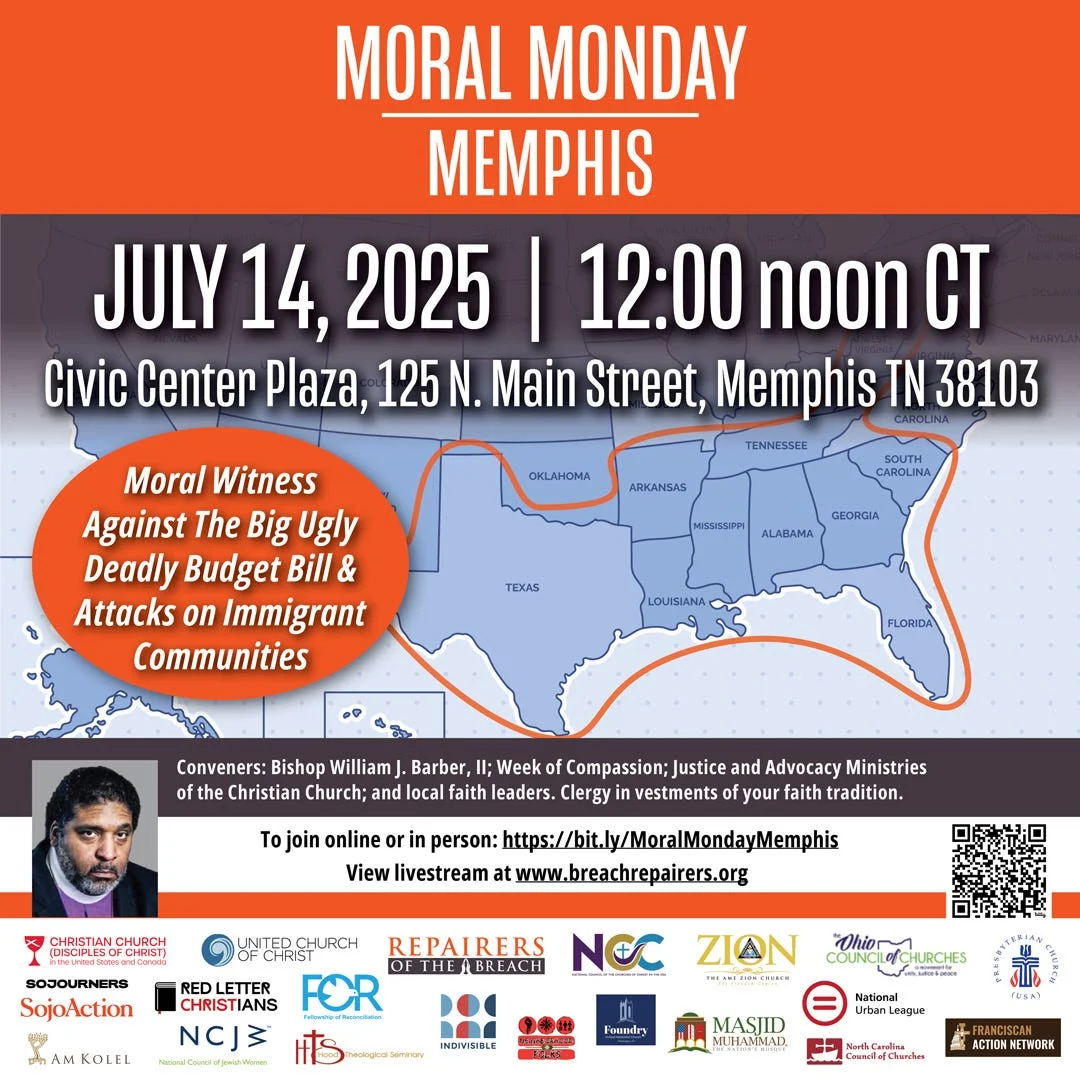
    This is why today, as all American’s celebrate our nation’s declaration of liberty and equality, we are announcing that the Moral Monday campaign we’ve been organizing in Washington, DC, to challenge the policy violence of this Big Ugly Bill is going to the Delta July 14th for Moral Monday in Memphis. As we rally moral witnesses in the city of Graceland and the Delta blues – the place where Dr. King insisted in 1968 that the movement “begins and ends” – delegations of moral leaders and directly impacted people will visit Congressional offices across the South to tell the stories of the people who will be harmed by the Big, Ugly, and Deadly bill that Donald Trump is signing today.

    Yes, this bill will kill. But we are determined to organize a resurrection of people from every race, religion, and region of this country who know that, when we come together in the power of our best moral traditions, we can reconstruct American democracy and become the nation we’ve never yet been.

    Today’s neo-fascists have passed their Big Ugly Bill, but they have also sparked a new Freedom Summer. We will organize those this bill harms. We will mobilize a new coalition of Americans who see beyond the narrow divisions of left and right. We will lean into the wisdom of Ms. Hamer and Delta’s freedom struggle, and we will build a moral fusion movement to save America from this madness.

    Source link

  • 1 in 3 Americans recommend trade school for high school graduates

    1 in 3 Americans recommend trade school for high school graduates

    This audio is auto-generated. Please let us know if you have feedback.

    More adults recommend trade school for new high school graduates than those who recommend college, according to a June 5 report from the American Staffing Association.

    When considering the “ideal post high school path” for today’s graduates, 33% of U.S. adults advocated for a vocational or trade school, followed by 28% who encouraged a four-year college or university, 13% who advised entering the workforce and 11% who supported apprenticeships.

    “The time has come to radically rethink how we’re preparing America’s future workforce,” said Richard Wahlquist, CEO of ASA. “Americans are clearly concerned that colleges and universities are failing to equip students with the workplace-relevant skills that employers need.”

    In the survey of more than 2,000 U.S. adults, opinions varied by generation. Vocational and trade school careers were most supported by baby boomers (41%), Generation X (37%) and millennials (31%), as compared to 22% of Generation Z.

    On the other hand, Gen Z was the only generation to recommend a four-year degree (36%) over a vocational or trade school (22%). Members of Gen Z were most likely to say graduates should pursue a traditional degree, followed by entering the workforce or attending a trade school.

    “These results underscore the importance of educators, policymakers and parents coming together now to develop, fund and support programs designed to prepare young people for the jobs of today and the future world of work,” Wahlquist said.

    More than 40% of Gen Z adults are working in or pursuing a blue-collar or skilled trade job, according to a Resume Builder report. Workers said they’re choosing these jobs for better long-term options, higher pay and a lower risk of being replaced by artificial intelligence tools.

    The labor market could face a “white-collar recession” as job postings decline for desk-based workers, according to an Employ report. 

    Although many Gen Z workers want to pursue skilled trades careers, they face challenges when trying to access critical training, according to a Dewalt report. Half of the students surveyed said they were placed on training waitlists, but once enrolled, they participated in internships, mentorship programs and real-world work experiences.

    Source link