Tag: Americas

  • Orchestrated silence: How one of America’s most elite music schools expelled a student for reporting harassment

    Orchestrated silence: How one of America’s most elite music schools expelled a student for reporting harassment

    TAKE ACTION

    On stage, baton in hand, Rebecca Bryant Novak found her calling in the precarious. She says conducting an orchestra sometimes “feels like trying to do brain surgery on a conveyor belt. You don’t get to stop. You don’t get to pause and say, ‘Hold on, let me think.’” But that high-stakes intensity, the kind that crackles through a Brahms crescendo or explodes in a Mahler finale, is what drew her in. “I love that,” she says. “To conduct an orchestra once in your lifetime, much less dozens or hundreds of times, is just an enormous privilege.”

    But behind the podium at the University of Rochester’s Eastman School of Music, one of the world’s premier conservatories, the peril Bryant Novak faced was not merely musical. In October 2023, she reported her doctoral program advisor and the director of orchestras, Neil Varon, for harassment. What followed, by her account and email correspondence describing the university’s own investigative findings, was a spiral of institutional dysfunction in which Eastman abandoned its own policies to retaliate against Bryant Novak for speaking out.

    What began as a childhood dream — “I saved my babysitting money to buy tickets for me and my mom to go to St. Louis Symphony concerts,” she recalls — has now soured into a fight not merely for her academic degree but for her dignity, for institutional transparency, and for a measure of justice in an industry she loves.

    A pianist by training, she fell for music director David Robertson’s conducting as a teenager in St. Louis, where she was captivated by his orchestra’s sound and force. “I loved the idea of being part of it,” she says. “As I look back at that person, she had no idea what she was getting into. But the draw was strong.”

    Chasing the grueling dream of the podium was a particularly steep climb for a woman. “There have only been three women admitted to my program in over 20 years,” she says, referring to Varon’s conducting studio, which she estimates has accepted approximately 40 students during that time. “The resources are immense. So is the gender disparity. I mean, it’s extreme.”

    Bryant Novak, a first-generation college graduate, said that upon arrival she felt “very much a fish out of water in the fancy music school scene.” Still, she was undeterred. “I said to myself, look, I won the audition. The orchestra voted, and I got an overwhelming orchestra vote. Everyone was thrilled about my being here.” She believed — naïvely, she now says — that the music would speak for itself. “Gender has nothing to do with this. My work stands on its own. So I was kind of in that mindset going in.”

    Her optimism did not last.

    I had jobs in this field before going back for my doctorate. I knew the scene. My actual experience is that staying silent doesn’t help you that much.

    Bryant Novak claims that during one rehearsal, as she was conducting in front of about 60 students, Varon told her she was “Gibson impregnated,” a reference to her former teacher at the University of Cincinnati, Mark Gibson, with whom she had cut contact after completing her master’s degree. Bryant Novak’s history with Gibson was fraught with alleged maltreatment: she says she suffered “inappropriate behavior, including comments on [her] physical appearance” and “physical contact under the guise of instruction” that resulted in “lasting professional harm.”

    Gibson and Varon were close professional contacts, and though Bryant Novak says Varon repeatedly noted Gibson’s problematic history and widely known reputation for abuse, she claims he “began referencing [her] history with Gibson as early as [her] audition.” According to Bryant Novak, Varon’s increasingly hostile and erratic behavior in class eventually forced her to end a conducting session with the orchestra, which typically lasted almost an hour, after just fifteen minutes.

    In what she describes as a “damned if you do, damned if you don’t” calculation, Bryant Novak chose to report Varon. “I had jobs in this field before going back for my doctorate. I knew the scene,” she says. “There have been situations where I’ve stayed silent before, as in my master’s program studying with Mark Gibson. My actual experience is that staying silent doesn’t help you that much.”

    Initially, she raised the alarm privately, requesting the administration limit her contact with Varon rather than filing a formal complaint. Her request was denied. Instead, Bryant Novak says Title IX coordinator John Hain suggested she transfer. “I remember asking, ‘How is that supposed to work?’ These programs are very competitive. They’re very small. It’s not like I’m getting my bachelor’s in history. How is this the solution? It was just not at all thought through.”

    “I don’t think it’s an exaggeration to call it sabotage,” she said, after her final recital was stacked with outlandishly difficult material. (Smiley Photography)

    “I got this whole lecture about how there’s no law against being a jerk. I’m like, ‘I’m aware of that.’” Worse, she adds, “They disclosed the report to [Varon]. They kind of wagged their finger at him and said ‘good luck’ to me. I was stunned.”

    Faced with Eastman’s inaction, Bryant Novak used the only tool she had left — her voice. She wrote about the experience in a post on her Substack, The Queen of Wands, sharing conversations with administrators, naming names, and describing Eastman’s lack of support.

    That’s when the retaliation began.

    A senior administrator threatened her with a defamation lawsuit — the very same John Hain in charge of handling her Title IX complaint. Students who once applauded her presence grew cold. Some faculty offered quiet support but refused to speak publicly. “It got very bizarre,” she says. “Very, very weird.”

    According to email correspondence between Rebecca and university officials, the University of Rochester — Eastman’s parent institution — conducted an investigation that concluded Varon had indeed violated their harassment policy and that Eastman had grossly mishandled her complaint. Despite this, rather than offering protection to Rebecca, Eastman remained intent on shielding its own faculty. 

    Tell Rochester to Stop Muzzling its Students

    Take Action

    Tell the University of Rochester: Reinstate Rebecca Bryant Novak, restore due process, and stop muzzling students into a culture of silence.


    Read More

    By the following semester, “there was some nastiness” from some of her fellow students in the orchestra. Her conducting opportunities were reduced. The faculty grew tight-lipped. She would walk into a room and people would stop talking. One tenured professor whispered to her that he’d written a letter of support but begged her not to tell anyone.

    Meanwhile, Bryant Novak continued writing publicly about her experience on Substack. Her posts were measured, personal, and often devastating. Her first post, titled “My First Year at Eastman,” told the story of the initial incident and the process that ensued from her point of view. Another, titled “Cease and desist,” detailed John Hain’s defamation threat against her.

    Then, however implausibly, things got worse.

    In December 2024, the University of Rochester launched a second investigation, this time into Eastman’s continued mishandling of Bryant Novak’s complaint and the retaliation she alleged had taken place against her. That might seem like a reason to think things were finally looking up — except two weeks after Bryant Novak disclosed the second investigation in a Substack post, Eastman expelled her for a “lack of academic progress.”

    According to Bryant Novak, this came despite Eastman’s prior confirmation that her academic plan and credits were sufficient in order to graduate. Worse, Eastman’s letter to Bryant Novak ended with a list of non-academic allegations: “misuse of University email systems,” “creating a hostile environment,” and “language that has been perceived as threatening violence.” All this was presented without detail or evidence. It was also described as not the actual cause of her dismissal, but worth “remark.” For her part, she sees it as a last-ditch attempt to discredit her. “The double standards were pretty intense,” she says. The school claimed there wasn’t much it could do to restrain Varon but, she says, “When it was time to expel me — boy, their hands were not tied.”

    People assume we’ve moved past this stuff. But no, speech is still powerful. People are still afraid of it. And they’ll try to shut you up.

    In a June 18 letter to the university, FIRE detailed how Eastman skipped every procedural safeguard required by their own academic progress policy: no warnings, no probation, no appeal. It doesn’t take a bloodhound to sniff out the pretext: just after Bryant Novak disclosed the second investigation on Substack, Eastman’s concerns about her suddenly became so acute that it bypassed the two-semester review process its own policy required before dismissal. FIRE lambasted the university for this egregious betrayal of due process and charged that the expulsion — taking place amidst baseless legal threats and conflicts of interest — was retaliation against Bryant Novak for speech Rochester’s policies protected.

    Bryant Novak says it was Eastman itself that endangered her academic progress. After she reported his behavior, she says, “They let Neil [Varon] have control over my degree recital, which is the centerpiece of my degree. I mean, it was retaliatory. He put material on it that was outlandishly difficult — so much so that two guest faculty intervened and said, ‘This is not okay.’ One of them actually said directly to me, ‘That is a giant middle finger from him to you.’ I don’t think it’s an exaggeration to call it sabotage. They did ultimately change it, although you’re supposed to have up to a year to work on this. I was left with two months. And then they were trying to get me out the door. It was very, very clear they wanted me out in any way possible. They created a situation that was unsustainable.”

    Rebecca Bryant Novak

    “There are consequences either way. There are consequences to yourself if you stay silent. There are consequences out in the world if you speak out.” (Smiley Photography)

    The situation became so upsetting that she began seeing a university therapist. In her final semester, at the therapist’s request, she started going multiple times a week. “I was just kind of personally deteriorating,” Bryant Novak recalls. “I was honestly kind of having a breakdown.” She spent roughly a month working through her difficulties with her professors and her therapist, who was willing to offer the school documentation of her situation. In turn, Bryant Novak offered to submit that documentation to the school, but says that “a week later,” the school “responded with an expulsion letter.”

    In the broader Eastman community, Bryant Novak was shunned by what she describes as a “cultish culture.” Online, including on FIRE’s own social media posts, her classmates have left comments smearing her reputation. Some think their interpersonal issues with Bryant Novak, or whatever shortcomings they see in her as a student or conductor, justify her expulsion.

    But being unpopular does not cost you your rights. It does not strip you of due process protections. It does not neuter your expressive freedom. 

    Bryant Novak sees her case as part of a larger trend. This isn’t the first time Eastman has allegedly blacklisted a student for standing up against misconduct. And beyond its Rochester campus, other classical music artists have suffered similar fates for stepping forward. Bryant Novak has no illusions about the conservatory culture she sees as responsible. “The culture’s awful. It just is,” she says. “Everybody knows it. But at the same time, the music is phenomenal.” 

    She references a case, documented in New York Magazine, in which an alleged rape victim and an ally were pushed out of the New York Philharmonic and bullied by their peers for speaking up while the accused perpetrators remained. “That story jolted me,” she says. “And now I’m living my own version of it. People assume we’ve moved past this stuff. But no, speech is still powerful. People are still afraid of it. And they’ll try to shut you up.”

    Reflecting on it all, Rebecca says that though she is grateful for FIRE’s help, she found it hard to believe she needed it for something like this. “You know, I wasn’t in a Gaza protest. It wasn’t that. It was just saying: ‘Hey, harassment is bad. Can you stop?’ The fact that speaking out against harassment is controversial in this space? That says a lot.”

    Still, Bryant Novak refuses to be silenced. In April, she submitted a 200-page complaint to the New York State Division of Human Rights under penalty of perjury. Believing sunlight is the best disinfectant, she is documenting everything and wants it all out in the open. “If there’s an online Neil Varon fan club,” she quips, “I think that’s good for us to know. Surface it all.”

    As for her future? “I still want to conduct,” she says. “But more than that, I want a world where women can do this without fear.”

    Pausing to think about it, she says, “There are consequences either way. There are consequences to yourself if you stay silent. There are consequences out in the world if you speak out. I prefer the consequences out in the world.”


    Source link

  • America’s Undocumented Educators Unsure of What’s Next Under Trump – The 74

    America’s Undocumented Educators Unsure of What’s Next Under Trump – The 74


    Get stories like this delivered straight to your inbox. Sign up for The 74 Newsletter

    This story was originally reported by Nadra Nittle of The 19th.

    LOS ANGELES — Scattered among the shrubs on the southern border lie belongings migrants left behind — toothbrushes, water bottles, baseball caps. Some of the owners forged north, crossing the boundary undetected. Others were apprehended or succumbed to dehydration, drowning or one of the unimaginable dangers in the harsh desert that straddles Mexico and the United States.

    Angélica Reyes survived. At nine months old, she made the journey that could have claimed her life just as it started.

    Since 1994, approximately 10,000 migrants have died in the borderlands. That year, the North American Free Trade Agreement (NAFTA) took effect. Designed to open trade between the United States, Canada and Mexico, the now-defunct policy has faced criticism for depressing Mexican wages. Their income flatlining, Reyes said, her parents left the city of Guadalajara, in the western part of Mexico, and headed with her to Los Angeles. They did not have authorization to live in the United States.

    Reyes is now 32, though she remembers knowing she was undocumented as early as first grade.

    “My mom was very cognizant of the discrimination and the obstacles that I would face throughout my life,” she said. “She made it clear, like, ‘You can’t mess up. You need to be twice as good to get half of the respect. You need to really prove that you earned your spot.’”

    To do that, Reyes earned the good grades that set her up to become a history teacher for the Los Angeles Unified School District. She is one of about 15,000 teachers — and among the more than 835,000 undocumented people — who have received temporary permission to live, work and study in the United States through an Obama-era program known as Deferred Action for Childhood Arrivals (DACA). Women represent over half of DACA recipients, whose future in this country has been under threat by legal challenges to the program’s existence and the anti-immigration agenda of President Donald Trump.

    https://datawrapper.dwcdn.net/nA5Cv/10/

    If DACA ends, the goal of ongoing litigation,  700 education personnel, including teachers and teacher aides, would lose their jobs each month for two years as their work permits are revoked, according to FWD.us, an immigration reform organization. In California, the state with the most DACA recipients, 200 educators would lose their jobs monthly. In Texas, 100 would.

    DACA-recipient teachers relate firsthand to the estimated 620,000 undocumented K-1 2 students, who confide in them about their experiences in immigrant families. They show youth that regardless of legal status, it’s possible to attain one’s professional goals. Many of these teachers are also activists, fighting for their students, themselves and other marginalized people. They see themselves as assets to schools.

    “My immigration status inspires both my undocumented and documented students because they know all the obstacles that are faced by folks with my immigration status can be overcome,” Reyes said. “They know that if I could do it, that’s something that they could do as well.”

    Without undocumented teachers, educator shortages across states could worsen. California has spent about $1.6 billion since the 2016-17 school year to tackle its teacher shortage. Still, the state issued 11 percent fewer teaching credentials between the 2021-22 and 2022-23 school years. Last year, it enacted legislation to eliminate barriers to entry, dropping a standardized test teaching candidates had to pass to demonstrate competence in math, reading and writing. But since undocumented immigrants aren’t widely perceived to be career professionals, the fact that schoolchildren nationwide depend on them has received scant attention in the broader immigration debate.

    Maria Miranda, elementary vice president of the United Teachers Los Angeles (UTLA) labor union, said undocumented teachers “bring a different perspective to the table, a different skill set.”

    Randi Weingarten, president of the American Federation of Teachers, the nation’s second largest teacher labor union, said DACA recipients in classrooms have strengthened the United States.

    “They are role models, like all teachers, and should be treated as such, but instead, they are made to feel uncertain and fearful as their protections are challenged in court and as the Trump administration promotes mass deportations, even from sensitive locations like schools that were once considered off limits,” Weingarten said. “Immigration reform can’t be used as an excuse to rip teachers out of classrooms, where they are so desperately needed.”

    Reyes at 1 year old with her father. (Angelica Reyes)

    When Reyes was about to register for the SAT during her senior year in high school, one misinformed guidance counselor asked her why she planned to take the college entrance exam, insisting that higher education was off limits to undocumented students.

    “I was devastated. It broke my heart,” Reyes said. “I remember crying and telling my mom, ‘I worked hard, for what?’”

    Since 2001, however, California has extended access to in-state college tuition to undocumented students who have lived there long term. Unaware of this law and under the assumption that her counselor was correct, Reyes missed the deadline for the SAT and for the application to University of California schools, so she enrolled in a community college she could afford, a common path for many undocumented immigrants.

    Then, in 2011, a state law was enacted that made her cry tears of gratitude: the California DREAM Act. The policy allows undocumented immigrants who entered the United States before they were 16 to obtain financial aid if they’ve earned qualifying credits at California schools. These young people have been nicknamed Dreamers after the Development, Relief, and Education for Alien Minors (DREAM) Act, a 2001 federal bill that would have given them legal status had it succeeded.

    Reyes said that when she decided to apply to the University of California, Los Angeles (UCLA), a community college counselor took in her light brown skin and wavy black mane and without so much as seeing the 4.0 GPA in her transcript, told her to apply somewhere less competitive.

    “I’m a competitive student!” Reyes recalled balking. “She opened my chart and she was, like, ‘Oh, you actually are.’ Her tune changed so quickly. It was really infuriating because if I had believed her, like many students believe counselors, I would have not gone to UCLA.”

    In college, Reyes had to make a choice about her career path. Her research project on youth activism at Abraham Lincoln High School, where she graduated in 2010, had drawn her to education. “I realized that’s where I was needed,” she said.

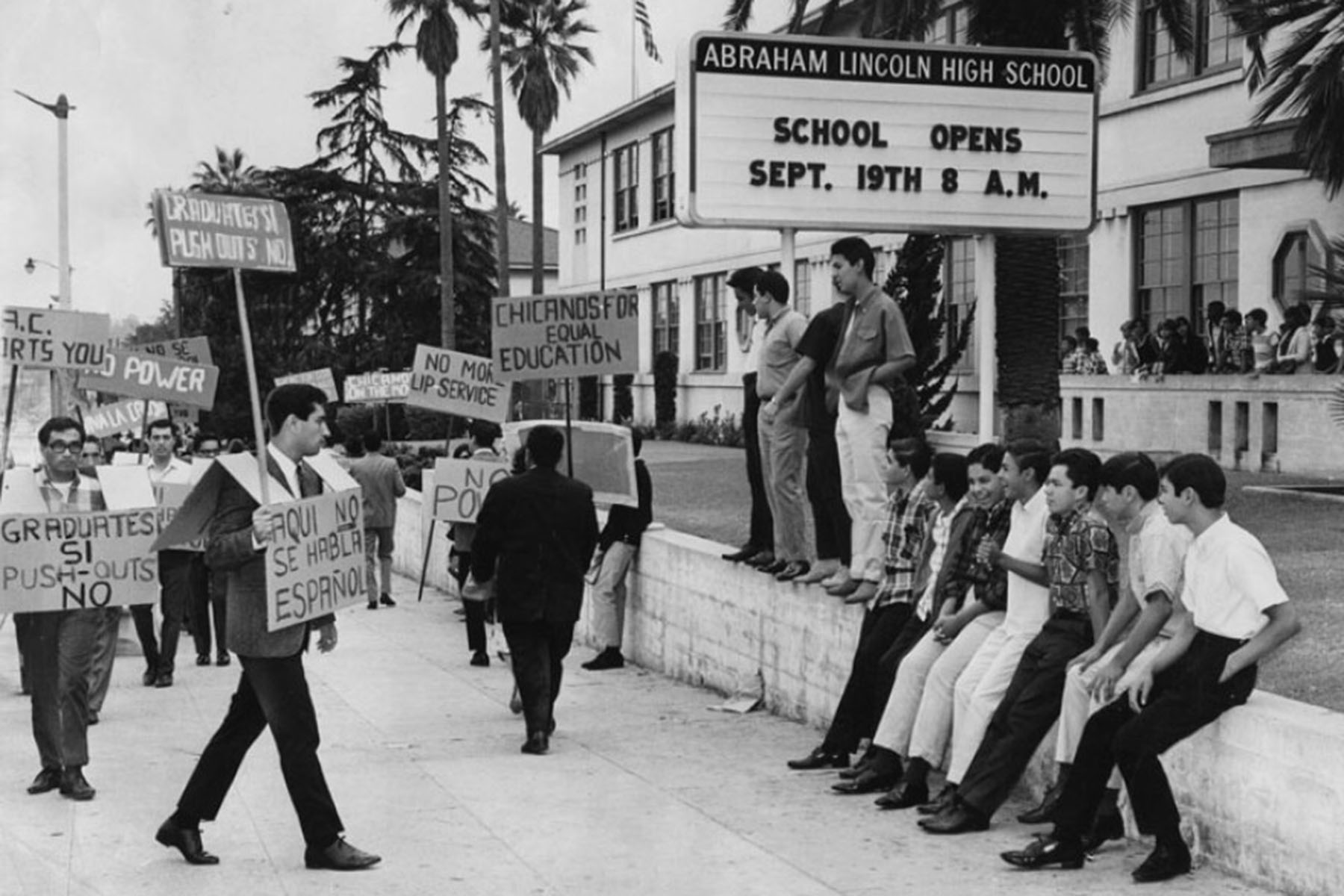
    It was at Lincoln High in March 1968 that students spearheaded the protests known as the Chicano Blowouts or East Los Angeles Walkouts. With signs stating “School Not Prison” and “We Are Not Dirty Mexicans,” almost 15,000 youth from Lincoln and other schools in historically Mexican-American East L.A. walked out of classes for a week to protest their substandard education.

    Black-and-white photo of students holding protest signs outside Abraham Lincoln High School demanding equal education and language rights.
    Chicano student walkouts in front of Abraham Lincoln High School in East Los Angeles during the 1968 blowouts. (LAPL)

    Back then, students could be paddled for speaking Spanish, and with few advanced courses at Eastside schools, they were routinely steered to vocational classes like auto shop. These inequities contributed to a 60 percent dropout rate in the area. Jailed for their activism against these circumstances, the teenagers garnered community support that ushered in sweeping policy changes — bilingual instruction, ethnic studies and more Latino teachers.

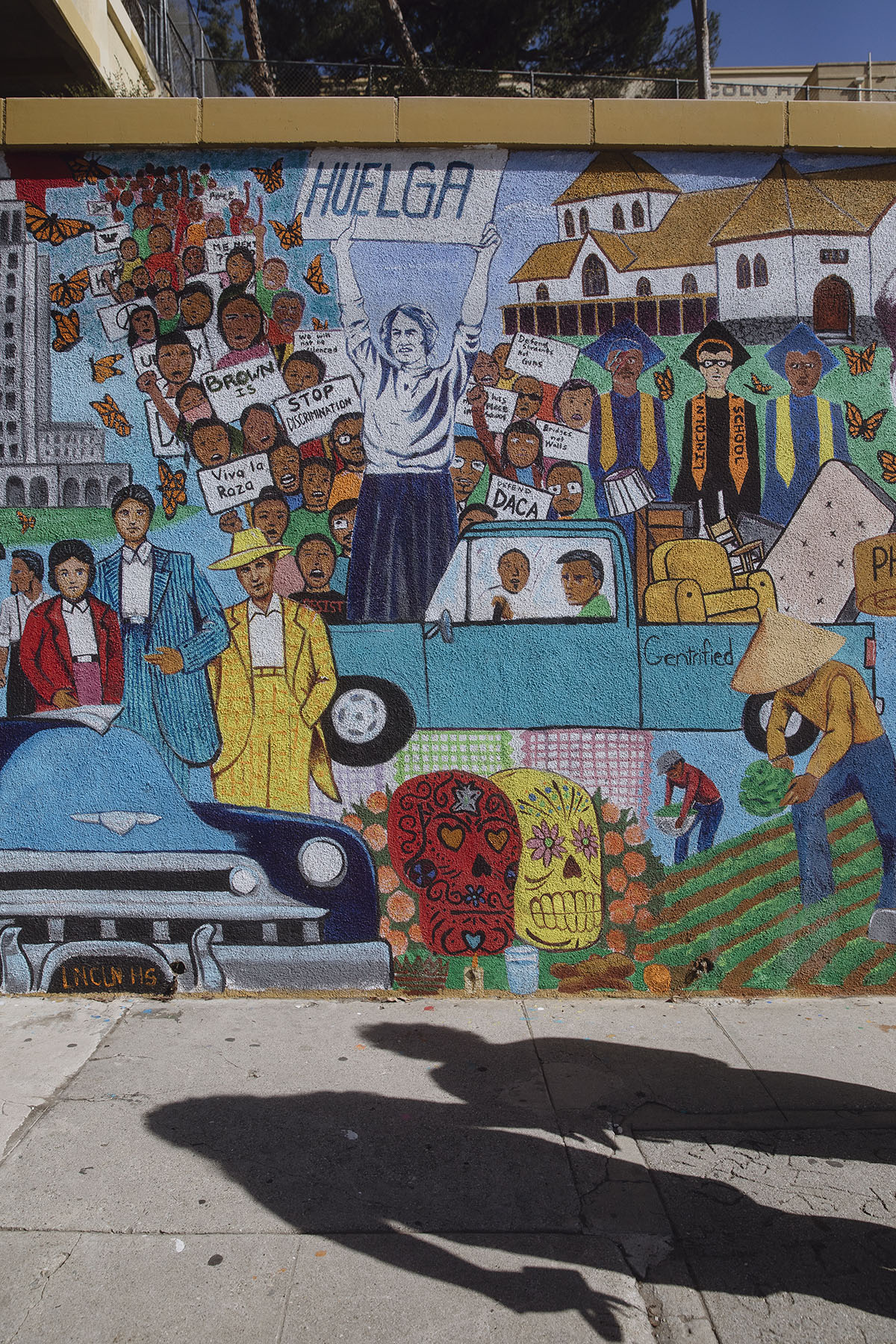
    Today, the carnicerías, bungalow homes and palm trees along North Broadway Avenue, leading to 93 acres of green hills, offer no hint of the past tumult, but a mural at Lincoln commemorates the walkouts of nearly six decades ago.

    Through her research, which also explored youth activism of the 2010s, Reyes learned that contemporary Lincoln High students continued to have unmet needs, such as support applying for college financial aid or accessing legal services as members of immigrant households. So when Lincoln High teachers asked if she wanted to develop a space to serve students, Reyes threw herself into the effort. The Paula Crisostomo Dream Center — named after a lead activist of the Chicano Blowouts and the inspiration for the 2006 film “Walkout” — opened at Lincoln in 2015.

    “We established programming for immigrant students, for immigrant parents. We did immigrant and educational history,” Reyes said. “It’s still a resource for students at Lincoln, and we’ve expanded it to several other schools.”

    Working at the Dream Center for three years convinced her that teaching was the best way to reach undocumented and marginalized youth. Rather than dismiss them, as she had been dismissed by school counselors, she would inspire students to excel academically regardless of legal status. In 2012, four years before she graduated from UCLA with a bachelor’s degree in sociology and six years before she earned her master’s in education from the university, DACA enabled undocumented students like herself to become career professionals.

    In 2017, the year Reyes began teaching, the Migration Policy Institute estimated that as many as 20,000 DACA-eligible individuals were involved in education occupations. But today the number of DACA-recipient educators is 25 percent lower as litigation has frozen new applications.

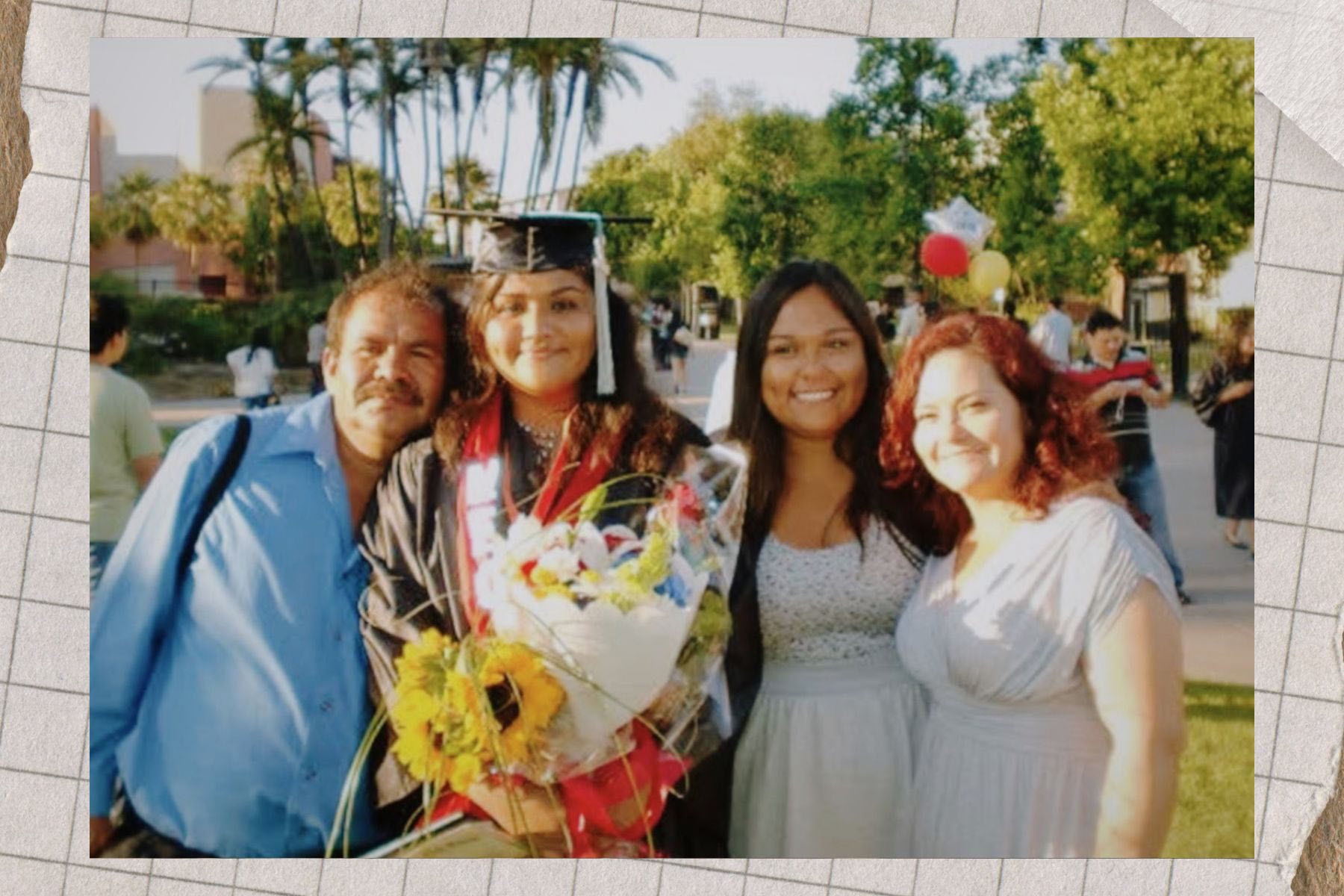
    Reyes wears a cap and gown, holding flowers and standing with three smiling family members on graduation day.
    Reyes surrounded by family at her high school graduation. (Angelica Reyes)

    It’s complicated: Those two words capture Reyes’ feelings about DACA. Although the program allowed her to teach, she has long viewed it as flawed, exploitative and a “constant reminder” she isn’t “fully accepted.”

    DACA stems from the activism of undocumented college students frustrated that the DREAM Act failed and that their immigration status would limit their potential, said Jennifer R. Nájera, author of “Learning to Lead: Undocumented Students Mobilizing Education.” Fighting for immigrant rights, they found a purpose.

    Like the DREAM Act, DACA was reserved for young people who came to the United States as children and didn’t have criminal histories. “They had to graduate from high school or college or go to the military, show ‘good moral character,’” said Nájera, an associate professor in the Department of Ethnic Studies at the University of California, Riverside. Instead of citizenship, Obama’s executive order “provided temporary relief from deportation, a two-year relief specifically, that could be renewed, and a work permit, which was a big deal.”

    While DACA recipients cherished their professional opportunities, some contended that the policy cast them as second-class citizens, Nájera said.

    That includes Reyes.

    “I knew it was a Band-Aid,” she said. “In fact, when I first started teaching, my DACA expired because of an issue with the application. They had asked me if I was in a gang, and apparently I didn’t check off the X hard enough, so I wasn’t hired at the beginning of the year. I remember feeling this immense frustration.”

    Los Angeles Unified employs about 300 DACA-recipient school personnel, according to Miranda of the UTLA labor union. As Reyes’ teaching career started, DACA weathered the first of multiple legal challenges. Trump rescinded the program during his first term, a move the Supreme Court later blocked; at the time, Reyes told her students about possibly losing her job. Since then, she has endured several other threats to DACA , though she’s now pained to tell her students that the program isn’t accepting new applicants.

    DACA, she said, must be replaced with a sustainable alternative.

    In a December interview, Trump said, “We’re going to have to do something with” DACA recipients. “They were brought into this country many years ago” and “in many cases, they’ve become successful.”

    But that sympathy has been absent from his immigration policies since he resumed office. He has issued an executive order prohibiting undocumented college students from receiving in-state tuition. He has also lifted restrictions on immigration enforcement in “sensitive locations” such as churches, hospitals and schools, prompting parents nationwide to keep kids out of class.

    A young girl looks out from the arms of an adult while holding a small Mexican flag during an immigration rights protest.
    A protester waves the Mexican flag during a demonstration for immigration rights outside Los Angeles City Hall on February 5, 2025. (Qian Weizhong/Getty Images)

    “A lot of times, the children are U.S. citizens and the parents are concerned,” Reyes said. “But I’ve had students who shared that their parents are U.S. citizens, and they’re still scared because they know that U.S. citizens are also caught up in these raids. So, this isn’t about criminality. It’s about the targeting of Brown folks.”

    Immigration and Customs Enforcement (ICE) agents and other federal authorities reportedly detained or deported at least 10 U.S. citizens, including children, in the first 100 days of Trump’s second term.

    Last month, the California state superintendent presented Senate Bill 48 to limit ICE appearances at schools as absences have spiked — and schools could lose millions of dollars since their funding is tied to average daily student attendance. About half of California children belong to families that include at least one immigrant parent, while one in five live in mixed-status families with at least one undocumented parent.

    “It’s very taxing emotionally for our members and our students,” Miranda said of ICE enforcement. “We have students at the elementary level who are terrified of seeing anyone in uniform. Some of them are so young that they don’t know the difference between the police and immigration. It’s a very scary moment.”

    When Trump targeted DACA during his first term, Reyes warned in a Los Angeles Times opinion piece that disbanding the program could upend public education. But now she says her students deserve more than DACA’s “breadcrumbs.”

    “We need to fight for something new because my kids want to be chefs and doctors and lawyers, but they’re being held back by their immigration status,” she said. “It’s excruciating in two ways: One, I want my students to have the opportunities that they deserve to serve the community. And, two, I don’t know when I’m going to be taken from them because of my own uncertainty.”

    For now, she knows that her presence makes a difference at her high school. Los Angeles Unified has an immigrant student body of about 30,000 students, according to UTLA. Of those, one in four is undocumented. After Reyes shared her immigration status with students during a recent lunchtime conversation, she said a ninth grader confessed that she planned to quit school because she, too, is undocumented. Learning Reyes managed to become a teacher made the girl reconsider.

    “It was really beautiful to see that, like it reignited her hope to have a bright future,” Reyes said.

    Although the risks of revealing her status frighten her, her conscience compels her to, Reyes said. She quoted Mexican Revolution leader Emiliano Zapata: “It’s better to die on your feet than to live on your knees.”

    Staying silent as the president attacks immigrants would make it hard for Reyes to face the youth in her life — her son, especially.

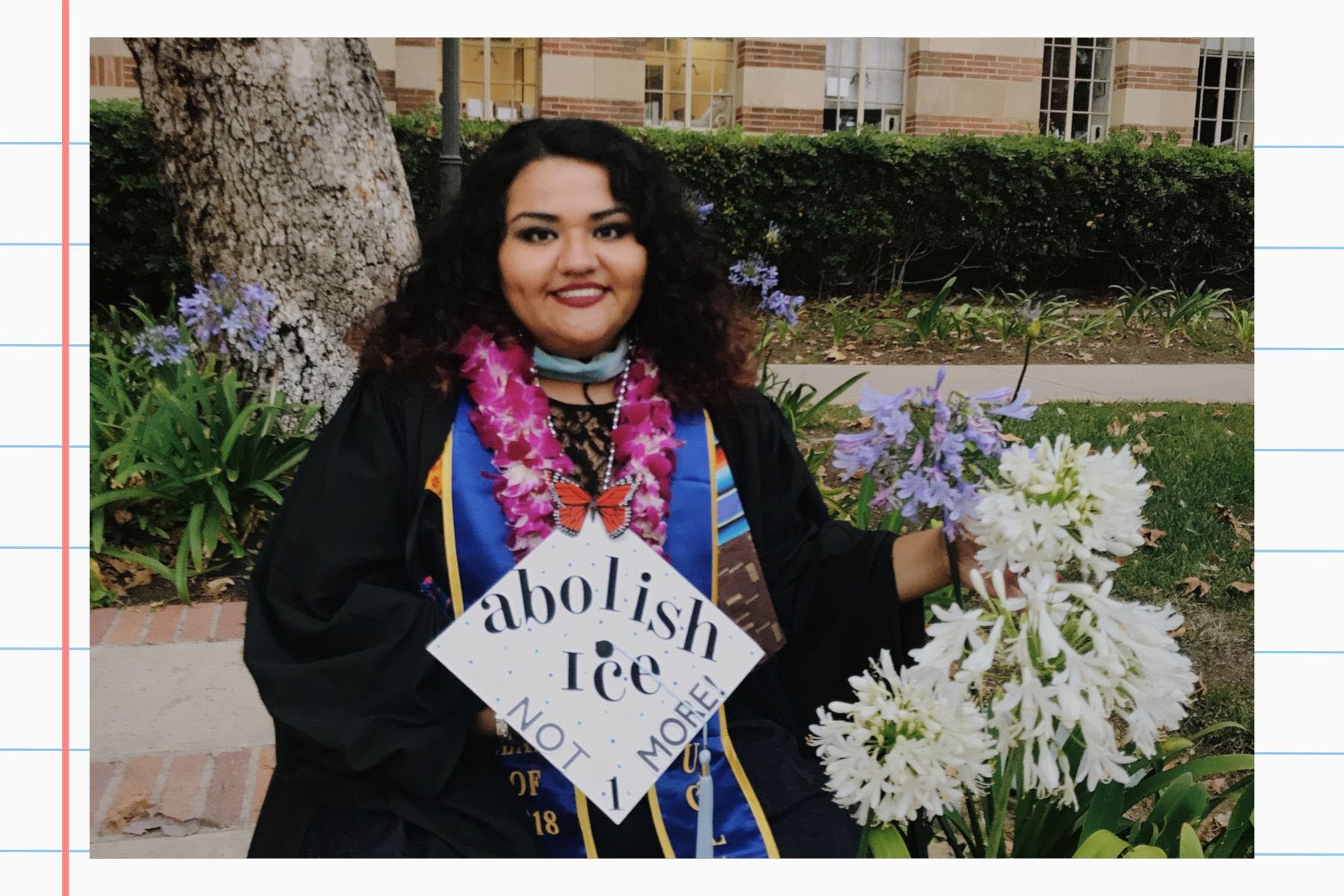
    Reyes smiles in her graduation gown, holding flowers and wearing a decorated cap that reads “abolish ICE — not 1 more!”
    Reyes after receiving her master’s degree in education from UCLA. (Angelica Reyes)

    Whenever a state turned red on Election Night, Nathan Reyes felt his anxiety shoot up. Still, he held out hope Kamala Harris would win. Then the Electoral College math made it plain: Donald Trump would be president again.

    Although he’s a U.S. citizen, Nathan wondered what lay ahead for his undocumented relatives under a president promising mass deportations.

    “I feel worried for them because if they get deported, what am I going to do?” he asked. “Where am I going to stay?”

    So, he began to plan. He and his family would “have to pick our poison” — stay in a country hostile to their presence or self-deport together to Mexico regardless of citizenship status.

    That her son, with a pile of ringlets and a round cherubic face, was even considering these options stunned Reyes. Nathan is in seventh grade.

    “I was like, ‘Oh, my God, this kid is 12,’” Angélica Reyes said. “Why is he talking about this?’”

    Rummaging through a bin of childhood possessions in her mother’s bedroom last year, Reyes found a poem she wrote in fourth grade about her fear of police. Her parents were street food vendors, an occupation California criminalized until 2018, so Reyes realized growing up that one brush with the law could have seen them deported.

    Just as she did not have a childhood free of deportation fears, neither has her son.

    Nathan, now 13, is hardly the only youth pondering the possibility of a relative’s departure, according to Lisette Sanchez, a psychologist in Long Beach, California. She said children are leaving school with “Know Your Rights” cards advising them of their civil liberties during ICE encounters, but they may not understand the information.

    “They’re just feeling fear,” she said. “They’re being told something’s gonna happen. So mental health wise, you’re looking at chronic anxiety. You’re looking at hypervigilance.”

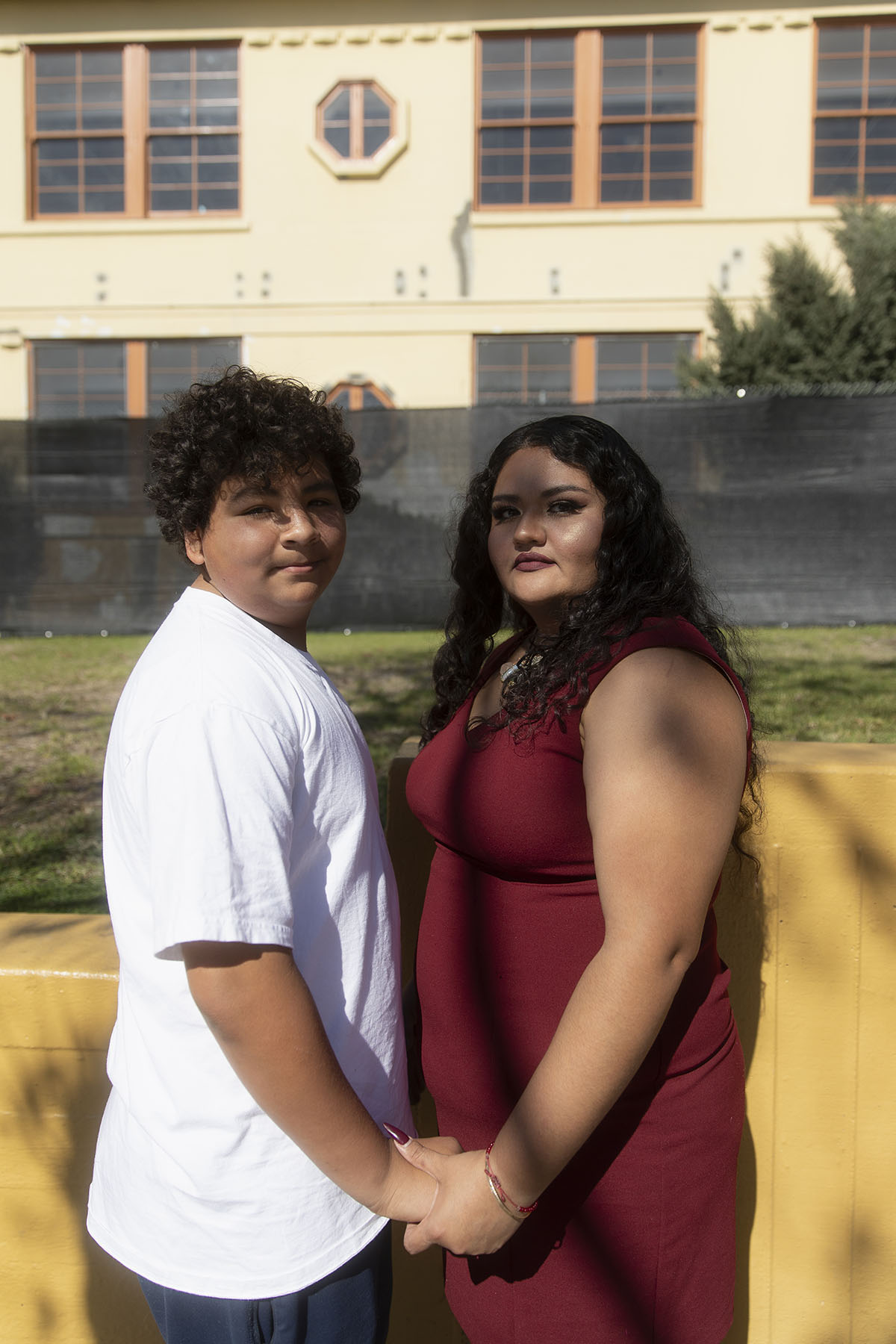
    Reyes and her teenage son Nathan stand side-by-side holding hands in front of a yellow school building, both looking directly at the camera.
    Angélica Reyes and her son Nathan Reyes in front of Abraham Lincoln High School in East Los Angeles, California, on February 9, 2025. (Zaydee Sanchez/The 19th)

    To gain some sense of control, they may overconsume social media, leading to racing thoughts, rapid heart rate and sleeping difficulties.

    “It’s this chronic nonstop anxiety because the state of uncertainty feels never-ending, and in many ways, it is not ending, right?” Sanchez said. “There’s different news every day.”

    By speaking openly with children, parents can help them better manage stress, she said. Teachers, if they’re permitted, can broach the topic of immigration. Nathan appreciated how his Spanish teacher led a class discussion after the election.

    “Sharing your feelings and emotions and finding that a lot of other people are feeling very similar can bring comfort to you,” he said.

    Reyes gave birth to her son while she was in college and briefly wed to his father. She applied for legal status as an immediate family member of a U.S. citizen, her spouse. But years passed before the federal government responded to her request, she said. By then, her marriage had ended.

    “I don’t think people understand how long the path to citizenship can be, what it looks like, how costly and time-intensive it is,” Sanchez said.

    Reyes, who has not remarried, said being undocumented seeps into every aspect of her life, including romantic relationships. She feels obligated to tell prospective partners about her status.

    “I remember to always be upfront, like, ‘Hey, I’m undocumented. I don’t want you to think I’m going to use you for papers,’” she said.

    Reyes lives in one of the country’s 4.7 million mixed-status households, which include undocumented individuals and people with legal status or U.S. citizenship. If she gets deported, she has arranged for others to care for her son.

    Her sister, two years younger, is a U.S. citizen. Asked if she resents that twist of fate, Reyes said, “I’m happy that she gets to be safe. I think that there’s a lot of pain and guilt for her.”

    Her sister realizes, Reyes said, that her entire family could be taken away.

    A younger Reyes and her son Nathan smile and throw their arms up while seated at a table with a bubbling orange bowl.
    Reyes and her son Nathan doing a science experiment when he was little. (Angelica Reyes)

    Should she be forced out of the only country she considers home, Reyes wants her son to know this: “I would never willingly leave you. I am dedicated to you. I love you, and I will always be working as hard as possible to get back to you.”

    For Nathan, it is mind-boggling that anyone would want his mother out. He doesn’t understand why politicians demonize immigrants. Trump launched his first presidential campaign calling them criminals and continues to malign them.

    “My mom has done a lot of good for her community,” Nathan said. “She has organized a finders keepers closet where people who don’t have some resources they need, like canned food or clothes, can take what they need.”

    Just as Nathan defends her honor, Reyes vouches for her parents. Her mother is now a nail technician and her father is a food vendor. Growing up, she said, she watched them visit the sick, volunteer at churches and fundraise for the poor.

    “Whenever they saw a need, they stepped up, and they didn’t wait for someone else to help,” she said.

    She’s hurt when people sympathize with Dreamers while disparaging their parents, that the immigration system paints family members as saints or sinners. The DACA recipients she’s researched feel similarly, Nájera said.

    “Many of the students that I interviewed were always talking about their parents,” Nájera said. “They did not want their stories to be divorced from their parents and their family stories. These families, they’re units.”

    But the Dream Act caused a migrant generational divide, insinuating that those who arrived in this country as children deserve citizenship, while their parents and others who arrived as adults do not, Nájera said.

    A colorful mural shows scenes from Chicano and immigrant activism, including raised fists, “HUELGA” signs, Day of the Dead skulls, and depictions of farmworkers and students.
    Angélica Reyes helped paint the red and yellow skulls on the mural across the street from Abraham Lincoln High School in East Los Angeles, where she graduated. (Zaydee Sanchez/The 19th)

    Migration often occurs out of necessity. For example, after NAFTA took effect in 1994, U.S. agricultural exports flooded Mexico, displacing workers, according to Edward Alden, a distinguished visiting professor in the College of Business and Economics at Western Washington University. Four years earlier, over 4 million Mexican migrants were in the United States, a figure that ballooned to nearly 13 million — around 9 percent of Mexico’s population — by 2008.

    Reyes said NAFTA crushed the bakery business her father’s side of the family owned because it could not compete with the U.S. companies that swooped in. Her parents migrated north to earn higher wages.

    Today, economic instability is but one of the reasons that motivate migrants.

    “A lot of the Venezuelans are leaving Venezuela because it’s a violent, dangerous place, and the government has destroyed the economy in different ways,” Alden said. “Same thing out of Central America. These are people who aren’t necessarily leaving for economic reasons. They’re doing it for personal safety reasons.”

    Reyes said she has Central American students who fled horrors. She wants them to feel safe in the United States, and the fact Los Angeles Unified has pledged not to cooperate with immigration officials voluntarily provides some comfort. Run by a formerly undocumented superintendent, the sanctuary district blocked Homeland Security agents from entering two schools in April.

    The fear of raids on campuses has traumatized her students, Reyes said. “It’s so difficult to convince my students that they are worthy of love and that they’re worthy of respect and that they deserve civil rights.”

    It is equally difficult to keep advocating for herself, she said. But as the threat of deportation looms, she has no choice but to keep fighting.

    “It’s hard to know that I can’t earn citizenship and that I can’t give my kid stability or safety,” she said. “I feel like if I could earn it, I would have three citizenships. I would have put in the work.”


    Get stories like these delivered straight to your inbox. Sign up for The 74 Newsletter

    Source link

  • The silencing of America’s voice leaves journalists abandoned

    The silencing of America’s voice leaves journalists abandoned

    On 28 March, several journalists in South Asia opened their inboxes and found messages that changed their lives. Reporting assignments were cancelled. Email access revoked. For many, it marked the end of years of work with Voice of America — without explanation, without notice.

    Nazir Ahmad is a journalist. For 11 years, Ahmad worked for Voice of America as a multimedia journalist. He documented protests, crackdowns and mass detentions. That morning, his email account was suspended. His press card was no longer valid.

    “It ended without warning,” he said. “No notice, no call. Just a message that my services were no longer needed. I had been filing reports even a week before this.”

    Nazir Ahmad is not his real name. We changed it for this article to protect his identity. And we offered anonymity to all the journalists we interviewed for this story because their reporting for Voice of America has put them in danger. 

    Ahmad is one of several South Asian journalists who lost their jobs after the Trump administration signed an executive order to downsize multiple U.S. government agencies, including the U.S. Agency for Global Media, which oversees Voice of America.

    On 22 April, a federal district judge in Washington, D.C. ruled that the administration illegally required Voice of America to cease operations and ordered it be temporarily restored until the lawsuits challenging the closure have run their course. How this will affect Ahmad and the other reporters who were dismissed remains to be seen. 

    Shutting down a news network

    The Trump Administration’s decision to end Voice of America affected journalists across Asia who have been covering sensitive political developments for years.

    “I covered the Delhi riots, Punjab farmers’ protests, and the elections,” said another Voice of America journalist. “These were not easy stories. I often worked without backup and sometimes without formal protection. Now, I’m being told to stop working.”

    Trump’s executive order resulted in mass administrative leave across Voice of America’s global network. Michael Abramowitz, Voice of America’s director, confirmed that nearly all 1,300 journalists and staff were placed on leave.

    The White House said the order was intended to reduce government spending and eliminate what it called “radical propaganda.” It accused outlets like Voice of America of political bias, despite decades of bipartisan support for the agency.

    For many South Asian journalists, the move came at a personal and professional cost. Several freelancers and stringers in India, Pakistan, Nepal, Bangladesh and Sri Lanka had worked with Voice of America for over a decade. 

    Telling important stories to the world

    Besides reporting on protests, these reporters covered elections, environmental disasters and rights violations in hard-to-reach areas.

    “I reported from Punjab’s border villages during the height of the farmers’ protests,” said yet another journalist who worked with Voice of America since 2014. “I was there when the police fired tear gas. I was there when elderly protesters braved the winter cold. And now I’m unemployed.”

    These journalists say they received no formal termination letters, only a message from editors citing administrative leave and funding suspensions. They have not been told when or if their jobs will resume.

    “There was a clear line in the message: stop all reporting,” said a Voice of America contributor from New Delhi. “I depend on this income to support my family. I’ve been sending stories every week for eight years.”

    Voice of America was established in 1942 during World War II to counter Nazi propaganda. It has since expanded to reach 360 million people weekly in nearly 50 languages. In South Asia, it provided a platform for independent voices, especially in regions where domestic media faced political pressure or censorship.

    Press coverage where the press is muzzled

    Experts say the funding freeze, if ultimately allowed by the courts, could silence important coverage from conflict zones. In regions like Kashmir, where local journalists already face surveillance and restrictions, international media partnerships like Voice of America provided both visibility and a layer of protection.

    “Working with VOA allowed us to tell local stories without fear of censorship,” says a journalist based in Srinagar. “Now that channel is gone.”

    The impact also extends beyond journalists. Translators, video editors and fixers who worked with Voice of America in the region say their contracts have been halted.

    “I’ve been working as a video editor for their South Asia bureau for six years,” said a technician based in Lahore, Pakistan. “We’ve stopped getting assignments. I haven’t been paid for last month’s work.”

    Some journalists say they are now exploring alternate work, but few opportunities exist for those with years of specialized international reporting experience.

    “I’m being told to apply to local newspapers, but they don’t have the budget or the editorial independence,” said a journalist from Kathmandu. “It feels like I’m starting over after 12 years.”

    Stories the domestic press hesitates to cover

    The Executive Order also affected coverage of religious freedom, caste violence and press crackdowns in India. Journalists who regularly filed in-depth features say important stories are now going untold.

    “I was working on a long story about attacks on Christian communities,” said a reporter based in Tamil Nadu. “It’s not something mainstream outlets want to cover. Voice of America gave me space to explore that. Now it’s shelved.”

    The global press watchdog Reporters Without Borders has described the shutdown as a serious setback for journalism, warning that it could encourage political interference in media operations across the world.

    Stephen Capus, head of Radio Free Europe/Radio Liberty, which also lost funding, said the move would leave millions without access to independent reporting.

    In South Asia, journalists say this is about more than losing a paycheck. For them, it’s the breakdown of a reporting network that allowed them to cover sensitive stories in challenging environments.

    “We weren’t just sending news reports,” says a journalist who covered the Indian government’s 2019 decision to revoke Kashmir’s autonomy. “We were capturing what was happening when few others could. And now someone in Washington has pulled the plug.”

    With no clarity on whether the shutdown is permanent, most contributors are in limbo. Some are looking for freelance work. Others are applying for short-term grants. But many say the abrupt stop has left them disoriented.

    “I always thought if I stopped reporting, it would be because of risks here,” one journalist said. “I didn’t expect to be cut off by a government halfway across the world.”


    Questions to consider:

    • What is the Voice of America?

    • Why has the U.S. government long funded foreign journalists outside the United States?

    • Do you think governments should pay journalists to cover events and other stories? Why?


    Source link

  • Strengthening America’s Regional Public Universities

    Strengthening America’s Regional Public Universities

    Title: Regional Public Universities: Expanding Higher Education’s ROI for Student and Communities

    Authors: Cecilia M. Orphan and Mac Wetherbee

    Source: Third Way

    A new Third Way report urges tailored federal and state support for regional public universities (RPUs)—rural and urban alike—that educate the majority of four-year public college students and drive local workforce development.

    RPUs are “regionally-focused colleges and universities that education 70 percent of all students (nearly seven million annually) attending four-year public institutions in the United States each year,” according to the report. They offer accessible education to individuals throughout their adulthood while also training students to enter economically important jobs in a particular region.

    While there are different types of RPUs (e.g., regionally-focused HBCUs, master’s degree-granting RPUs, urban-serving MSIs, and Puerto Rican Hispanic-serving RPUs), about 49 percent of RPUs are considered rural-serving.

    Yet RPUs face low funding under broad policies and programs that also fund non-RPUs. As such, report authors Orphan and Wetherbee suggest the following policy recommendations:

    Develop a federal Region-Serving Institution designation. Creating an RPU designation that is akin to what already exists for MSIs could create a new wealth of opportunities for the institutions. Subsequent funding and opportunities could potentially serve students in more effective ways.

    Build funding partnerships between state and federal government. States can reassess their funding and find ways to invest in RPUs, and the federal government should encourage states to invest more in these institutions. Doing so can foster better statewide economic outcomes, as well as improved success metrics for students.

    Revise federal programs with RPUs in mind. Institutions are often required to provide matching funds to access certain Department of Agriculture and Department of Labor grants, an obstacle for many RPUs. The government should consider waiving these requirements for RPUs, as well as encouraging federal agencies to offer more programming supporting applied research at RPUs.

    Differentiate policies based on type of institution. Given the diversity of RPUs, multiple types can exist in the same district. Thus, policymakers should consider adapting policies to target the different types of RPUs and their needs.

    To see the full report, click here.

    Kara Seidel


    If you have any questions or comments about this blog post, please contact us.

    Source link

  • OPINION: Here’s why we cannot permit America’s partnership with higher education to weaken or dissolve

    OPINION: Here’s why we cannot permit America’s partnership with higher education to weaken or dissolve

    Abrupt cuts in federal funding for life saving medical research. Confusing and misleading new guidance about campus diversity programs. Cancellation, without due process, of hundreds of millions of dollars in federal grants and contracts held by a major university. Mass layoffs at the Education Department, undermining crucial programs such as federal student aid.

    All of this, and more, in the opening weeks of the second Trump administration.

    The president has made clear that colleges and universities face a moment of unprecedented challenge. The partnership the federal government forged with American higher education long ago, which for generations has paid off spectacularly for our country’s civic health, economic well-being and national security, appears in the eyes of many to be suddenly vulnerable.

    America must not permit this partnership to weaken or dissolve. No nation has ever built up its people by tearing down its schools. Higher education builds America — and together, we will fight to ensure it continues to do so.  

    Related: Tracking Trump: his actions on education    

    Some wonder why more college and university presidents aren’t speaking out. The truth is, many of them fear their institutions could be targeted next.

    They are also juggling immense financial pressures and striving to fulfill commitments to teaching and research.

    But the American Council on Education, which I lead, has always stood up for higher education. We have done it for more than a century, and we are doing it now. We will use every tool possible — including litigation, advocacy and coalition-building — to advance the cause.

    ACE is the major coordinating body for colleges and universities. We represent institutions of all kinds — public and private, large and small, rural and urban — with a mission of helping our members best serve their students and communities.

    Let me be clear: We welcome scrutiny and accountability for the public funds supporting student aid and research. Our institutions are subject to state and federal laws and must not tolerate any form of discrimination, even as they uphold freedom of expression and the right to robust but civil protest. 

    We also know we have much work to do to raise public confidence in higher education and the value of a degree.

    However, we cannot allow unwarranted attacks on higher education to occur without a vigorous and proactive response.

    When the National Institutes of Health announced on Feb. 7 a huge cut in funding that supports medical and health research, ACE joined with the Association of American Universities, the Association of Public and Land-grant Universities and a number of affected universities in a lawsuit to stop this action.

    ACE has almost never been a plaintiff in a lawsuit against the federal government, but the moment demanded it. We are pleased that a federal judge has issued a nationwide preliminary injunction to preserve the NIH funding.

    When the Education Department issued a “Dear Colleague” letter Feb. 14 that raised questions about whether campus programs related to diversity, equity      and inclusion would be permissible under federal law, ACE organized a coalition of more than 70 higher education groups calling for the department to rescind the letter.      

    We raised concerns about the confusion the letter was causing. We pointed out that the majority opinion from Chief Justice John Roberts in the Students for Fair Admissions case acknowledged that diversity-related goals in higher education are “commendable” and “plainly worthy.”    

     We invited the department to engage with the higher education community to promote inclusive and welcoming educational environments for all students, regardless of race or ethnicity or any other factors. We remain eager to work with the department. 

    Related: Fewer scholarships and a new climate of fear follow      the end of affirmative action

    Unfortunately, in recent days the administration has taken further steps we find alarming.

    ACE denounced the arbitrary cancellation of $400 million in federal grants and contracts with Columbia University. Administration officials claimed their action was a response to failures to adequately address antisemitism at Columbia, though it bypassed well-established procedures for investigating such allegations. (The Hechinger Report is an independent unit of Teachers College, Columbia University.)

    Ultimately, this action will eviscerate academic and research activities, to the detriment of students, faculty, medical patients and others.

    Make no mistake: Combating campus antisemitism is a matter of utmost priority for us. Our organization, along with Hillel International and the American Jewish Committee, organized two summits on this topic in 2022 and 2024, fostering important dialogue with dozens of college and university presidents.

    We also are deeply concerned about the letter the Trump administration sent to Columbia late last week that makes certain demands of the university, including a leadership change for one of its academic departments. To my mind, the letter obliterated the boundary between institutional autonomy and federal control. That boundary is essential. Without it, academic freedom is at risk.

    Meanwhile, layoffs and other measures slashing the Education Department’s workforce by as much as half will cause chaos and harm to financial aid and other programs that support millions of students from low- and middle-income families. We strongly urge the administration to change course and Congress to step in if it does not.

    Despite all that has happened in the past several weeks, we want President Trump and his administration to know this: Higher education is here for America, and ready to keep building. Colleges and universities have long worked with the government in countless ways to strengthen our economy, democracy, health and security. We cannot abandon that partnership. We must fortify it. 

    Ted Mitchell is president of the American Council of Education in Washington, D.C.

    Contact the opinion editor at [email protected].

    This story about academic freedom was produced by The Hechinger Report, a nonprofit, independent news organization focused on inequality and innovation in education. Sign up for Hechinger’s weekly newsletter.

    The Hechinger Report provides in-depth, fact-based, unbiased reporting on education that is free to all readers. But that doesn’t mean it’s free to produce. Our work keeps educators and the public informed about pressing issues at schools and on campuses throughout the country. We tell the whole story, even when the details are inconvenient. Help us keep doing that.

    Join us today.

    Source link

  • Dismantling Ed Dept. Will Harm More Than 26 Million Kids — and America’s Future – The 74

    Dismantling Ed Dept. Will Harm More Than 26 Million Kids — and America’s Future – The 74


    Get stories like this delivered straight to your inbox. Sign up for The 74 Newsletter

    The layoffs of half of the employees of the U.S. Department of Education clearly demonstrate the Trump administration’s follow-through on one of Project 2025’s mandates, which intends to eliminate the resources, protections and opportunities that millions of children and families across this nation rely on.

    It is evident that the White House will not stop until it wipes out the most basic protections and supports for the American people, including the youngest children. The first step was the attempt to defund Head Start and Early Head Start, impacting 800,000 young children across the nation. This order was halted by a federal judge in Washington, thanks to the lawsuits filed by Democracy Forward and attorneys general from 23 states. 

    The mass layoffs will severely hamper the department’s ability to execute on its core responsibilities. This move is a direct assault on millions of students, teachers and families. It is clearly a precursor to dismantling the department without congressional consent, which would have an even more devastating impact. The department serves and protects the most vulnerable children and young adults, ensuring that they have equal access to education. This includes:

    • 26 million students from low-income backgrounds — more than half of all K-12 students — who rely on the department for reasonable class sizes; school meals; tutoring; afterschool and summer programs; school supplies such as laptops and books; parent engagement programs; and, in some cases, transportation
    • 9.8 million students enrolled in rural schools
    • 7.4. million students with disabilities
    • 5 million English learners
    • 1.1 million students experiencing homelessness
    • 87 million college students who receive Pell Grants and student loans 

    The department was created in 1980 with a single, crucial purpose: to ensure equal access to education and to promote educational excellence throughout the nation. Its creation followed decades of systemic inequities that left children in disadvantaged communities without the same learning opportunities as their more privileged peers. The department’s work has been a critical safeguard against discrimination in schools, whether on the basis of race, disability, gender or income. 

    Without the federal government’s intervention and oversight, the more than 13 million children who live in poverty would be even more vulnerable to systemic inequities. The department ensures that federal dollars are distributed to those students most in need, ensuring that underserved children have the same opportunities for success as their wealthier peers. Without the federal oversight and the department’s support, these students will fall even further behind, and the national achievement gap will grow wider.

    The federal government is the only entity that can ensure a baseline level of educational equity across the entire nation. The department holds states accountable for ensuring that all children, regardless of where they live or what their socioeconomic status may be, receive a quality education. If this accountability is removed, the children most at risk — those in underfunded schools, children of color, children with disabilities, English learners and those experiencing homelessness — will be the first to suffer. These children would be denied the critical services and protections they need to succeed in school and in life.

    Moreover, the president’s plan to turn education policy over to the states would completely dismantle the federal safety net that ensures that the most vulnerable children are not left behind. Each of the 50 states has different priorities, resources and political climates. While some might be able to provide excellent educational opportunities, others will leave children behind, particularly in rural or economically disadvantaged areas. Inequities between states could widen to an intolerable degree, and the resulting lack of uniform educational standards would only further disadvantage the children who need the most help.

    To be clear, the department cannot be dissolved at the whim of a sitting president. Under the Constitution, only an act of Congress can create or dismantle a federal agency. The president does not have the unilateral power to eliminate an entire federal institution that serves the educational needs of millions of children across this country. Attempting to do so would not only undermine the law, but also inflict tremendous harm to the very foundation of America’s educational system.

    The idea that dismantling the department could somehow improve that system is not only misguided, but dangerously naïve.

    It’s vital that we, as a nation, recognize the long-term damage this action would cause. The attempt to dismantle the Department of Education is not just an attack on a government agency — it is an attack on the future of America’s children.

    To parents across the country: This policy is not only unconstitutional — it is a grave threat to your children’s future. Whether your child is in a classroom in New York, Los Angeles or a small town in the Midwest, the U.S. Department of Education has worked to ensure that their educational opportunities are protected, funded and regulated. A president who seeks to eliminate this essential agency is jeopardizing the future of every single student in America.

    This is why we must all rise up and make our voices heard. We must demand that our leaders stop this dangerous plan in its tracks, that they fix what isn’t working and that they use this opportunity to reimagine public education and invest in a more effective, equitable system that gives all children the opportunity to succeed.


    Get stories like these delivered straight to your inbox. Sign up for The 74 Newsletter

    Source link

  • America’s kids are still behind in reading and math. These schools are defying the trend

    America’s kids are still behind in reading and math. These schools are defying the trend

    This story was produced by the Associated Press and reprinted with permission.

    Math is the subject sixth grader Harmoni Knight finds hardest, but that’s changing.

    In-class tutors and “data chats” at her middle school in Compton, California, have made a dramatic difference, the 11-year-old said. She proudly pulled up a performance tracker at a tutoring session last week, displaying a column of perfect 100 percent scores on all her weekly quizzes from January.

    Since the pandemic first shuttered American classrooms, schools have poured federal and local relief money into interventions like the ones in Harmoni’s classroom, hoping to help students catch up academically following COVID-19 disruptions.

    But a new analysis of state and national test scores shows the average student remains half a grade level behind pre-pandemic achievement in both reading and math. In reading, especially, students are even further behind than they were in 2022, the analysis shows.

    Compton is an outlier, making some of the biggest two-year gains in both subjects among large districts. And there are other bright spots, along with evidence that interventions like tutoring and summer programs are working.

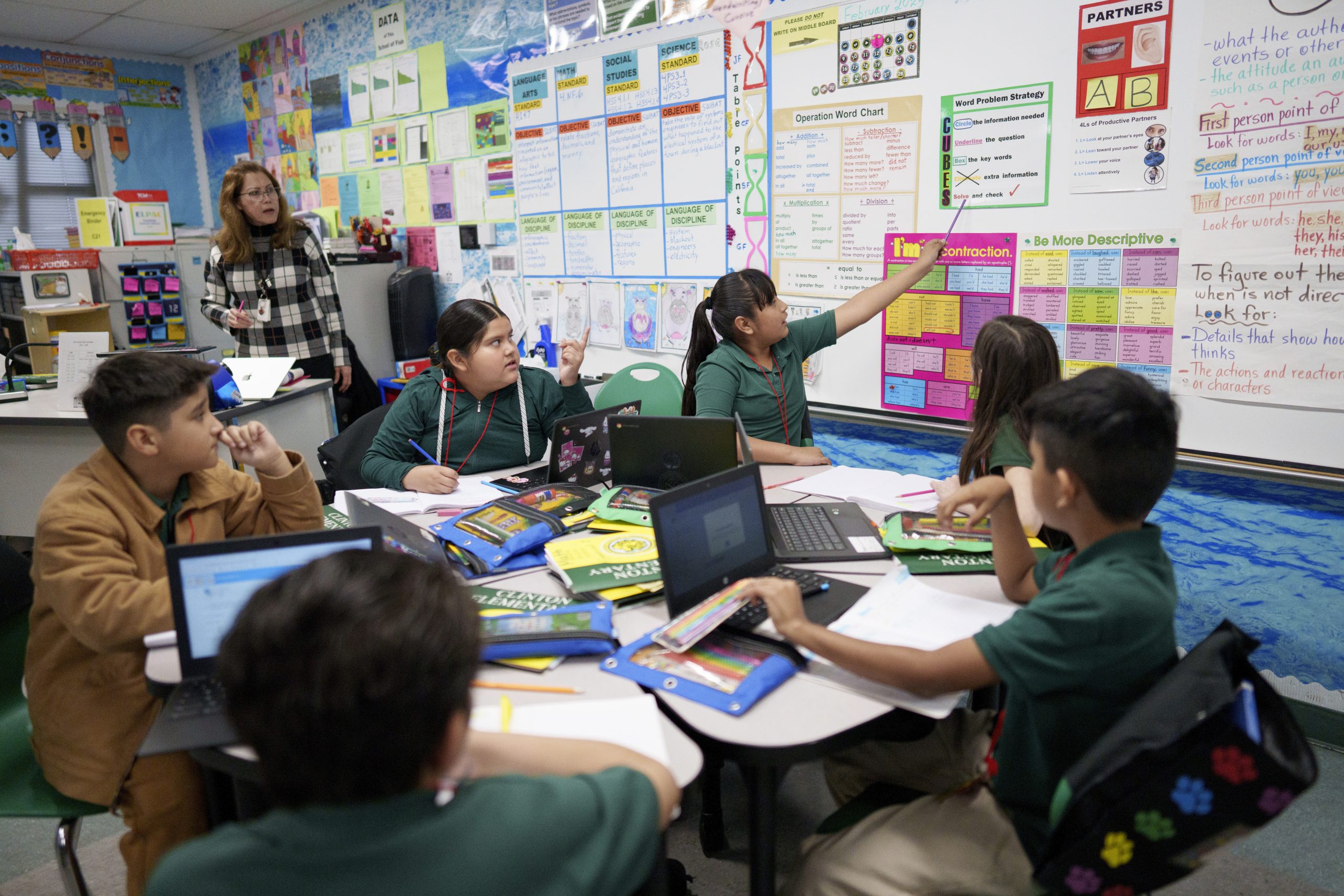
    Students interact in a fourth grade classroom at William Jefferson Clinton Elementary in Compton, Calif., Thursday, Feb. 6, 2025. Credit: Eric Thayer/Associated Press

    The Education Recovery Scorecard analysis by researchers at Harvard, Stanford and Dartmouth allows year-to-year comparisons across states and districts, providing the most comprehensive picture yet of how American students are performing since COVID-19 first disrupted learning.

    The most recent data is based on tests taken by students in spring 2024. By then, the worst of the pandemic was long past, but schools were dealing still with a mental health crisis and high rates of absenteeism — not to mention students who’d had crucial learning disrupted.  

    “The losses are not just due to what happened during the 2020 to 2021 school year, but the aftershocks that have hit schools in the years since the pandemic,” said Tom Kane, a Harvard economist who worked on the scorecard.

    In some cases, the analysis shows school districts are struggling when their students may have posted decent results on their state tests. That’s because each state adopts its own assessments, and those aren’t comparable to each other. Those differences can make it impossible to tell whether students are performing better because of their progress, or whether those shifts are because the tests themselves are changing, or the state has lowered its standards for proficiency.

    The Scorecard accounts for differing state tests and provides one national standard.

    Higher-income districts have made significantly more progress than lower-income districts, with the top 10 percent of high-income districts four times more likely to have recovered in both math and reading compared with the poorest 10 percent. And recovery within districts remains divided by race and class, especially in math scores. Test score gaps grew by both race and income.

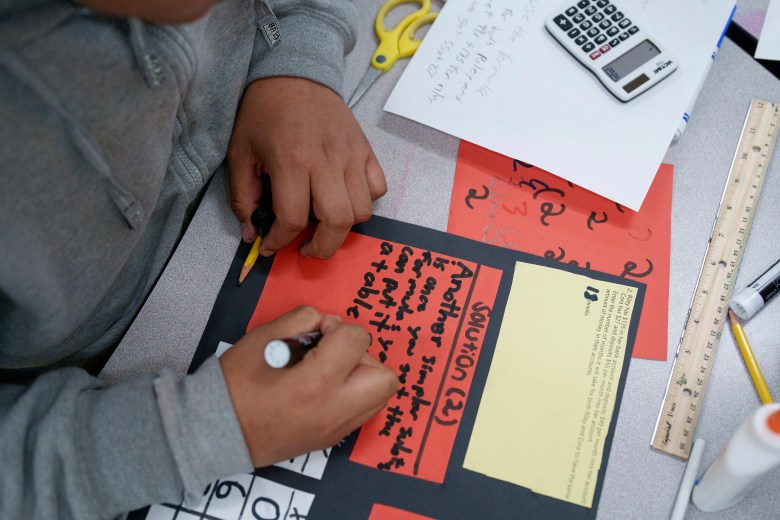
    A student works in a classroom at Benjamin O. Davis Middle School in Compton, Calif., Thursday, Feb. 6, 2025. Credit: Eric Thayer/Associated Press

    “The pandemic has not only driven test scores down, but that decline masks a pernicious inequality that has grown during the pandemic,” said Sean Reardon, a Stanford sociologist who worked on the scorecard. “Not only are districts serving more Black and Hispanic students falling further behind, but even within those districts, Black and Hispanic students are falling further behind their white district mates.”

    Still, many of the districts that outperformed the country serve predominantly low-income students or students of color, and their interventions offer best practices for other districts.

    Related: Become a lifelong learner. Subscribe to our free weekly newsletter featuring the most important stories in education.

    In Compton, the district responded to the pandemic by hiring over 250 tutors that specialize in math, reading and students learning English. Certain classes are staffed with multiple tutors to assist teachers. And schools offer tutoring before, during and after school, plus “Saturday School” and summer programs for the district’s 17,000 students, said Superintendent Darin Brawley.

    To identify younger students needing targeted support, the district now conducts dyslexia screenings in all elementary schools.

    The low-income school district near downtown Los Angeles, with a student body that is 84 percent Latino and 14 percent Black, now has a graduation rate of 93 percent, compared with 58 percent when Brawley took the job in 2012.

    Harmoni, the sixth-grader, said that one-on-one tutoring has helped her grasp concepts and given her more confidence in math. She gets separate “data chats” with her math specialist that are part performance review, part pep talk.

    “Looking at my data, it kind of disappoints me” when the numbers are low, said Harmoni. “But it makes me realize I can do better in the future, and also now.”

    Brawley said he’s proud of the district’s latest test scores, but not content.

    “Truth be told, I wasn’t happy,” he said. “Even though we gained, and we celebrate the gains, at the end of the day we all know that we can do better.”

    A tutor helps students at Benjamin O. Davis Middle School in Compton, Calif., Thursday, Feb. 6, 2025. Credit: Eric Thayer/Associated Press

    As federal pandemic relief money for schools winds down, states and school districts will have limited resources and must prioritize interventions that worked. Districts that spent federal money on increased instructional time, either through tutoring or summer school, saw a return on that investment.

    Reading levels have continued to decline, despite a movement in many states to emphasize phonics and the “science of reading.” So Reardon and Kane called for an evaluation of the mixed results for insights into the best ways to teach kids to read.

    Related: Why are kids struggling in school four years after the pandemic?

    The researchers emphasized the need to extend state and local money to support pandemic recovery programs that showed strong academic results. Schools also must engage parents and tell them when their kids are behind, the researchers said.

    And schools must continue to work with community groups to improve students’ attendance. The scorecard identified a relationship between high absenteeism and learning struggles.

    In the District of Columbia, an intensive tutoring program helped with both academics and attendance, said D.C. Public Schools Chancellor Lewis Ferebee. In the scorecard analysis, the District of Columbia ranked first among states for gains in both math and reading between 2022 and 2024, after its math recovery had fallen toward the bottom of the list.

    Pandemic-relief money funded the tutoring, along with a system of identifying and targeting support at students in greatest need. The district also hired program managers who helped maximize time for tutoring within the school day, Ferebee said.

    Students who received tutoring were more likely to be engaged with school, Ferebee said, both from increased confidence over the subject matter and because they had a relationship with another trusted adult.

    Related: Some of the $190 billion in pandemic money for schools actually paid off

    Students expressed that “I’m more confident in math because I’m being validated by another adult,” Ferebee said. “That validation goes a long way, not only with attendance, but a student feeling like they are ready to learn and are capable, and as a result, they show up differently.”

    Federal pandemic relief money has ended, but Ferebee said many of the investments the district made will have lasting impact, including the money spent on teacher training and curriculum development in literacy.

    Students walk through a hallway at Benjamin O. Davis Middle School in Compton, Calif., Thursday, Feb. 6, 2025. Credit: Eric Thayer/Associated Press

    Christina Grant, who served as the District of Columbia’s state superintendent of education until 2024, said she’s hopeful to see the evidence emerging on what’s made a difference in student achievement.

    “We cannot afford to not have hope. These are our students. They did not cause the pandemic,” Grant said. “The growing concern is ensuring that we can … see ourselves to the other side.”

    The Associated Press’ education coverage receives financial support from multiple private foundations. AP is solely responsible for all content. Find AP’s standards for working with philanthropies, a list of supporters and funded coverage areas at AP.org.

    The Hechinger Report provides in-depth, fact-based, unbiased reporting on education that is free to all readers. But that doesn’t mean it’s free to produce. Our work keeps educators and the public informed about pressing issues at schools and on campuses throughout the country. We tell the whole story, even when the details are inconvenient. Help us keep doing that.

    Join us today.

    Source link

  • Statement: Trump restores crucial due process rights for America’s college students

    Statement: Trump restores crucial due process rights for America’s college students

    The U.S. Department of Education’s Office for Civil Rights announced today it agrees with a federal court ruling that appropriately found the Biden-era Title IX rules to unconstitutionally restrict student First Amendment rights.  

    Those rules, effective in August 2024, infringed on constitutionally protected speech related to sex and gender. They also rolled back crucial due process rights for those accused of sexual misconduct on campus, increasing the likelihood that colleges would arrive at unreliable conclusions during those proceedings. OCR announced it will instead enforce the 2020 rules adopted during the first Trump administration which carefully considered the rights of complainants and respondents alike, while providing robust free speech and due process protections. 

    The following can be attributed to Tyler Coward, FIRE lead counsel for government affairs:

    The return to the 2020 rules ensures that all students — whether they are the accused or the accuser — will receive fair treatment and important procedural safeguards. That includes the right of both parties to have lawyers present during hearings, the right for both attorneys to cross-examine the other party and witnesses, and the right to receive all of the evidence in the institution’s possession. Colleges are also required to adopt a speech-protective definition of sexual harassment that enables schools to punish genuine harassment instead of merely unpopular speech. 

    Restoring the Trump administration’s rules means that students can once again feel secure that their rights to due process and free speech will be respected while ensuring administrators have the tools they need to punish those who engage in sexual misconduct and harassment.

    Source link

  • Average Net Price at America’s Public Colleges and Universities

    Average Net Price at America’s Public Colleges and Universities

    Good news: We have new IPEDS data on average net cost.  Bad news: Because IPEDS is IPEDS, it’s data from the 2021-22 Academic Year. 

    This is pretty straightforward: Each dot represents a public institution, colored by region, showing the average net price for first-year students entering in that year.  IPEDS breaks out average net price by income bands, so you can see what a family with income of $30,000 to $48,000 pays, for instance, by using the filters at right.

    You can also limit the institutions displayed by using the top three filters: Doctoral institutions in the Far West, or in Illinois, for instance.  If you want to see a specific institution highlighted, use that control.  Just type part of the name of the institution, like this example, and make your selection: 

    Average net price shows The Total Cost of Attendance (COA), which includes tuition, room, board, books, transportation, and personal expenses, minus all grant aid.  It does not include loans, but of course, loans can be used to cover part of the net price, along with other family resources.

    This display is a box and whisker chart, and if you’re not familiar with the format, here is a quick primer: 

    For the sticklers, the median shown is unweighted.

    As always, let me know what you see here that you find interesting or surprising.

    Source link