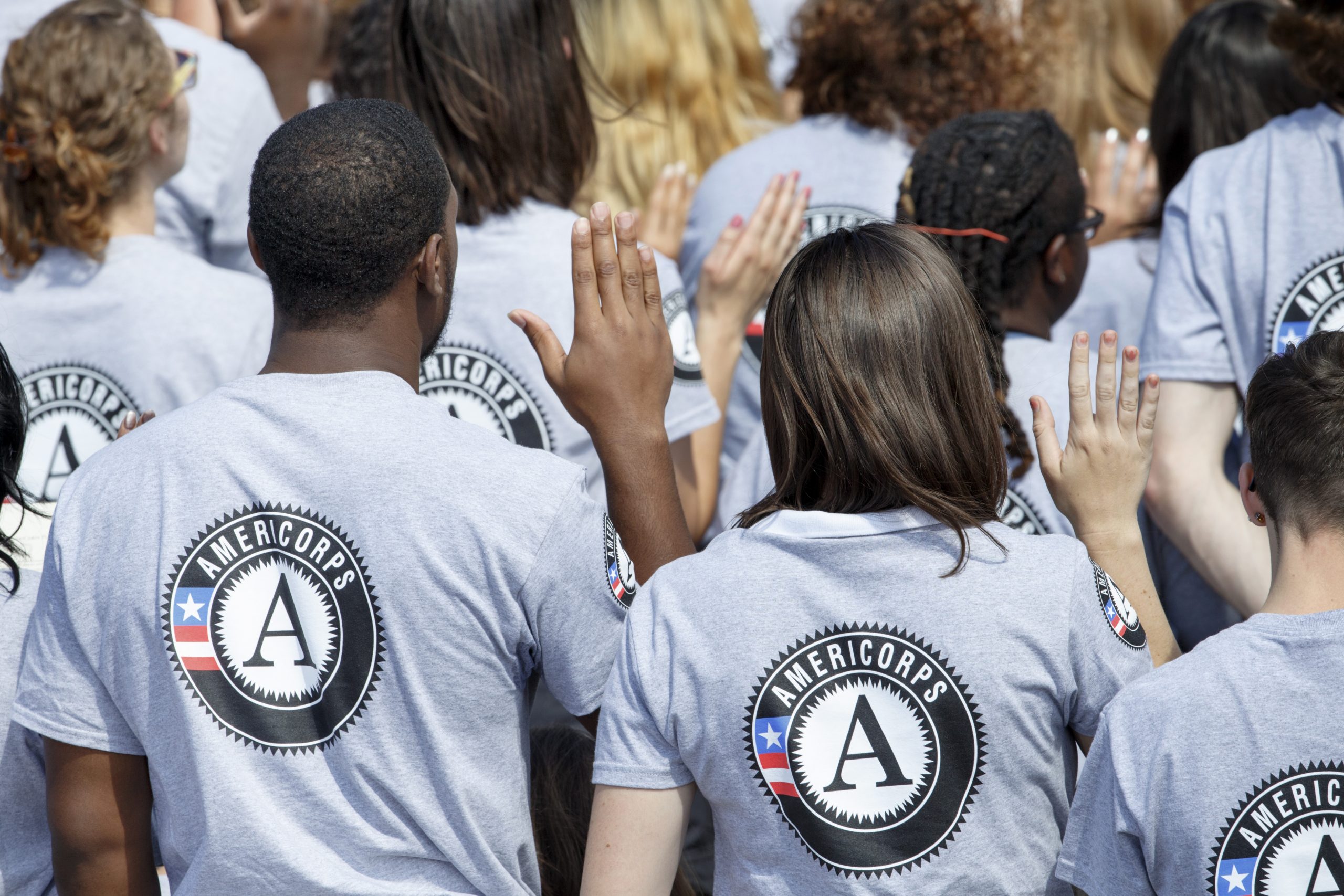
Tag: AmeriCorps

  • Federal cuts to AmeriCorps could make it harder for recent graduates to find jobs

    Federal cuts to AmeriCorps could make it harder for recent graduates to find jobs

    This story about AmeriCorps jobs was produced by The Hechinger Report, a nonprofit, independent news organization focused on inequality and innovation in education. Sign up for the Hechinger newsletter.

    Lily Tegner didn’t know what she wanted to do when she graduated from Oregon State University with a chemical engineering degree five years ago. She entered the workforce at a point when unemployment briefly skyrocketed and companies were freezing hiring because of the Covid pandemic. “I didn’t have a very clear direction as far as where I was going in life,” she said. 

    Like hundreds of thousands of other young adults, Tegner kick-started her career through AmeriCorps, a federal agency that sends its members to communities across the country to tutor students, help after disasters strike and restore wildlife habitats, among other activities. She took a position at the Alaska Afterschool Network, where her job was to help find ways to expand science, technology, engineering and math access in its programs. Four years later, she’s still there — now, as a full-time employee managing the nonprofit’s AmeriCorps program. 

    “This state became my home,” Tegner said, adding that her year in AmeriCorps “completely changed the trajectory of my career.” 

    An AmeriCorps member poses with a student in one of the Alaska Afterschool Network’s funded programs. The organization lost its AmeriCorps funding last spring. Credit: Courtesy of Alaska Afterschool Network

    This spring, Alaska Afterschool Network was one of hundreds of organizations abruptly notified that its AmeriCorps funding had been terminated. Federal funding cuts forced the nonprofit to eliminate three full-time positions and cancel 19 internships scheduled for this summer. Tegner’s job is also at risk, though the organization is trying to find a way to keep her on. 

    In late April, the Trump administration slashed 41 percent of AmeriCorps’ funding, cutting about $400 million in grants and letting go of more than 32,000 members serving in hundreds of programs across the United States. In June and also this month, judges ordered the government to restore some funding, but the ruling does not reinstate all the money that was taken away. Shrinking AmeriCorps is among the many steps the Trump administration has taken to curb what he has called “waste, fraud and abuse” of federal funds. More action is expected in the months ahead. 

    Related: Become a lifelong learner. Subscribe to our free weekly newsletter featuring the most important stories in education. 

    Over the years, the program former President Bill Clinton created has deployed more than a million people. On top of gutting AmeriCorps, the cuts have diminished the reach of an agency that has been a critical path to a career for recent high school and college graduates at a time when entry-level jobs can be difficult to find.

    AmeriCorps was created more than three decades ago to oversee expanded federal volunteer programs, incorporating existing projects including Volunteers in Service to America and the National Civilian Community Corps. Its members take on community service positions across the country that can last for up to two years. They receive a small living stipend, and full-time members are eligible for health insurance. At the end of their terms, members are awarded a grant that can be used to pay college tuition or student loans.

    “AmeriCorps dollars have a powerful ripple effect, for both the AmeriCorps members and the students that they serve,” said Leslie Cornfeld, founder and CEO of the National Education Equity Lab, a nonprofit that brings college courses to high-poverty schools. “In many instances, it helps them define their careers.” 

    About half of the AmeriCorps funding for the Philadelphia Higher Education Network for Neighborhood Development was cut this spring. Credit: Courtesy of PHENND

    Federal surveys of AmeriCorps members from 2019, 2021 and 2023 show that 90 percent of members joined the national program in part to gain skills that would help them in school and work, and well over 80 percent said their experience in AmeriCorps helped further their “professional goals and endeavors.”

    The Trump administration cited fraud as part of its reason for nearly halving the AmeriCorps budget. Audits of the agency have raised questions about its financial management. 

    Related: Hundreds of thousands of students are entitled to training and help finding jobs. They don’t get it

    Peter Fleckenstein, 23, joined Aspire Afterschool in Arlington, Virginia, through AmeriCorps last year after graduating from the University of Delaware with a degree in psychology. He saw AmeriCorps as a way to build out his resume; even the entry-level positions he encountered during his job search required experience in the field. 

    In his position at the after-school program, Fleckenstein leads daily activities for a group of about two dozen fourth grade students. The experience has helped him crystallize his career aspirations: Before AmeriCorps, he was considering clinical social work or teaching. Now, he wants to become a counselor.

    “Working with the kids here is a lot of behavior management: problem solving, helping them regulate themselves,” Fleckenstein said. “Doing one-on-one work with them, building habits and routines with them — that is something that I could focus on more if I was in a counseling job.”

    Fleckenstein’s position was cut in April before he could complete his one-year term set to end in August, but Aspire Afterschool was able to raise money through donations to hire him and some of the nonprofit’s other AmeriCorps members part-time to finish out their grant year. 

    The Philadelphia Higher Education Network for Neighborhood Development lost half of its AmeriCorps funding this past spring when the federal agency was slashed. Credit: Courtesy of PHENND

    While some members have joined Americorps after graduating, student Deja Johnson, 24, joined as a way to help pay for college. Her term at The Scholarship Academy — a nonprofit in Atlanta helping low-income high school students navigate financial aid applications — was supposed to end with a $7,400 education grant. Because the terms were cut short, members have been told they’ll get only a prorated portion of the money.

    “It’s a little bit of a shame,” said Johnson, who is using the education grant to pursue a bachelor’s degree in nonprofit leadership. 

    “That’s what a lot of us look forward to with this work that we’re doing, because we know how much of a sacrifice it can be at times. It’s that ‘pouring into our community’ — and that’s how our community pours into us,” Johnson said.

    The AmeriCorps termination letters told grantees that their programs no longer met agency priorities, but the nonprofits were not told what those priorities are. Programs with different missions, in both Democratic- and Republican-led communities, were cut.

    Sira Coulibaly, a member with the Philadelphia Higher Education Network for Neighborhood Development’s Next Steps AmeriCorps program, packs bags of food for the Metropolitan Area Neighborhood Nutrition Alliance. Credit: Courtesy of PHENND

    The Hindman Settlement School, a nonprofit in rural Kentucky, was one victim of the cuts. The organization receives about $1 million a year from AmeriCorps for its program tutoring students with math and reading learning disabilities in more than two dozen schools. Losing that funding means drastically scaling back services, said Josh Mullins, senior director of operations at the Hindman Settlement School. He said he does not know why Hindman’s grants were terminated: The nonprofit regularly passes its audits, and its last annual report showed an average gain of seven months in reading levels among students in its dyslexia intervention program.

    A statement published in January on an AmeriCorps webpage says the agency is in the process of “conducting a full review” to comply with President Donald Trump’s executive order banning diversity, equity and inclusion in federal programs. But Mullins and other AmeriCorps grantees said diversity, equity and inclusion efforts were not listed anywhere as part of their operations.

    “That’s what’s devastating,” Mullins said. “It was completely out of our control. There was nothing you could do.”

    Related: Tracking Trump: His actions to dismantle the Education Department, and more

    The administration also gutted 85 percent of the agency’s federal staff, which has caused problems even for programs that are still receiving AmeriCorps funding. 

    The federal government terminated about half of the AmeriCorps grants for the Philadelphia Higher Education Network for Neighborhood Development. The group uses the funding to place members in local nonprofits and to help develop community partnerships in high-poverty schools. Director Hillary Kane said she’s been experiencing delays from the national AmeriCorps office in getting members approved for the programs that are still operating.

    “We need the humans in D.C. to do the stuff that they do, so we can do the stuff that we do,” Kane said. “The person we communicate with isn’t there.”

    About half of the AmeriCorps funding for the Philadelphia Higher Education Network for Neighborhood Development was cut this spring. Credit: Courtesy of PHENND

    On June 5, a federal judge granted a temporary injunction ordering the Trump administration to restore AmeriCorps funding in states that had sued over the budget cuts. The lawsuit, which was filed by two dozen Democratic-led states in May, challenges the administration’s authority to cancel the funding without Congressional approval. But the judge’s injunction does not require the Trump administration to reinstate AmeriCorps’ federal employees, and funding is not being restored to programs in states that did not sign on to the lawsuit, including Alaska, home of the Alaska Afterschool Network, or Virginia, where Aspire Afterschool is based.

    The Hindman Settlement School in Kentucky was one organization whose funding was restored this summer because of the lawsuit. Mullins said he’s hopeful the nonprofit will continue to receive AmeriCorps funding for the upcoming grant cycle in the fall.

    For Kane, the injunction does not undo the chaos caused by the abrupt cancellation of half of her Philadelphia organization’s funding. Many terminated members that were with Kane’s organization have already moved on. 

    “It’s too late for us,” she said.

    Related: Schools push career ed classes ‘for all,’ even kids heading to college

    Programs whose grants were cut can apply again in the next grant cycle, but the president’s 2026 budget calls for shutting down AmeriCorps entirely. 

    While the debate in Washington rages, current and former volunteers mourn the potential loss of a program they said gave their lives meaning and led to employment. The avenue AmeriCorps provided for Tegner to start a career at the Alaska Afterschool Network gave her purpose in life, she said. She’s worried if the program ends, there won’t be another pathway on the same scale for young idealists who aren’t sure what they want to do with their lives.

    “It helps young people of all ages grow and try new things,” Tegner said. “That’s very much what it was for me.”

    Contact staff writer Ariel Gilreath on Signal at arielgilreath.46 or at [email protected].   

    This story about AmeriCorps jobs was produced by The Hechinger Report, a nonprofit, independent news organization focused on inequality and innovation in education. Sign up for the Hechinger newsletter.

    The Hechinger Report provides in-depth, fact-based, unbiased reporting on education that is free to all readers. But that doesn’t mean it’s free to produce. Our work keeps educators and the public informed about pressing issues at schools and on campuses throughout the country. We tell the whole story, even when the details are inconvenient. Help us keep doing that.

    Join us today.

    Source link

  • Judge Restores AmeriCorps Funding in 24 States, D.C.

    Judge Restores AmeriCorps Funding in 24 States, D.C.

    A federal judge ordered the Trump administration to restore funding to AmeriCorps programs in 24 states and Washington, D.C., following a lawsuit that challenged the April cuts to the program, The Hill reported Thursday.

    The judge, Obama appointee Deborah Boardman, ruled that the states were likely to succeed in their argument that the agency’s funding could not legally be cut without a notice-and-comment period. The ruling did not reinstate any of the agency’s staff.

    AmeriCorps volunteers and grants support at least 100 college-access organizations across the U.S., many of which had to lay off their AmeriCorps members in the wake of the cuts.

    It’s the latest court order blocking the administration’s crusade to reduce the size of the federal government; recently, judges reversed layoffs at the Department of Education and ruled that a lawsuit challenging funding cuts at the National Institutes of Health could move forward.

    Source link

  • Canceling AmeriCorps grants threatens the future of education and workforce pipelines that power our nation’s progress

    Canceling AmeriCorps grants threatens the future of education and workforce pipelines that power our nation’s progress

    The recent decision to cancel $400 million in AmeriCorps grants is nothing short of a crisis. With over 1,000 programs affected and 32,000 AmeriCorps and Senior Corps members pulled from their posts, this move will leave communities across the country without critical services.

    The cuts will dismantle disaster recovery efforts, disrupt educational support for vulnerable students and undermine a powerful workforce development strategy that provides AmeriCorps members with in-demand skills across sectors including education.

    AmeriCorps provides a service-to-workforce pipeline that gives young Americans and returning veterans hands-on training in high-demand industries, such as education, public safety, disaster response and health care. Its nominal front-end investment in human capital fosters economic mobility, enabling those who engage in a national service experience to successfully transition to gainful employment.

    As leaders of Teach For America and City Year, two organizations that are part of the AmeriCorps national service network and whose members receive education stipends that go toward certification costs, student loans or future education pursuits, we are alarmed by how this crisis threatens the future of the education and workforce pipelines that power our nation’s progress, and it is deeply personal. We both started our careers as corps members in the programs we now lead.

    Related: A lot goes on in classrooms from kindergarten to high school. Keep up with our free weekly newsletter on K-12 education.

    Aneesh began his journey as a Teach For America corps member teaching high school English in Minnesota. Jim’s path began with City Year, serving at a Head Start program in Boston. We know firsthand that AmeriCorps programs are transformative and empower young people to drive meaningful change — for themselves and their communities.

    At Teach For America, AmeriCorps grants are essential to recruiting thousands of new teachers every year to effectively lead high-need classrooms across the country. These teachers, who have a consistent and significant positive impact on students’ learning, rely on the AmeriCorps education awards they earn through their two years of service to pay for their own education and professional development, including new teacher certification fees, costs that in some communities exceed $20,000.

    Termination of these grants threatens the pipeline of an estimated 2,500 new teachers preparing to enter classrooms over the summer. At a time when rural and urban communities alike are facing critical teacher shortages, cutting AmeriCorps support risks leaving students without the educators they need and deserve.

    City Year, similarly, relies on AmeriCorps to recruit more than 2,200 young adults annually to serve as student success coaches in K-12 schools across 21 states, 29 cities and 60 school districts.

    These AmeriCorps members serving as City Year student success coaches provide tutoring and mentoring that support students’ academic progress and interpersonal skill development and growth; they partner closely with teachers to boost student achievement, improve attendance and help keep kids on track to graduate. Research shows that schools partnering with City Year are two times more likely to improve their scores on English assessments, and two to three times more likely to improve their scores on math assessments.

    Corps members gain critical workforce skills such as leadership, problem-solving and creative thinking, which align directly with the top skills employers seek; the value of their experience has been reaffirmed through third-party research conducted with our alumni. The City Year experience prepares corps members for success in varied careers, with many going into education.

    AmeriCorps-funded programs like Breakthrough Collaborative and Jumpstart further strengthen this national service-to-workforce pathway, expanding the number of trained tutors and teacher trainees while also preparing corps members for careers that make a difference in all of our lives.

    Those programs’ trained educators ensure all students gain access to excellent educational opportunities that put them on the path to learn, lead and thrive in communities across the country. And the leaders of both organizations, like us, are AmeriCorps alumni, proof of the lasting effect of national service.

    Collectively, our four organizations have hundreds of thousands of alumni whose work as AmeriCorps members has impacted millions of children while shaping their own lives’ work, just as it did ours. Our alumni continue to lead classrooms, schools, districts, communities and organizations in neighborhoods across the country.

    Related: Tracking Trump: His actions to dismantle the Education Department, and more

    The termination of AmeriCorps grants is a direct blow to educators, schools and students. And, at a time when Gen Z is seeking work that aligns with their values and desire for impact, AmeriCorps is an essential on-ramp to public service and civic leadership that benefits not just individuals but entire communities and our country at large.

    For every dollar invested in AmeriCorps, $17 in economic value is generated, proving that national service is not only efficient but also a powerhouse for economic growth. Rather than draining resources, AmeriCorps drives real, measurable results that benefit individual communities and the national economy.

    Moreover, two-thirds of AmeriCorps funding is distributed by governor-appointed state service commissions to community- and faith-based organizations that leverage that funding to meet local needs. By working directly with state and local partners, AmeriCorps provides a more effective solution than top-down government intervention.

    On behalf of the more than 6,500 current AmeriCorps members serving with Teach For America and City Year, and the tens of thousands of alumni who have gone on to become educators, civic leaders and changemakers, we call on Congress to protect AmeriCorps and vital national service opportunities.

    Investing in AmeriCorps is an investment in America’s future, empowering communities, strengthening families and revitalizing economies. Let’s preserve the fabric of our national service infrastructure and ensure that the next generation of leaders, educators and community advocates who want to serve our nation have the ability to do so.

    Aneesh Sohoni is Teach For America’s new CEO. Previously, he was CEO of One Million Degrees and executive director of Teach For America Greater Chicago-Northwest Indiana. He is a proud alum of Teach For America.

    Jim Balfanz, a recognized leader and innovator in the field of education and national service, is CEO and a proud alum of City Year.

    Contact the opinion editor at [email protected].

    This story about AmeriCorps, Teach For America and City Year was produced by The Hechinger Report, a nonprofit, independent news organization focused on inequality and innovation in education. Sign up for Hechinger’s weekly newsletter.

    The Hechinger Report provides in-depth, fact-based, unbiased reporting on education that is free to all readers. But that doesn’t mean it’s free to produce. Our work keeps educators and the public informed about pressing issues at schools and on campuses throughout the country. We tell the whole story, even when the details are inconvenient. Help us keep doing that.

    Join us today.

    Source link

  • AmeriCorps Cuts Force College Access Groups to Reduce Staff

    AmeriCorps Cuts Force College Access Groups to Reduce Staff

    Brianne Dolney-Jacobs has spent the last year advising high school seniors in Bay City, Mich., on their options after graduation.

    She met with 96 percent of the seniors at least once to talk about college applications, financial aid options, standardized tests and more. In doing so, she helped nearly 30 students access a countywide scholarship, up from under 10 in the previous year.

    But now, she’s one of 32,000 people affected by sweeping cuts to AmeriCorps, a federal agency focused on service and volunteerism across the United States. At least 100 college-access groups, including the Michigan College Access Network, where Dolney-Jacobs works, rely on AmeriCorps funding or members to make the college application process more accessible to high school students, especially those in low-income areas and at schools with low rates of college attendance.

    MCAN lost its grant funding this week and was ordered to cease all AmeriCorps work immediately, though the organization was able to use its own funds to buy staff members an extra month. Dolney-Jacobs will now wrap up her time at the high school at the end of May; she was supposed to stay on through late June.

    Without someone in her position, Dolney-Jacobs told Inside Higher Ed, there is no one at her school who would have the bandwidth to meet with individual students as they navigate the college application process. Many students would never have heard about different scholarships that are available to them or know that community college—including both an associate’s degree and some trade certifications—is free for recent high school graduates in Michigan.

    When her students heard that her position had been impacted, a group brought flowers to her office.

    “They told me, ‘you are the Class of 2025’s hero,’” she recounted. “And I was just bawling.”

    The National College Attainment Network, the association for MCAN and other similar organizations, is still taking stock of how many of its members have been impacted, said Elizabeth Morgan, NCAN’s chief external relations officer. But damage has been widespread.

    “I think it’s safe to say probably our members that use AmeriCorps are serving hundreds of thousands of students across the country,” Morgan said. “They are devastated by this news for a couple of reasons: The students they are supporting right now, many are high school seniors who are just weeding through their [college] decision-making process … [and] the AmeriCorps members are being thrown out of work months early.”

    A total of $400 million in AmeriCorps grants were axed, according to America’s Service Commission, a nonprofit that represents state and national service commissions, including funding for food pantries and disaster relief programs in areas impacted by recent natural disasters. The majority of AmeriCorps’ staff was also put on administrative leave in mid-April.

    It’s just one of the many agencies that have faced funding cuts and grant cancellations as part of the Trump administration’s war on government spending. Its defenders say that the agency, which pays modest stipends to its members, is anything but wasteful: It provides both vital supports for American communities and professional development training to its members, all for a low price tag.

    “I don’t believe Washington is really in tune to what is going on in the local communities,” said Grady Holmes, who works with a different MCAN AmeriCorps program that provides college success coaching to community college and tribal college students. “This is a program that is not government waste. It basically assists the government in making sure their productive citizens are being moved toward self-sufficiency and obtaining a college degree … When the powers that be decided this is wasteful spending—they don’t understand AmeriCorps.”

    Twenty-four states sued the Trump administration over the cuts, calling the dismantling of the agency, which was created by Congress in 1993, “unauthorized.”

    Advisers’ Impacts

    MCAN is facing cuts to two student-facing programs: AdviseMI, which is focused on college readiness for high schoolers, and the College Completion Corps, which is geared toward students at tribal and community colleges. Both rely on AmeriCorps grants and are staffed by AmeriCorps members, who work in yearlong service positions in exchange for stipends and educational awards that can cover current educational expenses or pay off student loans. The organization employs over 100 AmeriCorps members across both programs.

    Both programs have been successful, MCAN leaders say. In the 2023–24 academic year, students supported by AdviseMI advisers submitted 21,420 college applications and were awarded more than $32 million in financial aid.

    The advisers “often interact with parents, as well, to help parents understand the role of FAFSA and help parents understand what’s happening with their student,” said Ryan Fewins-Bliss, the organization’s executive director. “And [they] engage the school in what we hope to be a schoolwide college-going culture … so when the juniors become seniors, they’re ready for this.”

    After MCAN learned Friday night that it lost one of its AmeriCorps grants, the organization spent the weekend trying figure out how it could keep its AmeriCorps staff on board if the rest of the grants were also canceled. (In total, MCAN lost $2.1 million in AmeriCorps funds.)

    Come Monday, MCAN found out its remaining grants, including funding for AdviseMI and College Completion Corps, were indeed cancelled, and that it had to stop operating those programs immediately. MCAN was able to find funding in the budget to continue those programs for an extra month, but the future beyond then is uncertain.

    Other organizations had to lay off their AmeriCorps members entirely. Partnership 4 Kids, a Nebraska-based organization that works with students from prekindergarten through college, had two full-time AmeriCorps fellows working with high school seniors and three fellows working directly with college students. All five had to stop working Friday, immediately after P4K received word that its grants had been terminated.

    “These two in the high schools had great relationships with their students. They were doing one-on-one case management; they were the driving force [behind] college applications, scholarship applications, helping students overcome barriers they might have, and really to get them to that finish line to graduate,” P4K president Deb Denbeck said.

    This year, 97 percent of P4K’s senior cohort graduated and 80 percent of them are going to college—an impressive feat in a state where the college-going rate for high school graduates has been on the decline.

    ‘Brings Out the Best in People’

    AmeriCorps members have worked in high schools as college advisers for at least two decades, starting with the College Advising Corps, an organization that began in Virginia and has since expanded to 15 states. It’s a model that college-access leaders say has been incredibly effective, helping thousands of students go to college and boosting the careers of the advisers.

    It’s also been embraced by politicians on both sides of the aisle, according to Nicole Hurd, who founded the CAC and is now president of Lafayette College.

    AmeriCorps members are a natural fit for college-readiness work, these leaders say. Because many are recent college graduates, they can remember what it was like to be in the high schoolers’ shoes, making it easy for them to empathize with and respond to the challenges their students are facing. The college adviser positions are relatively easy to train, meaning individuals from any background can take on these roles.

    But perhaps most importantly, leaders of college-access nonprofits feel AmeriCorps’ long-standing ethos of volunteerism aligns perfectly with their missions to bring educational opportunity to all.

    “AmeriCorps brings out the best in people, and it gives them an opportunity to learn as well—to learn how to be professionals in their field,” said Denbeck. “When you look at everything that AmeriCorps does, whether it’s working in education or mentoring or agriculture or disaster relief, they’re doing it because of their heart.”

    The impacted organizations doubt they’ll be able to rely on AmeriCorps going forward. For now, they’re working to figure out how to continue their work and where they might get the funding necessary to deploy college advisers into the communities that need them most.

    “In the future, it’s safe to say that there are countless students that won’t attend college because they’re not getting this kind of support,” Morgan said.

    Source link