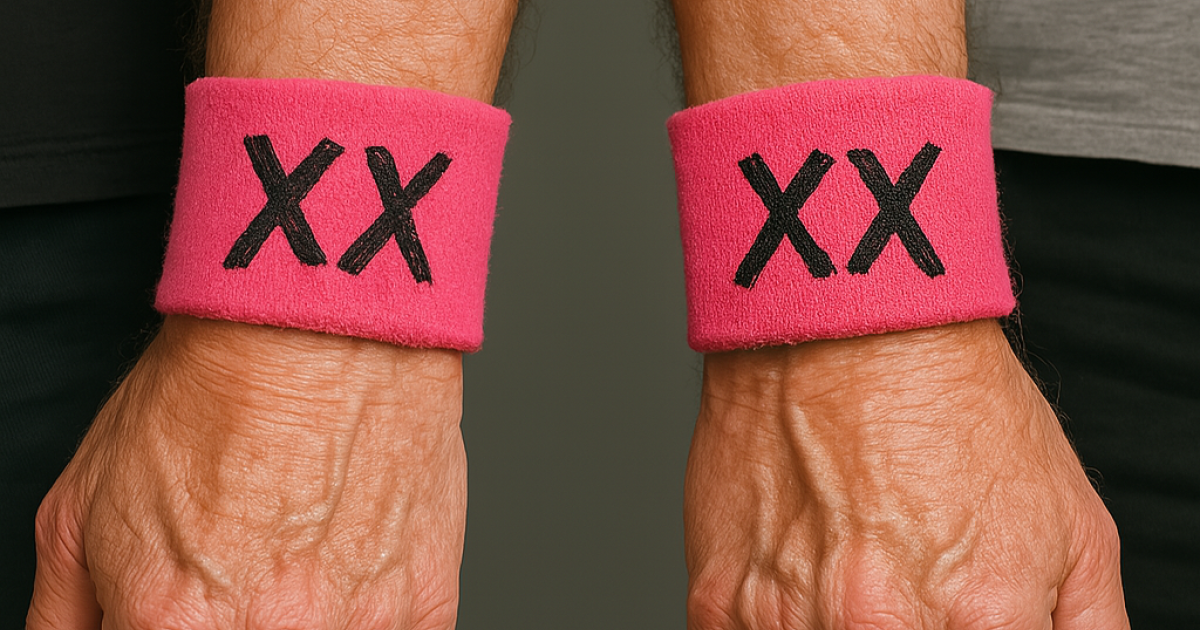
Does the First Amendment protect passive, nondisruptive political speech of adults in a public forum? Under longstanding precedent and common sense, the answer is yes, of course it does. Yet a federal district court in New Hampshire ratified a viewpoint-based removal of parents from a high school soccer game. So FIRE filed an amicus brief in the appeal from that decision, explaining how the court went astray.
In September 2024, as a form of silent protest against allowing a transgender athlete to play on the opposing girls’ soccer team against Bow High School, parents Kyle Fellers and Andy Foote donned pink “XX” wristbands during halftime. After about 10 minutes, school officials approached, along with a police officer, and demanded that the two parents remove the wristbands or leave the game.
Worse, when the parents invoked their First Amendment rights, the officials threatened to arrest them for trespassing despite having no evidence that the wristbands, as opposed to the school officials’ conduct, was causing any disruption of the soccer match. Nor is there any evidence the transgender athlete saw the wristbands.
So when a federal district court rejected the parents’ constitutional challenge to their treatment, it made two key mistakes.
First, it held censoring their message was not viewpoint discrimination — even though the record shows Bow High School officials explicitly cited what they perceived as the protest’s “exclusionary” views while allowing “inclusive” messaging. That is, they objected to the wristbands’ gender identity messaging because they found it offensive, while at the same permitting other displays, including those celebrating LGBT causes.
That is textbook viewpoint discrimination, and is simply unconstitutional in any kind of forum, full stop. As the Supreme Court ruled in the 2001 case Good News Club v. Milford Central School, “When a restriction is viewpoint discriminatory, we need not decide whether it is unreasonable in light of the purposes served by the forum.”
Second, the court imported precedent applicable only to K–12 students in school into its forum analysis, and misapplied it to the speech of adults. Although it acknowledged this is not a student speech case, the court looked to Tinker v. Des Moines Independent Community School District, which affords school officials some authority to regulate student speech that substantially causes disruption or invades the rights of others. But Tinker has no role in analyzing adult speech in a public forum.
The district court compounded that error by developing a test based on its reading of the First Circuit decision in L.M. v. Town of Middleborough to justify censorship of the parents’ passive protest as demeaning towards a visiting student. But L.M. involved student speech — not adult speech — and used reasoning that doesn’t apply here.
Even if Tinker did apply (it doesn’t), L.M. relied solely on its “substantial disruption” standard to hold demeaning statements might eventually lower test scores and cause “symptoms of a sick school,” while disclaiming reliance on “rights of others” under Tinker. Despite that, the district court centered its L.M.-based analysis on how the protest here might invade the visiting athlete’s rights, not that it would disrupt school functions.
Had other students or adults actually engaged in what both the school district and district court feared may occur — essentially, discriminatory harassment — school administrators are already empowered under Davis v. Monroe County Board of Education to counteract conduct that is “so severe, pervasive, and objectively offensive … that the victim-students are effectively denied equal access to an institution’s resources and opportunities.”
All told, as FIRE explained to the First Circuit, it is unwise to further dilute First Amendment protections by applying L.M. to adult speech. By sanctioning Bow High’s viewpoint discrimination against passive political protest and bastardizing student speech principles to silence adults, the district court’s decision would give administrators expansive authority over protected adult expression. That unwarranted and dangerous outcome is why the First Circuit should reverse on appeal, to protect First Amendment rights against erosion and abuse.