Tag: Analysis

  • Analysis: Early flurry of executive orders a mixed bag for free speech

    Analysis: Early flurry of executive orders a mixed bag for free speech

    Since taking office for his second term on Jan. 20, President Trump has issued a flurry of executive orders, including several implicating the First Amendment and freedom of expression. Below, we highlight some of these orders and evaluate the potential ramifications for free speech.

    Executive order on protecting freedom of speech is a good start — but more must be done

    One of the first executive orders the president signed was titled “Restoring Freedom of Speech and Ending Federal Censorship.” This order aims to “secure the right of the American people to engage in constitutionally protected speech” and “ensure that no Federal Government officer, employee, or agent engages in or facilitates any conduct that would unconstitutionally abridge the free speech of any American citizen.” Specifically, the order notes the government has “trampled free speech rights by censoring Americans’ speech on online platforms, often by exerting substantial coercive pressure on third parties, such as social media companies, to moderate, deplatform, or otherwise suppress speech that the Federal Government did not approve.”

    FIRE welcomes this order’s call to end federal government censorship, including that which is hidden from public view. Leaks, court documents, and other disclosures have revealed instances of federal officials pressuring social media companies to limit controversial but constitutionally protected speech on vigorously disputed topics like the origins of Covid-19, the Hunter Biden laptop story, and election integrity.

    We have written repeatedly about the dangers of such government coercion, commonly referred to as “jawboning,” highlighting how this sneaky form of government censorship threatens freedom of expression.

    A pledge by the executive branch to respect the free speech of all Americans is a good first step. But any executive order can be modified or reversed on the say-so of one person — the president. It will take actual legislation — such as FIRE’s model transparency bill — to create mechanisms that statutorily require disclosure and bring to light governmental efforts to strong-arm private social media companies into censoring protected speech. 

    In the meantime, FIRE will monitor the administration’s actions, just as we did during the Biden administration, and hold federal agencies to the standards set forth in the executive order.

    Executive orders targeting DEI programs appear to avoid First Amendment pitfalls — but FIRE will be watching their implementation

    President Trump also signed two executive orders with the aim of dismantling diversity, equity, inclusion, and accessibility programs. The first, signed on Jan. 20 and titled “Ending Radical and Wasteful Government DEI Programs and Preferencing,” calls for “termination of all discriminatory programs, including illegal DEI and ‘diversity, equity, inclusion, and accessibility’ (DEIA) mandates, policies, programs, preferences, and activities in the Federal Government, under whatever name they appear.”

    DEI/DEIA programs and initiatives take many forms. FIRE has no position on the values DEI programs may seek to advance. But our experience defending student and faculty rights on campus demonstrates that DEI administrators and offices have regularly been involved in threats to academic freedom and speech policing, functioning as a way to enforce preferred orthodoxy or ideology. And some DEI initiatives — such as mandatory DEI statements in faculty hiring or student admissions — flatly threaten free expression and academic freedom and should be prohibited. We have previously introduced model legislation designed to eliminate such use of political litmus tests in faculty hiring and student admission decisions.

    FIRE has also seen legislation in which overbroad attempts to curtail DEI mandates threaten the very same speech rights of faculty and students they aim to protect. Overbroad restrictions can improperly limit classroom discussions — as we saw in West Virginia’s recent executive order prohibiting faculty from sharing any material that promotes or encourages certain DEI-related views, while at the same time permitting criticism of those views. This allows institutions to continue ideological litmus tests as long as such tests oppose DEI — which just recreates the same problem.

    Overzealous enforcement could threaten free speech by, for example, indirectly chilling a professor from sharing their positive views of affirmative action policies or leading to investigation of a government grantee for a social media post expressing personal support for DEI initiatives.

    The president’s executive order appears to avoid these issues by targeting only the government’s own speech and initiatives, which it can constitutionally control. For instance, the Office of Management and Budget must provide a list of “Federal grantees who received Federal funding to provide or advance DEI, DEIA, or ‘environmental justice’ programs, services, or activities since January 20, 2021.” This is different from prohibiting any federal grantees from promoting DEI, which would threaten speech. Instead, the order specifically targets federal grants made specifically for the purpose of advancing DEI, and the federal government is free to shut off that funding if it no longer wishes to advance those ideals or views.

    A second DEI-related order, signed on January 21, “Ending Illegal Discrimination and Restoring Merit-Based Opportunity,” aims to eliminate “affirmative action” and “illegal discrimination and illegal preferences” in line with the Supreme Court’s decision in Students for Fair Admissions v. Harvard, which held race-based affirmative action programs in college admissions violated the Fourteenth Amendment. (FIRE takes no position on affirmative action.)

    FIRE releases statement on the use of ‘diversity, equity, and inclusion’ criteria in faculty hiring and evaluation

    News

    FIRE’s statement provides guidance to universities to ensure they respect faculty members’ expressive freedom when seeking to advance DEI.


    Read More

    The order helpfully includes two provisions that make clear it does not reach into the college classroom or infringe upon academic freedom:

    (b) This order does not prevent State or local governments, Federal contractors, or Federally-funded State and local educational agencies or institutions of higher education from engaging in First Amendment-protected speech.

    (c) This order does not prohibit persons teaching at a Federally funded institution of higher education as part of a larger course of academic instruction from advocating for, endorsing, or promoting the unlawful employment or contracting practices prohibited by this order.

    While these orders avoid constitutional pitfalls on their face, implementation should proceed carefully. Overzealous enforcement could threaten free speech by, for example, indirectly chilling a professor from sharing their positive views of affirmative action policies or leading to investigation of a government grantee for a social media post expressing personal support for DEI initiatives.

    Executive order on “gender ideology” invites possible abuse

    This executive order focuses on “[defending] women’s rights and [protecting] freedom of conscience by using clear and accurate language and policies that recognize women are biologically female, and men are biologically male.” The order requires federal government agencies to:

    remove all statements, policies, regulations, forms, communications, or other internal and external messages that promote or otherwise inculcate gender ideology, and shall cease issuing such statements, policies, regulations, forms, communications or other messages. Agency forms that require an individual’s sex shall list male or female, and shall not request gender identity. Agencies shall take all necessary steps, as permitted by law, to end the Federal funding of gender ideology.

    This aspect of the order is limited to the federal government’s own speech. However, there is a risk, similar to that presented by imprecise anti-DEI legislation, that the breadth of such an order could lead to direct or indirect censorship of private actors. The government has the power to control its speech when it is the speaker, such as in a training given to its employees. But its power is much more limited when the speaker is a private citizen.

    Of particular concern is this clause: “Federal funds shall not be used to promote gender ideology. Each agency shall assess grant conditions and grantee preferences and ensure grant funds do not promote gender ideology.”

    While the government can choose to change its own messaging on gender issues, it cannot deny funds to grantees for exercising their own First Amendment rights. Further, the imprecise language could encourage government actors to withhold otherwise available grants from those with opinions that do not align with the views expressed in this executive order — chilling constitutionally protected speech. Grantees who would otherwise espouse views agreeing with “gender ideology” may refrain for fear of losing their government grant, even if they do not use the grant itself to promote “gender ideology.”

    Executive order intended to “protect” Americans from noncitizens who “espouse hateful ideology” is at odds with our culture of free speech

    This executive order makes it federal policy to “protect [American] citizens from aliens who intend to commit terrorist attacks, threaten our national security, espouse hateful ideology, or otherwise exploit the immigration laws for malevolent purposes.” In addition to requiring agencies to ensure their policies for screening aliens align with the executive order, it requires the secretary of state to:

    Recommend any actions necessary to protect the American people from the actions of foreign nationals who have undermined or seek to undermine the fundamental constitutional rights of the American people, including, but not limited to, our Citizens’ rights to freedom of speech and the free exercise of religion protected by the First Amendment, who preach or call for sectarian violence, the overthrow or replacement of the culture on which our constitutional Republic stands, or who provide aid, advocacy, or support for foreign terrorists.

    The federal government has the authority to refuse entry to or deport people who genuinely present a national security threat. But the broad language of this order implies it may also be used to target people already in the U.S. for engaging in speech that is otherwise constitutionally protected. FIRE has previously expressed concern about denials of entry in cases where students and speakers were seemingly barred based on their speech. The ambiguous language of the order, including references to a “replacement of the culture,” suggests an intent to review and potentially punish foreign nationals for speech that would typically be protected.

    To be clear, speech that calls for violence is generally protected by the First Amendment. As we have previously written, calls for genocide or chanting “From the river to the sea,” though listeners may be offended or deeply upset, are generally constitutionally protected. Denying visas or deporting anyone who engages in such speech will create a chilling effect, deterring foreign nationals from participating in lawful protests and demonstrations.

    But just because the government may have the power to deport people for expressing their views, as it does in at least some circumstances, that does not make such deportations a good idea.

    While the driving force behind this executive order is the current Israel-Hamas conflict, there is no reason other than political whim that efforts to punish foreign nationals for their speech would stay confined to one side of that issue, or to the Israeli-Palestinian issue at all. If those targeted for “espousing hateful ideology” are today likely to be those supporting Hamas, a new government could aim such efforts at supporters of Israel’s military efforts in the coming years. Those from other nations experiencing ethnic or religious conflict, from Ukraine to Myanmar to Burkina Faso, could also face adverse immigration decisions for expressing their views.

    Why (most) calls for genocide are protected speech

    News

    Creating a “genocide” exception to free speech only opens the door to more speech restrictions and selective enforcement.


    Read More

    Because this executive order is directed at foreign nationals, the legal First Amendment issues (as distinct from the cultural free speech questions) are complicated. The Supreme Court noted in Bridges v. Wixon that the freedom of speech is accorded to resident aliens, but other precedent upholds immigration consequences based on viewpoint, and immigration officials have targeted foreign nationals for deportation for otherwise-protected speech.

    In the 1904 case United States Ex. Rel. John Turner v. Williams, the Court upheld a law that allowed the deportation of “anarchists.” In the 1954 case Galvan v. Press, the Court upheld a law that allowed the deportation of non-citizens for belonging to the Communist Party. (Interestingly, statutory prohibitions on the naturalization of anarchists and members of the Communist Party still exist.)

    But just because the government may have the power to deport people for expressing their views, as it does in at least some circumstances, that does not make such deportations a good idea. Establishing a system that allows for the routine deportation of foreign nationals based solely on their otherwise protected speech would erode our national commitment to freedom of expression as a uniquely American cultural value.

    FIRE’s Senior Scholar, Global Expression Sarah McLaughlin published a piece at MSNBC exploring President Trump’s Executive Order on anti-Semistism.

    Source link

  • Across All Ages & Demographics, Test Results Show Americans Are Getting Dumber – The 74

    Across All Ages & Demographics, Test Results Show Americans Are Getting Dumber – The 74


    Get stories like this delivered straight to your inbox. Sign up for The 74 Newsletter

    There’s no way to sugarcoat it: Americans have been getting dumber.

    Across a wide range of national and international tests, grade levels and subject areas, American achievement scores peaked about a decade ago and have been falling ever since. 

    Will the new NAEP scores coming out this week show a halt to those trends? We shall see. But even if those scores indicate a slight rebound off the COVID-era lows, policymakers should seek to understand what caused the previous decade’s decline. 

    There’s a lot of blame to go around, from cellphones and social media to federal accountability policies. But before getting into theories and potential solutions, let’s start with the data.

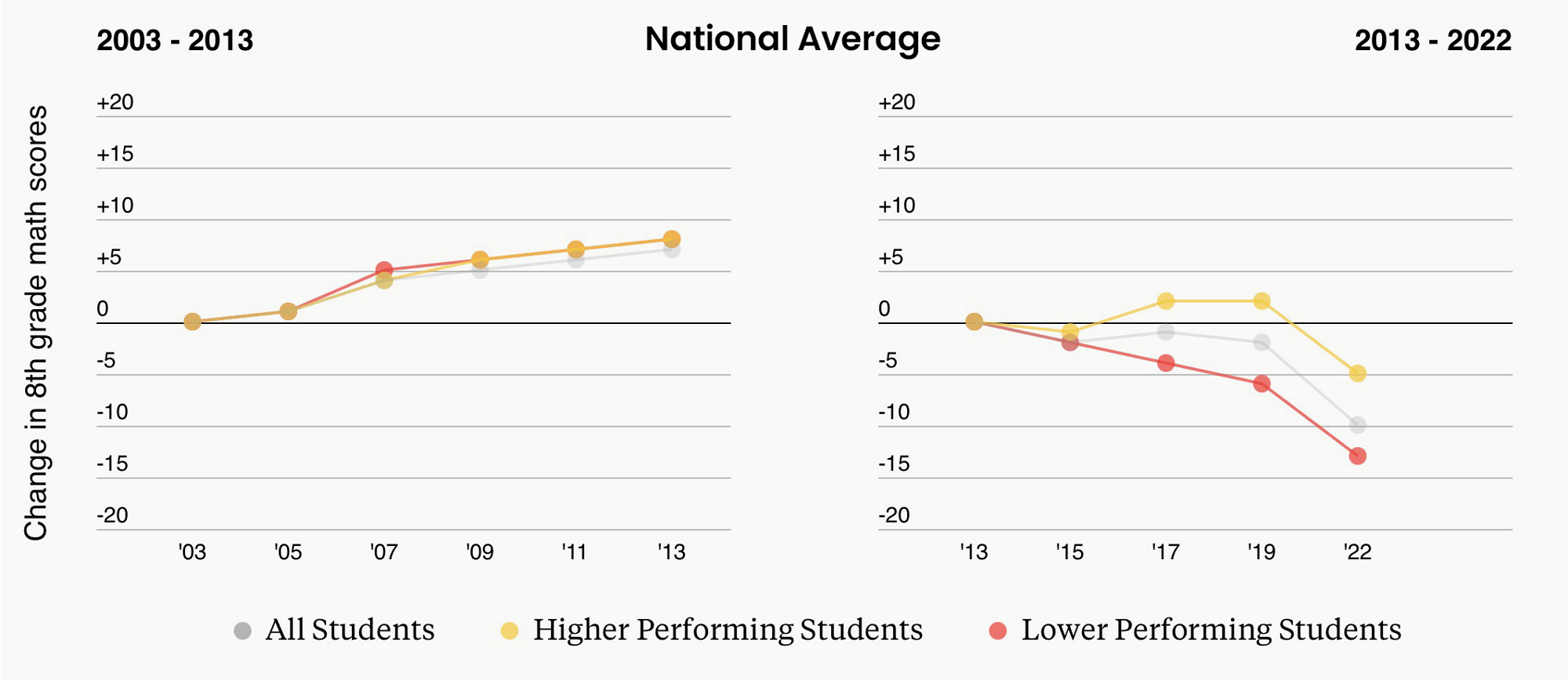
    Until about a decade ago, student achievement scores were rising. Researchers at Education Next found those gains were broadly shared across racial and economic lines, and achievement gaps were closing. But then something happened, and scores started to fall. Worse, they fell faster for lower-performing students, and achievement gaps started to grow.

    This pattern shows up on test after test. Last year, we looked at eighth grade math scores and found growing achievement gaps in 49 of 50 states, the District of Columbia and 17 out of 20 large cities with sufficient data.

    But it’s not just math, and it’s not just NAEP. The American Enterprise Institute’s Nat Malkus has documented the same trend in reading, history and civics. Tests like NWEA’s MAP Growth and Curriculum Associates’ i-Ready are showing it too. And, as Malkus found in a piece released late last year, this is a uniquely American problem. The U.S. now leads the world in achievement gap growth.

    What’s going on? How can students here get back on track? Malkus addresses these questions in a new report out last week and makes the point that any honest reckoning with the causes and consequences of these trends must account for the timing, scope and magnitude of the changes.

    Theory #1: It’s accountability

    As I argued last year, my top explanation has been the erosion of federal accountability policies. In 2011 and 2012, the Obama administration began issuing waivers to release states from the most onerous requirements of the No Child Left Behind Act. Congress made those policies permanent in the 2015 Every Student Succeeds Act. That timing fits, and it makes sense that easing up on accountability, especially for low-performing students, led to achievement declines among those same kids.

    However,  there’s one problem with this explanation: American adults appear to be suffering from similar achievement declines. In results that came out late last year, the average scores of Americans ages 16 to 65 fell in both literacy and numeracy on the globally administered Program for the International Assessment of Adult Competencies. 

    And even among American adults, achievement gaps are growing. The exam’s results are broken down into six performance levels. On the numeracy portion, for example, the share of Americans scoring at the two highest levels rose two points, from 10% to 12%, while the percentage of those at the bottom two levels rose from 29% to 34%. In literacy, the percentage of Americans scoring at the top two levels fell from 14% to 13%, while the lowest two levels rose from 19% to 28%. 

    These results caused Peggy Carr, the commissioner of the National Center for Education Statistics, to comment, “There’s a dwindling middle in the United States in terms of skills.” Carr could have made the same comment about K-12 education —  except that these results can’t be explained by school-related causes.

    Theory #2: It’s the phones

    The rise of smartphones and social media, and the decline in reading for pleasure, could be contributing to these achievement declines. Psychologist Jean Twenge pinpointed 2012 as the first year when more than half of Americans owned a smartphone, which is about when achievement scores started to decline. This theory also does a better job of explaining why Americans of all ages are scoring lower on achievement tests.

    But there are some holes in this explanation. For one, why are some of the biggest declines seen in the youngest kids? Are that many 9-year-olds on Facebook or Instagram? Second, why are the lowest performers suffering the largest declines in achievement? Attention deficits induced by phones and screens should affect all students in similar ways, and yet the pattern shows the lowest performers are suffering disproportionately large drops.

    But most fundamentally, why is this mostly a U.S. trend? Smartphones and social media are global phenomena, and yet scores in Australia, England, Italy, Japan and Sweden have all risen over the last decade. A couple of other countries have seen some small declines (like Finland and Denmark), but no one has else seen declines like we’ve had here in the States.

    Other theories: Immigration, school spending or the Common Core

    Other theories floating around have at least some kernels of truth. Immigration trends could explain some portion of the declines, although it’s not clear why those would be affecting scores only now. The Fordham Institute’s Mike Petrilli has partly blamed America’s “lost decade” on economic factors, but school spending has rebounded sharply in recent years without similar gains in achievement. Others, including historian Diane Ravitch and the Pioneer Institute’s Theodor Rebarber, blame the shift to the Common Core state standards, which was happening about the same time. But non-Common Core states suffered similar declines, and scores have also dropped in non-Common Core subjects.

    Note that COVID is not part of my list. It certainly exacerbated achievement declines and reset norms within schools, but achievement scores were already falling well before it hit America’s shores.

    Instead of looking for one culprit, it could be a combination of these factors. It could be that the rise in technology is diminishing Americans’ attention spans and stealing their focus from books and other long-form written content. Meanwhile, schools have been de-emphasizing basic skills, easing up on behavioral expectations and making it easier to pass courses. At the same time, policymakers in too many parts of the country have stopped holding schools accountable for the performance of all students.

    That’s a potent mix of factors that could explain these particular problems. It would be helpful to have more research to pinpoint problems and solutions, but if this diagnosis is correct, it means students, teachers, parents and policymakers all have a role to play in getting achievement scores back on track. 


    Get stories like these delivered straight to your inbox. Sign up for The 74 Newsletter

    Source link

  • 2024 Election Results and Analysis of Future Policy Impacts

    2024 Election Results and Analysis of Future Policy Impacts

    by CUPA-HR | November 14, 2024

    The results of the 2024 election are in: Donald Trump will serve as the 47th president of the United States, while both the Senate and House of Representatives will be controlled by Republicans. With the Republican trifecta in the White House and Congress, Republicans can focus on passing their policy priorities through legislation in Congress and regulatory action at the federal agencies. CUPA-HR’s government relations team provides the following analysis to offer insight into possible leadership, policies and regulations we expect starting in January 2025.

    Federal Agencies and Congressional Committees

    Department of Labor

    The Department of Labor (DOL), overseen by the secretary of labor, directs policy and regulations for employers, workers, and retirees in the U.S. Throughout the election season, news organizations have speculated President-elect Trump’s potential picks for the secretary position, though who will be nominated will be unknown until Trump announces it. According to Politico, two possible candidates are Patrick Pizzella and Bryan Slater. Under the first Trump administration, Pizzella served as deputy secretary of labor and acting secretary of labor between former secretaries Alex Acosta and Eugene Scalia. Slater, who currently serves as Virginia’s secretary of labor, had also previously served as assistant secretary at DOL under the previous Trump administration.

    In addition to the secretary of labor, Trump will pick people to head the subagencies at DOL, including the Employee Benefits Security Administration, Occupational Safety and Health Administration, and Wage and Hour Division, among others. These agencies draft and implement regulations governing retirement and health benefits plans, workplace safety and health, and minimum wage and overtime pay requirements. Leaders of the DOL subagencies are typically selected later in the Cabinet-appointment process.

    National Labor Relations Board

    The party control of the National Labor Relations Board (NLRB) depends on actions taken by the Senate during the lame-duck session between the election and President-elect Trump’s inauguration. Current chair of the NLRB Lauren McFerran’s term is set to expire in December 2024, but she has been renominated to serve on the board for another five years by President Biden. Senate Democrats, who are likely to push for her confirmation now that the Senate and White House will be Republican-controlled in 2025, will need to vote to confirm her position, only needing a simple majority. If confirmed, NLRB would be under Democratic control until at least August 2026, more than a year and a half into the Trump administration, leaving President Trump unable to obtain a Republican majority on the board — and thereby control the policy at the NLRB — for nearly half of his second term.

    Despite possibly not having control of the NLRB, President Trump may choose to fire the NLRB General Counsel Jennifer Abruzzo (Democrat), whose term is not set to expire until July 2025. In 2021, President Biden terminated then-General Counsel Peter Robb (Republican) within hours of his inauguration, despite Robb’s term not ending until November of that same year. This was the first time any sitting president had fired a sitting general counsel at an independent agency for policy differences. Federal courts upheld Robb’s termination, so President Trump is highly likely to terminate Abruzzo immediately upon taking office. As a reminder, Abruzzo issued several memos stating her position regarding employment status for student-athletes, severance agreements, and disclosure obligations under the National Labor Relations Act and Family Educational Rights and Privacy Act, all of which would likely be rescinded by Trump’s NLRB general counsel appointee.

    Equal Employment Opportunity Commission

    Unless a commissioner leaves their post before their term expires, the Equal Employment Opportunity Commission (EEOC) will maintain a Democrat majority (currently 3-1, with one Republican seat vacant) until July 2026. Despite this, President-elect Trump is likely to appoint Commissioner Andrea Lucas to serve as chair of the EEOC. Lucas and the EEOC would be limited in their ability to adopt new policies or reverse actions taken by the Democrat-controlled commission prior to July 2026. At that time, we expect the Republican-controlled EEOC to issue revised guidance that narrows the scope of the agency’s interpretation of Title VII protections in light of Bostock v. Clayton County and the legality of diversity, equity, and inclusion (DEI) initiatives in employment practices, possibly extending legal principles established under the Students for Fair Admission v. Harvard case.

    Similar to the NLRB, we expect that President-elect Trump will replace the current EEOC General Counsel Karla Gilbride (Democrat). In her role, Gilbride has litigated on behalf of the EEOC in federal court, but the position typically does not provide policy recommendations to the full commission like the NLRB general counsel does.

    Department of Education

    The Department of Education (ED) oversees and implements policy and regulations governing federal assistance to education. With respect to higher education, ED governs issues like federal financial aid, Title IX compliance, and other laws aimed at promoting student success. Under the incoming Trump administration, Politico has speculated that there are a few possible contenders who could ultimately lead the agency.

    One possible candidate for ED’s secretary is Betsy DeVos, who served as secretary of education during Trump’s first term. During DeVos’ first term as ED secretary, she led the agency to implement the 2020 Title IX regulations that are still currently in place in 26 states and hundreds of schools around the country, pending legal challenges to the Biden administration’s rule. However, DeVos resigned from her position as secretary of education after the January 6, 2021, riots at the U.S. Capitol, which may lead the incoming Trump administration to search for new candidates. Despite her resignation, DeVos has indicated that she is open to discussions about potentially serving in the role again.

    As we also discuss below, Rep. Virginia Foxx (R-NC) will be stepping down from her role as chair of the House Education and the Workforce Committee, where she most recently led an investigation into antisemitism on campus in higher education. This, along with her previous experience serving as an English instructor and president of a community college, may set her up for a bid for the secretary position.

    Some additional names that have been discussed by Politico are Virginia Governor Glenn Youngkin, Oklahoma State Superintendent of Public Instruction Ryan Walters, and Moms for Liberty founder Tiffany Justice.

    House Education and the Workforce Committee

    Republicans held control of the House in the 2024 election, but there will still be some shakeup in leadership for the Education and Workforce Committee. Chair of the committee Virginia Foxx will be stepping down from her role, leaving open the Republican leader position of the Committee. The two front-runners to chair the committee are Reps. Tim Walberg (R-MI) and Burgess Owens (R-UT), both currently serving on the committee. Notably, Walberg has served on the committee for 16 years, and Owens currently serves as the chair of the Higher Education and Workforce Development Subcommittee. For Democrats, current ranking member of the committee Bobby Scott (D-VA) is expected to maintain his position as leader of the Committee Democrats.

    Walberg and Owens have both publicized their policy priorities. Walberg has stated that, under his leadership, the committee would focus on legislation to make college more affordable, boost apprenticeships, implement a short-term Pell grant for workforce training programs, and reauthorize the Workforce Innovation and Opportunity Act. Owens hopes to steer the committee with a more education-centric focus, stating that top priorities for him are school choice and oversight into how ED uses its funding.

    Senate Health, Education, Labor, and Pensions Committee

    Republicans in the Senate gained control during the 2024 election, flipping the previously Democrat-controlled chamber. As a result, Senator Bill Cassidy (R-LA) will likely rise to the role of chair on the Health, Education, Labor, and Pensions (HELP) Committee. Senator Bernie Sanders (I-VT) will shift into the ranking member position after serving as the chair of the full committee in the 118th Congress. Before his political career, Cassidy was a physician, meaning he could pivot the committee to focus more on health policy. Despite this, Cassidy has also advocated for the HELP committee to advance a Workforce Innovation and Opportunity Act reauthorization bill, and he has advocated for the committee to focus on other education issues as well.

    Policy Implications of the Election

    FLSA Overtime

    As you already know, the Biden administration is in the process of implementing their FLSA overtime regulations. The final rule took a two-phased approach to increasing the minimum salary threshold. The first increase raised the salary threshold to $43,888 per year and took effect on July 1, 2024. The second increase would raise the salary threshold to $58,656 per year and is set to take effect on January 1, 2025. The regulations are currently being challenged in a federal district court in Texas, where a preliminary injunction to block the rule from taking effect has been placed only for public employers in the state of Texas. It remains to be seen how the federal judge will rule on the lawsuits, though a hearing for the cases was held on November 8 and a ruling is imminent.

    As the Trump administration will not take office until after the January 1 threshold, the regulation will take effect, pending further appeals, if the final rule is upheld in federal court. If the rule is struck down, we expect the Trump administration will let the court’s decision remain and make no further effort to appeal the decision. If the Trump administration decides to increase the minimum salary threshold during this upcoming term, they will likely use the methodology from the 2019 rule to increase the threshold.

    Title IX

    Similar to the overtime final rule, the Biden administration issued Title IX regulations in 2024 that are also facing legal challenges. The Biden administration’s Title IX rule took effect on August 1, 2024, but several lawsuits challenging the rule have resulted in preliminary injunctions blocking ED from enforcing it in 26 states and hundreds of other schools in states that did not challenge the final rule.

    The Biden administration’s regulations replaced the previous Trump administration’s 2020 Title IX regulations. If the regulations are upheld in federal court, we expect that the incoming secretary of education will repeal the Biden administration’s regulations in favor of keeping the 2020 regulations in effect across the country.

    Immigration

    There are several policies and regulations that CUPA-HR has been tracking on the immigration front that face uncertain futures under the incoming Trump administration. During the first term, the Trump administration placed a proposed rule on the regulatory agenda aiming to restrict the Optional Practical Training  program, which allows international students who graduate from U.S. institutions to work in their degree-related field for at least 12 months after graduating. The Trump administration also finalized a couple of final rules that would have increased wage obligations for H-1B visas and narrowed eligibility for H-1B visas to positions that qualified as “specialty occupations.” These rules were struck down in court, so while Trump is unlikely to implement the same rules, we could see similar attempts to increase H-1B wage obligations and narrow the H-1B program.

    Additionally, the incoming Trump administration will likely look to reverse policies implemented by the Department of Homeland Security under the Biden administration, including dropping any appeal of the recent court ruling against the “Keeping Families Together” program for undocumented spouses and children of U.S. citizens, as well as rescinding the guidance to streamline the H-1B visa waiver process for Deferred Action for Childhood Arrivals (DACA) recipients. Similarly, if the Biden administration does not finalize the H-1B modernization rule before the end of his term, a new Trump administration may seek to implement a more restrictive version, reshaping the rule to reflect its own priorities rather than those outlined in the Biden administration’s October 2023 proposal.

    Legislative Priorities

    With Republicans controlling both the House and the Senate, legislative priorities should be mostly aligned between the two chambers and the White House. However, their ability to pass legislation will still depend on bipartisan support, as Republicans hold a narrow majority in the House and do not have a large enough majority in the Senate to bypass the 60-vote filibuster. Despite these challenges, we expect Republicans to focus on issues like paid leave, workforce development, and affordable college and workforce training.

    Though paid leave is a priority for both parties, Republicans and Democrats have previously not agreed on the best approach to establish it through federal legislation. In his first term, Trump and other Republicans backed paid leave legislation that allowed parents to collect a portion of their future child tax credits early to use for leave and receive smaller credits in the following years. This proposal ran counter to the Democrat-supported Family and Medical Insurance Leave (FAMILY) Act, which would establish a payroll tax to fund a paid family and medical leave program that can be used to pay workers who are new parents or who are caring for their own health issues or those of their family. Republicans and Democrats will need to find a compromise if they are to pass any paid leave legislation in the upcoming Congress, as they will need 60 votes in the Senate to bypass a filibuster.

    Despite their differences on paid leave, Republicans and Democrats have made bipartisan efforts to pass legislation to improve workforce development and create a short-term Pell grant. During this Congress, both the House and Senate have worked to pass legislation to reauthorize the Workforce Innovation and Opportunity Act, which serves as the nation’s primary federal workforce development legislation designed to help Americans receive training and support to obtain skills necessary for high-quality jobs and careers. Additionally, there has been bipartisan support to pass legislation that would expand the Pell grant program to cover short-term workforce development and training programs that are outside the traditional higher education path. Again, Republicans and Democrats will need to find consensus on these issues in order to bypass the Senate’s 60-vote filibuster, but bipartisan issues like workforce development and short-term Pell grants appear to have a possible path to becoming law.

    CUPA-HR is hosting a 2024 election analysis webinar on November 21 at 12 PM ET. Registration is free for CUPA-HR members. Additional updates will be provided through future blogs and Washington Insider alerts.


    Source link

  • How to ChatGPT-proof Analysis Assignments –

    How to ChatGPT-proof Analysis Assignments –

    Let’s assume we live in a world in which students are going to use ChatGPT or similar tools on their assignments. (Because we do.) Let’s also assume that when those students start their jobs, they will continue to use ChatGPT or similar tools to complete their jobs. (Because they will.) Is this the end of teaching as we know it? Is this the end of education as we know it? Will we have to accept that robots will think for everyone in the future?

    No. In this post, I’m going to show you one easy solution that solves the problem of assuming students will use generative AI by incorporating it into assessments. Keep in mind this is just a sketch using naked ChatGPT. If we add some scaffolding through software code, we can do better. But we can do surprisingly well right now with what we have.

    The case study

    Suppose I’m teaching a college government class. Here are my goals:

    • I want students to be able to apply legal principles correctly.
    • I want to generate assignments that require students to employ critical thinking even if they’re using something like ChatGPT.
    • I want students to learn to use generative AI appropriately.

    Let’s throw in a couple of more goals just to make it interesting:

    • I want students to demonstrate competencies.
    • I want my assignment to support diversity, equity, and inclusion

    Can we do all that?

    Yes.

    The prompt

    I cobbled together a DEI guidelines document from some existing ones I found on the web to create something focused on curricular materials generation. I gave the document to ChatGPT along with the following prompt, which is designed to provide assessment questions that you can’t answer by just copying/pasting them into ChatGPT:

    You are instructed to generate 3 fictional legal scenarios assessing The following competency:

    • Assess whether a case is likely to be heard by the Supreme Court based on an analysis of the Court’s role and selection criteria.

    Evaluating Court functions will be consistently required.

    For each scenario:

    • Involve 2-3 parties and a dispute requiring application of the competency.
    • Make it sufficiently complex so direct questions don’t fully demonstrate understanding.
    • Generate 1-2 written questions requiring analysis using the competency.

    Additionally, construct a rubric table that is appropriate for all generated scenarios to evaluate student responses on:

    • Mastery of the competency above.
    • Mastery of the competencies below.

    Demonstration of the following additional competencies

    Critical Thinking Competencies

    • Ask probing questions to uncover deeper complexities beneath the surface. Questioning skills are inherently required by the assessment structure.
    • Critically evaluate source credibility and potential biases when analyzing information. Assessing the AI responses is crucial.
    • Produce sound arguments and reasoning to justify conclusions.

    Written justifications will necessitate this in all cases.

    AI Competencies:

    • Formulate questions and direct dialogue with an AI assistant to extract relevant insights. Strategic probing of the AI agent will be essential.
    • Efficiently utilize an AI’s knowledge while evaluating its capabilities and limitations. Critically appraising the AI’s responses is key.

    Rubric should include levels of performance for each competency (e.g. novice, developing, proficient). Apply the attached diversity, equity, and inclusion guidelines to the content you generate. Incorporate diverse litigants and equity-relevant issues in the cases you generate.

    [Note: I’ve added some formatting to make it more legible for humans. The actual prompt doesn’t have bullets and has fewer paragraph breaks.]

    The results

    Here’s what ChatGPT gave me back:

    Legal Scenario 1: The Case of Interstate Water Rights

    Background: The states of Aridonia and Riverbend are locked in a legal battle over the rights to water from the Silver River, which flows from the mountains in Aridonia and through the agricultural heartlands of Riverbend. Aridonia, facing an unprecedented drought, has constructed a series of dams to conserve water, significantly reducing the flow to Riverbend. Riverbend’s economy relies heavily on agriculture, which is now under threat due to the reduced water supply.

    Parties Involved:

    1. The State of Aridonia (Plaintiff)
    2. The State of Riverbend (Defendant)
    3. The Indigenous Tribes of the Silver River Basin (Intervenors) – They claim ancestral rights to the river and are impacted by the actions of both states.

    Complexity: The dispute requires an understanding of interstate commerce, environmental law, and indigenous rights.

    Questions:

    1. Analyze the potential arguments each party could make to justify their claims to the Silver River’s water. How might these arguments impact the likelihood of the Supreme Court electing to hear this case?
    2. Considering the Supreme Court’s historical approach to interstate disputes and the involvement of indigenous rights, what precedents might influence the Court’s decision to grant certiorari?

    Next, I will create the second legal scenario.

    Legal Scenario 2: The Case of Digital Privacy and International Data Exchange

    Background: GlobalTech Inc., a multinational tech company, is sued by the State of Freedonia on behalf of its citizens for allegedly breaching privacy laws. GlobalTech’s data centers, located in various countries, process and store data from Freedonian users. The lawsuit asserts that GlobalTech’s practices violate Freedonia’s stringent digital privacy laws. However, GlobalTech contends that they are compliant with international agreements on data protection to which Freedonia is a signatory.

    Parties Involved:

    1. The State of Freedonia (Plaintiff)
    2. GlobalTech Inc. (Defendant)
    3. International Privacy Watch (Amicus Curiae) – A global coalition advocating for citizens’ digital rights and privacy.

    Complexity: This scenario involves understanding international law, digital privacy, and the implications of cross-border data flow.

    Questions:

    1. Evaluate the competing interests of national privacy law and international data agreements in the context of this case. How might these factors affect the Supreme Court’s decision to grant a writ of certiorari?
    2. What are the broader implications for digital privacy and international commerce if the Supreme Court decides to hear this case? Consider historical precedents and current legal trends in your analysis.

    Now, I’ll proceed to create the third legal scenario.

    Legal Scenario 3: The Case of Health Care Access and Religious Exemptions

    Background: A new federal regulation mandates that all employers, regardless of their religious beliefs, must include comprehensive reproductive health services in their employee health insurance plans. FaithFirst, a nationwide chain of craft stores owned by a family with strong religious convictions, files a lawsuit claiming that this mandate violates their religious freedom. The case is further complicated by the intervention of HealAll, a non-profit organization that provides health services to underprivileged populations and argues that exemptions undermine public health efforts.

    Parties Involved:

    1. FaithFirst (Plaintiff)
    2. The Federal Government (Defendant)
    3. HealAll (Intervenor) – Advocating for universal access to health care.

    Complexity: This scenario encompasses the interpretation of religious freedom, federal regulatory power, and the right to health care.

    Questions:

    1. Assess the potential constitutional conflicts at play in this case, particularly the tension between religious liberty and federal health care mandates. How could these conflicts influence the Supreme Court’s inclination to review the case?
    2. Examine how the Supreme Court’s previous decisions on similar health care and religious freedom cases might be used as precedents in this scenario. What factors might the Court consider in deciding whether to hear this case?

    With the three legal scenarios outlined, it’s time to generate a universal rubric that can be applied to assess student responses for all three scenarios. I will incorporate the DEI guidelines into this rubric to ensure the content is sensitive to diversity, equity, and inclusion.

    Universal Rubric for Assessing Legal Scenario Responses

    The following rubric applies to responses for all three legal scenarios, ensuring that students are assessed on the mastery of core competencies along with critical thinking and AI engagement. The DEI guidelines are integrated to promote inclusive and diverse perspectives in the analysis.

    Competency Novice (1-2) Developing (3-4) Proficient (5-6) Mastery (7)
    Mastery of Supreme Court Case Assessment Displays limited insight into the Supreme Court’s selection criteria. Overlooks DEI considerations. Recognizes basic aspects of the Court’s role and criteria. Considers DEI aspects superficially. Analyzes the Court’s criteria proficiently, integrating DEI considerations into the analysis. Provides comprehensive analysis aligned with the Court’s criteria and DEI principles, demonstrating nuanced understanding.
    Critical Thinking: Questioning Questions lack depth and do not reflect DEI considerations. Questions show an emerging understanding of complexities with some DEI awareness. Probes complex issues effectively with questions that incorporate DEI awareness. Asks deep, insightful questions that fully embrace DEI complexities within the legal context.
    Critical Thinking: Source Evaluation Shows limited ability to evaluate credibility and biases, with minimal DEI consideration. Begins to critique sources for credibility and bias, showing awareness of DEI. Evaluates sources critically for credibility and biases with a consistent DEI lens. Expertly discerns source credibility and biases, thoroughly applying a DEI perspective.
    Critical Thinking: Argumentation Constructs basic arguments, lacking DEI perspective and strong justification. Develops arguments that begin to incorporate DEI considerations with moderate justification. Presents well-reasoned arguments that effectively integrate DEI considerations. Articulates complex arguments, richly informed by DEI considerations and robust justification.
    AI Competency: Question Formulation Struggles to craft questions that effectively leverage AI insights, with little DEI focus. Formulates questions that occasionally lead to relevant AI insights and consider DEI. Consistently crafts questions that elicit useful AI insights, mindful of DEI implications. Strategically formulates questions for AI that yield comprehensive insights, fully integrating DEI.
    AI Competency: AI Utilization Demonstrates limited understanding of AI capabilities and DEI considerations. Shows basic awareness of AI’s capabilities and DEI considerations in utilization. Utilizes AI effectively, with a clear understanding of its capabilities and DEI considerations. Masters AI utilization, skillfully balancing its capabilities with DEI awareness in analysis.

    The performance levels for each competency are:

    • Novice: Limited application and understanding
    • Developing: Basic to moderate application and understanding with some inconsistencies
    • Proficient: Consistent application and understanding with minor gaps
    • Mastery: Exceptional application and understanding with insightful integration

    These are challenging assignments. You’d need to precede them with lower-level formative assessments to ensure they’re getting the foundational concepts and know what kinds of questions to ask the generative AI.

    Which is exactly what you should be doing before any challenging competency application assessment anyway.

    I asked ChatGPT to generate three examples, but I just as easily could have asked it to generate 300. In other words, you can create a test bank if that’s what you need. Or just generate them on demand every term. You’d want a human expert to tweak the rubric and review each assignment; it’s a bit more complex and error-prone than algorithmic math problem generators.

    Grading the assignment

    The key here is that the assignment students turn in is the ChatGPT transcript. (You can optionally have them submit their final analysis work product separately.) The students are, in effect, showing their work. They can’t use ChatGPT to “cheat” because (1) ChatGPT is part of the assignment, and (2) the assignment is designed such that students can’t just plug in the questions and have the AI give them the answer. Their ability to analyze the problem using the new tool is what you are evaluating.

    You could use your generative AI here too as a TA. Give it the assignment and the rubric. Write a prompt asking it to suggest scores and cite evidence from the student’s work. You can decide how heavily you want to lean on the software’s advice, but at least you can get it.

    Learning to think like a lawyer (or whatever)

    Generative AI does not have to kill critical thinking skills. Quite the opposite. These assignments are much farther up on Bloom’s taxonomy than multiple-choice questions and such. Plus, they get students to show their thought work.

    In fact, these scenarios are highly reminiscent of how I use generative AI every day. Here is a sampling of tasks I’ve performed over the last several months using ChatGPT and other generative AI that I probably couldn’t have—and definitely wouldn’t have—performed without them:

    • Analyzed the five-year performance of a business based on its tax returns and developed benchmarks to evaluate the quality of its growth
    • Cloned a Github source code repository, installed Docker and other needed tools on my laptop, and ran the Docker image locally
    • Analyzed and hedged the risk to my retirement fund portfolio based on technical and economic indicators
    • Wrote the generative AI prompt that is the centerpiece of this post

    None of these scenarios were “one and done,” where I asked the question and got the answer I wanted. In all cases, I had to think of the right question, test different variations, ask follow-up questions, and tease out implications using generative AI as a partner. I didn’t have to learn accounting and business analyst but I did have to know enough about how both think to ask the right question, draw inferences from the answer, and then formulate follow-up questions.

    To score well on these assessments, I have to demonstrate both an understanding of the legal principles and the ability to think through complex problems.

    Critical thinking competencies

    Ethan Mollick, a professor at the Wharton School of Business who writes prolifically and insightfully about generative AI, wrote an excellent analogy for how to think about these tools:

    The thing about LLMs that make them unintuitive is that analogizing them to having a science fiction AI is less useful than thinking of them as infinite copies of some guy named Steve, a first year grad student who is great at coding & art and is widely-read, but makes up stuff based on what he remembers when he is pressed.

    Asking AI to do things an incredibly fast Steve couldn’t do is going to lead to disappointment, but there is a lot of value in Steve-on-demand.

    Ethan Mollick’s LinkedIn post

    This is a great analogy. When I was analyzing the tax returns of the business, I didn’t have to understand all the line items. But I did have to know how to ask Steve for the important information. Steve doesn’t understand all the intricacies of this business, its context, or my purpose. I could explain these things to him, but he’d still just be Steve. He has limits. I had to ask him the right questions. I had to provide relevant information that wasn’t on the internet and that Steve couldn’t know about. I used Steve the way I would use a good accountant whose help I need to analyze the overall quality of a business.

    Coming up with benchmarks to measure the business against its industry was even more challenging because the macroeconomic data I needed was not readily available. I had to gather it from various sources, evaluate the quality of these sources, come up with a relevant metric we could estimate, and apply it to the business in question.

    In other words, I had to understand accounting and economics enough to ask an accountant and an economist the right questions and apply their answers to my complex problem. I also had to use critical thinking skills. Steve could help me with these challenges, but I ultimately had to think through the problem to ask Steve for the kind of help he could give me.

    When you’re teaching students using a generative AI like ChatGPT, you should be teaching them how to work with Steve. And as bright as Steve may be, your student still has much she can contribute to the team.

    Generative AI competencies

    Suppose you have a circle of intelligent friends. Steve is brilliant. He has a mind like an engineer, which can be good or bad. Sometimes, he assumes you know more than you do or gives you too short an answer to be helpful. Also, he’s been focused night and day on his dissertation for the last two years and doesn’t know what’s been happening in the real world lately. He’ll do a quick internet search for you if it helps the conversation, but he’s not tuned in.

    Your friend Claude thinks like a Classics graduate student. He’s philosophical. He pays close attention to the nuances of your question and tends to give longer answers. He also has a longer attention span. He’s the kind of friend you talk with late into the night about things. He’s somewhat more aware of current events but is also a bit tuned out of the latest happenings. He can be analytical, but he’s more of a word guy than Steve.

    Then there’s your friend Anna. Anna Bard. She’s not quite as sharp as either Steve or Claude, but, as an international finance graduate student, she reads everything that’s happening now. If you need to have an in-depth conversation on anything that’s happened in the last two years, Anna is often the person to go to.

    Also, all of these friends being young academics in training, they’re not very good at saying “I don’t know” or “I’m not sure.” They’re supposed to be the smartest people in the room, and they very often are. So, they’re not very self-aware of their limitations sometimes. All three of my friends have “remembered” studies or other citations that don’t exist.

    And each has their quirks. Claude has a strong sense of ethics, which can be good and bad. I once asked him to modify a chapter of an OER book for me. I gave him the front matter so that he could see the Creative Commons licensing was there. He told me he couldn’t do the work unless he could see the whole book to verify that it was ethically OK to modify the content.

    I told him, “Claude, that book is 700 pages. Even you don’t have the attention span to read that much.”

    He told me, “You’re right. In that case, I’m sorry, but I can’t help you.”

    So I took the chapter to Steve, who had no ethical qualms at all but only skimmed the chapter and lost interest about halfway through my project.

    When I do my work, I have to figure out which of my AI colleagues can help me and when to trust them. For the business model analysis, Steve answered most of my questions, but I had to get him some information from my friends who haven’t been locked in the library for the past two years. I asked both Anna and Claude. They were somewhat different from each other, both of which were well-reasoned. I had to do some of my own Googling to help me synthesize the analyses of my two friends, develop my own opinion, and bring it back to Steve so he could help me finish the work.

    For the software project, surprisingly, Steve was useless. He assumed I knew more than I did despite my asking him several times to simplify and slow down. Also, the software had changed since he last looked at it. While he tried to make up for it by saying, “Look for a menu item labeled something like ‘X’ or ‘Y’,” he just couldn’t walk me through it. Anna, on the other hand, did a superb job. She knew the latest versions of all the software. She could adjust when I had trouble and needed some extra explanation. While I wouldn’t have guessed that Anna is the better co-worker for that type of task, I am learning how to get the most out of my team.

    Generated by DALL-E 3

    For the design of the prompt at the heart of this post, I went to Claude first to think through the nuances of the competency and the task. Then, I brought the summary I created with Claude to Steve, who sharpened it up and constructed the prompt. And yet, it still could use improvement. I can ask my friends for more help, but I will need to think through what to ask them.

    My retirement portfolio analysis was 90% Anna’s work since she’s been following the market and economic conditions. I asked Steve to give me a second opinion on bits of her analytic approach. But mostly I relied on Anna.

    We often say that we must teach students how to collaborate in teams since they will probably have to collaborate in their jobs. Teaching students how to use generative AI models is an overlapping skill. And it’s only going to get more critical as models proliferate.

    I have a model called Mistral running on my laptop right now. That’s right. It’s running locally on my laptop. No internet connection is required. I don’t need to share my data with some big cloud company. And I don’t need to pay for the usage.

    My subjective experience is that Mistral is generally more competent than GPT-3 but not as smart as ChatGPT-3.5 Turbo. However, according to one calculation, Mistral is 187 times cheaper to run than GPT-4. It’s also relatively easy and affordable to fine-tune, which is a bit like sending her out to earn a MicroMasters in a particular subject.

    Let’s suppose I’m a building site engineer for net-zero buildings in Nova Scotia. I have to know all the details of the building codes at the municipal, township, provincial, and national levels that apply to any given project. Since I’m using new building technologies and techniques, I may have to think through how to get a particular approach accepted by the local building inspector. Or find an alternative approach. And very often, I’ll be out in the field without any internet connection. Mistral may not be as smart at questions about macroeconomics or software development as Steve, Claude, and Anna, but she’s smart enough to help me with my job.

    If I were running that construction company, I would hire Mistral over the others and pay for her MicroMasters. So I have to know how to evaluate her against other potential synthetic employees I could employ. Choosing Steve would be like hiring a Harvard-educated remote-working external consultant. That’s not what I need.

    Fear not

    Personally speaking, my daily use of generative AI hasn’t made me dumber or lazier. Sure, it’s saved me a lot of work. But it’s also enabled me to do work that was beyond my reach before. It feels a little like when Google first came out. If I’m curious about something, I can explore it instantly, any time I want, and go as deep as I want.

    In fact, generative AI has made me a better learner because I’m fearless now. “Can’t” isn’t a viable starting assumption anymore. “Oh, I can’t analyze tax returns.” That answer doesn’t cut it when I have an Ivy League accounting MBA student available to me at all times. I need to know which financial questions to ask and what to do with the answers. But if I don’t at least try to solve a problem that’s bugging me, I feel like I’m copping out. I almost can’t not try to figure it out. The question won’t leave me alone.

    Isn’t that what we want learning to feel like all the time?

    Source link