Tag: Annual

  • The Impact of Data on Annual Giving Strategy

    The Impact of Data on Annual Giving Strategy

    A Conversation With West Virginia University Foundation’s Kristen Shipp

    Special thanks: It’s a privilege to support West Virginia University (WVU) Foundation’s annual giving outreach and big tent Giving Day Initiative. For almost 10 years, the WVU Day of Giving has relied on the ScaleFunder platform to power its campaign, leading to record-breaking success and a huge positive impact throughout the WVU community. The Foundation has also used the RNL360 report to establish a starting point for the strategic planning, link their wide-reaching fundraising efforts to major donations, and identify actions that can be implemented right away to boost the performance of their annual giving program.

    Our work in the advancement and nonprofit space feels pretty unsettled these days. There’s no shortage of uncertainty and daily headlines that often add to the confusion and concern. Navigating the distractions is hard and can be exhausting.

    What helps cut through the noise and keeps us focused on the work at hand? Our answer is data. Specifically, our RNL360 analytics report has proven to be an invaluable resource. Maybe it’s strange to think of data as a friend, but it can be a source of comfort, creating a little calm and providing clarity and guidance as we do our best to deliver for the people and communities we serve.

    We developed the RNL360 to illustrate historic and current giving trends. The report highlights metrics you would expect, including donor retention, consistency, path to major giving, and behaviors by generation. It offers important context for leaders and stakeholders, especially those new to or outside the advancement field. Insights from the analysis help shape our work with client partners. Whether it’s development of the fiscal year plan, segmentation, revisiting ask arrays or identifying priority donors for higher touch outreach. The “readout” also brings colleagues from across campus together for a better understanding of the general fundraising landscape and relevant, institution-specific trends.

    Focus on what’s actionable

    Kristin Shipp, West Virginia University Foundation
    Kristin Shipp

    At a time when resources are stretched and the stakes are high, RNL360 is used to inform both strategic planning and practical execution—it’s designed to provide specific takeaways and identify donors who should be prioritized.

    We just wrapped up a report with our partners at West Virginia University Foundation (WVUF). We learned a lot, and asked Kristen Shipp, the Foundation’s executive director of annual giving, to weigh in and share her valuable perspective.

    Success in bringing (and keeping) new donors on board

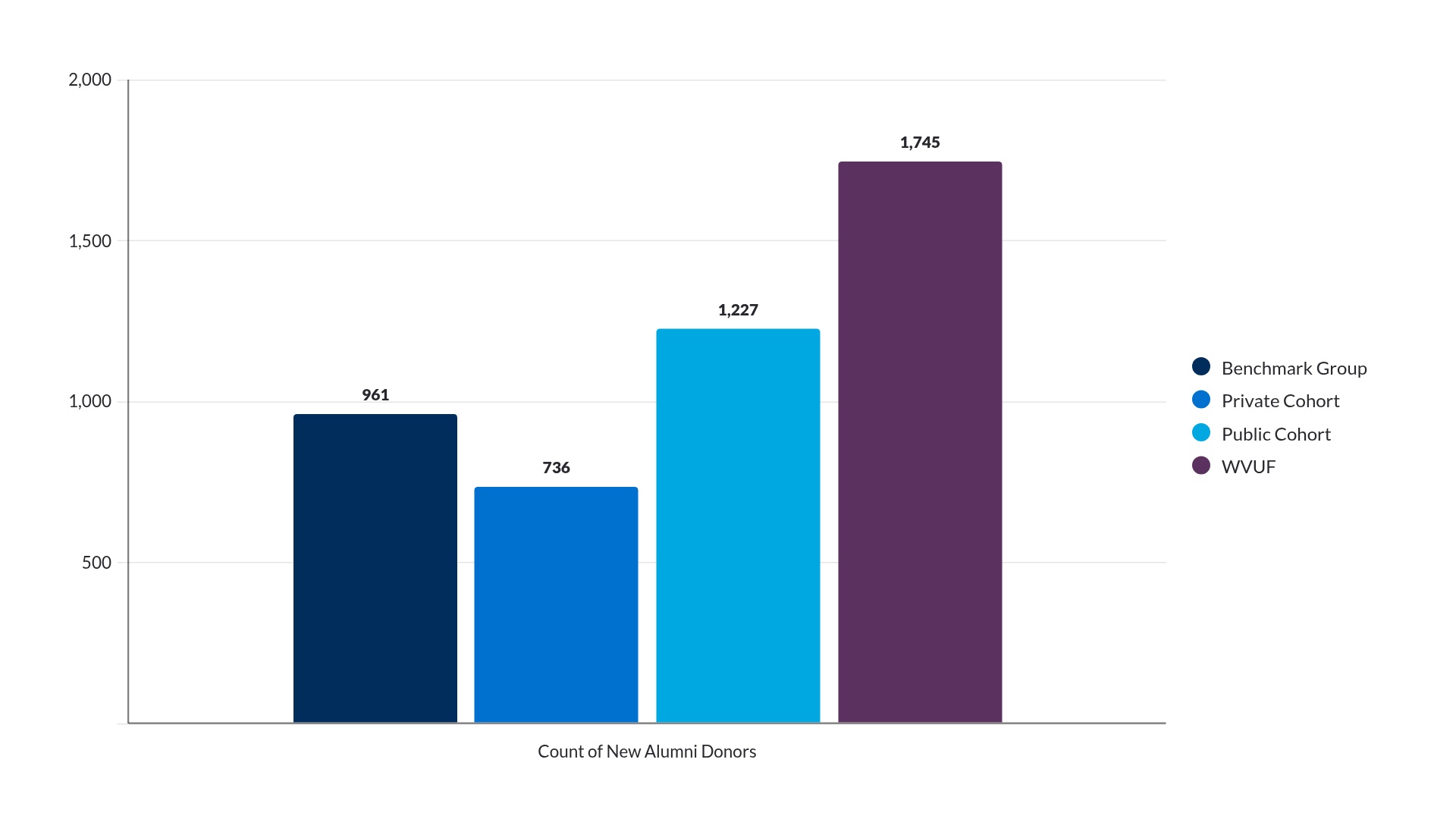
    WVUF’s count of 1,745 new alumni donors last fiscal year was well ahead of the benchmark group and the Foundation also received first-time gifts from an impressive count of more than 5,000 family and friends.

    Q: As you think about acquisition, what’s working for you? What are the campaigns or messages that actually convert?

    Kristen Shipp: WVU Day of Giving has been one of the key drivers in acquiring new donors. Each participating group is highly engaged on social media and takes full advantage of the challenges to inspire alumni and friends to give. Another effective strategy is peer-to-peer fundraising, which allows individuals to promote specific initiatives within their own networks, creating a more personal and powerful connection to the cause.

    Q: How are you approaching stewardship with new donors?

    KS: Our donor engagement team leads first-time donor stewardship by sending personalized messages through ThankView. This has been an effective stewardship strategy that has helped us strengthen donor retention. Overall rates have improved since our last RNL360, and retention among new alumni donors is up more than ten points.

    Median gifts on the rise

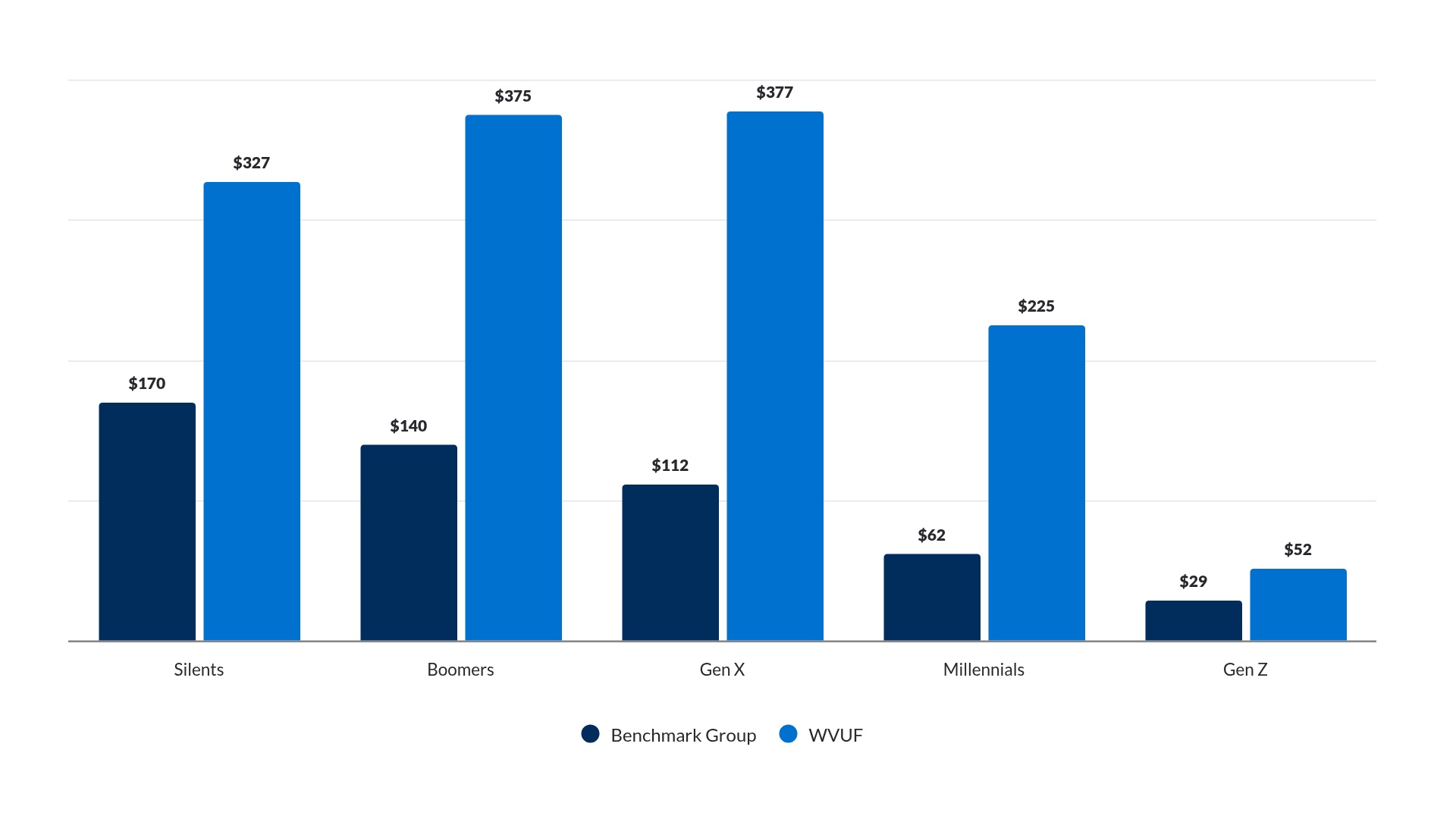
    We know that while younger generations are philanthropic, and many have capacity to make bigger gifts, most are directing their philanthropy elsewhere—giving to other causes and charities. WVUF has increased median gift amounts across all generations.

    Q: Are there one or two strategies you’ve found successful in driving movement with gift amounts? Any that are especially effective with younger generations?

    RNL 360 BenchmarkRNL 360 Benchmark

    KS: While the area of greatest need will always remain a priority, we also strive to provide opportunities throughout the year for alumni and donors to give to areas that align with their personal interests. Through our recent alumni survey, fielded by RNL, we learned that many are particularly interested in supporting mental health services, the student emergency fund, and initiatives that assist first-generation students. These priorities are featured in WVU Day of Giving, and we also leverage crowdfunding and peer-to-peer fundraising to raise awareness and support for these important areas.

    Practical, real-world application

     Alumni Donors  Alumni Donors
    Loyal donors = At least five years of consecutive giving.
    New donors = No gift history or no giving in the last decade.

    Q: Can you share a couple of specific ways that you are using the RNL360 outputs? Is the data helpful across teams and departments?

    KS: Through RNL360, we learned that in FY25, 44% of our individual donors were alumni. This reinforces the importance of developing audience-focused strategies for our annual giving campaigns to ensure our messaging resonates with both alumni and non-alumni donors. Another helpful insight was the number of new alumni donors—only 30% were graduates from the last decade. This highlights the need to better connect recent graduates with causes they’re passionate about and to engage them through the communication channels they prefer.

    Keeping the faith and focus

    Q: Circling back to the unsettling times…you’ve experienced a lot of change at WVU and the Foundation. What helps you reduce the noise and stay focused? Anything professionally or personally that helps keep you positive and motivated?

    KS: There have been many changes at WVU and the WVU Foundation, but with change comes new opportunity. I feel incredibly fortunate to be expanding the Annual Giving team by welcoming new staff members. It’s exciting to build a team that shares the same vision, drive, and passion—and to have fun together along the way. I like to keep things light and engaging, so whenever the moment allows, you’ll probably catch me sharing a funny movie quote or GIF with my teammates.

    Ready to increase engagement with your donors?

    Webinar: Starting at the Source: A Look into Data-Driven Paths to Donor GrowthWebinar: Starting at the Source: A Look into Data-Driven Paths to Donor Growth

    Reach out to us today, and we’ll set up a time to discuss your best fundraising strategies. Our strategists can discuss how to optimize your fundraising strategies with the right data, how you can have a great Giving Day, and much more.

    Or watch our webinar, Starting at the Source: A Look into Data-Driven Paths to Donor Growth, where we dive into more detail on insights we’ve learned from an analysis of more than six million cohort records.

    Talk with our fundraising experts

    Let’s talk about how you can increase donor engagement and strengthen your donor pipeline. Ask for a free consultation with our experts.

    Schedule consultation

    Source link

  • ASALH Brings Annual Conference to Atlanta Amid Attacks on Black History Education

    ASALH Brings Annual Conference to Atlanta Amid Attacks on Black History Education

    The Association for the Study of African American Life and History (ASALH) will convene its annual conference in Atlanta from September 24-28, 2025, bringing together Black leaders, academics, educators, and community members during what organizers describe as a “critical hour” for Black history and education.

    TDr. Stephanie Y. Evanshe conference, themed “African Americans and Labor,” comes as educational institutions nationwide face mounting pressure over diversity, equity, and inclusion initiatives, and as several states have enacted legislation restricting how race and racism can be discussed in classrooms.

    The conference will feature several prominent voices in African American studies and social justice, including Pulitzer Prize-winning historian Dr. Edda Fields-Black and scholar-activist Dr. Ibram X. Kendi. Labor organizer Chris Smalls, who led the successful effort to form the first independent union at an Amazon warehouse in the United States through the Amazon Labor Union, will headline the Friday John Blassingame Luncheon.

    Other featured speakers include historians Drs. Peniel Joseph, Maurice Hobson, Stephanie Evans, and Joe Trotter Jr., along with civil rights leaders Ambassador Andrew and Andrea Young and Rev. Jamal Bryant.

    A key component of the conference programming will address current challenges facing educators and institutions seeking to teach Black history. Specialized sessions will provide guidance to librarians, teachers, and community organizers on establishing Freedom Schools and teaching Black history “in the current challenged national environment.”

    Dr. Peniel JosephDr. Peniel JosephThe Wednesday plenary session, “The Fire Now!,” will specifically examine how budgets and policies are “Undermining Preservation of the African American Experience,” featuring experts from the National Parks Conservation Association, Trust for Public Land, and the U.S. Department of the Interior.

    “Our goal is to make as many of the activities free and accessible to the public as possible,” organizers announced, with Wednesday sessions, plenaries, film festival screenings, poster sessions, and vendor exhibits offered at no charge.

    Thursday’s plenary, “Towards a Theory of Liberation: The State of Black Radicalism Today,” will feature scholars Drs. Charisse Burden-Stelly, Gerald Horne, Akinyele Umoja, Joy James, and Ashley Howard examining contemporary Black liberation movements.

    Friday’s session will honor the scholarship of historian Dr. Joe William Trotter Jr., a leading expert on African American labor history and urban studies.

    A Saturday luncheon titled “An Unusual Emphasis on Scholarship: Carter G. Woodson, Omega Psi Phi, and the Power of Black History” will explore the legacy of ASALH’s founder and the role of Black Greek letter organizations in preserving African American history.

    Registration for the ASALH Conference is open, with both free and ticketed events available. The annual gathering represents one of the premier venues for African American historical scholarship and community engagement in the United States.

    Source link

  • 2025 Annual Conference Cancellations and Substitutions

    2025 Annual Conference Cancellations and Substitutions

    2025 Annual Conference

    2025 Annual Conference Cancellations and Substitutions

    Use this form to cancel your conference registration or to designate a substitute attendee. See the conference registration policies for more information.

    The post 2025 Annual Conference Cancellations and Substitutions appeared first on CUPA-HR.

    Source link

  • ACE strikes a fighting stance at annual conference

    ACE strikes a fighting stance at annual conference

    WASHINGTON, D.C.—Hundreds of higher ed leaders packed into the Kennedy Center for the annual American Council on Education conference this week, snapping photos of the large bust of the cultural center’s namesake, President John F. Kennedy, in the foyer. Some joked that it would soon be replaced by Donald Trump’s likeness, given the current president’s takeover of the Kennedy Center board, a move announced Wednesday.

    But it was Trump’s attempted takeover of higher education that was foremost on the minds of attendees.

    The Republican president, now in his second nonconsecutive term, dominated conference discussions as speakers grappled with how to interpret and respond to a vision for higher education that has been marked by cuts to research funding and personnel; the decimation of diversity, equity, and inclusion initiatives; and efforts to dismantle the U.S. Department of Education.

    “We’re under attack,” ACE president Ted Mitchell said in his opening remarks.

    He pointed to a flurry of executive orders and other recent actions that have caused “confusion and dismay” across the sector, as the Trump administration attempted to freeze federal funding and change research reimbursements, creating financial uncertainty for colleges.

    “These executive orders are an assault on American opportunity and leadership,” Mitchell said.

    He warned that such changes could destabilize higher education by undermining research, innovation, intellectual independence and autonomy.

    “The flurry of these threats [is] designed to cower us into silence,” he said.

    Mitchell also noted that ACE, along with other associations and several research universities, filed a lawsuit Monday against the National Institutes of Health for attempting to cap reimbursements for indirect research costs. While that lawsuit is pending, a federal judge has already prevented the cap, at least temporarily, in response to other litigation.

    In the face of such chaos and instability, Mitchell emphasized the importance of unity, urging conference goers to beware of attempts to sow discord among institutions. “We will only succeed if we stick together,” he said.

    He also pushed back on Trump’s attacks on diversity, equity and inclusion initiatives, which have already led some colleges and universities to scrub DEI language from websites, shutter offices and cancel events.

    “We can’t be apologetic of diversity. We just can’t,” Mitchell said.

    But even as he blasted some of Trump’s recent actions, he noted that ACE is also seeking common ground with the administration.

    “I continue to believe that there are important areas of policy where we can and must work with this administration. We will work to find those openings wherever we can,” Mitchell said.

    His remarks came a day after dozens of college presidents attended ACE’s inaugural Hill Day, where they met with congressional staff to learn and advocate for policy priorities.

    The Policy Outlook

    The notion of higher education being under siege was prevalent across numerous sessions, including in a Thursday policy update from Jon Fansmith, senior vice president of government relations and national engagement at ACE, who broke down recent actions and Republican priorities.

    Fansmith noted that Trump has sought to reshape higher education through a series of executive orders, investigations and attempts to defund and destabilize the sector.

    “We are not used to the wheels of government moving this quickly and impactfully,” he said.

    Despite the sense of alarm roiling the sector, Fansmith said “growing opposition” has emerged. In some cases, it’s been bipartisan, with congressional Republicans joining Democrats in expressing concern over how changes to federal funding or research dollars may harm their local institutions and employers.

    Additionally, Fansmith pointed out that the Trump administration has been sued repeatedly—at least 58 times, by his count—and that successful lawsuits have slowed the president’s rapid-fire attacks.

    Fansmith also noted that Trump’s nominees to lead the Department of Education, Linda McMahon as secretary and Nicholas Kent as under secretary, are more seasoned operators than other Trump World figures. McMahon’s Senate confirmation hearing took place Thursday.

    “She is not a firebrand; she is not the person who is going to blow things up,” Fansmith said, noting McMahon’s background as a longtime professional wrestling executive and prior head of the Small Business Association during Trump’s first term. But given Trump’s desire to dismantle or diminish the Education Department, McMahon “may be ordered to blow things up,” he said.

    Of Kent, a former for-profit college advocate and past staffer for Virginia governor Glenn Youngkin, Fansmith said he was “very passionate, deeply informed and highly intelligent.”

    Hope Amid the Challenges

    The conference also touched on a range of challenges beyond the turbulence of the Trump administration, including free speech, campus antisemitism, demographic changes and more.

    In a discussion Wednesday, Wesleyan University president Michael Roth weighed in on the state of free speech in higher education and questioned recent efforts by Trump to go after universities for alleged antisemitism, including threats of investigations and financial penalties.

    Roth, who is Jewish, acknowledged the existence of some antisemitism on college campuses, but argued that Trump’s efforts to address it were “disingenuous”—more of a cover for going after pro-Palestinian protesters who expressed concern about the bloodshed in Gaza.

    While he noted that college leaders need to be cautious, he advised them not to cower.

    “Not standing up for your mission in the long run won’t help your institution,” Roth said.

    In a panel Thursday on the challenge that shrinking demographics pose to higher education, experts noted enrollment pressures will continue as the number of high school graduates continues to decline. But rather than a demographic cliff, higher education will likely see a gentler slide, they said.

    Nathan Grawe, an economics professor at Carleton College, argued that the enrollment decline “won’t hit us all at once” but rather “little by little,” with incremental challenges year over year.

    Other panelists noted that workforce challenges won’t diminish along with the number of high school graduates, meaning that colleges will need to focus on enrolling and retaining more adult learners.

    For all the doom and gloom surrounding the policy discussions, the conference concluded on a high note. In his closing remarks, Freeman Hrabowski, an ACE Fellow and president emeritus of the University of Maryland Baltimore County, emphasized the importance of hope.

    He encouraged attendees to “use our heads and our hearts” to meet the moment, reflecting on his experience in 1963, when at the age of 12 he was jailed for participating in a civil rights march in Birmingham, Ala. Looking back more than 60 years later, Hrabowski said it was his faith and determination that helped him know then that “we would be OK.”

    He encouraged others to channel their own optimism amid turbulent times.

    “Don’t you dare allow the toxicity of some people to leave you hopeless,” Hrabowski said.

    Source link

  • 2025 UPCEA Annual Conference – Collegis Education

    2025 UPCEA Annual Conference – Collegis Education

    Higher education is evolving, and institutions need innovative strategies to keep up with shifting learner expectations. That’s why Collegis Education is excited to attend the 2025 UPCEA Annual Conference, the premier event for leaders in professional, continuing, and online education. This conference brings together experts and decision-makers to explore the latest trends, technologies, and strategies that are transforming higher ed.

    Why Attend the 2025 UPCEA Annual Conference?

    This conference is a must-attend event for higher ed leaders looking to stay ahead of the curve in online learning, workforce development, and digital transformation. Key themes include:

    • Data-Driven Decision-Making – Leveraging analytics to improve student outcomes and enrollment strategies.
    • Technology & Digital Transformation – Implementing scalable solutions to enhance the student experience.
    • Workforce-Aligned Learning – Creating programs that meet the evolving needs of students and employers.
    • Marketing & Enrollment Growth – Adapting strategies to attract, engage, and retain today’s learners.

    Collegis Education brings the expertise and proven strategies to help institutions overcome enrollment challenges, optimize operations, and drive sustainable growth.

    Where to Find Us

    Our team will be on-site, ready to connect and discuss how Collegis can help your institution navigate the complexities of online education, marketing, and student success.

    Want to meet up? Let’s schedule a time to chat! Contact us to book a meeting.

    We look forward to seeing you in Denver!

    Source link

  • Finding Shared Purpose at the 2024 Annual Conference

    Finding Shared Purpose at the 2024 Annual Conference

    by Julie Burrell | October 9, 2024

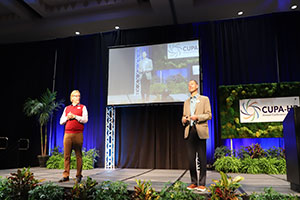
    At the CUPA-HR Annual Conference and Expo 2024, the three keynote sessions offered insights on how higher ed can articulate its value proposition for employees. How can HR, campus leaders and other culture architects ensure their institutions are places where candidates want to work and where employees want to stay? And how can we bridge the cultural, political and intergenerational divides so many of us are experiencing on campus to help our communities thrive?

    There isn’t a one-size-fits-all solution to these challenges, but the keynote speakers reminded higher ed HR pros not to underestimate the value of a shared purpose. Here are a few of their insights into remaking workplace culture through deliberate community-building, connecting through traditions and reinforcing our collective values.

    Fighting Burnout and Finding Community

    Workplace culture strategist Jennifer Moss opened the conference in Orlando with a reminder that, while it’s been many years since the COVID-19 pandemic, its lessons still linger. During that time, many of us asked, is what I’m doing important? Does it make a difference?

    For so many in higher ed, the answer is yes. But Moss also shared a hard truth: the passion that leads people to work in higher ed may lead to burnout or passion fatigue. The solutions offered for burnout are often focused on the individual (“take a bath” or “meditate”), when they need to be systemic and even societal. Burnout isn’t about having a bad day — it’s chronic stress, classified as a disease by the World Health Organization. A strange irony is that burnout from overperforming at work often looks like underperformance (exhaustion, disengagement and cynicism).

    One solution that Moss proposed is to encourage employees to deliberately build stronger community and positive social connections, both essential to building bridges and combatting loneliness. According to the data Moss shared, eating just one lunch per week with coworkers, rather than alone at a desk, can aid employee happiness and performance. So can spreading positive gossip (saying nice things about others behind their backs), which subconsciously supports psychological safety.

    Takeaway: It’s key that workplaces tie efforts to reduce employee burnout to specific objectives and key results so that individuals aren’t responsible for solving the crisis on their own.

    Great Storytelling for a Shared Purpose

    Annual conference attendees experienced the magic of Disney firsthand during the closing night EPCOT excursion. But what makes Disney so magical? According to keynote speakers Jeff Williford and Jay Pyka of the Disney Institute, it’s all in the details. Disney excels in the finer points, with each park and resort providing a unique and immersive experience, from what music guests hear, to what smells are piped in, to the thatched roofs in Animal Kingdom made by South African artisans.

    How does Disney engage over 70,000 employees — aka, cast members — to ensure that the details are done right? While cast members’ jobs may be different, from serving food at EPCOT to directing riders on Space Mountain, they all share in one common goal: creating happiness. In their talk, Williford and Pyka emphasized that culture is defined by how people behave, and training is critical to achieving desired behaviors. Caring and communication are also vital elements of culture. The extent to which organizations genuinely care for their people is the extent to which those people will, in turn, care for customers and each other. And high-quality communication can reinforce culture as much as lack of communication will undermine it.
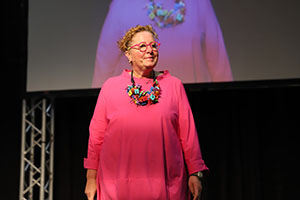
    Disney uses their expertise in storytelling to train and unite cast members in the common goal of creating happiness and embracing Disney culture. In fact, the first class new employees attend as part of their onboarding is one on Disney traditions because it helps them connect with the history and culture.

    Takeaway: Higher ed workplaces can create a powerful connection between employees and the institution’s mission, fostering a sense of belonging and commitment.

    Gen Z and the Future of Work

    In her closing keynote, Heather McGowan, a future-of-work expert, offered a hopeful vision of work — and of a society where more of us are united than divided. But she also admitted that “it’s difficult to be a human right now.” There’s a profound lack of connection among people, an uptick in loneliness and disconnection, and social divisions stemming from the pandemic, politics and social media.

    Why? One reason is that work has replaced what people once found in community, whether through church or bowling leagues or book clubs. McGowan said that’s why current and future generations entering the workforce seek jobs that reflect the totality of their values and personality.
    Gen Z is especially known for seeking greater meaning in work. They desire mentorship, they want to be part of something bigger than themselves (meaning), and they want to live their values through work (mission). They’re rejecting the work contract of previous generations, which promised job security in exchange for employee loyalty. Why, McGowan asked, are workplaces still demanding loyalty without offering the same security they did in previous generations?

    In asking for work to be meaningful, Gen Z is sending a critical lesson for the future of work, McGowan believes, one that workplaces need to take seriously to recruit new employees and retain existing ones. The data show that what employees want most in a job is growth, autonomy, achievement and respect.

    Takeaway: The future of work might just be in listening to what Gen Z is trying to convey: We all need a shared purpose and meaning in work.  

    Looking for More on Work Culture?

    Jennifer Moss’s new book, Why Are We Here?: Creating a Work Culture Everyone Wants, will be published in January. You can also check out these CUPA-HR articles and resources:


    Source link

  • The annual graduation rate post

    The annual graduation rate post

    I know I’ve been barking up the tree of “Graduation Rates are inputs, not outputs” for a long time.  And I know no one is listening.  So I do this, just to show you (without the dependent variable) just how unsurprising they are.

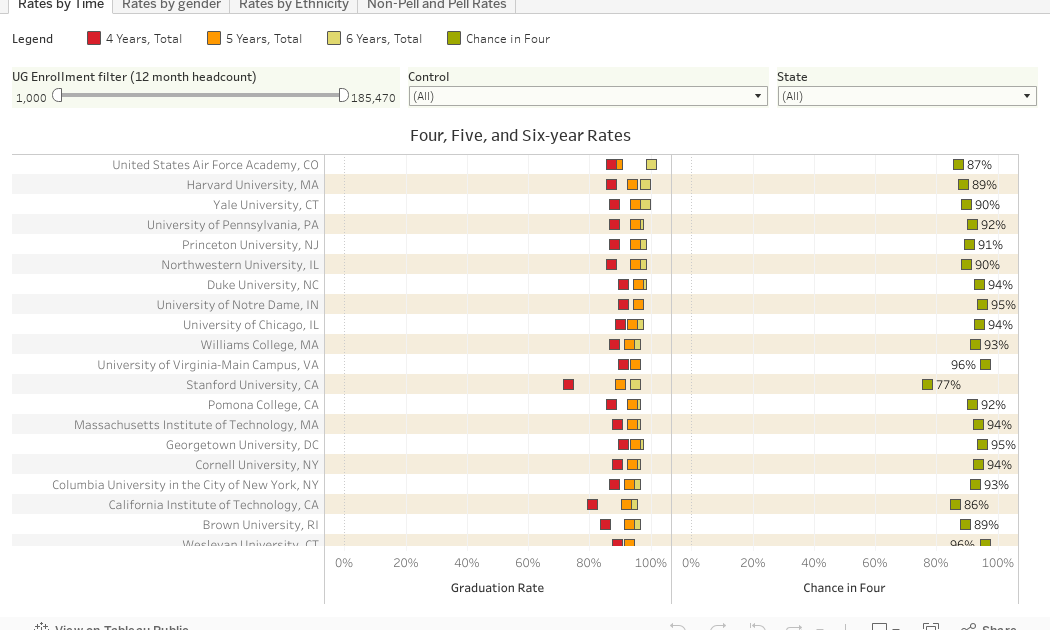
    Here are four views of graduation rates at America’s four-year public and private, not-for-profit colleges and universities. And I’ve put them in four views, with several different ways to look at the data.

    The first (using the tabs across the top) shows four-, five-, and six-year graduation rates on the left, and “Chance in four” on the right.  In other words, since everyone pretty much thinks they’re going to graduate from the college they enroll in as a freshman, what are the chances of graduating in four years, rather than six?  There are some surprises there, as you’ll see.

    On all the visualizations, you can apply filters to limit the colleges you’re looking at.  The scroll bar (to move up or down) is on the right but it’s sometimes hard to see.  And the size slider is set to a minimum of 1,000 students, but you can change that; just beware that small colleges often have wonky data, for several reasons.

    The second view shows six-year rates by gender.

    The third view breaks out six-year rates by ethnicity, comparing African-American, Hispanic, and Asian rates (the shapes) to the rate for White students (on the gray bars).

    And the final view breaks out six-year rates by Pell Grant status, then shows the gap between the two on the right. On the gap chart, a negative number shows colleges where Pell graduation rates are higher than non-Pell rates.

    Enjoy! 

    Source link

  • Three Questions to Help You Build a Better Workplace Culture — Annual Conference Takeaways – CUPA-HR

    Three Questions to Help You Build a Better Workplace Culture — Annual Conference Takeaways – CUPA-HR

    by CUPA-HR | October 18, 2023

    Culture was at the heart of the three keynote events at CUPA-HR’s 2023 national conference, which took place recently in New Orleans. Our keynote speakers asked thought-provoking questions that resonate with higher ed HR’s mission. Engaging with these questions can help you boost employee engagement, promote a culture of inclusivity and strengthen collaboration with your campus colleagues.

    1. Are You Creating an Ecosystem of Opportunity?

    Organizations with strong learning cultures tend to have significantly higher retention rates.

    In her keynote presentation on employee retention, business strategist and author Erica Keswin pointed out that the days of climbing the same corporate ladder for 50 years are long gone. Organizations are flatter, which means you need to get creative to give people opportunities to move not only up, but sideways, helping them gain new skills and find new pathways for their careers. Instead of thinking “ladders,” Keswin said, think “lilypads.”

    She also encouraged attendees to talk about employee learning opportunities early and often, beginning with their onboarding programs! Managers should be talking regularly with employees about what skills they want to learn and giving them the opportunity to learn with no strings attached.

    The mission, values and priorities of higher education have learning at their core, and that culture of learning is a value proposition higher ed is uniquely positioned to provide as an employer. Make it work to your advantage by prioritizing learning and opportunity for all employees.

    Another key takeaway from Keswin’s presentation was the importance of being a “human professional” and checking in with your team on a regular basis. She shared the story of a company that starts team meetings with a quick check-in called “Pick Your Nic.” Referring to a popular meme of Nicolas Cage images representing different feelings (happy, relaxed, excited, focused, stressed, meh, etc.), each person picks the Nic that represents how they’re feeling that day. The goal isn’t to address the responses in the meeting, but rather to give the team leader the opportunity to take a pulse and to give team members the opportunity to be seen and heard.

    You’ll find more retention strategies in Keswin’s new book, The Retention Revolution: 7 Surprising (and Very Human!) Ways to Keep Employees Connected to Your Company. And be sure to check out the article “The Higher Ed Employee Retention Crisis — and What to Do About It” in the fall issue of Higher Ed HR Magazine.

    2. Are You Treating Diversity as a Problem to Be Managed or a Value to Be Cherished?

    When it comes to creating and sustaining a more inclusive culture, Princeton professor and religion scholar Dr. Eddie S. Glaude Jr. prompted attendees to consider a question: Do you view diversity as a problem to be managed or a value to be cherished?

    Through a problem-solving lens, we might see diversity as a series of goals to be met and obstacles to be overcome. Through the lens of a cherished value, on the other hand, we are more likely to see every situation as an opportunity to expand and celebrate diversity of people and ideas. A problem-solving lens divides “us” from “others,” while a value-based lens sees diversity as constitutive of who we are, as a people, a country and an institution. Instead of envisioning inclusion as something undertaken in response to a mandate or in compliance with a law, what if diversity was seen as key metric of an institution’s success?

    The data support the positive impact of diversity on metrics like productivity and creativity in the workplace, and Glaude urged higher education to also view diversity as an integral part of its core identity and a reflection of its regional or national reach.

    To see how your institution compares to others when it comes to composition of your workforce and pay equity for employees, see the results of CUPA-HR’s signature surveys.

    3. Are You Ramping Up Retention Efforts in Your Most Vulnerable Departments?

    Retention and recruitment were on everyone’s mind at CUPA-HR’s annual conference. The closing panel discussion brought together leaders in student affairs, campus facilities and IT and provided insights on how HR can partner with these campus constituencies to support a culture of belonging. Here are a few of their recommendations:

    Provide training opportunities.

    John O’Brien, president of EDUCAUSE, which represents IT professionals in higher ed, stressed the importance of career pathways to support employees’ desire to grow in their careers.

    Noting that “supervisors will make or break us,” Lander Medlin, president and CEO of APPA, which serves the needs of facilities professionals, stressed the critical role that supervisor training has on retention and workplace culture in facilities, where the aging of the skilled craft workforce has posed unique recruitment and retention challenges, and all areas.

    Ensure employees feel they belong and are valued.

    No matter their role on campus, employees want their opinions to be heard and valued.

    Kevin Kruger, president of NASPA, the association for student affairs administrators in higher education, noted that millennial and Generation Z employees especially want to feel cared about at work and to believe their opinions matter. Today, as all student affairs professionals find themselves on the front lines of the mental health crisis, they need supervisors who have the skills to meet them where they are and to create a culture of belonging.

    Medlin seconded the importance of feeling heard when it comes to job satisfaction. She would ask supervisors this question: Are you a coach and mentor, or are you a boss?

    Offer job flexibility.

    Some campus jobs don’t easily lend themselves to remote work, but that doesn’t mean institutions can’t build in flexibility, which CUPA-HR found is a key retention factor.

    For example, facilities employees might take advantage of a compressed workweek, with employees having the option to work four 10-hour shifts.

    Since student affairs professionals often work outside of a typical nine-to-five day, there’s room for remote work. In fact, students might prefer to meet with student affairs professionals remotely.

    If year-round remote work isn’t a possibility, seasonal flexibility might be. When students are off campus during holiday and summer break, your staff might be able to work from home.

    See employees as a strategic asset (and pay them accordingly).

    The three areas represented by the panel — IT, facilities and student affairs — are among the most vulnerable to turnover and recruitment challenges on most campuses. How can HR lead the way in creating a culture that positions these employees as strategic assets? The panel offered these suggestions, based on their unique perspectives:

    • O’Brien encouraged satisfaction surveys. Find what’s working well and replicate it.
    • Kruger recommended streamlining job searches, posting salary ranges, and focusing on internal pay equity and livable wages.
    • Medlin asked conference attendees to help us help you. How we treat people matters, and HR leads the way in building that culture of belonging.


    Source link

  • Three Take-Home Messages From the 2022 Annual Conference – CUPA-HR

    Three Take-Home Messages From the 2022 Annual Conference – CUPA-HR

    by CUPA-HR | November 2, 2022

    Thank you to all who attended the CUPA-HR Annual Conference and Expo in person and virtually last week! It was wonderful to welcome new (300+ first-timers!) and familiar faces and to learn about successful projects and initiatives from higher ed peers at institutions across the country. 

    For those who weren’t able to attend, here’s some food for thought from our three outstanding keynote speakers:

    • Stand-Out Leadership — Opening keynote Sara Ross applied her passion for brain science to a key element of stand-out leadership: accountability. Ross explained that employees would rather have leaders who hold themselves accountable for their actions than perfect leaders. One way HR professionals can be stand-out leaders and hold themselves accountable is by using Ross’s SLOW strategy when responding to critical situations on campus. The SLOW strategy helps us respond in a way that is reflective of the positive impact we want to make in our roles as HR leaders.
      • S – Stop. Intercept your emotional reaction. Our brains are designed to process emotions first and logic second. By pausing and checking in with your emotions before responding to a situation, you prevent adding more fuel to the fire.
      •  L – Language. Check your body language. No really, look in the mirror! Pay attention to how you are presenting yourself. People are honed in on your body language, so you must make sure your body language is aligned with your message.
      • O – Oxygenate. Consciously slow your breathing to push back on your fight-or-flight instincts. Research shows that slowing down for as little as two minutes and deepening your breath can decrease the amount of cortisol in your system by up to 20 percent, which is essential when responding to an already stressful situation.
      • W – Wonder. Step outside your perspective and challenge yourself by thinking from someone else’s perspective. This simple practice helps reset our sensitivity and tap into empathy.
    • How to Citizen — Sunday’s keynote speaker, Baratunde Thurston, spoke about how racial injustices during the summer of 2020 motivated him to launch his podcast, “How To Citizen With Baratunde.” He challenged the audience to think about the word “citizen” as a verb rather than a noun. “Citizen” as a noun can carry divisive and exclusive undertones, but as a verb, it gives us something to do to improve our society. According to Thurston, there are four principles that serve as the foundation of how to “citizen.” The four principles are showing up and participating; investing in relationships with yourself and others; understanding power and what we give our power to; and to do all of these things to benefit our collective selves, not just our individual selves. What specific ways can you begin to “citizen” at your institution?
    • Reinvent HR — The take-home message from David Ulrich’s energizing talk about reinventing HR is that HR is not about HR, but about creating value for stakeholders inside and outside the organization (students, family, employers, community, alumni) so that our institutions and communities can succeed. Here are five ways HR can lead in this area: 1) Empower the next generation by making sure people feel better about themselves following their interaction with a leader, 2) Shape the future by establishing a compelling vision/mission, 3) Engage today’s talent by living the Es (empathy, emotion, energy, experience), 4) Make things happen by delivering on promises and creating a positive work environment, and 5) Invest in yourself so you can invest in others.

    Don’t Forget! Conference attendees can watch the sessions they missed or re-watch their favorites on demand. Recordings of our keynotes and livestreamed concurrent sessions are available for viewing in the desktop conference platform and the app.

    Be sure to save the dates for our Spring Conference, April 23-25 in Boston, and our 2023 Annual Conference, taking place October 1-3 in New Orleans! Registration details coming soon.


    Source link

  • Dr. Jennifer T. Edwards: A Texas Professor Focused on Artificial Intelligence, Health, and Education: FREE 11th Annual Texas Social Media Conference

    Dr. Jennifer T. Edwards: A Texas Professor Focused on Artificial Intelligence, Health, and Education: FREE 11th Annual Texas Social Media Conference

    Yes! I am excited! We are getting back into the training and development mode with the Texas Social Media Research Institute (and the Rural Communication Institute)! Are you looking for a FREE conference focused on social media and rural communication? Check out our conference schedule!

    Tuesday, November 2nd

    5pm – Journal Club (Discussing “Reality check: How adolescents use

    TikTok as a digital backchanneling medium to speak back against

    institutional discourses of school(ing).”

    Thursday, November 4th

    8pm – #TXSocialMedia Twitter Chat – Pumpkin Spice Lattes, Sweater

    Weather, and Autumn/Winter Social Media Outreach Strategies

    Monday, November 8th

    6pm – How Public Health Agencies in the United States in the United

    Kingdom Communicate with their Target Audience During the COVID19

    Pandemic (Presented by: Riley Odom, Megan Mackay, Erin McDonald,

    Bayley Chenault, Sydney Brown)

    8pm – How the Texas Department of Health and Safety and Colorado

    Department of Health and Environment are Communicating about

    Health During COVID19 (Presented By: Halie Hix, Shelby Hargrove,

    Magnolia Dunlap, Michaela Bierman, Steven Duncan)

    Tuesday, November 9th

    5pm – Journal Club – Discussing the article: “We (Want To) Believe in

    the Best of Men: A Qualitative Analysis of Reactions to

    #Gillette on Twitter”

    7pm – How the United States Federal Government and the State of Texas

    Communicate with the Public During the Pandemic (Presented by: Kristi

    Cortez, Jessica Thomas, Kennedy Onuam, Julia Nolen)

    Thursday, November 11th

    3pm – Neurodiversity at Work; Assignment Construction Strategies for

    Creative Thinkers in Online Teams (Presented By: Melanie Mason (University

    of Texas at Arlington)

    8pm – #TXSocialMedia Twitter Chat – Veterans Day and How the Military

    Engages the Public Through Social Media

    Thursday, November 11th

    11:59pm – #TXSocialMedia Undergraduate and Graduate Fellowship

    Applications Due

    Sunday, November 14th

    6:30 pm – How the Louisiana Department of Education and the Texas

    Education Agency are Communicating about Health During COVID19

    (Presented By: Katherine Mitchell, Audrey Morton, Jorge Irizarry,

    Audrey Morton, Morgan Maley, Christina Byrd)

    Monday, November 15th

    7pm – #TXSocialMedia LIVE: Let’s Network Session on Zoom –

    Social Media and Privacy – The Good, the Bad, and the Ugly

    Tuesday, November 16th

    1pm – Connecting & Engaging with Students –

    Presented By: Narissra Punyanunt-Carter & Dr. Ryan Martinez (Texas Tech University)

    3pm – Alzheimer’s (and Rural Health) Community Forum for Tarleton

    Staff and Faculty- Register online: alznct.news/ACF1116

    5pm – Journal Club – Discussing “Small Businesses Still Missing the Boat

    on Social Media and Internet Advertising.”

    Thursday, November 18th

    8pm – #TXSocialMedia Twitter Chat – National Rural Health Day –

    Innovative Ways Rural Residents Can Practice Preventative Care

    7pm – #TXSocialMedia LIVE: Let’s Network Session on Zoom – Innovative

    Ways TikTok Can Be Utilized in Education, Business, and Life

    Saturday, November 27th

    All Day – Use the Hashtag #ShopSmall for Small Business Saturday

    Monday, November 28th

    7pm – #TXSocialMedia LIVE: Let’s Network Session on Zoom –

    Social Media and Health – How Does Social Media Impact Our Health?

    Tuesday, November 30th

    12:30pm – Student-based Resourcing: Responding to Increased Needs as

    a Rural Institution (Presented by: Dr. Lora Helvie-Mason

    & Cameron Ellner, Tarleton State University)

    6pm – How the Texas Department of Health and Human Services

    and the State of Louisiana Department of Health are Communicating

    About Health (Presented By: Averill Hubbard, Zachary Mesa, Dylan

    Antonelli, Olivia Teague, Kyon Barnes)

    7pm – #TXSocialMedia LIVE: Let’s Network Session on Zoom –

    Hooked on Social: Social Media the New Kid’s Toy?

    Are They Becoming Hooked TOO EARLY?

    National Day of Giving – Give to the Rural Communication Institute and

    the Texas Social Media Research Institute

    National Mason Jar Day –

    Highlight Innovative Ways You Can Use Mason Jars

    (Use the #TXSocialMedia and #ThinkRuralComm hashtags)

    Save-the-Date & Call for Proposals

    The 12th Annual #TXSocialMedia Conference & the 3rd Annual Rural

    Communication Conference will be held on Friday, April 22, 2022 in Fort

    Worth Texas. Submit a Proposal – http://www.tinyurl.com/SMCCFP/

    Executive Director of the Texas Social Media Research Institute & Rural Communication Institute

    Source link