Tag: answers

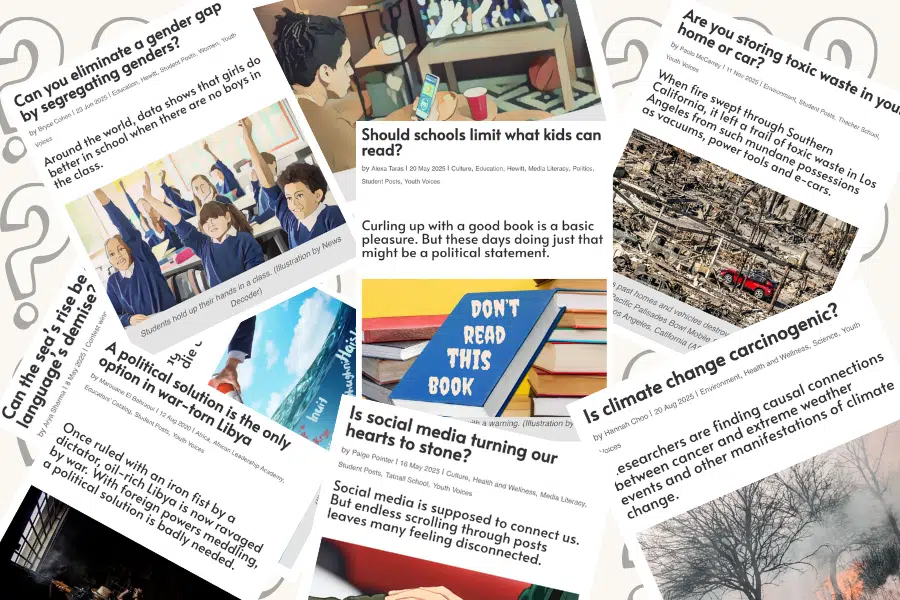
  • When young people ask big questions and seek answers

    When young people ask big questions and seek answers

    Cliffrene Haffner attended the African Leadership Academy (ALA) in South Africa during the Covid-19 pandemic. Her university applications were stalling and she felt stressed and anxious.

    “Life felt unstable, as if I were hanging by a thin thread,” Haffner said. But it was at ALA that she discovered News Decoder.

    “Joining News Decoder helped me rebuild my voice,” she wrote. “It created a place to write honestly and with purpose whilst supporting others in telling their stories. At a time when the world felt numb and disconnected, we used storytelling to bring back hope on campus by sharing our fears, thoughts and expectations.”

    At News Decoder, students work with professional editors and news correspondents to explore complicated, global topics. They have the opportunity to report and write news stories, research and present findings in global webinars with students from other countries, produce podcasts and sit in on live video roundtables with experts and their peers across the globe.

    Many get their articles published on News Decoder’s global news site.

    A different way of seeing the world

    Out of these experiential learning activities, they take away important skills valuable in their later careers, whatever those careers might be: How to communicate clearly, how to recognize multiple perspectives, how to cut through jargon and propaganda and separate facts from opinion and speculation.

    One milestone for many of these is our Pitch, Report, Draft and Revise process, which we call PRDR. In it, students pitch a story topic to News Decoder with a plan on how to research and report it. We ask them to identify different perspectives on problems they want to explore and experts they can reach out to for information and context.

    Then we guide them through a process of introspection, if the story is a personal reflection on their own experience, or a process of reporting and interviewing. News Decoder doesn’t promise students that their stories will get published at the end of the process. They have to work for that — revising their drafts until the finished story is clear and relevant to a global audience.

    One student who went through the process was Joshua Glazer, now a student at Emory University in the United States. Glazer came to News Decoder in high school as an exchange student in Spain with School Year Abroad.

    “I think the skills that I got out of that went on to really change the course of my education and how I view the world,” Glazer said. “Because when you step into the world of journalism you learn a different way of seeing the world.”

    Recognizing our biases

    Glazer learned that for journalism, he had to be less opinionated. “You have to really approach things kind of as they are in the world,” Glazer said. “And that is hard to do. That is not an easy skill that we can do as humans because we inherently have biases.”

    He said it challenged him to look inwards and recognize his biases and counter them with evidence.

    “So I think those skills have really changed the course of how I view having an argument with somebody because all of a sudden, you know, when you have an argument with someone, it’s all opinion,” he said.

    For Haffner, who is now a business administration student at Ritsumeikan Asia Pacific University in Japan, News Decoder reshaped how she and her peers understood storytelling.

    “It taught us to let go of rigid biases and to make authenticity the centre of our work,” Haffner said. “Students from different backgrounds found a space where their voices were heard, respected and valued. Our stories formed a shared map, each one opening a new room to explore, each voice strengthening the collective journey we were on. In that chaotic period, we created something meaningful together. Something bigger than us.”

    Working through the complexity of a topic

    Marouane El Bahraoui, a research intern at The Carter Center in the U.S. state of Georgia, also discovered News Decoder at the African Leadership Academy. At the time, he was interested in writing about the effectiveness of the Arab Maghreb Union — an economic bloc of five North African countries. He grew up in Morocco but didn’t want to approach the topic from a purely Moroccan perspective.

    “It was like a very raw idea,” he said.

    He pitched the story and worked with both News Decoder Founder Nelson Graves and correspondent Tom Heneghan to refine the idea. They guided him in the reporting and writing process.

    “One aspect that I liked a lot from my research was the people that I had the chance to talk to,” he said. “It was during Covid and I was just at home and I’m talking to, you know, professors in U.S. universities, I’m talking to UN officials, experts working in think tanks in D.C. and I was thinking oh those people are just so far, you can’t even reach them. And then you have a conversation with them and they’re just normal people.”

    He also found writing the story daunting. “It was a little bit overwhelming for me at the time,” he said. “You know, you’re not writing like an academic essay.”

    Graves encouraged him to write in a straightforward manner. In school, he had been taught to write in a beautiful way to impress.

    “From News Decoder, something I learned is to always keep the audience in mind who you are speaking to, who are you writing to,” he said.

    He took away the importance of letting readers make their own conclusions. “You’re not writing to tell the reader what to think,” he said. “You are writing to give them ideas and arguments, facts and leave the thinking for them.”

    Source link

  • The New COVID Vaccine Rules Leave Parents with More Questions than Answers – The 74

    The New COVID Vaccine Rules Leave Parents with More Questions than Answers – The 74


    Get stories like this delivered straight to your inbox. Sign up for The 74 Newsletter

    The federal government’s latest guidelines for COVID-19 vaccines make it difficult to know who, exactly, will be able to access shots this fall. While Health and Human Services Secretary Robert F. Kennedy Jr. and some of his staff claim anyone will be able to access a shot in consultation with their doctor, medical groups are warning that the new guidance will impact a broad swath of people, including postpartum people and healthy children.

    “For children and young adults that I see, there are constraints, and they are significant,” said Dr. Molly O’Shea, a pediatrician in Michigan and a spokesperson for the American Academy of Pediatrics (AAP).

    It might also take several more weeks to know who will be able to receive no-cost COVID-19 vaccines covered by health insurance. That decision partly depends on formal recommendations from a vaccine panel that isn’t scheduled to meet until mid-September. 

    Actions by the Food and Drug Administration last week mean that none of the COVID-19 vaccines that are slated to be on the U.S. market this fall will have an emergency use authorization that had allowed their quick (yet still rigorously tested) approval at the height of the pandemic. The removal of this designation means the drug company Pfizer will no longer offer COVID-19 vaccines to very young children, limiting parents’ brand options and potentially impacting supply.

    Moderna, Pfizer and Novavax, the three main COVID-19 vaccine manufacturers, have all shared news releases about what they’ve been approved to offer:

    • Moderna, Pfizer or Novavax will offer shots to anyone who is 65 and older, irrespective of medical history.
    • Pfizer will offer shots to anyone between the ages of five and 64 if they have at least one underlying condition that puts them at high risk for severe outcomes from COVID-19.
    • Moderna will offer shots to anyone between six months and 64 if they have at least one underlying condition that puts them at high risk for severe outcomes from COVID-19.
    • Novavax, the only company providing a non-mRNA COVID-19 vaccine, will offer shots to anyone between 12 and 64 if they have at least one underlying condition that puts them at high risk for severe outcomes from COVID-19.

    The vaccine panel known as the Advisory Committee for Immunization Practices (ACIP) is expected to make formal recommendations on these FDA-approved vaccines, and those recommendations have historically determined whether insurance providers will cover a vaccine at no cost under insurance.

    An HHS spokesperson did not immediately respond to a request for information and comment from The 19th, but in a post on X, Kennedy said: “These vaccines are available for all patients who choose them after consulting with their doctors.” Separately, USA Today reported on a document from HHS stating the FDA’s actions do “not affect access to these vaccines for healthy individuals. These vaccines remain available to those who choose them in consultation with their healthcare provider.”

    Dr. Marty Makary, FDA commissioner, added in a separate X post: “100% of adults in this country can still get the vaccine if they choose. We are not limiting availability to anyone.”

    But what that means practically for everyday people who want to access a COVID-19 shot — everything from whether their doctor will prescribe it, or if a pharmacy will be able to administer it, and whether there will be an out-of-pocket cost — is unclear for now. 

    How will it impact postpartum people?

    Pregnant people are expected to still have access to the vaccine because the CDC continues to list pregnancy as an underlying condition that puts an individual at high risk for severe outcomes from COVID-19. (The list of at least two dozen conditions also includes chronic health conditions and immunocompromised conditions.)

    But Kennedy, who has repeatedly questioned the safety of COVID-19 vaccines despite research that shows their effectiveness, announced in May that the CDC would no longer formally recommend such vaccines to pregnant people and healthy children, a move that seemed to contradict his own department

    Lactating and postpartum individuals must have an underlying medical condition to be eligible for one of the FDA’s approved vaccines, according to the American College of Obstetricians and Gynecologists (ACOG)’s understanding of the announcement. ACOG continues to recommend COVID-19 vaccination to people who are contemplating pregnancy, are pregnant, were recently pregnant or are now lactating.

    “We recognize that now, disappointingly, only lactating and postpartum individuals with an underlying condition will be eligible for vaccination. Still, it remains critical that pregnant patients receive the vaccines so that they are able to provide passive immunity from COVID-19 to their infants in those first few months of life before they can be vaccinated,” said ACOG President Steven J. Fleischman in an email.

    How will it impact healthy children?

    Healthy children will likely still be able to access the COVID vaccine, but the cost for a parent or guardian, as well as availability, will be impacted by these decisions.

    Charlotte A. Moser, co-director of the Vaccine Education Center at Children’s Hospital of Philadelphia, said parents who want to get their kids the COVID-19 vaccine should still be able to do so through what is called shared clinical decision-making in consultation with their child’s health care provider, according to the CDC’s current vaccine schedule. But it’s unclear whether this will change when ACIP meets again.

    But physicians who prescribe a COVID-19 vaccine outside of the parameters of how the FDA approved them would be OKing use of the shot “off-label” — a designation that means a medical product is being used outside of how the FDA approved it. That raises questions about access and cost. Physicians might not be willing to prescribe off-label because of concerns about liability.

    “I think that there will be a substantially smaller number of pediatricians, pharmacies, etc., who will be comfortable taking that risk,” O’Shea said.

    Dr. Dial Hewlett, medical director of tuberculosis services at Westchester County Department of Health in New York and a spokesperson for the Infectious Diseases Society of America, said an off-label prescription might also not be covered by insurance.

    “A mother or father can go in with their child and say, ‘I’d like for them to have the vaccine,’ but they may be told, ‘Well we’ll give it, but you’re going to have to pay $200,’” he said.

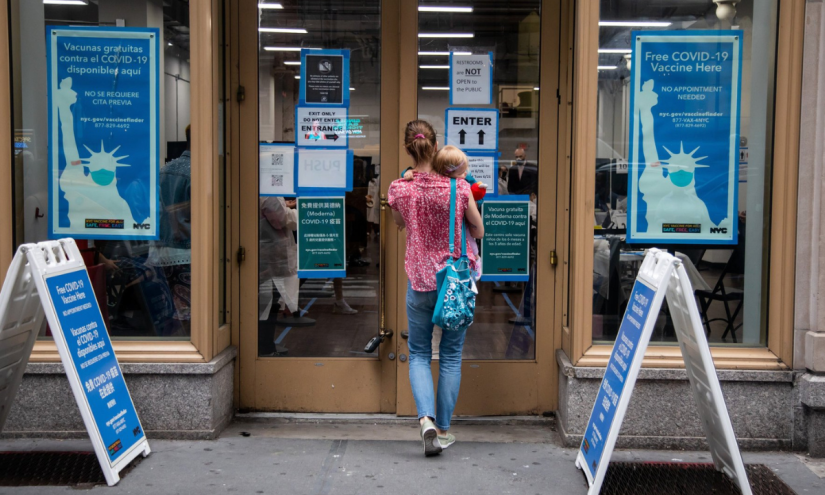
    The science on COVID vaccines has consistently indicated they are safe for children to receive.
    (Joseph Prezioso / AFP / Getty Images)

    Depending on the circumstances, pharmacists may also not be able to provide off-label vaccines. Some states tie pharmacist immunization authority to FDA approval,which has the potential to create a hodgepodge of access. The New York Times reported that CVS and Walgreens, the country’s largest pharmacy chains, have begun restricting COVID-19 shots in some states to people with a prescription. 

    “There may be some variability from state to state, but it’s a big barrier if FDA approval is not there, and the FDA approvals have been pulled back from where they were previously,” Hewlett said.

    The FDA announcement is “concerning,” added Moser, who noted that limiting Pfizer’s vaccine will make it more difficult for all children to get a COVID-19 vaccine this year because of anticipated supply limitations.

    O’Shea, the pediatrician in Michigan, said her office is currently deciding how many COVID-19 shots to stock, and it’s proving tricky as they weigh the cost vs. demand — the percentage of children under 18 getting the shot is under 15 percent.

    “Figuring out how much we want to have at any one time, and how we are going to give it to people — this really makes it a lot more complicated,” she said.

    What happens next?

    Moser said the announcement adds confusion for providers and families, and noted that the unilateral approach by Kennedy so far when it comes to vaccine policy “removes hundreds of voices of clinicians and scientists that were part of the process.” Moser recently served on ACIP and is among the members that Kennedy removed. He has replaced the panel with people who do not have relevant experience.

    “That army of voices ensured a process informed by clinical experience and scientific expertise to which the small group making these decisions now cannot possibly compare,” she said in an email.

    The revamped ACIP panel is scheduled to meet over two days beginning on September 18. Republican Sen. Bill Cassidy, a doctor who is chair of the Senate Health, Education, Labor, and Pensions (HELP) Committee, is now questioning whether that panel has enough legitimacy to meet, especially amid a leadership shakeup at the Centers for Disease Control and Prevention

    “Serious allegations have been made about the meeting agenda, membership, and lack of scientific process being followed for the now announced September ACIP meeting,” he said in a statement. “These decisions directly impact children’s health and the meeting should not occur until significant oversight has been conducted. If the meeting proceeds, any recommendations made should be rejected as lacking legitimacy given the seriousness of the allegations and the current turmoil in CDC leadership.”

    AAP called Kennedy’s latest COVID guidelines “deeply troubling” and urged COVID vaccine decision-making to remain between medical experts and families. 

    Dr. Susan J. Kressly, president of AAP, said in a statement that any barrier to COVID-19 vaccination as the nation enters the respiratory virus season creates “a dangerous vulnerability for children and their families.”

    “Any parent who wants their child vaccinated should have access to this vaccine,” she said, adding that HHS’ action “not only prevents this option for many families, but adds further confusion and stress for parents trying to make the best choices for their children.”

    This story was originally reported by Barbara Rodriguez of The 19th. Meet Barbara and read more of their reporting on gender, politics and policy.


    Get stories like these delivered straight to your inbox. Sign up for The 74 Newsletter

    Source link

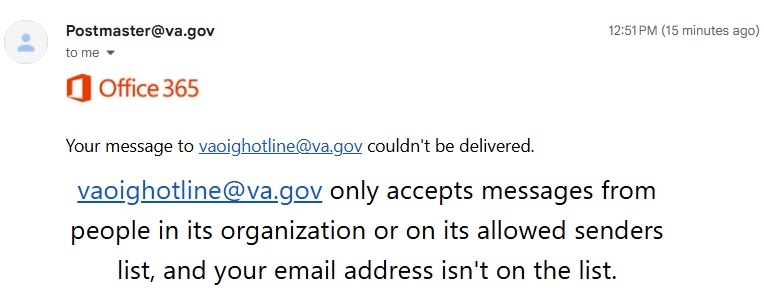
  • VA Office of Inspector General no longer accepting emails and VA chatbot has no answers.

    VA Office of Inspector General no longer accepting emails and VA chatbot has no answers.

    The Department of Veterans Affairs, Office of Inspector General (VA OIG), is no longer accepting tips from veterans who have been ripped off by predatory subprime colleges–at least not via email. The Higher Education Inquirer, at one time, was an important source for information for the VA OIG, but the VA’s watchdogs stopped corresponding with us a few years ago for no apparent reason. This failure to communicate is part of a longstanding pattern of indifference by the US Government (VA, DOD, ED, and DOL) and veterans’ organizations towards military servicemembers, veterans, and their families who are working to improve their job skills and job prospects.   

    VA’s chatbot also has much to be desired.

    Source link

  • FIRE demands answers from Trump admin officials on arrest of Mahmoud Khalil

    FIRE demands answers from Trump admin officials on arrest of Mahmoud Khalil

    FIRE Letter to Trump Administration Officials on Detention of Mahmoud Khalil

    March 10, 2025

    The Honorable Marco Rubio
    Secretary of State
    U.S. Department of State
    2201 C St., NW
    Washington, DC 20520

    The Honorable Kristi Noem
    Secretary of Homeland Security
    U.S. Department of Homeland Security
    Office of the Executive Secretary 
    Mail Stop 0525  
    Washington, DC 20528 

    The Honorable Pamela Bondi
    Attorney General
    U.S. Department of Justice
    950 Pennsylvania Ave, NW
    Washington, DC 20530

    Mr. Todd Lyons
    Acting Director, ICE Leadership
    U.S. Immigration and Customs Enforcement
    500 12th St., SW 
    Washington, DC 20536

    Dear Secretary Rubio, Attorney General Bondi, Secretary Noem, and Acting Director Lyons:

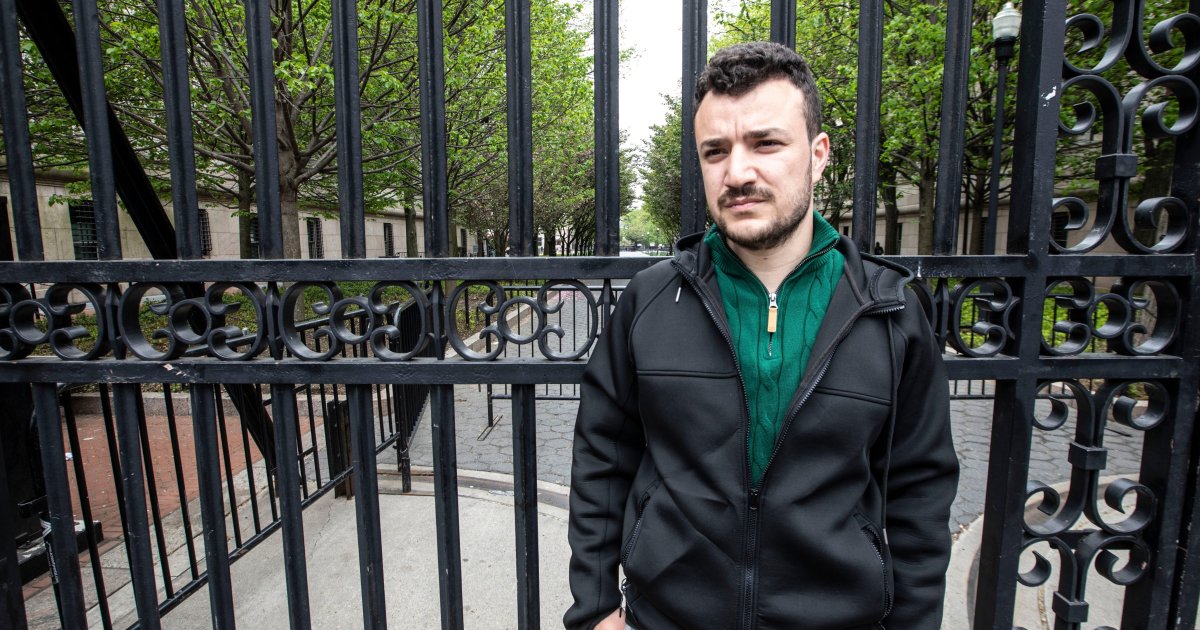
    On March 8, agents from the Department of Homeland Security arrested Mahmoud Khalil, a lawful permanent resident of the United States who has been involved in activism related to the current conflict in Gaza.[1] According to Mr. Khalil’s attorney, the agents who arrested him initially said his visa had been revoked.[2] Upon being informed that Mr. Khalil is a lawful permanent resident, whose status therefore cannot be revoked by unilateral DHS action, the agents arrested him anyway. When Mr. Khalil’s attorney asked to see a warrant for his arrest, DHS declined to produce one.[3] As of this writing, Mr. Khalil remains in DHS detention.

    Mr. Khalil recently received a graduate degree from Columbia University, where he has participated in student protests intended to express opposition to policies of the U.S. and Israeli governments. On March 9, DHS stated that Mr. Khalil’s arrest was made “in support of President Trump’s executive orders prohibiting anti-Semitism,” and that “Khalil led activities aligned to Hamas, a designated terrorist organization.”[4] Secretary Rubio, alluding to Mr. Khalil’s arrest, stated, “We will be revoking the visas and/or green cards of Hamas supporters in America so they can be deported.”[5] On March 10, President Trump remarked on Mr. Khalil’s arrest, noting that the government intends to seek removal of any foreign students who engage in “pro-terrorist, anti-Semitic, anti-American activity.”[6]

    Demonstrations occurring on Columbia’s campus since Oct. 7, 2023, have included both constitutionally protected speech and unlawful conduct, but the government has not made clear the factual or legal basis for Mr. Khalil’s arrest. The statements the government has released suggest its decision may be based on his constitutionally protected speech. This lack of clarity is chilling protected expression, as other permanent residents cannot know whether their lawful speech could be deemed to “align to” a terrorist organization and jeopardize their immigration status.

    The federal government must not use immigration enforcement to punish and filter out ideas disfavored by the administration. It must also afford due process to anyone facing arrest and detention, and must be clear and transparent about the basis for its actions, to avoid chilling protected speech. To that end, we request answers to the following questions: 

    • What was the specific legal and factual basis for Mr. Khalil’s arrest on March 8?
    • What is the specific legal and factual basis for Mr. Khalil’s detention?
    • What is the specific legal and factual basis on which you are seeking revocation of Mr. Khalil’s green card?
    • Will Mr. Khalil be afforded the due process protections required by U.S. law?
    • Is it your intention to seek the revocation of lawful immigration status on the basis of speech protected by the First Amendment?[7]

    We request a substantive response to this letter no later than close of business on Tuesday, March 11, 2025. Any delay in resolving these questions risks further chilling protected speech.

    Sincerely,

    Carolyn Iodice
    Legislative and Policy Director
    Foundation for Individual Rights and Expression

    Notes

    [1] Ginger Adams Otis, ICE Arrests Columbia Student Who Helped Lead Pro-Palestinian Protests, Wall St. J. (March 9, 2025, 10:07 pm), https://www.wsj.com/us-news/education/dhs-detains-columbia-student-who-helped-lead-pro-palestinian-protests-fbbd8196.

    [2] Eliza Shapiro, Immigration Authorities Arrest Pro-Palestinian Activist at Columbia, N.Y. Times (March 9, 2025), https://www.nytimes.com/2025/03/09/nyregion/ice-arrests-palestinian-activist-columbia-protests.html.

    [3] Canada’s New Leader, ICE Arrest Columbia Student, Congress and The Budget, NPR (March 10, 2025, 6:05 AM), https://www.npr.org/transcripts/1237260282.

    [4] Homeland Security (@DHSgov), X (March 9, 2025, 9:29PM), https://x.com/DHSgov/status/1898908955675357314.

    [5] Marco Rubio (@marcorubio), X (March 9, 6:10PM), https://x.com/marcorubio/status/1898858967532441945.

    [6] Donald Trump (@realDonaldTrump), Truth Social (March 10, 2025, 1:05PM), https://truthsocial.com/@realDonaldTrump/posts/114139222625284782.

    [7] Note there is no categorical exception to the First Amendment for speech that “aligns to” or even expresses explicit support for a foreign terrorist organization.

    Source link

  • Are students fleeing to the south to avoid The Woke? Three possible answers.

    Are students fleeing to the south to avoid The Woke? Three possible answers.

    The three answers to the question in the title, in case you want to cut to the chase, are “Yes,” “No,” and “Maybe but we really can’t tell for certain.”

    This has been a point of discussion for some time.  The completely neutral publication Southern Living, with absolutely nothing to gain from publishing this piece, for instance, was convinced it was true back in 2022. 

    The American Thinker had similar observations, but made it about politics in this piece. And finally, among the articles I’ve seen, at least, is this one, in The Free Press where the money quote is “Even if I could have gotten into Harvard, I wouldn’t have gone,” an observation which seems like it was made for a gif.

    There are a lot of anecdotes in these articles, of course, and we all know that three anecdotes are more than enough to build a story upon: My lawyer’s neighbor’s son’s girlfriend is going to Alabama because she liked the rush videos, for instance, can be the basis for a whole research paper in sociology.  Or, of course, an article in a publication that pays by the word.

    I have a stubborn old-fashioned preference for data, however.  And–just to spoil the fun–even data won’t tell us everything we need to know to answer the question.  But it’s a good start, and it’s perhaps a bit more robust than political hit pieces described as documenting societal trends.

    And good news for all of you who don’t like to interact with Tableau visualizations: This one is just pictures.

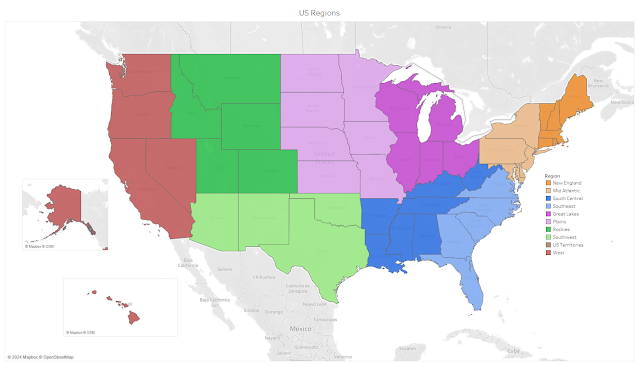
    First, let’s take a look at the shape of the market to have a place where we can put our feet down.  We’ll start with WICHE data, which I’ve found to be very reliable, but of course imperfect, showing high school graduates over time, with years after 2019 being projections.  For all of these views, I’ve broken things out by my own state regions, colored on this map. (Click it or any image to view larger).

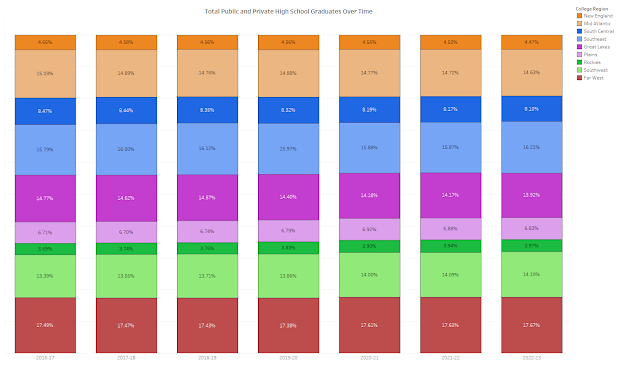
    Here is the breakdown of high school graduates by these regions, showing the percentage of total in each year. Columns total to 100% in each year.

    If you know anything at all about higher education data, you already see a problem as we try to establish some framework: Each state and each region has different college going patterns.  In wealthier states, and states with higher educational attainment among parents, college-going rates are higher.  Within states, there are differences too: About 8% of all college students in the US attend community colleges in California, for instance, and almost all of those students are California residents.

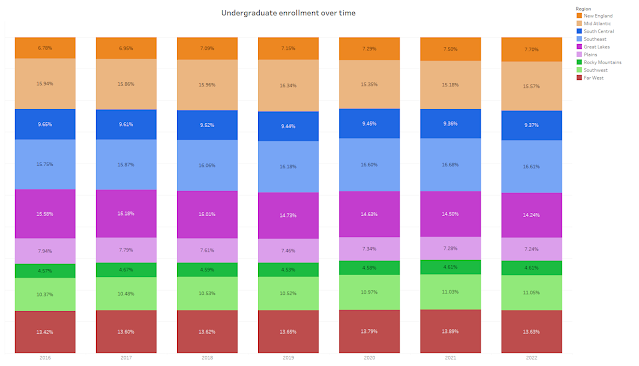
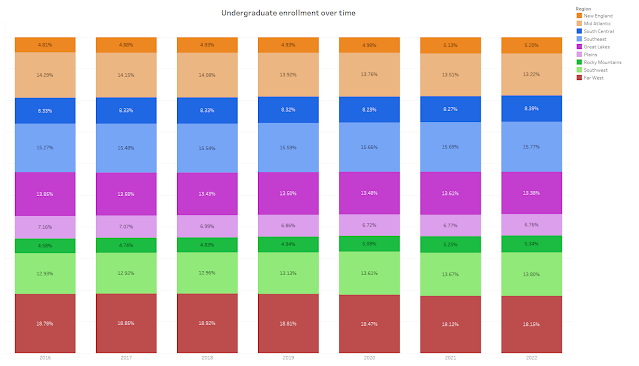
    Now, let’s take a look at undergraduate enrollment over this same period.  Because much of the national discussion is focused on first-time freshmen, I’ve limited this enrollment set to only those traditional, four-year institutions that enroll undergraduates and accept freshmen.  I’ll just call this The Filter Set going forward.

    You’ll probably notice that the patterns are about the same, but you see the effect of the California Community Colleges here: Many more students don’t attend four-year colleges in the state, which makes it different from other parts of the country.  For reference, here is the same visualization showing all undergraduate enrollment in all institutions (not just in The Filter Set).  You’ll note the re-balancing, which is a function of the vast majority of college students going to college close to home.
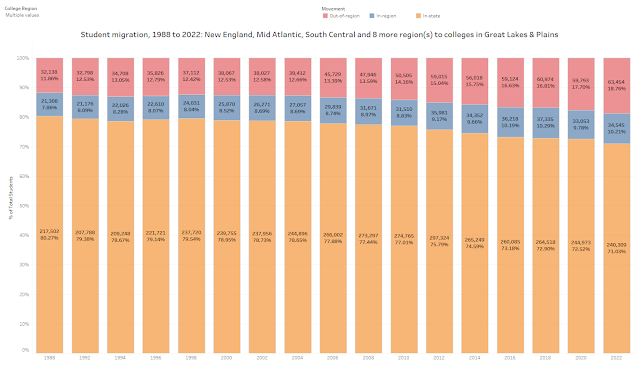
    Here is the historical pattern of first-year student migration, from 1988 to 2022.  As you can see, about seven of ten students stay in their own state for college, which means the number of students who cross state lines is small, making even big swings in those patterns hard to measure and describe as meaningful.  It’s also interesting to note that more students today are more mobile than in the past, for a lot of reasons I won’t go into here, but as always, you can start the finger pointing with Ronald Reagan. 

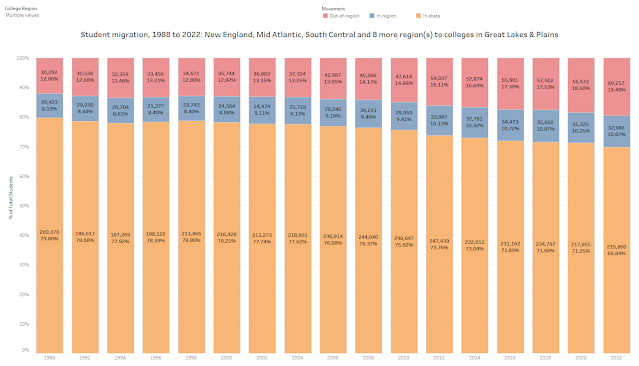
    For the sake of clarity (or confusion) here is the same data for The Filter Set.  Similar pattern, slightly different numbers.  More students cross state lines to attend these institutions with wider draws.

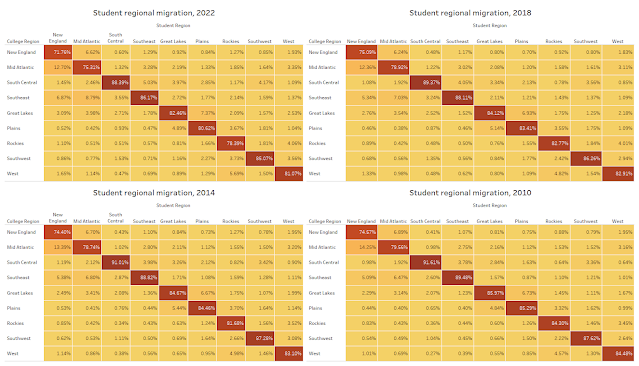
    And if you want to break it out a little bit, here is a view over time of The Filter Set and the migration patterns between regions in 2010, 2014, 2018, and 2022. 

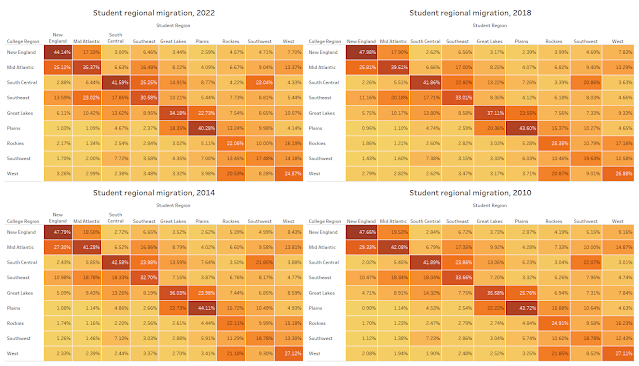
    And this data shows only those students who left their home state and who attended one of the colleges in the Filter Set, to help amplify the migration patterns. 

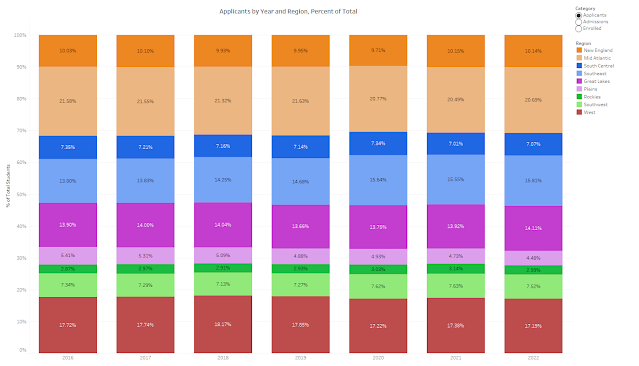
    Over time, the percentage of first-year applications submitted has grown in the Southeast, but not the Southcentral region.  Actually, what’s remarkable about this chart is the consistency over time.

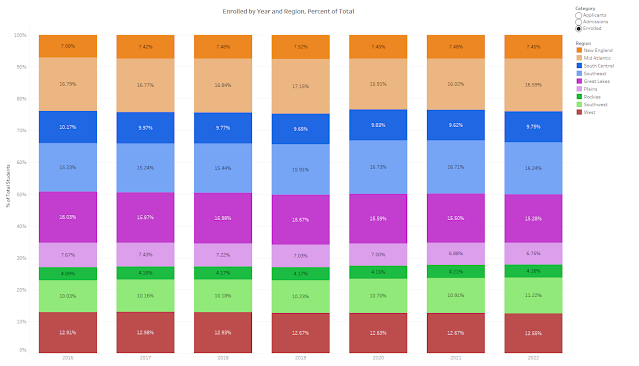
    The breakouts of enrolling first-year students by region?  Also stable and showing similar patterns.

    So, maybe there is a slight trend along the margins of college attendance.  But what’s causing it?  Most social scientists (going out on a limb here) would say it’s probably best when researching a problem like this to dive more deeply than interviews with a dozen students who fit the pattern you’re trying to demonstrate.  What I see in the overall patterns appears to follow population shifts, which is probably the biggest “duh” of all: If population in the Southeast is growing, you’d expect college enrollment to grow as well.  

    But let’s discount that obvious answer for a moment.

    Why would students be applying to more southern locations?  Well, first, they’re easier to get into, in general. 

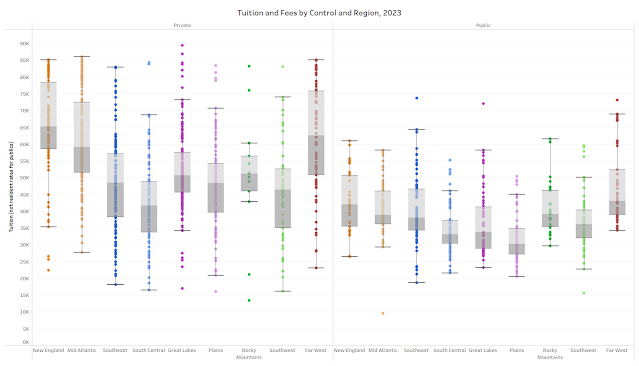
    For another thing, they cost a lot less, on average, based on sticker price.  Each dot represents one college, and the gray boxes cover the middle 50%, with the divider between dark gray and light gray showing the median.  You can see that for both public and (especially) private colleges, tuition seems to be much lower than other places. I’ve not tried to normalize this by Carnegie type or selectivity, to be clear.

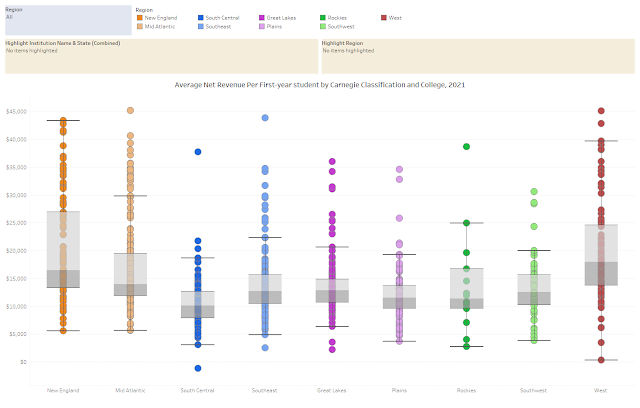
    Private colleges in the south net a lot less cash per freshman, too.  This does not always mean students pay less, but it’s a pretty sure bet in general it costs less after aid to go south as well. (I only calculate this for private institutions because discount rates at publics are fairly meaningless given different tuition levels and state funding models, in case you were wondering.)

    But the publics do a pretty good job of funding nonresidents, too. They recruit hard and roll out the welcome mat for students, especially on price.

    We don’t have 2023 data yet, and we won’t have 2024 data for about another 18 months, at least, so maybe we’ll wake up one morning and find that these small sample size stories are dead-on.  But I seriously doubt it.  For every student fleeing the north because of The Woke, there is probably a student fleeing the less Woke states below the Mason-Dixon Line.

    And yet, we know many–perhaps most–17-year-olds are afflicted with still-undeveloped prefrontal cortices that might keep them from being political, rational, and/or sophisticated when it comes to college choice.

    The answer to the headline?  You probably already knew the answer, didn’t you?  The lesson is that media pundits who look at a little bit of data and talk to a few people to confirm their perspectives often shape the narrative, which gets stuck in the collective consciousness of the American conversation.  It’s not something I can fix.  Maybe you can make a little dent if you share this with people.

    But it’s important, when we see increasing criticism of our institutions, and increased turmoil on campuses, that we–the people who work in higher education–provide the balanced and rational perspective we so often claim to impart to our graduates.

    Source link