Tag: antiTrump

  • They displayed anti-Trump buttons — then the sheriff alerted Secret Service

    They displayed anti-Trump buttons — then the sheriff alerted Secret Service

    When members of the Ashland County Democratic Party set up a booth at their local fair last month, they might have expected a few political disagreements. What they surely didn’t expect was to be expelled from the fairgrounds and reported to the Secret Service over buttons expressing opposition to President Donald Trump. Now, they’re suing the officials who trampled their First Amendment rights. 

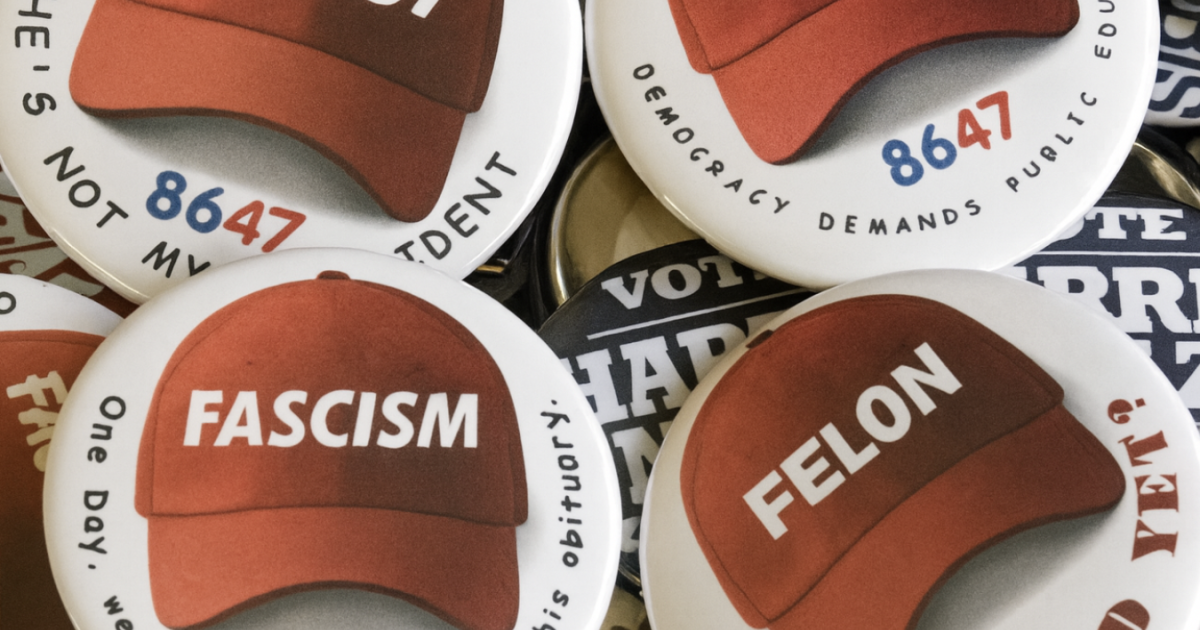
    The booth displayed various buttons depicting red MAGA-style hats, but instead of “Make America Great Again,” they said things such as “Fascist,” “Resist,” “Felon,” and “8647” (meaning to eighty-six, or remove, the 47th president, Trump).

    According to the lawsuit, the trouble started when fair officials told booth staffers they’d received complaints about two particular buttons. One read “Felon” and, beneath that, “Is he dead yet?” The other said “Fascism” and, beneath that, “One day, we will wake up to his obituary.” Officials said the buttons weren’t “family friendly” and had to go. Booth staff had already put them away, but that didn’t get them off the hook.

    Officials later returned to the booth with sheriff’s deputies and ordered the group to “pack up and leave.” The sheriff’s office then reported the matter to the Secret Service and began weighing criminal charges over the allegedly “threatening” buttons. 

    None of this should have happened. As the complaint explains, and as FIRE told the sheriff and fair board in a September letter, the First Amendment squarely protects the buttons’ political messages. That’s true even if the speech offends others or expresses a wish (serious or not) for someone’s demise. By ordering the removal of the buttons and ejecting the Ashland Democrats from the fairgrounds, county officials engaged in classic viewpoint discrimination. 

    The unwritten “family friendly” standard is far too vague to survive constitutional scrutiny. As this case shows, vague rules invite arbitrary and selective enforcement. Other vendors freely displayed merchandise depicting or glorifying violence or drug use, yet only the Ashland Democrats were shown the exit. It’s hard to escape the conclusion that their political views drove the decision.

    Some may find the buttons objectionable. That’s their right, and they’re free to voice that opinion. That exchange of views is exactly what the First Amendment is designed to protect. 

    Nor can officials hide behind fairgoers’ complaints. Censorship designed to appease offended onlookers is still censorship. That’s called a heckler’s veto, and it’s flatly unconstitutional.

    Reporting the incident to the Secret Service only added to the constitutional violations. There’s no evidence that the Ashland Democrats were threatening to physically harm the president. In Watts v. United States, the Supreme Court reversed a Vietnam War draftee’s conviction for telling a crowd, “If they ever make me carry a rifle the first man I want to get in my sights is L.B.J.” The Court recognized the statement as rhetorical, not an actual threat. The generalized slogans on the Ashland Democrats’ buttons are even further from a true threat than Watts’ direct, first-person reference to shooting President Johnson.

    The First Amendment also carves out an exception for inciting imminent lawless action, but it’s extremely narrow. Speech qualifies as incitement only when it directs others to commit unlawful acts and they’re likely to do so right away. The Ashland Democrats’ buttons did neither. They expressed disdain, not directives.

    The slogan “8647” is political shorthand for expressing opposition to Trump. When Joe Biden was president, a prominent conservative commentator used “8646” the same way. Both phrases even appear on Amazon merchandise. While the precise meaning may vary from one speaker to the next, it doesn’t inherently call for violence. There are ways to eighty-six a president that don’t involve violence, including impeachment and removal from office. 

    But even if the term is read to imply something darker, it’s still generally protected. Recall that incitement requires the speech to be likely to trigger imminent unlawful action. The idea that a fairgoer would see any of the buttons and then immediately track down the president’s whereabouts and try to kill him is, on its face, ludicrous.

    Some may find the buttons objectionable. That’s their right, and they’re free to voice that opinion. That exchange of views is exactly what the First Amendment is designed to protect. What it doesn’t protect is government officials wielding power to silence speech they dislike. Ashland County officials may soon learn that lesson the hard way.
    Source link

  • Joining two anti-Trump events this month (Bryan Alexander)

    Joining two anti-Trump events this month (Bryan Alexander)

    Over the past two weeks I carved out time to participate in two
    anti-Trump in-person events.  In this post I wanted to share some notes
    on the experiences, along with photos.

    Last Thursday, after the regular Future Trends Forum session, my son
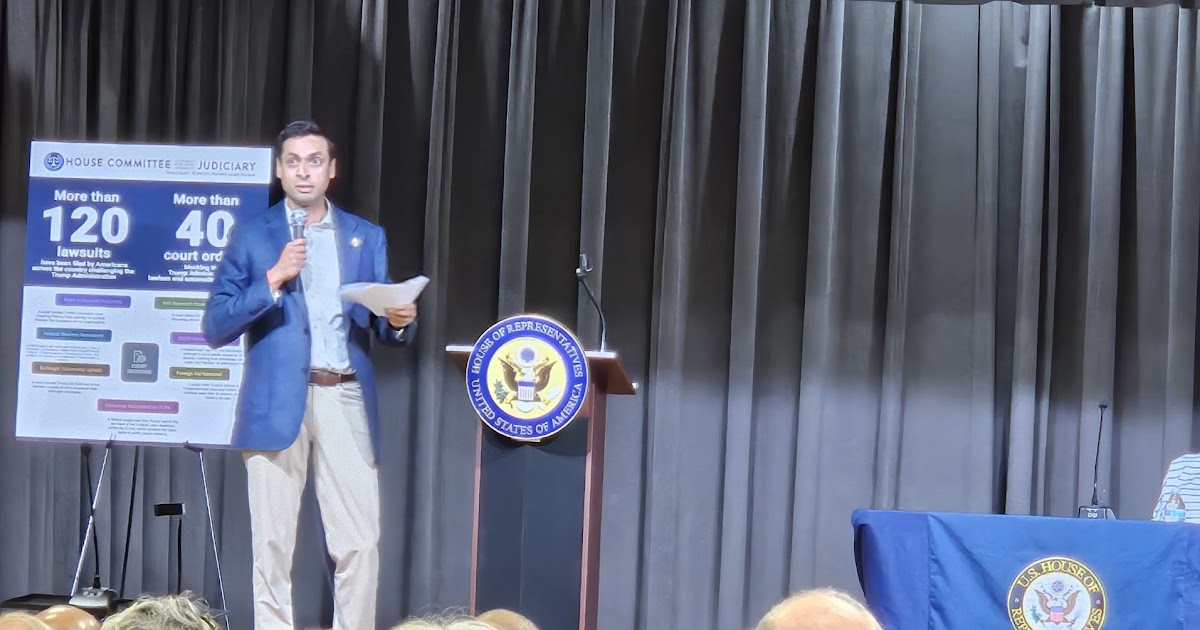
    Owain and I went to a local town hall led by our federal representative,
    Democrat Suhas Subramanyam.
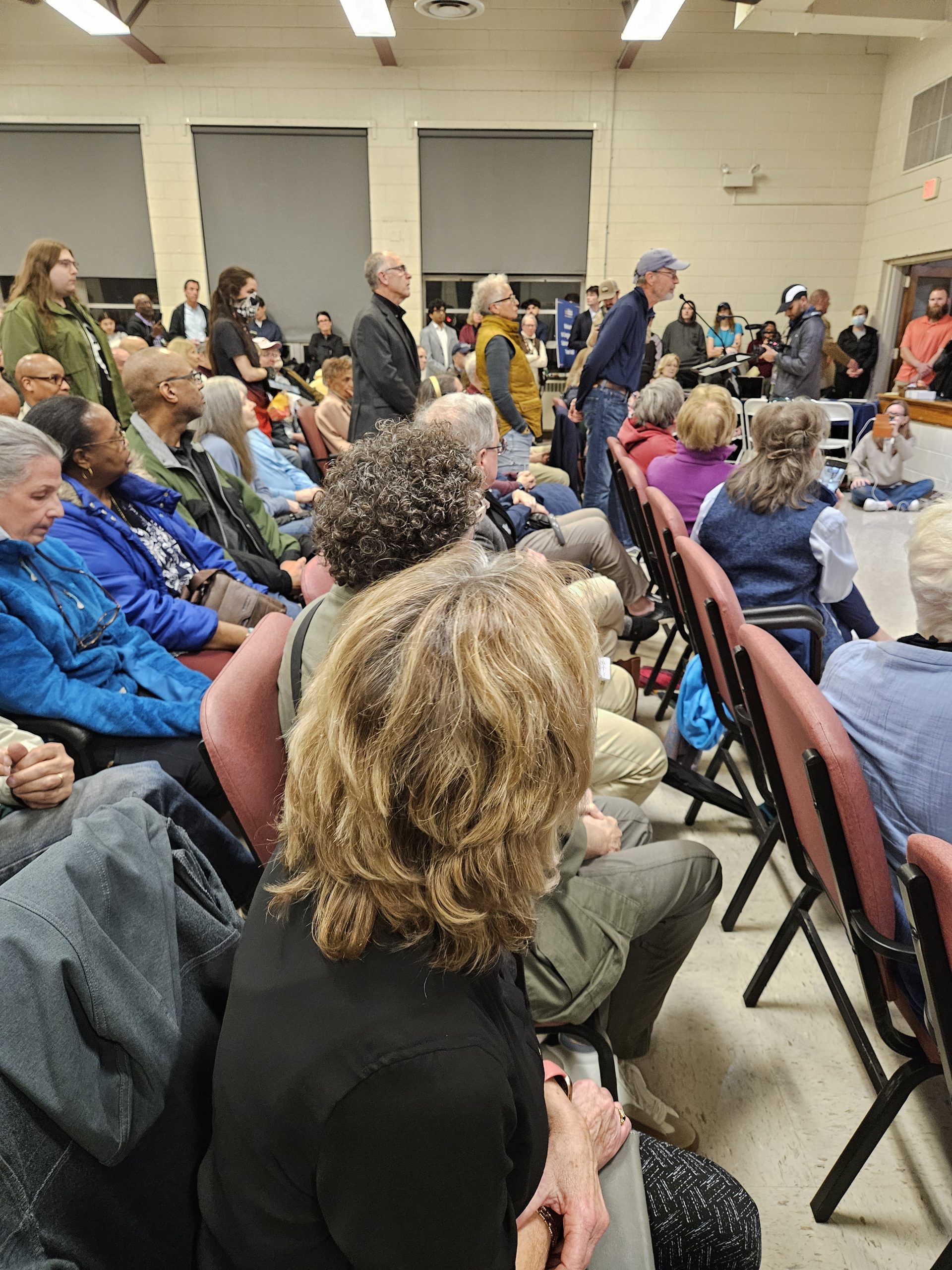
    It took place in a community center and was very crowded, packed with
    people.  Before it began I didn’t hear much discussion, but did see some
    folks with anti-Trump and -Musk signs.  I found some seats for Owain
    and I and we each opened up a Google Doc on our phones to take notes.

    Subramanyam took the stage and began with some brief remarks,
    starting with citing the dangers of DOGE. He mentioned working in the United States Digital Service
    during the Obama administration, the unit which DOGE took over as its
    institutional base. Subramanyam described why he voted against the
    continuing resolution to keep the government running and also spoke to
    the humanitarian and governmental problems of firing so many federal
    workers.

    Then it was over to questions. Folks lined up before two (somewhat
    functional) microphones. They told personal stories: of being lifelong
    federal workers, or having family members in those positions, and now
    facing their work being undone or their jobs ruined. Some spoke of
    depending on federal programs (SNAP, Medicare, Medicaid, Social
    Security) and fearing cuts to them.  Several had military experience,
    which won applause from the room. Above all was this seething sense that
    Trump was a brutal and extraordinary threat, that Democrats weren’t
    taking it seriously, and the question: what can we do to fight back?
    Subramanyam listened hard to each one and answered thoughtfully,
    respectfully, often pointing to resources or actions we could take.

    Subramanyam town hall 2025 March 20 questioner leaning forward
    Ever the extrovert, I joined the microphone line right away. I was going
    to ask about threats to higher education, but happily someone else beat
    me to it. The representative offered a positive response, praising the
    work of researchers and teachers, urging us to fight for educators.  So,
    standing in line, I came up with another question.  When my turn came I
    began by thanking the representative for actually doing a real town
    hall meeting, not a scripted thing. I compared this meeting favorably to
    Vermont’s town hall tradition, and mentioned Bernie Sanders as a
    comparable example of someone who also knows how to do a community
    meeting well, and the room erupted in applause.

    So I asked about climate change, how we – academics and everyone –
    can do climate work in this situation. I noted how the crisis was
    worsening, and how Trump was going to make things even more difficult. I
    was impressed to have Subramanyam’s full attention while I spoke.  I
    was equally impressed that he replied by supporting my remarks and work,
    then called for more climate action in the face of Trump’s actions.

    Nobody
    got a photo of me that I know of, so here’s a shot of the
    representative (on right) paying close attention to one resident
    (standing on left).

    (A sign of climate in culture today: people applauded my question.
    After I left the mic, several folks reached out to me – literally – to
    thank me for raising the topic.)

    Returning to that question of what can be done to oppose Trump, Subramanyam and questioners listed these actions:

      • Legal action: filing lawsuits and supporting other people’s.  Getting Democratic politicians to do the same.
      • Congressional investigations into Trump: the Congressman pointed out
        that these can expose administrative malfeasance and build resistance.
      • Flat out resistance to Trump actions. Subramanyam argued that when
        people refuse to comply, the admin sometimes backs down, saying they
        made a mistake.
      • Doing Freedom of Information Act (FOIA)
        requests to get the feds to cough up documentation. They can slow-walk
        queries or outright refuse, of course, but FOIA can produce results.
      • Phone calls to people in red counties. (I think this was aimed at calling GOP officials, but am not sure.
      • People telling stories of Trump harms in whatever setting works. At
        one point Subramanyam said if the GOP wants to “flood the zone” with
        bogus content we should flood it right back with true, personal stories.

    There were no calls for property damage or violence against people.
    Nor did anybody used the phrase “civil disobedience” or called for such
    actions.

    The hour grew late and people started to drift out.  Owain and I had to get home and we filed out as well.

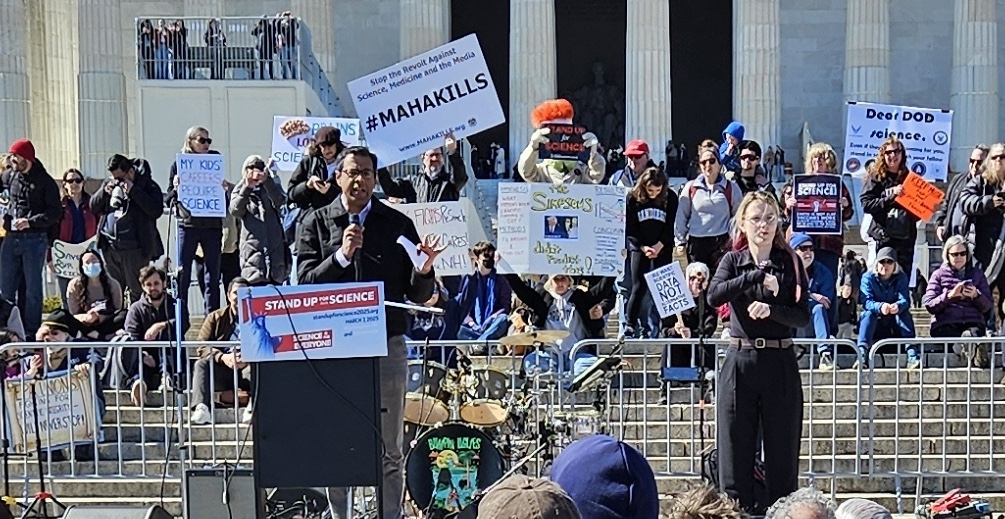
    Two weeks ago I joined a different event, a rally for science in Washington, DC
    It took place at the Lincoln Memorial.  Several thousand people were
    there, all ages, races, genders. The mood was upbeat despite the chill
    and strong winds.

    A podium rested on the steps and from there spoke quite the program of luminaries, including Bill Nye (I missed him), Francis Collins (just stepped down as NIH head), Atul Gawande (excellent medical writer, also surgeon), Phil Plait (astronomer, science communicator), and some other people I didn’t recognize. There was some singing, too.

    Dr. Gawande

    The overall theme was that Trump’s science cuts were awful.  Speakers
    hit on points under this header, such as that RFK was a dangerous idiot
    and that research reductions meant that human lives would be harmed and
    lost.  Diversity along race and gender lines was vital.  All kinds of
    science were mentioned, with medicine and public health leading the
    charge.

    The consensus was on returning science funding to what it was under
    Biden, not in expanding it. There were no claims for adding scientific
    overviews to policy – it was a defensive, not offensive program.

    There were plenty of signs.  Some had a fine satirical edge:

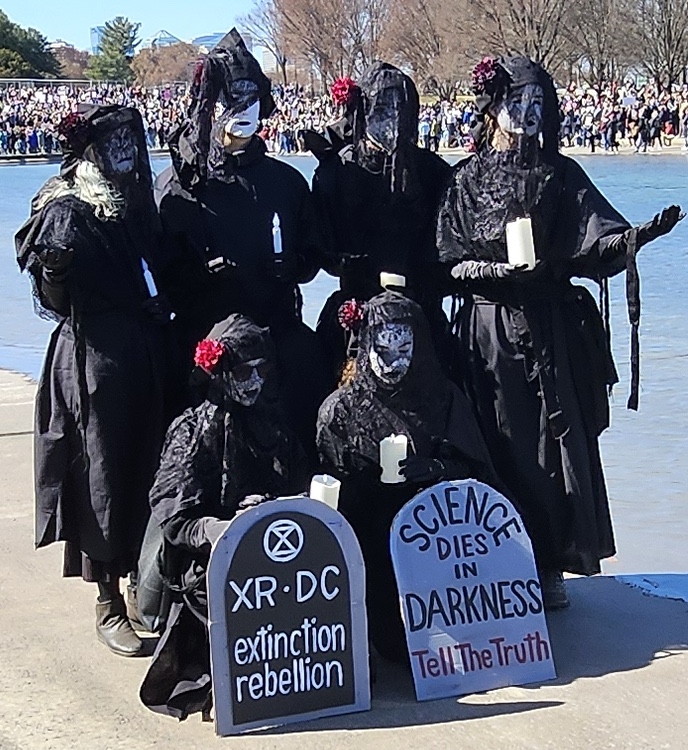
    Off to one side – well, down along the reflecting pool – there was an
    Extinction Rebellion performance or group appearance, but I didn’t get
    to see if they staged anything besides looking awesome and grim.

    Stand up for science rally DC 2025 March 7_XR group

    During the time I was there no police appeared. There weren’t any counterprotesters.

    Eventually I had to start the trip home.  As I walked along the
    reflecting pool towards the Metro station I heard speakers continuing
    and the roar of the appreciative crowd.


    What can we take away from these two events?

    There is a fierce opposition to Trump and it occurs across various
    sectors of society, from scientists to everyday folks (with some
    overlap!). Pro-Trump people didn’t appear, so I didn’t see arguments or
    worse between groups. I don’t know if this means that the president’s
    supporters are just confident or prefer to work online.

    The Democratic party is not in a leadership role.  Outrage precedes
    and exceeds its actions so far.  The town hall liked Subramanyam, but it
    was clear they were bringing demands to him, and that he did not back
    the party leadership.

    Both events had a strong positive feel, even though each was based on
    outrage. There was a sense of energy to be exerted, action to be had.

    Many people visibly recorded each event, primarily through phones. I
    didn’t see anyone object to this.  (I tried to get people’s permission
    to photograph them, when they were clearly identifiable individuals.)

    My feel is that climate interest is waning among people who oppose
    Trump.  They aren’t denying it and will support those who speak and act
    on it, but it’s no longer a leading concern.

    Yet these were just two events, a very small sample size, and both in
    roughly the same geographic area, about 50 miles apart.  We can’t
    seriously generalize from this evidence, but hopefully it’s a useful
    snapshot and sample.

    Personally, I found both to be rewarding and supportive. It was good
    to be with people who were similarly outraged and willing to be so in
    public.

    American readers, are you seeing anything similar in your areas?  Non-Americans, what do you think of this glimpse?

    [Editors note: This article first appeared at BryanAlexander.org.]

    Source link