
Tag: Apollo

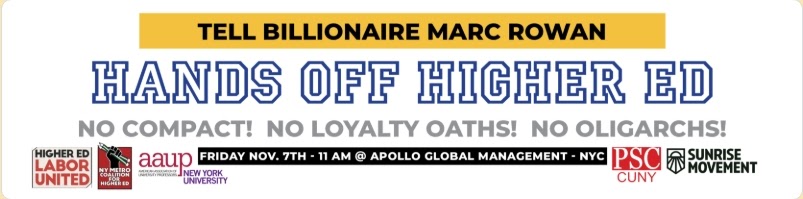
  • BORROWERS AGAINST APOLLO EVENT, FRIDAY NOVEMBER 7TH, NEW YORK CITY (HELU, AAUP, AFT)

    BORROWERS AGAINST APOLLO EVENT, FRIDAY NOVEMBER 7TH, NEW YORK CITY (HELU, AAUP, AFT)

    Higher Ed Unions, Student Unions, and For-Profit College Borrowers Unite Against Trump’s “Higher Education Compact”

    Several higher education unions, student unions, and former students of for-profit colleges are organizing in opposition to the Trump administration’s proposed “higher education compact”—a plan heavily shaped and promoted by private-equity billionaire Marc Rowan.

    Rowan, the CEO of Apollo Global Management, has played a central role in advancing this proposal. Apollo owns several predatory for-profit institutions, including the University of Phoenix, one of the most notorious offenders in the industry.

    In a recent New York Times op-ed, Rowan took public credit for the compact, writing:

    “The evidence is overwhelming: outrageous costs and prolonged indebtedness for students; poor outcomes, with too many students left unable to find meaningful work after graduating…”

    Yet, under Rowan’s leadership, the University of Phoenix has become the largest source of Borrower Defense claims of any for-profit school, with more than 100,000 pending applications as of July 2025. Borrower Defense is a federal protection that allows students to seek loan forgiveness if their school misled them or violated state or federal law.

    The University of Phoenix has faced multiple law enforcement investigations for deceptive recruiting tactics that targeted veterans, service members, and working adults nationwide. The school’s misconduct led to a $191 million settlement with the Federal Trade Commission for falsely claiming partnerships with major employers. More recently, the university attempted to portray itself as a public institution while seeking to sell to two states—both of which ultimately rejected the deal after public backlash.

    While Rowan’s personal fortune exceeds $7 billion, borrowers continue to shoulder crushing debt from degrees that delivered little to no value. His leadership has fueled a system that profits from student harm—and now, through this compact, he is setting his sights on reshaping major public universities.

    We refuse to stay silent. Borrowers, students, and educators are standing together to demand accountability and defend higher education from predatory perpetrators.
    Source link

  • Apollo Wants Investors to Buy Back the University of Phoenix. They Shouldn’t. (David Halperin)

    Apollo Wants Investors to Buy Back the University of Phoenix. They Shouldn’t. (David Halperin)

    Having failed to complete deals to sell the troubled giant for-profit University of Phoenix to major state universities in Arkansas and Idaho — after people in those states got cold feet — the school’s owner, private equity behemoth Apollo Global Management, just before the holiday weekend announced an initial public offering for the school. 

    Phoenix’s parent company had been publicly traded until AGM and two other firms took the company private in 2017. Now they have gone back to Wall Street to re-sell the school to investors. 

    But should investors want to buy this operation? The presence of the heavily-advertised University of Phoenix in the college market has been bad for U.S. students, taxpayers, and the economy, because it has led many students to enroll in a school that often deceives people, and often leaves students with heavy debts and without the careers they sought — when they could be using taxpayer support and their own money to enroll in better value programs. 

    Moral and macro-economic concerns aside, it’s not even clear that buying Phoenix will be good for investor bottom lines. 

    The University of Phoenix, which has received tens of billions from federal taxpayers for student grants and loans — at times more than $2 billion in a single year — has faced numerous law enforcement investigations and actions for its deceptive recruiting of veterans, military service members, and other students across the country.

    Most notably, in 2019, Phoenix reached a record $191 million settlement with the Federal Trade Commission, which claimed the school had lured students with false claims about partnerships with major employers. Phoenix ran ads falsely indicating that the school had deals with companies including AT&T, Yahoo!, Microsoft, Twitter, and the American Red Cross to create job opportunities for its students and tailor school programs for such jobs, when that was not the case. The deceptive claim went to the heart of prospective students’ motivations for enrolling. Andrew Smith, then the Director of the FTC’s Bureau of Consumer Protection, said at the time of the agreement, “Students making important decisions about their education need the facts, not fantasy job opportunities that do not exist.”

    And last year California’s attorney general reached a settlement with Phoenix to resolve allegations that the school’s aggressive recruitment tactics directed at military students violated consumer protection laws. 

    The now almost entirely online school did a two-year dance with the University of Idaho that drew immense criticism from lawmakers, executive branch officials, newspaper editorial boards, and others in that state before the deal was finally called off in June.

    Bloomberg reported earlier this year that an IPO might value the University of Phoenix operation, which had $810 million in revenue for 2023-24 (81 percent of that from federal taxpayer dollars), at $1.5 billion to $1.7 billion. And the new Trump administration has signaled in multiple ways that it is reducing protections for students against predatory college abuses, a development that may make investors more willing to buy a piece of a school like Phoenix.

    But new federal legislation requires schools to provide some financial value for students. Also, state attorneys general, who have curbed and even slayed a number of for-profit giants over a decade, are watching; the media understands this issue, as it did not in the last wild west era fifteen years ago; and more potential students are wary after a generation of abuses.

    So it may end up being much tougher to thrive in the predatory college business than some might think. 

    Source link