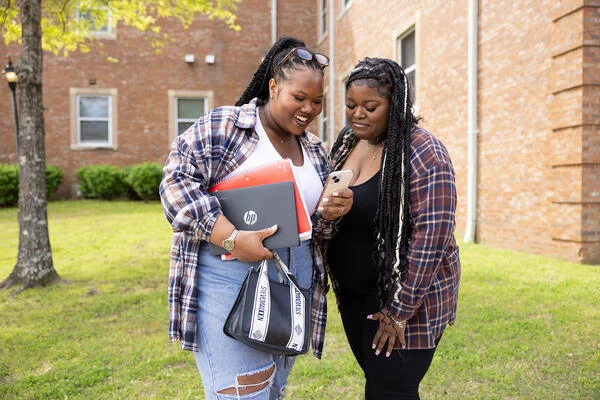
The app, Hello Heels, was relaunched during first-year orientation last fall after undergoing a redesign following input from students through advisory boards, focus groups and surveys.
Since the relaunch, the app now draws about 90,000 page views per week from roughly 37,000 users—up from 10,000 page views and 6,000 users before the redesign.
Elizabeth Poindexter, executive director of communications and special projects in UNC’s Office of Student Affairs, said students rely on the app for “real-time” updates on everything from bus tracking to dining hall offerings.
“Nothing thrills me more than running to the dining hall to grab my own lunch and seeing a student using the app or talking to their friends about it,” said Poindexter.
She added that student feedback has allowed the app to become a multifaceted “dynamic space,” featuring modules on career services and health and wellness and an up-to-date events calendar.
Poindexter also said the redesigned app has proven cost-effective, saving more than $40,000 in new student and family programs by eliminating the need for duplicative services. Instead of costly printed materials, the app provides real-time agenda updates and announcements.
“The more people hear about that cost savings, the more interested in and engaged with the app they become,” said Poindexter.
The approach: Poindexter said student input came from a diverse group, including undergraduates and graduate, transfer and international students.
“We really had a good spread of students who are representative of the student body at large, and they had some incredible recommendations,” said Poindexter, including suggestions to “overhaul” and “refresh” the health and wellness and career services modules.
She added that other features, such as real-time updates on recreation center occupancy, dining hall hours and integration with academic tools like Canvas, also arose directly from student feedback.
The app includes an opt-in messaging feature that allows campus offices to send targeted updates to students who choose to receive them. Poindexter said the most popular channels come from the financial well-being center and the mental health and wellness center.
The financial well-being center sends weekly money tips and appointment reminders, while the mental health and wellness center shares well-being messages during high-stress periods like finals, which she said students respond positively to.
The app also gathers in-app survey responses. Of roughly 250 respondents, 98 percent said they plan to continue using Hello Heels.
“That is why it’s been so successful,” Poindexter said. “We have student voices integrated every step of the way.”
What’s next: Poindexter said part of the redesign involved partnering with UNC’s business school to ensure the app’s long-term sustainability and continued improvement.
“It’s been really wonderful to see that we can have this universitywide impact and improve the student experience in how we communicate with them,” she said.
Poindexter recommended that higher education leaders take a close look at their own media, from mobile apps to online newsletters, and use student feedback to make sure those tools are actually engaging and informing their target audience.
“Our best advocates are our students, and they have really useful insights decision-makers should consider,” she said.
Get more content like this directly to your inbox. Subscribe here.
The University of Phoenix has launched TransferPath, a mobile app promising prospective students a quick estimate of how many previous college credits might transfer toward a Phoenix degree. At first glance, it sounds like a win: upload your transcripts, get a pre-evaluation, and move faster toward completing your degree. The EdTech Innovation Hub article covering the launch presents the app as an unambiguously positive innovation—but a closer look raises serious questions.
The EdTech piece reads more like a press release than investigative reporting. It offers no insight into how pre-evaluations are calculated, whether faculty are involved, or how often initial predictions align with final credit acceptance. Without this transparency, students risk developing false confidence and making financial or academic decisions based on incomplete or misleading information.
The app also reflects the asymmetry of power between institution and student. While marketed as a convenience, it is ultimately a recruitment tool. The University of Phoenix controls which credits are accepted, and the app’s messaging may funnel students into its programs regardless of whether other paths would better serve their educational goals.
Missing from the coverage is context. Phoenix’s history as a for-profit institution has drawn scrutiny over retention rates, student debt, and degree outcomes. Presenting TransferPath without acknowledging this background creates a misleading narrative that the app is purely a student-centered innovation. Equity concerns are similarly absent. Students without smartphones, stable internet, or digital literacy may be excluded or misled. There is no evidence that the app serves all students fairly or that its credit predictions are accurate across diverse educational backgrounds.
TransferPath may indeed offer some convenience, but convenience alone does not equal value. Prospective students deserve clarity, honesty, and rigorous evaluation of how tools like this actually function. They need more than marketing optimism—they need realistic guidance to navigate the complexities of credit transfer, institutional incentives, and long-term outcomes.
Until such transparency and accountability are provided, TransferPath risks being more of a recruitment gimmick than a meaningful step forward in higher education.
This prepared statement was delivered before the U.S. Senate Committee on Commerce, Science, and Transportation on Oct. 29, 2025.
Chairman Cruz, Ranking Member Cantwell, and honorable members of the Committee,
Good morning, and thank you for the opportunity to testify today. My name is Will Creeley, and I am the legal director of FIRE — the Foundation for Individual Rights and Expression, a nonpartisan nonprofit dedicated to defending the rights of all Americans to free speech and free thought, the essential qualities of liberty.
I’ve spent nearly 20 years defending the First Amendment rights of speakers from every point on the ideological spectrum. At FIRE, we have one rule: If speech is protected, we’ll defend it.
Typically, the censorship we fight is straightforward: The government punishes a speaker for saying things the government doesn’t like. That’s a classic First Amendment violation, a fastball down the middle. Unfortunately, that kind of textbook censorship isn’t the only way government actors silence disfavored or dissenting speech.
FIRE Legal Director Will Creeley testifies before the Senate Commerce Committee on Oct. 29, 2025.
Far too often, government officials from both sides of the partisan divide engage in “jawboning” — that is, they abuse the actual or perceived power of their office to threaten, bully, or coerce others into censoring speech. This indirect censorship violates the First Amendment just as surely as direct suppression.
What is jawboning? And does it violate the First Amendment?
Indirect government censorship is still government censorship — and it must be stopped.
This isn’t new law. The First Amendment’s prohibition against coerced censorship dates back decades, to the Supreme Court’s 1963 ruling in Bantam Books v. Sullivan. In that case, the Court confronted a Rhode Island state commission that sent threatening letters, “phrased virtually as orders,” to booksellers distributing “objectionable” titles — with follow-up visits from police, to ensure the message had been received.
The Court held the commission’s “operation was in fact a scheme of state censorship effectuated by extra-legal sanctions; they acted as an agency not to advise but to suppress.” And in the decades since, courts have consistently heeded Bantam Books’ call to “look through forms to the substance” of censorship, and to remain vigilant against both formal and informal schemes to silence speech.
But government officials regularly abuse their power to silence others, so the lesson of Bantam Books bears repeating. And in deciding National Rifle Association of America v. Vullo last year, the Supreme Court unanimously and emphatically reaffirmed it.
In Vullo, New York State officials punished the NRA for its views on gun rights by threatening regulatory enforcement against insurance companies that did business with the group and offering leniency to those who stopped. New York’s backdoor censorship was successful — and unlawful.
This regulatory carrot-and-stick approach was designed to chill speech, and the Court reiterated that “a government official cannot do indirectly what she is barred from doing directly: A government official cannot coerce a private party to punish or suppress disfavored speech on her behalf.”
A government official cannot do indirectly what she is barred from doing directly.
To be sure, the government may speak for itself, and the public has an interest in hearing from it. But it may not wield that power to censor. As Judge Richard Posner put it: The government is “entitled to what it wants to say — but only within limits.” Under no circumstances may our public servants “employ threats to squelch the free speech of private citizens.”
So the law is clear: Government actors cannot silence a speaker by threatening “we can do this the easy way or we can do this the hard way,” as the chairman of the Federal Communications Commission did last month. Nevertheless, recent examples of jawboning abound: against private broadcasters, private universities, private social media platforms, and more. The First Amendment does not abide mob tactics.
Despite the clarity of the law, fighting back against jawboning is difficult. Targeted speakers can’t sue federal officials for monetary damages for First Amendment violations, removing a powerful deterrent. And as a practical matter, informal censorship is often invisible to those silenced.
That’s particularly true in the context of social media platforms, as demonstrated by another recent Supreme Court case, Murthy v. Missouri.
Jawboning betrays our national commitment to freedom of expression.
Murthy involved coercive demands by Biden administration officials to social media platforms about posts related to Covid-19, vaccines, elections, and other subjects, resulting in the suppression of speech the administration opposed. But the Court held the plaintiffs lacked standing to sue, because the causal link between their deleted posts and the administration’s pressure wasn’t sufficiently clear.
Murthy illustrates a severe information disparity: Users whose speech is suppressed have no way to know if government actors put their thumb on the scale. Only the government and the platforms have that knowledge, and usually neither want to share it.
That’s why FIRE authored model legislation that would require the government to disclose communications between federal agencies and social media companies regarding content published on its platform, with limited exceptions. But transparency is not enough. Federal officials must be meaningfully deterred from jawboning, and held accountable when they do.
Jawboning betrays our national commitment to freedom of expression. Congress should take action to stop it.
Thank you for your time. I welcome your questions.
Ever since 15 private colleges and universities teamed up to launch the Common App 50 years ago, the college admissions form has shifted practices and technology to meet the changing needs of institutions and students.
For instance, the latest iteration of the application, which opened Aug. 1 for the 2026–27 academic year, has what the organization calls a “refreshed look” and a new question that allows students to share their experiences with working at a paid job or taking care of their siblings. Common App, the nonprofit that runs the portal, piloted the Responsibilities and Circumstances question over the last three years, which showed in part “the importance of giving students space—beyond the personal essay—to share how these factors have shaped their high school experience,” the organization wrote in its innovation guide.
Common App is continuing to build out its Direct Admissions program, in which eligible students get an admissions offer before they actually apply. In its second year, 119 institutions have participated in the initiative and more than 700,000 students received offers.
Nearly 1.5 million first-time applicants completed the Common App in the 2024–25 cycle, submitting more than 10 million applications, according to a report released this week. That included just over 571,000 first-generation students—a 14 percent increase compared to the previous cycle. The Common App is aiming to continue to increase the number of applicants who are first-generation and from low- or middle-income households as it seeks to close equity gaps.
For this current cycle, more than 1,100 institutions are participating in the Common App, which includes 10 community colleges—yet another change for the organization aimed at ensuring students know about the available opportunities.
As the organization marks its 50th anniversary, CEO Jenny Rickard sat down with Inside Higher Ed to talk about how the Common App has changed over the years and what’s next. The conversation has been edited for clarity and length.
Q: How has the founding and the history of Common App influenced the organization today?
Jenny Rickard has led Common App since 2016.
A: The thing about Common App that is unique is how its mission actually has not changed over the 50 years of history. It still is an organization that is governed by our members. The mission has always been to simplify the admission process to enable more students to gain access to higher education. So the idea of trying to simplify the college application process by collaborating and working with all the different stakeholders in the admission process—that include students, applicants, school counselors and, obviously, admission officers—is how we go about developing this application, and it’s critically important that we listen to all of those different constituencies. Over the 50 years of Common App, what has changed is technology and the demand for higher education has continued to grow over that time. Just as the times have changed, we’ve expanded the types of institutions that we serve. As a result of that, the students and the different high schools or secondary schools that we’re able to reach.
Q: As the demographics of who is attending college have changed, Common App has made an effort to adjust to that, such as working to better serve financially independent students. So what are the biggest demographic shifts happening now and that you see coming in the applicant pool over the next few years? And how are you looking to accommodate and invest in those changes?
A: I think one of the main challenges over the past 50 years has actually been reaching different socioeconomic groups. So our moon shot that we launched to close our gap in the income bands of students using Common App shined a light on the access challenges that higher ed has faced. And some of the initiatives that we have launched are to address that gap—70 percent of the students using Common App to apply to college are from above the national median income and 30 percent are below. And that’s something that has been pretty constant in the college admissions space. We’re working through some of the initiatives that we’ve launched to reach out to more low- and middle-income students who may not think that college is something that’s possible for them, to let them know it is possible and you can go to college, and colleges would love to see you there.
So it’s trying to go beyond addressing some of what I’d call the logistical barriers that students face to apply to college and get to some of the social and economic barriers that students face in applying to college. The main theme of what we’re trying to accomplish these days is expanding access to students who have felt that higher education may not be attainable for them.
Q: One of those initiatives is direct admissions. Why is that something you wanted to invest in and how’s the program going?
A: There are students who won’t even create a Common App account because they fear that rejection. And so one of the things that we’re working on is, how do we give students the positive reinforcement that you are going to be able to find a college? There are colleges that would love to enroll you. That can then inspire them to not only perhaps apply to some of the colleges that are reaching out to them, but also maybe think more broadly about where they might want to go to school and understand that they have some agency in this process.
How we went about doing our direct admission work was inspired by the state of Idaho that had launched a program to let high school students know about the state institutions that they could get into. And we looked at that and thought, “Wow, what could Common App do nationally to help students in states that may not have a direct admission program, but also be able to expose them to the 1,100 colleges and universities that are members of this nonprofit membership association?”
We did three different pilots to email students. We worked on the language and tried to understand from the student perspective what they were experiencing. We worked with our member colleges to understand the process from their vantage point as well as school counselors to see what might work best for their students and how to support them in this effort. And after the three pilots, we decided we could scale it and also enhance the technology so that we went beyond an email notification.
Once they’re in Common App, they can now have a dashboard to see which schools would already admit them if they just continued in the process with those institutions. Every year, we make enhancements to the process as we learn from all the different stakeholders about which aspects are supporting students the best and which are supporting the institutions the best.
Q:And the number of institutions participating in the direct admissions program is going to increase to more than 200 this fall, correct?
A: I found it overwhelming, in a really great way, that we reached out to over 700,000 individual students with direct admission offers last year. Thinking about the scale that we have and being able to provide that positive reinforcement to help encourage students to continue in the admission process and be able to attain higher education is really exciting.
Q: Certain elements of the admissions process are under scrutiny, such as concerns about standardized tests. I recently wrote about a report led by a Common App researcherthat found letters of reference for some minority groups tend to skew shorter. What do you make of those debates and how do you think college admissions will change over the next several years?
A: As technology changes and institutions look at their own way of doing their admission processes, we will continue to work with our members to understand what they are experiencing and what they are wanting in order to enroll the classes of students that they want and who will thrive on their campuses. We have a common platform, but there is also flexibility by institutional type, as well as a section for colleges to have their own questions beyond what’s on the common form. That format has provided the flexibility for us to be able to have a very diverse group of members, and also in welcoming associate’s degree–granting community colleges to the platform.
We’ve been constantly evolving as the higher education environment has evolved, as technology has evolved. When you look back at Common App 50 years ago, its technology inspiration was the photocopier, and the idea was a really great idea of admissions deans seeing that they were asking some similar questions, maybe they could streamline this process for students. And then floppy disks came along, and admissions officers and college counselors said, “We need to move into this floppy disk area.” And they quickly pivoted when the internet came out, and in 1998 launched the first online application. So we will continue to evolve. Obviously, with artificial intelligence, we’re looking into how this can assist in the process.
Q: Common App has reams of data about students’ applications, and the organization has worked to make that information more easily available. What do you see as Common App’s role in the world of higher ed research?
A: We were very grateful to the Gates Foundation who, over five years ago, awarded us a grant to create a data warehouse so that we could share nationally about trends in the college application process and help shine a light on areas where there are differences across institutions and across students. So you pointed to that research about how recommendations for some populations of students aren’t as strong as others. What does that mean? And is that a reflection of the students? Is it a reflection of the secondary schools that they might attend?
Because when you think about the great diversity of colleges, the diversity of secondary schools is that much more, and the opportunities that students have [are] so different, and being able to really highlight what that means from a student access perspective is critically important for all of us to try to make sure that students have the same level of opportunities.
So investing in that data warehouse—and that investment from the Gates Foundation—is something that has really transformed us, not just only from the research reports that we’re able to do but also during COVID, we were able to see right away that first-generation college students’ applications had really dropped off. And we were able to alert all of our members that COVID was really having an impact on first-generation college students and [look into] what we could all do to try to mitigate that negative impact.
It also has been important for us to be able to understand how students are persisting within the Common App, and to help us enhance the system to try to ensure that students are not only able to start an application but to complete the application. And we’ve been able to collaborate with organizations like the National Student Clearinghouse to see if students are persisting in college. We have beenable to add the texture that the admission application provides to the clearinghouse data to understand more about student behavior, not only in Common App but also in college.
I see that as all critical in terms of informing our broad community about the kinds of changes we might need to make or things that we might want to stop doing because it’s not helping the situation. The data has really just shined a light on a number of the challenges in the admission process and informed us about ways that we might be able to mitigate those challenges. Direct admission is one of those.
The Common App allows students to submit applications to more than 1,100 higher ed institutions. But until now, none of its members were community colleges focused on granting associate degrees.
The organization announced a first-of-its-kind partnership with the Illinois Community College Board last week, adding Sauk Valley Community, Rend Lake, Carl Sandburg and Black Hawk Colleges to its ranks. Three more two-year institutions will join next admissions cycle: Lincoln Land Community, Oakton and Triton Colleges.
When the Common App launched 50 years ago, it offered high school students a streamlined application path to 15 private institutions. Since then, hundreds of others have signed on, most of them fairly selective four-year colleges and universities. The new move raises a question: What do open-access institutions, which accept all students, stand to gain from joining the application platform?
Brian Durham, executive director of the Illinois Community College Board, said most importantly, it boosts their visibility.
Starting this year, the Common App is partnering with the Illinois Board of Higher Education to support its direct admissions program to eight public universities in the state. As a part of the partnership, eligible high school students who apply to any college through the Common App will be notified of their direct admissions offers from these universities. Durham wants those students to receive notice about their local community college choices, too.
“We want to make sure that community colleges are seen as an option on that list”—even “potentially a first choice for students,” Durham said. “It’s ultimately about exposing them to that as an option.” He added that students who gain admission to universities sometimes realize later that “they can’t afford it, or it’s not right choice for them.” This way, if they come to that conclusion after filling out the Common App, they’ll know which community colleges are “right there” and ready to serve them.
Research suggests the move could offer community colleges an enrollment bump. The National Bureau of Economic Research published a paper in 2019 that found that institutions that joined the Common App enjoyed on average a 12 percent increase in admissions compared to the years before they joined, according to an analysis of Common App data from 1990 to 2015.
Durham hopes that eventually all 45 of the state’s public two-year colleges offer a Common App application route in addition to their in-house application systems.
A Decade-Long Effort
Jenny Rickard, president and CEO of the Common App, said that the organization has been working toward representing a broader swath of higher ed institutions for a decade.
In 2014, the organization stopped requiring member colleges to use a “holistic admissions” process—assessing students beyond test scores—in order to open up the platform to more institutions. The Common App also got rid of its requirement that applications include essays and recommendations. Then, in 2018, the organization launched a new application for transfer students applying to four-year universities.
All those moves “opened the door for us to be able to welcome two-year and four-year public institutions into the membership,” Rickard said. She noted that, as of the 2022–23 application cycle, 77 percent of current Common App members admitted over 50 percent of their fall first-year applicants, a sign that the organization has moved away from serving only more selective institutions.
The Common App also set a “moonshot” goal in 2023 to substantially increase its applicants from low- and middle-income communities, Rickard said. The organization aims to bring in 650,000 additional applicants from those backgrounds by 2030.
Rickard said teaming up with community colleges is the organization’s most recent step toward diversifying both its member institutions and its applicant pool.
“Bringing a greater diversity of college and university members into the Common App helps us pursue that mission, and it also helps students from all different backgrounds be able to see the great diversity of institutions in the United States and the world,” she said. “Most students go to more open-access and less selective institutions,” yet too often “we focus on the places that nobody can get into.”
Durham agreed that the move could expand the Common App’s “footprint,” given applicants to community colleges are disproportionately low-income and first-generation students.
“More underserved students are naturally going to go to community college for all the reasons we know: affordability, location,” he said. So, working with community colleges offers the Common App a new “opportunity to reach those students.”
Steps for the Future
As much as Durham would like to see more community colleges join the Common App’s ranks, he believes the platform will need to change to serve community colleges at a larger scale.
Currently the platform is designed for high school students, he said, but many community college applicants are adult learners or attend college part-time. Those types of students are more likely to enroll directly at a college rather than find themselves on the Common App platform like high school seniors applying to multiple institutions with guidance from college counselors.
“How do you get a 34-year-old guy who wants to go into welding to go through that application?” Durham said. For now, he expects participating Illinois community colleges will maintain their own “parallel” application systems “until we can work that out down the road.”
Rickard acknowledged the organization has work to do to optimize its platform for a more diverse set of institutions. She hopes that onboarding this initial cohort of community colleges will help the Common App figure out its blind spots.
“We know that we need to learn more about how our platform can continue to evolve to meet their needs more effectively,” she said.
Common Appis adding its first ever community college members, the organization announced in a press release Thursday.
The seven new partner institutions are all members of the Illinois Community College system. Four of them—Sauk Valley Community, Rend Lake, Carl Sandburg and Black Hawk Colleges—are joining the platform immediately; another three institutions, Lincoln Land Community, Oakton and Triton Colleges, will join next admissions cycle.
Common App has a few members that technically include community colleges, like Miami-Dade College in Florida, but those institutions also offer baccalaureate degrees. The new members offer associate degree programs only.
In the press release, Common App CEO Jenny Rickard said she hoped the move would help promote college access and ease struggling community colleges’ recruitment efforts.
“To close the gap in low- and middle-income students applying, we need to expand the types of institutions students can connect with,” she wrote.
This audio is auto-generated. Please let us know if you have feedback.
Dive Brief:
First-year Common Applications are up 5% year over year, with over 1.2 million prospective students submitting the forms for the 2024-25 application cycle as of Jan. 1, the company said Thursday.
First-year applications ticked up across both institution types and student demographics, but some groups saw accelerated growth. Common App found disproportionate increases among students believed to be from low-income households and those who identified as underrepresented minorities.
Applications to public institutions grew by 11% year over year, outpacing the 3% growth seen at private colleges, Thursday’s report said.
Dive Insight:
Applications from prospective first-year students have steadily increased since the 2020-21 application cycle, Common App found.
That’s despite the challenges that have thrown aspects of college admissions into tumult, including the botched rollout of the updated Free Application for Federal Student Aid during the 2024-25 cycle and the U.S. Supreme Court’s June 2023 ban on race-conscious admissions.
Roughly 960,000 students used the Common App portal to submit over 4.8 million applications during the 2020-21 cycle. In the 2024-25 cycle, over 1.2 million users submitted just under 6.7 million applications.
Prospective students can continue to apply to colleges through the month and beyond. But a majority of applications for the following fall semester are traditionally submitted by the end of December.
The number of colleges first-year prospects applied to ticked up slightly between 2020-21 and 2024-25, but remained between five and six institutions.
Common App found disproportionate application growth among students from low-income households. The portal does not directly collect household income from applicants, but researchers used students who were eligible forfee waivers as a proxy. Application rates for that group increased by 10%, compared to 2% for their counterparts who weren’t eligible for the waivers.
Moreover, applications from students in ZIP codes where median incomes fall below the national average grew 9% since the 2023-24 cycle, compared to 4% growth from those in above-median income areas, Common App found.
The company also saw more applications from minority groups underrepresented in higher education, classified by researchers as those who identify as Black or African American, Latinx, Native American or Alaska Native, or Native Hawaiian or other Pacific Islander.
As of Jan. 1, 367,000 underrepresented applicants used Common App to submit first-year applications. But their numbers are growing at a faster rate than their counterparts.
Among students in underrepresented groups, first-year applications grew by 13% since last year, compared to the 2% growth for the others.
Latinx and Black or African American candidates drove much of that growth, showing year-over-year increases of 13% and 12%, respectively.
However, it appears that students are reconsidering their application materials following the 2023 Supreme Court decision. In June, separate Common App research found a decrease in the number of Asian, Black, Latinx and White students referencing race or ethnicity in their college essays.
Thursday’s report also found more first-year students including standardized test scores in their applications, up 10% since last year. The number of applicants leaving them out remained unchanged year over year.
“This marks the first time since the 2021–22 season that the growth rate of test score reporters has surpassed that of non-reporters, narrowing the gap between the two groups,” the report said.
That’s despite interest slowing in highly selective colleges, the type of institutions that have historically most used standardized test scores in the admissions process.
Applications to colleges with acceptance rates below 25% grew just 2% in 2024-25, Common App found. That’s compared to the between 8% and 9% increases seen at institutions of all other selectivity levels.
Just 5% of the colleges on Common App required test scores in the 2024-25 application cycle, a slight uptick from the 4% that did so the previous year.
COVID-19 pushed many institutions with test requirements to temporarily waive this mandate, and some ultimately made the change permanent.
But others returned to their original rules. And reversal announcements continue to trickle in, including one from the highly selective University of Miami just this past Friday.
Consensus – A Game Changing App for Faculty Researchers
Today, I started to utilize a new AI app for my research. This app, Consensus, is a game changer for faculty researchers. I wish that I had this app in graduate school – it would have definitely made life easier!
Step 1 – Here are some screen shots of the software. You can type a question in the box (yes, a question) and the system does the work. Yes, the work that you would usually have to do!
Step 2 – Then, AI does the rest. You receive AI-powered answers for your results. Consensus analyzes your results (before you even view them) and then summarizes the studies collectively.
Step 3 – You can view the AI-powered answers which review each article for you.
*I would also encourage you to review the article independently as well.
Step 4 – View the study snapshots! Yes, a snapshot of the population, sample size, methods, outcomes measured, and more! Absolutely amazing!
Step 5 – Click the “AI Synthesis” button to synthesize your results. Even better!
Step 6 – Use the “powerful filters” button. You can view the “best” research results by: a) population, b) sample size, c) study design, d) journal quality, and other variables.
I plan to make a video soon, but please take a look at this video to discover exactly how Consensus can help you in your research!
It is widely recognized that engaged parents can significantly contribute to a student’s academic success. That’s why the school-to-home communication space is a healthy sector, bristling with numerous vendors vying for attention, each backed by various forms of funding and marketing strategies. This review by EdTechReview aims to cut through the marketing noise, offering an objective comparison of FinalSite, ParentSquare, Apptegy, and SchoolBlocks. We base our evaluation on several criteria, including funding sources, user experience, community reach, integration with popular tech platforms, and overall cost. Remember, this is an assessment to guide your decision-making process; we recommend taking demos and considering your district’s unique needs and leadership preferences.
Webmaster Experience: Ease of Management
In the dynamic world of school-to-home communication, the role of a webmaster transcends mere website management. It embodies the seamless integration of technology, education, and community engagement. Therefore, a happy, efficient webmaster is most important because any dissatisfaction here can derail all other platform features and benefits. A webmaster’s ability to efficiently navigate and utilize a communication platform is pivotal, acting as the linchpin that ensures the swift, effective dissemination of information and fosters an environment ripe for educational success and community involvement. The efficiency, satisfaction, and overall experience of webmasters, therefore, are not just operational concerns but foundational elements that can significantly influence a school’s digital presence and its ability to connect with families. In recognizing this critical role, our review delves into the webmaster experience offered by each platform, evaluating them on a spectrum of ease of use, intuitiveness, and the support provided to those who manage the digital heartbeat of our educational communities.
FinalSite
SchoolBlocks
Apptegy
ParentSquare
Ease of Management
2
8
8
4
FinalSite: Known for its robust feature set, FinalSite wins the feature-set competition. It offers a sophisticated and complex solution that demands a high level of expertise from its webmasters—think Edlio, SchoolPoint, and SchoolinSites, elaborate platforms not reviewed here which similarly position themselves as offering comprehensive digital solutions rich in features and capabilities. However, this breadth of functionality comes with a complexity that often necessitates a highly trained webmaster at each school to manage updates successfully. Designed with a wealth of functionalities, FinalSite may overlook the practical resource limitations that schools, especially those prioritizing technology, often face. This can make the platform appear daunting to institutions without dedicated technical staff.
ParentSquare: Until recently, ParentSquare lacked a web solution, a gap that led to missed opportunities when responding to requests for proposals (RFPs) seeking a unified app and website provider. Leveraging their venture capital funding, ParentSquare acquired Gabbart’s web solution, known for its longevity and quality, albeit supported by a modest client base. This acquisition has resulted in a harmonious integration of Gabbart’s comprehensive features with ParentSquare’s extensive app functionalities, presenting a cohesive package particularly appealing to district leadership. However, this integration necessitated the streamlining of Gabbart’s features, resulting in a pared-down version of the original platform. While effective for experienced administrators, this streamlined solution may present challenges in distributing website management tasks across school staff with varying levels of technical expertise.
Apptegy: A platform that prioritizes a mobile-first approach, Apptegy featuring an appealing design that, while visually impressive, results in a uniform appearance across different districts. This consistency extends from the front page to sub-pages, suggesting a design philosophy that favors a standardized look over customization. The platform’s core, centered around the Thrillshare posting system, streamlines content management into specific sections but tends to cater to scenarios best handled by a single webmaster. This focus on simplicity through Thrillshare, although efficient, may limit the diversity and uniqueness that schools might wish to express in their digital presence.
SchoolBlocks:With its dual approach, SchoolBlocks appeals to content creators offering both simplicity and beauty through its two-page types, as well as the option for robust customization via content blocks. This design philosophy enables a straightforward user experience that typically necessitates minimal training, accommodating a wide range of technical proficiencies among school staff. Notably, SchoolBlocks incorporates content streams, significantly reducing the workload for content managers through automatic updates. This feature streamlines the process of keeping the school community informed and engaged, showcasing SchoolBlocks’ commitment to enhancing webmaster satisfaction with a blend of user-friendly functionality and efficient content management.
Community Reach: Bridging the Gap
In the diverse landscape of educational communities, the ability of a school communication platform to inclusively and effectively reach every family is paramount. Recognizing the varied needs and preferences across demographics requires a solution that not only understands but embraces this diversity. A platform’s success is measured not just by its features, but by its capacity to connect with all segments of the community, ensuring no family is left behind in the digital divide.
FinalSite
SchoolBlocks
Apptegy
ParentSquare
Community Reach
2
7
8
8
FinalSite: Rooted in its original mission, established well before the rise of the attention economy, FinalSite prioritizes substance over immediacy in its approach to community engagement. Primarily serving as a robust emergency notification tool, its app complements the website’s role as a comprehensive information hub. While this strategy ensures the delivery of essential information, it may not fully capture the dynamic interactivity many modern families seek. FinalSite’s dedication to creating a well-structured digital environment demonstrates a commitment to quality, though it might not always engage all demographics in the constantly evolving digital landscape.
ParentSquare: Renowned for its comprehensive capabilities, ParentSquare positions itself as a leading contender in the market, aiming to capture the attention of both students and parents effectively. Its inclusion of a ‘Reach’ graph underscores the platform’s commitment to transparency, providing tangible evidence of message engagement within the school community. Despite these strengths, ParentSquare faces challenges with low app download rates, leading to a reliance on traditional communication methods like texting and email, which may not fully resonate with all community members. Additionally, the choice to brand the app primarily with ParentSquare’s or the district’s identity, rather than tailoring it to individual schools, may inadvertently weaken the personal connection families feel towards their specific educational environment.
Apptegy: On the strength of its ThrillShare app, Apptegy stands out for its ambition to dominate school community conversations through its comprehensive omni-channel posting capabilities and seamless integration with Student Information Systems. Despite its robust feature set designed to streamline communication across various platforms, the app faces challenges in garnering widespread adoption, as reflected by its low download rates. This discrepancy highlights a potential gap between the app’s capability to engage users and its actual reach within the community, raising questions about its effectiveness in the competitive attention economy of today’s digital landscape.
SchoolBlocks: Available directly from each school’s website, SchoolBlocks excels in capturing the engagement of students and their families through a strategically designed app interface. This approach not only facilitates ease of access but also fosters a deeper sense of connection by aligning the app’s identity with that of the individual schools, rather than a broader district or vendor brand. Furthermore, SchoolBlocks’ integration of the SchoolFeed solution with popular educational platforms like Google Classroom, Schoology, or Canvas significantly enhances its ability to maintain the community’s attention. This synergy, coupled with the innovative use of a school-safe, AI-powered discussion platform, positions SchoolBlocks as a uniquely effective tool in bridging the communication gap between schools and families, ensuring that engagement goes beyond mere information sharing to foster a vibrant, interactive community.
Google & Microsoft Integration: Enhancing Educational Infrastructures
In today’s educational environments, Google and Microsoft accounts are not merely tools; they are foundational components that shape the digital landscape of schools worldwide. Recognizing this, it becomes essential to assess how seamlessly school communication platforms integrate with these ubiquitous ecosystems. At EdTechReview, we understand the critical role these integrations play in streamlining administrative tasks, enhancing classroom collaboration, and facilitating seamless communication. Therefore, our evaluation places a premium on the ability of each vendor to harmonize with Google and Microsoft’s toolsets, ensuring schools can leverage the full potential of their technology investments to benefit educators, students, and families alike.
FinalSite
SchoolBlocks
Apptegy
ParentSquare
Google & Microsoft Integration
2
10
4
4
FinalSite: In integrating with Google and Microsoft, FinalSite encompasses single-sign-on and calendar synchronization within its approach, aiming to foster a more connected and accessible digital environment for users. Despite these integrations offering a foundation for ease of use, they face the challenge of technological overlap, particularly in how and where digital files are stored and managed across platforms.
ParentSquare: Simplifying user access and schedule management, ParentSquare integrates with Google and Microsoft, providing streamlined single-sign-on access and calendar functionalities that enhance user experience. This level of integration supports a unified communication landscape but also mirrors the limitation of potentially overlapping data management, reflecting a common challenge in balancing convenience with comprehensive technological cohesion.
Apptegy: Like its counterparts, Apptegy’s integration with Google and Microsoft platforms facilitates essential functionalities such as single-sign-on and calendar integration, simplifying user access and schedule management. However, this integration approach, while offering basic connectivity, may introduce redundancy within the school’s technological framework, particularly in the dual storage of files across web and cloud services.
SchoolBlocks: Standing distinct as a partner to both Google and Microsoft, SchoolBlocks opts for a streamlined approach to integration, deliberately avoiding functionality overlap to clarify the technology landscape for schools. It achieves seamless synchronization with the Groups and Organizational Units (OUs) in Active Directory, ensuring permissions are consistently managed. Furthermore, SchoolBlocks utilizes WebHooks to create dynamic links to documents stored in Google Drive or OneDrive, enabling immediate website updates following any document changes, thus enhancing the efficiency and coherence of school-wide digital resources.
Omni-Channel Posting: Fostering Inclusion
In today’s interconnected digital age, the capacity for omni-channel posting has become a cornerstone for effective school communication, enabling messages to seamlessly traverse multiple platforms from a single point of action. This capability ensures that critical information reaches every member of the school community, regardless of their preferred communication channel.
FinalSite
SchoolBlocks
Apptegy
ParentSquare
OmniChannel Posting
5
8
8
8
FinalSite: While FinalSite may not be extensively linked to a dedicated app, limiting its in-app posting capabilities, it compensates with a versatile interface that facilitates direct posts to social media alongside website updates. This feature, complemented by an array of additional functionalities such as scheduling options, ensures that FinalSite remains a comprehensive tool for managing and disseminating information across various channels, albeit with a focus on web and social media platforms.
ParentSquare: A leader in this category, ParentSquare excels in omni-channel communication, providing a robust platform that supports synchronized updates not only on the school’s website but also across various social media channels. The platform’s advanced features, such as the ability to schedule posts and tailor messages for specific groups within the school community, position ParentSquare as a vital tool for schools looking to engage effectively with every stakeholder.
Apptegy: Equally advanced, Apptegy offers a dynamic approach to omni-channel posting with its sophisticated application, facilitating effortless dissemination of information through social media, websites, and beyond. With features that allow for easy scheduling and precise recipient targeting, Apptegy ensures comprehensive coverage, making it a leader alongside ParentSquare in the realm of modern school communication strategies.
SchoolBlocks: While SchoolBlocks offers a more streamlined user experience compared to the intricate functionalities of ParentSquare and Apptegy, it provides an efficient and user-friendly approach to omni-channel posting. Utilizing an intelligent form that adjusts fields based on selected channels, SchoolBlocks enables straightforward scheduling and simultaneous posting across social media and websites. This simplicity, although slightly less feature-rich, ensures accessibility and ease of use, making SchoolBlocks a practical choice for schools prioritizing straightforward communication processes.
Mobile App Mastery: Navigating iOS & Android Solutions
In today’s mobile-centric world, the effectiveness of educational communication platforms is significantly influenced by their presence and performance on iOS and Android devices. A seamless mobile experience is essential for engaging students, parents, and educators alike, ensuring that vital information is accessible anywhere, at any time.
FinalSite
SchoolBlocks
Apptegy
ParentSquare
App Download Rates
2
8
6
6
App Functionality
2
5
8
10
FinalSite: Mirroring the complexity of its core website, FinalSite’s mobile app experience leaves room for improvement, presenting challenges that necessitate extra management effort. This similarity indicates a consistent approach across platforms but also highlights areas where enhancements could better serve the needs of a mobile-first user base.
ParentSquare: Originating as a mobile application, ParentSquare has developed an app rich in features, offering an extensive array of tools for school communication. While the app’s robustness is commendable, its complexity can sometimes pose usability challenges for users navigating through its many functionalities. A notable concern is the app’s generic branding, which aligns more closely with ParentSquare itself rather than adopting the unique identity of individual districts, potentially impacting its relevance and connection to the school community. Additionally, the app’s download rates have been affected by the requirement for users to navigate the iOS and Play stores, adding an extra step that may deter timely and widespread adoption.
Apptegy: With a focus on mobile-first solutions, Apptegy delivers an exceptional user experience through its app, notably through the well-executed Thrillshare posting feature and a comprehensive set of functionalities. While the option for districts to have a branded app is typically favorable, the lack of a more direct school-specific branding could diminish the app’s appeal to parents who prefer a stronger visual connection to their child’s school. Similar to ParentSquare, Apptegy’s app faces challenges with download rates, primarily because access is limited to navigating through the Play Store, which may hinder widespread adoption among the intended user base.
SchoolBlocks: While SchoolBlocks may not boast the extensive feature set found in ParentSquare or Apptegy, it compensates effectively in several key areas. Notably, its app can be directly downloaded from a school or district’s website, a convenient approach that significantly boosts download rates—tripling the industry average. Most importantly, SchoolBlocks offers apps tailored to individual schools, enhancing the sense of connection between schools and their communities without imposing extra administrative burdens. This focused strategy underscores SchoolBlocks’ commitment to accessibility and user-centric design, proving that sometimes, simplicity and direct engagement hold more value than a long list of features.
Branding: Creating Distinct Digital Identities
A visually appealing website is more than just an aesthetic choice; it’s a crucial element that shapes the first impression of a school’s digital presence. While the pursuit of stunning design is important, it’s equally essential to balance beauty with functionality, ensuring the chosen platform enhances your school’s brand without complicating website management.
FinalSite
SchoolBlocks
Apptegy
ParentSquare
Branding
9
8
8
4
FinalSite: Known for providing a diverse range of templates, FinalSite excels in crafting visually stunning websites that effectively reflect a school’s brand identity. Their commitment to aesthetic excellence ensures that each site not only looks impressive but also resonates with the values and character of the institution it represents. However, this emphasis on design sophistication can sometimes introduce complexities in site management, suggesting a trade-off between visual appeal and ease of use.
ParentSquare: The journey of ParentSquare in establishing a distinct brand identity for its web presence has undergone significant evolution. Initially lacking a dedicated website, and consequently, a cohesive branding strategy, their acquisition of Gabbart marked a pivotal shift. This move has equipped ParentSquare with the foundational elements of a web solution, though the integration appears to be in a transitional phase. As they navigate this integration, the coherence of their branding remains under development, signaling a period of transformation and potential for a more unified brand identity in the future.
Apptegy: Operating under the belief that a strong visual identity can make a substantial impact, Apptegy invests a significant amount of marketing effort into branding. Despite the attractive design of their platforms, this approach results in a uniform appearance across all Apptegy clients. The consistency, while initially appealing, may lead to a sense of monotony and lack of individuality for schools seeking to distinguish themselves in the digital landscape.
SchoolBlocks: Offering a unique approach to branding, SchoolBlocks features a dual-style system: one that employs a block-based layout for dynamic content presentation and another that adopts a long-scroll format for streamlined navigation. This strategy emphasizes ease of use and operational efficiency, ensuring that, while their designs might occasionally appear simpler in comparison, they are highly effective for schools focusing on accessibility and clear communication.
Financial Foundation: Decoding Company Funding
Unveiling the backbone of the funding source behind an educational technology provider can significantly influence its operational priorities, innovation pace, and the nature of its relationship with school districts. While some districts may lean towards partnering with well-funded companies for the perks and benefits, others value a more collaborative relationship, seeking influence over product development. Understanding these financial underpinnings offers insights into a company’s future behavior and its alignment with a district’s needs and values.
FinalSite
SchoolBlocks
Apptegy
ParentSquare
Financial
Private Investment
Leader Backed
Venture Capital
Venture Capital
FinalSite: Under the ownership of Veritas Capital since 2021, FinalSite has a long history of catering to private schools, often assuming the presence of a well-equipped webmaster team to manage its comprehensive features. With growth, the company has expanded its reach to public sectors, notably acquiring Blackboard K12, a move that synergizes with its existing offerings to effectively compete in RFPs. However, this expansion and the ambition to offer extensive feature sets have introduced complexities, making extensive and costly training a prerequisite for optimizing the platform’s use, which can challenge the balance between advanced functionality and user accessibility.
ParentSquare: Sharing a venture capital-driven growth trajectory similar to Apptegy, ParentSquare differentiates itself by retaining its founding team. This retention underscores a consistent vision even as the company aggressively expands, highlighted by strategic acquisitions such as Remind. This approach not only signals ParentSquare’s commitment to rapid expansion but also suggests a balance between innovation and the founding team’s original mission, navigating the path of growth while staying true to its core values.
Apptegy: Founded by the marketing-savvy Jetson George, Apptegy has successfully secured multiple rounds of venture capital funding, amassing over $20 million. George’s eventual cash out departure left the company under the direct management of its venture capital investors. This shift underscores Apptegy’s alignment with typical venture capital goals—scaling quickly with an eye towards selling or going public, aiming to significantly increase value for its investors. This strategic focus highlights a path driven by growth and financial milestones, reflecting the influence of its funding structure on company direction.
SchoolBlocks: SchoolBlocks, led by its president, represents his second venture in the education technology space, with 24 years of experience. Notably, the company’s approach differs, reflecting a unique perspective on what best serves schools. Unlike larger competitors, SchoolBlocks remains independent, devoid of venture capital funding. They adopt a partner-oriented mindset, focusing on collaboration rather than a traditional vendor-client dynamic. The president’s personal investment and leadership prioritize fostering higher-achieving students, involved parents, and a caring community, emphasizing substance over superficiality, and quality over quantity.
Pricing
Prices are typically associated with a per-student annual fee, with costs varying within the range of $2 per student to $8 per student. Please note that we at EdTechReview do not assign subjective scores to pricing, as it may be misleading to assign higher scores to lower prices.
FinalSite
SchoolBlocks
Apptegy
ParentSquare
Overall Score
$$$
$$
$$$$
$$$$
Summary
After a thorough evaluation of four prominent website and app communication platform vendors in the K-12 education sector, we At EdTechReview have assessed their performance across various critical aspects. Each vendor brings unique strengths and considerations to the table, making them suitable for diverse educational institutions with varying needs.
FinalSite
SchoolBlocks
Apptegy
ParentSquare
Overall Score
3.4
7.7
7.1
6.3
FinalSite excels in several areas, with an overall score of 3.3, offering a reliable web solution with a focus on robust features and well-designed templates. However, its complexity may require substantial training for efficient utilization.
ParentSquare with an overall score of 6.3 offers a feature-rich platform but faces challenges with app download rates and branding. Its recent acquisition of Gabbart showcases its commitment to enhancing its web solution.
Apptegy stands out with an overall score of 7.1, providing mobile-first solutions and a strong emphasis on marketing and branding. Its Thrillshare app and versatile posting capabilities make it an appealing option for districts aiming to establish a dynamic online presence.
SchoolBlocks emerges as the solid overall choice, earning an impressive overall score of 7.7. Its user-friendly interface and direct school-specific app downloads contribute to its popularity, making it a strong contender for schools prioritizing simplicity and community engagement.