Dropping the appeal ends a yearlong legal battle over the guidance that declared race-based programming illegal.
Celal Gunes/Anadolu/Getty Images
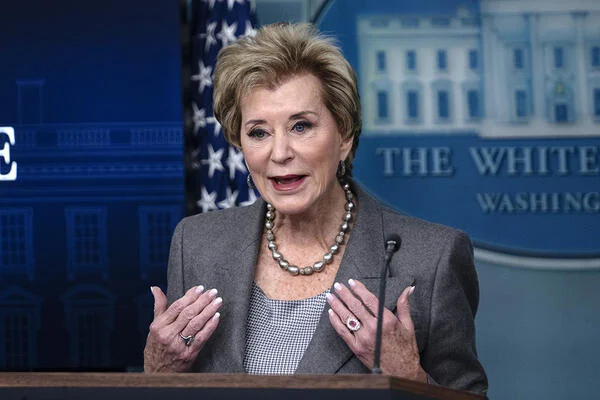
Education Secretary Linda McMahon and her legal team have dropped their appeal of a federal court ruling that blocked the department from requiring colleges to eradicate all race-based curriculum, financial aid and student services or lose federal funding.
The motion to dismiss was jointly approved by both parties in the case Wednesday, ending a nearly yearlong court battle over the department’s Feb. 14 Dear Colleague letter that declared race-based programming and policies illegal. If institutions didn’t comply within two weeks, department officials threatened to open investigations and rescind federal funding.
In response, colleges closed offices related to diversity, equity and inclusion; scrubbed websites; and cut other programming.
First Amendment advocacy groups and the DEI leaders who remain in higher ed declared it a major victory for public education. Democracy Forward, the legal group that represented educators in the case, went as far as to say that it marks the “final defeat” of Trump’s effort to censor lessons and scrub student support programs.
Skye Perryman, president of Democracy Forward, said it should encourage those affected by the Trump administration’s “unlawful crusade against civil rights” to keep fighting back.
“Today’s dismissal confirms what the data shows: government attorneys are having an increasingly difficult time defending the lawlessness of the president and his cabinet,” she said in a news release about the court filing. “When people show up and resist, they win.”
The court filing did not explain why the department chose to abandon the case, and Ellen Keast, a department spokesperson, declined to provide any further comment.
Trump officials had argued that they were merely enforcing existing federal civil rights laws and the 2023 Supreme Court ruling that struck down affirmative action. They claimed race-based programming constitutes discrimination.
But 10 days later, a coalition of education unions, a national association and a public school district challenged the letter in court, arguing it violated administrative procedure law and institutions’ First Amendment rights. Then, in August, federal district Judge Stephanie Gallagher struck down the department’s guidance, arguing it “ran afoul” of procedural requirements and that “the regulation of speech cannot be done casually.”
Colleges and universities aren’t entirely in the clear, though. Just days before the Maryland District Court issued its ruling on the ED letter, the Department of Justice released its own nine-page memo on DEI.
That guidance, which went even further than ED’s guidance, said that basing services on stand-ins for race—like “lived experience,” “cultural competence” and living in a minority-heavy geographic area—could also violate federal civil rights laws. In response, colleges have closed campus centers and publications cater to certain racial or ethnic groups.
Still, many educators see this as a significant step forward.
“When you fight you don’t always win, but you never win without a fight,” said Randi Weingarten, president of the American Federation of Teachers, one of the cases’ plaintiffs, in a news release. “We are proud that this case has once again halted the administration’s pattern of using executive fiat to undermine America’s laws that enshrine justice and opportunity for all.”
This audio is auto-generated. Please let us know if you have feedback.
Dive Brief:
A federal appeals court ruled on Monday that the National Institutes of Health cannot cap research overhead funding across the board, upholding an April lower court decision that spelled relief for beleaguered universities.
The 1st U.S. Circuit Court of Appeals unanimously concluded that NIH violated statutory law and the agency’s own regulatory procedures when it issued a policy capping reimbursement rates for indirect research costs at 15% for current and new grants.
The ruling is the latest blow to the Trump administration’s attempts to have multiple federal agencies cap indirect cost reimbursement rates at 15%. NIH on Tuesday declined to comment on the ruling or say if it planned to appeal.
Dive Insight:
When NIH issued the contested guidance in early February, it said it expected the move to save $4 billion — money that it planned to funnel toward financing direct research costs for institutions.
The move — widely panned in the academic community and elsewhere — broke with long-standing procedure of negotiating reimbursement rates with individual research institutions. For many large research universities, those rates top 50% and help pay for things like information technology, utilities, administrative support, and building and running laboratories.
These negotiations, built into NIH’s regulations, were also codified by Congress during the first Trump administration. Legislators passed an addition to an appropriations bill that advocates and judges have said specifically bars NIH from drawing up a universal reimbursement rate rather than negotiating individually with grantees.
NIH’s new policy drew multiple lawsuits, with high stakes looming while the legal battle played out. As one researcher at the University of Alabama at Birmingham put it, the cap would “cripple research infrastructure at hundreds of US institutions, and threatens to end our global superiority in scientific research.”
In court documents, scores of universities have described in detail how NIH’s 15% indirect cost cap would imperil their medical research operations and workforces, as well as the country’s ability as a whole to advance biomedical science — historically one of the U.S.’s major economic strengths. A February New York Times analysis found the policy could cost some of the top research universities over $100 million a year in funding.
As federal appellate Judge Kermit Lipez, a Clinton appointee, noted in this week’s ruling, NIH research has led to major medical breakthroughs and lowered death rates from conditions such as heart attacks and strokes.
“In short, the public-health benefits of NIH-funded research are enormous,” Lipez wrote.
In March, a district court judge ruled the new policy illegal and issued a preliminary injunction against it, followed by a permanent injunction in April. Despite the setbacks, the Trump administration has tried instituting identical caps at other agencies — namely, the U.S. departments of Energy and Defense, and the National Science Foundation. Federal judges so far have blocked those moves as well.
Several of those opposing NIH’s cap, which included a coalition of state attorneys general, lauded this week’s ruling.
“The Trump Administration wanted to eviscerate funding for medical research that helps develop new cures and treatments for diseases like cancer, diabetes, and Alzheimer’s,” California Attorney General Rob Bonta said in a statement Monday. “We’re starting the new year by building on our previous successes and securing yet another important victory against the Trump Administration.”
This audio is auto-generated. Please let us know if you have feedback.
Dive Brief:
A group of faculty and students at Alabama public collegeson Monday appealed a ruling keeping in placethe state’s law barring public colleges and K-12 schoolsfrom sponsoring diversity, equity and inclusion programs or having DEI offices.
In their lawsuit against Alabama Gov. Kay Ivey and the University of Alabama’s trustees, the plaintiffs argued the 2024 law violatestheir free speech rights and undermines due process because it is too ambiguous for them to know what is prohibited.
The appeal, filed with the 11th U.S. Circuit Court of Appeals, is necessary because the law “continues to undermine academic freedom and the integrity of higher education in Alabama,”according to Dana Patton, a political science professor at the University of Alabama and one of the plaintiffs.
Dive Insight:
Since Oct. 2024, Alabama law has prohibited public colleges and K-12 schools from offering any programming, training or events that base attendance on “race, sex, gender identity, ethnicity, national origin, or sexual orientation.”
The law, SB 129, also requires these institutions to designate multiple occupancy bathrooms based on “biological sex”and prohibits them from promoting or endorsing “divisive concepts.”
The legislation’s examples of such concepts include that “meritocracy or traits such as a hard work ethic are racist or sexist”and that people are “inherently racist, sexist, or oppressive, whether consciously or subconsciously” based on their federally protected personal characteristics.
Colleges can teach or discuss divisive concepts if they do so objectively and “without endorsement as part of a larger course of academic instruction,” the law says.
In January, Alabama public college faculty and students, along with the NAACP’s Alabama State Conference, sued to end the law. In addition to being too ambiguous, the legislation places viewpoint-based restrictions on what students and professors say, the lawsuit alleged.
U.S. District Judge R. David Proctor declined the plaintiffs’ request to block the new law in August, ruling that public colleges could “reasonably control” the content of their classes. He also disagreed with their argument that the law’s language is impermissibly vague.
The plaintiffs, represented by the nonprofit Legal Defense Fund and the American Civil Liberties Union of Alabama, appealed that decision on Monday.
Patton and the other professor plaintiffs argued in their appeal that Proctor had misconstrued the First Amendment by ruling that public college instructors have no right “to teach free of viewpoint discrimination,” according to a Monday press release.
“This law has created a climate of fear on campus that narrows what students can learn and what educators can teach,” Patton said in a Monday statement.
Patton reported censoring herself and changing the curriculum in “a freshman honors course that she has taught, without incident, for numerous years” following a university investigation and a threat from a state lawmaker to pull back funding for the honors program, according to the appeal.
The student plaintiffs also pushed back on Proctor’s conclusion that they hadn’t been sufficiently harmed to necessitate a preliminary injunction, arguing he had overlooked important facts and incorrectly applied the law.
“SB 129 continues to harm my campus community in the months since it went into effect, and that’s why this appeal is so important,” Sydney Testman, a student plaintiff studying at University of Alabama at Birmingham, said in a statement.
Prior to SB 129, Testman served as finance coordinator for her campus’s Social Justice Advocacy Council, according to the appeal.After the law took effect, the university closed the multicultural diversity center that had funded the council and the stipend for Testman’s position.
The University of Alabama at Birmingham cited SB 129 when eliminating funding for the council and at least one other student group, but its leaders “failed to identify which divisive concept or component” motivated the cut, Monday’s appeal said.
“I have watched our campus change overnight, as students are afraid to speak, opportunities for thoughtful engagement have disappeared, and students’ shared sense of belonging has eroded,” Testman said Monday.
Dr. Martin Luther King Jr. often reminded us that ‘the arc of the moral universe is long, but it bends toward justice.’ Yet arcs do not bend on their own; people must pull them. For Black women in higher education, that bending is not a metaphor but a lived, exhausting struggle. Justice is not just a concept but a long, arduous climb. We teach. We research. We lead. And sometimes, we must also stand against the very institutions that hired us.
Dr. Leah P. Hollis By a unanimous 3-0 decision, I recently won a federal appeal in a complex unequal pay case, Hollis v. Morgan State University (No. 24-1476, 4th Cir. 2025), after close to a decade of retaliation and erasure from a prior employer. The Fourth Circuit ruled that the district court wrongly applied Title VII’s timing/exhaustion rules to the Title IX, § 1983 Equal Protection, and Maryland law claims and reversed that mistake.
More importantly, the panel rejected the lower court’s cramped reliance on the McDonnell-Douglas burden-shifting framework. Since 1973, the Supreme Court’s McDonnell-Douglas case has forced discrimination plaintiffs through a rigid three-step burden-shifting test—one that too often shuts cases down before a jury can ever weigh the evidence. However, the Fourth Circuit emphasized instead Rule 56’s simple question: could a reasonable jury find discrimination?
As the court put it, the record contained “circumstantial evidence—including evidence of pretext—that would allow a jury to infer” bias. Judge Quattlebaum went further in a separate concurrence, praising the majority for skipping the rigid McDonnell Douglas steps and instead “pointing out the evidence that creates a genuine dispute of material fact.” He urged the Supreme Court to scrap McDonnell Douglas altogether, calling it “unnecessarily complex” and “more restrictive than Title VII itself.” This appeal and decision chips away at rigid judge-made hurdles that for decades have silenced plaintiffs before a jury could ever hear their stories.
Why Procedure Matters in Civil Rights
For discrimination litigants, this decision is more than technical. The old McDonnell-Douglas test forced plaintiffs to meet rigid “prima facie” boxes and disprove every employer excuse, often leading to dismissal at summary judgment. By centering Rule 56, the Fourth Circuit made clear that all the evidence, biased remarks, shifting justifications, policy deviations, comparators, and suspicious timing, belongs in one evidentiary bundle. In turn, this lowers the procedural bar, makes it harder for employers to paper over bias, and gives plaintiffs a fairer chance to be heard.
My own scars tell the story. I was paid tens of thousands less than men doing the same job, called names behind closed doors, had dossiers suppressed, gaslighted for leadership errors, and was unjustly demoted to “at-will.” Like many women in my department, I scraped for resources while being told to stay quiet, told I was nothing. Silence, they said, was the price of survival. I refused. And when the Fourth Circuit reversed, it was more than a personal win—it was a civil rights intervention that affirmed the importance of truth, insisting that such truths be considered as a whole, the way we live them, not dissected into sterile sound bites.
The 300,000 Who Couldn’t Stay
Between April and June 2025 alone, nearly 300,000 Black women exited the U.S. labor force because they felt unsafe, not by choice but by structural neglect. As of September, unemployment for Black women hovers near 6 percent—twice that of their white counterparts. These departures are not accidents; they are ruptures in equity and dignity, the consequence of harassment, unequal pay, bullying, and institutional betrayal.
Each exit letter echoes the same civil rights path: Harriet Tubman walking 4,500 miles to free enslaved people, Dr. Martin Luther King Jr. jailed 29 times, Colin Kaepernick forfeiting his NFL career. Several times on my journey, I was told, “you’re ruining your life” or “ be grateful to have a job.” But what if Harriet turned back? What if Martin stopped dreaming? What if Colin stood up and stayed quiet? Their resistance was costly; so too is the exodus of Black women from today’s workplaces. Justice does not bloom in surrender.
Intersectional Betrayal in the Academy
In higher education, Black women are showcased on websites and brochures yet undermined in daily practice. Research confirms we are disproportionately bullied, mobbed, and harassed. We remain the only group that required the Crown Act to affirm that our natural hair is lawful. Too often, the hostility comes not only from men but also from women—including women of color—who proclaim solidarity in public but dismantle it in private. These wounds, born of silence and duplicity, are institutional betrayals as old as the academy itself. That is why social justice must be more than a logo or slogan. When institutions use taglines as a façade, people make life-changing decisions based on those promises—only to discover too late that the commitments were hollow, leaving their careers and families in jeopardy. Zora Neale Hurston said it plainly: “The Black woman is the mule of the world.” That weight remains. And yet, even when battered, we persist. Because if we do not disrupt silence, the record calcifies into precedent.
Truth Telling as a Contact Sport
Writing in my personal capacity and researcher in this area, I still serve as a professor, still honor my students, and still respect the office I hold. This appeal shows that justice doesn’t clock out, the fight for equality yawns on despite the fatigue of its warriors; yet we walk on, dream on of a day when one should not have to fight for the dignity they were born with. Whistleblowers and resisters are often isolated, mischaracterized, and told to take the “high road.” Yet if we as educators do not teach justice by living it, the next generation inherits our silence as permission.
I prevailed because the record mattered, and because the Georgetown Civil Rights and Appellate Courts Immersion Clinic believed in my case and had the determination to fight for justice. What we do not correct becomes precedent. The appellate court saw what those in power at my prior institution chose to ignore—the pretext, the contradictions, the lies. With support from family, counsel, and ancestors, I stood. And now, with Hollis v. Morgan State joining Ames v. Ohio in questioning the stranglehold of McDonnell-Douglas, the judiciary too has taken a step toward clearing the road.
The Unending Path Forward
This is not the end. My case now returns to the district court where it will either go to trial or may yet be resolved through mediation. My forthcoming book, Disrupt the Not Telling, by Oxford University Press, will continue excavating the silences and erasures imposed on Black women scholars. As Audre Lorde reminds us: “Your silence will not protect you.” Some of us cannot speak loudly, constrained by family, caregiving, or survival—but presence, prayer, and quiet resistance are also forms of disruption.
The fight for equity is cyclical, echoing Reconstruction, the Red Summer of 1920s, and the civil rights movement 1960s. Each time, the nation tries to turn us back. Yet like Harriet, Martin, and Colin, those of us who set out on the trail of justice cannot turn back.
The exodus of 300,000 Black women from the workforce is not just a labor statistic—it is the latest reminder that civil rights remain unfinished, and that silence cannot be its price.
_______
Dr. Leah P. Hollis is Associate Dean and Professor at Penn State University.
Saint Augustine’s University has lost another appeal to maintain its accreditation status, the Southern Association of Colleges and Schools Commission on Colleges announced Monday.
But the historically Black university in North Carolina is continuing to fight to stay open, and leaders sayrecent loans and efforts to streamline operations are cause for optimism. Classes will be held online this fall but otherwise proceed as planned.
SACS initially stripped accreditation from the university in December 2023 due to financial and governance issues, setting off a lengthy battle between SAU and its accreditor. SAU appealed that decision and lost in February 2024 but took the fight to court and won last July, when an arbitration committee agreed to restore SAU’s accreditation.
However, SACS pulled Saint Augustine’s accreditation again in December 2024, prompting another appeal, which was denied in March. Leadership at the embattled university once again sought a legal remedy only for a panel of arbitrators to side with the accreditor. Arbitrators determined that Saint Augustine’s “did not meet the burden of proof to show” that the accreditor “failed to follow its procedures and that such failure significantly attributed to the decision to remove the institution from membership,” according to details SACS released on Monday.
But in the Monday news release, SAU officials wrote that the “fight is far from over.”
University officials plan to request an injunction in court “to prevent any disruption to the university’s accreditation status,” according to SAU’s website. While SAU will remain accredited as the legal challenge plays out, the university “will explore all other means of accreditation if necessary.”
SAU officials also sought to dispel the notion that the university was closing, a prospect that has swirled for more than a year as the HBCU has dealt with various financial setbacks and lawsuits. The university has also struggled to maintain enrollment, which has collapsed since 2022.
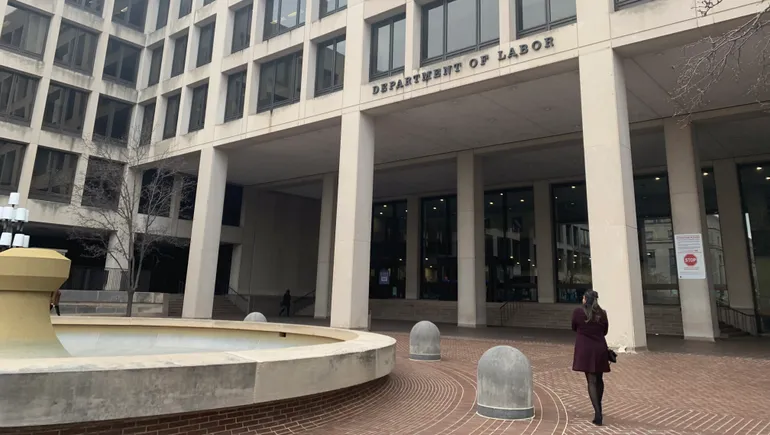
On February 28, the Department of Labor (DOL) filed an appeal in Flint Avenue, LLC v. U.S. Department of Labor, which previously led a district court to strike down the agency’s overtime final rule set forth under the Biden administration. The action is the second pending appeal from DOL with respect to cases involving the Biden administration’s overtime rule and may be acting as a placeholder to provide time for the Trump administration to determine how they want to move forward with the Biden administration’s overtime rule.
Background
As a reminder, the Biden administration’s final rule implemented a phase-in approach to increasing the minimum salary threshold under the Fair Labor Standards Act (FLSA) overtime regulations. Specifically, the rule increased the minimum salary threshold, effective July 1, 2024, from the previous level of $684 per week ($35,568 per year) to a new level at $844 per week ($43,888 per year). This first increase used the same methodology set by the first Trump administration’s 2019 overtime rule to determine the new salary threshold level. The rule also aimed to increase the threshold a second time effective January 1, 2025; however, the Biden overtime rule was struck down in federal court before the second increase could take effect. This increase would have changed the minimum salary threshold again to $1,128 per week ($58,656 per year). Finally, the rule adopted automatic updates to the minimum salary threshold that would occur every three years.
Shortly after the Biden overtime rule was published, lawsuits were filed challenging the final rule. These lawsuits resulted in two district court orders to vacate the final rule. On November 15, 2024, a federal judge in the Eastern District Court of Texas ruled to vacate the Biden administration’s FLSA overtime final rule in State of Texas v. U.S. Department of Labor. Similarly, on December 30, 2024, another federal judge in the Northern District Court of Texas ruled to vacate the Biden administration’s overtime rule in Flint Avenue, LLC. Both rulings vacated all components of the rule, meaning both the July and January salary thresholds set under the final rule were no longer in effect and automatic updates to the minimum salary threshold would not take place.
DOL’s Appeals
Soon after the federal judge ruled in the State of Texas case, the Biden administration’s DOL filed an appeal. The appeal was filed in the 5th U.S. Circuit Court of Appeals, where it remained through the presidential transition. On February 24, the Department of Labor under the Trump administration requested an extension to file its opening brief in the State of Texas appeal. The 5th Circuit Court agreed to the extension, allowing for opening briefs to be filed by May 6, 2025.
Soon after, on February 28, DOL filed its second appeal to the 5th Circuit Court in the Flint Avenue case. Both actions may be intended to give time to newly confirmed Labor Secretary Lori Chavez-DeRemer to settle into her new role and determine how the Trump administration will move forward with litigation and the Biden administration’s rulemaking.
CUPA-HR will continue to keep members apprised of legal updates regarding the overtime regulations.
Protesting in public parks is as American as apple pie. It’s at the heart of our First Amendment — and one of our nation’s most time-honored principles. That right does not disappear merely because a private entity operates the public park on the government’s behalf.
That’s why FIRE and the Law and Religion Clinic at the University of Texas School of Law are appealing a district court ruling that weakens this First Amendment right. And we are proud to be backed by a broad coalition of prominent organizations as “friends of the court.”
Here’s what happened. Several years ago, animal welfare advocates Daraius Dubash and Dr. Faraz Harsini took to Houston’s largest public park to raise awareness about the harms of industrialized farming. For Dubash, this activism is rooted in his Vedantic Hindu faith, which compels him to promote the teaching of ahimsa, or nonviolence. To communicate their message, Dubash and Harsini serve as co-organizers for an international nonprofit animal-rights group. Their signature event involves volunteers showing muted documentary footage of farming practices to passersby, while others remain available to answer questions.
Dubash and Harsini’s right to peacefully advocate on this issue in a public park is beyond dispute. But on three separate occasions, the public park’s private management ordered them to leave. The fourth time, park management had Houston police arrest Dubash for criminal trespass and banned them both from showing their video footage in the park in the future. Why? Because the park’s private managers and city police deemed their message “offensive.”
With the help of FIRE and the Law and Religion Clinic, Dubash and Harsini filed suit in 2023 against the City of Houston, the park management corporation, its then-president, and the arresting officers. But in September, 2024, the U.S. District Court for the Southern District of Texas dismissed their claims, ruling that none of the defendants were responsible for violating Dubash and Harsini’s constitutional rights in a public park.
We disagree.
FIRE and the Clinic appealed to the Fifth Circuit, arguing that the ruling effectively lets the government bypass the First Amendment by delegating the management of public spaces to private organizations. And the court’s limited interpretation of governmental liability would make it nearly impossible for anyone to challenge violation of their constitutional rights by municipalities or law enforcement.
Last week, 12 prominent organizations from across the ideological spectrum filed nine amicus curiae briefs in support of Dubash and Harsini:
The ACLU of Texas argues the park management company was acting as a state actor and public-private partnerships “cannot serve as an end run around the First Amendment.” The brief also argues the district court erred by failing to hold the arresting officers accountable based on their “mistaken belief” that the park was private. As the brief explains, probable-cause findings must be based on “objective facts and circumstances rather than subjective beliefs.”
Young America’s Foundation, Hamilton Lincoln Law Institute, and Advancing American Freedomexplain that Houston cannot bypass its duty to protect free speech in its public spaces by granting oversight authority to a private third party. The brief also emphasizes the sweeping implications of the district court’s decision, including in the academic context where state universities are increasingly attempting to evade First Amendment protections by outsourcing park management to nominally private entities like student governments.
Liberty Justice Center argues the district court’s decision “blurs the line between state and private actors,” allowing Houston to “contract out of its constitutional obligations.” We could not agree more.
The Center for American Liberty, in a brief submitted through Reeves Law LLC, argues that maintaining a public park is a traditional and exclusive government function, with public parks serving “as public forums for the expression of speech,” whether or not they are managed by a private entity.
The National Press Photographers Association, in abrief submitted through the First Amendment Clinic at Southern Methodist University Dedman School of Law, explains how the district court’s ruling “threatens the sanctity of the spaces where speech is deserving of the highest protection.”
Law Enforcement Action Partnership and the National Police Accountability Projectexplain that accountability for law enforcement officers and municipalities is crucial to preserving public confidence in the police and the government, and that failing to hold police officers accountable “undermines public trust in law enforcement.” The brief also argues that municipalities should know their police officers “need training and guidance to appropriately respond” to peaceful expressive activity, and failing to provide that training is sufficient to establish municipal liability.
Protect the First Foundation, in a brief submitted through the Religious Freedom Clinic at Harvard Law School and Schaerr Jaffe LLP, highlights that Dubash was motivated to proselytize nonviolence by his deeply held religious beliefs, and describes the long history and tradition of public proselytization, from the persecution of religious minorities in the colonies through the legal protections established by First Amendment jurisprudence.
The Hindu American Foundation, in a brief submitted through Jackson Walker LLP, explains that Dubash’s religious motivation to advocate for nonviolence towards animals is consistent with Hindu teachings. The brief also argues that his “arrest, detention, and the ongoing prohibition on his method of proselytizing” do not pass constitutional muster.
The American Hindu Coalition, in a brief submitted through the Free Exercise Clinic at Yale Law School, emphasizes the history of public parks and streets as centers of religious activity, how marginalized faiths rely on these spaces to exercise their faith, and that Dubash’s activism is rooted in his religious beliefs.
Our clients and their counsel are grateful for the support of this impressive and diverse amicus coalition. This case will play a critical role in protecting the rights of other protesters and religious minorities to engage in protected expression as guaranteed under the First Amendment.
This audio is auto-generated. Please let us know if you have feedback.
Dive Brief:
The U.S. Department of Labor has appealed a Texas federal judge’s 2024 decision blocking its Biden-era final rule which sought to expand overtime pay protections under the Fair Labor Standards Act, according to a Feb. 28 court filing.
Last December, Judge Sam Cummings of the U.S. District Court for the Northern District of Texas ruled against DOL in Flint Avenue, LLC v. U.S. Department of Labor, vacating and setting aside the final rule. Cummings’ decision came just over one month after another Texas judge similarly vacated and set aside the rule in a separate lawsuit filed by the state of Texas and parties including the Plano Chamber of Commerce.
The appeal takes Flint Avenue to the 5th U.S. Circuit Court of Appeals, the same court in which DOL filed an appeal of the decision in the State of Texas case last year. DOL’s public affairs staff did not immediately respond to a request for comment. The U.S. Department of Justice, which represents the DOL, did not respond to a request for comment submitted via its online form.
Dive Insight:
The Feb. 28 notice of appeal may come as a surprise to employers who expected the Trump administration to abandon the final rule; attorneys who previously spoke to HR Dive said that the rule was effectively “dead” despite DOL’s State of Texas appeal because of the Trump administration’s conservative policy stance on overtime.
In fact, the new administration had already filed motions in the 5th Circuit pertinent to overtime rule litigation. On Jan. 22, two days after President Donald Trump’s inauguration, DOJ attorneys sent a letter to the 5th Circuit requesting a 30-day extension on the deadline set by the court to file an opening brief in the State of Texas appeal. The court granted the request and the agency’s filing deadline is currently set to March 7.
The April 2024 final rule proposed a two-step process that would have eventually raised the minimum annual salary threshold for overtime pay eligibility under the FLSA from $35,568 to $58,656 by Jan. 1, 2025. The rule would then have implemented a mechanism for automatically adjusting the threshold every three years using current wage data beginning in July 2027.
But a series of Texas court decisions froze the rule. The judge in State of Texas held that the rule exceeded DOL’s authority and was unlawful. Likewise, Cummings said in his decision that he found the State of Texas judge’s reasoning “persuasive,” and he adopted the same reasoning in ruling for the plaintiffs.
There is some intrigue in how the 5th Circuit might rule on the two appealed judgments given that the court signed off on DOL’s overall use of a salary basis test for determining overtime pay eligibility in last year’s Mayfield v. U.S. Department of Labor. The Mayfield plaintiffs alleged that the salary basis test had no basis in the FLSA’s text, but the 5th Circuit disagreed. The court did hold, however, that DOL “cannot enact rules that replace or swallow the meaning” of the FLSA’s text, adding that particular salary threshold may raise legal issues because of their size.
This audio is auto-generated. Please let us know if you have feedback.
Dive Brief:
Saint Augustine’s University announced Thursday that its appeal to keep its accreditation has been denied,striking a major blow to the struggling historically Black institution.
Officials at the North Carolina university said they are entering a 90-day arbitration process in another bid to remain accredited. That will also ensure students graduating through May 2025 will earn their diplomas from an accredited institution, according to the university.
Brian Boulware, Saint Augustine’s board chair, struck an optimistic tone in Thursday’s announcement about the arbitration process, saying that the university’s “strengthened financial position and governance will ensure a positive outcome.”
Dive Insight:
Saint Augustine’s has been on the precipice of losing its accreditation for over a year. In 2023, the university’s accreditor — the Southern Association of Colleges and Schools Commission on Colleges — voted to terminate the university’s accreditation.However, college officials successfully contested that last year through arbitration.
Yet in December, SACSCOC once again voted to terminate Saint Augustine’s from its membership, citing issues with the university’s finances and governance.Saint Augustine’sThursday announcement says that it lost its appeal of that decision, but arbitration once again gives the university another shot at retaining its accreditation.
Since the December vote, the university has sought to shore up its budget through widespread cuts and new sources of funding.
Still, Saint Augustine’s is grappling with steep declines in enrollment, with just 200 students in the 2024-25 academic year, WRAL reported. That’s down from over 1,100 students just two years ago.
In Thursday’s announcement, Saint Augustine’s officials announced they had secured up to $70 million, which they described as a bridge loan, “at competitive market rates and terms” in a deal that they expect to close later this month. University officials did not disclose where the $70 million in funding is coming from, citing nondisclosure agreements.
The announcement comes after Saint Augustine’s failed to get approval from the state attorney general’s office to enter a land lease deal with 50 Plus 1 Sports, an athletics development firm.
In January, the attorney general’s office said the deal could put the university’s nonprofit status at risk,arguing that the upfront lease payment of up to $70 million was far too low for Saint Augustine’s103-acre property. The office said the campus had been appraised at over $198 million.
Following the decision from the attorney general’s office, the two parties began restructuring the deal to lease less than half of Saint Augustine’s campus to50 Plus 1 Sports, INDY Week reported. Under the new terms — which circumvent the need for the state office’s sign-off — the sports development firm would also share some of its revenue from its use of the land with the university.
Saint Augustine’s did not mention 50 Plus 1 Sports in Thursday’s announcement.
“This funding is a game-changer,” Hadley Evans, vice chair on Saint Augustine’s board, said in Thursday’s announcement. “We now have the financial leverage to protect SAU’s legacy, enhance academic offerings, and create sustainable revenue streams through strategic campus development.”
Saint Augustine’s has also drastically cut its workforce amid its financial woes. In November, the university said it was cutting over 130 staff and faculty positions to shave $17 million from its budget.
The Southern Association of Colleges and Schools Commission on Colleges denied Saint Augustine’s University’s appeal to remain accredited, SAU announced Thursday.
The decision is the latest blow to the embattled historically Black university in North Carolina, which has struggled to maintain its accreditation since December 2023, when SACSCOC voted to strip it of its membership due to compliance issues related to governance and finances. Following that decision, SAU lost an appeal to remain accredited; it won a reprieve in the courts last July but lost accreditation again in December. Now that SASCOC has denied SAU’s latest appeal, the university will again pursue a legal remedy, officials announced.
“We have made substantial progress and are confident that our strengthened financial position and governance will ensure a positive outcome,” Board of Trustees chairman Brian Boulware said in a Thursday statement announcing plans to contest the accreditation decision in court. “SAU is resilient, and we are resolute in our commitment to academic excellence.”
Beyond accreditation issues, Saint Augustine’s has navigated severe fiscal issues that left it teetering on the brink of closure for months as it pursued various financial lifelines. SAU recently attempted to lease its campus to 50 Plus 1 Sports, a fledgling Florida company. The $70 million deal to lease property for 99 years with development options would have provided much-needed funds for SAU, but following a review required by state law, North Carolina officials declined to sign off on the arrangement due to the transfer of nonprofit assets.
SAU had unsuccessfully sought approval of the deal before its appeal to SACSCOC last month.
The North Carolina attorney general’s office, which reviewed the deal, cited insufficient documentation and concerns that SAU was only receiving $70 million for property appraised at $198 million. Saint Augustine’s and 50 Plus 1 Sports have since restructured the terms of the deal.
In Thursday’s statement, SAU announced it “secured up to $70 million in sustainability-focused funding at competitive market rates and terms,” which it expects to close later this month. It added that nondisclosure agreements “prevent SAU from publicly disclosing the partners’ names.”