Tag: applications

  • Study visa applications to NZ dip, approval rate jumps nearly 7%

    Study visa applications to NZ dip, approval rate jumps nearly 7%

    According to data highlighted by Immigration New Zealand (INZ), the government agency responsible for managing the country’s immigration system, the first 10 months of 2025 saw 55,251 study visa applications, down from 58,361 in the same period last year.

    However, approval rates have risen sharply. In 2024, INZ approved 42,724 of 58,361 applications (81.5%) and declined 9,161 (17.5%). Meanwhile, in 2025, despite fewer applications at 55,251, approvals rose to 43,203 (88.2%) with 5,317 declined (10.9%).

    NZ sets itself apart from other key study destinations

    Even as major anglophone study destinations take a cautious approach to international education policy, New Zealand is aiming to be an outlier in the market.

    The country is looking to boost international student enrolments from 83,700 to 119,000 by 2034 and double the sector’s value to NZD$7.2 billion (GBP £3.2bn) under the recently launched International Education Going for Growth plan.

    This month, new rules came into effect allowing eligible international tertiary and secondary students with visas from November 3 to work up to 25 hours a week, up from 20, while a new short-term work visa for some vocational graduates is also expected to be introduced soon.

    “As part of the International Education Going for Growth Plan, changes were announced to immigration settings to support sustainable growth and enhance New Zealand’s appeal as a study destination. These changes aim to maintain education quality while managing immigration risk,” Celia Coombes, director of visas for INZ, told The PIE.

    “Immigration New Zealand (INZ) and Education New Zealand (ENZ) work in close partnership to achieve these goals.”

    We have more students applying for Pathway Visas year on year, which means more visas granted for longer periods, and less ‘year by year’ applications
    Celia Coombes, Immigration New Zealand

    Why the drop in study visa applications?

    While study visa approval rates have skyrocketed over the past year — a stark contrast to the Covid period, when universities across New Zealand faced massive revenue losses owing to declining numbers — stakeholders point to a mix of factors behind the drop in new applications.

    “There has been an increase in approvals, but overall, a slight decrease in the number of students applying for a visa. However, interest in New Zealand continues to grow,” stated Coombes, who added that the number of individuals holding a valid study visa rose to 58,192 in August 2025, up from 45,512 a year earlier.

    “We have more students applying for Pathway Visas year on year, which means more visas granted for longer periods, and less ‘year by year’ applications.”

    While multi-year pathway visas can cover a full planned study path, reducing the need for repeated applications, Richard Kensington, an NZ-based international education consultant, says refinements could make the route more effective in attracting international students.

    “The Pathway Visa, introduced nearly a decade ago as a trial, has never been fully expanded. Although reviews are complete and the scheme is set to become permanent, no additional providers have been given access,” stated Kensington.

    “Simple refinements — such as allowing pathways to a broad university degree rather than a specific named programme — would encourage more students to utilise this route.”

    The drop could also be linked to the underdeveloped school sector and the slower recovery of New Zealand’s vocational education sector, as noted by Kensington.

    “The school sector remains one of New Zealand’s most untapped international education markets. Demand is growing, especially from families where a parent wishes to accompany the student. The Guardian Parent Visa makes that a viable option,” stated Kensington.

    “Vocational education hasn’t rebounded in the same way. The loss of work rights for sub-degree diplomas has significantly reduced demand from traditional migration markets.”

    New Zealand’s vocational education woes

    Just this year, the New Zealand government announced the disestablishment of Te Pūkenga, the country’s largest vocational education provider, formed through the merger of 16 Institutes of Technology and Polytechnics.

    It is being replaced by 10 standalone polytechnics, following concerns that the model had become too costly and centralised.

    “Te Pūkenga’s rise and fall created real confusion offshore. With standalone polytechnics returning, we should see greater stability from 2026 onwards,” Kensington added.

    “Many polytechnics are now relying on degree and master’s programmes, putting them in more direct competition with universities.”

    Applications fall in China, climb in India

    As per data shared by INZ on decided applications across both 2024 and 2025 — including on ones submitted in earlier years — countries like India (+2.7%), Nepal (+26.8%), Germany (+5.2%), and the Philippines (+7.8%) have seen growth in the number of study visas approved.

    Meanwhile, many East and Southeast Asian markets have recorded year-on-year declines, most notably the largest sending market, China, which dropped by 9.9%.

    The data shows that while 16,568 study visas were approved for China in January–October 2024, this fell to 14,929 in 2025 though it remains the largest source country.

    Other markets such as Japan (-9.7%), South Korea ( -24.8%), and Thailand (-33.7%) also saw significant declines.

    According to Frank Xing, director of marketing and operations at Novo Education Consulting, the slowdown from China is clear, with weaker student interest reflected in both their enquiries and feedback from partners, and echoed by some New Zealand institutions.

    “It’s a mixed picture — a few schools, particularly in the secondary sector, are still doing well, but many providers are starting to feel the impact,” stated Xing, who believes several factors are driving the slowdown.

    “The first is the weaker Chinese economy — many families have been affected by job losses or lower business income. In the past, property assets often helped families fund overseas study, but the real estate downturn has reduced that flexibility,” he added, also noting New Zealand’s own unemployment challenges and competition from lower-cost destinations.

    “We’ve actually seen some students abandon their New Zealand study plans or switch to more affordable destinations such as Malaysia or parts of Europe.”

    According to Xing, while China remains one of New Zealand schools’ strongest markets, this could change as Chinese families place greater emphasis on career outcomes — an area where New Zealand’s slower job market remains a challenge.

    He added that New Zealand’s role as the 2025 Country of Honour at China’s premier education expo could help raise awareness among prospective students.

    False applications remain a major concern

    For Education New Zealand and INZ, the more immediate challenge now lies in addressing fraudulent applications, according to Coombes.

    “New Zealand sees a lot of false financial documents. To address this and help ensure students have the money they need to live and study in New Zealand, we are improving processes to maintain integrity and streamline processing,” stated Coombes.

    “This includes expanding the Funds Transfer Scheme, where students deposit their living costs in New Zealand, and they are released monthly.”

    According to Kensington, some agencies across South Asia and likely parts of Africa, where New Zealand has limited representation may not meet required standards, creating challenges. However, he believes improved processing is reducing the impact.

    “INZ only accepts financial evidence from specific banks in some jurisdictions. Student loans must be secured; unsecured loans aren’t accepted even from major banks,” stated Kensington.

    “It’s hard to say whether fraud is increasing, but the rise in high-quality applications means INZ can process many files quickly and devote more time to forensic checks where needed.”

    Source link

  • UK study visa applications up 7% while dependant numbers plummet

    UK study visa applications up 7% while dependant numbers plummet

    New Home Office migration statistics show the full effect of an almost outright ban on dependants – with numbers dropping sharply for the second year in a row since the policy was announced.

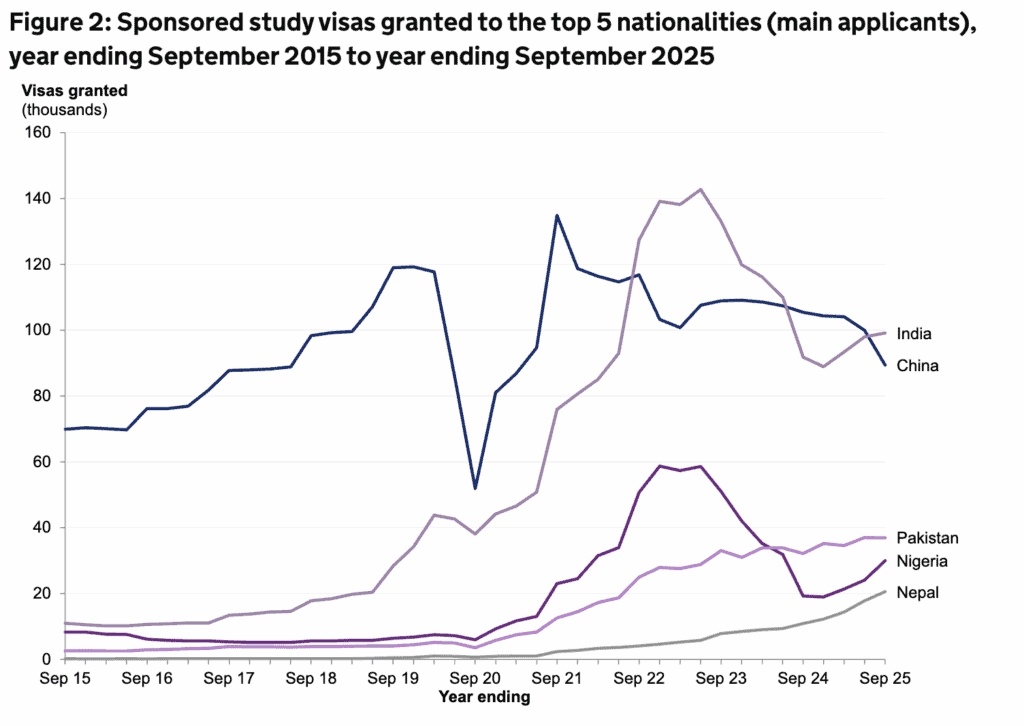
    While there were 419,558 main applications for UK study visas in the year ending September 2025, marking a 7% increase on the previous year, there were 20,366 dependants – a 57% decrease year on year.

    It marks the second consecutive year of falling dependants, with this number decreasing annually by a whopping 87% in the year ending September 2024.

    It follows new rules introduced in January 2024 to ban students on postgraduate-taught programs from bringing their dependants with them to the UK.

    The number of UK study visas issued to international students and their dependants rose sharply after 2016 – reaching a post-Covid peak of 652,072 in 2023. Now, since the dependants ban, the number of study visas issued has fallen to 439,924.

    According to the Home Office, there has been roughly one dependant for every 20 main study visa applicants since the year ending March 2025 – a stark decline since the year ending September 2023, when this number stood at six per 20 main applicants.

    Source: Home Office

    Indian students were issued the most sponsored study visas in the year ending September 2025, with 99,18 visas issued. Chinese students made up the second biggest cohort – with 89,397 visas issued, 15% fewer than the previous year.

    Pakistani students were the third biggest group – issued 39,924 study visas, while there were gains for Nepali students (up 89% to 20,572) and Nigerian students (up 56% to 30,009).

    According to James Pitman, chairman of Independent Higher Education (IHE) and CEO of Studygroup, the effect of the dependants ban has been discriminatory – disproportionately affecting women.

    Speaking in a personal capacity at yesterday’s IHE annual conference, Pitman acknowledged that the dependants visa has “a major flaw”, but said that this could have been corrected rather than withdrawing the scheme entirely for taught degrees.

    “As predicted by the sector, that withdrawal was gender discriminatory, leading to the loss of 19,000 female students vs prior year in the January 2024 intake alone,” he said. “Every one of those was a human story, of ambitions denied, families fractured, careers restricted and yet again women being discriminated against – in this case by UK government policy.”

    Every one of those was a human story, of ambitions denied, families fractured, careers restricted and yet again women being discriminated against
    James Pitman

    Home Office figures obtained by Pitman via a freedom of information request show a marked year-on-year decline in women issued sponsored study visa grants for courses at RQF level 6-8 or equivalent starting in January.

    In 2023, of 81,079 total student visas, 45% were issued to women, compared to 55% that were issued to men. But the following year, after the dependants ban was brought in, the gender split was 66% in favour of men. These numbers stayed stable in 2025, the data showed, with 65% of sponsored study visas issued to men.

    Source link

  • Australia expands accepted English language tests for visa applications

    Australia expands accepted English language tests for visa applications

    LanguageCert Academic, CELPIP General, and the Michigan English Test (MET) are now officially accepted for use in Australian visa applications.

    With this update, a total of nine tests from eight different providers are now officially recognised for Australian visa purposes. These include previously accepted options such as IELTS, Pearson (PTE Academic), Cambridge English, TOEFL iBT, and OET. Notably, IELTS Academic and IELTS General Training are now registered as separate tests.

    Commenting on the news, Sharon Harvey, CEO of Michigan Language Assessment, said: “We are proud that Michigan Language Assessment has been approved by the government of Australia for MET to be used for Australian visa purposes. This recognition is a clear acknowledgment of the validity and reliability of MET, and of its value in assessing and certifying English language skills.”

    We are proud that Michigan Language Assessment has been approved by the government of Australia for MET to be used for Australian visa purposes

    The company, which launched in 2009 and enhanced with a secure digital version in 2021, said that to earn this status, MET underwent an extensive validation process.

    Meanwhile, LanguageCert‘s partnerships and recognitions director Fraser Cargill said the company was “excited to deepen our engagement in Australia, supporting individuals as they pursue opportunities in this dynamic country”.

    “This contract reflects our ongoing commitment to supporting government departments with secure solutions and individuals worldwide in achieving their academic, professional or personal goals through accessible and trusted language assessment,” he added.

    As of August 7, updated score requirements for certain tests have been implemented, with full details available on the Department of Home Affairs website.

    For its part, CELPIP General said it was “pleased to announce” that its test was one of those accepted by the Australian government as proof of English langage proficiency for visa purposes.

    “With this designation, we are pleased to provide test takers seeking to attain an Australian visa with the same dedicated assessment of English language proficiency that is tried and true for the government of Canada and other score users,” it said.

    Source link

  • Grant Applications for Campus Childcare Put on Hold

    Grant Applications for Campus Childcare Put on Hold

    Eveline McPhee, a 39-year-old mother of two, has been a dental assistant in northern Massachusetts for nearly 15 years. And while she’s long aspired to upgrade that title to dental hygienist, for most of her career that goal seemed unattainable.

    With a full-time job, managing classes seemed arduous, and without a job she and her husband wouldn’t be able to afford day care and after-school programs.

    But that all changed last year when an admissions officer at Mount Wachusett Community College told McPhee about Child Care Access Means Parents in School, or CCAMPIS—a $75 million federal grant program designed to help low-income parents in college pay for childcare both on and off campus. McPhee enrolled last fall and is on track to graduate in 2026.

    “I have a 9-year-old son, and they paid for him to go to camp this summer so that I can take an intensive course in the dental hygiene program,” McPhee said. “I definitely would not have been able to go back to school without CCAMPIS.”

    Now the future of the program is cloudy.

    Applications for this year’s CCAMPIS grants—which typically open in May and close by the end of July—have yet to be announced, leaving thousands of student parents in limbo.

    Multiple think tank fellows and student advocacy representatives said they’ve been reaching out to the Trump Department of Education for more information since the spring, but the response is always “We’ll open it soon.” Similar circumstances have been reported for other basic needs programs included under FIPSE, the Fund for the Improvement of Postsecondary Education.

    Neither the Department of Education nor Republican committee chairs in the House and the Senate responded to Inside Higher Ed’s request for comment.

    With the new academic year quickly approaching, the lack of funds leaves many colleges and universities with major budget gaps.

    Until last month, Mount Wachusett’s childcare finances looked grim; CCAMPIS funding was set to run out on Sept. 30. But Ann Reynolds, the student support adviser who runs the program, had seen all the headlines about the Trump administration’s funding freezes and anticipated the delay. (Last year, the Biden administration chose not to open the grant to new applicants, but it sent out a clear notice in advance and allowed existing awardees to reapply.) She reached out to a local philanthropy and secured $94,000 to carry McPhee and about a dozen other student parents through graduation.

    “We could see the writing on the wall, so to speak,” Reynolds said. “And it’s lifted a great weight from my student parents’ shoulders.”

    Not all colleges were so forward-thinking. Many students, including future enrollees at Mount Wachusett, will have to take out additional loans—or drop out and try to repay the loans they already have without a college degree.

    “We’re seeing a lot of students raising children coming to school now, so our need is greater,” Reynolds said. “But we can’t take in new students.”

    Without the grants, which have had bipartisan support in Congress for years, historically underfunded institutions, including community colleges and minority-serving institutions, will be cash-strapped. Some may be forced to cut staffing or eliminate services entirely.

    “Given all the other funds from the U.S. Department of Education that have been frozen or subject to political games in the last few months, the community is right to worry,” said Bryce McKibben, senior director of policy and advocacy at Temple University’s Hope Center for Student Basic Needs. “This doesn’t serve anyone—certainly not taxpayers. The administration should announce a competition or award continuation grants immediately.”

    ‘A Vicious Cycle’

    Most experts speculate the delay is occurring for one of two reasons: Either the department lacks the capacity to meet this statutory requirement since it laid off half its staff in March, or it is intentionally withholding the dollars as part of a broader effort to claw back education funding through a process known as rescission.

    The latter option would require congressional approval. But the president already won enough votes to pass one rescission package earlier this month, and policy analysts say it’s likely he’ll try to do it again. (Trump’s proposed budget for fiscal year 2026 axes CCAMPIS and FIPSE completely.)

    Either way, Theresa Anderson, a senior education and labor fellow at the Urban Institute, a nonpartisan think tank, said the delay symbolizes a larger restriction on college access.

    This is a “well-documented agenda pattern and strategy” of the Trump administration, she explained. “It represents further disinvestment and disinterest in helping people access the necessary training, education and credentialing programs that states recognize are necessary to development of the workforce.”

    Tanya Ang, executive director of the Today’s Student Coalition, an adult learner advocacy group, described the situation as putting the leaders of critical student support services “up against a brick wall.”

    “If students are going to school, we want them to finish, because that’s going to ensure they can get a job and start a long-term career that will provide a strong return on investment,” Ang explained. Cutting off access to childcare “creates a vicious cycle that will hurt not just them and their children as individuals but, honestly, our economy.”

    Critics have long argued that CCAMPIS is a duplicate program, suggesting that the Child Care and Development Block Grant, which is run by the Department of Health and Human Services, fulfills a similar purpose. But higher education experts say that’s simply not the case.

    CCDBG, they say, supports broad, state-level childcare subsidies, predominantly allocated to parents who work full-time. CCAMPIS, on the other hand, is more targeted and serves student parents, many of whom can’t meet the work requirements attached to the block grant.

    “CCAMPIS was really important to not only be able to fill childcare needs in a way that was very flexible for colleges, but also to allow for additional wraparound supports that are incredibly important to support persistence,” Anderson said. It helps student parents “build meaningful community connections, not only with staff of the college, but also with each other.”

    At Mount Wachusett, Reynolds said student parents who participate in the CCAMPIS program have one of the highest completion rates among any demographic, at 73 percent. So she hopes that even a sliver of the current operation will survive past its current end date in 2027.

    When asked what she would tell the Trump administration if she had the chance, McPhee said she was worried people were losing the opportunity to get ahead.

    “I wanted to do better for my family, and this allowed me to do that,” she said. “To not be able to provide that for people moving forward, it’s just not what this country is about. It’s wrong, and I don’t really understand why they would do it.”

    Source link

  • UCAS applications and offer making by June deadline, 2025

    UCAS applications and offer making by June deadline, 2025

    The UCAS 30 June application deadline is the last point an applicant can apply outside of clearing.

    Though most applications (particularly from UK 18 year olds) happen by the January deadline, the June figures allow for a complete analysis of application behaviour in the UCAS main scheme.

    The number of 18 year old UK applicants has reached a record high of 328,390 (up 2.2 per cent on last year) – with the total number of applicants at 665,070 (up 1.3 per cent on last year).

    Application rates

    As always it is salutary to compare the often-pushed narrative that young people are being tempted away from expensive/poor-value/woke (delete as per your personal preference) higher education with the actuality that numbers are rising. You could even be tempted to imagine what the application rates might be like in a sector with a realistic student maintenance offer.

    I mention application rates because this is what declinist commentators will seize on. For UK domiciled 18 year old applicants, the application rate is 41.20 – down from 41.80 per cent last year. This fall is visible across most measures of deprivation: in England, for example, every IMD quintile but quintile 5 (the least disadvantaged) sees a falling application rate.

    [Full screen]

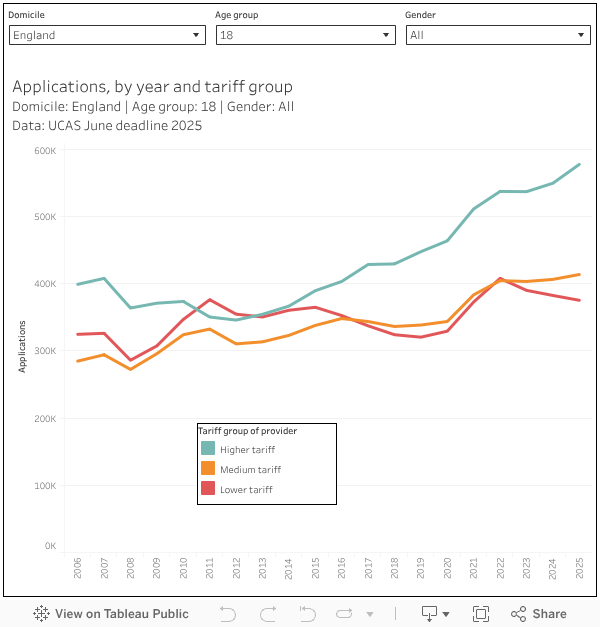
    In part, this could be a function of another year where the dominance of higher tariff providers in driving applications has increased: higher tariff providers disproportionately inspire applications from (and recruit) better off young people.

    This chart shows the number of applications to each of three tariff groups. For UK 18 year olds the default is fast becoming an application to a high tariff provider. We don’t (unfortunately) get application numbers by deprivation and tariff group.

    [Full screen]

    These number of placed students is likely to rise too: UCAS and Ofqual have suggested that there are 28,000 places available in Clearing this year.

    Offer rates

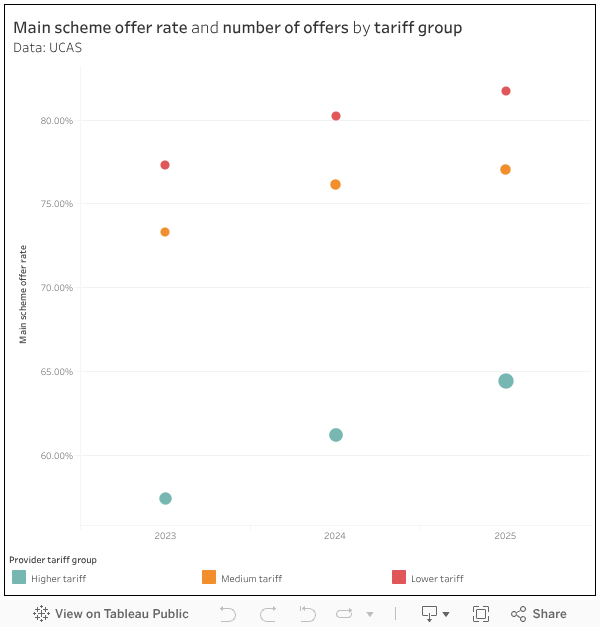
    One innovation in this year’s release is information on offer rates – the proportion of applications that result in an offer being made. We get three years of data, which demonstrate that offer rates are rising across the sector – and that (as you may expect) high tariff providers are less likely to make offers than lower tariff providers. The growth among high tariff providers is driven both by rising application numbers and a rising offer rate.

    [Full screen]

    For believers of the other recruitment myth (that universities load up on international students and are less keen to take even very able home students) we get a timely corrective. It turns out that 98.5 per cent of UK 18 year old applicants have an offer, compared with 89.7 per cent of international students.

    [Full screen]

    Subjects

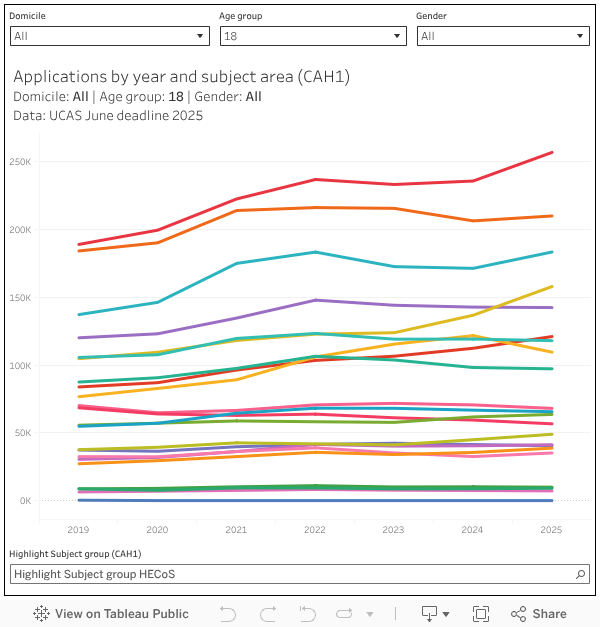
    Finally, it’s always fascinating to look at applications by subject area – a plot by CAH1 groups shows a sharp rise in the popularity of business, subjects allied to medicine, engineering, and law: with an intriguing drop in applications to computing subjects. There may be a generative AI effect on computing applications – the rise of “vibe coding” and other uses of agents in software development may mean that the attraction of learning to programme computers properly may be waning.

    That’s the best explanation I have – and it is curious that law (a domain where predictions of AI tools eating entry level roles are ten a penny) doesn’t appear to be experiencing a similar phenomenon.

    [Full screen]

    Source link

  • Smart or Risky? Using AI in College Applications

    Smart or Risky? Using AI in College Applications

    Is your child cheating if they’re turning to AI for help with college applications? The answer isn’t clear-cut. When used thoughtfully, AI can save time, help with organization, and spark creativity. But if misused, it can easily backfire and risk your child’s college dreams.

    Kevin Krebs

    Founder & Managing Director, HelloCollege

    Most people are familiar with ChatGPT, but there are a host of tools to support the admissions process, including platforms to explore colleges aligned with specific interests (AdmitYogi), keep application tasks organized (Trello), and find scholarships based on career aspirations (BigFuture).

    The biggest risk? Relying on AI to write application essays. These essays are your student’s opportunity to demonstrate something about their values, perspective, and character — things that grades and test scores can’t capture.

    Bottom line — don’t ask a machine to write a human story.

    Originality is key, and no matter how advanced generative AI gets, it will never capture the quiet pride of walking away from a captain position on the robotics team to pursue a true passion for journalism — or the growth that came from navigating the space between your Indian heritage and Western traditions.

    Most colleges are aware of AI-generated writing and have started using tools like GPTZero and Turnitin to spot it, so over-relying on technology is a good way to have an application flagged or even disqualified. Bottom line — don’t ask a machine to write a human story.

    Instead, it’s best to use AI at the beginning and end of the process for idea generation, as a sounding board or for minor edits — never for writing full paragraphs, sentences, or even phrases. Your child might try prompts like: “Generate a list of questions to help me explore my values,” “Scan my essay for places where I could add more specific details,” or “Is it clear how I grew as a person from this experience?”

    While there’s no replacement for the human touch of an expert, AI tools can help students refine their ideas and polish their writing.

    AI can be a powerful tool in college admissions, but only when the student stays firmly in the driver’s seat. The best applications come from creativity, originality, and personal perspective — things no algorithm can replicate.


    To learn more, visit sayhellocollege.com


    Source link

  • Applications to ITE increase due to new incentives – Campus Review

    Applications to ITE increase due to new incentives – Campus Review

    Student teacher enrolments are bouncing back nationally after they dipped during the Covid-19 pandemic, fuelling positivity that the pipeline of graduates can ease the profession’s workforce shortage.

    Please login below to view content or subscribe now.

    Membership Login

    Source link

  • Banks to waive HECS-HELP loans in mortgage applications – Campus Review

    Banks to waive HECS-HELP loans in mortgage applications – Campus Review

    People with student debt can now borrow more for a house as new government guidance filters through to the banks.

    Please login below to view content or subscribe now.

    Membership Login

    Source link

  • Greek TNE applications surge under new law

    Greek TNE applications surge under new law

    The applications from 11 British, one French and one Cypriot institution were submitted to the Greek Ministry of Education on March 31, after regulatory reform allowing international universities to establish fully accredited branch campuses in Greece.  

    Greek education minister Sophia Zacharaki welcomed the “historic reform”, which aims to meet the growing demand from Greek students for internationally recognised and accredited university degrees.  

    “[The reform] provides new choices to Greek college students, establishes Greece as an educational destination for thousands of foreign students,” said Zacharaki.

    She added that the reform would provide the opportunity for Greek scientists working abroad to return to Greece, transforming the country into “a hub of knowledge and innovation for the greater region of southeastern Europe”.  

    As well as attracting international students, the legislation aims to meet the “ever-increasing domestic demand” for higher education, halt the emigration of Greek young people and encourage the return of Greek academics and scientists.

    In 2024, more than 40,000 Greeks studied abroad, according to the government.

    And yet, the bill was met with fierce opposition during its parliamentary debate, sparking weeks of protests from domestic students and faculty who argued the legislation would undermine Greek state universities and devalue domestic degrees.  

    It’s advocates, however, maintain that healthy competition will uplift Greece’s higher education system, attract international investment and create new jobs.  

    “The government wants to modernise the Greek higher education landscape and create two systems, one state and one non-state that will interact creatively with each other,” said Study in Greece director, Theodoros Papaioannou, when the bill was passed.  

    Pending government approval, the majority of applicants plan to launch branch campus operations in October 2025, with nine institutions already partnered with Greek private colleges that operate as affiliates of European institutions.  

    For instance, York University’s existing partner, CITY College in Thessaloniki, will transition into the University of York Europe Campus, CITY U.L.E, operating as a non-state, non-for-profit university.

    Among the other UK applicants are the University of East London, the University of Greater Manchester, the University of Derby, London Metropolitan University, the University of West London and the University of Essex.

    [The branch campus] promises to elevate the educational landscape in Greece and offer students even more pathways for success

    Constantine Arcoumanis, Metropolitan College, Greece

    UEL’s institutional partner, Metropolitan College, Greece (MC), welcomed the collaboration, highlighting the benefit of Greek students obtaining accredited degrees from leading European universities.  

    “[The branch campus] promises to elevate the educational landscape in Greece and offer students even more pathways for success,” said MC academic board chairman Constantine Arcoumanis, adding he was “excited” about the proposals.  

    To ensure accessibility for domestic students, UEL said that many of its programs would be delivered in Greek, and that students would have access to UEL’s careers services and soft skills support, as well as study abroad, cultural exchange and learning resources.  

    The University of York’s campus, with locations in Thessaloniki and Athens, plans to establish a “leading hub for computer science studies”, initially offering undergraduate and postgraduate degrees across the schools of business studies, sciences, and law and humanities.  

    In a video message, York’s vice-chancellor welcomed the Greek government’s decision and said that his branch campus aimed to “contribute to the advancement of higher education and to establish Greece as an international education hub”.

    Last month, Greek Prime Minister Kyriakos Mitsotakis spotlighted York University’s interest in expanding operations to Greece: “Ranked 146th globally in 2025, York has been recognised for its excellence in research and teaching by official British institutions,” he told Greek media.

    Since Mitsotakis came to power in 2019, Greece has pursued the internationalisation of higher education, with the Prime Minister highlighting the need to combat Greece’s “brain drain”.

    In July 2022, the government changed the constitution to allow universities to offer bachelor programs taught in English.

    Source link

  • 5 powerful ways to link STEM lessons to real-world applications

    5 powerful ways to link STEM lessons to real-world applications

    Key points:

    “Why are we learning this?”

    This is a question every educator has faced before. To be fair, it’s a valid question. Students are naturally curious, and it’s normal for them to wonder about the knowledge that they’re acquiring. The real issue is how we, as educators, choose to respond to them.

    In my experience, teachers have two standard replies to this question:

    1. They’ll try to explain the subject in detail, which results in a long-winded answer that confuses their students and doesn’t satisfy them.
    2. They’ll argue that the information is important because it’s on an upcoming test, which typically leaves students feeling frustrated and disengaged.

    Either way, the result is the same: Students lose all legitimacy in the lesson and they’re unable to connect with the content.

    If we want our students to engage with the material in a way that’s memorable, meaningful, and fun, then we need to help them discover why it is important. Teachers can accomplish this by introducing real-world connections into the lesson, which reveal how the information that students acquire can be practically applied to real-world problems.

    Without building these connections between the concepts our students learn and real-world applications, students lose interest in what they are learning. Using the strategies below, you can start to build student investment into your classroom content.

    The everyday enigma

    Use everyday items that operate with mystery and frame your lesson around them. Your students’ curiosity will drive them to learn more about the object and how it functions. This allows students to see that the small concepts they are learning are leading to the understanding of an object that they interact with daily. When choosing an item, pick one that is familiar and one that has multiple STEM elements. For example, you could use a copper wire to discuss electrical currents, a piece of an automobile to explore chemistry and combustion, or shark teeth when teaching about animal adaptations and food chains.  

    Interest intersect

    Connect your students’ personal hobbies to the subject matter. For instance, if you have a student who is really passionate about soccer, try having them create a mini poster that connects the sport to the concepts learned in class. This gets them to think creatively about the purpose of content. This strategy has the additional benefit of helping teachers learn more about their students, creating opportunities to build communication and rapport.

    Get an expert

    Invite professionals (scientists, engineers, etc.) to talk with your class. This gives students a first-hand account of how the concepts they are learning can be applied to different careers. If you’re teaching chemistry, consider inviting a nurse or doctor to share how this subject applies to human health. If you’re teaching math, a local architect can expound on how angles and equations literally shape the homes in which students live. Not only does this provide a real-world example of students, but it helps schools connect with their community, creating vital relationships in the process.           

    Problem to progress

    Create an engineering investigation based on a local, real-world problem. For instance, I once knew a music teacher who was frustrated because pencils would regularly fall off his music stands. I challenged my 5th grade students to create a solution using the engineering design process. Not only did they succeed, but the experience allowed my students to see the real-world results of the inventions they created. When students understand that their work can make a tangible difference, it completely changes their relationship with the material.  

    Project-based learning

    Project-based learning is driven by inquiry and student ownership. This allows students to make contributions to the real world through hands-on investigations. What makes these inquiry-focused lessons so useful is that students are the driving force behind them. They choose how to approach the information, what questions to pursue, and what solutions they want to test. This makes the learning intensely personal while taking advantage of students’ natural curiosity, creativity, and critical-thinking skills. If you need a little help getting started, consider using one of these Blue Apple projects from Inquiry Outpost.

    By linking our STEM lessons to real-world experiences, teachers can provide a meaningful answer to the age-old question of, “Why are we learning this?” We can equip our students with the skills to not only navigate everyday challenges but also create positive change within their own communities. So, let’s empower young learners to see the relevance of STEM in their lives, and lay a strong learning foundation that will support them well beyond the classroom.

    Latest posts by eSchool Media Contributors (see all)

    Source link