
Tag: Applying

  • Texas Families Begin Applying for Private School Vouchers – The 74

    Texas Families Begin Applying for Private School Vouchers – The 74


    Get stories like this delivered straight to your inbox. Sign up for The 74 Newsletter

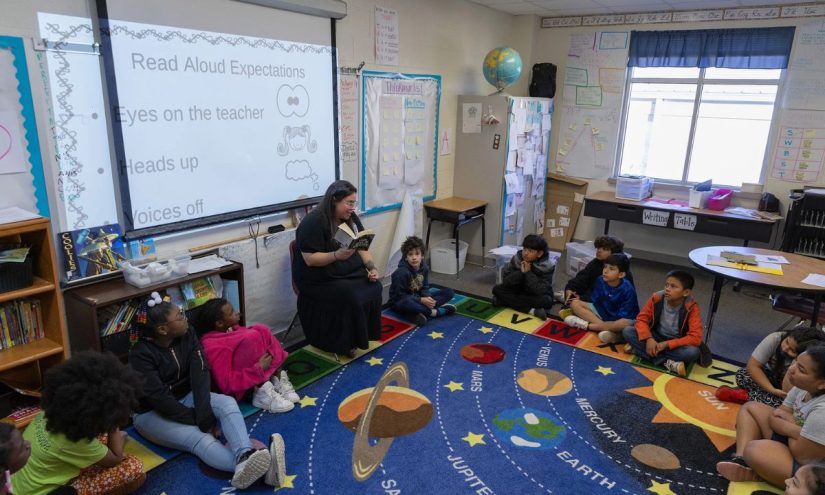
    Texas families can begin applying for private school vouchers Wednesday, the most significant step yet in a state program set to launch next school year.

    Texans have until March 17 to apply for the program, which allows families to receive taxpayer dollars to send children to private school or educate them at home.

    If the number of applicants exceeds the $1 billion lawmakers set aside for the program, the state will prioritize students based on family income and whether they have a disability — though neither guarantee access.

    The program, overseen by the comptroller, Texas’ chief financial officer, will launch at the beginning of the 2026-27 school year.

    As of Wednesday night, more than 35,000 families submitted applications, according to the comptroller’s office.

    The state can spend no more than $1 billion on the program during the current two-year budget cycle, which ends Aug. 31, 2027. It is unclear how much the program’s costs could rise — lawmakers will make that determination in future legislative sessions — but state budget experts predict the tab could escalate to roughly $4.8 billion by 2030.

    Here’s what to know about the applications.

    Most Texas families with school-age children can apply.

    That includes students already attending private school or in home schooling. Families with children in a public school must plan to unenroll them if they want to participate. Parents must also submit proof of their child’s U.S. citizenship or evidence the child lawfully resides in the country.

    If public demand for the program exceeds available funding, the state will prioritize the following applicants:

    • Students with disabilities in families with an annual income at or below 500% of the federal poverty level, which includes a four-person household earning less than roughly $165,000 a year.
    • Families at or below 200% of the poverty level, which includes any four-person household earning less than roughly $66,000.
    • Families between 200% and 500% of the poverty level.
    • Families at or above 500% of the poverty level; these families can receive up to $200 million of the program’s total budget.

    The priority system does not guarantee access to the program, as students must still find a private school to accept them. No state or federal laws require private schools to make learning accommodations for students with disabilities.

    In other states with large-scale voucher programs, participation has skewed toward more affluent and white families with children already in private school.

    Families must have several documents prepared.

    That includes Social Security numbers for the parent and child; an IRS Form 1040 for 2024 or 2025; and a Texas identification card or utility bill, lease agreement, mortgage statement or voter registration certificate if the state cannot verify a Texas ID number.

    Families can also prove their child’s U.S. citizenship or lawful resident status by submitting documents like birth certificates or certificates of naturalization or citizenship.

    For private pre-K eligibility, children must be at least 3 years old and meet at least one of the state criteria for public pre-K. That criteria includes being eligible to participate in the free or reduced-price lunch program, being unable to speak or understand English, or being in foster care. Families with children in foster care must submit proof, such as a court order, adoption documents or a placement order.

    Some families could receive up to $30,000 each year.

    Most participating families with children in private schools will receive about $10,500 annually. Home-schoolers can receive up to $2,000 per year. Children with disabilities can receive up to $30,000 — an amount based on what it would cost to educate that child in a public school.

    To apply for the voucher program, families can submit a Social Security determination letter or a physician’s note as proof their child has a disability.

    But to qualify for the higher tier of funding, families must submit an Individualized Education Program, a legal document specifying that a child needs special education services. If families do not have that documentation, they can request it from their local public school. Public schools must complete those requests within 45 days of a parent consenting to the evaluation.

    Families will receive the money through education savings accounts. Managed by the finance and technology company Odyssey, the digital accounts will let families pay tuition and make education-related expenses, like private tutoring, transportation and school meals.

    Students must also find private schools to accept them.

    During the application process, families must signal their intent to enroll their child in a private school.

    But they do not have to officially have their children enrolled until June 1, nearly three months after the application period closes. If parents cannot find a school by the initial deadline, the state will give them until July 15. Private schools will then confirm enrollment between June 15 and July 31.

    Private schools, on a rolling basis, can apply to join the program if they have operated a campus for at least two years and received accreditation. They must also administer a nationally recognized exam of their choosing in grades 3-12. The schools are not required to administer the same standardized tests issued to public school kids each year — currently the State of Texas Assessments of Academic Readiness, or STAAR.

    More than 1,600 private schools have opted in thus far, with most located in the Houston and Dallas-Fort Worth areas.

    Texas Attorney General Ken Paxton released a January opinion stating his belief that the comptroller can block certain schools from participating in the program if they’re “illegally tied to terrorists or foreign adversaries.”

    The opinion came after Acting Comptroller Kelly Hancock requested guidance from Paxton, saying schools associated with the accreditation company Cognia had hosted events organized by the Council on American-Islamic Relations, a Muslim civil rights group that Gov. Greg Abbott recently designated a terrorist organization.

    CAIR has sued Abbott over the label, calling it defamatory and false. The U.S. State Department has not designated the organization a terrorist group.

    As first reported by the Houston Chronicle, hundreds of Cognia schools have been shut out of the program, including those that primarily serve Muslim students, Christian students and children with disabilities. The comptroller’s office has said it is now inviting groups of Cognia schools that it considers in compliance with the law to participate.

    Families will start receiving notifications in April.

    Those notifications will let parents know they will receive funding — contingent upon enrolling their children in a private school by either the June 1 or July 15 deadline.

    The first portion of state funding will become available in families’ education savings accounts between July 1 and mid-August.

    This article first appeared on The Texas Tribune.


    Did you use this article in your work?

    We’d love to hear how The 74’s reporting is helping educators, researchers, and policymakers. Tell us how
    Source link

  • Applying the Moral Intensity Framework: Ethical Decision-Making for University Reopening During COVID-19

    Applying the Moral Intensity Framework: Ethical Decision-Making for University Reopening During COVID-19

    by Scott McCoy, Jesse Pietz and Joseph H Wilck

    Overview

    In late 2020, universities faced a moral and operational crisis: Should they reopen for in-person learning amid a global pandemic? This decision held profound ethical implications, touching on public health, education, and institutional survival. Using the Moral Intensity Framework (MIF), a multidimensional ethical decision-making model, researchers analysed the reopening choices of 62 US universities to evaluate the ethical considerations and outcomes. Here’s how MIF provides critical insights into this complex scenario.

    Why the Moral Intensity Framework matters

    The Moral Intensity Framework helps assess ethical decisions based on six dimensions:

    1. Magnitude of Consequences: The severity of potential outcomes.
    2. Social Consensus: Agreement on the morality of the decision.
    3. Probability of Effect: Likelihood of outcomes occurring.
    4. Temporal Immediacy: Time between the decision and its consequences.
    5. Proximity: Emotional or social closeness to those affected.
    6. Concentration of Effect: Impact on specific groups versus broader populations.

    This framework offers a structured approach to evaluate ethical trade-offs, especially in high-stakes, uncertain scenarios like the COVID-19 pandemic.

    Universities’ dilemma: in-person -v- remote learning

    The reopening debate boiled down to two primary considerations:

    1. Educational and Financial Pressures: Universities needed to deliver on their educational mission while addressing steep revenue losses from tuition, housing, and auxiliary services. Remote learning threatened educational quality and the financial viability of institutions, especially those with limited endowments.
    2. Public Health Risks: Reopening campuses risked COVID-19 outbreaks, jeopardising the health of students, staff, and surrounding communities. Universities also faced backlash for potential spread to vulnerable populations.

    Critical Findings Through the Moral Intensity Lens

    Magnitude of Consequences

    Reopening for in-person learning presented stark risks: potential illness or death among students, staff, and the community. However, keeping campuses closed threatened jobs, reduced education quality, and caused financial strain. The scale of harm from reopening was considered higher, particularly in densely populated campus settings.

    Social Consensus

    Public opinion and government policies influence decisions. States with stringent public health mandates leaned toward remote learning, while those with lenient regulations often pursued in-person or hybrid models. Administrators balanced community sentiment with institutional needs, highlighting the importance of localized consensus.

    Temporal Immediacy

    Health risks from in-person learning manifested quickly, while financial and educational setbacks from remote learning had longer timelines. This immediacy added ethical weight to public health considerations in reopening decisions.

    Probability of Effect

    The uncertainty surrounding COVID-19 transmission and mitigation complicated ethical judgments. Universities needed more data on the effectiveness of safety protocols, making probability assessments challenging.

    Proximity and Concentration of Effect

    Campus communities are close-knit, amplifying the emotional weight of decisions. Both reopening and remaining remote affected broad populations similarly, lessening these dimensions’ influence.

    Ethical Outcomes and Practical Mitigation Strategies

    Many universities implemented extensive safety measures to align reopening decisions with ethical standards:

    • Testing and Tracing: Pre-arrival testing, on-campus surveillance, and contact tracing reduced outbreak risks.
    • Modified Learning Environments: Hybrid and remote options ensured flexibility, accommodating vulnerable populations.
    • Health Protocols: Social distancing, mask mandates, and enhanced cleaning protocols were widely adopted.

    Despite risks, universities that reopened often avoided large-scale outbreaks, demonstrating the effectiveness of these measures.

    Lessons for Crisis Management

    The COVID-19 reopening experience offers valuable lessons for future crises:

    1. Use Multidimensional Ethical Frameworks: Applying tools like MIF provides structure to navigate complex moral dilemmas.
    2. Prioritize Stakeholder Engagement: Balancing diverse perspectives helps bridge gaps between perceived and actual risks.
    3. Adapt Quickly: Flexibility in implementing mitigation strategies can mitigate harm while achieving core objectives.
    4. Build Resilience: Strengthening financial reserves and digital infrastructure can reduce future vulnerabilities.

    Global Implications

    While this analysis focused on U.S. universities, the findings have worldwide relevance. Institutions globally grappled with similar decisions, balancing public health and education amid diverse cultural and political contexts. The Moral Intensity Framework offers a universal lens to evaluate ethical challenges in higher education and beyond.

    Conclusion

    The reopening decisions of universities during COVID-19 exemplify the intricate balance of ethical, financial, and operational considerations in crisis management. The Moral Intensity Framework provided a robust tool for understanding these complexities, highlighting the need for structured ethical decision-making in future global challenges.

    This blog is based on an article published in Policy Reviews in Higher Education (online 20 September 2024) https://www.tandfonline.com/doi/full/10.1080/23322969.2024.2404864.

    Scott McCoy is the Vice Dean for Faculty & Academic Affairs and the Richard S. Reynolds, Jr. Professor of Business at William & Mary’s Raymond A. Mason School of Business.  His research interests include human computer interaction, social media, online advertising, and teaching assessment.

    Jesse Pietz is a faculty lead for the OMSBA program at William & Mary’s Raymond A. Mason School of Business.  He has been teaching analytics, operations research, and management since 2013.  His most recent faculty position prior to William & Mary was at the U.S. Air Force Academy in Colorado Springs, Colorado. 

    Joseph Wilck is Associate Professor of the Practice and Business Analytics Capstone Director
    Kenneth W. Freeman College of Management, Bucknell University He has been teaching analytics, operations research, data science, and engineering since 2006. His research is in the area of applied optimization and analytics.

    Author: SRHE News Blog

    An international learned society, concerned with supporting research and researchers into Higher Education

    Source link