Tag: Arkansas

  • Arkansas Judge Orders Removal of Ten Commandments Displays from Lakeside School District – The 74

    Arkansas Judge Orders Removal of Ten Commandments Displays from Lakeside School District – The 74


    Get stories like this delivered straight to your inbox. Sign up for The 74 Newsletter

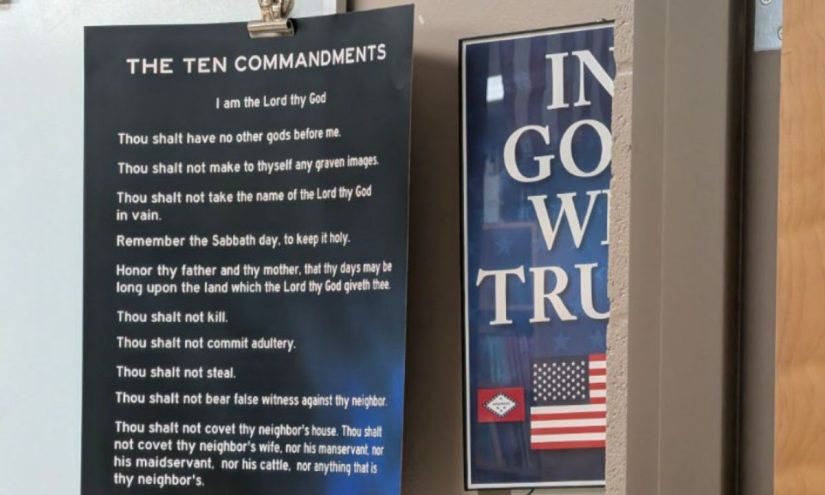
    A federal judge on Friday ordered Ten Commandments posters be removed from Lakeside School District, two days after he permitted the Garland County district to be added to a lawsuit challenging a new state law requiring the displays.

    Following passage of Act 573 of 2025 this spring, public schools are now required to “prominently” display a “historical representation” of the Ten Commandments in classrooms and libraries. The posters must be donated or bought with funds from voluntary contributions. The law also requires them to be displayed in public colleges and universities and other public buildings maintained by taxpayer funds.

    Seven Northwest Arkansas families of various religious and nonreligious backgrounds filed a lawsuit in June challenging the constitutionality of the statute. The families allege the state law violates the First Amendment’s Establishment Clause, which guarantees that “Congress shall make no law respecting an establishment of religion,” and its Free Exercise Clause, which guarantees that “Congress shall make no law … prohibiting the free exercise [of religion].”

    Supporters of the law have argued the tenets have historical significance because they influenced the country’s founders in creating the nation’s laws and legal system.

    U.S. District Judge Timothy Brooks granted a preliminary injunction in August that blocked implementation of the statute in four districts — Bentonville, Fayetteville, Siloam Springs and Springdale.

    Brooks later allowed the Conway School District to be added to the suit as a defendant and district families as plaintiffs. He also ordered Ten Commandments posters be removed from the district’s schools and converted a temporary restraining order against the district into a preliminary injunction.

    A temporary restraining order temporarily halts an action and may be issued immediately, without informing all parties and without holding a hearing. It’s intended to last until a court holds a hearing on whether to grant a preliminary injunction, according to Cornell Law School.

    After Brooks granted permission Wednesday to add Lakeside School District as a defendant and Christine Benson and her minor child as plaintiffs in the case, attorneys for the plaintiffs filed a motion for a temporary restraining order and/or preliminary injunction on Thursday.

    Brooks granted the temporary restraining order Friday and held the preliminary injunction in abeyance. He also temporarily blocked Lakeside from complying with the law and ordered the district to remove Ten Commandments displays from its schools by 5 p.m. Monday.

    “A temporary restraining order should issue as to Lakeside School District No. 9,” Brooks wrote in Friday’s order. “Lakeside Plaintiffs are identically situated to the original Plaintiffs: They advance the same legal arguments, assert the same constitutional injuries, and request the same relief.”

    Defendants and the attorney general’s office, which intervened in the case, have until Nov. 3 to submit briefs to address why the existing preliminary injunction should not be modified to include Lakeside School District as a defendant, according to Friday’s order.

    Arkansas Advocate is part of States Newsroom, a nonprofit news network supported by grants and a coalition of donors as a 501c(3) public charity. Arkansas Advocate maintains editorial independence. Contact Editor Sonny Albarado for questions: [email protected].


    Did you use this article in your work?

    We’d love to hear how The 74’s reporting is helping educators, researchers, and policymakers. Tell us how

    Source link

  • Arkansas wants to jail librarians. The First Amendment won’t allow it.

    Arkansas wants to jail librarians. The First Amendment won’t allow it.

    Arkansas is trying to save one of the most extreme book censorship laws in recent memory, one that would allow jailing librarians and booksellers for keeping materials on their shelves that fall under the statute’s broad definition of “harmful to minors.” 

    The state’s Act 372 not only makes it possible for librarians to be jailed for providing teenagers with Romeo and Juliet, but also allows anyone to “challenge the appropriateness” of any book in a library.

    After the law passed, a coalition of booksellers, librarians, libraries, library patrons, and professional associations persuaded a federal judge to stop the law from taking effect in Fayetteville Public Library v. Crawford County. But the state appealed. FIRE in turn submitted a friend-of-the-court brief urging the U.S. Court of Appeals for the Eighth Circuit to affirm the permanent injunction against Act 372.

    How Act 372 operates

    Arkansas’s law compels public libraries to adopt policies allowing “any person affected” by a book to challenge its “appropriateness,” forcing libraries to remove or sequester the book in an area “not accessible to minors” if the challenge succeeds. The law provides no definitions for crucial terms like “appropriateness” or “accessible,” leaving librarians to guess how to comply and inviting challenges based on personal or political objections. 

    Worse still, the process creates a one-way ratchet in favor of censorship by granting challengers the right to appeal decisions to keep a book in place while having no appeal procedure when a book is removed or segregated. ​​FIRE advocates for a fair system — call it “due process for books” — where libraries use an impartial and objective process for reviewing challenged books’ educational value and age appropriateness. And a system that permits only one side to appeal a ruling while denying appeals by the other is inherently unfair, as we’ve noted in campus Title IX hearings. Act 372’s unbalanced system empowers hecklers to reshape public collections according to their tastes, undermining libraries’ historic role as repositories of diverse ideas and viewpoints.

    These issues are worsened by a broad and unconstitutional definition of “harmful to minors.” That section threatens librarians and booksellers with up to a year in jail if they furnish, present, provide, make available, give, lend, show, advertise, or distribute to a minor any material considered harmful—without distinguishing between materials inappropriate for young children and those suitable for older teens. By grouping all minors into one category and failing to define key terms, Act 372 effectively criminalizes access to classic and educational works that may include mature themes. 

    Why Act 372 is unconstitutional

    FIRE has consistently stated it’s entirely proper for public school libraries to consider whether books are age-appropriate for their collections based on various factors. But Act 372 falls far short of that commonsense standard by employing a broad definition that applies to all public libraries, as well as private bookstores, and by treating all minors the same, from first graders to high school seniors. 

    To understand why Act 372’s “harmful to minors” definition does not meet constitutional standards, one must consider the Supreme Court’s precedents in this area. For decades, the Court has been cautious to ensure that merely labeling sexually suggestive materials as obscene does not give the government blanket authority to censor speech. That’s because works that are obscene are considered unprotected speech—for both adults and minors—and essentially freely regulable or sanctionable. But what about sexually explicit material that is not obscene and thus protected?

    In Ginsberg v. New York, the Court recognized the state’s limited power to restrict minors’ access to sexually explicit content, while emphasizing it remains constitutionally protected for adultsIn Miller v. California, the Court formulated a rigorous test for obscenity that ensured works with serious literary, artistic, political, or scientific value would not meet the test simply because they involve sex. Taken together, GinsbergMiller, and cases flowing from them acknowledge that states may use a variable obscenity test based on the viewer’s age, while ensuring that adults can access non-obscene materials. 

    The Supreme Court further clarified the issue in Virginia v. American Booksellers Association, where it cautioned against laws that aim to protect minors but could potentially limit free speech. The law in question survived only after the Virginia Supreme Court narrowed its definition of “harmful to juveniles” to cover works judged as harmful to older teens, and only when someone knowingly put that material where kids could easily see it. Without this clarification, the law would have been unconstitutionally overbroad and vague.

    The standard for obscene-for-minors or “harmful to minors” material has thus generally coalesced around a version of the Miller obscenity test tailored to the underaged to require that: the material taken as a whole must appeal primarily to a prurient interest in sex as to minors; it must portray hardcore sexual conduct in a manner patently offensive to the average adult under contemporary community standards for minors; and it must lack serious literary, artistic, political or scientific value for minors.

    Unlike the Virginia Supreme Court, the Arkansas Supreme Court adopted a much broader interpretation of “harmful to minors” that treats all minors under 18 the same. As a result, libraries and local bookstores could be penalized simply for providing older minors with access to books that would be objectionable only to the youngest children. In other words, books older minors have a right to read under the First Amendment.

    This would require librarians to put classics like Romeo and Juliet or Catcher in the Rye behind adults-only walls. Further, Act 372’s challenge system also subjects the availability of library books to a “heckler’s veto” by anyone who objects to the material. But the very purpose of public libraries is to provide everyone access to a broad marketplace of ideas. If Act 372 stands, librarians will be forced to choose between their professional duty to provide the community with a wide range of books and the threat of imprisonment if any of those books might be inappropriate for a 5-year-old.

    What’s at stake

    FIRE is asking the Eighth Circuit to affirm the district court’s ruling striking down Arkansas’s Act 372, because if the state can jail librarians for letting kids read books, it won’t stop at Arkansas. The First Amendment doesn’t allow governments to censor ideas under the guise of “protecting children,” and we’re fighting to make sure it never does.

    Source link

  • University of Arkansas Creates Faculty Learning Community

    University of Arkansas Creates Faculty Learning Community

    Effective teaching and learning are key elements of a student’s academic success, but ensuring professors have access to training, support and resources to employ best practices in the classroom can be a challenge for institutions.

    At the University of Arkansas at Fayetteville’s Fulbright College of Arts and Sciences, Lynn Meade created the Faculty Learning Community to tackle this issue, uniting professors across disciplines to improve student learning and achievement.

    The Faculty Learning Community, which launched this summer, strives to unite staff and faculty across campus to work toward the shared goal of student success, Meade said.

    The background: Meade has worked as a communications professor at the University of Arkansas for two decades, but in 2023, she realized there were entire student support teams and departments that she didn’t know about. The university hosted an event on high-impact practices to invite stakeholders to share and learn from one another.

    “I sat down at a table with a whole lot of student success people, and I was amazed at all the things that they were doing and how I could be on our campus for so long and [have] no idea the things that were going on behind the scenes, things students could take advantage of that they hadn’t yet,” Meade said.

    This experience prompted her to get more involved with support staff and orchestrate opportunities for other professors to learn from one another across campus. “We need to find a way to integrate faculty and student success initiatives,” Meade said. “They need to know what one another are doing, they need to shake hands, make friends, have coffee, talk—the things that really make things happen, because our students, their success depends on us cooperating.”

    Students are more likely to talk to a faculty member they trust than seek out a support office on campus, Meade said. “I think informing them not only how to teach their class well, but also how to integrate those resources, is really important.”

    The result was the Fulbright Faculty Learning Community, a community of practice and faculty development program, which Meade now leads as director.

    How it works: The program launched with four offerings for faculty: a course-building workshop, a reboot class to help with updating content, forums for sharing innovative teaching ideas and introductions to student success teams.

    One of Meade’s goals is to avoid replicating existing efforts on campus but provide a one-stop shop to unify and amplify the great work taking place. “There’s so many cool resources on our campus, but there’s no one place they all exist,” she said.

    The Fulbright Learning Community had its kickoff event this summer, engaging 14 faculty members in a three-hour workshop on course building.

    The workshop invited faculty to consider students, rather than content, at the center of their syllabus, using a communications principle of audience and purpose. “I think if our audience is students and our purpose is to teach them, maybe we shouldn’t say, ‘I’m going to cover my material,’ but, ‘I’m going to think of ways that they can learn the material,’” Meade said.

    Survey Says

    A 2024 Student Voice survey by Inside Higher Ed and Generation Lab found that 40 percent of respondents believe their academic success would improve if professors connected in-classroom learning to issues outside the classroom or students’ career goals.

    Some professors who are straight out of grad school may have only received teacher education or used material given to them by other faculty, Meade said. Others who have taught abroad but never in the U.S. may need some help adapting their materials for American students.

    The learning community also invited career center professionals to showcase ways to embed career competencies in the syllabus and attach resources to their learning management system to help address career development for students. A future session will invite professors to share how they’re using and teaching generative AI tools.

    “Faculty success equals student success,” Meade said. “The teachers are their first line [of support]; a lot of that success is what’s happening with the teacher. When we all work together on the same side, how we communicate with each other is going to make a big impact on the student retention.”

    If your student success program has a unique feature or twist, we’d like to know about it. Click here to submit.

    Source link

  • Arkansas Passes Higher Ed “Reform” Bill

    Arkansas Passes Higher Ed “Reform” Bill

    Arkansas governor Sarah Huckabee Sanders signed a wide-ranging bill last Tuesday, upending the state’s higher education budget and clamping down on DEI and student protests, according to The Arkansas Democrat-Gazette.

    The Arkansas ACCESS Law includes a number of measures prioritizing funding for trade schools and short-term credential programs, including using the lottery system to fund school scholarships and eliminating support for Advanced Placement accelerated learning tracks in an effort to encourage career readiness over traditional college prep.

    The law also doubles funding for the state’s Academic Challenge Scholarship and expands eligibility to trade school applicants; prohibits colleges from spending on diversity, equity and inclusion initiatives or participating in any external DEI programs; and amends the state’s excused absence policies to prevent students from participating in protests.

    Source link