It took 50 years for the secret transcripts of the McCarthy hearings to be released. Within these relics of the Red Scares, you can read all manner of hostile interactions, with people doing their level best to protect their careers and their futures (with some also explicitly fighting for the principles of freedom of speech and expression).
In one hearing, Langston Hughes testified that his political interests, such as they were, sprang from trying to understand how he “can adjust to this whole problem of helping to build America when sometimes [he] cannot even get into a school or a lecture or a concert or in the south go to the library and get a book out.” That answer, grounded in the betterment of the United States, didn’t matter to his interrogators. Roy Cohn, an attorney working for Senator Joseph McCarthy, continued berating the poet using out-of-context snippets of his work while appearing to advocate for federally funded libraries removing it. This mistreatment was, unfortunately, not a rarity.
The Red Scares were one of the most repressive periods of the 20th century, and yet we are seeing similar efforts to stifle free speech and punish political dissent in higher education today. As a professor who studies higher education policy, I want to better understand policymakers’ focus on resegregating the country, student protests, and why many key figures in higher education stay silent when political attacks target marginalized groups, especially trans scholars and scholars of color.
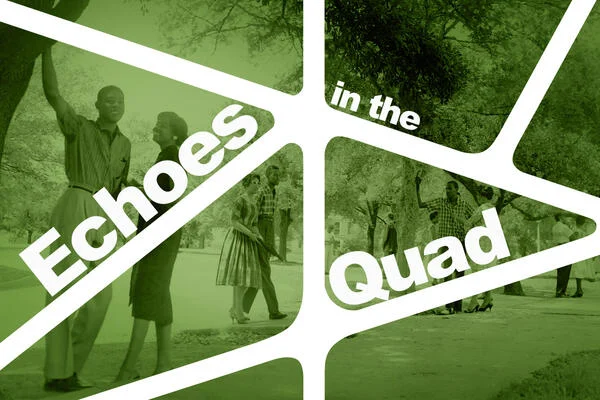
That journey motivates this column, “Echoes in the Quad.” Here, I’ll explore what tethers our current higher education policy realities to past moments in history, leading to potential lessons on crafting an American higher education system that thrives within a multiracial democracy.
I’ll begin with a three-part series on the Red Scares when, throughout the decades surrounding the World Wars, federal and state governments investigated thousands of people, including more than 100 academics, over their supposed links to the Communist Party. These investigations, or the threats of them, led to thousands of people losing their jobs and their friends and, in some cases, even taking their own lives. Throughout this crucible, most of academia, and the country, went along with or actively encouraged the purges and ostracization of “undesirables.”
In the 1950s, McCarthyism succeeded because of a two-part system of repression. In No Ivory Tower: McCarthyism and the Universities, Ellen W. Schrecker notes that the crackdown first required the federal government to identify “suspected Communists” and then higher education institutions to investigate and fire them. This targeting in tandem gives the game away. The attacks and firings were never about scholars’ fealty to Communism (which should have been protected under the U.S. Constitution, as later Supreme Courts ruled several times). Instead, they were about the expulsion of leftist ideals around worker rights, racial integration and more.
As several characters in the classic 1990s movie Clue proclaim, when it came to the Red Scares, “Communism was simply a red herring.” Charisse Burden-Stelly, in her 2023 book Black Scare/Red Scare, skillfully outlines how Blackness, particularly Black radicalism and the fight for racial justice, became synonymous with Communism and the dreaded moniker of being “un-American.” This scapegoating strategy meant that faculty members could be fired for being a current or former member of the Communist Party or for such transgressions as advocating as a member of a labor union, fighting for racial integration, or being Black or homosexual.
In No Ivory Tower, Schrecker demonstrates how elite members of higher education either actively worked to ensure that universities censored suspected political dissidents or neglected calls for help from targeted people. At the same time, a substantial share of rank-and-file members of academia allowed their colleagues to be harassed and ostracized, while helping to maintain a version of an academic blacklist—ensuring that people who had even the faintest taint of suspicion would not be hired at their institutions.
These actions, whether driven by cowardice, complicity or some combination of the two, led to a world where professors and students targeted by the federal government began making plans for their eventual firing or, in some tragic instances, their own death.
And so, the U.S. House of Representatives devoting precious time to passing bills “denouncing the horrors of socialism,” colleges firing or suspending faculty and staff because of their speech, and students getting grabbed off the street for writing opinion pieces seem like relics of the past. Yet these events are part of our current, dangerous escalation in repression. Auburn University, High Point University, and Texas A&M have all introduced tools or forms that assess whether courses violate vague policies meant to curtail discussions of concepts like racial integration. Just last week we learned that Texas A&M has flagged at least 200 courses& in its review for offenses as grave as assigning students to read Plato. In the wake of Charlie Kirk’s death, universities investigated, and often ultimately suspended or fired, at least 50 members of the faculty and staff—sometimes simply for the transgression of quoting his own past statements. State policymakers frequently played a role in targeting and threatening either these people directly or the funding for universities that employed them.
This is not solely a “red state” or “southern” problem. At the same time that University of Texas at Austin was firing staff members to satisfy ideological aims, Muhlenberg College fired a faculty member in a manner that led the AAUP to declare that the institution had “severely impaired the climate for academic freedom.” Brooklyn College, part of the City University of New York (CUNY) system, fired four contingent faculty members, allegedly& due to their advocacy for Palestine. (Perhaps an homage to the 1940s Rapp-Coudert Committee, which led to the firing of dozens of faculty and staff at the City College of New York, also part of CUNY.) While some are quick to note Indiana University’s censorship of speech in the student newspaper, the same flavor of tactics has been used against student journalists at Columbia University, Dartmouth University, and Stanford University. And, who can forget the ignominious list of, at present count, six institutions that have signed agreements with the federal government containing different commitments—large fees, acceptance of recent Executive Orders aimed at reducing medical care and controlling teaching and hiring—all with the goal of curtailing speech and expression on their campuses.
Most heartrending though, are the lives lost, sacrificed at the altar of authoritarian demagoguery. Middlebury College swimmer Lia Smith, who left the team due to attacks on trans athletes, died by suicide last fall. There is no direct evidence that this was caused by the ever-escalating vitriol hurled at trans people in the United States, but it strains credulity to believe that she was not impacted by this rise in hate, backed by the power of the government, and implemented by blue and red states alike.
One of the loudest echoes of the Red Scares is perhaps the reality that libraries continue to remove books due to censorship. The federal government interrogated Langston Hughes because the State Department included his work in U.S. libraries abroad. McCarthy’s lieutenants traveled to Europe removing books that they determined to be “subversive” from these libraries. In another hearing, William Mandel, an expert on the Soviet Union forced out of his position at Stanford’s Hoover Institution during the Red Scares, stated, “This is a book-burning! You lack only the tinder to set fire to the books as Hitler did 20 years ago, and I am going to get that across to the American people!”
The culture of fear created by Senator McCarthy and others served to silence ideas and beliefs that they disagreed with. The future is yet unwritten, but by understanding what political repression looked like then, we can recognize it and figure out how to fight it now. As Mandel noted, once we see censorship for what it is, it’s our responsibility to get that across to the American people.
The next two columns in this series will focus on the organizations and people that made McCarthyism as effective as it was: the academic elite who worked hand in glove with the rank and file to ensure that, what the government started, higher education would finish.
(Copies of No Ivory Tower are difficult to find, but several libraries stock it and, if you can’t get access there, here’s a lovely interview with the author.)