Tag: art

  • Students call for AI art class cancellation – Campus Review

    Students call for AI art class cancellation – Campus Review

    Technology

    UNSW says the course explores creative and ethical questions about the use of gen AI in art

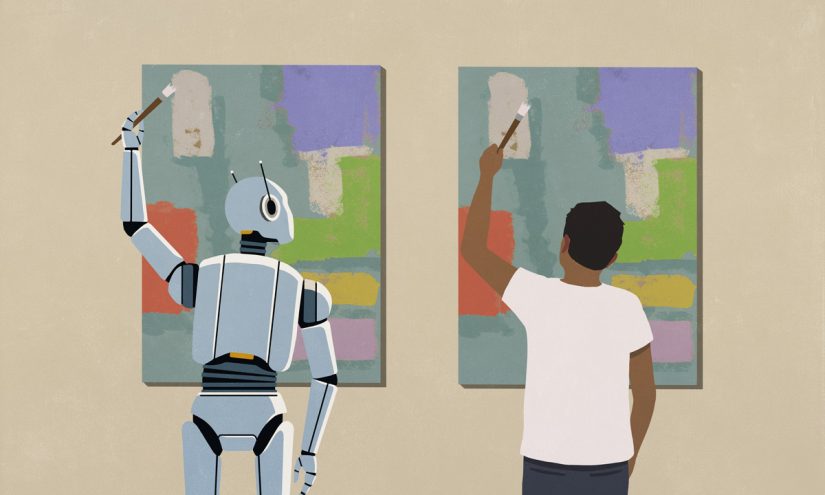
    The University of New South Wales has come under fire for offering a new subject that asks students to explore how to use generative AI to create art.

    Please login below to view content or subscribe now.

    Membership Login

    Source link

  • AI and Art Collide in This Engineering Course That Puts Human Creativity First – The 74

    AI and Art Collide in This Engineering Course That Puts Human Creativity First – The 74

    I see many students viewing artificial intelligence as humanlike simply because it can write essays, do complex math or answer questions. AI can mimic human behavior but lacks meaningful engagement with the world.

    This disconnect inspired my course “Art and Generative AI,” which was shaped by the ideas of 20th-century German philosopher Martin Heidegger. His work highlights how we are deeply connected and present in the world. We find meaning through action, care and relationships. Human creativity and mastery come from this intuitive connection with the world. Modern AI, by contrast, simulates intelligence by processing symbols and patterns without understanding or care.

    In this course, we reject the illusion that machines fully master everything and put student expression first. In doing so, we value uncertainty, mistakes and imperfection as essential to the creative process.

    This vision expands beyond the classroom. In the 2025-26 academic year, the course will include a new community-based learning collaboration with Atlanta’s art communities. Local artists will co-teach with me to integrate artistic practice and AI.

    The course builds on my 2018 class, Art and Geometry, which I co-taught with local artists. The course explored Picasso’s cubism, which depicted reality as fractured from multiple perspectives; it also looked at Einstein’s relativity, the idea that time and space are not absolute and distinct but part of the same fabric.

    What does the course explore?

    We begin with exploring the first mathematical model of a neuron, the perceptron. Then, we study the Hopfield network, which mimics how our brain can remember a song from just listening to a few notes by filling in the rest. Next, we look at Hinton’s Boltzmann Machine, a generative model that can also imagine and create new, similar songs. Finally, we study today’s deep neural networks and transformers, AI models that mimic how the brain learns to recognize images, speech or text. Transformers are especially well suited for understanding sentences and conversations, and they power technologies such as ChatGPT.

    In addition to AI, we integrate artistic practice into the coursework. This approach broadens students’ perspectives on science and engineering through the lens of an artist. The first offering of the course in spring 2025 was co-taught with Mark Leibert, an artist and professor of the practice at Georgia Tech. His expertise is in art, AI and digital technologies. He taught students fundamentals of various artistic media, including charcoal drawing and oil painting. Students used these principles to create art using AI ethically and creatively. They critically examined the source of training data and ensured that their work respects authorship and originality.

    Students also learn to record brain activity using electroencephalography – EEG – headsets. Through AI models, they then learn to transform neural signals into music, images and storytelling. This work inspired performances where dancers improvised in response to AI-generated music.

    The Improv AI performance at Georgia Institute of Technology on April 15, 2025. Dancers improvised to music generated by AI from brain waves and sonified black hole data.

    Why is this course relevant now?

    AI entered our lives so rapidly that many people don’t fully grasp how it works, why it works, when it fails or what its mission is.

    In creating this course, the aim is to empower students by filling that gap. Whether they are new to AI or not, the goal is to make its inner algorithms clear, approachable and honest. We focus on what these tools actually do and how they can go wrong.

    We place students and their creativity first. We reject the illusion of a perfect machine, but we provoke the AI algorithm to confuse and hallucinate, when it generates inaccurate or nonsensical responses. To do so, we deliberately use a small dataset, reduce the model size or limit training. It’s in these flawed states of AI that students step in as conscious co-creators. The students are the missing algorithm that takes back control of the creative process. Their creations do not obey AI but reimagine it by the human hand. The artwork is rescued from automation.

    What’s a critical lesson from the course?

    Students learn to recognize AI’s limitations and harness its failures to reclaim creative authorship. The artwork isn’t generated by AI, but it’s reimagined by students.

    Students learn chatbot queries have an environmental cost because large AI models use a lot of power. They avoid unnecessary iterations when designing prompts or using AI. This helps reducing carbon emissions.

    The Improv AI performance on April 15, 2025, featured dancer Bekah Crosby responding to AI-generated music from brain waves.

    The course prepares students to think like artists. Through abstraction and imagination they gain the confidence to tackle the engineering challenges of the 21st century. These include protecting the environment, building resilient cities and improving health.

    Students also realize that while AI has vast engineering and scientific applications, ethical implementation is crucial. Understanding the type and quality of training data that AI uses is essential. Without it, AI systems risk producing biased or flawed predictions.

    Uncommon Courses is an occasional series from The Conversation U.S. highlighting unconventional approaches to teaching.

    This article is republished from The Conversation under a Creative Commons license. Read the original article.

    Source link

  • The Art of Collaboration: Designing Assignments That Work – Faculty Focus

    The Art of Collaboration: Designing Assignments That Work – Faculty Focus

    Source link

  • The Art of Collaboration: Designing Assignments That Work – Faculty Focus

    The Art of Collaboration: Designing Assignments That Work – Faculty Focus

    Source link

  • The ART of Professionalism (opinion)

    The ART of Professionalism (opinion)

    A career is much like a work of art: We select an area to study—a medium, of sorts—in which to pursue an interest or a desire. We start by obtaining foundational knowledge before creating something that contributes to the greater society. Some may benefit from what is produced; others may not. Some will appreciate the output; others will not gain much, if anything, from what is constructed. At the center of the result is the artist themselves. Others along the way lend their own expertise, time and insights toward the outcome. However, it is the unique skills, perspectives, knowledge, choices and behaviors of the artist that determine what is created.

    We are all artists in the making. We have a profession in which we have chosen to engage. As graduate students or postdoctoral scholars, we gain the foundations needed for our chosen discipline. During our time training in higher education, we focus on acquiring technical skills and techniques to contribute to sustaining and expanding our fields of study. We set upon the path to becoming experts through trial and error, discovery and disappointments, gains and losses.

    Like with a work of art, we may start from a place of uncertainty: What can appear to be confounding fragments of a greater idea can coalesce in ways that surprise and satisfy us. We pull together parts and pieces to make something whole or even construct something unique. Yet while we are engaged in this creative and intellectual process, we must also work within defined boundaries. Expectations and ethical standards guide our professional conduct. Understanding these nuances is essential to forming a professional identity.

    Each profession carries its own expectations for behavior, decision-making and accountability. Cambridge defines “professionalism” as “the qualities connected with trained and skilled people.” We can have strong technical skills and deep knowledge in our particular disciplines; however, these alone do not guarantee our level of professionalism when we are actually in the workforce interfacing with supervisors, colleagues, team members and clients.

    While having the foundational skills and understanding may guarantee some success within a career, it is actually the capacity for acquiring and applying what I’ve termed “human-centered competencies” that ensures a greater degree of career fulfillment. Human-centered competencies consist of behaviors that involve a deeper sense of self-awareness. Recognizing and managing our behaviors, and understanding how they may impact those interacting with us, helps us relate to others in ways that forge effective communication, efficacious decision-making, constructive conflict resolution and fruitful work endeavors.

    With this in mind, let’s explore the ART of professionalism through some simple reflective exercises. Think about the questions presented here as intended to encourage an honest reflection on the art we are creating within our own spheres of influence.

    Attitude

    Our attitude is an outward reflection of what we are thinking and how we are feeling. Our attitude toward an assignment, toward a co-worker, toward ourselves or toward life itself is exemplified through our behaviors. Are we respectful and kind to others? Do we smile at who we see in the mirror or constantly chastise ourselves for what we have done (or not done)? Do we tend to jump to negative conclusions regarding those with whom we interact? Do we shake hands, look people in the eye and smile? Or are we downcast, avoidant and possibly even surly? How do we appear? Are we dressed for the part—one in which we want to be respected and taken seriously—or do we look like we would rather be on the couch bingeing on Netflix and eating potato chips?

    Our attitude says a lot about ourselves, and sometimes we do not even have to open our mouths to reveal it. Our internal dialogue can have an impact on our external behaviors, so we need to be aware of our attitude. We can improve it, if needed. We can start by examining how we carry ourselves, as our posture and physical appearance convey nonverbal messages. How we show up is also important to consider. Are we prepared for meetings? Do we speak up with confidence? Do we actively listen to others and appreciate their contributions?

    Our attitude reflects our frame of mind, and we illustrate who we are through our attitude. We also should keep in mind that each of us represents more than ourselves; we reflect the values and credibility of our professional communities.

    Responsibility

    Within the work environment we all have duties, projects or assignments that we manage. Responsibility involves taking ownership of our decisions, our actions and our outcomes. Work involves interdependence; it is rare that we can achieve a goal all on our own. Even artists need people who help them develop their skills, manufacture their tools, market their work and provide venues to exhibit their talent. Within the workplace, we will need others and others will need us.

    Responsibility, therefore, is a crucial competency to have as a professional. Exhibiting responsibility involves both dependability and accountability. Being dependable is a choice, and this can involve time management, setting boundaries and fulfilling obligations; we show up on time and we follow through with what we say we are going to do. Accountability means that we acknowledge when things have not worked out as planned, we recognize our contributions to successes and we face the consequences of our decisions and actions, whether positive or negative. Instead of evaluating situations as win or lose, we can choose to look at outcomes as win or learn. Whether we experience a victory or suffer a defeat, we can always learn from the process. In essence, responsibility is about us doing our part so that we contribute, in a mindful way, to the success and well-being of our colleagues and co-workers.

    Trust

    Trust is by far the most important component of professionalism. Trust looks different in a professional atmosphere than it does in personal life. Trust involves being genuine with others. We want to be able to count on others and to believe that they are being honest with us. The same expectations for honesty should hold when it comes to our own behavior.

    Trust involves being reliable, striving to meet expectations, fulfilling obligations, avoiding gossip and feeling secure in the knowledge that harm will not be done or betrayal will not occur. As professionals, it is imperative that we are trustworthy, as this is a fundamental component of human interactions. Being competent at trust involves building goodwill, being cooperative, displaying integrity, adhering to our values, engaging in sincere interactions and forming strong alliances. Without trust, bonds are broken, relationships are destroyed and organizations fail. We need to examine our words and our actions to evaluate how trustworthy we may seem to others. Being empathetic, reliable and ethical will serve us well as we pursue our passion and contribute our talents to the well-being of those with whom we work, as well as those who benefit from what our teams and organizations produce.

    Conclusion: Building a Body of Work

    As professionals, we are not just building careers; we are creating something much more enduring: a body of work, a reputation, a legacy. The skills we acquire in our chosen disciplines are only part of the equation. Equally important are the attitudes we embody, the responsibilities we accept and the trust we build. It takes time, reflection and endurance to create a great work of art; the same is true for our careers. The process may be unpredictable, but the core elements—our values, our character and our professionalism—will determine how our work is received and remembered.

    So ask yourself: What kind of professional artist do you want to be? What are you creating through your everyday choices? How will your ART— attitude, responsibility and trust—shape your path forward?

    Rhonda Sutton is dean of professional development at North Carolina State University’s Graduate School. She oversees a team that provides programming focused on career readiness, communication skills and teaching for graduate students and postdoctoral scholars. She also facilitates professional development initiatives on leadership, mentoring and wellness. Rhonda is a member of the Graduate Career Consortium, an organization providing an international voice for graduate-level career and professional development leaders.

    Source link

  • The AI balancing act: universities, innovation and the art of not losing the plot

    The AI balancing act: universities, innovation and the art of not losing the plot

    • By Professor Alejandro Armellini, Dean of Education and Digital Innovation at the University of Portsmouth.

    Universities want to be at the cutting edge of knowledge creation, but many are grappling with a paradox: how to harness the potential of AI while minimising its pitfalls. Done well, generative AI can help institutions run more efficiently, enhance teaching quality and support students in new and exciting ways. Done poorly, it can generate misinformation, introduce bias and make students (and staff) over-reliant on technology they do not fully understand. The challenge is not whether to use AI but how to make it work for human-driven, high-quality education.

    Across the sector, institutions are already putting AI to work in ways that go far beyond administrative efficiencies. At many universities, AI-driven analytics are helping identify students at risk of disengagement before they drop out. By analysing attendance, engagement and performance data, tutors can intervene earlier, offering personalised support before problems escalate. Others have deployed AI-powered feedback systems that provide students with instant formative feedback on their writing. The impact? Students who actually improve before their assignments are due, rather than after they’ve been graded.

    Concerns about the accuracy, transparency and provenance of AI tools have been well documented. Many of them operate as ‘black boxes’, making it difficult to verify outputs or attribute sources. These challenges run counter to academic norms of evidence, citation and rigour. AI tools continue to occupy a liminal space: they promise and deliver a lot, but are not yet fully trusted. AI can get things spectacularly wrong. AI-powered recruitment tools have been found to be biased against women and minority candidates, reinforcing rather than challenging existing inequalities. AI-driven assessment tools have been criticised for amplifying bias, grading students unfairly or making errors that, when left unchallenged, can have serious consequences for academic progression.

    With new applications emerging almost daily, it’s becoming harder to assess their quality, reliability and appropriateness for academic use. Some institutions rush headlong into AI adoption without considering long-term implications, while others hesitate, paralysed by the sheer number of options, risks and potential costs. Indeed, a major barrier to AI adoption at all levels in higher education is fear: fear of the unknown, fear of losing control, fear of job displacement, fear of fostering metacognitive laziness. AI challenges long-held beliefs about authorship, expertise and what constitutes meaningful engagement with learning. Its use can blur the boundaries between legitimate assistance and academic misconduct. Students express concerns about being evaluated by algorithms rather than humans. These fears are not unfounded, but they must be met with institutional transparency, clear communication, ethical guidelines and a commitment to keeping AI as an enabler, not a replacement, for human judgment and interaction. Universities are learning too.

    No discussion on AI in universities would be complete without addressing the notion of ‘future-proofing’. The very idea that we can somehow freeze a moving target is, at best, naive and, at worst, an exercise in expensive futility. Universities drafting AI policies today will likely find them obsolete before the ink has dried. Many have explicitly reversed earlier AI policies. That said, having an AI policy is not without merit: it signals an institutional commitment to ethical AI use, academic integrity and responsible governance. The trick is to focus on agile, principle-based approaches that can adapt as AI continues to develop. Over-regulation risks stifling innovation, while under-regulation may lead to confusion or misuse. A good AI policy should be less about prediction and more about preparation: equipping staff and students with the skills and capabilities to navigate an AI-rich world, while creating a culture that embraces change. Large-scale curriculum and pedagogic redesign is inevitable.

    Where does all this leave us? Universities must approach AI with a mix of enthusiasm and caution, ensuring that innovation does not come at the expense of academic integrity or quality. Investing in AI fluency (not just ‘literacy’) for staff and students is essential, as is institutional clarity on responsible AI use. Universities should focus on how AI can support (not replace) the fundamental principles of good teaching and learning. They must remain committed to the simple but powerful principle of teaching well, consistently well: every student, every session, every time.

    AI is a tool – powerful, perhaps partly flawed, but full of potential. It is the pocket calculator of the 1970s. How universities wield it will determine whether it leads to genuine transformation or a series of expensive (and reputationally risky) missteps. The challenge, then, is to stay in control, keep the focus on successful learning experiences in their multiple manifestations, and never let AI run the show alone. After all, no algorithm has yet mastered the art of handling a seminar full of students who haven’t done the reading.

    Source link

  • Art Activities Help Med Students Unwind

    Art Activities Help Med Students Unwind

    Administrators at Duke University have devised a creative program to encourage medical students to practice mindfulness and take time for themselves during a rigorous and demanding course of study.

    A partnership between the Office of Learning Environment and Well-Being and Duke Arts Create established a free workshop that takes place twice a month to provide students the chance to unwind using various artistic media. The events help students engage in new art forms, connect with their peers and learn skills they can apply to their careers and beyond.

    In the Literature

    A 2018 research study found that medical students who had greater exposure to arts and humanities had better empathy, emotional intelligence and wisdom than those who didn’t. They were also less likely to develop burnout. Another study showed that art courses reduced stress for students enrolled in medical school.

    Crafting opportunities: Duke’s School of Medicine enrolls over 1,400 students in a variety of health-profession programs, including doctor of medicine, physician assistant, master of biomedical sciences and doctor of physical therapy programs, each with its own goals and accrediting body. Students represent a variety of backgrounds and experiences, so “there is no one-size-fits-all strategy for well-being,” said Jane Gagliardi, associate dean for learning environment and well-being for the medical school.

    Medical school students are able to participate in wider campus events, but the programs often feel siloed or off-limits to them, Gagliardi explained.

    Gagliardi first met Anna Wallace, who is the student engagement coordinator for Duke Arts, the university’s school of arts, at a student resource fair where they both had tables. Wallace had decorated hers with brown paper and crayons, allowing visitors to stop by and color.

    Gagliardi realized how much something as simple as coloring could be a pick-me-up for students, and she created a partnership with Wallace to provide art workshops for those in the medical school.

    Getting artsy: The free workshops, part of Duke Arts Create Workshops, take place twice monthly throughout the academic year on Duke Medicine’s Wellness Wednesdays.

    Activities include watercolor painting, needle felting, poetry through text deconstruction, zine making and singing workshops. One notable art project focused on the Duke chapel; students used watercolors to decorate a freely drawn image of the chapel.

    Students bring a variety of skills and talent levels to the workshops, sometimes surprising the staff.

    “It’s the students you think are the most clearly science-focused who are also just brilliant at expressing themselves creatively and supporting their classmates and colleagues at doing those things,” Gagliardi said.

    Some of the events are cohosted by affinity organizations on campus; for instance, the Lunar New Year celebration was conducted in partnership with the Duke Med Chinese Association, which taught students paper cutting and shared treats like boba tea.

    Events have been well received by everyone who’s participated, Gagliardi said, but having high attendance isn’t a goal. Rather, Gagliardi hopes such efforts show students that the school cares about their mental health and well-being.

    “I wanted an outlet to be free and let my creativity flow,” said Carly Williams, a Ph.D. student in the department of biochemistry, according to a Duke Arts press release. “I remembered doing watercolors as a kid and loving it, so this seemed like the perfect art session for me. And it turned out to be a relaxing two hours of painting and good company.”

    One of the benefits of the program is that it’s fairly low budget and easy to implement, Gagliardi said, allowing the school to pivot and be responsive to student interests as they arise.

    Holistic support: In addition to art workshops, Gagliardi heads various well-being initiatives across the medical school to support students and staff.

    “Finding ways to maintain your humanity while pursuing your rigorous study is important,” she said, particularly in a field like medicine, in which students learn about illness, recovery and death. “Equipping people with skills and strategies to deal with distress is important to maintain a functional ability to learn.”

    Each week, she hosts Granola With Gagliardi, open hours for anyone to stop by, pick up a KIND bar and talk with her.

    Duke Medicine also regularly collaborates with Medicine in Motion, hosting events like power yoga, running or pickleball tournaments to promote physical activity and well-being.

    In the future, Gagliardi hopes to connect additional student groups with Wellness Wednesday events.

    Do you have a wellness intervention that might help others promote student success? Tell us about it.

    Source link

  • Supporting Performing Art Students via Wellness Resources

    Supporting Performing Art Students via Wellness Resources

    The image of the suffering artist is a cliché that faculty and staff who work with students in the performing and visual arts are trying to dispel. They believe that creative inspiration doesn’t have to come at the expense of health and well-being.

    “You definitely have to be able to connect on some level to that artistry. But that doesn’t mean necessarily that you have to suffer mental health issues to be able to access this,” said Frank M. Diaz, professor in the Indiana University Jacobs School of Music.

    A growing awareness of young people’s mental health and the challenges depression and anxiety pose to student retention and college completion has inspired services for students of underrepresented minority backgrounds, student athletes and other populations on campuses.

    More performing arts programs have also begun embracing education on emotional and physical well-being to equip students to succeed in college and beyond.

    Under pressure: Performing arts students, like many college attendees, face academic pressures—as well as financial responsibilities to pay for college—that can put them under immense stress. A 2024 survey by Inside Higher Ed and Generation Lab found that just under half of respondents indicated their top stressor while enrolled was balancing academics with personal, family or financial responsibilities.

    Performers also juggle rehearsals, whether individual training or as part of an ensemble, that can require several hours of work outside of regularly scheduled classes. Musicians are often in practice rooms for hours each day, causing them to deprioritize their well-being.

    “Some of them practice for six hours,” Diaz said. “That does not include their academic courses, their music courses, their ensembles that they’re in, their lessons and their studio classes. While you pile all that on, it’s a lot.”

    Young people in general are more open to talking about mental health compared to previous generations, but performing arts students often feel cultural pressures to maintain certain appearances.

    “There’s a lot of stigma around the arts and mental health,” Diaz said. “Music students—we also have ballet here—don’t like to admit that they have issues. It’s seen as a weakness, so it’s been traditionally not talked about in our field.”

    Additionally, the performing arts can put pressure on students’ physical health if they’re not trained or properly supported. A research study of music schools in Switzerland and the U.K. found music students had lower levels of physical and psychological health compared to the general population.

    This unique combination of factors has pushed some colleges and universities to invest in specialized resources dedicated to students studying music.

    Institutional change: Members of the National Association of Schools of Music, the accrediting body for most music programs, are required to provide music students with information about physical and mental health. Most institutions meet this requirement through a dedicated webpage where students can browse campus and external services. If you ask James Brody, director of the Musicians’ Wellness Program (MWP) at the University of Colorado, Boulder, College of Music, that’s just the tip of the iceberg.

    Brody and his colleagues have been engaging in this work informally for over a decade. In 2020 the university rolled out an embedded counseling program, which provided the College of Music with a dedicated mental health clinician, Matthew Tomatz, to lead outreach and deliver services to music students. Tomatz, a former musician himself, receives referrals from faculty and staff to meet with students and provides regular group therapy for student musicians to engage with peers and talk about their struggles.

    MWP was officially established in 2021, providing physical and social wellness education to learners across CU Boulder’s school of music to prevent and recover from injuries for long-term thriving.

    Approximately 160 students participate in MWP offerings each year, and more than 130 music students accessed counseling and psychiatric services in the 2022–23 academic year, according to a university press release.

    The Office of Wellness and Arts Health Initiative (OWAHI) at the Jacobs School of Music was established in 2023 as a way to increase student access to supports. The school is home to 1,600 students, making it one of the largest music schools in the U.S. The size can make music students more isolated from the larger campus community of Indiana University, because “everything [within the music school] is in one place and our students never go out and venture into this Big Ten campus that we have,” Diaz said.

    Instead of making students seek out resources, the school centralized offerings into the OWAHI, creating a one-stop shop for a variety of support services that are student-centered and student-led.

    Social wellness: One of the undertones of performing arts programs is competition; students fought hard to win a spot at an accredited music program, which can create feelings of rivalry and isolation from their peers.

    Jacobs School of Music students enjoy a holiday party thrown by the Office of Wellness and Arts Health Initiatives in partnership with the Jacobs School’s Health and Wellness Committee.

    Wendi Chitwood/Indiana University

    To combat this narrative, Diaz created events centered on relationships. “Our data basically indicates that people are seeking community. They don’t know how to find it; they don’t know how to build good relationships. They know they want them. So, to me, that’s the basis of everything we do.”

    OWAHI offers drop-in office hours for students to get snacks, talk with their peers and engage in destressing activities, including mindfulness training, massage, games and yoga. In addition, the office partners with the School of Social Work to provide student-led wellness coaching, which both connects learners with peers and gives social work students needed supervised practicum hours.

    Six students sit in chairs with their eyes closed in relaxed postures as they meditate.

    Jacobs students participate in a meditation session provided by the Office of Wellness and Arts Health Initiatives.

    Jacobs School of Music/Indiana University

    OWAHI offered about 70 coaching sessions in 2023–24 and an estimated 300 sessions during this academic year, which Diaz attributes to increased engagement on campus, student-led marketing and positive partnerships. Students who participate in services are also demographically representative of the school’s population, and Diaz has been pleased to see high participation rates among male students (41 percent of participants), given perceived barriers to engagement in mental health supports for men.

    At New York Film Academy in Los Angeles, acting professor Victor Verhaeghe noted that his students tended to arrive with fewer socio-emotional skills, making it harder for them to engage. Verhaeghe has started using class time to lead meditation and shared affirmations, allowing students to become more vulnerable and connected to each other, as well as create self-love.

    “I say, ‘Let’s start with sharing who you are; let’s open up to discussion,’” Verhaeghe said. “Some people are not ready to share, but I’ll share my story … It’s all about rewiring, it’s about changing the programming. As an artist, vulnerability is essential. You have to be able to tap into that.”

    Physical wellness: Injuries among college students often come from late-night recklessness, sports, accidents or overwork. Less common is the physical strain improper musical technique can have on musicians.

    “People don’t understand that musicians get injured, and the injury rate is high—as high as 80 percent of college students,” Brody of CU Boulder said.

    Brody offers one-on-one consultations and lessons with students to help them recover from injury, misuse, anxiety or physical tension, helping them connect music and the body to ensure they can continue playing for many years. “I am continually amazed at how anatomically illiterate most musicians are,” he said.

    James Brody helps position a young clarinet player to improve his posture

    Professor James Brody, director of the Musicians Wellness Program, instructs a student musician on clarinet.

    University of Colorado, Boulder

    He’s passionate about physical wellness education for musicians, and admits he sometimes has to pull back from overloading students with anatomy lessons.

    “Some people say, ‘No pain, no gain,’” Brody added. “I say, ‘No pain, no pain.’ It really shouldn’t hurt.”

    CU Boulder music students can also receive free hearing tests, a common practice for music schools to ward against noise-induced hearing loss.

    The University of North Carolina at Greensboro offers two elective courses within the school of music that connect physical health to performance, encouraging students to move strategically and reduce tension.

    In the future, Brody would love to see donor support for more resources to support musician well-being, including specially designed hearing protection and vocal health support from a laryngologist.

    Occupational wellness: College students in general are anxious about their careers—71 percent of students say they feel at least somewhat stressed thinking about life after college—but the performing arts has always been an especially challenging field. Recent data from the Bureau of Labor Statistics found that only about 20 percent of students with a fine arts degree actually work in arts, design, entertainment or media occupations.

    “Every single student is terrified right upon getting out because of the complete unpredictable nature of this business,” Verhaeghe said.

    Brody noted student musicians’ anxiety levels are high regarding their future plans, particularly due to a shrinking number of symphony orchestras and full-time opportunities. “Still, folks line up to do it,” he said. “We don’t have any lack of talent and motivation.”

    In class, Verhaeghe talks about the challenging elements of being an actor, from not having work to playing demanding roles with long hours. “I think it’s important that we talk about the next phase,” he said. “I believe this is a calling to do this work, and not everybody’s called … if you really want to have a craft, then you will invest.”

    Performing arts students also often live with the tension of trying to balance passion and work. Many people consider art to be a healing or soothing experience, allowing them to engage in mindfulness or relaxation. “The evidence is pretty clear that musicians and artists in general are the exception to the, ‘I do art and I feel good’ thing, like, we don’t experience that because it’s vocational,” Diaz said.

    There’s one exception to this work, Diaz noted: when art becomes a service. At IU, students can participate in performances at senior centers through the Senior Outreach Program.

    “Instead of going as ‘I’m going to perform this awesome thing with you,’ [it’s] ‘I’m going to connect with you, I’m going to go learn your name and learn what you like and perform for you at these senior community centers,’” Diaz said.

    Faculty members agreed there’s a need to encourage students not to burn out or overexert themselves for the sake of their art, because it’s not sustainable in the long term and reduces their career potential.

    “The culture is gradually changing because it has to,” Brody said. “If it doesn’t, it’s like feeding people into a wood chipper.”

    Source link

  • New College Looks to Acquire A USF Campus and Art Museum

    New College Looks to Acquire A USF Campus and Art Museum

    New College of Florida could soon expand its footprint in a significant way if plans to absorb a nearby museum and local branch campus of the University of South Florida come to fruition.

    Current proposals would see New College taking over stewardship of the John and Mable Ringling Museum of Art in Sarasota and other associated properties and merging with USF Sarasota–Manatee. Such moves would nearly double New College’s acreage and triple its enrollment at a time when critics have raised questions about spending at NCF, where the cost to Florida taxpayers per student is roughly 10 times higher than any other institution in the State University System.

    The proposed expansion would continue efforts to grow NCF after state leadership tasked a new board in 2022 with shifting the small liberal arts college in a conservative direction and growing its student body, which the administration has so far aimed to do by adding athletic programs.

    But critics have raised concerns about a lack of transparency around both potential acquisitions and whether New College has the capacity to manage another campus and a sprawling art museum.

    A Contested Acquisition

    New College officials have quietly been preparing for a merger with USF Sarasota–Manatee for at least several months, according to public records obtained by WUSF, the local NPR affiliate.

    A WUSF public records request turned up a draft press release from New College announcing the merger between the two institutions as well as talking points and details on the transition.

    Details in the documents make the deal sound more like an acquisition than a merger.

    Students will have the option to transfer to another USF campus “or remain at New College,” according to the documents. Under the proposed plan, USF Sarasota–Manatee employees would possibly be reassigned to other USF campuses or “to comparable roles” at New College.

    University of South Florida Sarasota–Manatee main building.

    Alaska Miller/Wikimedia Commons

    Although it appears that New College would absorb USF Sarasota–Manatee in the merger, New College is the much smaller of the two institutions. In fall 2023, it enrolled 731 students compared to more than 2,000 at USF Sarasota–Manatee, according to details on the university website.

    “As we reimagine the future of higher education in Florida, this integration is a testament to the power of collaboration,” New College of Florida president Richard Corcoran said in the news release obtained by WUSF. “Governor [Ron] Desantis [sic] has shown exceptional leadership in enabling this bold vision, one that positions New College to advance as a model of academic excellence while fostering economic innovation and impact in the Sarasota-Manatee region.”

    The news release adds, “This collaboration is more than a merger,” casting it as “an opportunity to design a singular institution that meets the demands of the 21st century” and allows USF to focus on its mission as a research university and NCF to become the nation’s top liberal arts college.

    “The integration also addresses longstanding inefficiencies, consolidating administrative functions and aligning academic offerings. USF-SM’s programs often overlap with those offered by other public higher education institutions in Sarasota and Manatee counties, including New College and State College of Florida,” part of the draft press release from New College reads.

    New College officials did not respond to requests for comment from Inside Higher Ed.

    USF president Rhea Law is also quoted in the draft press release, stating that “by coming together, we honor the distinct institution while creating a stronger foundation for the future of both institutions and our communities.”

    But USF officials have distanced themselves from the announcement since it emerged publicly.

    “Please be aware that the documents are several months old and include a draft press release and talking points that were prepared by New College. USF did not approve the proposal or communications drafted by New College. There have been no plans made to make any such announcement,” USF spokesperson Althea Johnson wrote to Inside Higher Ed by email.

    However, Johnson noted that the two institutions have engaged in talks since last fall, when Florida Board of Governors chair Brian Lamb asked them to “identify additional synergies.”

    Asked if NCF invented quotes attributed to Law and other USF officials, Johnson reiterated, “USF did not draft or approve of the communications. They were prepared by New College.”

    Community members have also opposed the move. Last week more than a dozen former USF Sarasota–Manatee officials and community partners signed on to an open letter against the merger, calling the move “a bad deal for our students and families, employers and community.” They wrote, “There has been no community consultation on the impacts” of the proposal.

    The merger proposal would require legislative approval. Although no bill has been filed, Republican state senator Joe Gruters—whose wife works at NCF—has thrown support behind the idea in interviews. Gruters did not respond to a request for comment from Inside Higher Ed.

    Expanding Into the Arts

    While NCF quietly planned to absorb USF Sarasota–Manatee, an effort to take stewardship of the Ringling Museum, currently administered by Florida State University, was also underway.

    Art Peter Paul Rubens room at the Ringling Museum.

    Visitors view paintings in the Ringling Museum of Art’s Peter Paul Rubens room.

    Education Images/Universal Images Group/Getty Images

    When DeSantis unveiled his state budget plans in February, many observers were shocked to see a proposal for New College to take over the Ringling art museum and affiliated properties, which includes a former home of the namesake founder, and the Ringling Museum of the Circus.

    Florida State has had stewardship of the Ringling properties since 2000. FSU’s responsibilities include managing the Ringling’s endowment and employing the staff that operate the facilities, which does everything from curate collections to provide security and other functions. One recent report counted 229 employees on the FSU payroll at the Ringling.

    Many museum supporters are appalled at the idea of a New College takeover, including Nancy Parrish, a former member of its board and president of the nascent Citizens to Protect the Ringling. She argues FSU has transformed the Ringling from a property that had fallen into disrepair when it took over stewardship in 2000 to a thriving institution with annual surpluses. Parrish worries that NCF is incapable of taking on the same role and would upend that progress.

    “New College is in a costly, complicated, precarious transition. How can it possibly manage an institution larger than itself? And an institution as complicated as a museum was never in its business plan. It’s outrageous government overreach and an outrageous waste of taxpayer money, because it would take millions to replace what FSU provides the museum,” Parrish said.

    The timeline for the proposed transition from FSU to NCF by Aug. 1 is also rushed, she argues.

    Amid the uncertainty over the Ringling’s future, she said that “donors are fleeing in panic.”

    Details on how NCF would take over the operations are not laid out in the DeSantis proposal, and NCF officials did not fulfill a public records request about the transition prior to publication.

    A Feb. 19 op-ed from Corcoran in a local news outlet yielded few details.

    “This transition is not only sensible; it is a collective win. It is a win for Sarasota, reinforcing its reputation as a global leader in the arts and higher education; boosting tourism, cultural engagement and economic growth—all while preserving a historical gem,” Corcoran wrote.

    He added that NCF stewardship would both expand “research partnerships, student engagement and statewide academic initiatives in the arts and humanities” and provide “an infusion of resources” to allow it “to elevate its world-class exhibitions, research and outreach.”

    FSU did not respond to requests for comment from Inside Higher Ed.

    The Financial Picture

    New College’s potential expansion comes as it has grown in other ways since DeSantis appointed a conservative board that tapped Corcoran, a former GOP lawmaker, as president.

    Since 2022, NCF has added six intercollegiate teams and plans to field 24 altogether by 2028. Beyond the inaugural programs in sports such as basketball, baseball and soccer, New College plans to expand to tennis, golf, bass fishing and various other athletic pursuits. NCF is investing in developing its athletic facilities in addition to paying for coaches and athletic scholarships.

    New College’s strategic transformation has come with a substantial price tag for taxpayers. The state has already infused New College with millions of dollars since the change in leadership. And NCF’s leaders want more state money—at least $200 million over the next decade.

    But that spending has prompted some pushback from the DeSantis-appointed Florida Board of Governors, which oversees New College and other members of the State University System.

    FLBOG member Eric Silagy has challenged Corcoran at times on financial transparency and the high cost per student, calculating that NCF spent $91,000 per student in the 2023–24 academic year. The system average is $10,000, Silagy said at a September board meeting.

    Corcoran initially disputed that number, arguing it was $68,000 per head.

    But at a January meeting, Silagy said he had spoken with Corcoran, who now agreed that figure was between $88,000 and $91,000 per student, a figure Silagy said continues to climb. He projects that NCF could soon spend between $114,000 and $140,000 for each student.

    Concerns about fiscal management also prompted a shake-up at the New College Alumni Association last month, when then-director Ben Brown resigned in protest because of “a deteriorating institutional relationship” between the college and alumni, and concerns that Corcoran had squandered funds. Brown also wanted more transparency.

    Brown told Inside Higher Ed he is concerned about the state giving Corcoran more power.

    “There’s no ingrained alumni opposition to the idea of being part of USF or doing things jointly with USF, but the current alumni sentiment is very clear that for this administration, operating the way it is, to take responsibility for part of USF is dangerous to the state and to the taxpayers,” Brown said.

    Source link

  • How to Turn Creativity into a Healing Career in Art Therapy

    How to Turn Creativity into a Healing Career in Art Therapy

    Investing in Arts Education

    Pursuing a career in art therapy can help turn your creative and artistic abilities into a mental health profession, allowing you to support others, especially at a time when Americans are facing unprecedented mental health crises. 

    Every day, art therapists support their clients within a therapeutic relationship to use art and creativity to improve their mental, emotional, and physical well-being. They work with people of all ages and backgrounds — from children experiencing developmental delays or emotional and behavioral challenges to military service members with PTSD to older adults struggling with dementia or Alzheimer’s disease.

    “At the heart of my work as an art therapist is the creativity and self-expression found in art-making. We’ve all experienced it as children, and some of us have the joy to work with art to help people and communities heal. I’m always inspired by clients who may be afraid of using art materials as non-verbal language at first, but try it anyway,” explains art therapist Christianne E. Strang, Ph.D., ATR-BC.

    Particularly when people are struggling, facing a challenge, or even a health crisis, their own words or language may fail them. During these times, an art therapist can help clients express themselves in ways beyond words or language. Art therapists are trained in art and psychological theory and can help clients integrate nonverbal cues and metaphors that are often expressed through the creative process. 

    According to research, art therapy helps people feel more in control of their own lives and helps relieve anxiety and depression, including among cancer patients, tuberculosis patients in isolation, and military veterans with PTSD.

    According to art therapist Kathryn Snyder, Ph.D., ATR-BC, LPC, “Engaging in art therapy offers imagery and creative processes that support communication, expression, and insight into, as well as release of, difficult emotional experiences.”

    Opportunities for art therapists

    Art therapists serve diverse communities in different settings, such as medical institutions like hospitals, cancer treatment centers, and psychiatric facilities; outpatient offices and community centers; and schools. Many art therapists have independent practices. They also help support individuals and communities after a crisis or traumatic event, like a mass shooting or a natural disaster.

    Training in a broad range of psychological theories and ways to use art media and creative processes is necessary to becoming an art therapist who is able to help people process and cope with mental health challenges. Art therapists hold postgraduate degrees and are then credentialed by the Art Therapy Credentials Board as ATR (art therapist registered) or ATR–BC (board-certified art therapist registered).

    Learn more about art therapy and how to become an art therapist through the American Art Therapy Association.

    Source link