Tag: Artificial Intelligence

  • Using MindTap for English to Help Monitor Students’ Use of AI

    Using MindTap for English to Help Monitor Students’ Use of AI

    Reading Time: 4 minutes

    Depending on the era in which we began learning, formally or informally, we all have a diverse range of valuable definitions and perspectives about artificial intelligence pertaining to teaching and learning.

    Teaching and learning with AI

    When I was a student in elementary school during the 1980s, AI was using a calculator rather than longhand or a traditional adding machine for arithmetic. Additionally, the entire school only had six computers for student use, which were housed in the library. Only students acting responsibly earned access to time on these devices to play The Oregon Trail, “an educational game that simulates the hardships of [1848] …”

    With all of this in mind, AI has been teaching us, and we’ve been learning from it, for quite some time, in and out of school.

    However, with the advancement of generative AI, the implications for teaching and learning now have to do more with academic integrity. And academic dishonesty policies about original work vs. AI in education have come into the conversation. This is where MindTap features like Turnitin can be applied to help monitor students’ acceptable and ethical use of AI in English composition courses.

    My conversation with students

    My students may engage in conversations about acceptable, ethical uses of GenAI and academic integrity before they even enroll in my courses. This is because I post the policies in my syllabus. Students learn that there is a monitoring system in place in MindTap for English by Turnitin. Once enrolled in MindTap, there are discussions, in both online and face-to-face modalities, about these policies at length. Policies are also copied into each of the writing assignments in MindTap. Our focus is on ethics, or academic integrity, to ensure students’ coursework is original. Valuable feedback, information and resources can be provided for students to learn and progress rather than to get a grade.

    Since students cannot prove learning and mastery of learning outcomes without work being original, I discuss with them and copy in their assignments that they should not use any words that are not original. MindTap provides me with access to Turnitin to monitor academic integrity.

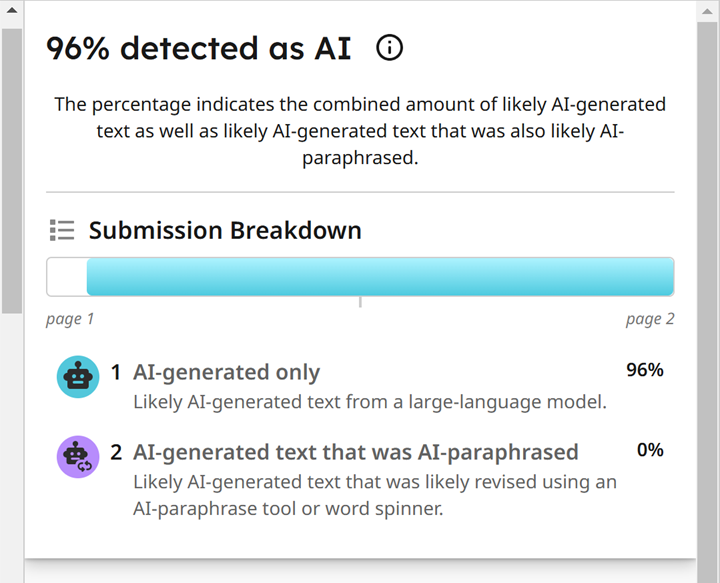
      Turnitin AI detector screenshot

    Suggestions for monitoring

    To help monitor students’ use of AI, parameters in MindTap for English with Turnitin should be set. For example, students need to submit more than 300 words for the detector to perform. Once students submit work, the detector generates an originality report. This can be downloaded to provide the instructor and learner with feedback about the percentage amount of acceptable and ethical usage of AI or plagiarism.

    Turnitin inbox where the similarity percentage can be viewed and clicked on for expanded, detailed information.
    Inbox where the similarity percentage can be viewed and clicked on for expanded, detailed information.

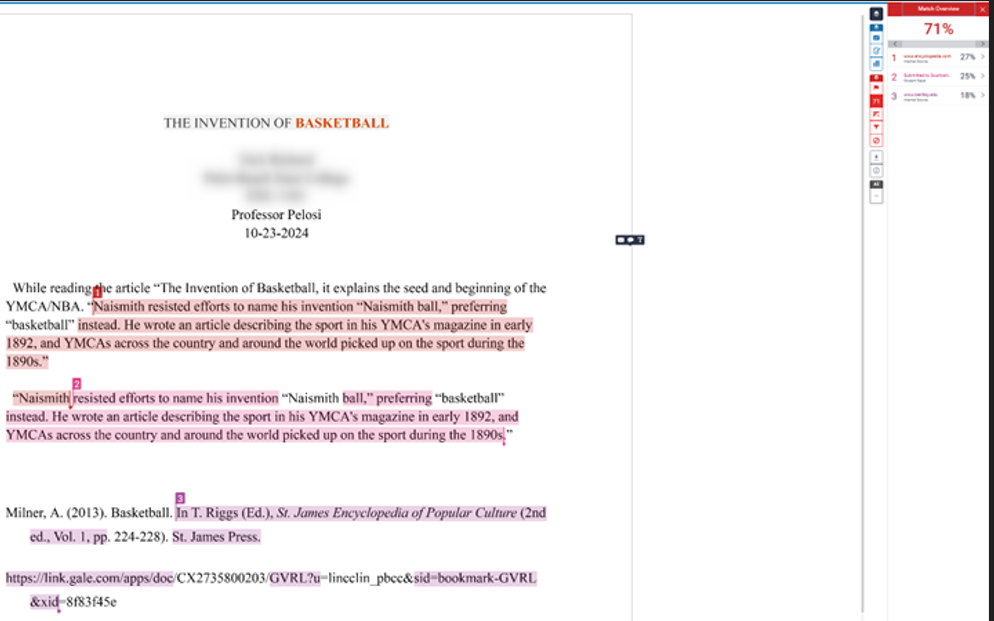
    The report highlights where originality is in question directly on the student’s document. Some instructors will set percentage parameters as well, instructing students that there cannot be more than 15% flagged by the detector in MindTap. Clicking on what the detector has highlighted shows the possible source where information may have been taken or just generally that AI has been used. Note: this is just a monitoring system. So, please be mindful that the report is a tool instructors can use to have conversations with their students. We cannot accuse academic dishonesty based on a report alone.

    Turnitin shows the match overview with all of the plagiarism flagged, which can also be AI. Each part can be clicked on and expanded to show the original source.
    Shows the match overview with all of the plagiarism flagged, which can also be AI. Each part can be clicked on and expanded to show the original source.

    MindTap’s monitoring system has always been correct for me, but conversations are still beneficial for assurance. I use this monitoring document for every submission in MindTap.

    The big picture to consider

    AI can be used ethically as a tool for teaching and learning, bridging student learning gaps and strengthening their mastery of skills. However, when it comes to academic integrity, the concern is that GenAI is being used not as an aid, but as a tool devoid of the values of teaching and learning. According to Cengage’s recent research, 82% of instructors expressed concern specifically about AI and academic integrity. Setting policies and parameters with clear definitions and having conversations with students is essential to my ability to monitor my students’ acceptable use of AI.

    Do you use AI in your English composition classroom? Reach out to discuss the ways you’re utilizing AI as an ethical tool to advance teaching and learning.

    Written by Faye Pelosi, Professor in the Communications Department at Palm Beach State College and Cengage Faculty Partner. 

    Stay tuned for Professor Pelosi’s upcoming video demo of how she uses the MindTap Turnitin feature in her English course.

    Source link

  • 5 Steps to Update Assignments to Foster Critical Thinking and Authentic Learning in an AI Age – Faculty Focus

    5 Steps to Update Assignments to Foster Critical Thinking and Authentic Learning in an AI Age – Faculty Focus

    Source link

  • 60% of Teachers Used AI This Year and Saved up to 6 Hours of Work a Week – The 74

    60% of Teachers Used AI This Year and Saved up to 6 Hours of Work a Week – The 74


    Get stories like this delivered straight to your inbox. Sign up for The 74 Newsletter

    Nearly two-thirds of teachers utilized artificial intelligence this past school year, and weekly users saved almost six hours of work per week, according to a recently released Gallup survey. But 28% of teachers still oppose AI tools in the classroom.

    The poll, published by the research firm and the Walton Family Foundation, includes perspectives from 2,232 U.S. public school teachers.

    “[The results] reflect a keen understanding on the part of teachers that this is a technology that is here, and it’s here to stay,” said Zach Hrynowski, a Gallup research director. “It’s never going to mean that students are always going to be taught by artificial intelligence and teachers are going to take a backseat. But I do like that they’re testing the waters and seeing how they can start integrating it and augmenting their teaching activities rather than replacing them.”

    At least once a month, 37% of educators take advantage of tools to prepare to teach, including creating worksheets, modifying materials to meet student needs, doing administrative work and making assessments, the survey found. Less common uses include grading, providing one-on-one instruction and analyzing student data.

    A 2023 study from the RAND Corp. found the most common AI tools used by teachers include virtual learning platforms, like Google Classroom, and adaptive learning systems, like i-Ready or the Khan Academy. Educators also used chatbots, automated grading tools and lesson plan generators.

    Most teachers who use AI tools say they help improve the quality of their work, according to the Gallup survey. About 61% said they receive better insights about student learning or achievement data, while 57% said the tools help improve their grading and student feedback.

    Nearly 60% of teachers agreed that AI improves the accessibility of learning materials for students with disabilities. For example, some kids use text-to-speech devices or translators.

    More teachers in the Gallup survey agreed on AI’s risks for students versus its opportunities. Roughly a third said students using AI tools weekly would increase their grades, motivation, preparation for jobs in the future and engagement in class. But 57% said it would decrease students’ independent thinking, and 52% said it would decrease critical thinking. Nearly half said it would decrease student persistence in solving problems, ability to build meaningful relationships and resilience for overcoming challenges.

    In 2023, the U.S. Department of Education published a report recommending the creation of standards to govern the use of AI.

    “Educators recognize that AI can automatically produce output that is inappropriate or wrong. They are well-aware of ‘teachable moments’ that a human teacher can address but are undetected or misunderstood by AI models,” the report said. “Everyone in education has a responsibility to harness the good to serve educational priorities while also protecting against the dangers that may arise as a result of AI being integrated in ed tech.”

    Researchers have found that AI education tools can be incorrect and biased — even scoring academic assignments lower for Asian students than for classmates of any other race.

    Hrynowski said teachers are seeking guidance from their schools about how they can use AI. While many are getting used to setting boundaries for their students, they don’t know in what capacity they can use AI tools to improve their jobs.

    The survey found that 19% of teachers are employed at schools with an AI policy. During the 2024-25 school year, 68% of those surveyed said they didn’t receive training on how to use AI tools. Roughly half of them taught themselves how to use it.

    “There aren’t very many buildings or districts that are giving really clear instructions, and we kind of see that hindering the adoption and use among both students and teachers,” Hrynowski said. “We probably need to start looking at having a more systematic approach to laying down the ground rules and establishing where you can, can’t, should or should not, use AI In the classroom.”

    Disclosure: Walton Family Foundation provides financial support to The 74.


    Get stories like these delivered straight to your inbox. Sign up for The 74 Newsletter

    Source link

  • a-closer-look-two-areas-changes-in-student-expectations The Cengage Blog

    a-closer-look-two-areas-changes-in-student-expectations The Cengage Blog

    Reading Time: 3 minutes

    As the world of higher ed continues to evolve at lightning speed, many students are understandably feeling some pressure to keep up. And that’s having a significant impact on the way they’re operating day-to-day in and out of the classroom. Over the past few years, faculty have reported noticeable changes in student expectations, with 49% recently telling us that the need to adapt to those expectations is a top challenge.

    So, what’s shifting, and how can faculty better adapt to meet their students where they are without going overboard? Let’s examine two examples of how needs and expectations are changing: AI use and deadline extension requests.

    The line between responsible AI use and cheating is fuzzy for some students

    Last year, 46% of those we surveyed in our annual Faces of Faculty report named combating cheating and plagiarism as a top challenge, down only slightly from 49% in 2023. And as AI becomes a bigger, more integral part of the higher ed experience, it’s growing increasingly difficult for many students to distinguish between responsible AI use and academic dishonesty.

    Forty-two percent of faculty we surveyed say they see significant or severe ethical and legal risks associated with generative AI in education, with 82% of instructors expressing concern specifically about AI and academic integrity. While today’s students expect AI to play some kind of role in the learning process, many stand on shaky ground when it comes to applying it ethically in their coursework.

    How instructors are responding

    As we reported, many instructors are taking a proactive approach when it comes to combatting this issue:

    • Many faculty have told us that they like to set clear expectations at the beginning of the semester/term around AI-use, either verbally or within their syllabus. By doing so, they can provide students with clear-cut guidance on how they should approach their coursework.
    • Faculty are finding that the more they know about AI, the better they can safeguard assignments from potential overreliance. One educator from Missouri told us, “I am learning more about Al and Al detection this year, and am making quite a few adjustments to my assignments so they are more personal and reflective, rather than Al-tempting assignments.”
    • Using anti-cheating software has become a very popular method for instructors, with many using online plagiarism detection tools like turnitin or “locked down” browsers.

    “Spending a lot more time and effort identifying and using reliable plagiarism detection software, especially AI detectors.” – Faculty member


    Extension requests: pushing deadlines and boundaries

    Another example of changing student needs is the growing expectation from students that their extension requests will be granted. But this has left many instructors feeling overwhelmed, not only by the number of requests to keep track of, but by a rising uncertainty over which requests are based on legitimate reasons. This may very well be a contributing factor for 35% of faculty who cited perceived dishonesty and lack of accountability from students as a top driver of dissatisfaction in 2024.

    An adjunct professor from Virginia told us, “I leaned into adapting to students’ expectations, but this became somewhat unmanageable when teaching multiple courses. I am also concerned with setting a precedent for future students in my courses if current students share that accommodations are easily given.”

    How instructors are responding

    Despite the challenges that this shift presents, many instructors are jumping in to accommodate extension requests from students, offering both patience and a generally high level of understanding. Faculty acknowledge that today’s students have a lot to contend with these days — from financial stressors to academic and social pressures — and they’re prepared to flex to those challenges.

    “I became more flexible. I get annoyed by professors my age who ignore the fact that today’s students are under ten times the pressure we were when we were undergraduates. Some of these students are carrying a full course load while working two jobs.” – Other professor role/lecturer/course instructor, Ontario

    While they’re empathic to students’ evolving needs, instructors are ready to set their own boundaries when necessary. One faculty member told us, “For the most part, I held firm in my deadlines. I did however increase the number of reminders I sent.”

    Regardless of the approach, clear communication with students remains at the heart of how faculty are dealing with this particular shift. Another instructor said, “I look at the individual situation and adapt…I remind students to complete items early to avoid unexpected delays. If there is a technology issue, then I will extend if it is communicated timely.”

    We’re happy to see our faculty skillfully weaving through these obstacles while remaining committed to adapting to new student expectations.


    To get a full picture about what 1,355 surveyed U.S. and Canadian faculty had to say about changes in student expectations, read our 2024 Faces of Faculty report.

    Source link

  • ai-transforming-student-engagement-in-the-online-classroom- The Cengage Blog

    ai-transforming-student-engagement-in-the-online-classroom- The Cengage Blog

    Reading Time: 3 minutes

    Let’s be real — online teaching isn’t about dumping lecture notes into a learning system and calling it a day. If we want students to actually engage, grow and retain what we teach, we’ve got to meet them where they are with tools and strategies that turn passive screens into powerful learning spaces.

    This is at the heart of our Spring 2025 Empowered Educator recorded webinar session, “Interactive Learning Redefined With A.I.”

    During our session, we explored tools and mindsets that make all the difference, whether you’re just starting as an educator or looking to breathe new life into your virtual classroom.

    Let’s talk about the “why”

    We’re teaching in an era where attention spans are short, expectations are high and personalization is the norm. Students don’t just want to listen. They want to participate, problem-solve and feel seen. The combination of interactive learning and Generative AI (GenAI) makes this not only possible, but sustainable.

    Interactive learning: Real-time tools that work

    Forget static slides. The key is giving students something to do, not just something to watch. Some of the most effective, real-time strategies listed in the CID Quick Tip Guide were explored during our session:

    Synchronous engagement ideas:

    • Live polls and Q&A: Check comprehension on the fly.
    • Gamified quizzes (Kahoot, Mentimeter): Turn reviews into fast-paced competitions that stick.
    • Virtual whiteboards (like Miro or Padlet): Co-create visuals in real time.

    Asynchronous options that still feel real:

    • Scenario-based videos and interactive PDFs help students explore at their own pace.
    • Reflective prompts build deeper understanding.
    • Gamified modules with badges or levels give students a sense of progress and motivation.

    This kind of learning keeps things dynamic, allows for quick feedback and, best of all, shows students you’re in it with them.

    How GenAI changes the game for personalization

    Now, here’s where we level up. AI isn’t just about automation — it’s about tailoring the learning journey to meet each student where they are. In our session, we explored ways to:

    • Use GenAI to generate custom study guides or quizzes based on student progress, ensuring that the use of copyrighted material falls within your license or other legal parameters.

    It’s like having a digital co-teacher who’s always ready to personalize.

    The evidence is in

    We also dove into case studies and data from real classrooms where these approaches led to:

    • Higher engagement and retention
    • More frequent participation
    • Better overall comprehension
    • Improved digital and collaborative skills

    When students feel included and in control of their learning, outcomes naturally improve.

    Final thoughts: Teaching that connects

    In the end, this isn’t just about tools or tech. It’s about creating experiences where students feel challenged, supported and seen.

    Watching this session on transforming student engagement in the online classroom will more than inspire you. You’ll learn how to:

    • Integrate interactive strategies with your LMS.
    • Engage with gamified quizzes, reflective prompts and real-time activities.
    • Evaluate your current engagement strategies and plan next steps.

    Let’s create classrooms that aren’t just digital — but dynamic.


    Written by Dr. Clevester Moten, Business Instructor at Jackson College and James Bender, Adjunct Instructor at Jackson College. 


    Dr. Clevester Moten is a transformative educator, scholar and thought leader whose research and work focus on equity, leadership and systemic reform. With more than 20 years of leadership spanning public, private and nonprofit sectors, he specializes in fostering collaboration and addressing societal challenges. Dr. Moten holds advanced degrees in public policy and business administration.


    Watch Dr. Clevester Moten and James Bender’s recorded webinar session, “Interactive Learning Redefined with AI,” part of our Spring 2025 Empowered Educator series, to learn more about transforming student engagement in the online classroom. 

    Source link

  • leveraging-ai-empowering-students-to-enhance-discussion- The Cengage Blog

    leveraging-ai-empowering-students-to-enhance-discussion- The Cengage Blog

    Reading Time: 2 minutes

    In recent years, artificial intelligence (AI) has rapidly integrated into the world of business, with higher education being no exception. According to recent Cengage research, 92% of higher ed instructors and 83% of students say it’s important to include AI literacy in courses, partly because 84% of students believe AI skills proficiency is important for future employment.

    AI tools, such as ChatGPT, Liner, Gemini and other similar platforms, are becoming influential in reinforcing student learning. They can help contribute to the generation of ideas, provide unique perspectives and facilitate deeper engagement with course resources. For example, students can use AI to enhance discussions, discover helpful images and content and improve their critical thinking skills. However, it’s necessary to consider AI integration thoughtfully and responsibly to make the most of its benefits while abating potential barriers.

    Enhancing critical thinking through AI

    One of the substantial benefits of integrating AI into the classroom is its capability to foster critical thinking. By offering students various viewpoints on a topic, AI encourages them to explore, compare and contrast different arguments. This process not only deepens their understanding but also sharpens their analytical skills. Additionally, AI can generate prompts that guide students to ask more reflective, intuitive and probing questions, further increasing scholarly interest in a topic.

    Ethical considerations and academic integrity

    Even with its benefits, the ascent of AI in academia has raised concerns about academic integrity. When it comes to the risks and ethics of AI, 82% of instructors Cengage surveyed are concerned about academic integrity (cheating, plagiarism). To tackle these concerns, educators must determine well-defined instructions on ethical AI use, emphasizing the importance of originality and proper citation of AI generated content. This methodology ensures that students explore AI responsibly, maintaining integrity in their academic efforts.

    Supporting diverse learning styles

    AI’s malleability makes it a valuable tool for accommodating various styles of learning. Visual learners can benefit from AI-generated illustrations and graphs, auditory learners from audio abstracts and kinesthetic learners from interactive engagement. By tailoring learning to these diverse needs, AI can create a more stimulating learning environment, enhancing intellectual capacity and student persistence.

    Long-term goals for integrating AI into the classroom

    Looking ahead, institutions should aspire to develop a viable AI-integrated curriculum that progresses with technological improvements. Continuous enhancement and innovation are essential, as is the creation of AI literacy programs for both students and faculty. Such initiatives will guarantee long-term expertise and certainty in leveraging AI effectively, preparing the academic world for a future where AI plays an integral role in education and the business world.

    Conclusion

    The integration of AI into higher education proposes a transformative opportunity to enrich synchronous and asynchronous discussions, while cultivating critical thinking. By embracing AI responsibly and ethically, educators can equip students with the skills and strategies to engage more meaningfully with course content, ensuring they are well prepared in an increasingly digital environment.


    Written by Dr. Neisa Jenkins, Professor at DeVry University

    Interested in practical strategies for integrating AI as a resource in discussion-based learning? Watch Dr. Jenkins’ webinar, “Leveraging AI: Empower Students to Enhance Discussion,” part of our Spring 2025 Empowered Educator series.

    Source link

  • AI as an Educational Ally: Innovative Strategies for Classroom Integration – Faculty Focus

    AI as an Educational Ally: Innovative Strategies for Classroom Integration – Faculty Focus

    Source link

  • Two More Ways Faculty Are Using AI

    Two More Ways Faculty Are Using AI

    Reading Time: 3 minutes

    We recently shared three ways faculty are using generative AI (GenAI) to help them handle the more administrative aspects of their roles — gleaned from ongoing research that culminates in our annual Faces of Faculty report. This comprehensive report explores the professional landscape, challenges, and opportunities facing today’s higher education faculty. Over the past few years, we’ve learned that GenAI has enjoyed popularity among early adopting educators as: a tool for jumpstarting ideas and conversations with students; to help with differentiation of instruction for different learning levels and styles; and a tool for automating feedback. We’ve also learned that around half of instructors now hold a positive view of GenAI, up from just 28% in 2023, and we expect that the number is continuing to rise as more educators experiment with the tech.

    What are some other ways in which higher education faculty are using AI to lighten their professional loads? Here are two more use-cases we learned about: 

    GenAI to combat plagiarism and cheating

    Since GenAI arrived on the higher education scene in a meaningful way, faculty have been understandably frustrated by the ways in which students can use it to cheat and plagiarize the work of others. In fact, 82% of faculty in a recent report expressed concern about academic integrity and AI. An adjunct in Washington told us, “When students rely on AI instead of learning to write and study, they learn less. This is like giving kids a calculator before they know what it even means to add and subtract…” 

    Yet, we’re hearing from educators that a “fight fire with fire” approach can be really effective at combating plagiarism and cheating. Importantly, this involves having honest conversations with students about academic integrity and the value of original work and critical thinking. Many faculty are spending time explaining to students that while GenAI tools are often appealing as a quick fix, using them to cheat and plagiarize will only harm their chances of  academic success. Others are going beyond theory and integrating AI tools into their lessons; effectively asking students to use AI in an integral way, without sacrificing originality. 

    Some are taking it a step further, though, and are using AI to stay a step ahead of the cheaters by thinking as they do. Faculty are often cued into the possibility of plagiarism by virtue of essays and responses that contain verbatim key terms from prompt phrases, or by stilted and inauthentic word choice and syntax. Running a page of text through an AI detection tool can quickly flag which sentences, concepts or phrases have been “lifted” straight out of ChatGPT or other GenAI platforms. One article suggests that educators subtly obtain a baseline sample of each student’s authentic writing style and capabilities at the start of the term, so that any potential plagiarism becomes far more obvious. 

    A faculty member at Purdue summarized the nature of the plagiarism challenge in a blog post.  “I realized that 80-90% of the assignment I had created for my courses could now be readily answered by AI…We are now thinking about how we can make our courses both AI-amplified and AI-resilient.”  

    AI for routine administrative tasks 

    “Judicious use of AI tools will make many tasks less burdensome. Good AI results depend on detailed and well-crafted prompts.” – Instructor, North Carolina

    In 2023, over half (58%) of instructors reported wanting to use AI for administrative tasks. As the overall popularity of GenAI has risen among educators, we expect that more and more are also now using GenAI tools to lessen their admin burden. What does this look like, and how can faculty use AI to make professional life easier on the administrative side of things? 

    A few AI-powered tasks we heard about from survey respondents include:

    • Scheduling office hours or emails

    AI calendar features can help educators optimize their workday by scheduling time blocks that are based on patterns and urgency. It can also deploy automated responses to routine student queries based on certain words and phrases. This simple use-case allows educators to find better work-life balance, avoid scheduling conflicts, and divide their time and attention fairly among the students and situations that most require it.

    • Reviewing and refining recommendations, resumes and cover letters

    Asking AI to write a recommendation, resume or cover letter borders on the unethical, but using AI to review these documents and suggest enhancements seems like a smart use of time and technology, and one that can benefit students while saving educators time.

    • Building reading lists or providing additional learning resources

    While its results aren’t always perfect, GenAI pulls from a virtually infinite pool of resources to generate lists and recommendations for users. So, no matter how seasoned or well-read an educator may be, AI can offer a helpful starting point for suggesting comprehensive resources and reading material that can benefit students.


    Wondering how else AI can support you?

    Check out our part 1 article: Three Ways Faculty Are Using AI to Lighten Their Professional Load. It highlights three practical ways instructors are putting AI to work — helping them save time, streamline tasks and refocus on what matters most.


    Source link

  • student-assistant-new-genai-capabilities – The Cengage Blog

    student-assistant-new-genai-capabilities – The Cengage Blog

    Reading Time: 2 minutes

    Since launching the Student Assistant in beta last year, we’ve been working with thousands of faculty and students to train it and bring a personalized learning experience to more students. So, what’s next for this GenAI-powered tool? 

    We’re taking it to the next level. Starting this fall 2025, the Student Assistant will become available to over 1 million students with new capabilities, including integration throughout the learning experience, course offerings across 100+ products and our new AI-powered insights dashboard.  

     Let’s jump in. 

    A quick refresher: Let us reintroduce you to the Student Assistant 

    Leveraging intelligent language models and Cengage-trusted content, the Student Assistant guides students through the learning process within their specific products. Currently, embedded in our online learning platform, MindTap, it provides tailored feedback to help students reach their own solutions, without giving away the answers. We want to support students to not only understand what they’re learning, but apply course concepts with confidence. That’s why this tool was purposefully trained by students and instructors, to ensure academic integrity is at the forefront.  

    Personalized support across learning activities 

    We’ve told you how the Student Assistant personalizes learning. Soon, students can experience that level of comprehensive, personalized support throughout their entire learning experience. The Student Assistant is expanding across various learning activities and can support more difficult question types. Plus, its responses will link to actual textbook chapters, images, videos and other resources. This allows students to instantly connect with their course content and understand exactly what they’re learning.  

    More course options equal more opportunities for students 

    Spanning 100+ products, the Student Assistant will be available to over 1 million students, each with their own set of unique learning needs. We’ve expanded access across our best-selling products, including “Principles of Economics” by N. Gregory Mankiw, “Anatomy & Physiology” by Dr. Liz Co, “Precalculus” by James Stewart and more. With more product offerings and platforms available, we can reach a wider range of students from a variety of key disciplines.

    Allows instructors to look beyond grades with AI-powered insights dashboard  

    The most desired AI use case for 52% of instructors we surveyed is AI that personalizes learning and instruction.  

    Built on real-time interactions from the Student Assistant, our new AI-powered insights dashboard is a tool instructors can utilize to support and meet students right where they’re at in the learning process. Instructors can track students’ learning patterns and increase engagement with personalized, actionable insights on everything from study habits to learning challenges and concept gaps – all before it impacts their grades.  

    The future of learning is looking bright 

    Overall, this expansion will help us create better learning experiences for more students and allow instructors like you to meet their individual needs — so you can support them in their academic journeys and create futures full of opportunity.   

    Want to stay posted on updates about our fall 2025 expansion and learn more about the Student Assistant for your course?  

    Source link

  • generative-ai-in-online-education – The Cengage Blog

    generative-ai-in-online-education – The Cengage Blog

    Reading Time: 3 minutes

    The rapid advancements in generative artificial intelligence (GenAI) are reshaping education, offering innovative tools for content creation, adaptive learning, and instructional strategies. GenAI models, such as ChatGPT, assist educators by generating structured lesson plans, assessments, and multimedia content, reducing workload and enhancing efficiency. These tools also support adaptive learning by personalizing content to match students’ strengths and learning gaps, increasing engagement and knowledge retention.

    However, the integration of GenAI presents ethical and legal concerns, including potential biases in AI-generated content, violation of the copyrights held by content creators and data privacy risks. Responsible use, complemented by human oversight, is essential to maintaining educational integrity. Successful applications of GenAI demonstrate its potential to expedite course development and create engaging digital learning experiences. Striking a balance between innovation and ethical considerations ensures AI enhances, rather than replaces, human-led teaching.

    Content creation and lesson planning

    GenAI streamlines lesson planning by allowing educators to input objectives and receive lesson plans tailored to learning goals. In fact, recent Cengage research cites lesson planning as a use-case for how teaching and learning can be supported by AI. While this functionality can save instructors valuable time and ensure their subject needs are met, it’s important to ensure that the use of copyrighted material falls within your license or other legal parameters.

    Additionally, AI-generated assessments support MOOCs, or Massive Open Online Courses, by facilitating adaptive and interactive course components, bridging the gap between large-scale online instruction and personalized learning. GenAI ensures lessons cater to diverse learning styles, enhancing accessibility and retention by integrating various formats, text, video and interactive activities.

    Adaptive learning and personalization

    AI can help assess and target students’ individual learning needs, enhancing student motivation and academic outcomes. Real-time feedback mechanisms allow learners to self-assess progress and focus on areas needing improvement, particularly beneficial in large-scale online courses. Additionally, GenAI can help personalize study materials, such as quizzes and practice tests, ensuring students learn at their own pace while maintaining engagement. When following copyright laws, these advancements help bridge gaps in traditional online learning, where standardized content may not meet diverse student needs.

    The future of AI in online education

    The use of AI in asynchronous learning is revolutionizing how educators develop content. With AI-driven tools, instructors can create high-quality, interactive, and accessible video lectures without the steep learning curve of traditional production methods. As technology continues to advance, AI will play an increasingly pivotal role in shaping the future of online education.

    For educators looking to simplify their lecture creation process, adopting AI tools is a game-changer. Instructors can focus more on teaching and less on technical production, ultimately providing students with a more engaging and effective learning experience.

    Ethical considerations and challenges

    While GenAI enhances education, ethical matters must be addressed. AI systems often rely on extensive data collection, raising privacy concerns that necessitate stringent safeguards. Moreover, biases in training data can result in skewed educational content, underscoring the need for careful dataset curation.

    Another challenge is the risk of over-reliance on AI-generated materials. While AI can assist in lesson planning and content development, human oversight remains critical to ensure contextual understanding and engagement. AI-based assessment tools, though efficient, may fail to interpret nuanced student responses accurately, necessitating human intervention to maintain fairness in evaluations.

    Conclusion

    Collaboration between educators, policymakers, and AI developers is crucial in establishing best practices that optimize AI’s benefits while mitigating risks. A balanced approach — leveraging AI’s efficiency while preserving human oversight — can foster an equitable, innovative, and effective learning environment.

    Follow Matt Larcin, subscribe to the Age of AI in Higher Education newsletter and visit www.mattlarcin.com.

    Written by Matt Larcin, Senior Instructional Designer, University of California, Los Angeles 

    Source link