This audio is auto-generated. Please let us know if you have feedback.
Dive Brief:
The California College of the Artsplans to wind down after its 2026-27 academic year,ending the 120-year-old institution’s long-running effort to turn around its finances, officials announced Tuesday.
Vanderbilt University has agreed to acquire CCA’s campus.Vanderbilt’s plans include operating a school to be dubbed the “California College of the Arts Institute at Vanderbilt,” along withoffering arts programming and maintaining elements of CCA’s legacy, such as its archives and an exhibition venue.
The arts college’s leaders ultimately realized its “tuition-driven business model is not sustainable” amid demographic declines and persistent financial deficits,CCA President David Howse said in the announcement.
Dive Insight:
Over the past year, CCA has been in talks with possible partners as it recognized “lasting financial independence is out of reach given our current constraints,” Howse said.
“Throughout our conversations, Vanderbilt has been a thoughtful and responsive partner, with a team of people who clearly respect our 120-year legacy and see in it great value for future generations of students,” he added.
Howse acknowledged that the news of CCA’s closure and Vanderbilt’s takeover of the campus might evoke “shock, frustration, and disappointment” in stakeholders.
Less than a year ago, Howse trumpeted an “extraordinary milestone” for the institution after raising $45 million to fund a turnaround.That donation blitz was anchored by a $22.5 million matching gift from Jensen Huang, the billionaire founder of Taiwanese technology company Nvidia, and his wife, Lori.
But CCA was ultimately unable to raise the full amount needed to sustain itself. The year before receiving those gifts, the college’s endowment totaled just $42.6 million, most of it earmarked for student aid,according to its fiscal 2024 financials.
Anticipating the question of why the Huangs couldn’t donate more to help the college, officials said in an FAQ that while the couple has been supportive, they “understand that CCA’s existing tuition-driven financial model is not working.”
The college — the last private arts institution in the city after the San Francisco Art Institute closed in 2022 — has suffered sizable enrollment losses in recent years. Between 2019 and 2024, fall headcount dropped by roughly 30% to 1,308 students, according to federal data. That’s a problem for a college that drew just under 70% of its core revenues from tuition and fees in fiscal 2023.
Local media raised the possibility in 2024 that CCA could close or merge with another institution. By September of that year, the college laid off 10% of its staff and eliminated open roles as it tried to reduce a $20 million budget deficit.
Now it’s winding down and handing the keys over to Vanderbilt. Students on track to graduate by the end of the 2026-27 year will be able to get their degrees from the college, and CCA is working on transfer and teach-out pathways for the students who won’t be finished with their studies by then, the college said.
For its part, Vanderbilt plans to keep aspects of CCA’s legacy alive. The Nashville-based private institution will operate CCA’s Wattis Institute of Contemporary Arts while maintaining the arts college’s archival materials and engaging its alumni.
CCA’s agreement with the university also “provides opportunities for both faculty and staff to apply for positions with Vanderbilt once Vanderbilt has completed an assessment of its needs,” CCA said in its FAQ.
The institutions didn’t disclose the financial terms of the deal.
The acquisition of CCA’s campus adds to Vanderbilt’s national expansion, with planned campuses in New York and Florida as well. The New York campus is set to open this fall.
The university plans to open the San Francisco branch for the 2027-28 academic year, pending regulatory approvals,Vanderbilt said. The university expects to serve around 1,000 students, both graduate and undergraduate, at the campus.
“San Francisco offers an extraordinary environment for learning at the intersection of innovation, creativity and technology, and it provides an unparalleled setting for Vanderbilt to shape the future of higher education,” Vanderbilt Chancellor Daniel Diermeier said in a statement Tuesday.
CCA is one of a handful of distressed arts colleges to end operations in recent years. Perhaps the most dramatic case was the University of the Arts in Philadelphia, which shuttered suddenly in 2024 — a fate that CCA managed to avoid through its fundraising and deal with Vanderbilt.
As part of its national expansion, Vanderbilt has purchased the California College of the Arts campus, which is closing.
Photo illustration by Justin Morrison/Inside Higher Ed
California College of the Arts will close by the end of the 2026–27 academic year amid enrollment declines that have rendered its business model unsustainable, officials announced.
But the Wednesday announcement at a press conference at San Francisco’s City Hall came with surprising fanfare. Though CCA is going away, Vanderbilt University is stepping in to purchase its campus, giving the private institution in Tennessee a foothold on the West Coast.
Following the closure, Vanderbilt will assume ownership of the campus and “establish undergraduate and graduate programming, including art and design programs,” and maintain archival materials from the college, CCA president David C. Howse wrote in an announcement.
The move comes after recent financial struggles for CCA, which laid off 23 employees in 2024 and closed other vacant positions to address a $20 million budget gap. While the private college raised nearly $45 million recently, those funds were evidently not enough to stave off closure.
CCA enrolled 1,308 students in fall 2024, according to recent federal data, down from a recent high of nearly 2,000 students in fall 2016.
Officials have not made details of the transaction publicly available.
Vanderbilt’s takeover of the San Francisco campus is the latest national push from the university, which has pursued an ambitious growth plan in recent years. Vanderbilt is currently leasing a campus in New York City and building another in West Palm Beach, Fla., as announced in 2024.
Vanderbilt chancellor Daniel Diermeier told Inside Higher Ed last fall that the university was exploring a site in San Francisco and noted the booming artificial intelligence scene in the city was part of the appeal for a campus there.
While at least 16 nonprofit institutions announced closure plans last year, California College of the Arts appears to be the first to do so in 2026, coming less than two weeks into the new year.
Chronic absenteeism is a longstanding problem that has surged to troubling levels. Recent data show that in 20 states, more than 30% of students are chronically absent, about twice the rate seen before the pandemic. Absenteeism is a multifaceted problem, and the reasons students stop showing up aren’t always academic. Sometimes it’s because they don’t feel connected to their school, or they are not engaged in the curriculum. Other times, they face adversity outside the classroom. While the problem is complicated, it’s easy to overlook one of its simplest, most effective solutions: What if the key to keeping students is a performance stage, a music room or an art studio — a creative outlet to shine?
Despite decades of research, arts education is still treated as a “nice-to-have” when education budgets allow. From 2015 to 2019, the NAMM Foundation conducted a four-year study across 1,700 New York City public schools serving over 1.1 million students. They found that schools offering music and arts programming had lower rates of chronic absenteeism and higher overall school-day attendance than those that didn’t. Similarly, a comparison of cohort data over seven years found that dropout rates fell from 30% to just 6% among students participating in consistent arts programming.
Clearly, the arts are a powerful tool for academic engagement, resilience and, most importantly, graduation. For example, after tracking more than 22,000 students for 12 years, the National Dropout Prevention Center found that those with high levels of involvement in the arts were five times more likely to graduate from high school than those with low involvement.
But while over 90% of Americans feel the arts are important for education, only 66% of students participate, and access remains uneven. Charter schools, the fastest-growing segment of public education, have the lowest availability of arts courses: Just 37% of public charter high schools offer arts instruction. Students in charter schools, military families and homeschool programs are too often the ones with the fewest opportunities to engage with the arts, despite needing them most.
This is an issue that the Cathedral Arts Project in Jacksonville, Florida, is trying to solve.
In partnership with and with funding from the Florida Department of Education, our program piloted a year-long arts education initiative during the 2024-25 school year, reaching more than 400 students in charter schools, homeschools, military families and crisis care. Our teaching artists visited classrooms weekly, providing instruction in dance, music, visual arts and theater. Throughout the year, students in kindergarten through high school found joy, confidence and connection through creative learning. Homeschool students brought history to life through art projects, children from military families found comfort and stability during times of deployment and young people in crisis discovered new ways to express themselves and heal. Each moment affirmed the power of the arts to help children imagine what’s possible.
To better understand the impact of this work, we partnered with the Florida Data Science for Social Good program at the University of North Florida to analyze reports and survey evaluations collected from 88% of program participants. Here’s what we found:
Students grew not only in artistic skill, but also in self-confidence, teamwork, problem-solving and engagement. After completing the program, over 86% of students said they “like to finish what they start” and “can do things even when they are hard” — a key indicator of persistence, which is a strong predictor of long-term academic success. Students rated themselves highly in statements like, “I am good at performance.”
Families noticed, too. In the age of screens, nearly three-quarters reported that their child had increased in-person social interaction since beginning arts programming and had improved emotional control at home. Nearly one-third saw noticeable gains in creative problem-solving and persistence through challenges.
According to the State of Educational Opportunity in America survey conducted by 50CAN, parents view the arts as a meaningful contributor to their child’s learning, and they want more of it. In Florida, where families have been given the power of school choice, they’re increasingly seeking out programs that inspire creative thinking and meaningful engagement while promoting academic success. But finding them isn’t always easy. When funding allows, traditional public schools may offer band or visual arts, but these options are often unavailable to families choosing alternative education options for their children.
Now in its second year, our program fills this critical gap by working directly with school choice families across northeast Florida, bringing structured arts instruction to students who otherwise wouldn’t have access.
What makes the arts such an effective intervention? It’s structure, expression and connection. When students learn through the creative process, they navigate frustration, build resilience and find joy in persistence. These are not soft skills — they’re essential for survival, and increasingly important in today’s workplaces.
Arts education is a necessary investment in student achievement. It’s time for other states to treat it that way and follow Florida’s lead.
Did you use this article in your work?
We’d love to hear how The 74’s reporting is helping educators, researchers, and policymakers. Tell us how
This blog was kindly authored by Professor Randall S Whittaker Principal and CEO Rose Bruford College.
London’s creative industries are not a cultural accessory; they are an economic engine. Around one in seven jobs in the capital sits within the creative industries, and if you include creative roles embedded across other sectors, that figure rises to nearly one in five. Almost a third of all UK creative businesses are based in London.
The UK’s creative success is no accident. It rests on a delicate, interdependent education ecosystem: specialist arts institutions; research hubs; and universities that together generate not only talent but innovation, identity and national soft power.
That ecosystem is under pressure. Rising costs, uneven funding, and the new fashion for mergers, the proposed “super university” being the latest example, are driving a wave of consolidation.
Why “super universities” miss the point
When two generalist universities merge, their academic portfolios may blend. When a small, practice-led arts institution is absorbed, it rarely blends; it dissolves. Studios become seminar rooms. Ensemble training becomes optional. Niche disciplines disappear in the name of efficiency. Scale rewards the generic; creativity thrives in the specific.
The Kent–Greenwich merger, planned for 2026, is being hailed as a pragmatic response to sector-wide financial stress. On paper, such consolidations look neat: shared back-office functions, pooled estates, a single regional brand. But higher education is not a spreadsheet exercise.
It’s understandable that, given Rose Bruford College’s geography — located between Kent and Greenwich — and a financial position that has been challenging but is now improving, some might assume that joining a “super university” is the logical next step.
Yet that assumption misunderstands what specialist colleges contribute. Rose Bruford’s strength lies precisely in what cannot be merged: its scale, its agility, its ensemble ethos, its craft-specific research culture, and its proven industry connectivity. The College’s recovery — from stabilised finances to a UKRI-funded research project and multiple national awards for both performance and technical excellence — shows that independence is not indulgence; it is impact.
The question is not whether Bruford can survive outside the merger, but whether the creative industries can afford to lose what institutions like Bruford uniquely provide. When specialist institutions disappear, we do not gain efficiency; we lose an entire mode of creativity.
There are, of course, examples where partnership has protected identity: the Royal Birmingham Conservatoire operates as an associate faculty of Birmingham City University, retaining its governance and character while sharing infrastructure. That balance, autonomy with alignment, is the exception not the rule. For most specialist creative institutions, a merger could mean absorption, not collaboration.
From curtain call to crucible
It remains true that it is a curtain call for the old, exclusionary model of time-intensive training that shuts out those without privilege or flexibility. What must be defended now is the right of specialist institutions to re-imagine rigorous training on equitable, sustainable terms.
Specialist creative higher education is not a conveyor belt. It is a crucible. To mistake it for a “skills pipeline” is to misunderstand its purpose. Specialist higher education institutions are not service departments for the creative industries; they are cultural forces — sites of disruption, experimentation and social imagination.
Graduates from these environments do not merely enter the creative industries; they redefine them. They found new companies, invent formats, challenge hierarchies, and expand who gets to tell Britain’s stories.
Research, re-imagined
Specialist arts institutions do not reject research; they redefine it. Practice is their laboratory. Performance, design and experimentation are their methodologies. Rose Bruford’s recently UKRI-funded research project exemplifies how specialist providers drive national innovation, producing knowledge that moves from rehearsal rooms to public discourse, from artistic experiment to policy impact.
The power of the specific
The reach of this work is visible every night on screens and stages.
Jessica Gunning, BAFTA, Emmy and Golden Globe winner for Baby Reindeer, trained at Rose Bruford.
Bernardine Evaristo, Bruford alumna and Booker Prize winner, saw her novel Mr Loverman adapted for television and a Women’s Prize Outstanding Contribution Award, recognising her “transformative impact on literature and her unwavering dedication to uplifting under-represented voices”.
Stephen Graham and Hannah Walters, who met as Bruford students, co-starred in Adolescence — proof that specialist institutions forge lifelong creative partnerships.
Sir Gary Oldman, Slow Horses, began his journey at Bruford and continues to define British performance worldwide.
Excellence extends far beyond the spotlight. At the Profile Awards, lighting design alumni Jessica Hung Han Yun, Sarah Readman, and Joshua Pharo, together with Joshie Harriette, all received national recognition. Hung Han Yun — also an Olivier Award winner for My Neighbour Totoro — shows how specialist training produces innovators whose artistry is both technical and conceptual. These achievements prove that excellence in production crafts is not ancillary to the arts; it is integral to Britain’s creative leadership.
Diversity and student choice
A healthy higher-education system depends on difference, in mission, in method, in who it serves.
If independent specialist higher education institutions disappear, the UK’s higher-education landscape flattens. The sector loses, not only training for performers and designers, but the pedagogical diversity that keeps higher education alive, the alternative modes of learning that reach students who may not thrive in traditional university structures.
For students, the consequences are immediate. Choice collapses from a landscape of craft pathways to a handful of broad “creative-arts” degrees. The student who might have trained as a lighting designer, scenographer or community-theatre facilitator is left with a single, generic option. In a system obsessed with “student choice”, consolidation removes the very choices that matter most — about identity, craft and form.
GuildHE’s recent Championing a Diverse Higher Education Sector manifesto underscores this point. It highlights the extra costs of small-class teaching and industry-standard facilities that specialist colleges cannot cross-subsidise, and calls for direct funding, reform of research and knowledge-exchange thresholds, and capital investment to secure the sector’s future. These are not indulgences; they are the practical conditions for diversity itself.
Funding reform is an investment in inclusion
What specialist institutions seek is not indulgence — and not simply more money to do the same thing. They seek resources that enable transformation: sustainable workloads, flexible modules, hybrid teaching, and equitable access, without sacrificing rigour.
As GuildHE notes, funding architecture must recognise that small specialist colleges cannot offset studio-based costs in the way comprehensive universities can. Reforming those systems is how government can genuinely champion diversity rather than merely declare it.
Starving specialist institutions into mergers is not efficiency; it is slow erasure.
A national imperative
Britain’s creative industries are a cornerstone of the economy and of international reputation. Yet the institutions that make that possible are treated as optional extras.
If independent, practice-led institutions vanish, we lose not only talent pipelines but the laboratories of imagination, the incubators of diversity, and the ability to renew what British creativity means.
Specialist creative institutions are not relics of the past. They are the crucibles of the future — where risk is rehearsed, difference made visible, and new worlds imagined into being. Fold them into super universities, and the loss will not be obvious at first. But over time, our screens, our stages and our stories will all start to look the same. And by then, it will be too late.
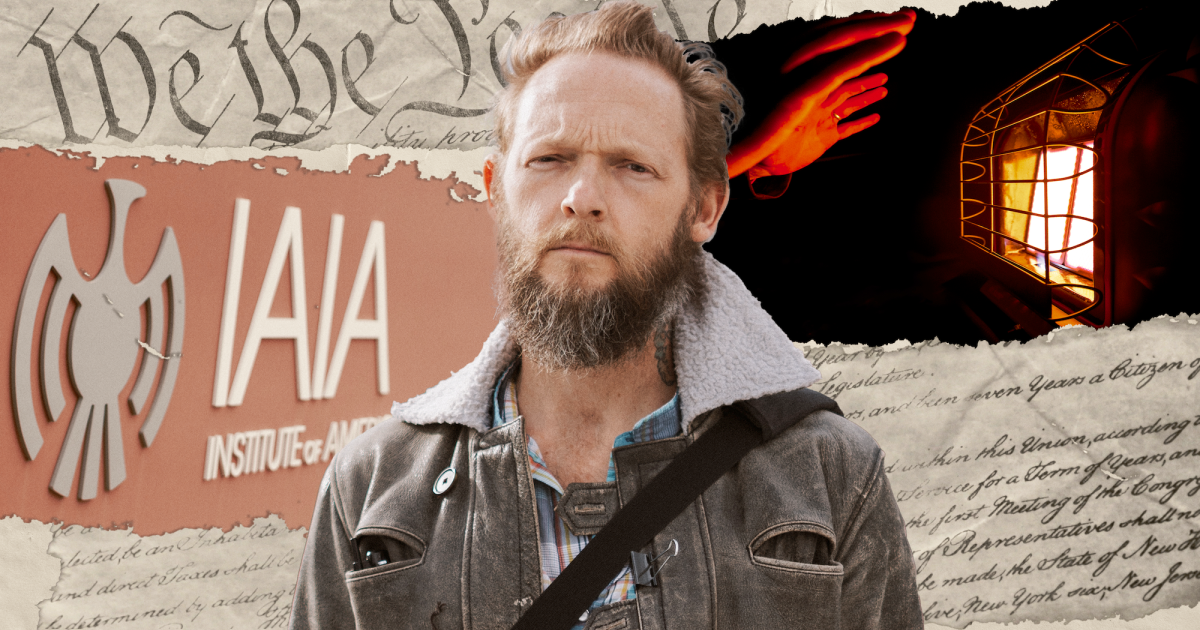
Today, the Foundation for Individual Rights and Expression and three partner organizations demanded that the Institute for American Indian Arts and its new president Shelly Lowe drop all sanctions on student David McNicholas, who was punished for supposedly “bullying” IAIA administrators. The offense? Investigative journalism exposing an empty food pantry on a campus where many students live below the poverty line. Since then, McNicholas has faced over a year of retaliation from administrators. Most recently, IAIA said he couldn’t even put up posters soliciting student submissions for a new edition of his independent student magazine, since it is not a school-funded publication — despite the fact that school policies list no such requirement.
FIRE, the National Coalition Against Censorship, the Society of Professional Journalists, and the Student Press Law Center are urging Lowe to drop the sanctions on McNicholas and revise the school’s anti-bullying and posting policies to comply with the First Amendment.
The following statement is from FIRE Strategic Campaigns Specialist William Harris.
Student journalist David McNicholas isn’t backing down after the Institutefor American Indian Arts tried to silence him yet again. And now, he has four national nonprofits on his side. IAIA’s forbidding McNicholas from putting up posters seeking student submissions — ironically, for a new, free-speech-themed edition of The Young Warrior — is just the latest attack in its retribution campaign against investigative journalism that put McNicholas on probation, cost him work, and even left him homeless.
Coalition Letter to IAIA, September 25, 2025
FIRE and other organizations urge the Institute of American Indian Arts to drop its sanctions against McNicholas and comply with the First Amendment.
IAIA’s brand-new president, Shelly Lowe, should know better. A former chair of the National Endowment for the Humanities, an institution that has faced many attempts by politicians to police artistic expression over the years, she now leads a school whose attacks on press freedom and expression are straight out of the authoritarian playbook.
Such hostility towards the First Amendment is especially offensive at an arts school — the last place where free expression should be under attack. Strong speech policies protect the sort of expression that drives culture forward.
Over 500 members of the public have signed on to our Take Action campaign demanding that IAIA reverse course. Lowe should heed the call.
Stand with us and tell IAIA to end this censorial saga and restore free expression to campus.
Faculty members in the Los Angeles Valley College (LAVC) Media Arts Department implicated in decades of fraud and misconduct have been removed from administrative positions, though they remain in teaching roles.
Over the summer, longtime department head Eric Swelstad, who had led Media Arts since 2008, was replaced as chair by Chad Sustin, a full-time professor of Cinema and Media Arts. The change followed a notification from the LACCD Whistleblower Movement to new Chancellor Alberto J. Roman, alleging that Swelstad falsely claimed membership in the Writers Guild of America – West for more than 20 years and used this misrepresentation in official LACCD promotional materials.
Sustin, a tenured faculty member since 2016 and a former Technicolor post-producer, now leads the department.
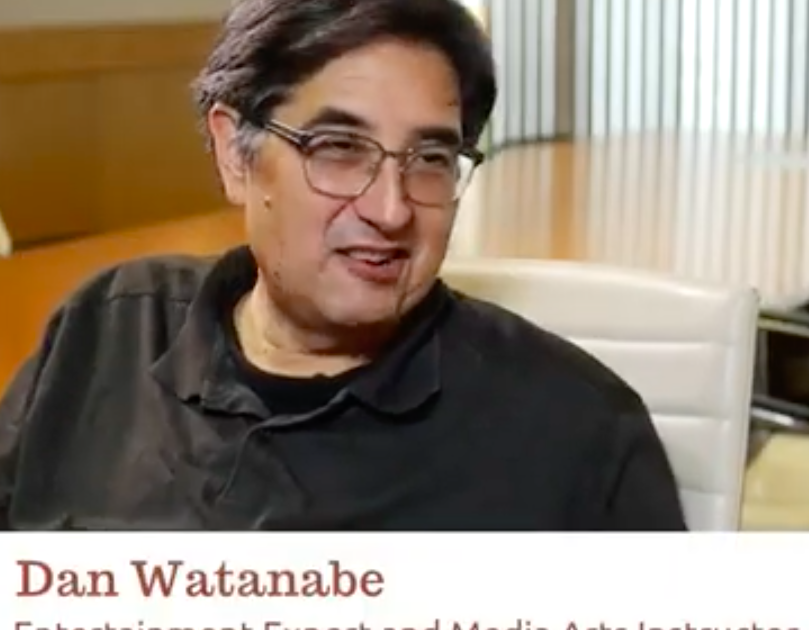
The reshuffling comes amid years of internal turmoil. In 2022, full-time cinema professor Arantxa Rodriguez resigned and was replaced by Jonathan Burnett as assistant professor. Rodriguez had previously been implicated in department infighting and, alongside Swelstad, was named as a co-defendant in a 2008 case alleging failure to provide advertised technical training and education. Burnett’s hiring bypassed longtime adjunct and former grant director Dan Watanabe.
Watanabe previously administered several Media Arts training grants, the last of which—ICT & Digital Media, LA RDSN—was reported as fraudulent in 2016. The 2013 grant proposal promised courses such as The Business of Entertainment, Advanced Digital Editing, Photoshop, and After Effects. Yet once funding was approved, The Business of Entertainment and Advanced Digital Editing were archived by LAVC’s Academic Curriculum Committee and Senate. Photoshop and After Effects were offered only minimally, with After Effects disappearing after 2015 and Photoshop shifting to online-only by 2017.
Students reported the suspected fraud to the State of California in 2016, prompting a review of the grant. Renewal applications submitted by Watanabe in 2018 and 2021 were both denied.
Grant Record (Denied Renewal, 2018):
Project Title: ICT & Digital Media – LA RDSN (Renewal)
Funding Agency: CCCCO EWD
Grant Amount: $165,000
Funding Period: Oct. 1, 2018 – June 30, 2019
Project Director: Dan Watanabe
Description: Proposed renewal of the Deputy Sector Navigator grant under the California Community Colleges Chancellor’s Office, focused on curriculum development and alignment with universities and K–12 schools.
Despite this, Watanabe (who was also passed over for a full-time position at Los Angeles Pierce College) remains an adjunct faculty member slated to teach Cinema 111, Developing Movies – a field he reportedly last worked in twenty years ago. Arantxa Rodriguez and Eric Swelstad have both been scheduled to teach Fall 2025. Despite falsifying his credentials as a member of the Writer’s Guild of America – West, and implying he was a Primetime Emmy Winner (he in fact was the director of a movie that received a local Los Angeles Emmy in the 1990s), he is slated to teach Cinema 101 and screenwriting core class Media Arts 129. Rodriguez will a remote History of Film Class.
Reportedly the new full-time faculty in the department have started working to reverse the damage. Fall 2025 schedule includes Media Arts 112, Creative Sound Design Workshop.
Veronica Alvarez was 4 when her family came to the U.S. from Cotija in Michoacán, Mexico, a small town famed for its cheese. Her father picked avocados amid the scorching heat in the San Fernando Valley, while her mother cleaned houses. One of nine children, she learned how to scrimp and save, how to work hard and how to dream big.
“We were so poor, I knew not to ask for much,” said Alvarez, 52, now executive director of Los Angeles-based Create CA, one of the state’s leading arts education advocacy organizations. “Looking back on those years now, I don’t know how my parents did it. I have a white-color job and two sons, and I can barely afford it.”
Her sunny disposition belies a steely resolve. She remembers well the sting of being an undocumented immigrant in the age of Gov. Pete Wilson, an era when some felt ashamed to even speak Spanish in public. She brings that fire to her arts education mission.
“I believe access to the arts is a social justice issue,” as she puts it.
“Unfortunately, students that have the most need do not get equal access and opportunities.”
Her chops as a fighter, someone who doesn’t give up on a cause, are part of what makes her special, arts advocates say.
“Veronica is an inspiring and dedicated arts education advocate and leader,” said Merryl Goldberg, a veteran music and arts professor at Cal State San Marcos, who also serves on the Create CA board. “Her commitment to equity and lifting student voices is front and center.”
Alvarez didn’t become fluent in English until about the fourth grade, but she instinctively understood that education was the key to escaping poverty.
Education was my path out of poverty. That was always my thing. I loved school.
Veronica Alvarez
The only one in her family to graduate from high school, for her, school was always a matter of sink or swim. She chose to dive deep. She paid her way through college working at Chuck E. Cheese, where she honed her chops in engaging children.
“I’ve always been pretty driven,” said Alvarez, a mother of two boys with a doctorate in education and a master’s in ancient history. “Education was my path out of poverty. That was always my thing. I loved school.”
She also loved to walk to the library. It conjured an oasis of calm amid her raucous household.
“I’d come home with bags of books and sit in a corner to read and immerse myself in the world created by the author,” she remembers. “That love of reading has lasted to this day.”
At first, she wanted to be an artist, but her fourth grade teacher said she lacked talent.
“I loved making art as a child,” said Alvarez. “But I had always been taught to respect your elders. I didn’t think it was my place to question it.”
So, she stopped trying to make art, channeling her drive into academics. Determined to graduate early, she took every AP class she could in high school and found her happy place in art history. A self-professed nerd, she always felt drawn to the world of books and ideas.
“To be able to sit and read and learn always seemed like a luxury to me,” she said.
As a child, she was first entranced by Caravaggio and Bernini, and later became beguiled by the works of Frida Kahlo and Graciela Iturbide.
Making sure everyone can participate in the arts is what drives Veronica Alvarez, now head of Create CA. (Courtesy of Veronica Alvarez)
“I loved Bernini’s ‘David’ because of his teeth biting his lip; he looked vulnerable and intense — along with the fact that he was mid-motion as he threw the rock at Goliath,” she remembers. “The ‘Barberini Faun’ made me blush. A big piece of marble made me blush.”
She’s a full-fledged museum addict and a politics junkie with a passion for the place of women in antiquity, particularly Greek and Roman history. That expertise is what led her to the Getty Museum, where she helped launch the Getty Villa.
“My parents would’ve never dreamed of taking us to museums; that was not a place for us,” said Alvarez, who later became the director of school and teacher programs at the Los Angeles County Museum of Art. “My passion has always been about access and equity, making a place for everyone.”
While at the Getty, she worked on an English learners program with migrant workers who often start work at 4 a.m., which means language classes happened at all hours of the day and night. It was a struggle to convey the meanings of words until she landed on using the visual realm.
“When you learn a new language, you learn ‘manzana’ means apple, and then you see a picture of an apple,” she recalls. “I thought, why don’t we use Cézanne’s ‘Still Life with Apples’? And the conversations suddenly got so much more interesting. We got the students to really engage, centered around the artwork.”
That obsession with making sure everyone, not just the lucky few, can feel the transformative power of the arts is why she feels right at home at Create CA, which has been helping schools navigate the rules around Proposition 28, the state’s arts education mandate.
The organization has long fought for expanding access to arts education and helped advocate for arts educators and teaching artists in the classroom. One of the biggest challenges facing the organization now is making sure Prop. 28 funds are spent as they were intended, as well as pushing for more funding.
“With the passage of Prop. 28 and dedicated funds for arts education, people may think we have solved arts education,” she said. “However, while a billion dollars may sound like a lot of money, we have 6 million students in CA. When we parcel out what that means to individual school districts, especially in rural areas, sometimes the funds aren’t sufficient to hire one art teacher.”
Alvarez is known for her poise and her ability to keep the peace amid intense personalities.
“I’ve been struck by her powerfully calm demeanor and her openness to advocacy as a ground-up endeavor versus a top-down activity,” said Goldberg. “Being an arts leader can be challenging in so much as there are many voices in the mix and they don’t all agree.”
Alvarez has the polish to be diplomatic in a deeply divided world, partly because she puts the cause first.
“She brings a worldly and positive energy to the discussions, and she strikes me as very much always in the problem-solving and equity-centered mode,” said Letty Kraus, director of the California County Superintendents Statewide Arts Initiative. “I also have experienced her as hands-on, participatory, and collegial in her approach.”
For Alvarez, art is the tether that connects us to our shared human heritage. It’s a bridge to the past that all should be encouraged to cross.
“Human beings are unique,” she said. “Out of all the animals, we have the ability to create art, to connect across time and culture. That’s why I love the arts so much. The craftsmanship of the human hand, the human eye, is so important to me.”
As an educator, the elusive nature of cognition — why the human mind absorbs some concepts while discarding others — also fascinates her.
“To me, what you have to teach is the love of learning,” she said. “How does the mind retain information? It’s all about making connections. You learn something in history, and then you apply it in English. It’s about providing the full context; that’s how you retain information.”
If something truly moves us, she suggests, we may remember it forever. That’s why the arts can push us to transcend boundaries and grasp universal truths.
“The arts are essential to students’ creativity,” she said. “When students can’t access the traditional curriculum, the arts allow them to express themselves, their feelings, and tell their stories. The arts are essential to our well-being.”
David John Baer McNicholas sleeps every night next to a bomb.
The worst thing about being homeless is the weather, he says. Santa Fe gets so cold that sometimes diesel fuel turns to gel. At those temperatures, frostbite hits in minutes.
In The Martian, Matt Damon’s character Mark Watney uses a radioactive isotope to keep his rover warm. In the Martian landscape of New Mexico’s Chihuahuan Desert, McNicholas keeps his van warm with a rusty five-gallon propane tank hissing beside his bed.
It’s not just the cold of the desert at night, either. Santa Fe is also the highest state capital in America, at 7,000 feet above sea level. That’s higher than the base lodge at most ski resorts. To stay warm, he keeps a pile of old covers and shirts in his van. A top from TJ Maxx. A blanket from a friend. An oversized green-and-black fleece from his sister who died of cancer.
But in the thick of winter, it’s nowhere near enough. So he fires up the heater hooked to the propane tank beside his bed. Burning an open flame inside a flammable structure filled with combustible fuel isn’t exactly safe, so he keeps a carbon-monoxide detector on his pillow. It’s a thin safeguard since these alarms can, and do, fail. But it’s better than nothing. To avoid freezing to death, he has to risk burning alive.
Summer brings no relief either. “The average temperature in the van during summer is about 110 degrees,” he says. “There’s only so much shade in Santa Fe, especially considering most people don’t want you parking near them.”
And if the weather doesn’t get you, there are a hundred other little things about being homeless that surely will. For one, his van is tiny, and he’s tall. Cooking involves a camp stove that makes his clothes stink of grease, increasing the risk of fire, and turning his van into a dripping sweatbox. Not to mention, the constant anxiety of knowing his belongings are not safe. Or that his home could be towed. Or having to move multiple times a day to avoid such an outcome. Or having to pee into a plastic bottle every night. Or having to find a place to dump the bottles every morning.
“I go to bed every night thinking, this could be it,” he says, reflecting on how his propane tank might blow up and kill him in his sleep. “I might not wake up.”
He adds, after a pause, “All my troubles would be over.”
The moment of truth
McNicholas is a student journalist who studies creative writing at the Institute of American Indian Arts (IAIA) in Santa Fe, and he is on track to graduate this spring with a 4.0 GPA. He often writes about life on the road. His poem “Flatbed,” which earned the 2022 Betty and Norman Lockwood Poetry Prize from the Academy of American Poets, captures a cross-country adventure he took with his father when he was 15.
In New Mexico, over half of students face food insecurity. When a whistleblower at IAIA uncovered evidence that school officials might have misused a $50,000 grant meant to support campus food pantries, McNicholas thought it was clearly newsworthy. When students claimed school officials retaliated against the whistleblower who raised the alarm, he published their allegations.
This was groundbreaking journalism. Food scarcity in Native American communities is a dire problem, so a food-pantry scandal at the nation’s top indigenous arts college is a five-alarm fire. Native Americans are twice as likely to face food insecurity compared to white Americans, and sometimes three times higher. In fact, the entire Navajo Nation, which overlaps New Mexico, is considered a food desert.
But instead of being celebrated for such journalistic work, David McNicholas was fired. Put on probation. Evicted. Homeless.
One of the two anonymous student submissions published in The Young Warrior
McNicholas’s clash with IAIA leadership began in 2024, after he published two anonymous submissions in his student-run zine The Young Warrior. One piece accused school officials of bullying a beloved student advisor, Karen Redeye, out of her job. Redeye herself later confirmed this, writing:
I resigned from IAIA due to repeated lack of support from my superiors, maltreatment and bullying from my direct supervisors. It elevated to the point of affecting me physically and my workspace did not provide me emotional safety … I loved my job but it became a hostile workplace and I could not continue on with my position.
The second piece accused Dean of Students Nena Martinez of misappropriating the $50,000 food-security grant. After publishing, McNicholas says he received a flood of thanks and support from his fellow students. Many of them, like McNicholas, depended on the food pantry for survival.
But the administration was not so grateful. They hit back hard, claiming McNicholas was “bullying” university staff. They opened a formal investigation with consequences sure to follow.
“Oh shit,” McNicholas remembers thinking at the time. “They’re going to throw everything at me.”
Learning to hide
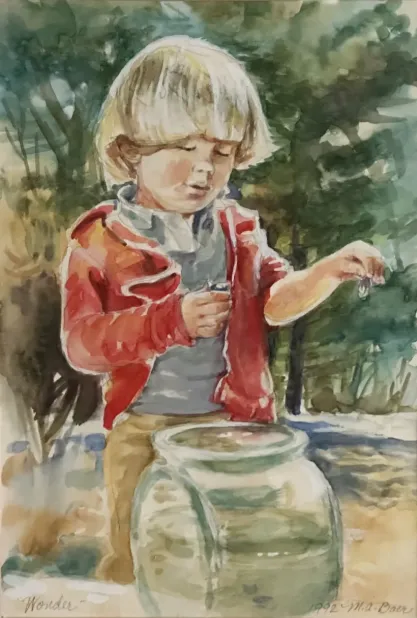
“Wonder” by McNicholas’ mother Mary Alice Baer, depicting her son
I grew up in the 1980s near the poverty line, raised by a single mom. The McNicholas residence was a one-car garage with a few rooms tacked on the back in Newington, New Hampshire. Mom was an artist who scraped by doing cleaning jobs. She struggled with alcoholism. Dad was absent until I was 12, but sent $150 a month in child support. Mom didn’t really cook, but she could make a pot of beans. Most nights, we ate TV dinners. It was more than some folks had.
I had undiagnosed autism as a kid, so as you can imagine, school was hell. I learned to keep my mouth shut or get beaten up. Most of the torment from my peers was psychological. I was terrified and lonely. But work was different. In high school, I worked part-time at Market Basket, on the front end. Got hired as a bagger, promoted to keyholder within a day. I found it easier to talk to the cashiers and baggers my age because there, our roles were clearly defined.
Life at school was harder. Blending in became its own kind of hobby. I spent years studying people like an anthropologist, trying to fit in. And I spent years ostracized and harassed for being different. But every year, I got better at hiding myself.
I had traditional hobbies too, you know. I liked computers. I even thought I might study computer science. But I changed my mind at the close of senior year because I knew I had to study people more if I was ever going to have a normal life.
I could only take so much. I started drinking and ended up living in parking lots, storage closets, and couch-surfed for over a decade. But eventually I got sober, bought a house, even started a business. The startup life was too stressful, though. I lost everything — except my sobriety. I entered IAIA to study creative writing. I did my first two years at IAIA while living in my van. In my third year, I moved into the dorms. It was a chance at more stability. And life began to make sense.
I entered at 42, while my peers were mostly 19, so there wasn’t the same pressure to make friends. I contextualize my social life at IAIA as work. Most of my peers are half my age and I am a trusted mentor. These clearly defined roles make me comfortable. Around this time, I was diagnosed with autism, and that helped make sense of things. I also started The Young Warrior, and people liked it. I was part of a community.
When I got into trouble for publishing those pieces, I did what I always do. I tried to study my way out of the problem. I went to the archives and read about old IAIA publications. I read Dean Spade’s “Mutual Aid” and FIRE’s “Guide to Free Speech on Campus.” I studied other undergrad publications and wrote an official proposal and operations manual for what I hoped would be the new Young Warrior.
But overall, life was going well. I haven’t had a drink or drug in 13 years. IAIA has been a huge part of my continued sobriety. And my creative studies have given me the space to unpack the person I hid away so long ago.
Going public
Anticipating housing sanctions barring him from his dorm room, McNicholas left campus before they were formally applied and started living out of his van. But the school’s vicious overreaction in moving to evict him only convinced him it was trying to cover something up. In addition, McNicholas says when Dean of Students Martinez heard the allegations about school officials robbing the food pantry, she simply dismissed the need for food pantries to begin with. According to him, she said, “Students have meal plans. They don’t need food pantries.”
But that explanation didn’t sit right with McNicholas, who lives below the poverty line and depends on food pantries to survive. The situation escalated, he says, when the administration denied that the grant even existed. On March 21, 2024, after McNicholas, acting as press officer for the Associated Student Government (ASG), re-posted an image on Instagram summarizing the scandal, Provost Felipe Colón emailed ASG officers:
It has come to my attention over the last 24 hours that in response to the resignation of Student Success Adviser, Karen Redeye, several students, including members of ASG, have been involved in bullying, defamation, and possibly legally actionable slander and liable [sic] against members of the IAIA staff.
He then suggested that the ASG officers invite him to discuss “Karen’s departure, and particularly to receive information about the pantry grant fund and re-stocking process which has been repeatedly and grossly misrepresented.”
When McNicholas and other ASG members met to discuss the matter with Colón, McNicholas didn’t come empty-handed. An anonymous source had already given him a photocopy of the grant-award letter for $50,000. But when Colón denied the existence of the grant, and McNicholas brandished the proof, Colón tried to explain it away.
Not only that, but university President Robert Martin later threatened to sue them all.
McNicholas was floored. But given the school’s history, he wasn’t surprised. IAIA has a pattern of silencing critics — especially those trying to improve the school’s performance where it falls glaringly short. During a faculty meeting with the Board of Trustees in February 2022, former sculpture professor Matthew Eaton cited an academic paper by a former IAIA department head that showed a staff turnover rate of 30%. According to McNicholas, “They came down on him hard.”
Colón told Eaton he had embarrassed Martinez and demanded that Eaton write a public apology. Eaton wrote the coerced apology and quit the next day. In it, he said citing the high turnover rate was “disparaging” to Martinez as well as “a direct assault” against her.
But McNicholas’ main concern was for his fellow students. The lack of food, coupled with legal threats and the intense stress of having to deal with an administration that appeared to prey on its students rather than support them, had taken an emotional toll on him and his peers. And that toll was beginning to show.
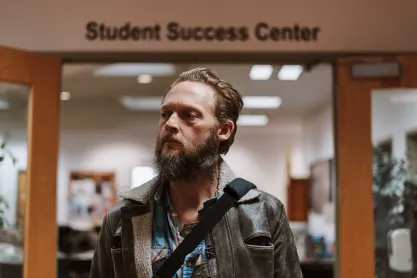
David McNicholas on IAIA campus
One day, the ASG called yet another meeting to discuss the situation, but this time they only invited ASG members because the students feared they couldn’t trust their own advisors. When the meeting began, the ASG president showed up in tears. She had just come from a one-on-one meeting with President Martin, who had delivered shocking news — the school was seriously considering suing ASG and her over the bad publicity.
“She came to us and said, ‘They told me to fix it,’” McNicholas says. “She was in tears. And that made me mad.”
At the next ASG meeting, now that the existence of the grant was proven, Colón changed his tune. McNicholas says, “He showed up and said, ‘Oh, you know what? I did some looking, I researched it, and I think I found the grant that you guys were talking about. And I’d like to come and explain how it was spent.’”
“I was like, yeah,” says McNicholas, “I bet you do.”
McNicholas was unable to attend the meeting, but he got the sheet Colón handed out, which showed budget-to-actual figures. When pressed to release the ledger, however, Colón claimed bank statements might not go back that far. “We’re talking a year,” says McNicholas, “maybe two at most. I think he thought he could get away with that because he was in a room full of 19-year-olds. If I’d been there, I would’ve pushed back.”
In all this, what got under his skin the most, he says, was how the school treated his fellow students, such as the girl who had posted the original Instagram summary of the scandal. “I can’t stand that they did the same thing [they did to me] to a 19-year-old freshman for making an Instagram post,” he says. “They kicked that person out, kept their money, and made a 19-year-old student homeless. As far as I’m concerned, that’s unconscionable.”
IAIA’s anti-bullying policy
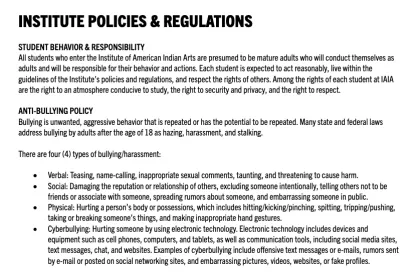
Meanwhile, Colón concluded his investigation, finding McNicholas guilty of violating IAIA’s highly restrictive anti-bullying policy, which broadly bans “unwanted, aggressive behavior” and includes constitutionally-protected expression as examples of prohibited conduct. That is, he accused McNicholas of bullying administrators by publishing claims that those administrators had bullied others. McNicholas later successfully appealed his ban from campus housing and recovered about $2,000 in lost fees, but much of the damage was already done. Given this victory, he could move back into housing this upcoming semester, but continues to live in his van where IAIA can’t kick him out.
The sanctions against him not only sent him back to homelessness, but cost him work too, including a federal work-study opportunity that should have been protected from administrative meddling. “I was hired to be an orientation mentor at the end of last summer,” says McNicholas. “And the day before I was going to start, I got a call from the director of that program who said, ‘Yeah, you can’t participate because you’re on institutional probation.’”
Finding himself ruthlessly targeted by the administration, McNicholas turned to the press. Teaming up with a few peers, they went to the Santa Fe Reporter, and the article that followed made an immediate impact. “When that article came out,” he says, “both the interim director and dean of students were gone within days. Like, they were gone.”
Breaking through
After the Santa Fe Reporter exposé and the ensuing leadership shakeup, the food pantry underwent a striking transformation. The 20-foot-long conference table in the Student Success Center, once a barren surface lined with unused cans of tomatoes, is suddenly overflowing with fresh groceries. McNicholas’s journalistic work, for which he was evicted from campus housing, has not only been vindicated, but has helped make his campus a better place.
As for himself, McNicholas is about to enter his fifth and final year at IAIA. He is applying to MFAs this fall and says he hopes all this doesn’t affect his chances. “But,” he adds, “I chose to stick up for my community — and to incur the costs of doing so.”
That said, he remains shaken by the experience. “The school administration violated my rights and treated me like a criminal, offering no meaningful due process, and protecting themselves over the community at every turn.”
Indeed, IAIA has offered little in the way of accountability. The school has refused FIRE’sdemands to clear McNicholas’s disciplinary records or those of any other student punished and threatened for speaking out, including the ASG president. It has also failed to revise its vague and censorial anti-bullying policy, still found in the publicly-available student handbook — leaving open the possibility of IAIA silencing other students the same way they did McNicholas. On top of all this, IAIA leadership has also failed to offer any legal or moral justification for its actions.
Following President Martin’s retirement this July, one can only hope that the newly minted president, Shelly C. Lowe, breaks from his administration’s legacy of censorship and authoritarianism. IAIA’s crackdown on student dissent must be challenged. Oversight from the school’s Board of Trustees and the Bureau of Indian Education is essential to help push IAIA in the right direction. Because no student should ever be left homeless for telling the truth.
Each night, McNicholas returns to his van. On cold nights, the propane tank hisses beside him, threatening him in whispers. On hot nights, he lies there sweating. But he remains unshaken. In one of his poems, McNicholas describes chopping through six feet of ice, the water “fixed like concrete,” his hands burning in the cold “with thin gloves or nothing.” It’s a searing image. McNicholas is nothing if not resilient.
“I want my uncredited legacy to be a small part of the student handbook,” he says, “enshrining the right to free speech that we all fought for.”
As congressional Republicans scratched and clawed to pass President Trump’s signature policy effort, the One Big Beautiful Bill Act—a sprawling, tax-heavy package celebrated as much for its branding as for its contents—it is notable how few people could explain what exactly was in it. Tax cuts for some, probably. A Social Security bonus, maybe. A gutting of public benefits, almost certainly. What is clear, though, is that the bill’s complexity was always in service of its politics: When no one understands tax policy, it’s much easier to sell whatever story you want.
That confusion is exactly why we should be teaching tax policy more broadly—not just in sparsely attended law school classes and accounting departments, but in general education curricula and first-year seminars. Tax isn’t just a technical rule-following subject; it’s a civic one. Tax policy shapes everything from fairness and inequality to the functional shape of the state itself. Yet, most students will graduate college without ever being asked to consider what tax is for—much less whom it helps, whom it harms and why it remains so easy to obscure.
That is precisely the starting point for the course I designed at Drexel University, Introduction to Tax Theory and Policy, which I teach in our innovative undergraduate law major, housed at the Thomas R. Kline School of Law. It’s not a course for aspiring tax attorneys, prospective C.P.A.s or Excel mavens—few of my students intend to practice tax law. They’re interested in criminal or family law, or they’re business majors, future social workers, engineers or undecided second-years. But they’re all taxpayers—and that’s the relevant bit.
Courses like mine aim to democratize access to legal and policy tools so that all students, irrespective of their major, can become more informed and empowered participants in civic life. In class, we don’t parse tax rates or calculate deductions. No calculators are required, and at no point is anyone expected to consider the straight-line depreciation of an apartment complex. We ask why the system is built the way it is, and we talk about the power that it reflects and protects. We talk about values: what kinds of behavior the tax code encourages or punishes. We talk about trust and legitimacy: What happens when people believe the system is rigged, and what if they’re right? In short, we treat tax not as a set of arcane rules and rates to memorize, but as a lens through which we can better understand the power structures we live under.
The surprising part (at least to me, when I first taught it and admittedly just hoped I wouldn’t be lecturing to an empty room) is how much students connect with this approach. More than connect with it—they often enjoy it. I’ve received feedback from students that describes the class as life-changing and course reviews that have noted how it changed assumptions regarding what tax even is. High praise from 19- and 20-year-olds.
The course itself draws on philosophy, political theory, economics and law—but what it really cultivates is a kind of civic literacy. It asks students to think about who they are in relation to the state and how much of their future may be shaped by the tax policy they’ve never been taught to see. For many, it is the first time they’ve encountered taxation not as something to dodge, but as something to question, debate and reimagine in furtherance of their own values.
In one session, we explore how the tax code is employed as a kind of soft steering wheel in the economy—how it at turns encourages homeownership, subsidizes sports stadiums, directs corporate research and development, and shapes (or even outright creates) the market for electric vehicles. Another week, we explore estate taxes and inheritance: not just who pays, but what it means to redistribute wealth across generations and what happens when we don’t. We read Garrett Hardin’s “The Tragedy of the Commons,” engage in spirited debates about the potential for tax to solve the artificial intelligence copyright debate, and unpack why TurboTax spent two decades fighting free filing.
Over the course of the class, the question shifts away from what is a tax and toward whose values does this system reflect? That shift—from mere definitional awareness to focused critical engagement—is when I know the class is working. Students cease to see tax as someone else’s problem and begin seeing it as a potent tool of and for democracy.
In their final papers, students have proposed remarkably forward-looking and sophisticated tax policy reforms—reflecting both creativity and civic seriousness. One student argued that companies receiving public subsidies through tax credits, like chemical and drug manufacturers, should be barred from claiming additional credits to remediate harms their products create. Another proposed a data-collection “sin tax” aimed at discouraging exploitative surveillance practices by tech companies. These aren’t rote academic exercises. They’re thoughtful intervention proposals that treat tax as a lever for shaping society.
If tax policy determines who gets what, who pays for it and how the government keeps a hand in the marketplace, then it belongs squarely at the heart of a liberal arts education. We don’t cabin discussions of justice in law schools, and we don’t isolate questions of the public good in policy programs—why do we treat taxation, which intersects with both and innumerable other facets of modern life, as off-limits or too technical for undergraduates?
This isn’t a plea to teach undergraduates to file their own taxes—though there is probably a case to be made for that, too. It’s about ensuring curricula help them understand how the world works and how it’s been designed to work for some more than others. That means tackling the politics of Internal Revenue Service funding, exploring how “tax relief” often functions as an upstream transfer of wealth and how a positively sprawling bill like the one recently passed through Congress can obscure much more than it reveals.
If no one understands how tax policy works, how can anyone meaningfully weigh in on whether they support one revenue bill or another? On issues like immigration, abortion or education funding, many people bring at least some passing knowledge or lived experience to the conversation. Tax remains, for most, a black box. The more opaque it becomes, the more tempting it is for lawmakers to retreat into it—tucking major redistributive choices into the shadows of the tax code, where they can be shielded from public scrutiny.
On the other hand, when students come to see tax as a form of the civic superstructure—something they live within and not just under—they are empowered to not only understand tax policy but to shape it. That should be one of the goals of any serious undergraduate education.
We don’t have to, and should not, keep treating tax as one professional niche within other professional niches. If we want students to understand how tax relates to power, fairness and democratic participation, we should give them the tools to talk about it. This needn’t focus on the rates and rules but should illustrate the values taxes reflect and trade-offs they embed.
Courses like mine don’t require a background in economics, accounting or law. They require a willingness to take seriously the idea that how we tax equates to how we govern. If we can help students see tax not as a source of dread or line item on their paycheck, but as the site of collective economic decision-making, we don’t just produce better-informed graduates—we’ll also produce more engaged citizens.
Andrew Leahey is a practice professor of law at Drexel University’s Thomas R. Kline School of Law.