As public skepticism about the value of a college degree persists, the number of students who expect to earn one is also on the decline.
Between 2002 and 2022, the percentage of students surveyed who said they expected to earn a bachelor’s degree or higher fell from 72 percent to 44 percent, according to a research brief the Pell Institute for the Study of Opportunity in Education published Tuesday.
During the same time frame, the percentage of first-generation students who aspired to earn a degree fell from 60 percent to 33 percent; among students with at least one college-educated parent, degree aspirations dropped from 83 percent to 53 percent.
“The decline in college aspirations among first-generation students is deeply concerning,” Kimberly Jones, president of the Council for Opportunity in Education, which oversees the Pell Institute, said in a news release. “These students have long faced systemic barriers to higher education, and this data underscores the urgent need for renewed investment in outreach, support, and affordability—including through programs like TRIO and the Pell Grant.”
But in his quest to shrink the size of the federal government, President Donald Trump has proposed cutting funding for TRIO—a set of federally funded programs that support low-income, first-generation college students and students with disabilities as they navigate academic life.
Major cuts to the federal government also mean it will be harder to produce reports like the one the Pell Institute released this week. That’s because such studies rely on data from now-discontinued longitudinal surveys that were administered by the National Center for Education Statistics; the Trump administration fired all but a handful of NCES employees earlier this year.
“Without the continuation of these programs, it will be much harder to track the progress of high school, first-generation, and college students and to learn how to improve education outcomes,” Sean Simone, vice president of research at COE, said in the news release.
Millions of international students have used the ApplyBoard platform to search for international study opportunities.[1] For many of these students, searching for courses in Australia, Canada, Ireland, the United Kingdom, and the United States is one of the first steps in their study abroad journey. This proprietary search data reveals a leading indicator of changing student preferences.
What UK Fields of Study did International Students Search for in 2024?
After the Sunak Government announced the tightening rules on international student dependants and a review into the graduate route, the UK saw a significant contraction in interest from international students in 2024—applications declined by 14% year-over-year, while dependant applications dropped by 84%. The good news for a struggling sector is that early signs point to positive momentum in 2025, with higher enrolments for many of the institutions that offer a January intake. Enroly data suggests a 23% increase in January 2025 compared to January 2024, and ApplyBoard has experienced growth at three times this rate.
ApplyBoard’s search trends reinforce these early signs: interest in UK courses jumped 25% in 2024 vs. 2023. With search behaviour often signaling future application trends, this surge suggests the UK’s positive momentum in early 2025 could continue throughout the year. Beyond this overall growth, shifting field-of-study preferences highlight how international applicants are adapting to the UK’s changing landscape:
Health fields saw the largest proportional increase among UK searches, climbing nearly four percentage points to 12.8% of all searches. This growing interest aligns with the UK’s expanding healthcare sector, which is projected to add 349,000 jobs by 2035, growing 7% from 2025. Likewise, the information technology sector is expected to grow 8% over the next decade, which aligns with shifting student preferences—ApplyBoard platform data shows Engineering and Technology accounted for 17% of searches in 2024, up two percentage points year-over-year.
Interest in the Sciences also expanded, rising from 13% in 2023 to 16% in 2024. Alongside the gains in Health and Engineering and Technology, this shift underscores how international student priorities are increasingly aligning with long-term global workforce demands.
How International Students are Navigating UK Study Fields
This alignment comes at a time when interest in UK courses is rising. Interest in UK courses grew significantly among several key student populations in 2024, with searches from students in Bangladesh, Sri Lanka, Ghana, and Saudi Arabia doubling year-over-year. Meanwhile, student searches from Nigeria and Pakistan saw substantial gains, rising 66% and 40%, respectively. However, searches from Nepalese students experienced the most dramatic increase, with searches tripling compared to 2023.
Further supporting the possibility that the UK’s positive momentum in January 2025 will continue throughout the year, searches from most key student demographics reached an all-time monthly high in either December 2024 or January 2025.
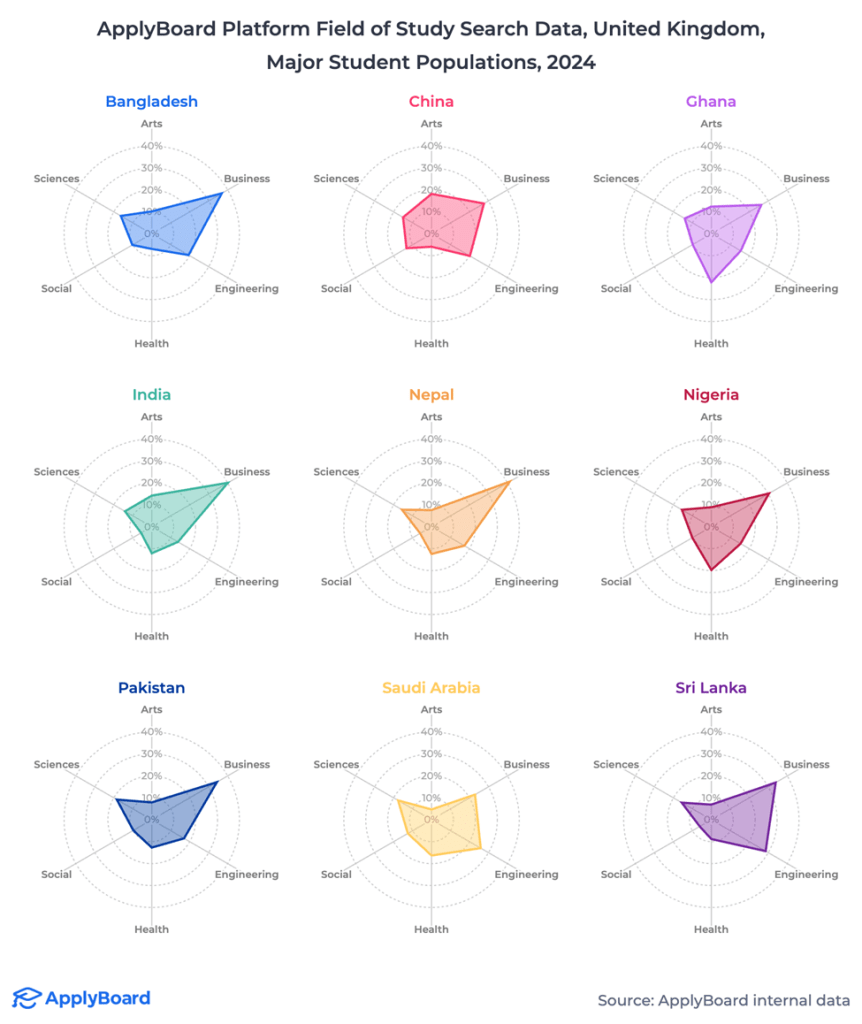
The graphic below illustrates how major student populations explored different fields of study in the UK on the ApplyBoard platform last year:
Student interest in Health fields was strongest among Ghanaian (22%), Nigerian (20%), and Saudi Arabian students (16%). Compared to the previous year, the share of searches for this field rose by six percentage points among Ghanaian students and five percentage points among Nigerian students. Additionally, the proportion of Health searches among Sri Lankan students doubled over this period.
By comparison, the Sciences were a priority across all nine student populations, making up at least 14% of UK course searches. Students from Pakistan (18%), Saudi Arabia (18%), and Bangladesh (16%) had the highest proportion of Science-related searches. Notably, seven of the nine key student populations devoted a greater share of their searches to the Sciences in 2024 than in the previous year.
Engineering and Technology also accounted for at least 14% of searches among these major student populations, although Sri Lankan (29%), Saudi Arabian (26%), and Chinese (23%) students showed the highest engagement in this field. Additionally, eight of the nine key student populations allocated a larger share of their searches to Engineering and Technology in 2024. As student interest in UK courses continues to grow, institutions can strengthen their appeal by aligning their portfolio with evolving student priorities and workforce needs.
The UK’s Edge: Where Student Interest Outpaces Canada and the US
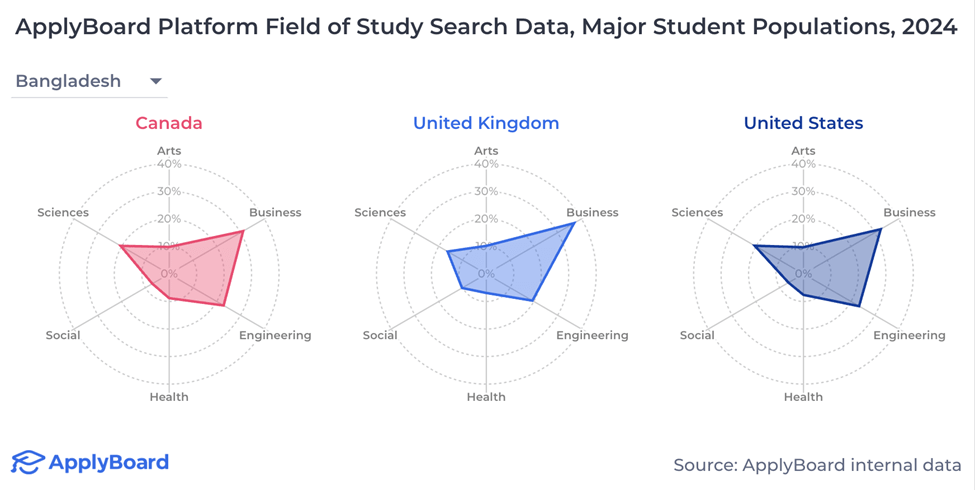
Understanding where the UK sees higher proportional interest in key fields of study compared to Canada and the US can reveal important competitive advantages for institutions and better inform strategic recruitment strategies. This interactive visualization allows you to explore student interest by field and destination, filterable by top student populations:
Health-related fields accounted for 25% of searches for UK institutions among Filipino students—three percentage points higher than their searches for Canada and the US. Likewise, 22% of Ghanaian students were interested in UK-based Health courses, outpacing the interest shown for both Canadian (21%) and American (20%) options.
In Engineering and Technology, 29% of Sri Lankan students’ searches for UK courses were in this field—matching their interest in US study but well surpassing their searches for Canada (24%).
Social-related fields like Law, Social Sciences, and Teaching captured 10% of Pakistani searches for the UK, outpacing that for Canada (6%) and the US (7%). A similar trend occurred among Bangladeshi students, with 10% of their UK-based searches occurring for social-related fields compared to 7% of Canada and 6% for the US.
Leveraging Search Trends to Shape Future Recruitment
Search trends serve as a leading indicator of shifting student interest, often signaling future application patterns. The surge in searches for UK courses—particularly in high-demand fields like health, engineering, and sciences—suggests a growing alignment between student priorities and workforce needs. By analysing these trends, institutions can proactively refine course offerings and recruitment strategies to attract top international talent. As demand continues to evolve, leveraging real-time search insights enables institutions to stay ahead of market shifts, ensuring they meet student expectations while strengthening their global competitiveness. Understanding where the UK holds a competitive edge will be key to optimizing outreach and course development in 2025 and beyond.
[1] In the past, ApplyBoard platform search data was generated based on button clicks on a page, while the new search data is generated by any changes made to the page’s filters (destination, field of study, etc.) As a result, the new search count, if tallied using the previous search data approach, would be significantly inflated compared to the original search count. To make the search counts more comparable, we changed our methodology as of August 2024 to use unique entries per user within each hour.