Tag: Assess

  • Is research culture really too hard to assess?

    Is research culture really too hard to assess?

    Assessing research culture has always been seen as difficult – some would say too difficult.

    Yet as REF 2029 pauses for reflection, the question of whether and how culture should be part of the exercise is unavoidable. How we answer this has the potential to shape not only the REF, but also the value we place on the people and practices that define research excellence.

    The push to assess research culture emerged from recognition that thriving, well-supported researchers are themselves important outcomes of the research system. The Stern Review highlighted that sustainable research excellence depends not just on research outputs but on developing the people who produce them. The Harnessing the Metric Tide report built on this understanding, recommending that future REF cycles should reward progress towards better research cultures.

    A significant proportion of what we have learnt about assessing research culture came from the People, Culture and Environment indicators project, run by Vitae and Technopolis, and Research England’s subsequent REF PCE pilot exercise. Together with the broader consultation as part of the Future Research Assessment Programme, this involved considerable sector engagement over multiple years.

    Indicators

    Nearly 1,600 people applied to participate in the PCE indicators co-development workshops. Over 500 participated across 137 institutions, with participants at all levels of career stage and roles. Representatives from ARMA, NADSN, UKRN, BFAN, ITSS, FLFDN and NCCPE helped facilitate the discussions and synthesise messages.

    The workshops confirmed what many suspected about assessing research culture. It’s genuinely difficult. Nearly every proposed indicator proved problematic. Participants raised concerns about gaming and burden. Policies could become tick-box exercises. Metrics might miss crucial context. But participants saw that clusters of indicators used together and contextualised could allow institutions to tell meaningful stories about their approach and avoid the potentially misleading pictures painted by isolated indicators.

    A recurring theme was the need to focus on mechanisms, processes and impacts, not on inputs. Signing up for things, collecting badges, and writing policies isn’t enough. We need to make sure that we are doing something meaningful behind these. This doesn’t mean we cannot evidence progress, rather that the evidence needs contextualising. The process of developing evidence against indicators would incentivise institutions to think more carefully about what they’re doing, why, and for whom.

    The crucial point that seems to have been lost is that REF PCE never set out to measure culture directly. Instead, it aimed to assess credible indicators of how institutions enable and support inclusive, sustainable, high-quality research.

    REF PCE was always intended to be an evolution, not a revolution. Culture has long been assessed in the REF, including through the 2021 Environment criteria of vitality and sustainability. The PCE framework aimed to build on this foundation, making assessment more systematic and comprehensive.

    Finance and diversity

    Two issues levelled at PCE have been the sector’s current financial climate and the difficulty of assessing culture fairly across institutional diversity. These are not new revelations. Both were anticipated and debated extensively in the PCE indicators project.

    Workshop participants stressed that the assessment must recognise that institutions operate with different resources and constraints, focusing on progress and commitment rather than absolute spending levels. There is no one-size-fits-all answer to what a good research culture looks like. Excellent research culture can look very different across the sector and even within institutions.

    This led to a key conclusion: fair assessment must recognise different starting points while maintaining meaningful standards. Institutions should demonstrate progress against a range of areas, with flexibility in how they approach challenges. Assessment needs to focus on ‘distance travelled’ rather than the destination reached.

    Research England developed the REF PCE pilot following these insights. This was deliberately experimental, testing more indicators than would ultimately be practical, as a unique opportunity to gather evidence about what works, what doesn’t, what is feasible, and equitable across the sector. Pilot panel members and institutions were co-designers, not assessors and assessees. The point was to develop evidence for a streamlined, proportionate, and robust approach to assessing culture.

    REF already recognises that publications and impact are important outputs of research. The PCE framework extended this logic: thriving, well-supported people working across all roles are themselves crucial outcomes that institutions should develop and celebrate.

    This matters because sustainable research excellence depends on the people who make it happen. Environments that support career development, recognise diverse contributions, and foster inclusion don’t just feel better to work in – they produce better research. The consultation revealed sophisticated understanding of this connection. Participants emphasised that research quality emerges from cultures that value integrity, collaboration, and support for all contributors.

    Inputs

    Some argue that culture is an input to the system that shouldn’t be assessed directly. Others suggest establishing baseline performance requirements as a condition for funding. However, workshop discussions revealed that setting universal standards low enough for all institutions to meet renders them meaningless as drivers of improvement. Baselines are important, but alone they are not sufficient. Research culture requires attention through assessment, incentivisation and reward that goes beyond minimum thresholds.

    Patrick Vallance and Research England now have unprecedented evidence about research culture assessment. Consultation has revealed sector priorities. The pilot has tested practical feasibility. The upcoming results, to be published in October, will show what approaches are viable and proportionate.

    Have we encountered difficulties? Yes. Do we have a perfect solution for assessing culture? No. But this REF is a huge first step toward better understanding and valuing of the cultures that underpin research in HE. We don’t need all the answers for 2029, but we shouldn’t discard the tangible progress made through national conversations and collaborations.

    This evidence base provides a foundation for informed decisions about whether and how to proceed. The question is whether policymakers will use it to build on promising foundations or retreat to assessment approaches that miss crucial dimensions of research excellence.

    The REF pause is a moment of choice. We can step back from culture as ‘too hard’, or build on the most substantial sector-wide collaboration ever undertaken on research environments. If we discard what we’ve built, we risk losing sight of the people and conditions that make UK research excellent.

    Source link

  • Why Assess Your Students: The Path to Better Retention and Graduation Rates

    Why Assess Your Students: The Path to Better Retention and Graduation Rates

    As an enrollment manager or a vice president of academic affairs, or even a leader in student affairs, you might think, “Why should I care about gathering data from our current student population? That’s Institutional Research’s job.” But if you care about the health of your institution, if you care about keeping your students enrolled to graduation and if you care about showing your students you care about them as individuals, then regularly assessing student motivation and student satisfaction is an activity that should be on your radar. Intentionally using that data to improve the lives of your students and to identify key challenges for the college should be a priority for every member of the institutional leadership team.

    You may know that assessing student satisfaction is important, but you need to get others on board on campus.

    “If the WHY is powerful, the HOW is easy.” – Jim Rohn

    Student-level data: Motivational assessments

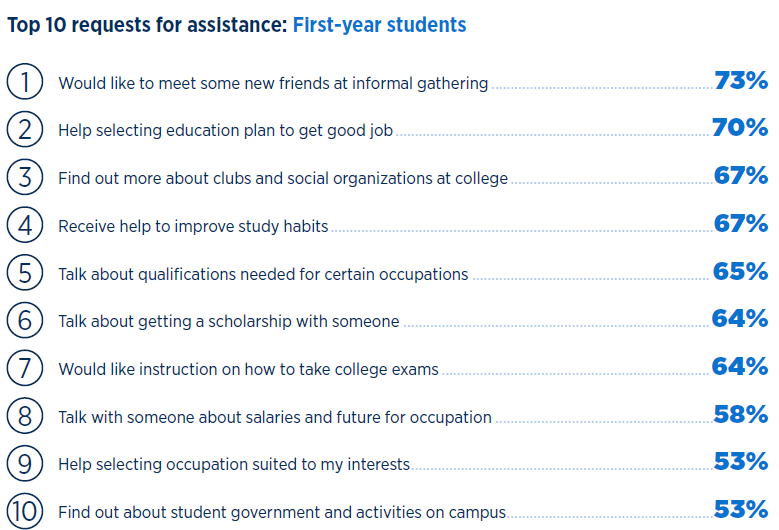
    Understanding what students need to be successful as they first enter your institution is a powerful way to begin building connections and showing students you care about them. Providing them with the services that they say they want and need to be successful will put you in the best position to serve students in the way they want to be served. In the recently published 2025 National First-Year Students and Their Motivation to Complete College Report, we identified the top 10 requests for support by incoming first-year students, based on the nearly 62,000 responses to the College Student Inventory in the fall of 2024:

    2025 National First-Year Students and Their Motivations for Completing College: Top 10 requests for assistance

    Source: 2025 National First-Year Students and Their Motivation to Complete College Report

    Among first-year students’ top ten requests for assistance, we found themes of connection and belonging, career assistance, academic support, and financial guidance. These top 10 have remained fairly consistent over the last few years.

    When campuses are aware of what incoming students need in the aggregate, institutional resources can be targeted to support these services. And when campuses, specifically advisors, know what individual students have self-identified as desired areas of support, guidance can be provided directly to the students most in need of and most receptive to receiving assistance.

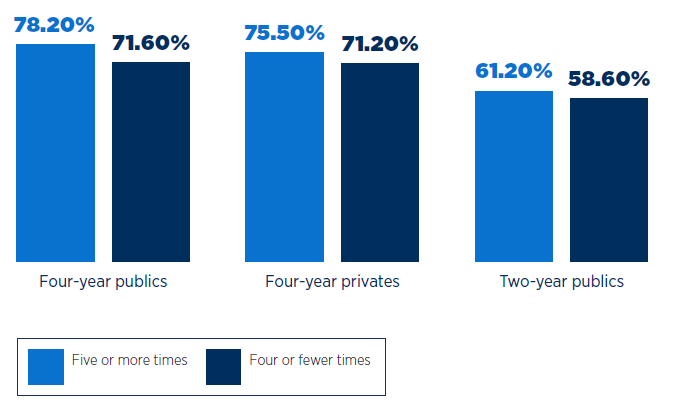
    While campuses can see a 1% improvement in student retention within the first year of implementing a motivational assessment, we have found that campuses that are assessing student motivation on a consistent basis over multiple years are most likely to see retention levels improve.(We recognize that motivation data alone doesn’t lead to improved retention, but the student-level data is an important component of institutional retention efforts.) The impact of consistently assessing student motivation with the RNL Retention Management System (RMS):

    2025 National First-Year Students and Their Motivations for Completing College: Chart showing higher graduation rates for institutions using retention assessments2025 National First-Year Students and Their Motivations for Completing College: Chart showing higher graduation rates for institutions using retention assessments
    Data based on a February 2025 RNL review of reported retention rates 2015-2024 in IPEDS for client institutions using one or more of the instruments in the RNL Retention Management System.

    The bottom line on why you should care about assessing individual student motivation

    Asking students as they enter your institution what they need shows that you care about their experience. Using that data to build relationships between advisors and students lays the foundation of one of the most important connections students can have with your institution. Guiding students to the specific service or support they seek puts you in the best position to engage your students in meaningful ways. Ultimately, serving your students in the ways they need will make your institution more likely to retain those students.

    Learn more about the national student motivation data and how it supporting campus retention efforts by joining live or listening to the on-demand session First Year Focus: Understanding Student Motivations, Recognizing Opportunities, and Taking Action.

    Download the First-Year Student Motivation Report

    2025 National First-Year Students and Their Motivation to Complete College Report2025 National First-Year Students and Their Motivation to Complete College ReportWhat are the needs, challenges, and priorities for first-year college students? Find out in the National First-Year Students and Their Motivation to Complete College Report. You will learn their attitudes on finishing college, top areas of assistance, desire for career assistance, and more.

    Read Now

    Institution-level data: Student satisfaction assessments

    Knowing what students value across all class levels at your institution can provide the student voice in your data-informed decision-making efforts. Assessing student satisfaction is another way to show students you care about them, their experience with you, and what matters to them. Aligning your resources with student-identified priorities will reflect a student-centered environment where individuals may be more likely to want to stay.

    Student satisfaction data from across your student population can inform and guide your institutional efforts in multiple ways:

    • Student success and retention activities: Identifying your top priorities for response so you are working on high-importance, low-satisfaction areas from the student perspective.
    • Strategic planning: Incorporate the student voice into your long-term planning efforts to stay aligned with where they want to see you make investments.
    • Accreditation: Document your progress year over year as part of a continuous improvement process to show your regional accreditor that you are paying attention and responding to students (and not just when it is time for re-affirmation!).
    • Recruitment: Highlight your high-importance, high-satisfaction strengths to attract students who will care about what you can offer.

    To assist institutions with building the case for student satisfaction assessment on their campuses, we have developed two brief videos (under two minutes each), one talking about why assess satisfaction and why work with RNL specifically. My colleague Shannon Cook also hosted a 30-minute webinar that is available on demand to dive deeper into the why and how of assessing student satisfaction.

    Satisfaction data provides valuable perspectives for every department on campus, identifying areas to celebrate and areas to invest more time, energy, and resources. Campuses that respond to what their students care about have reported seeing satisfaction levels increase and graduation rates improve. Most institutions we work with assess student satisfaction at least once every two or three years and then use the intervening months to explore the data through demographic subpopulations and conversations on campus, take action in high-priority areas, and communicate back with students about what has been done based on the student feedback. These ongoing cycles put institutions in the best position to create a culture of institutional improvement based on the student voice.

    Student motivation and satisfaction assessments are effective practices

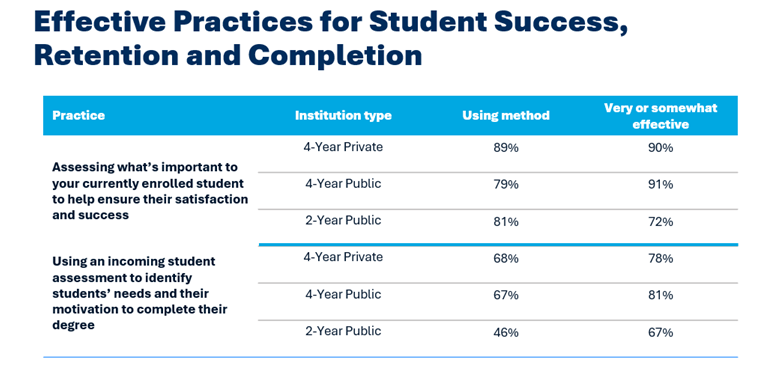
    According to the results of the 2025 Effective Practices for Student Success, Retention and Completion Report, assessing student motivation and student satisfaction are methods used by high percentages of institutions and are considered to be highly effective.

    2025 Effective Practices for Student Success Report: Chart showing 2/3 of four year institutions assess incoming students and only half of two-year institutions do2025 Effective Practices for Student Success Report: Chart showing 2/3 of four year institutions assess incoming students and only half of two-year institutions do

    Source: 2025 Effective Practices for Student Success, Retention, and Completion

    The impact of assessing student motivation and student satisfaction on institutional graduation rates has been documented with numerous studies over the years.

    It is important to be aware that just gathering the data will not magically help you retain students. It is the first step in the process, following these ABCs:

    1. Assess the needs with student and institutional level data collection
    2. Build a high impact completion plan to engage students from pre-enrollment to retention to graduation, taking action based on what students say
    3. Connect students to campus resources that best match their needs and will increase their likelihood to persist and complete and Communicate about what you are doing and why as improvements are made.

    Contact me if you would like to learn more about assessing student motivation and student satisfaction on your campus.

    Source link