Universities are required under the Equality Act 2010 to make reasonable adjustments for disabled students. While it’s often much clearer how to do this for undergraduate students and postgraduate taught students who have coursework and written exams – for example, by giving them extra time or a scribe – support for postgraduate research (PGR) students is far behind.
Many universities and staff are less clear how to make adjustments for PGRs during supervision, when reading drafts of thesis chapters, and then for the traditional oral viva, which is problematic for many as it relies on instantaneous cognitive processing, fluency and other skills. The Abrahart vs University of Bristol case, in which a student died by suicide after being refused reasonable adjustments to a mode of assessment, highlighted just how critical this issue has become.
Some universities and academics have expressed concerns that making adjustments for disabled PGR students will somehow “disadvantage” non-disabled students. This misunderstands the provisions of the Equality Act. Reasonable adjustments are a unique legal duty in relation to disability which go some way towards reducing the barriers that disabled people encounter on a daily basis.
Cultural barriers
Cultural beliefs – including that PGR study is “supposed to be difficult”, that overcoming the struggle is part of the achievement of obtaining a doctorate, and that adjustments devalue the doctorate – all contribute to unhelpful attitudes towards disabled PGRs and institutions meeting their legal obligations. The still widely held view that a doctorate is training the next generations of academics, limited oversight on progression, lack of consistent training for examiners and supervisors, and the closed-door nature of the viva indicate the cultural nature of many of the barriers.
The recent work within universities on research culture, equality, diversity and inclusion, and widening participation has in many cases focused on everything other than disability. Where disability is considered, it’s often in relation to neurodivergence. Neurodivergent people may find themselves objects of fascination or considered difficult and a problem to be solved, rarely simply as human beings trying to navigate their way through a society which seems to have suddenly noticed they exist but is still reluctant to make the necessary changes.
At the PhD viva, often the centring of the examiners’ experience takes priority – rigid arrangements, and the presumed importance of meeting examiners’ expectations, appear very much as priorities, leaving disabled PhD students without a voice or agency or made to feel demanding for simply suggesting they have legal rights which universities must meet.
Mode of assessment or competence standard?
The Disabled Students Commitment Competence Standards Guide clarifies that the Equality Act’s reference to the duty to make reasonable adjustments to any provision, criterion or practice (PCP) which places disabled students at a substantial (i.e. more than minor or trivial) disadvantage applies to modes of assessment. It is an indictment of entrenched cultural attitudes in the sector that it took the death of a student after being denied adjustments she was legally entitled to for this distinction to be clarified.
Many in HE defend the current approach to PhD assessment as being a necessary way of assessing the types of skills a PGR would need as an academic. However, the QAA level 8 descriptors don’t specify a particular mode of assessment, or that the ability to communicate “ideas and conclusion clearly and effectively to specialist and non-specialist audiences” relates to academic contexts either solely or primarily, nor do they specify that assessment relates to whether or not examiners believe the candidate is “ready” for employment as a lecturer.
The purpose of PhD assessment is to assess whether a candidate meets the assessment criteria to be awarded a doctoral degree. While the question as to whether these level 8 descriptors remain appropriate to assess a PhD may be valid, introducing additional unspoken criteria such as assumptions about academic career readiness is unacceptable for all students, but particularly so for disabled PGRs due to the constant demands on them and cognitive load required to navigate an already unclear system.
Unhelpfully, the QAA characteristics statement for doctoral degrees asserts that “all doctoral candidates experience a similar format – that is, an assessment of the thesis followed by the closed oral examination.” This could conflict with the legal requirement to adjust assessment for disabled and neurodivergent students, and is despite the Quality Code on Assessment reflecting the importance of inclusive assessment which allows every student to demonstrate their achievements, “with no group or individual disadvantaged”.
Sharing this reasoning and information is fundamental to changing entrenched and often misunderstandings in the sector about what we’re actually assessing in the PhD viva and how to approach that assessment.
What needs to be done?
Making adjustments for individual PGR vivas is time consuming when many adjustments could be made as standard (a “universal design” approach), releasing time to focus on making a smaller number of less commonly required adjustments. Many adjustments are easy to make: holding the viva in a ground floor room, linking to already existing accessibility information, limits on the length of the viva with compulsory breaks, ensuring there are toilets nearby, training for examiners, and options about the viva format.
While many PGRs are content with the traditional oral viva, others would prefer a written option (for many years the standard option in Australasia) or a hybrid option with written questions in advance of a shorter oral viva. Universities often raise AI assistance as being a reason that an oral viva is necessary. However, this is best addressed through policies, training and declarations of authorship, rather than relying solely on an oral viva.
Feedback from delegates at a webinar on the topic of inclusive viva which we delivered – hosted by UKCGE – underlined the need for clarity of expectations, standard approaches to adjustments, and training for everyone involved in the PGR journey to understand what the requirements of the Equality Act 2010 are. Adjustments for “visible” disabilities are often easier to understand and make – it would be difficult to deny a deaf PGR a British Sign Language interpreter.
Where disabilities are less visible, cultural attitudes seem more difficult to shift to make these needed adjustments. Revisions to sector documents, such as the doctoral degrees characteristics statement are also overdue.
Put simply, it’s not reasonable to deny a student the award of a degree that their research warrants due to an inappropriate mode of assessment.
The authors would like to thank Charlotte Round, Head of Service for Disability Support at the University of Nottingham, for her involvement.
HEPI Director, Nick Hillman, takes a first look at today’s Final Report from the Curriculum and Assessment Review.
It feels like Christmas has come early for policy nerds. At 6.01am this morning, we finally got sight of Building a world-class curriculum for all, the long-awaited report from the Government’s independent Curriculum and Assessment Review (CAR).
Overseen by Professor Becky Francis, who is an experienced educational leader and researcher and someone who also has a background in policy, it was commissioned when the Labour Government was facing brighter days back in their first flush.
The first thing to note about the report is that, in truth, independent reports commissioned by governments are only half independent. For example, the lead reviewer is usually keen to ensure their report lands on fertile soil (and, indeed, is usually chosen because they have some affinity to the people in charge). In addition, independent reviews are supported by established civil servants inside the machine and there is usually a conversation behind the scenes between the independent review team and those closest to ministers as the work progresses. (In higher education, for example, both the Browne and Augar reviews fit this model.) So it is no great surprise that the Government has accepted most of what Becky’s largely evidence-led team has said.
Yet anyone reading the press coverage of the CAR while it has been underway, or anyone who has seen the front page of today’s Daily Mail, which screams ‘LABOUR DUMBS DOWN SCHOOLS’, may wonder if the report that has landed today is the nightmare before Christmas rather than a welcome festive present. There is lots to like but the document also feels incomplete, especially – for example – for people with an interest in higher education. So it is perhaps best thought of as a present for which the batteries have yet to arrive.
Nonetheless, this morning I spoke at the always excellent University Admissions Conference hosted annually by the Headmasters’ and Headmistresses’ Conference (HMC) and the Girls’ School Association (GSA) and I could not help wondering aloud whether any new restraints on state-maintained schools might give our leading independent schools, who are much freer to teach what they like, an additional edge – especially as academy schools are already, even before today, having freedoms ripped from them.
What does the CAR say (and what does it not say)
But what does the review, which had a team of 11 beneath Becky (including one Vice-Chancellor in Professor Nic Beech and also Jo-Anne Baird from the Oxford University Centre for Educational Assessment) actually say?
The first thing to note is that it is much better than the Interim Report, which said little, sought to be all things to all people and read like it had been written by one of the better generative AI tools.
In terms of hard proposals, the Final Report starts and ends with older pupils, those aged 16 to 19, for whom we are told there should be ’a new third pathway at level 3 to sit alongside A-Levels and T Levels.’ If this feels familiar, it is because the Curriculum and Assessment Review’s emerging findings helped shape the recent Post-16 Education and Skills white paper and, more importantly, because there is already such a pathway populated by qualifications like BTECs.
So there is a sense of reinventing the wheel here, with (to mix my metaphors) politicians putting a new coat of paint on the current system. In many respects, the material on 16-to-19 pupils is the least interesting part of the report – especially as there is next to nothing at all on A-Levels. The review team starkly states, ‘we heard very little concern regarding A Levels in our Call for Evidence and our sector engagement’, so they basically ignore them – in a world of change, A Levels continue to sail steadfastly on.
As trailed in the newspapers, there is a recommendation for new ‘diagnostic Maths and English tests to be taken in Year 8.’ This would obviously help track progress between the tests taken at the end of primary school (in Year 6) and the public exams taken at age 16. But the idea has already prompted anger from trade unionists, almost guaranteeing that the benefits and downsides will be overegged in the inevitable political rows to come.
There are also numerous scattergun subject-by-subject recommendations. These are largely sensible (see, for example, the iideas on improving English GCSEs or the section on Science) but also a little unsatisfying. Some of the subject-specific changes are a little trite or inconsequential (like tweaks to the name of individual GCSEs) while others need much more detail than a general review of everything that happens between the ages of 11 and 19 is able to offer. Any material changes will need to be at a wholly different level of detail to what we have got today, and they will be some years away, so may make no difference to anyone already at secondary school.
Other points to note include that the Review is Gove-ian in its love of exams, which it stresses are a protection against the negatives of AI, over coursework. (I suspect Dennis Sherwood, the campaigner against grading inaccuracy will be incandescent about how the report appears to skate over some of the imperfections of how exams currently operate.) However, despite the support for exams, one of the crunchiest recommendations in the review is the proposal of a 10% reduction in ‘overall GCSE exam volume’, which we are told can happen without any significant downsides, though the tricky details are palmed off to Ofqual and others.
The English Baccalaureate and Progress 8
The one really clear place where Professor Francis’s review team and the Government, who have generally accepted the recommendations, are out of kilter with one another is on Progress 8.
Progress 8 is a school accountability measure that assesses how much ‘value-added’ progress occurs between primary school (SATs) and GCSEs. It is such a favoured measure that the Government has recently proposed a new Progress 8 measure for universities (which is a mad idea that wrongly assumes universities are just big schools – in reality, it is a defining feature of universities that they set their own curricula and are their own awarding body).
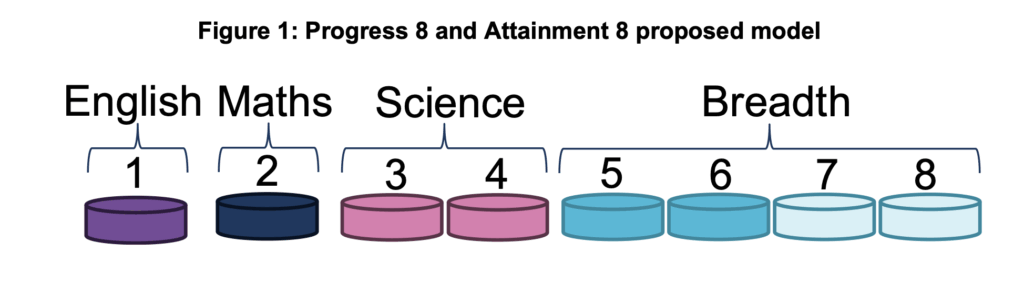
Becky Francis opposes the EBacc, which is a metric related to, but separate, from Progress 8, yet she wishes to maintain some vestiges of the EBacc within Progress 8. While the EBacc focuses specifically on how many students achieve qualifications in a list of specially favoured subject areas (English Lang and Lit, Maths, Sciences, Geography or History plus a language), the CAR recommends ‘the removal of the EBacc measures but the retention of the EBacc “bucket” in Progress 8 under the new title of “Academic Breadth”.’
This is something the Government is not running with, favouring less restrictions on Progress 8 instead, which may or may not reinvigorate some creative subjects. Yes, it is all exceptionally complicated but Schools Week have an excellent guide and the two pictures below (from Government sources) might help: the first shows the status quo on Progress 8 and is what Becky Francis wishes to maintain (though pillars 3, 4 and 5 would be renamed if she got her way); the second shows the Government’s proposal.
How does it fare?
Call me simple, but I was always going to judge the Curriculum and Assessment Review partly on the extent to which it tackled specific challenges that we have looked at closely at HEPI In recent years. Here the CAR is a mixed bag. On the positive side of the ledger, the review recommends more financial education, reflecting the polling we conducted to help inform the CAR’s work: when we asked undergraduates how well prepared they felt for higher education, 59% said they felt they should have had more education on finances and budgeting.
The most obvious problem that the CAR insufficiently addresses is the huge underperformance of boys. This issue usually gets a namecheck in Bridget Phillipson’s interviews but it was entirely ignored in the recent Post-16 white paper; in the CAR, it does at least receive a quick nod and just maybe some of the proposed curriculum changes will benefit boys more than girls. But there is more focus on class and other personal characteristics than sex and in the end the brief acknowledgement of boys’ underperformance does not lead to anything properly focused on the problem.
This is very strange for we simply cannot fix the inequalities in outcomes until we give the gaps in the attainment of boys and girls the attention they deserve. I am beginning to think I was wrong to be so hopeful that a female Secretary of State was more likely to focus on this issue than a male one (on the grounds that it would be less sensitive politically).
Another area where we at HEPI have been mildly obsessed is the catastrophic decline in language learning, as tracked for us by the Oxonian Megan Bowler. Here, as with boys, the new review is disappointing. In the section looking at welcome subject-by-subject changes, the recommendations on languages are both relatively tentative and relatively weak. As one linguist emailed me first thing this morning, ‘It is pretty remarkable that the CAR’s decision on languages runs exactly contrary to the best and consistent advice of the key language advisers on the issue’. However, the Government’s response goes a little further and Ministers promise to ‘explore the feasibility of developing a new qualification for languages that enables all pupils to have their achievements acknowledged when they are ready rather than at fixed points.’ We might not want languages always to be treated so differently from other subjects but I am still chalking that up as a win.
The CAR also ignores entirely one issue that is currently filling some MPs’ postbags – the defunding of the International Baccalaureate (IB). The IB delivers a broad curriculum for sixth-formers, is liked by highly selective universities and tackles the early specialisation which marks out our education system from those in many competitor nations. Back in the heady Blair years, Labour politicians loved the qualification and promised to bring it within touching distance of most young people.
As HEPI is a higher education body, it also feels incumbent upon me to point out that higher education is largely notable by its absence in the CAR, with universities being mentioned just nine times across the (almost) 200 pages and despite schools and colleges obviously being the main pipeline for new students. It is rather different from the days when universities were regarded as having a key direct role to play in designing what goes on in schools. Indeed, our exam boards tended to originate within universities.
The odd references to universities that do make it in to the CAR report are not especially illuminating. For example, more selective universities appear as part of the rationale for killing the EBacc ‘the evidence does not suggest that taking the EBacc combination of subjects increases the likelihood that students attend Russell Group universities.’ Universities also appear in the section on bolstering T Levels, with the review proposing ‘The Government should continue to promote awareness and understanding of T Levels to the HE sector.’ But that is about it.
Incidentally, there is also less in the report on extracurricular activities than the pre-publication press coverage might have led you to believe, even if the Government’s response to the review does focus on improving the offer here.
Trade-offs
Becky Francis used to head up the UCL Institute of Education (IoE), which is an institution that has always wrestled with excellence versus opportunity. Years ago, I sat in a learnèd IoE seminar on why university league tables are supposedly pernicious – but I had to walk past multiple banners boasting that the IoE was ‘Number 1’ in the world for studying education to get to the seminar and, while I was in the room, news came through that the IoE was going to cement its reputation and position by merging with UCL.
Such tension is a reminder that educational changes generally have trade-offs and the Executive Summary of the main CAR document admits: ‘All potential reforms to curriculum and assessment come with trade-offs’. Abolishing the EBacc as the CAR team want and watering down Progress 8 as the Department for Education want, might help some pupils and some disciplines while making the numbers we produce about ourselves look better – though the numbers produced by others about us (at places like the OECD) could come to tell a different story in time.
In the end, we have to recognise that there are only so many hours in the school day, only so many (ie not enough) teachers and only so much room in pupils’ lives, not to mention huge diversity among pupils, schools and staff, which together ensure there can be no perfect curriculum. More of one subject or more extracurricular activities are likely to mean less of other things because the school day is not infinitely expandable (and there is nothing here to free up teachers’ time or fill in all those teacher vacancies). Yet the school curriculum does need to be revised over time to ensure it remains fit for purpose.
The question now is whether the CAR report matters. Will we still be talking about it in 20 years time? Can a Government buffeted by all sides, facing a huge fiscal crisis and with a Secretary of State for Education who sometimes seems more focused on political battles (like the recent Deputy Leadership election of the Labour Party) than on engaging with the latest educational evidence really deliver Becky Francis’s vision? Or will the CAR’s proposals wilt as quickly as the last really big proposal for curriculum reform: Rishi Sunak’s British Baccalaureate? In all honesty, I am not certain but there are, in theory at least, four years of this Parliament left whereas Rishi Sunak spent more like four months pushing his idea.
My parting thought, however, is different. It is that, while the trade-offs in the CAR report partly just represent the facts of life in education, they do not entirely do so. Trade-offs are much trickier to deal with when you are also seeking to root out diversity of provision. And in the end, if there is one thing that marks this Government’s mixed approach to schooling out above all, it is the desire to make all schools more alike, whether that is reducing academy freedoms, micromanaging the rules on school uniforms, defunding the IB, forcing state schools to stop offering classical languages or pushing independent schools to the wall. Would it be better, and also make politicians’ lives easier, if we stopped pretending that the 700,000 kids in each school year group are more like one another than they really are?
Postscript: While the CAR paper is infinitely more digestible than the interim document, there is still some wonderful eduspeak, my favourite of which is:
A vocational qualification is aligned to a sector and is usually taught and assessed in an applied way. A technical qualification meanwhile has a direct alignment with an occupational standard. Despite the name ‘Technical Awards’, these qualifications are therefore vocational rather than technical.
Let’s set the stage. You’re a sharp, focused higher education leader staring down the realities of expanding your online and hybrid learning programs. You’ve got big goals: running your online operations in-house, owning the process, and driving growth on your terms.
This is where Online Growth Enablement comes in. This isn’t a fancy buzzword. It’s the real work behind sustainable change. It’s the boots-on-the-ground understanding of exactly where you are today so you can figure out how to move forward tomorrow.
At Archer, we do this every day — rolling up our sleeves and digging deep to map out the real picture of an institution’s online learning infrastructure. Because, let’s be honest. The only way to grow is to start with the truth about your current state and your place within the landscape of the communities you serve with your programs.
Why Your Current State Matters
Success doesn’t happen in a vacuum — especially not in online learning. Enabling the growth of your online learning infrastructure takes coordination, collaboration, and a whole lot of buy-in from every corner of your university. Marketing, tech, enrollment, financial aid, the registrar, faculty, leadership — if they’re not on the same page as you, you can’t successfully move forward. Period.
Driving real growth starts with taking an unflinching look at where you stand today. Questions you should be asking about your online operations include:
Where are you strong?
Where are you struggling?
Where are the untapped opportunities you can scale?
This isn’t about a vague, feel-good assessment from 50,000 feet up. It’s about getting into the weeds. Because, until you understand the inner workings of your current infrastructure, you’re not going to build anything sustainable. You’ll just be putting a fresh coat of paint on a crumbling foundation. And that’s not going to cut it in the long run.
The Power of Deep Insights
Let’s take a look at a real-world example of why a close examination of your current online learning infrastructure matters. One of our partner universities was taking 14 days to review and process the transcripts of students applying to their online programs. This might work fine for a traditional on-campus program with two or three big start dates a year, but for an online program, the game changes. To stay competitive, you need five or six start dates annually. And that 14-day turnaround? For our partner, it meant missing out on dozens of potential enrollments.
Fixing this issue wasn’t about throwing money at the problem. It was about setting a clear benchmark and making it happen. We worked with the institution to rethink its processes, reassign its teams’ responsibilities, and streamline every single step of its transcript review.
The effectiveness of every touchpoint you have with a potential student and every handoff between your admissions, financial aid, and academic advising teams affects your ability to deliver an overall positive student experience. Deep operational insights aren’t just nice to have; they’re the key to uncovering bottlenecks so you can clear the way for real, measurable growth.
How We Help: The Growth Enablement Assessment
At Archer, we don’t do guesswork. We help our partners make sense of the current state of their online learning infrastructure through our Growth Enablement Assessment — a no-stone-left-unturned look at every department and operational variable. From enrollment workflows to marketing execution, we get into the details that others overlook to help you figure out where you are and make a plan for where you want to be.
Our approach is anchored in our Good, Better, Best methodology:
Good: Your processes are functional. They get the job done, but let’s be honest — they need improvement to keep pace in a competitive online marketplace.
Better: There’s progress. Your processes are showing alignment, but they’re not quite optimized yet.
Best: This is where you want to be. Your processes are efficient, scalable, and fully aligned with your strategic goals.
This isn’t just an audit. It’s a road map. By pinpointing exactly where you stand and where you need to go, we equip you with the insights and strategies to move your online learning operations from functional to thriving.
Why It’s All Worth It
Yes, this takes time. Yes, it’s hard work. But the payoff is undeniable.
Fully understanding the current state of your online learning infrastructure isn’t just a box to check — it’s the foundation for every initiative that follows. It gives you the clarity to enhance not only your online learning programs but also the overall health and effectiveness of your institution.
When you commit to this process, you’re building something bigger than just operational efficiency. You’re creating alignment across departments, fostering innovation, and embedding collaboration and continuous improvement into your institution’s culture. When every team is in sync, bottlenecks disappear, every touchpoint matters, and your processes deliver on the promise of a strong student experience.
It’s not just worth it. It’s transformative. If you’re ready to take the first step toward long-term success and scalability, contact Archer Education. Let’s build the online learning infrastructure your institution deserves, together.
John Goodwin is Archer Education’s EVP of Online Growth Enablement. Archer revolutionizes the student experience by supporting partners through change, helping institutions achieve sustainable growth while fostering self-sufficiency.
CORRIGAN: Is there anything else you’d like to share about reading, teaching, or Reading Wide Awake that I haven’t asked you?
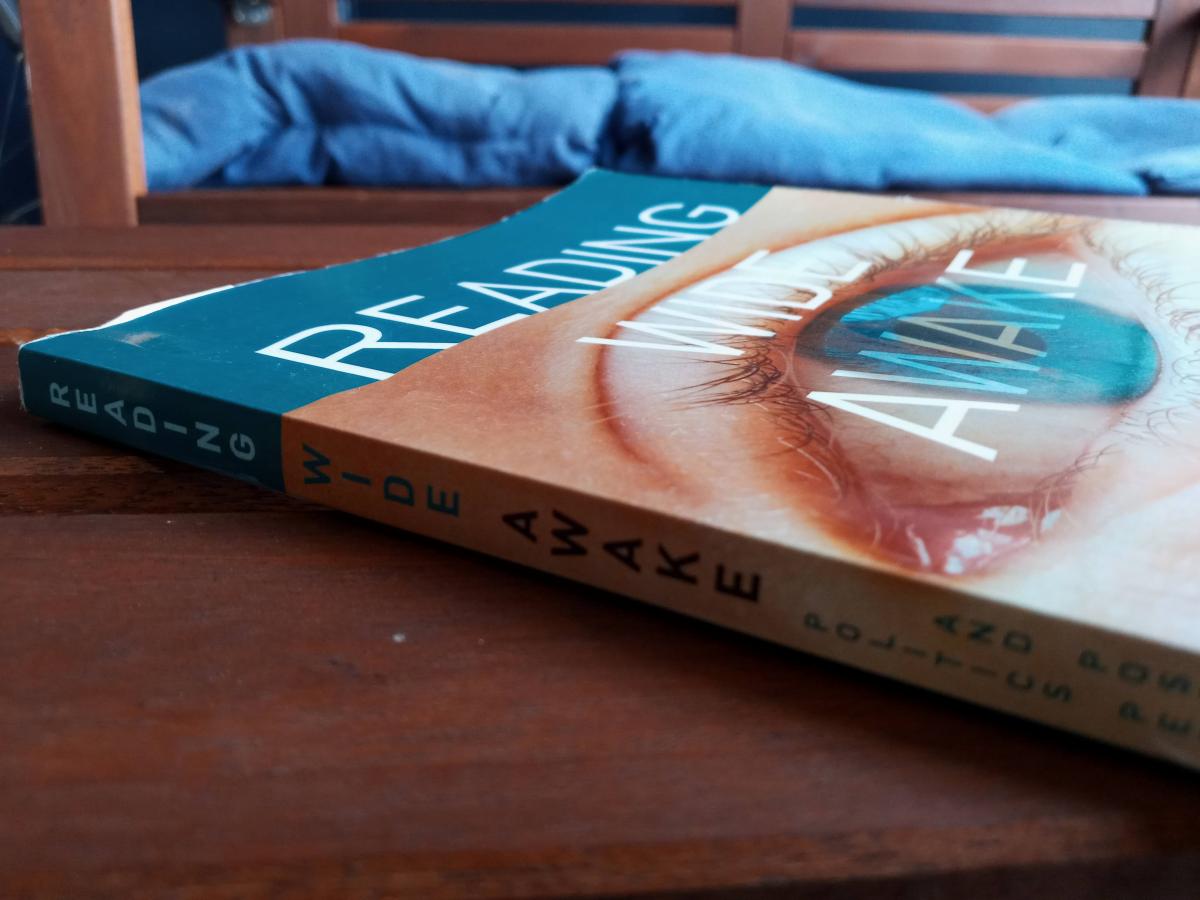
SHANNON: I’ll start here. Reading Wide Awake examines reading as flexible practices of personal and social agency necessary for the continuous remaking of ourselves and democracy in and across changing times and contexts. By telling stories of my reading social objects (including printed texts) in everyday life, I invite readers to awaken to the ways these ‘texts’ work for and against their interests and the promises of democracy. By analyzing my reading experiences critically, I demonstrate how to take up these practices and why they are vital to acting in and on the world. I hope I wrote with some intelligence and humor.
This short book is organized according to paraphrased questions that people asked me across the first forty of my now fifty years as an educator: Why read? What is text? How do texts work? Where is meaning? Isn’t reading out of date? Can reading like this get me in trouble? Do regular people read like this? Fifteen years prior to this book, I offered a different structure in text, lies & videotape, a book about whose stories get told in and out of school. That text began with a reading of my junior high principal enforcing “school integrity” with a ping pong ball down my pant leg and a wooden paddle on my backside. My (our) reading practices are always in-the-making, and I’m only five years away from the next installment!
CORRIGAN: In Reading Wide Awake, you seem to use the words “read” and “reading” loosely and expansively—to mean not just looking at written texts but more broadly seeing, recognizing, understanding, or thinking about the world. I’m wondering, how do you define “reading” and why use the word “reading” instead of something broader like “thinking”?
SHANNON: Originally, my choice of the term reading was purely tactical. If seeing, recognizing, understanding, thinking, assessing, and acting in and about the world through the production of social things can be separated from the term reading, then they can be excluded from school curricula. If they are inseparable moments of reading, then they remain basic skills (See Herb Kohl’s pre-TikTok Basic Skills – 1982). My route to this realization maps my development as a critically pragmatic reader with a sociological imagination. That is, the choice stemmed from reading personal experiences (my problem?) and eventually recognizing that they are actually social issues produced and maintained through the texts of powerful discourses in and out of schools (K-20).
By the early 1970s when I was a history graduate student, Americans had been lied to about the Bay of Pigs, Tet Offensive, and bombing of Cambodia; two Kennedys, Malcolm X, Salvador Allende, Fred Hampton and Martin Luther King assassinations; the “collapse” of Students for a Democratic Society and the Black Panthers; and the Angela Davis and the Chicago 7 trials. Official and mainstream representations of these events across time and media led to Richard Nixon being elected and re-elected with an agenda to win the cold war militarily and to bring law and order back to American streets. I lost faith in the path I had chosen at the end of college to become a historian of societal outsiders, which I believed would help more people to develop their “sociological imaginations” (C. Wright Mills), overcoming the “repressive tolerance of a one-dimensional society” (Herbert Marcuse), and thus, freeing their minds to rationally pursue the truth (J. S. Mill). Although certainly necessary, more historically accurate information (reconstructed history books) about the neglected in society no longer seemed adequate. Rather I thought what would be vital, but lacking, was the habitual practice of accessing, interpreting, assessing, and acting upon daily information, artifacts, and events to secure the original promises of liberal democracy. To me, that practice was the act of reading which could be extended and spread through public schooling. I joined the Teacher Corp and set my sights on the first R.
Despite the economic, racial, cultural, and religious diversity among the families of my first class of kindergarten students, the school district supplied me with the DISTAR Language and Reading program and required me to “teach reading” by following the scripts in its teacher’s manual for a specified amount of time daily. The authors of DISTAR assumed that my students had little or no prior experience with reading, phonological or syntactic command of English, or interest in learning to read or in the world around them. They argued their approach was scientifically based. Lessons consisted of small groups articulating phonemes in unison with me. When those articulations were “mastered”, I was to point to manipulated letter symbols arranged randomly on a page in the teacher’s manual and groups were to produce the corresponding sounds (pretending that English has one-to-one letter to sound correspondence). When mastered, I was to point to a symbol to elicit the assigned sound from all, and then, run my finger to another symbol to “make a syllable or blend” as students slurred the first with second phoneme. Eventually, we all graduated to words, phrases, short sentences, and sentence strings (called stories).
All materials were black print on off white newsprint with no illustrations. To ensure that parents participated in these reading instructions, students were to bring home half-sheet “student copies” of the stories to demonstrate their mastery of reading. Standardization through teacher and student fidelity to the program assumptions and scripts were presented as the keys to success in reading, in school, and in life. There were no expected discussions of the meaning of the program’s texts or the practices encouraged in or outside of the classroom. When the students finished the last DISTAR lessons, they and I began the daily lessons supplied in commercially prepared reading materials, (called basals), following more loosely scripted lessons as we worked our way through anthologies, workbooks, worksheets, and criterion reference tests across grades 1 through 6. This defined learning “to read at school.”
Because the remainder of the kindergarten curriculum was not prescribed except by name of subjects, the students and I had time to discuss their lives outside of school, their interests, habits, family traditions, ideas about how the world works, media use (TV and radio)….Later, I came to recognize these discussions as examples of what William James meant by “pluralism:” there will always be different perspectives and interpretations of any idea, event or artifact – all work in some situations and none are superior in all. We used these talks and their surroundings to read their worlds to consider how people use symbols to make meaning and get things done. While emphasizing the “why” of reading, we engaged in the “how”, attending to salient features (color, size, position) in images and things and studying phonics by recognizing and using Sylvia Ashton Warner’s Key Words techniques (Zoo), examples from Septima Clark’s and Beatrice Robinson’s Freedom Schools (“What’s a good a word? Amendment”), local store signs (Red and White), and learning to recognize everyone’s printed name (from Abby to Zimbalist) posted on their cubbies and supply boxes. To varying degrees, all participated in what Allan Luke and Peter Freebody would later call the four-resource model of reading – code cracking, meaning making, determine use and effects of genre, and social analyses – without any of us knowing these labels.
I found willing confederates among the music, art, and gym teachers to help us study how sounds, images, and bodies can be used symbolically to represent our intentions to mean. We called this “reading”, and because I lived in the neighborhood and looped with many of these students through the primary grades (K-3), I had time to demonstrate how this reading blended with their family members’ reading outside of school. By our third year together, we had convinced our building administrator that DISTAR was not appropriate for our community; unfortunately, my fellow teachers chose to replace DISTAR with a single K-6 set of commercial reading materials (with significant amounts of promised free components and staff development promised by their publishers) for reading instruction at our school. That “other stuff” that we employed daily as reading, while not necessarily harmful, was considered “beside the point”. Those practices, you see, were not essentials in an elementary school curriculum…
I finished my four-year commitment to shepherd those students and families through the primary grades and enrolled at the University of Minnesota (then famous for its reading research program) to try to understand how my colleagues’ decision could make sense. The best outcome of that move was that I read my first-day schedule incorrectly, went to the wrong office, and met Kathleen (I’m married to Kathleen). Another outcome was that I began to develop an understanding of reading at school. My first course – History of Research on Reading – assigned titles such as The Psychology and Pedagogy of Reading (Huey, 1908), Reading as Reasoning (Thorndike, 1917), Remembering (Barlett 1932), Literature as Exploration (Rosenblatt, 1933)….These texts and my peers’ discussion of them taught me that my interpretation of reading was not wrong or beside the point because reading was information processing, not ever mastered or easily transferred among situations or tasks, colored by cultural attitudes and personal habits, and involved emotions as well as reason.
Buoyed with those insights, I used the intellectual tools I brought with me to class (Marxism/critical theory) and began to develop new ones (pragmatism – old, new, American and French – Richard Bernstein) to understand my experiences with past colleagues (and continued experiences in and around reading education over 40 years). Marxism directed me toward analyses of the social relations embedded in those commercially prepared basals. Critical theory honed my attention to how power was/is used in reading education (in at least the U. S.). The pragmatists pointed toward the language school personnel use to represent and reflect upon their interests and experiences while teaching reading, and then, to follow the consequences of their acting on those reflections. I concluded initially that three hegemonic discourses (science, business, and the state) speak through school personnel’s words and actions (Broken Promises, 1988). I’ve tracked the consequences of those discourses over time (e.g., Reading Against Democracy, 2007; Closer Readings of the Common Core, 2013; and Reading Poverty in America, 2014).*
You can read current consequences of the continued power of those three discourses in the recent struggles over the definitions of reading and reading instruction as it played out in the New York Times this spring – insisting reading is a psychological, not a set of social, cultural, and historical practices; treating reading instruction as a market and reading as human capital, not creative, contextualized, human endeavors; and mandating guidelines for schools and teachers to overcome social and economic inequalities, not social problems in need of collective democratic solutions.
For example, the New YorkTimes reported that the COVID pandemic resulted in a “reading crisis” across the country as systematic reading lessons moved online render the lessons to be parents’ responsibility (Jonathan Wolfe). Reflecting on his struggles with learning to read at school, the new mayor of New York City mandated that city teachers be “trained” to use phonics-based commercial reading programs to teach reading in order to overcome the crisis (Lola Fadulu). Ten days later, a Times reporter described how Columbia University professor Lucy Calkins “retreated” from meaning centered lesson to a more sound oriented position in her commercial materials (which occupies one quarter of the US market for reading education) (Dana Goldstein).
*I address a history of counter-discourses in The Struggle to Continue, 1990; Progressive Reading Instruction in America, 2017.
CORRIGAN: Throughout the middle chapters of the book you discuss reading specific types of social texts (like NPR and Google Maps), and you also present a more general theory of reading (regarding sociological competence, sociological imagination, pluralism, etc.). In other words, these chapters take up the somewhat traditional matters related to reading: texts, ideas, the life of the mind. But all of that appears bookended with two case studies from “real life,” a less traditional concern for reading: one case is about the fate of a canyon wilderness area and the other is about a dying town being revitalized and the questions are about what to do and what is being done in each situation that affects real lives of real people and environments. Through this bookending, the reading life gets anchored in the life of action—even activism—such that reading is not just about thinking and feeling but also about doing. Can you elaborate on that?
SHANNON: Bear with me…I find it not useful to consider ideas separately from actions because we must experiment to adapt to continuously changing physical and social environments. That need to adapt, to experiment, induces our ideas; not the other way around. Wide-awake reading is an array adaptation practices – ways for Americans to enhance our “self-evident” right to participate as peers with all others in the making of democratic social life. Perhaps, that is what could be meant by reading as activism – wide awake readers refuse to cede that right to others and exercise ‘intelligent action.’ I didn’t make this up – see quotes below – listed in chronological order, not the order of my ‘discovery’ of these authors (Marx, Foucault, Dewey, Emerson).
Emerson: Circles 1841
In nature every moment is new; the past is always swallowed and forgotten; the coming only is sacred. Nothing is secure but life, transition, the energizing spirit. No love can be bound by oath or covenant to secure it against a higher love. No truth so sublime but it may be trivial to-morrow in the light of new thoughts. People wish to be settled; only as far as they are unsettled is there any hope for them.
I am only an experimenter. Do not set the least value on what I do, or the least discredit on what I do not, as if I pretended to settle anything as true or false. I unsettle all things. No facts are to me sacred; none are profane; I simply experiment, an endless seeker, with no Past at my back.
Marx: Eleventh Thesis on Feuerbach, 1888
The philosophers have only interpreted the world in various ways; the point, however, is to change it.
Dewey: Democracy and Education (1916)
We can definitely foresee results only as we make careful scrutiny of present conditions, and the importance of the outcome supplies the motive for observations. The more adequate our observations, the more varied is the scene of conditions and obstructions that presents itself, and the more numerous are the alternatives between which choice may be made. In turn, the more numerous the recognized possibilities of the situation, or alternatives of action, the more meaning does the chosen activity possess, and the more flexibly controllable it is.
Foucault: “On the Genealogy of Ethics’ (1983)
My point is not that everything is bad, but that everything is dangerous, which is not exactly the same as bad. If everything is dangerous, then we always have something to do. So my position leads not to apathy but to a hyper- and pessimistic activism. I think that the ethico-political choice we have to make every day is to determine which is the main danger.
Human agency begins in the deep and critical reading of the present conditions in our attempts to adapt to continuously changing environments. Marx directs Emerson’s experimenters to collective action within their historical contexts, and toward equality; Dewey engages experimenters in intelligent actions to address social problems to move closer to the realization of the promises of democracy; and Foucault warns experimenters that consequences of all alternatives are dangerous, at least to some group(s), regardless of experimenters’ aims. He rejects cynicism and passivity, setting individual and collective daily agendas to decide and act on the main dangers.
CORRIGAN: In Reading Wide Awake, you connect reading to an embrace of such values as democracy, dissensus, difference, pluralism. The idea is that reading can enable and motivate readers to genuinely dialogue with those who are different and who hold different values, beliefs, opinions. But Reading Wide Awake came out in 2011, a few years before what appeared to me to be a remarkable intensification of conflict, fake news, and bad faith arguments in the United States—the Trump era. Has your hope for the possibilities of collaboration, dissensus, and dialogue changed since?
SHANNON: My short answer is “no.” If anything, the last decade has made me more committed to those values, and I thank you for considering that “reading wide awake” could serve as a tool in the on-going “real utopian project” of the making of democracy for these times. Many share your interpretation (although they vary in readings of the problem): Zolan Kanno-Youngs and Michael D. Shear, Sarah Vowell, Max Fisher.
Liberal democracy is not a thing or a template to be applied; rather, it is a method for identifying and solving the common problems of securing the rights of life and pursuit of happiness for all, across time and contexts. According to John Dewey, “The democratic faith in equality is the faith that each individual shall have the chance and opportunity to contribute whatever he is capable of contributing, and that the value of his contribution be decided by its place and function in the organized total of similar contributions: —not on the basis of prior status of any kind whatever.”
For the individual, democracy means having a share in directing the activities of the group – participatory parity; for the group, democracy demands the development and maintenance of social arrangements enabling the liberation of the potentials of each individual member. Those are unmet promises made in the second sentence of The Declaration of Independence. Democratic patriots are keepers of that faith, acting to ensure that this country lives up to those principles within and across its borders. I am a patriot.
Other patriots and I read the texts and contexts to name, resist, dismantle barriers to democratic possibilities and to develop and maintain social arrangements which would enable greater participatory party among all groups and individuals. Even among patriots, however, conflict is likely because we begin our searches for just social arrangements from differing historical positions, and therefore, while we share at least a rhetorical goal, our interests and strategies will differ necessarily. Chantel Mouffe (2018) argues “in a democratic polity, conflict and confrontation, far from being a sign of imperfection, indicate that democracy is alive and inhabited by pluralism.” What we patriots need then are ways to keep that agonism from becoming antagonism. Many imply that it might already be too late for dissensus – a process of identifying differences and locating these differences in relation to each other, leading to collective explanations of how people differ, where their differences come from, and whether they can live and work together with these differences. However, unless individuals and groups have given up entirely on democratic faith, I believe dissensus is possible and necessary to build coalitions among disparate groups to continue the search for and reality of democratic social arrangements.
If we engage in real utopian projects for liberal democracy within pluralistic societies, then patriots must engage in practices of dissensus to support others and ourselves as we sort through our repertoires of social discourses to find points of, at least temporary, agreement. Dissensus affords the possibility(ies) for coalitions to form around specific goals and strategies to act intelligently toward the promises of democracy. As Eric Olin Wright (2010) explained, these projects are utopian because we are thinking about alternatives that embody our deepest aspirations for a just society, and each is real because we continue to experiment with and deliberate within our associated ways of living as we struggle toward the just (and flexible) social arrangements across contexts and time. Reading wide awake can alert us to the ways power works through the “texts” of our lives, enabling us patriots to tame the harm caused by barriers to participatory parity, to erode those barriers through our actions, and to experiment toward just social arrangements. Keep the democratic faith!
CORRIGAN: Since you are on one hand a college professor and on the other hand a scholar who studies K12 education and a teacher who teaches (future) K12 teachers, it seems you have an unique view into both worlds: education in college and education before college. Traditionally and unfortunately, there has been, at least in my experience, little exchange of pedagogy across that line. But I think there are things we could learn from some cross pollination. So in that spirit, I’m curious if you might comment on what commonalities and what differences you see between what we ought to be teaching about reading before college compared to in college.
SHANNON: Most texts I encounter are institutionally produced to teach me who I am, what I should know, value, and do. Unfortunately for me, but certainly by design, they are intended to position me as a consumer, not a producer. Government, business, media news and entertainment, church, science, sports, and other institutions teach me not only to consume goods and services, but also, to swallow expert opinion, idealized representations of the past, and the spectacle of celebrity and success, as if their texts were representations of the way things are and should be. I am to receive from others and not create for myself and contribute with others; I am free to choose among, but not to determine, alternatives. These institutional texts leave little space for me to think outside their intended parameters or to imagine what they left unstated. Their intentions are not my personal problems alone; they are social issues affecting many if not all. These texts, most texts, intend to teach us that civic life is complex and boring, we’re not smart enough to understand or change it, and therefore, we should seek only comfort and security for ourselves and family. These lessons are dangerous for our individual and collective identities and agencies, and I believe, main dangers for the health of our pluralistic democracy.
Except for middle school/junior high, I’ve taught at every level from preschool to doctoral study. (I am afraid of tweens and early adolescents for reasons obvious to anyone who has personal knowledge of this age group.) Reading the texts of my teaching experiences tells me that schools participate in limiting the potential power of reading through decisions surrounding the social arrangements of school curricula and pedagogy. From my first encounter with official reading instruction as a teacher (and a student in the 50s) to the assigned reading list for the History of Reading Research which began my focused study of reading, to my assignment to teach a course on reading and teaching to 300 or more students each semester, schooling has undersold readings’ personal, social, and civic potential. The result, I fear, is that school teaches our students that they are consumers of social life, and not active, equal participants in its continuous making. So my comment to preK-25 teachers about reading is a question (an on-going inquiry really). How can we tame and erode the intentions behind school texts in order to disrupt the production of ‘sleepy’ readers, to develop the social arrangements of our classes, engaging all our students in reading wide awake; and to encourage participatory parity in the making of pluralistic democracies in and out of school?
My recommendation is to trust our students, to see them as interesting and interested, to arrange our courses and readings to enable participatory parity across the differences they bring to class, to seek real reasons for them to engage in dissensus, and to act on their new knowledge and convictions through the discourses we represent.
I’ll share one effort to address this question. During the decade before I retired, I worked with others to reorganize our university’s K-12 reading specialist certification coursework. We sought to add secondary discourses to our students’ repertoires so that they could choose to critique, tame, and erode the typical specialist habitus. Specialists are assigned officially to support students at any grade level who have been labeled as struggling to learn to read and write at school. By law and tradition, these public-school programs are typically organized around assumptions that during their cognitive development of the reading process to date, strugglers have failed to learn one or more code-breaking skills and/or mechanical strategies for extracting meaning from passages – that is their cognitive development of the reading process is incomplete for the demands of their schooling. Specialists are to repair these failures by diagnosing and remediating these problems, bringing students to mastery through scientifically-based reading instruction, and then, to send repaired students back to regular classes able to complete reading assignments. Often, specialists are taught to focus primarily on the how to read and to devote less or little attention to: why read; how texts work; why and how struggling students should assess texts’ intentions; or how struggling students make sense of (all types of) texts outside of school. If these typical reading specialist assumptions, practices, and absences brought the desired consequences, then perhaps, all these explicit and implicit lessons would be warranted. However, beyond the immediate contexts of those lessons, desired outcomes have been scarce – even by their gold standard measure, annual reading test scores. *
Our efforts were complicated by the accreditation processes legally and professionally required for all specialized certification courses. We could not just “do as we pleased.” We proposed our changes as a design experiment with the expected outcome of specialists with competence and imagination. We were approved with “some” concern from the state and some accolades from the profession. Our graduates would be competent (all would pass the state certification licensing exam for reading specialists and be recommended by practicing specialists based on a practicum experience) and imaginative (able to design and act upon social arrangements for learning to read that are not yet, but could be, if specialist focused on the roles for reading in the development of self and democracy). Our assumption for the experiment was that if the specialist could see themselves as reading agents – participants as peers with all others in the decisions of reading programs – they could demonstrate that agency for their students and negotiate/develop social arrangements in their classroom that immersed their students in participatory parity of its social life.
This is getting long and you’re probably now sorry you asked. I’ll be brief. We tripled our teaching workloads to develop three discourses for reading specialists: cognitive, socio-cultural, and political – creating three identity kits of how to speak, think, value and act accordingly across issues of pluralism, policy, scientific warrants, curriculum, and pedagogy. We arranged students in groups of at least three, encouraging the members to deliberate over meanings and likely consequences of their readings of the social things of reading specialists (e.g., cultural differences of experiences, ability grouping, technical reports, time scheduling, state mandates, book chapters, room arrangements, journal articles, pedagogical strategies, tests and assessment procedures, parents/guardians…). Whole class discussions became purposeful exercises of dissensus – always with obligation to move forward toward our state obligation to enter schools to demonstrate reading specialist competence (equipped with multiple discourses with which to read the intentions behind existing school texts), and then, to use our individual and collective imaginations to design, construct, and implement the social arrangements we thought most likely to support our first through eighth grade struggling students as wide-awake readers. From the first course to the tenth, university instructors and school supervisors worked to communicate to each cohort of university students that we expected them to be successful and we were there to support them.
Early in our efforts to remake the reading specialist courses, the students and the instructors decided that a museum was most likely to enable us to develop social arrangements that would afford struggling students the opportunity and support to develop wide awake reading. (There are ten museums on campus of various sizes and budgets.) Each university student cohort began its courses with severe doubts that such students were capable to produce exhibits individually and a museum collectively based solely on their readings and actions. Before the final imagination practicum, we worked collectively to develop our students’ language to discuss, if not believe, that a museum was possible. Doubling down on the university instructors’ belief that our (now) Teachers and their Curators could and would indeed engage actively in the inquiries and production, we scheduled a grand opening for the museum on the last day of practicum.
Following John Dewey’s (1938) notion that the realization of any ideal must be based on experience, Teachers organized practicums’ social arrangements to reduce, if not eliminate, barriers to each Curator’s participation as a peer in the design, construction, and presentation of multimodal museum exhibits on a central topic (e.g., habitats, transportation, weather). Prior to the practicum, neither Teachers nor Curators were experts concerning museums or the central topic, although each brought differing amounts of experience with each. They would learn both together. Teachers provided support for Curators as they read to become experts on the topic (“What do you know about . . . ? How do you know that? What would you like to learn about? Would you like help with that?”), and then, write and with the assistance of a resident community artist create multimodal texts to represent their new knowledge for the expected visitors to the museum (“What caught your interest in the museum we visited? How was it interesting? What would you like to write and show about your new knowledge? Would you like help with that?”).
Scores of family members, university personnel, and former participants visited the two-hour museum opening each year. We never had to defend our goals and methods to visitors, parents or Curators because our practice-based events (process and product) trumped the evidence-based practices that Curators (and their parents/guardians) experienced at school. Although the thick school folders that accompany Curators label them as autistic, behind, ELL, learning disabled, dyslexic, or ADHD, every Curator demonstrated her/his/their literate competence by producing and presenting (proudly) an exhibit situated prominently within the museum (two university classrooms and a connecting hallway). And every Teacher showed some signs of reading wide awake. Here’s an excerpt of Teacher Joshua’s final report on Curator Tim.
What does Tim need? It depends:
If you read his folder….
If you watch him during independent reading,…
If you sit next to him and listen to him read a book you picked for him….
But if you work with him on his model train, then….
The first three “ifs” suggest that Tim can’t read well enough to engage in inquiry, and therefore, he needs preliminary skill lessons before you start. The last one shows you that you don’t know Tim or his capabilities unless you let him participate (2014).
* Despite a century of reading research and billions of dollars invested annually in reading education, students from low income families (Carnoy & Rothstein, 2013)— confounded by race (Vigor, 2011), immigrant status (Swartz & Stiefel, 2011) and segregated location (Burdkick-Will et al., 2011)—continue to “struggle” with school literacy. Although some schools have made modest improvements (Rowan, 2011), the overall income achievement gap has increased by 40% since the Reagan Administration (Reardon, 2011).
CORRIGAN: You stress in Reading Wide Awake that you’re still learning how to read. So what have you learned since writing this book?
SHANNON: In 2017, Penn State offered the ARod-deal to all employees of a certain age and length of employment. We had lived in the Happy Valley since 1990. I qualified, took the year’s salary to not come back (the NY Yankees offered this deal to Alex Rodriguez to induce his retirement), and began to write an operetta entitled ‘Bourne in the USA’ (while trying vainly to read ‘flow offense’ during noon basketball games). I’m working on a third draft, learning how to read many genres of musical theater in front of and behind the curtain as well as popular music at the turn of the 19th century and symbols of American social, economic, intellectual, and political history between the depression of ’93 and the end of WWI. It continues to be a thrilling, and humbling experience. When I admit to others what I’m doing “these days”, they often ask: “How are you prepared?” “Who’s Bourne?” “Why now?” “What will Bruce say?”
I have played in a garage band since 1966 (The Root Beer Beaver), appeared in several musicals as a high school student (portraying a sailor in the South Pacific, a Jet, and Conrad Birdie), and maintained a dozen or so pages of decades-old notes on Randolph Bourne. I have formal training in neither music nor theater. When Kathleen and I visit theaters now, we are becoming “wide awake” to ways in which all involved work collectively to produce that play on that “stage” in these times to teach the audience who we are, what we should know and value, and what we should do. In State College, NYC and the Twin Cities, these lessons have changed our theatering experiences, making us attentive differently than my pre-Bourne afternoons and evenings.
I declare that I’m a playwright in the making who is sampling the melodies from popular songs of Bourne’s times, rewriting lyrics to “teach” audiences Bourne’s democracy faith, and drawing images of staging for each scene, both acts, and the whole play. This is shorthand for the new ways I’m reading: new technologies, musical notation, emotional effects of auditory, physical, and visual symbols, historical presentism, lyricism across time, and technical, kinesthetic, physical, and aesthetic practices and objects of musical theater. Keeps me busy.
I picked Bourne as a subject because his life offers remarkable examples of reading wide awake and the challenges of patriotism. Bourne was a social critic and essayist who died in 1918 at the age of 32. I “discovered” Bourne (and began my notes) while reading about John Dewey and the counter-hegemonic discourse of progressive education (unassigned, but necessary texts for that first course in the UMN doctoral program). Bourne was Dewey’s student at Columbia University and wrote two books on education (and another concerning youth culture). I reconnected with Bourne when I read Jeremy McCarter’s 2017 New Yorker piece “The Critic Who Refuted Trump’s World View, in 1916.” McCarter called Bourne, the “Anti-Trump” for Bourne’s essay “Trans-National America” (published in The Atlantic Monthly). Jennifer Ratner-Rosenhagen devoted three pages to that essay in her 2021 book American Intellectual History: A Very Short Introduction (Thomas Jefferson gets two pages and Dewey none in the 130 pages of prose). Between 1911 and 1918, Bourne wrote over 1400 essays that were published in regional and national magazines (e.g., Columbia Review, The Atlantic Monthly, The New Republic, The Masses, The Dial, Seven Arts).
In its current form, the operetta has two acts. I’ve structured the first around Bourne’s writing of his first national publication “The Handicapped by One of Their Own” (The Atlantic Monthly, 1914). The attending physician misused forceps during Bourne’s birth, changing the shape of his head and altering his breathing, voice, and hearing. At four, Bourne contracted spinal tuberculosis, which over three years curved his spine and limited his gate and height. The Atlantic publisher asked Bourne to write an autobiographical piece to explain his life “struggles.” That essay is often cited as a founding manifesto of the disability rights movement in America. It ends: “Do not take the world too seriously, nor let too many social conventions oppress you. Keep sweet your sense of humor, and above all do not let any morbid feelings of inferiority creep into your soul.”
Floyd Dell’s obituary for Bourne (1919) frames the second act, highlighting Bourne’s participation in the bohemian culture of Greenwich Village, his “Trans-National America” argument for cosmopolitanism over melting pot assimilation to adopted Anglo Saxon cultural expectations, and his vanguard leadership of the anti-war movement (See Twilight of Idols, 1917). In the latter, Bourne explained that Americans couldn’t “make the world safe for democracy” by suppressing it at home or through military force abroad. Bourne’s positions proved unpopular with business and the state, and Bourne died of the Spanish Flu penniless and sleeping on his fiancee’s divan. As Dell (1919) explained:
“There are few avenues of expression for protest, however sane and far-seeing, against the mood of a nation in arms; and one by one, most of these were closed to him as he went on speaking out his thought. It is one of the more subtly tragic aspects of his death, a misfortune not only to a fecund mind that needed free utterance, but to a country which is nearly starved for thought, that he should in these last years have been doomed to silence.”
Oh, and I anticipate Springsteen and E Street will play the opening bars of the overture…