AI is now at the center of almost every conversation in education technology. It is reshaping how we create content, build assessments, and support learners. The opportunities are enormous. But one quiet risk keeps growing in the background: losing our habit of critical thinking.
I see this risk not as a theory but as something I have felt myself.
The moment I almost outsourced my judgment
A few months ago, I was working on a complex proposal for a client. Pressed for time, I asked an AI tool to draft an analysis of their competitive landscape. The output looked polished and convincing. It was tempting to accept it and move on.
Then I forced myself to pause. I began questioning the sources behind the statements and found a key market shift the model had missed entirely. If I had skipped that short pause, the proposal would have gone out with a blind spot that mattered to the client.
That moment reminded me that AI is fast and useful, but the responsibility for real thinking is still mine. It also showed me how easily convenience can chip away at judgment.
AI as a thinking partner
The most powerful way to use AI is to treat it as a partner that widens the field of ideas while leaving the final call to us. AI can collect data in seconds, sketch multiple paths forward, and expose us to perspectives we might never consider on our own.
In my own work at Magic EdTech, for example, our teams have used AI to quickly analyze thousands of pages of curriculum to flag accessibility issues. The model surfaces patterns and anomalies that would take a human team weeks to find. Yet the real insight comes when we bring educators and designers together to ask why those patterns matter and how they affect real classrooms. AI sets the table, but we still cook the meal.
There is a subtle but critical difference between using AI to replace thinking and using it to stretch thinking. Replacement narrows our skills over time. Stretching builds new mental flexibility. The partner model forces us to ask better questions, weigh trade-offs, and make calls that only human judgment can resolve.
Habits to keep your edge
Protecting critical thinking is not about avoiding AI. It is about building habits that keep our minds active when AI is everywhere.
Here are three I find valuable:
1. Name the fragile assumption Each time you receive AI output, ask: What is one assumption here that could be wrong? Spend a few minutes digging into that. It forces you to reenter the problem space instead of just editing machine text.
2. Run the reverse test Before you adopt an AI-generated idea, imagine the opposite. If the model suggests that adaptive learning is the key to engagement, ask: What if it is not? Exploring the counter-argument often reveals gaps and deeper insights.
3. Slow the first draft It is tempting to let AI draft emails, reports, or code and just sign off. Instead, start with a rough human outline first. Even if it is just bullet points, you anchor the work in your own reasoning and use the model to enrich–not originate–your thinking.
These small practices keep the human at the center of the process and turn AI into a gym for the mind rather than a crutch.
Why this matters for education
For those of us in education technology, the stakes are unusually high. The tools we build help shape how students learn and how teachers teach. If we let critical thinking atrophy inside our companies, we risk passing that weakness to the very people we serve.
Students will increasingly use AI for research, writing, and even tutoring. If the adults designing their digital classrooms accept machine answers without question, we send the message that surface-level synthesis is enough. We would be teaching efficiency at the cost of depth.
By contrast, if we model careful reasoning and thoughtful use of AI, we can help the next generation see these tools for what they are: accelerators of understanding, not replacements for it. AI can help us scale accessibility, personalize instruction, and analyze learning data in ways that were impossible before. But its highest value appears only when it meets human curiosity and judgment.
Building a culture of shared judgment
This is not just an individual challenge. Teams need to build rituals that honor slow thinking in a fast AI environment. Another practice is rotating the role of “critical friend” in meetings. One person’s task is to challenge the group’s AI-assisted conclusions and ask what could go wrong. This simple habit trains everyone to keep their reasoning sharp.
Next time you lean on AI for a key piece of work, pause before you accept the answer. Write down two decisions in that task that only a human can make. It might be about context, ethics, or simple gut judgment. Then share those reflections with your team. Over time this will create a culture where AI supports wisdom rather than diluting it.
The real promise of AI is not that it will think for us, but that it will free us to think at a higher level.
The danger is that we may forget to climb.
The future of education and the integrity of our own work depend on remaining climbers. Let the machines speed the climb, but never let them choose the summit.
Laura Ascione is the Editorial Director at eSchool Media. She is a graduate of the University of Maryland’s prestigious Philip Merrill College of Journalism.
In my recent conversations with student success leaders on campuses across the country, I have been hearing more focus on Key Performance Indicators (KPIs). Knowing and tracking appropriate KPIs are essential for gauging a college or university’s success in achieving its objectives. Specific KPIs that matter most will vary based on institutional selectivity, mission, and strategic goals. Some critical KPIs that many institutions track include:
enrollment yield
net tuition revenue
first-year fall to spring persistence
second-year return (official retention rate)
student learning outcomes
student engagement
overall student satisfaction
graduation rates/time-to-degree (four-year, five-year or six-year)
career placement rates
alumni giving/engagement rates
Increasingly, institutions are recognizing the power of data-informed decision-making and leveraging student feedback to drive improvements in key areas and to see the results in their targeted KPIs. Critical components of this approach involve regularly assessing student motivation and student satisfaction.
Proactively addressing challenges to enhance the student experience
Motivational and satisfaction assessments provide valuable insights into the student journey, allowing institutions to proactively address challenges and enhance the student experience. These assessments, administered at various points throughout a student’s academic career, can reveal areas of strength and opportunities for improvement, directly impacting a range of KPIs.
By regularly collecting and analyzing this student feedback, institutions can move beyond reactive problem-solving and instead cultivate a proactive, student-centered approach for continuous improvement. Beyond traditional data points, incorporating the students’ voice provides a richer understanding of the factors influencing student success and retention. The data gathered from these assessments are not only about identifying problems; they uncover the nuances of the student experience and understanding what truly drives engagement and success.
Improving persistence with targeted interventions
Understanding student motivation levels, particularly during the critical first and second years, allows for targeted interventions to improve persistence. Early identification of at-risk students, coupled with proactive support, can significantly impact first-year and second-year retention rates. Why stop there?
Measuring satisfaction with services like advising, instruction, career services, and access to classes can significantly impact student persistence, graduation rates and, ultimately, career readiness. A positive campus climate, characterized by safety, inclusivity, and a strong sense of belonging, fosters student engagement and satisfaction, and student success, which may lead to improved alumni engagement. Furthermore, demonstrating a commitment to student feedback (and acting upon it) can enhance the institution’s reputation and attract prospective students who value a supportive and responsive learning environment.
Boost student success by tracking the right KPIs
What KPIs are you regularly tracking and how have you incorporated student feedback data into your efforts and your documented indicators? If this is an area where you would like to do more, contact me to discuss how student motivation and satisfaction data can best help support your KPI efforts.
When I ask apprentices to reflect on their learning in professional discussions, I often hear a similar story:
It wasn’t just about what I knew – it was how I connected it all. That’s when it clicked.
That’s the value of dialogic assessment. It surfaces hidden knowledge, creates space for reflection, and validates professional judgement in ways that traditional essays often cannot.
Dialogic assessment shifts the emphasis from static products – the essay, the exam – to dynamic, real-time engagement. These assessments include structured discussions, viva-style conversations, or portfolio presentations. What unites them is their reliance on interaction, reflection, and responsiveness in the moment.
Unlike “oral exams” of old, these conversations require learners to explain reasoning, apply knowledge, and reflect on lived experience. They capture the complex but authentic process of thinking – not just the polished outcome.
In Australia, “interactive orals” have been adopted at scale to promote integrity and authentic learning, with positive feedback from staff and students. Several UK universities have piloted viva-style alternatives to traditional coursework with similar results. What apprenticeships have long taken for granted is now being recognised more widely: dialogue is a powerful form of assessment.
Lessons from apprenticeships
In apprenticeships and work-based learning, dialogic assessment is not an add-on – it’s essential. Apprentices regularly take part in professional discussions (PDs) and portfolio presentations as part of both formative and end-point assessment.
What makes them so powerful? They are inclusive, as they allow different strengths to emerge. Written tasks may favour those fluent in academic conventions, while discussions reveal applied judgement and reflective thinking. They are authentic, in that they mirror real workplace activities such as interviews, stakeholder reviews, and project pitches. And they can be transformative – apprentices often describe PDs as moments when fragmented knowledge comes together through dialogue.
One apprentice told me:
It wasn’t until I talked it through that I realised I knew more than I thought – I just couldn’t get it down on paper.
For international students, dialogic assessment can also level the playing field by valuing applied reasoning over written fluency, reducing the barriers posed by rigid academic writing norms.
My doctoral research has shown that PDs not only assess knowledge but also co-create it. They push learners to prepare more deeply, reflect more critically, and engage more authentically. Tutors report richer opportunities for feedback in the process itself, while employers highlight their relevance to workplace practice.
And AI fits into this picture too. When ChatGPT and similar tools emerged in late 2022, many feared the end of traditional written assessment. Universities scrambled for answers – detection software, bans, or a return to the three-hour exam. The risk has been a slide towards high-surveillance, low-trust assessment cultures.
But dialogic assessment offers another path. Its strength is precisely that it asks students to do what AI cannot:
authentic reflection, as learners connect insights to their own lived experience.
real-time reasoning – learners respond to questions, defend ideas, and adapt on the spot.
professional identity, where the kind of reflective judgement expected in real workplaces is practised.
Assessment futures
Scaling dialogic assessment isn’t without hurdles. Large cohorts and workload pressures can make universities hesitant. Online viva formats also raise equity issues for students without stable internet or quiet environments.
But these challenges can be mitigated: clear rubrics, tutor training, and reliable digital platforms make it possible to mainstream dialogic formats without compromising rigour or inclusivity. Apprenticeships show it can be done at scale – thousands of students sit PDs every year.
Crucially, dialogic assessment also aligns neatly with regulatory frameworks. The Office for Students requires that assessments be valid, reliable, and representative of authentic learning. The QAA Quality Code emphasises inclusivity and support for learning. Dialogic formats tick all these boxes.
The AI panic has created a rare opportunity. Universities can either double down on outdated methods – or embrace formats that are more authentic, equitable, and future-oriented.
This doesn’t mean abandoning essays or projects altogether. But it could mean ensuring every programme includes at least one dialogic assessment – whether a viva, professional discussion, or reflective dialogue.
Apprenticeships have demonstrated that dialogic assessments are effective. They are rigorous, scalable, and trusted. Now is the time for the wider higher education sector to recognise their value – not as a niche alternative, but as a core element of assessment in the AI era.
A new DESSA screener to be released for the Fall ‘25 school year–designed to be paired with a strength-based student self-report assessment–accurately predicted well-being levels in 70 percent of students, a study finds.
According to findings from Riverside Insights, creator of research-backed assessments, researchers found that even students with strong social-emotional skills often struggle with significant mental health concerns, challenging the assumption that resilience alone indicates student well-being. The study, which examined outcomes in 254 middle school students across the United States, suggests that combining risk and resilience screening can enable identification of students who would otherwise be missed by traditional approaches.
“This research validates what school mental health professionals have been telling us for years–that traditional screening approaches miss too many students,” said Dr. Evelyn Johnson, VP of Research & Development at Riverside Insights. “When educators and counselors can utilize a dual approach to identify risk factors, they can pinpoint concerns and engage earlier, in and in a targeted way, before concerns become major crises.”
The study, which offered evidence of, for example, social skills deficits among students with no identifiable or emotional behavioral concerns, provides the first empirical evidence that consideration of both risk and resilience can enhance the predictive benefits of screening, when compared to strengths-based screening alone.
In the years following COVID, many educators noted a feeling that something was “off” with students, despite DESSA assessments indicating that things were fine.
“We heard this feedback from lots of different customers, and it really got our team thinking–we’re clearly missing something, even though the assessment of social-emotional skills is critically important and there’s evidence to show the links to better academic outcomes and better emotional well-being outcomes,” Johnson said. “And yet, we’re not tapping something that needs to be tapped.”
For a long time, if a person displayed no outward or obvious mental health struggles, they were thought to be mentally healthy. In investigating the various theories and frameworks guiding mental health issues, Riverside Insight’s team dug into Dr. Shannon Suldo‘s work, which centers around the dual factor model.
“What the dual factor approach really suggests is that the absence of problems is not necessarily equivalent to good mental health–there really are these two factors, dual factors, we talk about them in terms of risk and resilience–that really give you a much more complete picture of how a student is doing,” Johnson said.
“The efficacy associated with this dual-factor approach is encouraging, and has big implications for practitioners struggling to identify risk with limited resources,” said Jim Bowler, general manager of the Classroom Division at Riverside Insights. “Schools told us they needed a way to identify students who might be struggling beneath the surface. The DESSA SEIR ensures no student falls through the cracks by providing the complete picture educators need for truly preventive mental health support.”
The launch comes as mental health concerns among students reach crisis levels. More than 1 in 5 students considered attempting suicide in 2023, while 60 percent of youth with major depression receive no mental health treatment. With school psychologist-to-student ratios at 1:1065 (recommended 1:500) and counselor ratios at 1:376 (recommended 1:250), schools need preventive solutions that work within existing resources.
The DESSA SEIR will be available for the 2025-2026 school year.
This press release originally appeared online.
eSchool Media staff cover education technology in all its aspects–from legislation and litigation, to best practices, to lessons learned and new products. First published in March of 1998 as a monthly print and digital newspaper, eSchool Media provides the news and information necessary to help K-20 decision-makers successfully use technology and innovation to transform schools and colleges and achieve their educational goals.
Texas’ students saw some wins in reading but continued to struggle to bounce back from pandemic-related learning losses in math, state testing results released Tuesday showed.
Elementary students who took the State of Texas Assessments of Academic Readiness exam this year made the biggest gains in reading across grade levels. Third graders saw a three percentage point increase in reading, a milestone because early literacy is a strong indicator of future academic success. Progress among middle students in the subject, meanwhile, slowed.
“These results are encouraging and reflect the impact of the strategic supports we’ve implemented in recent years,” said Texas Education Agency Commissioner Mike Morath. “We are seeing meaningful signs of academic recovery and progress.”
This year’s third grade test takers have benefited from state investments in early literacy in recent years. Teachers in their classrooms have completed state-led training in early literacy instruction, known as reading academies. The state also expanded pre-K access and enrollment in 2019.
Morath did acknowledge students needed more help to make similar gains in math. Five years after pandemic-related school closures, students are still struggling to catch up in that subject, the results showed. About 43% of students met grade-level standards for math, a 2 percentage point increase from the previous year, but still shy of the 50% reached in 2019.
Low performance in math can effectively shut students out of high-paying, in-demand STEM careers. Economic leaders have been sounding the alarm about the implications that weak math skills can have on the state’s future workforce pipeline.
The STAAR exam tests all Texas public school students in third through eighth grade in math and reading. A science test is also administered for fifth and eighth graders, as well as a social studies test for eighth graders. Science performance improved among fifth and eighth grades by 3 and 4 percentage points respectively, but students in those grades are still below where they were before the pandemic.
Students in special education also made small gains. English learners, meanwhile, saw drops in all subjects but one — a 4% decrease in reading, a 2% decrease in math, and a 2% decrease in social studies.
The test scores give families a snapshot of how Texas students are learning. School accountability ratings — which the Texas Education Agency gives out to each district and campus on an A through F scale as a score for their performance — are also largely based on how students do on the standardized tests.
The test often casts a shadow over classrooms at the end of the year, with teachers across the state saying they lose weeks of valuable instructional time preparing children to take the test. Some parents also don’t like the test because of its high-stakes nature. They have said their kids don’t want to go school because of the enormous pressure the hours-long, end-of-year test puts on them.
A bill that would have scrapped the STAAR test died in the last days of the 2025 legislative session. Both Republican and Democratic legislators expressed a desire to overhaul STAAR, but in the end, the House and Senate could not align on what they wanted out of an alternative test.
Legislators this session did approve a sweeping school finance package that included academic intervention for students who are struggling before they first take their STAAR test in third grade. The package also requires teachers get training in math instruction, mirroring existing literacy training mandates.
Parents can look up their students’ test results here.
Graphics by Edison Wu
This article originally appeared in The Texas Tribune, a member-supported, nonpartisan newsroom informing and engaging Texans on state politics and policy. Learn more at texastribune.org.
Lumio by SMART Technologies, a cloud-based learning platform that enhances engagement on student devices, recently announced a new feature for its Spark plan. This new offering integrates AI Assist, an advanced tool designed to save teachers time and elevate student engagement through AI-generated quiz-based activities and assessments.
Designing effective quizzes takes time—especially when crafting well-balanced multiple-choice questions with plausible wrong answers to encourage critical thinking. AI Assist streamlines this process, generating high-quality quiz questions at defined levels in seconds so teachers can focus on engaging their students rather than spending time on quiz creation.
More News from eSchool News
HVAC projects to improve indoor air quality. Tutoring programs for struggling students. Tuition support for young people who want to become teachers in their home communities.
Almost 3 in 5 K-12 educators (55 percent) have positive perceptions about GenAI, despite concerns and perceived risks in its adoption, according to updated data from Cengage Group’s “AI in Education” research series.
Our school has built up its course offerings without having to add headcount. Along the way, we’ve also gained a reputation for having a wide selection of general and advanced courses for our growing student body.
When it comes to visual creativity, AI tools let students design posters, presentations, and digital artwork effortlessly. Students can turn their ideas into professional-quality visuals, sparking creativity and innovation.
Ensuring that girls feel supported and empowered in STEM from an early age can lead to more balanced workplaces, economic growth, and groundbreaking discoveries.
In my work with middle school students, I’ve seen how critical that period of development is to students’ future success. One area of focus in a middle schooler’s development is vocabulary acquisition.
For students, the mid-year stretch is a chance to assess their learning, refine their decision-making skills, and build momentum for the opportunities ahead.
Middle school marks the transition from late childhood to early adolescence. Developmental psychologist Erik Erikson describes the transition as a shift from the Industry vs. Inferiority stage into the Identity vs. Role Confusion stage.
Art has a unique power in the ESL classroom–a magic that bridges cultures, ignites imagination, and breathes life into language. For English Language Learners (ELLs), it’s more than an expressive outlet.
In the year 2025, no one should have to be convinced that protecting data privacy matters. For education institutions, it’s really that simple of a priority–and that complicated.
Educators should build a classroom culture that values learning over compliance
5 practical ways to integrate AI into high school science
A new era for teachers as AI disrupts instruction
For more news on AI and assessments, visit eSN’s Digital Learning hub
In recent years, the rise of AI technologies and the increasing pressures placed on students have made academic dishonesty a growing concern. Students, especially in the middle and high school years, have more opportunities than ever to cheat using AI tools, such as writing assistants or even text generators. While AI itself isn’t inherently problematic, its use in cheating can hinder students’ learning and development.
More News from eSchool News
Many math tasks involve reading, writing, speaking, and listening. These language demands can be particularly challenging for students whose primary language is not English.
As a career and technical education (CTE) instructor, I see firsthand how career-focused education provides students with the tools to transition smoothly from high school to college and careers.
As technology trainers, we support teachers’ and administrators’ technology platform needs, training, and support in our district. We do in-class demos and share as much as we can with them, and we also send out a weekly newsletter.
Math is a fundamental part of K-12 education, but students often face significant challenges in mastering increasingly challenging math concepts.
Throughout my education, I have always been frustrated by busy work–the kind of homework that felt like an obligatory exercise rather than a meaningful learning experience.
During the pandemic, thousands of school systems used emergency relief aid to buy laptops, Chromebooks, and other digital devices for students to use in remote learning.
Education today looks dramatically different from classrooms of just a decade ago. Interactive technologies and multimedia tools now replace traditional textbooks and lectures, creating more dynamic and engaging learning environments.
There is significant evidence of the connection between physical movement and learning. Some colleges and universities encourage using standing or treadmill desks while studying, as well as taking breaks to exercise.
This story was originally published by Chalkbeat. Sign up for their newsletters at ckbe.at/newsletters. In recent weeks, we’ve seen federal and state governments issue stop-work orders, withdraw contracts, and terminate…
English/language arts and science teachers were almost twice as likely to say they use AI tools compared to math teachers or elementary teachers of all subjects, according to a February 2025 survey from the RAND Corporation.
In the words of Carol Dweck, “Becoming is better than being.” As novice sixth grade math and English teachers, we’ve learned to approach our mid-year benchmark assessments not as final judgments but as tools for reflection and growth. Many of our students entered the school year below grade level, and while achieving grade-level mastery is challenging, a growth mindset allows us to see their potential, celebrate progress, and plan for further successes amongst our students. This perspective transforms data analysis into an empowering process; data is a tool for improvement amongst our students rather than a measure of failure.
A growth mindset is the belief that abilities grow through effort and persistence. This mindset shapes how we view data. Instead of focusing on what students can’t do, we emphasize what they can achieve. For us, this means turning gaps into opportunities for growth and modeling optimism and resilience for our students. When reviewing data, we don’t dwell on weaknesses. We set small and achievable goals to help students move forward to build confidence and momentum.
Celebrating progress is vital. Even small wins (i.e., moving from a kindergarten grade-level to a 1st– or 2nd-grade level, significant growth in one domain, etc.) are causes for recognition. Highlighting these successes motivates students and shows them that effort leads to results.
Involving students in the process is also advantageous. At student-led conferences, our students presented their data via slideshows that they created after they reviewed their growth, identified their strengths, and generated next steps with their teachers. This allowed them to feel and have tremendous ownership over their learning. In addition, interdisciplinary collaboration at our weekly professional learning communities (PLCs) has strengthened this process. To support our students who struggle in English and math, we work together to address overlapping challenges (i.e., teaching math vocabulary, chunking word-problems, etc.) to ensure students build skills in connected and meaningful ways.
We also address the social-emotional side of learning. Many students come to us with fixed mindsets by believing they’re just “bad at math” or “not good readers.” We counter this by celebrating effort, by normalizing struggle, and by creating a safe and supportive environment where mistakes are part of learning. Progress is often slow, but it’s real. Students may not reach grade-level standards in one year, but gains in confidence, skills, and mindset set the stage for future success, as evidenced by our students’ mid-year benchmark results. We emphasize the concept of having a “growth mindset,” because in the words of Denzel Washington, “The road to success is always under construction.” By embracing growth and seeing potential in every student, improvement, resilience, and hope will allow for a brighter future.
Latest posts by eSchool Media Contributors (see all)
Before starting at his Harlem high school, Jeurry always assumed he was progressing appropriately in school, despite having significant learning challenges.
However, in his freshman year, he began to notice himself struggling to read longer words and more complex sentences.
As he grew increasingly overwhelmed, it became clear that the small classes exclusively for students with disabilities that he had been in since kindergarten had not adequately prepared him for high school.
Still, Jeurry managed to pass nearly all his classes. His final meeting with his Committee on Special Education — which consisted of Jeurry’s mom and several faculty members — took place in December 2016. By then, the senior had earned 45 credits — 44 were required to graduate — and a C+ average, records show.
But Jeurry was devastated to learn that he would not earn a diploma.
The reason was based on a decision the committee made when Jeurry was in sixth grade and, according to records, never revisited while he was in high school. At that time, the educators concluded that Jeurry could not learn grade-level curriculum. They decided he would be “alternately assessed,” or evaluated based on lower achievement standards. New York State students who take alternate assessments through high school cannot earn a diploma, a prerequisite for military service, many jobs, and most degree- or certificate-granting college and trade school programs.
Heartbroken, he begged the faculty to find a solution during the 2016 meeting. “They didn’t even care,” Jeurry said. “They just wanted me to ‘graduate’ and get out.”
Jeurry, who is now 26 and was diagnosed with a mild intellectual disability after graduating high school, requested that his last name be withheld over concerns about the stigma surrounding intellectual disabilities.
Special education advocates say the systemic failures that led to Jeurry’s situation eight years ago continue to jeopardize the futures of similar students. Last school year, 6,116 New York City students took the New York State Alternate Assessment, according to state data. Federal law requires that states offer such assessments for students with disabilities who are incapable of taking state tests. Importantly, it also states that only “students with the most significant cognitive disabilities” can take the alternate assessment, and that schools must fully inform parents of the potential ramifications. (State education departments are responsible for ensuring compliance with these mandates.)
Too often, however, those standards are neither maintained nor enforced, special education advocates, teachers, and families told Chalkbeat. Instead, factors like under-resourcing, nebulous procedures, and a failure to equip parents to make fully informed decisions have led schools to place some students without significant cognitive disabilities on a non-grade-level, non-diploma track. Students who take alternate assessments are typically placed in non-inclusive, low-rigor settings, which can deprive them of academic and socialization opportunities.
At the December 2016 meeting, the members of Jeurry’s special education committee said their hands were tied. According to documentation from the meeting, Jeurry’s mother said “she was not made aware of the long-term effects of alternate assessment when it was first initiated or during any supplemental [meetings].”
“They would always tell my mom, ‘His diploma is going to be real,’” Jeurry said. “She kept believing them.”
Throughout his time as a K-12 student in Harlem, Jeurry received inadequate academic support and struggled to advance past a first- or second-grade reading level.
In response to requests to interview state special education leadership, a New York State Education Department spokesperson said in an email: “NYSED is committed to working with schools and parents to determine the appropriate participation of students with disabilities in [the alternate assessment] and to fully understand the impact it has on these students.”
Since New York’s alternate assessment is used to meet federal special education law requirements, the spokesperson said, “there are very strict criteria for its development, administration, and applicability to students.”
Christina Foti, the city Education Department’s deputy chancellor for inclusive and accessible learning, acknowledged that there is room for more robust safeguards, and she said the Education Department recently recommended that the state consider several alternate assessment-related policy changes. They include clarifying definitions and participation criteria, requiring the use of a decision-making flowchart and checklist, and mandating that special education committees “conduct a complete and up-to-date battery of psychoeducational assessments” before making assessment decisions.
The Education Department is also pursuing local-level reforms, but officials are still in the early stages of developing a “definitive language and shift in practice [and] policy,” Foti said.
Inequitable outcomes for students on non-diploma track
In New York, special education committees determine annually how students will be assessed, usually starting around third grade. Although the state has established participation criteria for the alternate assessment, deciding whether students meet those criteria can be a relatively subjective process.
Data obtained through a public records request show that students placed on the non-diploma track are disproportionately Black or English language learners. Last school year, 29% of New York City students who took the alternate assessment were Black, while Black children represented only 20% of all students and 26% of those with disabilities. More than 29% of students who were alternatively assessed were English learners, while such students accounted for just 19% of the school system’s overall population and 14% of students with disabilities.
There have been some signs of progress toward ensuring that only students with the most significant cognitive disabilities are placed on the non-diploma track. Participation is declining in New York City and statewide, and racial disproportionalities among alternatively assessed students decreased between the 2022-23 and 2023-24 school years, according to the data.
The New York City Education Department has worked to minimize subjectivity in assessment decisions “over the past five or six years,” said Arwina Vallejo, the department’s executive director of school-based evaluations and family engagement.
To more holistically determine students’ aptitude for grade-level learning and test participation, schools now administer “specialized assessments in reading, in writing, in math, in executive functions, in neurological abilities,” Vallejo said.
The Education Department also trains school psychologists in “culturally responsive, non-discriminatory assessment practices” to mitigate the impact of bias, she said.
But special education advocates and families say more must be done. School officials sometimes change the graduation track of children with mild intellectual disabilities or disruptive behaviors when they don’t have the will or means to try other options, said Juliet Eisenstein, a special education attorney and former assistant director of the Postsecondary Readiness Project at Advocates for Children of New York.
“It’s just a box that’s checked and not really talked about, because it’s an easier solution than figuring out a program that fits this more complex student profile,” she said.
Resources that could help such students — like one-on-one tutors or specialized placements — are often limited or nonexistent. This is especially true in New York City, where around 300,000 students qualify for special education services, and government audits have found that the Education Department regularly fails to meet its obligations to them. An estimated 2,300 special-education staff vacancies exist citywide.
Trevlon, 18, has been both alternatively and regularly assessed. He has a history of behavioral problems, an attention deficit hyperactivity disorder diagnosis, and an intellectual disability classification from the Education Department. Trevlon struggled to keep up academically in elementary school and attended a middle school in District 75, a citywide district that caters to students with significant disabilities. There, he received intensive academic and behavioral support and made major strides, but he was not on a diploma track.
Trevlon, who requested that his last name be withheld because a complaint he filed against the Education Department has yet to be resolved, said he was unhappy in the highly restrictive environment. He committed himself to proving that he could be successful at a community high school. By the time Trevlon graduated middle school as valedictorian of his eighth grade class, his special education committee had agreed that he could transition back to the diploma track and into a community school.
However, Trevlon was placed in a school that did not offer the learning environment the Education Department had determined most appropriate for him: a self-contained special education classroom for 15 students. Instead, he attended large classes that integrated students with disabilities and their general education peers. He said he struggled to focus and keep up. As he fell behind academically, he became increasingly frustrated and started acting out.
After his tumultuous freshman year, Trevlon was moved back onto a non-diploma track in a District 75 school, where he felt out of place and insufficiently challenged. He begged for a different placement that might offer a path back to community school — or a diploma, at least — but nothing changed, he said.
Knowing he would never have a “real” high school experience, Trevlon grew disillusioned, started attending school infrequently, and finally dropped out last year.
“It’s not just, ‘Oh, I stopped going to school because I don’t like school,’” Trevlon said. “I feel like the system gave up on me to a certain extent, as a Black male. … All I ever really wanted to do was to work and sit down and be like everybody else.”
Parents often unaware of children’s placement on non-diploma track
Schools are legally mandated to inform a student’s parents abou
When Jeurry was in middle school, the faculty members of his Committee on Special Education pointed to his lack of academic progress and recommended that he be “alternately assessed.” Although his mother agreed to the change, she did not realize that the decision would take away her son’s opportunity to earn a high school diploma. (Sarah Komar for Chalkbeat)
t the long-term ramifications of the alternate track. However, special education advocates said they regularly work with parents who had no idea their children were on a non-diploma path — often until it was too late.
“Many parents do not even know to ask questions about alternate assessment, because they’re never informed,” said Young Seh Bae, executive director of the Queens-based Community Inclusion and Development Alliance and a parent of a student with disabilities. It’s only when graduation approaches that many parents say, “‘Oh, I didn’t realize my child wouldn’t receive a high school diploma … The school didn’t explain my child never will be able to go to college or get a license for certain things.’”
In New York, diploma-track students must pass a certain number of Regents exams, making it one of eight states that require high school seniors to pass standardized tests to earn a diploma. (New York State is planning to phase out Regents as a graduation requirement in fall 2027.)
Because Jeurry was on a non-diploma track and never took his Regents, he could only earn a Skills and Achievement Commencement Credential, which cannot be used to apply for college, trade school, the military, or many jobs.
Jeurry was reading and doing math on a first-grade level by the start of middle school and on second- to third-grade levels by the end of high school, records show. Over the years, the Education Department classified him with several different kinds of disabilities, including a learning disability at one point and an intellectual disability at another. While he was a student, he was not evaluated by an outside provider, which some families pay for if they think their children have been improperly classified by district professionals. Faculty members repeatedly told Jeurry’s mother he was incapable of progressing academically, his academic records show, and they eventually used his lack of progress to justify placing him on the non-diploma track.
From kindergarten through eighth grade, he remained in self-contained classes, receiving only speech language therapy as a supplementary service. In high school, Jeurry moved from a self-contained setting into integrated classrooms, which benefited him socially but only further highlighted how far his academics lagged behind his peers.
At no point did Jeurry’s special education committee suggest additional services or more intensive support, records show. Federal law mandates more intensive intervention if a special education student is not making progress toward his goals.
Kim Swanson, the principal of Jeurry’s high school who overlapped with him during his last year there, declined to comment on Jeurry’s situation. She said her school “always follows state guidance.”
The school’s special education committees have always informed parents of the ramifications of alternate assessment, but the school has implemented additional safeguards during Swanson’s 11-year tenure as principal, she said. These include sending home a form letter that was developed by the state with input from the city Education Department (a requirement of all New York schools since 2019), and ensuring that faculty members discuss students’ progress toward their goals before special education committee meetings.
Vallejo, who oversees school-based evaluations, said the Education Department worked with the state to develop the form letter because “there was a point where little information was available to students and families regarding alternate assessment and the impact of that designation.” Education Department faculty are committed to fully involving students’ parents in assessment decisions and revisiting them annually, Vallejo said.
Special education advocates have lobbied the state for specific alternate assessment reforms for years, with little success — including a 2022 push for policy changes that could have helped demystify the assessment decision-making process.
In August 2024, for the first time in at least five years, the state proposed policy tweaks of its own, including seeking feedback from special education advocates and families on how to clarify the existing eligibility criteria for alternate assessment and update existing decision-making tools and training materials.
In the future, Jeurry hopes to earn a four-year degree and go into marketing before someday opening his own restaurant.
After legal battle, NYC pays for more than 1,300 hours of services
Knowing that he wouldn’t receive a diploma, Jeurry skipped his June 2017 graduation.
He then languished in a city-funded GED program for more than a year. In fall 2018, on the recommendation of a teacher, Jeurry contacted Advocates for Children. Within months, a pro-bono legal team arranged by the organization filed an action against the city school system, accusing it of denying Jeurry a free, appropriate public education as required by law.
While the legal process unfolded, Jeurry’s advocates helped him apply for his diploma through a “superintendent determination,” a safety net for students with disabilities who are unable to earn the Regents scores needed for graduation but meet all other requirements. In June 2019, he received his high school diploma.
As part of the 10-month legal process, a neuropsychologist evaluated Jeurry and diagnosed him with a mild intellectual disability, concluding that he could have benefited from more rigorous support, such as one-on-one literacy tutoring.
The city ultimately agreed to compensate Jeurry for what he missed during his 14 years of school by paying for 1,308 hours of academic tutoring, life skills training, and transition services. For more than a year, he attended all-day tutoring sessions that started with phonics and built upward.
“At first, I was like, ‘It’s not helping,’” Jeurry said. But then, little by little, I started noticing my reading level going up … and I was like, ‘Oh, it is working!’”
Although it has required him to work through significant education-related trauma, Jeurry now attends community college online while working full time. He’s considering transferring to a four-year institution after he earns his associate degree in business administration.
“I didn’t want to go back, but I had to do it, you know?” Jeurry said. “I needed to get a better education.”
Sarah Komar is a New York City-based journalist. She reported this story while at the Toni Stabile Center for Investigative Journalism at Columbia University’s Graduate School of Journalism.
Chalkbeat is a nonprofit news site covering educational change in public schools.
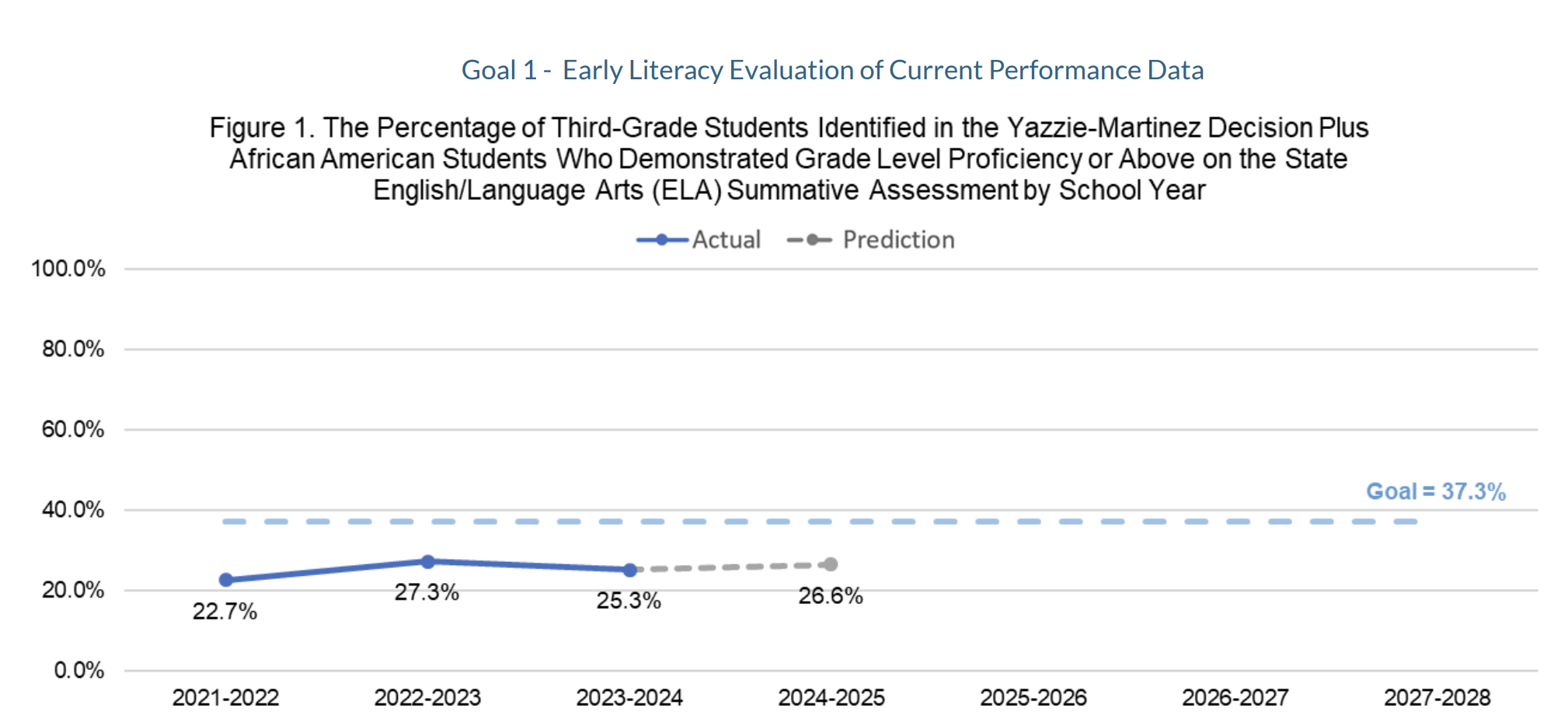
Last year’s Albuquerque Public Schools third-graders identified in the Yazzie-Martinez decision plus African American students fell short of the reading proficiency goal set by the district in its first year of concerted progress monitoring under a new strategic plan, according to a report released earlier this month.
APS administrators pointed out during an October 2 school board meeting that these third-graders, identified in the Yazzie-Martinez decision plus African Americans, were kindergarteners during the Covid-19 pandemic, and spent much of that formative year learning online, which served them poorly.
The review is part of the district’s plan to monitor progress towards the four goals adopted by the APS Board of Education in 2023, aligned with the district’s new Emerging Stronger Strategic Plan. Each of the four goals have interim goals that serve as indicators of progress.
Goal One of the district’s four overarching goals calls for a 10 percentage-point increase in reading proficiency among that group of third-graders between 2023 and 2028. The interim goal for spring of 2024 was to raise the rate from 2023’s 27.3 to 28.3.
Instead, last year’s third-graders actually slipped to a proficiency rate of 25.3.
The district is still devising individualized strategies to catch kids up, officials told board members.
“Strategic measures moving forward can be summarized by the word specificity,” Antonio Gonzales, deputy superintendent of leadership and learning told the board. This means getting detailed in determining what different subgroups need, for example special education and English language learners students need, and how to provide for those needs.
“We know that we have a strategy in place, and that’s great. And I believe in the strategy that we have in place. But what this strategy calls us to action on is being specific and specific by student,” Gonzales said.
APS has not modified its five-year goal, but now predicts that the current year’s proficiency rate for identified third-graders will be 26.6 percent, rather than the 29.3 percent that would keep the district on track to meet the ultimate goal.
The board also heard reports on two sub-goals, where the news was decidedly better.
Interim Goal 1.1 focuses on the reading proficiency rates of first graders as measured by Istation formative assessments given at the beginning, middle, and end of the school year. “This interim assessment gives teachers real-time insights into each student’s reading abilities to help inform instruction and provide intervention,” said a slide presentation produced by the district.
The three-year target for Interim Goal 1.1 is to increase the proficiency rate of first graders in the targeted groups by six percentage points—from 17 percent in 2023 to 23 percent in 2026. Students significantly exceeded that goal last school year, ending the year with a 24.1 percent proficiency rate.
Interim Goal 1.2 has a three-year target of increasing the percentage of second-grade students identified in the Yazzie-Martinez decision plus African American students who demonstrate grade level proficiency or above as predicted by Istation from 18.3% in May 2023 to 24.3% in May 2026.
By the end of last school year, 26.3 percent of those students were proficient.
If these trends hold, it will suggest that the performance of last year’s third-graders was a Covid-related aberration, and that students on the grades that follow are performing significantly better.