Tag: Assistance

  • Offering student loan payment assistance a ‘no brainer,’ benefits manager says

    Offering student loan payment assistance a ‘no brainer,’ benefits manager says

    This audio is auto-generated. Please let us know if you have feedback.

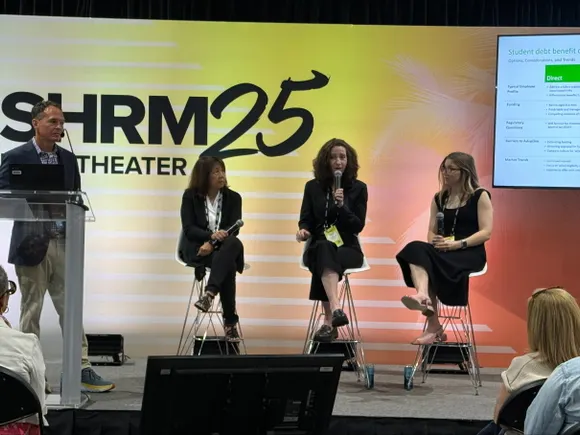
    SAN DIEGO — Applied Materials’ student loan repayment program for employees reaped such rewards that the company more than doubled its annual contribution after the first year, Tes Fernandez, director of U.S. benefits for the company said during a panel discussion at the annual conference for SHRM, formerly known as Society for Human Resource Management.

    In year one, the manufacturing company contributed $2,000 per employee in direct repayment of workers’ student loans. In the years that have followed, Applied Materials now pays out $4,800 per employee and uses the benefit as both a way to support generally newer hires, recent graduates and some underrepresented groups and as a recruiting tool.

    “They had to go up to the CFO and ask for extra millions of dollars to add this benefit. A year later, they more than doubled the benefit amount, not because the CFO got generous, but because they were seeing the results of the benefits,” Chris Rinko, VP and student debt and health and wellness benefits administration account executive at Fidelity Investments, said during the panel, which he moderated.

    When it comes to student loan debt assistance, employers have two choices, Rinko explained. They can either provide a direct payment to student loan servicers to help pay down employees’ loans, or they can elect to offer matching contributions in the 401(k) plans of workers who demonstrate they are making student loan payments.

    The direct payment method can be targeted to only apply to certain groups — those who earn less or those in a specific job, for example — and can have a set end date, Rinko said, while matching contributions are tied to a company’s overall 401(k) plan offering and can’t exclude any workers.

    Tracey Gannon, a senior benefits manager at eBay, said it was “kind of a no-brainer” for the e-commerce company to offer matching funds after the passage of the SECURE 2.0 Act. The law gave employers the ability to match employee contributions to certain student loan payments.

    “We felt that this was just such an easy first step,” Gannon said.

    The company already budgets for all employees to get the full matching contribution in their retirement plans and has a 96% participation rate, Gannon said. That meant the new offering wasn’t a big budget item for the company but could provide support to some employees in need.

    Similarly, offering a matching contribution seemed like “an easy win” for The Walt Disney Co. and its workers, said Marianne Lynch, a senior manager of executive benefits and hypercare for the company.

    “It’s a huge, huge benefit to reduce that burden” of student loan debt, Lynch said. At Disney, 97% of employees already receive the full 401(k) match, but for those who don’t, it’s a way not to miss out on the matching funds to which they’re already entitled, she added.

    “The only change here is you’re giving them another way to earn that match by paying their student debt,” Rinko said.

    At companies where most employees already receive the full matching contribution, some leaders may ask, “Why bother?” with a student loan repayment match, Rinko said.

    “The reason is, if it’s just 1% or 2%, if you can find a path for that small number, for those people who are usually in the greatest need to earn the match, why not?” Rinko said.
    Source link

  • EEOC and DOJ Issue Technical Assistance Documents on Unlawful DEI-Related Discrimination

    EEOC and DOJ Issue Technical Assistance Documents on Unlawful DEI-Related Discrimination

    by CUPA-HR | March 20, 2025

    On March 19, the Equal Employment Opportunity Commission (EEOC) and Department of Justice (DOJ) released two technical assistance documents intended to educate “the public about unlawful discrimination related to ‘diversity, equity, and inclusion’ (DEI) in the workplace.” The two documents aim to inform the public about how civil rights rules and laws like Title VII of the Civil Rights Act of 1964 apply to employment policies, programs and practices, including those labeled or framed as “DEI.”

    Title VII prohibits employment discrimination based on protected characteristics, including race, color, religion, sex or national origin. As the agencies note in both documents, DEI is a broad term that is not defined under statute. The technical assistance explains that DEI practices may be unlawful if they involve an employer or other covered entity taking an employment action motivated in whole or in part by an employee’s race, sex, or other protected characteristic. The agencies emphasize that Title VII’s protections apply equally to all racial, ethnic, and national origin groups, as well as both sexes, and that unlawful discrimination may exist no matter which employees are harmed.

    Technical Assistance Document #1: The EEOC describes what DEI-related discrimination looks like.

    The first document, “What To Do If You Experience Discrimination Related to DEI at Work,” explains how DEI-related practices may manifest as discrimination under Title VII.

    • Title VII bars disparate treatment: Any employment action motivated in whole or in part by race, sex, or another protected characteristic that is taken in the context of the terms, conditions, or privileges of employment may be unlawful.*
    • Title VII prohibits limiting, segregating, and classifying: Any action taken that limits, segregates, or classifies employees based on race, sex, or other protected characteristics in a manner affecting their status or depriving them of employment opportunities may be unlawful. Examples of these practices include the establishment of workplace groups (employee resource groups or employee affinity groups) that limit membership to a protected group or groups, as well as the separation of employees into groups based on a protected characteristic when administering trainings or other privileges of employment. The document makes clear that the latter may still violate Title VII even if the separate groups receive the same training or programming content.
    • Title VII prohibits workplace harassment: Workplace harassment is illegal when it results in an adverse change to a term, condition, or privilege of employment, or it is so frequent or severe to reasonably be considered intimidating, hostile, or abusive. The document explains that DEI training may give rise to a hostile work environment claim and that harassment may occur when an employee is subject to unwelcome remarks or conduct based on protected characteristics.
    • Title VII prohibits employer retaliation: The agencies explain that reasonable opposition to a DEI training may constitute protected activity if the employee provides a fact-specific basis for their belief that the training violated Title VII, and that an employer may not retaliate if an employee participates in an EEOC investigation or files an EEOC charge.

    The document reaffirms that Title VII protects employees, potential and actual applicants, interns, and training program participants. It directs individuals who suspect to have experienced DEI-related discrimination to contact the EEOC “promptly” as claimants have 180 to 300 days to file a claim depending on whether a state or local agency enforces a law that prohibits employment discrimination on the same basis.

    Technical Assistance Document #2: The EEOC answers additional questions about DEI-related discrimination in the workplace.

    The second technical assistance document, titled “What You Should Know About DEI-Related Discrimination At Work,” expands upon the information provided in the technical assistance document discussed above and answers a number of additional questions on how Title VII intersects with DEI-related practices in the workplace.

    Notably, the document addresses questions surrounding employers’ DEI-related considerations of race, sex, and other protected characteristics when the protected characteristic wasn’t the “sole or deciding factor” for the employers’ action. The document states that “race or sex (or any other protected characteristic under Title VII) does not have to be the exclusive (sole) reason for an employment action or the ‘but-for’ (deciding) factor for the action” for there to be unlawful discrimination. Additionally, the agencies explain that workers only need to show “some injury” or “some harm” affecting their terms, conditions or privileges of employment to allege a colorable claim of discrimination under Title VII.

    The document also makes clear that an employer may not justify an employment action simply on the basis that they have a business necessity or interest in “diversity” as Title VII prohibits employers from using business necessity as a defense against intentional discrimination claims. Likewise, the agencies explain that “client or customer preference is not a defense to race or color discrimination” and that “basing employment decisions on the racial preferences of clients, customers, or coworkers constitutes intentional race discrimination.”

    CUPA-HR will continue to monitor for updates related to Title VII enforcement from the EEOC.


    *The terms and conditions of employment include: hiring; firing; promotion; demotion; compensation; fringe benefits; exclusion from training; exclusion from mentoring or sponsorship programs; exclusion from fellowships; selection for interviews (including placement on candidate slates).


    Source link

  • EEOC Adds Technical Assistance Guidance to Clarify When COVID-19 Is Considered a Disability Under the ADA – CUPA-HR

    EEOC Adds Technical Assistance Guidance to Clarify When COVID-19 Is Considered a Disability Under the ADA – CUPA-HR

    by CUPA-HR | December 22, 2021

    On December 14, the Equal Employment Opportunity Commission (EEOC) released additional COVID-19 technical assistance to clarify certain circumstances under which employers and employees may consider COVID-19 a disability under the Americans with Disabilities Act (ADA) and the Rehabilitation Act. The guidance, which is presented in a Q&A format, focuses broadly on the definition of disability under the ADA and Rehabilitation Act and provides examples detailing how an individual diagnosed with COVID-19 or post-COVID-19 conditions could be considered to have a disability under these laws.

    According to an EEOC press release, the technical assistance adds the following key guidance:

    • An applicant’s or employee’s COVID-19 may cause impairments that can be considered disabilities under the ADA, regardless of whether the initial case of COVID-19 itself constituted an actual disability.
    • An applicant or employee with mild COVID-19 symptoms that resolve in a few weeks with no other consequences will not have a disability as defined under the ADA that would make them eligible to receive a reasonable accommodation.
    • Applicants or employees with disabilities under the ADA are entitled to a reasonable accommodation when their disability requires it, and the accommodation is not an undue hardship for the employer. They are not automatically entitled to reasonable accommodations under the ADA. Employers can choose to do more than the ADA requires.
    • Employers risk violating the ADA if they prevent employees from returning to work once the employee is no longer infectious and is medically able to return to work without posing a threat to infect others.

    The EEOC also clarifies that this technical guidance differs from July guidance from the Department of Justice (DOJ) and the Department of Health and Human Services (HHS), which addresses “Long COVID” as a Disability under Sections 504 and 1557 of the ADA. According to the press release, the DOJ and HHS guidance only focuses on long COVID, while the EEOC’s new technical assistance focuses more broadly on COVID-19 in the context of Title I of the ADA and Section 501 of the Rehabilitation Act, which covers employment.

    CUPA-HR will continue to keep members apprised of any COVID-19 guidance as it relates to disability and discrimination under EEO law.


    Source link