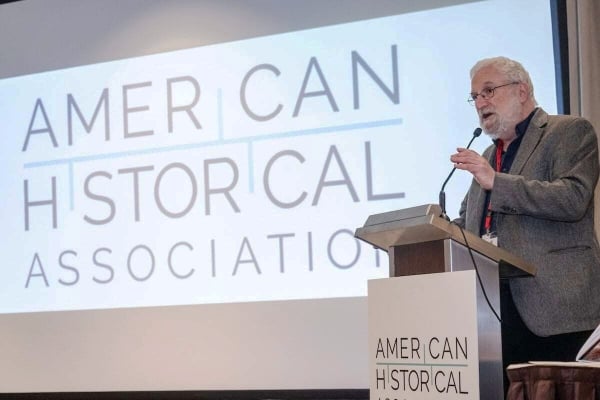
A chapter of history is closing: Jim Grossman is retiring after 15 years as executive director of the American Historical Association, a group of more than 10,400 members. He began leading the scholarly organization after two decades at Chicago’s independent Newberry Library, where he was vice president for research and education. His own scholarly work focused on American urban history, especially of Chicago, and the Great Migration of African Americans.
In the past decade and a half, the AHA and its members have commented on contemporary controversies that have arisen from or invoked historical events, such as the Charlottesville, Va., white supremacist rally; the debate over whether to remove Confederate monuments; the Jan. 6, 2021, U.S. Capitol insurrection; and more. Over that time, lawmakers in some states began restricting how history—especially when it’s relevant to current events—is taught.
Grossman headed the AHA amid such controversies and has repeatedly spoken out in defense of the discipline. He’s denounced the first Trump administration’s 1776 Commission report, which criticized histories produced by Howard Zinn and The New York Times Magazine’s 1619 Project. Grossman called the report “history without historians.” He’s also pushed for other historians to do more public-facing work.
The AHA has itself faced criticism during Grossman’s tenure, including for then-president Jim Sweet’s critique of The 1619 Project in 2022. This past weekend, it entered another current controversy when attendees of its annual conference overwhelmingly passed a resolution opposing “scholasticide” in Gaza and the U.S. government’s funding of Israel’s war.
Inside Higher Ed interviewed Grossman shortly before that conference about his tenure and the current issues the history discipline faces. The questions and answers have been edited for clarity and length.
Q: Why did you apply to become executive director in the first place?
A: I had been involved in a variety of AHA activities. There were things I was trying to do in Chicago at the Newberry Library that involved increasing the public scope of historians. What the AHA provided was the opportunity to do some of those things on a national scale, rather than just within Chicago. How do we get historians to be more involved in public culture, more influential in public policy?
Q: Why are you retiring now?
A: I’m 72 years old. It’s time for somebody younger to be doing this work—not because I don’t enjoy it, but because I think it’s important for membership organizations to be directed by people who are generationally closer to the membership and the audience. And I’ve had 15 years to accomplish what I’ve tried to accomplish.
Q: What have your biggest accomplishments been?
A: At least getting started on helping the discipline rethink the definition of historical scholarship—to broaden the definition of scholarship for promotion and tenure. We came out with recommendations that departments are taking seriously about thinking about going beyond books and peer-reviewed articles. Reference books, textbooks, op-eds, testifying in legislatures and courts—all of these things are works of scholarship.
Second is I think that we reoriented the AHA towards a much broader scope, so that the AHA and the discipline itself take teaching more seriously. Our annual conference is no longer “a research conference”; it includes all sorts of things that relate to teaching, that relate to advocacy, that relate to professional development. I also think that we have ramped up and broadened our advocacy work. We’re very active in state legislatures now; we’re very active in reviewing changes to state social studies and history standards for K-12 education. So, we’ve kept our focus on Capitol Hill and in Washington, but we’ve moved out to the states.
Q: Why did you make such an emphasis during your tenure on broadening the focus of AHA? Is it because of a decline in tenure-track, traditional faculty jobs for new history Ph.D. earners?
A: That was part of it. But that came later. I had that goal from the very beginning because I became a historian because I think historians are useful to public culture as well as academia. If I had my druthers, every time a decision was made at a table in government, private sector, nonprofit sector, I would want a historian at the table. Everything has a history, and since everything has a history, historical context always matters when you’re making decisions, when you’re trying to develop good judgment.
That’s what someone learns in a history course. They learn judgment by thinking about the past. Historians don’t need to be working just as teachers and professors. Historians should be everywhere.
Q: You’re saying you’ve gotten AHA more involved in state legislatures, in discussions of state standards—all of these things are political or politics-adjacent, right?
A: Not necessarily. Let’s start with the federal level. We work on the Hill and in federal agencies to promote history. Our congressional charter, which goes back to 1889, says that we are here to promote history. So that’s not politics. It’s engaging in politics in order to promote history, yes. We are providing historical context to congressional staff so that they can make well-informed decisions when they make recommendations to their member. If you’re going to think about immigration policy, you need to know the door was closed for 40 years.
There are times when we take stands that are perceived as political. We took a stand against the Muslim ban, for example. But we did so on the basis of what we’ve learned from history. State legislatures, it’s the same thing—we are promoting the integrity of history education. We are saying high school teachers need to be trusted as professionals, high school teachers should not be censored in the classroom; we are saying that state history standards should be good history.
Q: What are the biggest issues within K-12 history—teaching and learning—and how do they actually impact colleges and universities?
A: State legislatures have mandated that certain things have to be taught for years. What they have not done in the past is say certain things cannot be taught, which is censorship. There’s very little precedent for this. So that is one big challenge, which is fighting back against this notion that state legislatures can tell teachers you cannot teach X, Y or Z. And that affects college because if students don’t learn things in high school, then they’re less prepared when they get to college. If students don’t learn in high school that racism has been a central aspect of American history since Europeans came to the Americas—if students don’t learn that in high school, then the college professors are starting off at a much different level.
If I had my druthers, every time a decision was made at a table in government, private sector, nonprofit sector, I would want a historian at the table.”
—Jim Grossman
We do know that young people are reading less. Instead of wringing our hands and saying they have to read more, we need to step back and ask ourselves, “How do we rethink our college courses for students who are now educated differently?” That doesn’t mean that we shouldn’t be pushing them to read, but it also means that we need to think about different ways of teaching history.
Q: Has the discipline of history become increasingly polarized over your tenure?
A: The discipline itself has not been polarized. Historians are still much more capable of disagreeing with each other in a civil manner than my neighbors in the capital. The larger polarization in public culture has harnessed the discipline of history in the same way it’s harnessed other disciplines and other aspects of life, but no, historians are still arguing with each other in a way that’s productive and constructive.
Q: How do you expect the Trump administration and Republican control of both chambers of Congress to impact the discipline of history?
A: I have no idea—that’s why we’re here to watch.
Q: I know you’ve expressed concern about the 1776 Commission coming back.
A: There has been talk among people who are part of the incoming administration of reviving the 1776 Commission and that notorious report, and so I’m concerned about that possibility, and I’m prepared for that possibility, and when things like that happen, we will speak out.
Q: What impact has The 1619 Project had on the teaching of history and history scholarship? For instance, I know you were leading the AHA as it faced controversy over former association president Jim Sweet’s criticism of that work.
A: Jim Sweet, like every historian, has a right to criticize any work of historical scholarship. The 1619 Project is not a work of historical scholarship. It’s—according to its compiler, its organizer—it’s journalism. And that’s fine, and there are aspects of it that I and many of my colleagues agree with, and aspects of it that I and many of my colleagues disagree with, just like any other piece of historical scholarship or journalism. It’s an easy target for people who want to take one thing that has been controversial and then use it for all sorts of other purposes.
Controversies that ask people to ask questions are useful. It’s useful for teachers to be able to say to students, “So how do we think about the beginnings of a nation? Do we think of the beginning of a nation as the creation of its governing documents? Or do we think about the beginnings of a nation as the origins of its economy? Or do we think about the beginnings of the nation as the beginning of its culture, or as the origins of it, the roots of its culture?” Those are good historical questions, and The 1619 Project has initiated or nourished those questions.
Q: What impact have the ongoing Israel-Hamas war and related U.S. higher education developments had on the teaching and study and scholarship of history?
A: I think that many people who teach Middle Eastern history have probably been more careful, and I suspect that classroom management has been more difficult because it’s an emotional topic. But it’s different from The 1619 Project. The 1619 Project offered a certain way of understanding the history of the United States, and a controversial way of seeing the history of the United States—and offered, therefore, teachers an opportunity, or a nudge, to ask important questions and have students address them.
That’s very different from a war that’s happening on the other side of the world. It’s important to the United States, it’s important to Americans, but it doesn’t have the same valence in teaching a course in American history, which is the most widely taught course in the United States. It does mean that historians have to balance sensitivity to diversity of students in their classroom with the integrity of the history that they teach.