Tag: ASU

  • ASU Receives $50M Gift to Develop Energy Institute

    ASU Receives $50M Gift to Develop Energy Institute

    Arizona State University has received a $50 million donation to launch the Global Institute for the Future of Energy, a collaboration between its Julie Ann Wrigley Global Futures Laboratory and the Thunderbird School of Global Management that seeks to promote education and innovation regarding energy production and use.

    The gift comes from Bob Zorich, who earned his master’s degree in international management in 1974 from Thunderbird’s predecessor, the American Graduate School of International Management.

    “ASU has long been a pioneer in building bold, pragmatic solutions for the future,” said Zorich, founder and managing partner of the Texas-based private equity firm EnCap Investments. “President Michael Crow has taken a visionary and action-oriented approach to positioning the university as a leading center for research, educational excellence and global influence. For these reasons, I was excited to fund the formation of this energy institute at ASU because of the university’s unique ability to scale and reach a global audience.”

    Zorich’s gift will help the institute recruit a chair and staff and start developing curriculum for students, executives and the public. In the second year, the institute aims to launch a fellowship and executive-in-residence program, as well as a series of public programs, including lectures, summer camps and a global energy conference.

    In addition, some of the funds will support Energy Switch, a point-counterpoint show on Arizona PBS that brings together experts from government, NGOs, academe and industry to debate energy-related topics.

    “Energy is central to nearly every facet of our daily lives, and we have to prepare now for an evolving energy future,” Crow said in a statement. “With the rapid growth of AI and other fast-moving innovations, we have a responsibility to ready the next generation of energy leaders and solutions. Bob Zorich’s visionary investment will empower our global understanding of energy, our vital literacy and how we can work together to develop the best paths forward.”

    Source link

  • ASU Police Reportedly Assisted DHS With Arrest

    ASU Police Reportedly Assisted DHS With Arrest

    Arizona State University police assisted in arranging the violent arrest of a staff member by Department of Homeland Security officials earlier this week, The Phoenix New Times reported.

    The ASU chapter of the National Lawyers Guild alleged in an Instagram post that ASU police officer James Quigley arranged a meeting with a staff member, who was not named, “under the pretense of discussing a ‘concern’ about a social media post.” After a brief meeting, the employee was then arrested by multiple plainclothes Immigration and Customs Enforcement agents, according to the group.

    A purported video of the encounter was later posted on X. The video shows several men with badges, one of whom identifies himself as “a special agent with Homeland Security” twisting an individual’s wrist before kneeing him in the back. In the video, the arrested individual, who is the employee in question, according to the post, asks, “What did I do?” as he is arrested.

    The employee was later released, according to the newspaper. 

    In the aftermath of the arrest, the ASU chapter of the National Lawyers Guild called on the university and President Michael Crow to publicly denounce the incident, end all cooperation with ICE and enact policies “to prevent future targeting and harm” to community members.

    “ASU must protest the safety and dignity of its staff and students—not partner with agencies that terrorize them,” the organization wrote online.

    ASU spokesperson Jerry Gonzalez told Inside Higher Ed that the U.S. Secret Service and Department of Homeland Security had questioned an employee after receiving an anonymous tip.

    “In order to remain informed about a matter involving an ASU employee, an ASU police officer accompanied a DHS investigator to a meeting with the employee at a coffee shop off campus,” Gonzalez wrote.

    He confirmed that the employee was later released.

    (This article has been updated with a comment from ASU.)


    Source link

  • ASU Projects 18% Drop in International Student Enrollment

    ASU Projects 18% Drop in International Student Enrollment

    yongyuan/iStock/Getty Images Plus

    Arizona State University typically welcomes over 17,900 international students to its four campuses each year, but this fall, due to a variety of complications, the university expects only 14,600 international students will attend this fall—an 18 percent drop.

    If the projection holds, international students will account for 7.5 percent of ASU’s 194,000 students this fall, according to an Aug. 11 news release. In comparison, during the 2023–24 academic year, ASU hosted 18,400 international students, with a total enrollment of 183,000, or more than 10 percent.

    The change is in part due a drop in master’s applications from international students, but primarily driven by challenges to visa appointments, according to a university spokesperson.

    ASU’s president, Michael Crow, told Bloomberg that as of early August, 1,000 of the university’s incoming international students (a third of the new cohort of 3,313 students) were still waiting on their visas. The university is providing several pathways for students unable to make it to campus, including online programs, study abroad, starting later in the semester or enrolling in a partner institution overseas, the spokesperson said.

    “We anticipate that our enrollment of international students will continue to grow throughout the year,” said Matt López, deputy vice president of academic enterprise enrollment, said in the university news release. “When students have their visa in hand, we will welcome them with open arms and the classes they need to continue their degree without delay.”

    ASU has the largest share of international students in Arizona, providing $545.1 million in revenue to the state and supporting 5,279 jobs, according to data from NAFSA, the association of international educators.

    ASU also ranks fourth among four-year colleges and universities in terms of total international students enrolled, according to 2023–24 OpenDoors data, behind New York University, Northeastern University and Columbia University.

    Nationally, international student enrollment is projected to decline by about 15 percent this fall due to federal changes to visa issuance and other actions against international students.

    Source link

  • Visa Appointment Slowdown Hinders ASU International Enrollment

    Visa Appointment Slowdown Hinders ASU International Enrollment

    yongyuan/iStock/Getty Images Plus

    This article has been revised to reflect more enrollment data provided by Arizona State University after publication to correct Inside Higher Ed’s previous analysis.

    Arizona State University welcomed over 15,100 international students to its four campuses in fall 2024, but this fall, due to a variety of complications, the university expects only 14,600 international students will attend.

    If the projection holds, international students will account for 7.5 percent of ASU’s 194,000 students this fall, according to an Aug. 11 news release. In comparison, during the 2023–24 academic year, ASU hosted 18,400 international students, with a total enrollment of 183,000, or more than 10 percent.

    The change is in part due a drop in master’s applications from international students, but primarily driven by challenges to visa appointments, according to a university spokesperson.

    “We anticipate that our enrollment of international students will continue to grow throughout the year,” said Matt López, deputy vice president of academic enterprise enrollment, said in the university news release. “When students have their visa in hand, we will welcome them with open arms and the classes they need to continue their degree without delay.”

    ASU’s president, Michael Crow, told Bloomberg that as of early August, 1,000 of the university’s incoming international students (a third of the new cohort of 3,313 students) were still waiting on their visas. The university is providing several pathways for students unable to make it to campus, including online programs, study abroad, starting later in the semester or enrolling in a partner institution overseas, the spokesperson said.

    ASU has the largest share of international students in Arizona, providing $545.1 million in revenue to the state and supporting 5,279 jobs, according to data from NAFSA, the association of international educators.

    ASU also ranks fourth among four-year colleges and universities in terms of total international students enrolled, according to 2023–24 OpenDoors data, behind New York University, Northeastern University and Columbia University.

    Nationally, international student enrollment is projected to decline by about 15 percent this fall due to federal changes to visa issuance and other actions against international students.

    Source link

  • ASU Online: Where Success Is Accessible and Innovation Is Standard

    ASU Online: Where Success Is Accessible and Innovation Is Standard

    What is your passion? What sparks your curiosity and brings you joy? Whatever it is, Arizona State University (ASU) will help you find it, study it, master it, and turn it into a rewarding career, regardless of your previous educational journey.

    Casey Evans

    Chief Operating Officer, EdPlus at ASU

    For more than 15 years, ASU has offered high-quality programs online taught by the same world-renowned faculty that teach on-campus students, using the same rigorous curriculum. ASU offers more than 300 degree programs online, with over 100,000 graduates now working across nearly every industry, helping to strengthen the university’s reputation for educational excellence and career readiness. ASU graduates are highly recruitable, with ASU ranking No. 2 in the United States among public universities for the employability of its graduates, ahead of UCLA, the University of Michigan, and Purdue University.

    ASU Online combines the exceptional resources and academic excellence of the nation’s most innovative university with a rigorous, world-class online learning experience. Students are supported every step of the way, ensuring they gain the skills and knowledge they need to thrive in their career, no matter where they are in the world.

    “ASU’s rigorous coursework and knowledgeable instructors have been instrumental in preparing me for my career, equipping me with the skills to excel in my field,” said Evelyn M., ’24 BS in speech and hearing science.


    To learn more, visit asuonline.asu.edu


    Source link

  • Love, loyalty, and liberty: ASU alumni unite to defend free speech

    Love, loyalty, and liberty: ASU alumni unite to defend free speech

    Late last year, a group of Arizona State University alumni gathered on the rooftop of the Canopy Hotel — high enough to see the headlights snake through the city of Tempe, but low enough to feel the pounding bass line of Mill Avenue’s nightlife. 

    Though the setting was casual, the conversation was anything but. A simple question had brought them together: What obligations do alumni have to their alma mater? 

    For most graduates, the answer is simple. Come back for Homecoming, buy the sweatshirt, scribble a check when the fundraising office calls. Thanks for your generosity! Click

    But for the assembled Sun Devils — spanning the classes of ’85 to ’24 — their connection to ASU is more than rahrah nostalgia. They feel a duty to protect what made the university worth attending in the first place. 

    And so, that evening, they formed ASU Alumni for Free Speech. Their mission? “To promote and strengthen free expression, academic freedom, and viewpoint diversity, both on campus and throughout the global ASU community.” 

    The group’s inaugural chairman is Joe Pitts, ASU class of ’23 — whose beard, broad shoulders, and sage intellect belie his youth. For him, alumni should be more than mere spectators or “walking check books,” as he puts it, “endlessly giving and expecting little in return.” Instead, they should be invested stakeholders. 

    Pitts says it’s now fashionable to view a college diploma as little more than a fancy receipt. People think, I paid my tuition, endured the required courses, and behold: I’m credentialed! A neat little market transaction — no lingering ties, no ongoing investment.

    But this mindset, Pitts argues, is both morally bankrupt and pragmatically wrong-headed. As a practical matter, he says, “the value of your degree is tied to the reputation of your school — if your alma mater improves over time, your degree becomes more prestigious. If it declines, so does the respect it commands.” 

    And in the cutthroat world of status-signaling and social capital that matters — a lot. 

    ASU alumni have already petitioned the Arizona Board of Regents, urging them to adopt a policy of institutional neutrality, which would prevent the university from taking positions on current political issues and weighing in on the cause-du-jour.

    As a moral matter, “spending four years (or even more) at a university inevitably shapes you in some way,” Pitts says. “And in most cases, it’s for the better — even if we don’t exactly realize it at the time.” Think about it: how many unexpected friendships or serendipitous moments of clarity, insight, rebellion, and revelation do we owe our alma mater? 

    To discard that connection the moment you graduate — to treat it like an expired gym membership — isn’t just ungrateful. It’s a rejection of one’s own formation.

    But beyond these considerations, Pitts insists that what united them on the Canopy Hotel rooftop last year was — love, actually. Not the saccharine, Hallmark kind or the fleeting thrill of a Tinder rendezvous, but the sort of love that drives men to build cathedrals and forge legacies.

    Echoing St. Thomas Aquinas, Pitts says, “We love ASU, and to love is to will the good of the other — not to sit idly by.” And what is the good? It’s a campus where students unapologetically speak their minds; where professors dare to probe the perilous and the provocative; where administrators resist the temptation to do their best Big Brother impression! 

    Fortunately for ASU Alumni for Free Speech, their alma mater is already a national leader when it comes to free speech on campus — though, as Pitts notes, that’s “a damn low bar.”

    ASU ranks 14 out of 251 schools in FIRE’s 2025 College Free Speech Rankings, and has maintained a “green light” rating from FIRE since 2011, meaning its official policies don’t seriously imperil free expression. In 2018, ASU adopted the Chicago principles, committing to the “free, robust, and uninhibited sharing of ideas” on campus.

    The university didn’t stop there. This spring, ASU will launch a Center for Free Speech alongside an annual Free Speech Forum. 

    But despite these credentials, the specter of censorship still lingers at ASU, and the numbers tell the tale:

    • 68% of ASU students believe shouting down a speaker is at least rarely acceptable.
    • 35% believe violence can sometimes be justified to silence speech.
    • 37% self-censor at least once or twice a month. 
    • Over one-third of surveyed ASU faculty admit to self-censorship in their writing.

    And so — like the cavalry cresting the hill — ASU Alumni for Free Speech arrives just in time.

    “When controversy inevitably arises on a campus of 100,000 students,” Pitts argues, “the defense of free expression shouldn’t be left solely to outside organizations or political bodies. Instead, those speaking up should be people who genuinely care about ASU and have its best interests at heart.”

    ASU Alumni for Free Speech aims to be that voice. “In the long run, we want to have a seat at the table,” Pitts explains. “We want to build relationships not just with the ASU administration but also with the Arizona Board of Regents.”

    Along with FIRE, ASU alumni have already petitioned the Arizona Board of Regents, urging them to adopt a policy of institutional neutrality, which would prevent the university from taking positions on current political issues and weighing in on the cause-du-jour.

    SIGN THE PETITION TO ADOPT INSTITUTIONAL NEUTRALITY!

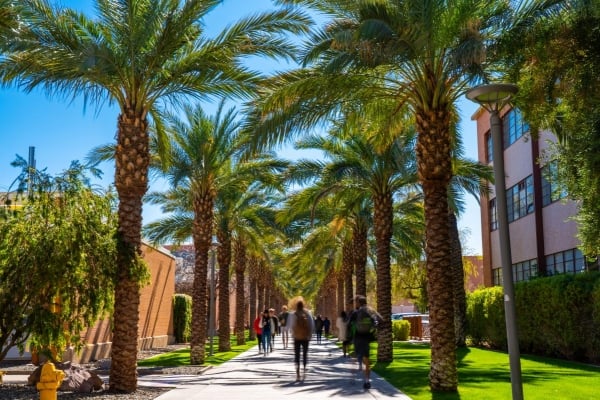
    Pitts and the rest of ASU Alumni for Free Speech are tired of playing cheerleader. They’re here to ensure that ASU flourishes not just today, but for every Sun Devil yet to step onto Palm Walk for the first time.

    “Sometimes that may look like applause,” Pitts says. “Other times, that may look like criticism.” 

    In either case, he insists, it’s an act of love.


    If you’re ready to join ASU Alumni for Free Speech, or if you’re interested in forming a free speech alumni alliance at your alma mater, contact Bobby Ramkissoon at [email protected]. We’ll connect you with like-minded alumni and offer guidance on how to effectively protect free speech and academic freedom for all. 

    Source link