Tag: attendance

  • The Arts Aren’t ‘Nice to Have’ — They Can Boost Student Engagement & Attendance – The 74

    The Arts Aren’t ‘Nice to Have’ — They Can Boost Student Engagement & Attendance – The 74


    Get stories like this delivered straight to your inbox. Sign up for The 74 Newsletter

    Chronic absenteeism is a longstanding problem that has surged to troubling levels. Recent data show that in 20 states, more than 30% of students are chronically absent, about twice the rate seen before the pandemic. Absenteeism is a multifaceted problem, and the reasons students stop showing up aren’t always academic. Sometimes it’s because they don’t feel connected to their school, or they are not engaged in the curriculum. Other times, they face adversity outside the classroom. While the problem is complicated, it’s easy to overlook one of its simplest, most effective solutions: What if the key to keeping students is a performance stage, a music room or an art studio — a creative outlet to shine?

    Despite decades of research, arts education is still treated as a “nice-to-have” when education budgets allow. From 2015 to 2019, the NAMM Foundation conducted a four-year study across 1,700 New York City public schools serving over 1.1 million students. They found that schools offering music and arts programming had lower rates of chronic absenteeism and higher overall school-day attendance than those that didn’t. Similarly, a comparison of cohort data over seven years found that dropout rates fell from 30% to just 6% among students participating in consistent arts programming.

    Clearly, the arts are a powerful tool for academic engagement, resilience and, most importantly, graduation. For example, after tracking more than 22,000 students for 12 years, the National Dropout Prevention Center found that those with high levels of involvement in the arts were five times more likely to graduate from high school than those with low involvement.

    But while over 90% of Americans feel the arts are important for education, only 66% of students participate, and access remains uneven. Charter schools, the fastest-growing segment of public education, have the lowest availability of arts courses: Just 37% of public charter high schools offer arts instruction. Students in charter schools, military families and homeschool programs are too often the ones with the fewest opportunities to engage with the arts, despite needing them most.

    This is an issue that the Cathedral Arts Project in Jacksonville, Florida, is trying to solve.

    In partnership with and with funding from the Florida Department of Education, our program piloted a year-long arts education initiative during the 2024-25 school year, reaching more than 400 students in charter schools, homeschools, military families and crisis care. Our teaching artists visited classrooms weekly, providing instruction in dance, music, visual arts and theater. Throughout the year, students in kindergarten through high school found joy, confidence and connection through creative learning. Homeschool students brought history to life through art projects, children from military families found comfort and stability during times of deployment and young people in crisis discovered new ways to express themselves and heal. Each moment affirmed the power of the arts to help children imagine what’s possible.

    To better understand the impact of this work, we partnered with the Florida Data Science for Social Good program at the University of North Florida to analyze reports and survey evaluations collected from 88% of program participants. Here’s what we found:

    Students grew not only in artistic skill, but also in self-confidence, teamwork, problem-solving and engagement. After completing the program, over 86% of students said they “like to finish what they start” and “can do things even when they are hard” — a key indicator of persistence, which is a strong predictor of long-term academic success. Students rated themselves highly in statements like, “I am good at performance.”

    Families noticed, too. In the age of screens, nearly three-quarters reported that their child had increased in-person social interaction since beginning arts programming and had improved emotional control at home. Nearly one-third saw noticeable gains in creative problem-solving and persistence through challenges.

    According to the State of Educational Opportunity in America survey conducted by 50CAN, parents view the arts as a meaningful contributor to their child’s learning, and they want more of it. In Florida, where families have been given the power of school choice, they’re increasingly seeking out programs that inspire creative thinking and meaningful engagement while promoting academic success. But finding them isn’t always easy. When funding allows, traditional public schools may offer band or visual arts, but these options are often unavailable to families choosing alternative education options for their children.

    Now in its second year, our program fills this critical gap by working directly with school choice families across northeast Florida, bringing structured arts instruction to students who otherwise wouldn’t have access. 

    What makes the arts such an effective intervention? It’s structure, expression and connection. When students learn through the creative process, they navigate frustration, build resilience and find joy in persistence. These are not soft skills — they’re essential for survival, and increasingly important in today’s workplaces.

    Arts education is a necessary investment in student achievement. It’s time for other states to treat it that way and follow Florida’s lead.


    Did you use this article in your work?

    We’d love to hear how The 74’s reporting is helping educators, researchers, and policymakers. Tell us how

    Source link

  • Human connection still drives school attendance

    Human connection still drives school attendance

    Key points:

    At ISTE this summer, I lost count of how many times I heard “AI” as the answer to every educational challenge imaginable. Student engagement? AI-powered personalization! Teacher burnout? AI lesson planning! Parent communication? AI-generated newsletters! Chronic absenteeism? AI predictive models! But after moderating a panel on improving the high school experience, which focused squarely on human-centered approaches, one district administrator approached us with gratitude: “Thank you for NOT saying AI is the solution.”

    That moment crystallized something important that’s getting lost in our rush toward technological fixes: While we’re automating attendance tracking and building predictive models, we’re missing the fundamental truth that showing up to school is a human decision driven by authentic relationships.

    The real problem: Students going through the motions

    The scope of student disengagement is staggering. Challenge Success, affiliated with Stanford’s Graduate School of Education, analyzed data from over 270,000 high school students across 13 years and found that only 13 percent are fully engaged in their learning. Meanwhile, 45 percent are what researchers call “doing school,” going through the motions behaviorally but finding little joy or meaning in their education.

    This isn’t a post-pandemic problem–it’s been consistent for over a decade. And it directly connects to attendance issues. The California Safe and Supportive Schools initiative has identified school connectedness as fundamental to attendance. When high schoolers have even one strong connection with a teacher or staff member who understands their life beyond academics, attendance improves dramatically.

    The districts that are addressing this are using data to enable more meaningful adult connections, not just adding more tech. One California district saw 32 percent of at-risk students improve attendance after implementing targeted, relationship-based outreach. The key isn’t automated messages, but using data to help educators identify disengaged students early and reach out with genuine support.

    This isn’t to discount the impact of technology. AI tools can make project-based learning incredibly meaningful and exciting, exactly the kind of authentic engagement that might tempt chronically absent high schoolers to return. But AI works best when it amplifies personal bonds, not seeks to replace them.

    Mapping student connections

    Instead of starting with AI, start with relationship mapping. Harvard’s Making Caring Common project emphasizes that “there may be nothing more important in a child’s life than a positive and trusting relationship with a caring adult.” Rather than leave these connections to chance, relationship mapping helps districts systematically identify which students lack that crucial adult bond at school.

    The process is straightforward: Staff identify students who don’t have positive relationships with any school adults, then volunteers commit to building stronger connections with those students throughout the year. This combines the best of both worlds: Technology provides the insights about who needs support, and authentic relationships provide the motivation to show up.

    True school-family partnerships to combat chronic absenteeism need structures that prioritize student consent and agency, provide scaffolding for underrepresented students, and feature a wide range of experiences. It requires seeing students as whole people with complex lives, not just data points in an attendance algorithm.

    The choice ahead

    As we head into another school year, we face a choice. We can continue chasing the shiny startups, building ever more sophisticated systems to track and predict student disengagement. Or we can remember that attendance is ultimately about whether a young person feels connected to something meaningful at school.

    The most effective districts aren’t choosing between high-tech and high-touch–they’re using technology to enable more meaningful personal connections. They’re using AI to identify students who need support, then deploying caring adults to provide it. They’re automating the logistics so teachers can focus on relationships.

    That ISTE administrator was right to be grateful for a non-AI solution. Because while artificial intelligence can optimize many things, it can’t replace the fundamental human need to belong, to feel seen, and to believe that showing up matters.

    The solution to chronic absenteeism is in our relationships, not our servers. It’s time we started measuring and investing in both.

    Latest posts by eSchool Media Contributors (see all)

    Source link

  • K-12 Chronic Absenteeism Rates Down From Peak, But Remain Persistently High – The 74

    K-12 Chronic Absenteeism Rates Down From Peak, But Remain Persistently High – The 74


    Get stories like this delivered straight to your inbox. Sign up for The 74 Newsletter

    Since hitting a record high in 2022, national chronic absenteeism rates have dropped modestly — by about five percentage points — according to the most recent available data, but still remain persistently higher than pre-pandemic levels. 

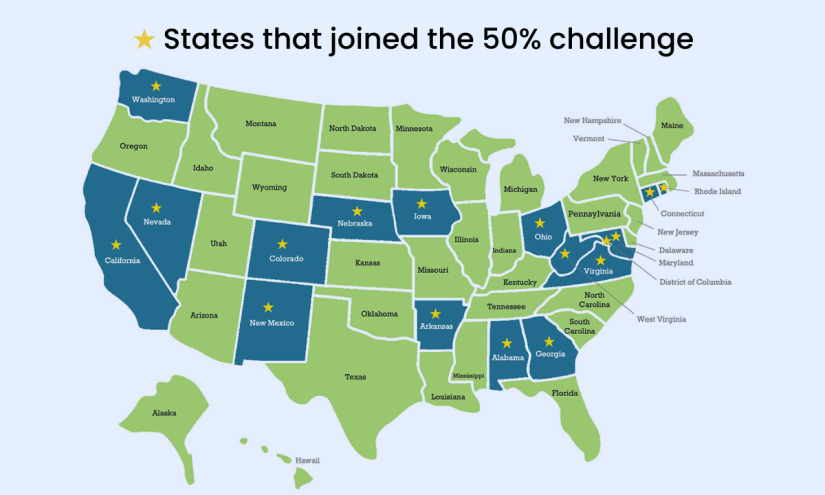
    States that joined a national pledge led by three high-profile education advocacy and research groups to cut chronic absenteeism in half over five years fared better. The 16 states and Washington, D.C. posted results “substantially above the average rate” of decline, though exact numbers are not yet available, said Nat Malkus, deputy director of education policy studies at the American Enterprise Institute, one of the trio.

    The national chronic absenteeism average dropped from 28.5% in 2022 to 25.4% in 2023, and fell an additional two points to 23.5% in 2024. Virginia, which is among the 16 participating states, cut its chronic absenteeism by 4.4 percentage points, year over year, to 15.7%, as of spring 2024.

    Speaking of the states collectively, Malkus told The 74, “That’s good but it’s not as good as we need it to be. I think it points to the need for sustained pressure and a sustained campaign to bring absence rates down and to bring more students back to consistent attendance.”

    Last July, AEI and EdTrust, right-and left-leaning think tanks, respectively, and the national nonprofit Attendance Works joined forces to launch The 50% Challenge. This week, the organizations hosted an event in Washington, D.C., to report on their progress, re-up the call to action and hear insights from state, district and community partners on how they are improving student attendance and engagement.

    With California and Georgia recently joining, the 16 states and D.C. who signed on to the pledge account for more than a third of all students nationally. While Malkus doesn’t necessarily attribute their better results to the pledge itself, he noted that their participation shows a willingness to commit to the cause and be publicly accountable for their results. 

    “I will hold their feet to the fire on this goal,” he added during his opening remarks in D.C.

    While felt most acutely by students of color and those in poorer districts, the spike in chronic absenteeism — students missing more than 10% of school days a year — cut across districts regardless of size, racial breakdown or income. Chronic absenteeism surged from 13.4% in 2017 to 28.5% in 2022 before beginning to drop in 2023.

    Only about one-third of students nationally are in districts that are on pace to cut 2022 absenteeism in half by 2027, according to an AEI report, and rates improved more slowly in 2024 than they did in 2023, “raising the very real possibility that absenteeism rates might never return to pre-pandemic levels.

    AEI

    Research has shown that students with high rates of absenteeism are more likely to fall behind academically and are at a greater risk of dropping out of school. About 8% of all learning loss from the pandemic is attributed just to chronic absenteeism, according to soon-to-be-released AEI research.

    The continued disproportionate impacts of chronic absenteeism were confirmed by recent RAND research, which found that in roughly half of urban school districts, more than 30% of students were chronically absent — a far higher share of students than in rural or suburban school districts.

    RAND also found that the most commonly reported reason for missing school was sickness and one-quarter of kids did not think that being chronically absent was a problem.

    SchoolStatus, a private company that works with districts to reduce chronic absenteeism, also released new numbers this week for some 1.3 million K-12 students across 172 districts in nine states. Districts using proactive interventions, the company reports, drove down chronic absenteeism rates from 21.9% in 2023–24 to 20.9% in 2024–25.

    At this week’s event, numerous experts across two panels emphasized the importance of a tiered approach to confronting the issue, which has resisted various remedies. Schools must build enough trust and buy-in with kids and their families that they are willing to share why they are absent in the first place. Once those root causes are identified, it is up to school, district and state leaders to work to remove the barriers.

    And while data monitoring must play a significant role, it should be done in a way that is inclusive of families.

    “We need to analyze data with families, not at them,” said Augustus Mays, EdTrust’s vice president of partnerships and engagement.

    Augustus Mays is the vice president of partnerships and engagement at EdTrust. (EdTrust)

    It’s imperative to understand the individual child beyond the number they represent and to design attendance plans and strategies with families so they feel supported rather than chastised.

    “It’s around choosing belonging over punitive punishment,” Mays added.

    One major and common mistake schools make is “accountability without relationships,” said Sonja Brookins Santelises, the superintendent of Baltimore City Public Schools.

    “You can’t ‘pull people up’ if you don’t have enough knowledge of what they’re really going through,” she said.

    Panelists were transparent that all this would require immense funding, staff and community partnerships.

    Virginia achieved its noteworthy drop in chronic absenteeism after launching a $418 million education initiative in the fall of 2023, in part after seeing their attendance data sink, with about 1 in 5 students chronically missing school. At least 10% of those funds are earmarked to prioritize attendance solutions in particular, according to panelist Emily Anne Gullickson, the superintendent of public instruction for the Virginia Department of Education. 

    These strategies are far-reaching, she noted: Because parents had been told throughout the pandemic to keep their kids home at the slightest sign of illness, schools partnered with pediatricians and school nurses to help counter the no-longer-necessary “stay home” narrative.

    Hedy Chang is the founder and executive director of Attendance Works. (Attendance Works)

    Gullickson said she also broke down bureaucratic silos, connecting transportation directors and attendance directors, after realizing the role that transit played in chronic absenteeism. The state now has second chance buses as well as walking and biking “buses,” led by parents or teachers along a fixed route, who pick up students along the way.

    And they are “on a mission to move away from seat time and really deliver more flexibility on where, when and how kids are learning,” she said. 

    “This isn’t one strategy. It’s a set of strategies,” said Attendance Works founder and executive director Hedy Chang, who moderated the panel.

    In Connecticut, state leaders have launched the Learning Engagement and Attendance Program, a research-based model that sends trained support staff to families’ homes to build relationships and better understand why their kids are missing school. 

    Charlene Russell-Tucker is the commissioner of the Connecticut State Department of Education. (Connecticut State Department of Education)

    A recent study confirmed that six months after the program’s first home visits, attendance rates improved by approximately 10 percentage points for K-8 students, and nearly 16 percentage points for high schoolers, said Charlene Russell-Tucker, the commissioner of the Connecticut State Department of Education.

    Schools must also work to motivate kids to want to show up in the first place, panelists said, making it a meaningful place that students believe will support and help them in the long run. The only way to do this is to start with student and family feedback, said Brookins, the Baltimore schools chief.

    During the pandemic many parents saw up-close for the first time what their kids’ classrooms and teacher interactions looked like, “and I don’t think a lot of folks liked what they saw for a variety of different reasons,” Brookins said.

    “I think it opened up boxes of questions that we — as the education establishment — were unprepared to answer,” she added. But chronic absenteeism cannot be successfully fought without engaging in those uncomfortable conversations.

    Disclosure: The Bill & Melinda Gates Foundation provides financial support to EdTrust and The 74.


    Get stories like these delivered straight to your inbox. Sign up for The 74 Newsletter

    Source link

  • Data Shows Attendance Improves Student Success

    Data Shows Attendance Improves Student Success

    Prior research shows attendance is one of the best predictors of class grades and student outcomes, creating a strong argument for faculty to incentivize or require attendance.

    Attaching grades to attendance, however, can create its own challenges, because many students generally want more flexibility in their schedules and think they should be assessed on what they learn—not how often they show up. A student columnist at the University of Washington expressed frustration at receiving a 20 percent weighted participation grade, which the professor graded based on exit tickets students submitted at the end of class.

    “Our grades should be based on our understanding of the material, not whether or not we were in the room,” Sophie Sanjani wrote in The Daily, UW’s student paper.

    Keenan Hartert, a biology professor at Minnesota State University, Mankato, set out to understand the factors affecting students’ performance in his own course and found that attendance was one of the strongest predictors of their success.

    His finding wasn’t an aha moment, but reaffirmed his position that attendance is an early indicator of GPA and class community building. The challenge, he said, is how to apply such principles to an increasingly diverse student body, many of whom juggle work, caregiving responsibilities and their own personal struggles.

    “We definitely have different students than the ones I went to school with,” Hartert said. “We do try to be the most flexible, because we have a lot of students that have a lot of other things going on that they can’t tell us. We want to be there for them.”

    Who’s missing class? It’s not uncommon for a student to miss class for illness or an outside conflict, but higher rates of absence among college students in recent years are giving professors pause.

    An analysis of 1.1 million students across 22 major research institutions found that the number of hours students have spent attending class, discussion sections and labs declined dramatically from the 2018–19 academic year to 2022–23, according to the Student Experience in the Research University (SERU) Consortium.

    More than 30 percent of students who attended community college in person skipped class sometimes in the past year, a 2023 study found; 4 percent said they skipped class often or very often.

    Students say they opt out of class for a variety of reasons, including lack of motivation, competing priorities and external challenges. A professor at Colorado State University surveyed 175 of his students in 2023 and found that 37 percent said they regularly did not attend class because of physical illness, mental health concerns, a lack of interest or engagement, or simply because it wasn’t a requirement.

    A 2024 survey from Trellis Strategies found that 15 percent of students missed class sometimes due to a lack of reliable transportation. Among working students, one in four said they regularly missed class due to conflicts with their work schedule.

    High rates of anxiety and depression among college students may also impact their attendance. More than half of 817 students surveyed by Harmony Healthcare IT in 2024 said they’d skipped class due to mental health struggles; one-third of respondents indicated they’d failed a test because of negative mental health.

    A case study: MSU Mankato’s Hartert collected data on about 250 students who enrolled in his 200-level genetics course over several semesters.

    Using an end-of-term survey, class activities and his own grade book information, Hartert collected data measuring student stress, hours slept, hours worked, number of office hours attended, class attendance and quiz grades, among other metrics.

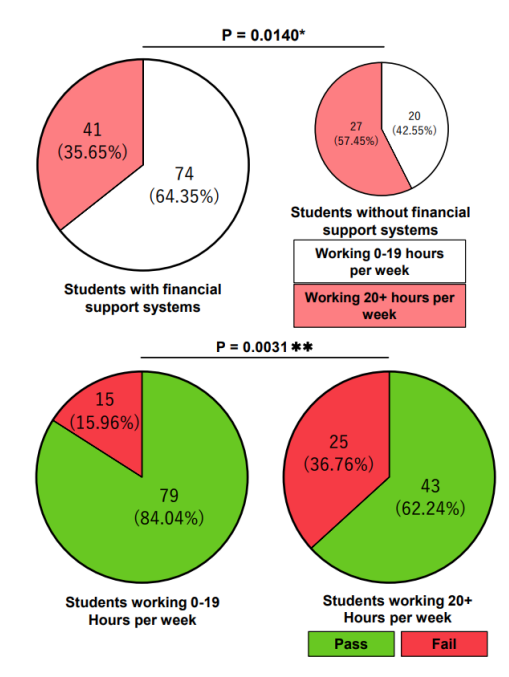
    Mapping out the various factors, Hartert’s case study modeled other findings in student success literature: a high number of hours worked correlated negatively with the student’s course grade, while attendance in class and at review sessions correlated positively with academic outcomes.

    Data analysis by Keenan Hartert, a biology professor at Minnesota State University, Mankato, found student employment negatively correlated with their overall class grade.

    Keenan Hartert

    The data also revealed to Hartert some of the challenges students face while enrolled. “It was brutal to see how many students [were working full-time]. Just seeing how many were [working] over 20 [hours] and how many were over 30 or 40, it was different.”

    Nationally, two-thirds of college students work for pay while enrolled, and 43 percent of employed students work full-time, according to fall 2024 data from Trellis Strategies.

    Hartert also asked students if they had any financial resources to support them in case of emergency; 28 percent said they had no fallback. Of those students, 90 percent were working more than 20 hours per week.

    Four pie charts show how working students often lack financial support and how working more hours is connected to passing or failing a course.

    Data analysis of student surveys show students who are working are less likely to have financial resources to support them in an emergency.

    The findings illustrated to him the challenges many students face in managing their job shifts while trying to meet attendance requirements.

    A Faculty Aside

    While some faculty may be less interested in using predictive analytics for their own classes, Hartert found tracking factors like how often a student attends office hours was beneficial to helping him achieve his own career goals, because he could include those measurements in his tenure review.

    An interpersonal dynamic: A less measured factor in the attendance debate is not a student’s own learning, but the classroom environment they contribute to. Hartert framed it as students motivating their peers unknowingly. “The people that you may not know that sit around you and see you, if you’re gone, they may think, ‘Well, they gave up, why should I keep trying?’ Even if they’ve never spoken to you.”

    One professor at the University of Oregon found that peer engagement positively correlated with academic outcomes. Raghuveer Parthasarathy restructured his general education physics course to promote engagement by creating an “active zone,” or a designated seating area in the classroom where students sat if they wanted to participate in class discussions and other active learning conversations.

    Compared to other sections of the course, the class was more engaged across the board, even among those who didn’t opt to sit in the participation zone. Additionally, students who sat in the active zone were more likely to earn higher grades on exams and in the course over all.

    Attending class can also create connections between students and professors, something students say they want and expect.

    A May 2024 student survey by Inside Higher Ed and Generation Lab found that 35 percent of respondents think their academic success would be most improved by professors getting to know them better. In a separate question, 55 percent of respondents said they think professors are at least partly responsible for becoming a mentor.

    The SERU Consortium found student respondents in 2023 were less likely to say a professor knew or had learned their name compared to their peers in 2013. Students were also less confident that they knew a professor well enough to ask for a letter of recommendation for a job or graduate school.

    “You have to show up to class then, so I know who you are,” Hartert said.

    Meeting in the middle: To encourage attendance, Hartert employs active learning methods such as creative writing or case studies, which help demonstrate the value of class participation. His favorite is a jury scenario, in which students put their medical expertise into practice with criminal cases. “I really try and get them in some gray-area stuff and remind them, just because it’s a big textbook doesn’t mean that you can’t have some creative, fun ideas,” Hartert said.

    For those who can’t make it, all of Hartert’s lectures are recorded and available online to watch later. Recording lectures, he said, “was a really hard bridge to cross, post-COVID. I was like, ‘Nobody’s going to show up.’ But every time I looked at the data [for] who was looking at the recording, it’s all my top students.” That was reason enough for him to leave the recordings available as additional practice and resources.

    Students who can’t make an in-person class session can receive attendance credit by sending Hartert their notes and answers to any questions asked live during the class, proving they watched the recording.

    Hartert has also made adjustments to how he uses class time to create more avenues for working students to engage. His genetics course includes a three-hour lab section, which rarely lasts the full time, Hartert said. Now, the final hour of the lab is a dedicated review session facilitated by peer leaders, who use practice questions Hartert designed. Initial data shows working students who stayed for the review section of labs were more likely to perform better on their exams.

    “The good news is when it works out, like when we can make some adjustments, then we can figure our way through,” Hartert said. “But the reality of life is that time marches on and things happen, and you gotta choose a couple priorities.”

    Do you have an academic intervention that might help others improve student success? Tell us about it.

    Source link

  • Colorado School Attendance Zones Keep Racial, Socioeconomic Segregation Going – The 74

    Colorado School Attendance Zones Keep Racial, Socioeconomic Segregation Going – The 74


    Get stories like this delivered straight to your inbox. Sign up for The 74 Newsletter

    Colorado school districts should revise their school attendance zones at least every four years with a “civil rights focus.” State lawmakers should increase funding to transport students to and from school. And attorneys, advocates, and community organizations should embrace the right to sue over school assignments that increase racial segregation.

    Those are among the recommendations in a new report from the Colorado Advisory Committee to the U.S. Commission on Civil Rights. “Examining the Racial Impact of Public School Attendance Zones in Colorado” concludes that the way Colorado draws school attendance boundaries and assigns students to schools mirrors segregated housing patterns and results in low-income families having less access to high-quality schools.

    “This segregation fuels a widespread belief that schools serving predominantly white and affluent students are inherently better than those serving predominantly students of color or low-income families,” an accompanying policy brief said.

    Other reports from local and national think tanks and advocacy organizations have reached similar conclusions. While some local school officials, such as the Denver school board, have talked about possible solutions, the federal Trump administration has framed efforts to increase racial diversity in schools as discrimination that could trigger civil rights investigations.

    The Colorado Advisory Committee is a 10-person group of bipartisan appointed volunteers. Each state has an advisory committee that produces reports on civil rights issues ranging from housing discrimination to voting rights to the use of excessive force by police officers.

    In its latest report, the Colorado committee found that “thousands — perhaps tens of thousands — of Colorado students are likely to be assigned to schools in violation” of a federal law that says assigning a student to a school outside their neighborhood is unlawful “if it has segregating effects.”

    The committee’s recommended solutions attempt to balance strong support for neighborhood schools with allowing families to choose the best school for their child. School choice, or the ability for a student to apply to attend any public school, is enshrined in state law.

    The committee advocated for what it called “controlled choice,” which it said could mean that popular schools reserve seats for students who live outside the neighborhood or that schools give priority admission to non-neighborhood students who live the closest.

    To produce its report, the committee held hearings in 2023 to gather input from national experts including university professors, the author of a book on school attendance zones, and representatives from think tanks across the political spectrum.

    The committee also convened a group of 10 local experts including Brenda Dickhoner from the conservative advocacy organization Ready Colorado; Kathy Gebhardt, who was then a member of the Boulder Valley school board and now sits on the State Board of Education; former Aurora Public Schools superintendent Rico Munn; and Nicholas Martinez, a former teacher who heads the education reform organization Transform Education Now.

    The committee’s other recommendations include:

    • The civil rights divisions of the federal education and justice departments should review options for enforcing “the permissible and impermissible use of race in drawing attendance boundaries and setting school assignment policies.”
    • Colorado lawmakers should correct “the systemic racial and ethnic disparities” caused by the state’s school transportation system, which does not require school districts to provide transportation to students who use school choice.
    • State lawmakers should improve Colorado’s school choice system, including by adopting a uniform school enrollment window statewide and providing families with more information about schools’ discipline policies, class sizes, and other factors.
    • Colorado school districts should revise their school attendance zones and student assignment policies at least every four years and “consider racial and ethnic integration as part of the rezoning process.”

    “Redrawing school boundaries every few years can help prevent segregation from becoming entrenched while still allowing students to maintain a sense of stability in their educational environment,” the committee’s policy brief said.

    Chalkbeat is a nonprofit news site covering educational change in public schools.


    Get stories like these delivered straight to your inbox. Sign up for The 74 Newsletter

    Source link

  • Here’s how Missouri’s largest district rallied its community to boost attendance

    Here’s how Missouri’s largest district rallied its community to boost attendance

    NEW ORLEANS — Between 2020 and 2024, student attendance in Missouri’s Springfield Public Schools dipped from 94.73% to 90.63%. 

    Like many other school districts nationwide, Springfield’s attendance rates took a hit from the COVID-19 pandemic. 

    Data from the American Institutes for Research shows fall 2020 attendance rates nationwide for elementary school at 92%, middle school at 90%, and high school at 89% — down from pre-pandemic averages of 95% for elementary and 92% for middle and high school.

    And because of the global health crisis, the state kept Springfield at its 2019-20 attendance numbers for funding purposes, Superintendent Grenita Lathan told attendees in March at the annual conference of AASA, The School Superintendents Association, in New Orleans.

    But with the state’s hold harmless order on attendance about to sunset, Lathan said, officials in the 24,500-student district knew that they needed to boost attendance during the 2023-24 school year. So they set a goal: By the end of that school year, they would raise attendance to 92%.


    “When it comes to school attendance, 90% is not an A.”

    Springfield Public Schools’ messaging on attendance


    Announcing that charge during her annual state of the schools address in August 2023, Lathan said chamber of commerce members and the community at large needed to understand the impact that a 2 percentage-point attendance increase would have. 

    “That would bring in anywhere from $3 [million] to $4 million in funding that would help us with different programs,” Lathan said.

    Lathan and other district officials laid out a districtwide strategic plan that included a communication timeline, monthly updates to 300 local business leaders, and a promise that Lathan would let herself be publicly doused in Powerade if the district reached its goal. Here are the keys to how officials rallied the community to work toward the attendance goal.  

    Keep it simple and be bold

    “It was important that we had buy-in from everyone in the district so that the messaging would resonate with everyone in the community,” said Stephen Hall, the district’s chief communications officer.

    To that end, the district prioritized making its messaging simple, direct and bold in presentation. This was reflected not only in the attendance campaign’s slogan — “Attend today, succeed forever” — but also in messaging on social media and on signage around the city. 

    In their car pickup lines, each of Springfield Public Schools’ 50 elementary, middle and high school buildings displayed five 18-inch by 24-inch yard signs heralding the directive “Attend daily. On time. All day.” 

    Additionally, the district used digital billboards at three major intersections to get its message out. For only $500, Hall said, the district was able to get more than 250,000 ad placements on the billboards over 20 days. 

    The attendance initiative became an easy, noncontroversial message for media and business partners to get behind. District leaders asked businesses to be creative in incorporating the campaign into their own messaging and also to sponsor PSAs on local TV stations. 

    Furthermore, the district sent monthly news releases to local media showing the district’s progress. One local reporter even made it his mission to try to calculate the progress on his own, because he wanted to beat the competition on getting the story out once the district hit its goal, Hall said.

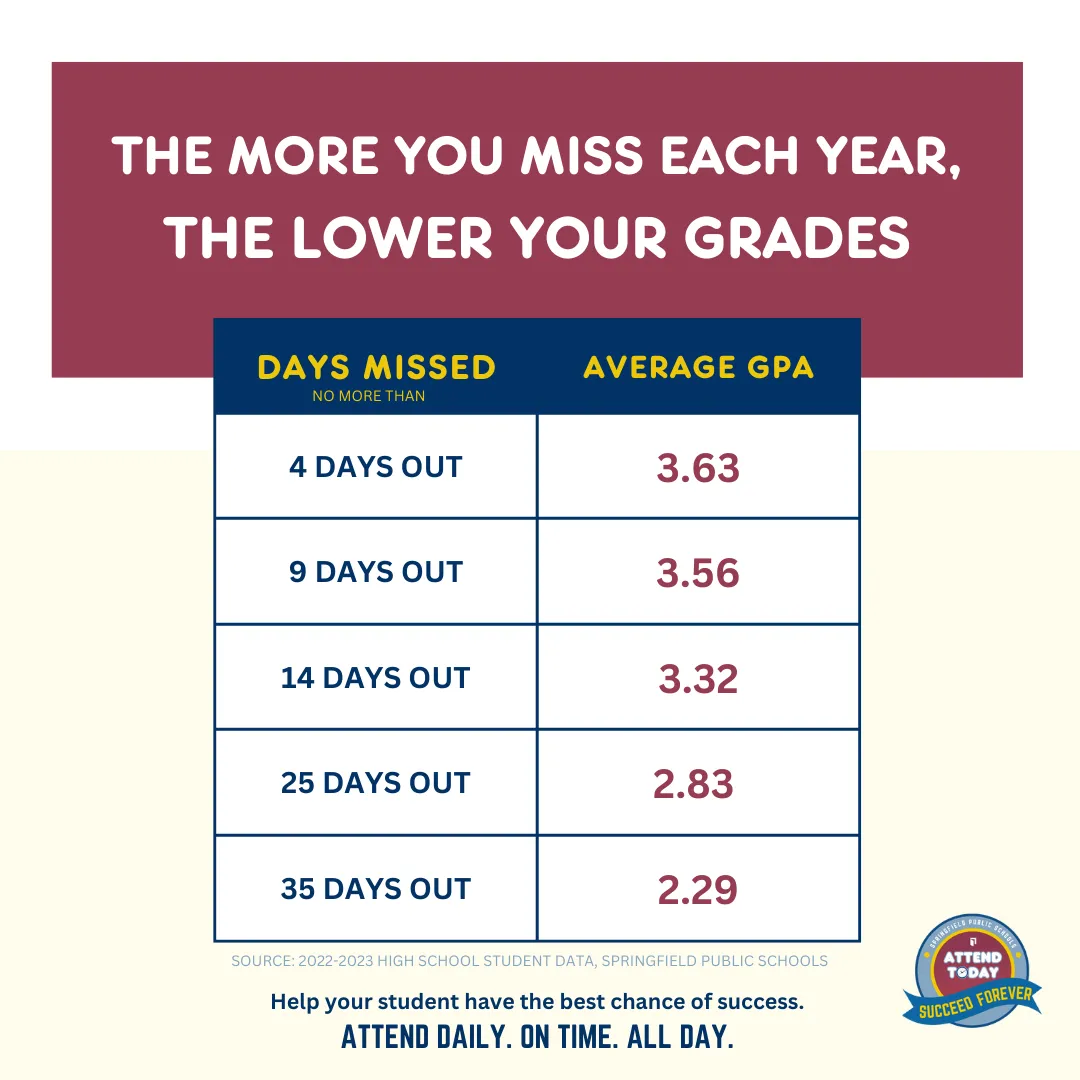
    On social media, the district boldly declared, “When it comes to school attendance, 90% is not an A.” The school system supplemented these posts with graphics that simplified attendance data. Visuals, for instance, demonstrated how much of an impact each successive absence could have on a student’s performance, as defined using their GPA: Where a student with four absences might average a 3.63 GPA, a student with 35 absences might have a 2.29.

    A graphic shows how prolonged absences correlate to potential impacts on student GPAs.

    A social media graphic from Springfield Public Schools shows how prolonged absences correlate to potential impacts on student GPAs.

    Permission granted by Springfield Public Schools


    Don’t sweat the pushback

    Shifting a community’s mindset isn’t without its hiccups, however. If your messaging is working, you should expect to receive pushback, the Springfield officials told AASA conference attendees.

    “Because it was consistent, because it was bold, and because we were holding people accountable, we heard quite a bit of feedback,” Hall said.

    Source link

  • Detroit District Offered Gift Cards For Perfect Attendance. 4,936 Kids Earned It – The 74

    Detroit District Offered Gift Cards For Perfect Attendance. 4,936 Kids Earned It – The 74


    Get stories like this delivered straight to your inbox. Sign up for The 74 Newsletter

    Nearly 5,000 Detroit high school students have earned at least one $200 incentive for perfect attendance since early January.

    High school students in the Detroit Public Schools Community District can earn $200 gift cards for each two-week period in which they have perfect attendance, from Jan. 6 through March 21.

    There have been two cycles so far for which students have received the gift cards and, in addition to the 4,936 students who had perfect attendance in at least one of two-week periods, 2,028 have had perfect attendance in both cycles, according to data Superintendent Nikolai Vitti shared with Chalkbeat this week.

    The attendance incentive is aimed at improving attendance in the district, where two-thirds of nearly 49,999 students were considered chronically absent during the 2023-24 school year. The incentive is among a number of efforts the district has employed over the years to create an attendance-going culture among students. The district has invested heavily into attendance agents to improve attendance and this school year announced that students with extremely high rates of chronic absenteeism will be held back a grade at the K-8 level and required to repeat classes at the high school level.

    The number of students earning the perfect attendance incentive is a fraction of the nearly 15,000 high school students in the district, leading one school board member to question last week whether the incentive is working. But Vitti said he is encouraged that the program is getting more high school students to class and resulting in a small decrease in the chronic absenteeism rate for high school students. He said the district and board will have to evaluate the program’s success at the end of the school year.

    Chronic absenteeism has been one of the district’s biggest challenges for years. The chronic absenteeism rate has declined, from a high of nearly 80% at the height of the pandemic, when quarantining rules meant many students missed school because of COVID exposure. But last school year’s much lower chronic absenteeism rate of 66% still means it is difficult to have consistency in the classroom and improve academic achievement.

    Students in Michigan are chronically absent when they miss 10%, or 18 days in a 180-day school year. Statewide, 30% of students are considered chronically absent, compared to 23% nationally. A recent education scorecard cited the state’s rate as being a factor in students’ slow academic recovery from the pandemic.

    Here are some of the highlights of the students who’ve received the incentive so far::

    • 3,473 students had perfect attendance during the first cycle.
    • 3,492 students had perfect attendance during the second cycle.
    • About 10% already had perfect attendance.
    • About 4% were considered chronically absent at the time the incentive began.
    • About 16% had missed 10% of the school year at the time the incentive began.
    • About 25% had missed 5-10% of the school year.
    • About 44% had missed 5% or fewer days in the school year.

    At a Detroit school board meeting last week, Vitti said the statistic showing that just 10% of the students who earned the incentive already had perfect attendance is an indication that “this is not just rewarding those that have already been going to school.”

    Board member Monique Bryant questioned what school leaders are doing to promote the incentive to students who haven’t earned it.

    Bryant suggested that data Vitti shared at the meeting showing that chronic absenteeism is down by 5 percentage points for high school students since the incentive began is an illustration that most students aren’t rising to the goal of the incentive.

    Vitti responded that it depends on how you look at the data.

    “Right now, chronic absenteeism at the high school levels improved by five percentage points,” Vitti said. “That means that 700 high school students are not chronically absent where they were last year. I’d also say that at least on the 97th day, our chronic absenteeism at the high school levels is the lowest it’s been since the pandemic.”

    The question for board members to decide at the end of the school year is whether the incentive “is the right investment with other challenges that we have districtwide,” Vitti said. “But I think the data is suggesting it’s working for many students … but not all.”

    Board member Ida Simmons Short urged the district to survey students to learn more about what is preventing them from coming to school.

    The causes of chronic absenteeism are numerous and include physical and mental health reasons, lack of transportation,and lack of affordable housing. Most of them tie back to poverty. Vitti specifically cited transportation, because half of the students in the district don’t attend their neighborhood school and the district doesn’t provide school bus transportation for high school students, who must take city buses to get to school.

    “Sometimes they’re unreliable, they’re late, they’re too far away from where the child lives,” Vitti said.

    Vitti said traditional school bus transportation for high school students “was decimated” under emergency management and it could cost between $50 million and $100 million to bring that level of transportation back.

    Another factor, Vitti said, is that for some students, school isn’t relevant. Middle and high school students, in particular, “struggle to understand, ‘why am I going to school every day? How is this connected to what I’m going to I need to know for life.’”

    Mi’Kah West, a Cass Technical High School student who serves as a student representative on the board, said that when talking to other members of the District Executive Youth Council last week, many said students overall are excited about the incentive.

    One thing that stuck out, she said, was council members saying they heard students in the hallways or on social media saying they were coming to school because they want the money.

    “And, while we don’t want to just say we want to come to school for the money,” West said, “I think it’s important to see that students … may have stayed home because they don’t want to come to school, but they’re willing to come to school now.”

    Lori Higgins is the bureau chief for Chalkbeat Detroit. You can reach her at [email protected].

    Chalkbeat is a nonprofit news site covering educational change in public schools.


    Get stories like these delivered straight to your inbox. Sign up for The 74 Newsletter

    Source link

  • Podcast: Funding, attendance, student hardship

    Podcast: Funding, attendance, student hardship

    This week on the podcast Minister of State for Skills Jacqui Smith helped launch a pamphlet on whether universities are “worth it” – and was notably cold on extra money. But does she mean outlay or eventual return to the Treasury?

    Plus there’s changes afoot in Scotland, UKVI is cracking down on attendance for international students and students are still feeling the pinch financially – is a return to maintenance grants a lost possibility?

    With Ben Vulliamy, Executive Director at the Association of Heads of University Administration, Dani Payne, Senior Researcher at the Social Market Foundation, Michael Salmon, News Editor at Wonkhe and presented by Jim Dickinson, Associate Editor at Wonkhe.

    Read more

    Jacqui Smith rules out (much) more money while her department assesses the impacts

    The Scottish government wants its own post-study work offer

    A new funding body landscape emerges in Scotland

    UKVI is tightening the rules on international student attendance

    Higher education should lift students out of poverty – not trap them within it

    Source link

  • UKVI is tightening the rules on international student attendance

    UKVI is tightening the rules on international student attendance

    Back in April you’ll recall that UKVI shared a draft “remote delivery” policy with higher education providers for consultation.

    That process is complete – and now it’s written to providers to confirm the detail of the new arrangements.

    Little has changed in the proposal from last Spring – there are some clarifications on how it will apply, but the main impact is going to be on providers and students who depend, one way or another, on some of their teaching not being accessed “in person”.

    The backstory here is that technically, all teaching for international students right now is supposed to be in-person. That was relaxed during the pandemic for obvious reasons – and since, the rapid innovations in students being able to access types of teaching (either synchronously or asynchronously) has raised questions about how realistic and desirable that position remains.

    Politics swirls around this too – the worry/allegation is that students arrive and then disappear, and with a mixture of relaxed attendance regulation (UKVI stopped demanding a specific number of contact points a few years ago for universities) and a worry that some students are faking or bypassing some of the attendance systems that are in place, the time has come, it seems, to tighten a little – “formalising the boundaries in which institutions can use online teaching methods to deliver courses to international students”, as UKVI puts it.

    Its recent burst of compliance monitoring (with now public naming and shaming of universities “subject to an action plan”) seems to have been a factor too – with tales reaching us of officials asking often quite difficult questions about both how many students a provider thinks are on campus, and then how many actually are, on a given day or across a week.

    The balance being struck is designed, says UKVI, to “empower the sector to utilise advances in education technology” by delivering elements of courses remotely whilst setting “necessary thresholds” to provide clarity and ensure there is “no compromise” of immigration control.

    Remote or “optional”?

    The policy that will be introduced is broadly as described back in April – first, that two types of “teaching delivery” are to be defined as follows:

    • Remote delivery is defined as “timetabled delivery of learning where there is no need for the student to attend the premises of the student sponsor or partner institution which would otherwise take place live in-person at the sponsor or partner institution site.
    • Face-to-face delivery is defined as “timetabled learning that takes place in-person and on the premises of the student sponsor or a partner institution.

    You’ll see that that difference isn’t (necessarily) between teaching designed as in-person or designed as remote – it’s between hours that a student is required to be on campus for, and hours that they either specifically aren’t expected to come in for, or have the option to not come in for. That’s an important distinction:

    Where the student has an option of online or in-person learning, this should count as a remote element for this purpose.

    Then with those definitions set, we get a ratio.

    As a baseline, providers (with a track record of compliance) will be allowed to deliver up to 20 per cent of the taught elements of any degree level and above course remotely.

    Then if a provider is able to demonstrate how the higher usage is consistent with the requirements of the relevant educational quality standards body (OfS in England, QAA in Wales and Scotland) and remains consistent with the principles of the student route, they’ll be able to have a different ratio – up to 40 per cent of the teaching will be allowed to be in that “remote” category.

    Providers keen to use that higher limit will need to apply to do so via the annual CAS allocation process – and almost by definition will attract additional scrutiny as a result, if only to monitor how the policy is panning out. They’ll also have to list all courses provided to sponsored students that include remote delivery within that higher band – and provide justification for the higher proportion of remote learning based on educational value.

    (For those not immersed in immigration compliance, a CAS (Confirmation of Acceptance for Studies) is an electronic document issued by a UK provider to an international student that serves as proof of admission, and is required when applying for a student visa. The CAS includes a unique reference number, details of the course, tuition fees, and the institution’s sponsorship license information – and will soon have to detail if an international agent is involved too.)

    One question plenty of people have asked is whether this changes things for disabled students – UKVI makes clear that by exception, remote delivery can permitted on courses of any academic level studied at a student sponsor in circumstances where requiring face to face delivery would constitute discrimination on the basis of a student’s protected characteristics under the Equality Act 2010.

    A concern about that was that providers might not know if a student needs that exception in advance – UKVI says that it will trust providers to judge individual student circumstances in cases of extenuating circumstances and justify them during audits. The requirement to state protected characteristics on the CAS will be withdrawn.

    Oh – and sponsors will also be permitted to use remote delivery where continuity of education provision would otherwise be interrupted by unforeseen circumstances – things like industrial action, extreme weather, periods of travel restriction and so on.

    Notably, courses at levels 4 and 5 won’t be able to offer “remote delivery” at all – UKVI reckons they are “more vulnerable to abuse” from “non-genuine students”, so it’s resolved to link the more limited freedoms provided by Band 1 of the existing academic engagement policy to this provision of “remote” elements – degree level and above.

    Yes but what is teaching?

    A head-scratcher when the draft went out for consultation was what “counts” as teaching. Some will still raise questions with the answer – but UKVI says that activities like writing dissertations, conducting research, undertaking fieldwork, carrying out work placements and sitting exams are not “taught elements” – and are not therefore in scope.

    Another way of looking at that is basically – if it’s timetabled, it probably counts.

    Some providers have also been confused about modules – given that students on most courses are able to routinely choose elective modules (which themselves might contain different percentages of teaching in the two categories) after the CAS is assigned.

    UKVI says that sponsors should calculate the remote delivery percentage on the assumption that the student will elect to attend all possible remote elements online. So where elective modules form part of the course delivery, the highest possible remote delivery percentage will have to be stated (!) And where hours in the timetable are optional, providers will have to calculate remote delivery by assuming that students will participate in all optional remote elements online.

    The good news when managing all of that is that the percentage won’t have to be calculated on the basis of module or year – it’s the entire course that counts. And where the course is a joint programme with a partner institution based overseas, only elements of the course taking place in the UK will be taken into account.

    What’s next

    There’s no specific date yet on implementation – IT changes to the sponsor management system are required, and new fields will be added to the CAS and annual CAS allocation request forms first. The “spring” is the target, and there’s also a commitment to reviewing the policy after 12 months.

    In any event, any university intending to utilise (any) remote delivery will need to have updated their internal academic engagement (ie attendance) policy ahead of submitting their next annual CAS allocation request – and UKVI may even require the policy to be submitted before deciding on the next CAS allocation request, and definitely by September 2025.

    During the consultation, a number of providers raised the issue of equity – how would one justify international and home students being treated differently? UKVI says that distinctions are reasonable because international students require permission to attend a course in the UK:

    If attendance is no longer necessary, the validity of holding such permission must be reassessed.

    There’s no doubt that – notwithstanding that providers are also under pressure to produce (in many cases for the first time) home student attendance policies because of concerns about attendance and student loan entitlements – the new policy will cause some equity issues between home and international students.

    In some cases those will be no different to the issues that exist now – some providers in some departments simply harmonise their requirements, some apply different regs by visa status, and some apply different rules for home students to different dept/courses depending on the relative proportion of international students in that basket. That may all have to be revisited.

    The big change – for some providers, but not all – is those definitions. The idea of a student never turning up for anything until they “cram” for their “finals” is built into many an apocryphal student life tale – that definitely won’t be allowed for international students, and it’s hard to see a provider getting away with that in their SFE/SFW/SAAS demanded home student policy either.

    Some providers won’t be keen to admit as such, but the idea of 100 per cent attendance to hours of teaching in that 80 per cent basket is going to cause a capacity problem in some lecture theatres and teaching spaces that will now need to be resolved. Module choice (and design) is also likely to need a careful look.

    And the wider questions of the way in which students use “optional” attendance and/or recorded lectures to manage their health and time – with all the challenges relating to part-time work and commuting/travelling in the mix – may result in a need to accelerate timetable reform to reduce the overall number of now very-much “required” visits to campus.

    One other thing not mentioned in here is the reality that UKVI is setting a percentage of a number of hours that is not specified – some providers could engage in reducing the number of taught hours altogether to make the percentages add up. Neither in the domestic version of this agenda nor in this international version do we have an attempt at defining what “full-time” really means in terms of overall taught hours – perhaps necessarily given programme diversity – but it’ll be a worry for some.

    Add all of this up – mixing in UKVI stepping up compliance monitoring and stories of students sharing QR codes for teaching rooms on WhatsApp to evade attendance monitoring systems – and for some providers and some students, the change will be quite dramatic.

    The consultation on the arrangements has been carried out quite confidentially so far – I’d tentatively suggest here that any revision to arrangements implemented locally should very much aim to switch that trend away from “UKVI said so” towards detailed discussion with (international) student representatives, with a consideration of wider timetabling, housing, travel and other support arrangements in the mix.

    Source link