Myriam Da Silva, CEO of CheckIT Learning, discusses the complexities of attention in education, emphasizing realistic expectations for student engagement. Through research and practical examples, she highlights how teachers can create engaging environments. The episode also shares a poignant story about the impact of a teacher’s attention on a young girl in the 1960s.
We want kids to “pay attention” But is it realistic that they could actually pay attention all the time? How about the attention at the beginning of class? Or multiple peaks of attention?
Myriam Da Silva, CEO of CheckITLearning and author of the first AI neuroscience lesson planning tool, Cleo, talks today about the aspects of attention that can help us be better teachers. She dives into practical examples, research, and we share lots of ideas for helping our classroom students learn while having an engaging, exciting environment (and realistic expectations.)
The, I share a story of Sue and Mrs. Scruggs about the power of 20 minutes of a teacher’s attention of a young girl living in Alabama in the 1960’s. This is a special story and I hope you enjoy how we’ve retold and remastered it just for high quality radio.
I hope you enjoy this show. The content is so great, I’m going to also be sharing a full blog post with the ideas in written form, but in the meantime, I hope you enjoy the show.
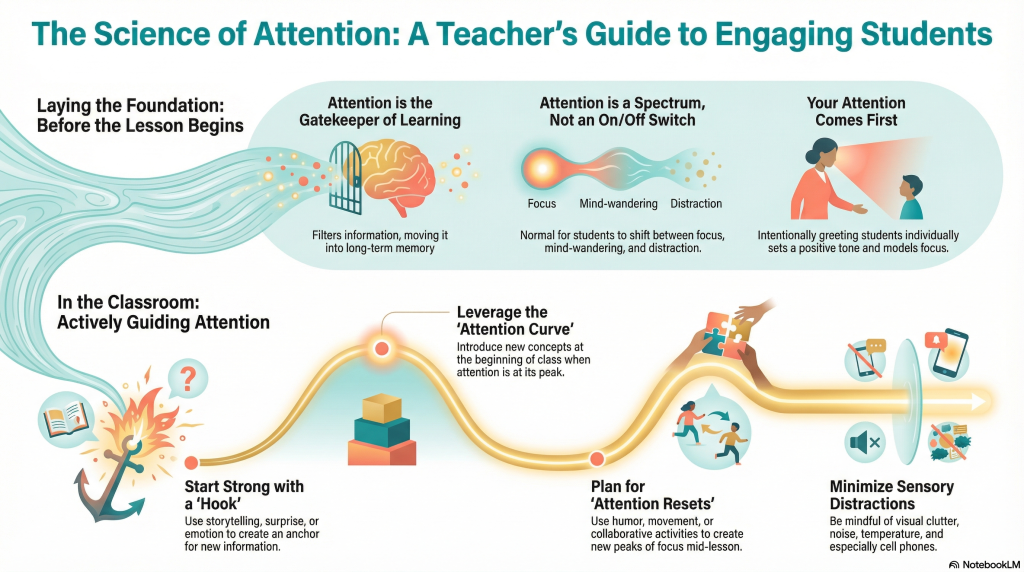
This infographic was created using the transcript of this episode and Google Notebook LM’s infographic feature based on the content shared in the show.
Listen to the Show
The Science of Attention: How One Teacher Changed Everything
Myriam Da Silva – Bio as Submitted
Myriam Da Silva, CheckIT Learning CEO
Myriam Da Silva is a visionary, entrepreneur, AI ethicist, speaker, and artist driven by a singular mission: to inspire people to believe in themselves. Through her work and her story, she empowers audiences to embrace their unique gifts as a force for contribution, leading lives filled with meaning, purpose, and fulfillment.
As the CEO of CheckIT Learning and President of the CheckIT Foundation, Myriam is pioneering a new vision for education grounded in human development. She is the creator of Cleo, the world’s first AI neuro-mentor designed to support teachers and students through the science of learning, and she developed a widely adopted Science of Learning micro-course that helps educators bring neuroeducation into daily practice.
Myriam works with global organizations on AI ethics and child-centered design, including UNESCO, iRAISE, and international coalitions shaping responsible AI in education. She will also be featured on Women in Power, an Inside Success TV series highlighting female leaders who are redefining impact and innovation.
She is the author of the forthcoming book The Black Sheep (2026), a powerful call to reimagine education so that every student’s uniqueness becomes their strength, empowering them to live, lead, and contribute with lasting impact.
Disclosure of Material Connection: This is a “sponsored podcast episode.” The company who sponsored it compensated me via cash payment, gift, or something else of value to include a reference to their product. Regardless, I only recommend products or services I believe will be good for my readers and are from companies I can recommend. I am disclosing this in accordance with the Federal Trade Commission’s 16 CFR, Part 255: “Guides Concerning the Use of Endorsements and Testimonials in Advertising.”
You Might Be Interested In
Never miss an episode
Get the 10-minute Teacher Show delivered to your inbox.
Thank you for subscribing to the 10 Minute Teacher! Now, check your email and confirm to get this podcast delivered to you every weekday.
Check out our past episodes at www.coolcatteacher.com/podcast
Any educator can attest to the mounting challenge of maintaining student attention in the classroom. Students’ exposure to digital media from a very young age has both diminished their capacity to pay attention and led them to crave interactions with devices during times when their use is not essential.
Yet, engagement matters. Students’ capacity to participate in activities and “be present” serves as a powerful indicator of how they will fare in engagement with people and academics. Here are a few ways to foster that engagement, despite the challenges:
1. Igniting Curiosity and Relevance
Students should be taught lessons with thought-provoking questions. The more inquisitive the mind, the more in sync they are with dealing with real-world problems and building connections later in life. It’s important to have teachers who help students see value in what they’re learning. To help students discover that value, allow them to draw connections by using current events, surprising facts, or personal stories as examples. Incorporating movement and multiple modes of learning in day-to-day classroom life helps to build active inquiry. The idea is to foster greater participation and sustained focus. Relating students’ learning to their lived experience will help you boost interaction, spark curiosity, and keep students invested in their learning journey.
2. Create a Safe and Supportive Environment
Countless studies have shown that psychological safety acts as a foundation for participation; encouraging a culture where all contributions are respected builds that much-needed safety net. An essential key to building this safety net is establishing your classroom as a stable structure that can hold student curiosity, experimentation, and mistakes. Take care to build consistency between sessions. Using callbacks to past discussions, maintaining a classroom journal, or introducing a themed narrative across lessons helps students to stay engaged and makes their learning journey more cohesive. Strategies such as think-pair-share or anonymous responses can help students build confidence, especially as they grow into less familiar areas of learning.
3. Use Storytelling and Creative Expression
Consistent use of storytelling in the classroom can deepen students’ connection with one another, their teachers, and their voice. Storytelling allows students to express novel ideas in a familiar format. It also helps to make abstract topics more accessible and memorable. But storytelling isn’t all about comfort and familiarity. Surprise elements, such as unusual prompts, playful props, music, or themed challenges can keep your students invested in the art of making narrative. Surprise and innovation also lead to improved memory and a sharper capacity to synthesize abstract concepts.
4. Incorporate Movement and Sensory Engagement
Integrating interactive elements such as hands-on activity, physical movement, and visual aid helps to combat student restlessness and increase their enjoyment of a lesson. If your material requires lecture, break it up with quick, student-centered activities; a movement break; or an opportunity for students to give feedback. Incorporating movement and sensory engagement helps to keep the energy levels up and supports varied learning styles.
5. Give Students Voice and Choice
Offering multiple ways to approach an assignment or allowing students to help determine class discussion fosters an invaluable sense of agency and control. Invite students to prepare and lead part of a lesson; they’ll integrate their perspectives into the experience, which benefits their teachers, their peers, and themselves. The resulting sense of autonomy will increase their ownership and investment in learning.
6. Be Flexible and Empathetic
It’s important that teachers and caregivers for students understand and respond to individual learning rhythms and needs. Having flexibility with pace, deadlines, and participation formats helps to build trust, reduce anxiety, and support engagement. Teaching students the importance of empathy from a young age helps them grow into more responsible and emotionally mature adults.
Conclusion
Student attention and participation need to be nurtured through intention, empathy, and creativity. It’s important to have an all-around approach towards student-centered learning. It is important that we encourage our teachers to experiment, listen, and evolve with their students. As teachers and caregivers, we can empower students to embrace the learning process and build confidence by infusing joy and curiosity into the daily routine.
A happy, comfortable classroom invites deeper engagement and holds its students in consistent positive regard. Introducing short activities like gratitude journaling, music, and light-hearted check-ins, while adding a bit of humor to them, creates a welcoming atmosphere where students are more likely to speak up, stay focused, and enjoy the learning process.
Mallory Hellman (she/her) is a writer, educator, and advocate for youth creativity. Since 2015, she has served as the Director of the Iowa Youth Writing Project, where she leads programs that bring free, high-quality writing opportunities to young people across Iowa. Mallory graduated from the Iowa Writers’ Workshop (MFA in Fiction) and Harvard University (BA in English and American Literature) and has taught creative writing at the University of Iowa, the Duke University Talent Identification Program, and in schools, shelters, and community centers throughout the Midwest. Her nonfiction has appeared in publications such as Tuesday Magazine and Forbes. In recognition of her leadership and community engagement, she received the Bravo Award from the Coralville Chamber of Commerce in 2015. In 2024, she co-founded the Experiential Education Collective, an organization devoted to promoting student-centered learning and hands-on creativity in schools and other educational spaces.
It can be tempting for department chairs to think about their role as a series of tasks on a to-do list: managing faculty and staff reviews, running department meetings, implementing a new university policy, dealing with unexpected emergencies. After all, it’s an ever-changing list that demands attention.
But focusing only on tasks misses the ways that chairs shape how department members interact with one another and the quality of relationships that result. Meetings are a common example. Chairs have choices about how to organize meetings, help staff feel included or excluded, coach new assistant professors about participation norms, and assign people to committees. How chairs do these routine tasks can have powerful effects on how department members relate to one another and the quality of relationships that develop. Cumulatively, small moments of interaction have a profound influence on a department and its culture and can be an important ingredient in helping to make departments healthier places to work.
However, many chairs aren’t used to noticing all the ways their everyday chair work impacts work relationships. To take advantage of the opportunity to positively impact relationships in departments, chairs need to develop their relational attention, or ability to notice opportunities to impact how people connect. Two years ago, I developed a six-part workshop series, Healthy Relationships at Work Fellowship, for chairs at University of Massachusetts Amherst, for a small cohort to work on just this issue. By engaging with research-based practices, they were able to develop competence and confidence as leaders while improving the quality of relationships in their departments.
Below, I describe four ways chairs can develop their relational attention and increase the occurrence of positive, inclusive relationships in their department. In describing these four suggestions, I share examples from two cohorts of chairs I’ve had the pleasure to work with.
Invest in one-on-one relationships with department members.
It is easy for department chairs to take for granted that they know the faculty and staff in their departments—and that they know you. After all, as a faculty member you have likely had many casual conversations and sat in many meetings with them. But relying on your past knowledge can leave chairs with an incomplete view. We all inevitably have some faculty or staff we favor and those we avoid, leaving us with uneven relationships and information about their work, motivations and lives. Similarly, faculty and staff may have a hard time viewing you as an impartial department chair unless you take the time to demonstrate it. After all, making visible efforts to cultivate relationships is a cornerstone of inclusive leadership.
One important way to create the foundations for positive inclusive relationships with your department members is to re-establish your relationships with them. You can do this by holding 30-minute one-on-one meetings with every member of your department. Given that chairs often have very little idea about what staff do and how they contribute to the department, it is important to meet with staff as well as faculty. In some departments, it may be important to meet with students as well.
Before beginning these one-on-one conversations, try to get in a mindset of openness, humility and genuine curiosity, no matter your relationship history. Ideally these meetings can occur in their workspace (versus your own office) so you convey that you are interested in them and are willing to come to their space. Ask open-ended questions about their interests, their motivations and their jobs. In smaller departments, these meetings can happen over the course of a month, while in larger departments it may require a whole semester. In larger departments, where one-on-one meetings seem impractical, you can hold meetings with small groups of people in similar roles or ranks. These meetings demonstrate that you want to hear from everyone, no matter your past relationships.
You may also learn new things that you can use to make your department a healthier place. For example, you may learn that two faculty unknowingly have a shared research or teaching interest. By connecting them, you can help to strengthen the connections within the department and potentially spark new collaborations.
What you learn in these meetings can also help to address unhealthy relationships. For example, one chair learned new information about a curmudgeonly faculty member who frustrated his colleagues (including the new chair!) because he had a reputation for not pulling his weight on committees. When the new chair asked him, “How do you want to contribute to the department?” she learned that the one thing he cared about was graduate education. With this new information, she placed him on a committee that matched his interests, and he contributed to the committee fully. By crafting his job to his interests, the faculty member was more intrinsically motivated to participate, and his colleagues were no longer annoyed by his behavior on committees.
Learn about the diversity of your faculty, staff and students and demonstrate your interest in learning from them.
Departments, like all organizations, are diverse in visible (race and gender) and invisible (political, neurodiversity) ways. While there is lots of debate about DEI these days, learning about the diversity of your faculty and staff helps you become a better leader because you can understand how to help everyone succeed. To develop positive inclusive relationships, chairs have to make visible effort to demonstrate respect and express genuine interest in people different from themselves.
To build chairs’ foundational knowledge, you can learn about the experiences of diverse groups in your department, school or university by reading institutional resources, such as climate surveys, or by having a conversation with college or university-level experts. For example, a conversation with a school DEI leader can speak to the experiences of your faculty, staff and students. A university’s international office can provide insight into immigration-related issues, which may be useful for understanding the complexity of managing immigration for international faculty, staff and students.
Bolstering your own knowledge can help contextualize issues that come across your desk. For example, if a student comes to you to complain about a faculty member’s teaching, and you have learned that members of that group have to fight for respect in your university’s classrooms, your knowledge about the broader climate can help you think of this complaint in light of the larger context as you consider what an appropriate response might be.
If you have more confidence in your knowledge, skills and abilities to manage DEI, you can connect more publicly. For example, if there are on-campus employee resource groups or off-campus community organizations, reach out and tell them you would like to learn from them; ask if there are any events that would be appropriate for you to attend. Given your stronger foundation in terms of the local DEI landscape, you can offer to connect marginalized faculty and staff with on-campus mentors and communities.
The ability of chairs to engage publicly with DEI issues will depend both on their own expertise and their institutional and local contexts, as DEI work grows more fraught in many parts of the country. Some chairs who have expertise in DEI or related topics may be comfortable hosting activities in their departments. For example, one chair hosts a monthly social justice lunch and learn, a voluntary reading group for faculty and staff. Given her expertise, she chooses the article and is comfortable facilitating the discussion herself.
Chairs can also create opportunities for critical feedback for the department. For example, if there is tension between groups within the department, instead of ignoring it, create a game plan for how to receive critical feedback about what’s causing the tension and how it might be addressed. Faculty and staff exert a lot of energy withstanding such tension; finding ways to address it can be a huge relief and release of energy.
Remember, faculty and staff evaluate a leader’s inclusivity based not just on one-time events, but instead search for patterns in terms of the leader’s efforts around inclusion. You don’t have to have all the answers about how to serve the diversity of members in your department, but you can strengthen your networks to include those with knowledge and expertise.
View committees as connection opportunities.
Chairs can use committees, meetings and other routine ways that faculty and staff gather as opportunities to build higher-quality connections. By focusing your relational attention on these routine interactions, you can improve relationship quality. For example, people often don’t know why they’ve been placed on a committee or task force, nor do they know what other people bring to the table. As a chair, you can use introductions strategically. Publicly communicating your view of faculty and staff strengths and potential contributions to committees, task forces and meetings helps them feel respected and makes it more likely others will view them that way. This can increase the chances that these routine ways of interacting will result in positive connections.
Committees and meetings are also opportunities to create greater inclusion of staff and to spread knowledge about their work. University staff too often feel like second-class citizens and that faculty don’t know or care about their expertise. To counter this tension, one chair introduces staff members as experts in their respective areas and provides them with opportunities to present in their areas of expertise in meetings. This chair reported that these innovations created new positive connections between faculty and staff; faculty had a new appreciation for staff work, and the staff felt seen and valued.
Design social events as connection opportunities.
We are in a moment in which many people want, and some have, the ability to work remotely. At the same time, faculty and staff desire more connection from work. As an architect of social relationships, chairs have the opportunity to hold meaningful social events that will bring people together. There is no one-size-fits all for designing such events: The goal should be to make events magnets, not mandates.
To start, think creatively about what will bring people together in your specific department. For example, one department chair knew all faculty would come together to support their students. In his department, faculty wanted their undergraduates to have a good experience in the major because they genuinely valued undergraduate education. Accordingly, the chair organized an open house event for faculty and students. In the process of connecting with students, faculty also deepened their connections to each other.
Another chair created a social event around the dreaded faculty annual reviews. The day before the reviews were due, she reserved a conference room and brought snacks so that faculty could trade tips about how to complete the cumbersome form. Still others hosted department parties at their homes, used departmental funds to host monthly lunches or upgraded the department’s shared space to make it more conducive to shared interactions.
Improving the quality of relationships through social events in a department doesn’t have to rely on the chair alone; it can also be the work of a culture committee that can brainstorm social events that will resonate. Ideally, these events will become part of the rhythm of the department. One caveat: It is not advisable to use workplace socializing to try to repair relationships between warring internal factions. In fact, it can make things worse.
Each of these four approaches can help chairs invest in and improve the health of relationships in their departments. It is, of course, also important to contain and manage negative relationships in them (that is another topic I address in the Healthy Relationships at Work program). But taking advantage of these everyday opportunities through strategically investing in your relationships, your knowledge and the ways people connect provides important sustenance to support departmental relationships and ultimately a positive departmental culture.
Emily Heaphy is a professor of management, a John F. Kennedy Faculty Fellow and an Office of Faculty Development Fellow at the University of Massachusetts Amherst. She developed the Healthy Relationships at Work Fellowship for department chairs when she was a Chancellor’s Leadership Fellow affiliated with OFD in 2023–24.
After graduating from Knox College in Illinois with a bachelor’s degree, Stephanie Martinez-Calderon’s plans were upended by the pandemic. She hadn’t planned on becoming a teacher but found an opportunity to tutor remotely for the year after college.
Tutoring helped her build confidence and develop instructional skills, and today she’s a middle school teacher in the Washoe County School District in Nevada.
Tutoring can be a powerful training ground for future educators, providing hands-on experience, confidence and a bridge into the classroom. And what might begin as a temporary opportunity can become a career path at a time when teachers are needed more than ever: A recent report noted that nearlyone in five K-12 teachers plan to leave teaching or are unsure if they’ll stay.
Turnover remains a crisis in many districts, one that can be solved by a ready-made pipeline of young future educators with instructional experience and relationship-building skills they’ve gained from tutoring.
How school districts think about tutoring should evolve. Rather than seeing it as a short-term response to pandemic-interrupted learning, they should view it as part of the fabric of school design and future educator development. This requires including tutoring in strategic plans, forming community partnerships and creating a structure to sustain programs that cultivate tutors for careers in education. To fund these programs and pay tutors, districts can redirect Title I funds, use federal work-study and create apprenticeship programs.
Starting as a tutor allows aspiring educators to build core teaching skills in a supportive, lower-stakes environment. Tutors learn to navigate student relationships and adapt lessons to individual needs. Without having to manage an entire classroom, they can practice asking questions that get students thinking and selecting problems to help students learn. This early practice eases the transition into teaching.
Tutors from Generation Z, born between 1996 and 2012, often bring fresh energy to the profession. As digital natives, they are reimagining how to engage and inspire students, leverage technology and foster creativity and new approaches to learning.
They are alsothe most ethnically and racially diverse generation yet: Many come from backgrounds historically underrepresented in the teaching force; over half of undergraduates identify as first-generation college students. Their engagement broadens the prospects for a more diverse teacher pipeline.
Gen Z’s emphasis on flexibility and remote opportunities is one of the most significant workforce changes since the pandemic. They value mental health, stability and mission-driven work. Part-time, hybrid and wellness benefits help recruit young talent.
At our nonprofit, recruiters hear from education candidates that Gen Z appreciates the chance to try out industries, and that tutoring provides them with a window into the world of teaching.
Public schools could better meet the evolving needs of young professionals entering education by reimagining tutor roles to include hybrid options, mental health supports and collaborative teaching pathways for professional growth. For instance, a tutor might start off working in a part-time online tutoring role, but after interacting with students virtually and gaining more experience, they may be more excited to take on a full-time teaching role on-site.
For school districts, tutoring programs can serve as effective recruitment pipelines. By offering recent graduates a low-barrier entry point into education — one that doesn’t require immediate certification — districts can spark interest in teaching among candidates who may not have previously considered it.
When tutors step into teaching roles, they bring valuable continuity — familiarity with the students and insight into progress and school culture. This seamless transition supports both student learning and district staffing needs.
The idea that tutoring should be built into future educator pipelines is spreading. For example, since the launch of its Ignite Fellowship in 2020, Teach for America says that 550 of its former tutors have become full-time teachers. The program has proven to be especially effective at drawing in nontraditional candidates — those who may not have initially envisioned themselves in the classroom. In Washington, D.C., the school district launched a tutor-to-teacher apprenticeship program after success with high-impact tutoring. In Texas, teacher residents are required to work as tutors and in other support roles while co-teaching with a mentor.
By offering flexible, purpose-driven opportunities, districts can attract Gen Z professionals and give them a meaningful entry point into teaching. And tutoring programs can become more than academic support — they can serve as strategic talent pipelines that strengthen the future of the teaching workforce.
Alan Safran is co-founder, CEO and chair of the board ofSaga Education; Halley Bowman is senior director of academics.
This story about tutoring was produced byThe Hechinger Report, a nonprofit, independent news organization focused on inequality and innovation in education. Sign up for Hechinger’s weekly newsletter.
The Hechinger Report provides in-depth, fact-based, unbiased reporting on education that is free to all readers. But that doesn’t mean it’s free to produce. Our work keeps educators and the public informed about pressing issues at schools and on campuses throughout the country. We tell the whole story, even when the details are inconvenient. Help us keep doing that.
Earlier this month, the Manhattan Institute released a statement with a proposed “new contract” for higher education and called on President Trump to write the terms of that contract into “every grant, payment, loan, eligibility, and accreditation” and then revoke federal funding for colleges and universities if they aren’t following them. To maintain public funding, universities would, for example, have to “advance truth over ideology,” “cease their direct participation in social and political activism,” and “adhere to the principle of colorblind equality, by abolishing DEI bureaucracies, disbanding racially segregated programs, and terminating race-based discrimination in admissions, hiring, promotions, and contracting.”
Another term of the proposed contract would require universities to enact “swift and significant penalties, including suspension and expulsion, for anyone who would disrupt speakers, vandalize property, occupy buildings, call for violence, or interrupt the operations of the university.”
You may be thinking: Well, think tanks and political actors publish things like this all the time. What’s the big deal?
This proposed list of reforms was led by the Manhattan Institute’s Christopher Rufo, who has been the architect of many of the attacks on higher ed that we have seen come out of the White House and the Department of Education over the last six months.
But what is more concerning is it was signed by Congresswoman Virginia Foxx—former chair of the House Education and Workforce Committee who oversaw the first subpoena sent to a higher education institution under the pretext of fighting antisemitism on campus. It was also endorsed by Education Secretary Linda McMahon, who posted on X to congratulate the Manhattan Institute for “envisioning a compelling roadmap to restore integrity and rigor to the American academy!”
All this brings to mind Project 2025—an initiative led by another conservative think tank, the Heritage Foundation, which Democrats warned the American people about before the election and that has since been largely followed as a policy agenda for the Trump administration. You may remember that the education chapter of this conservative platform was written by the director of Heritage’s Center for Education Policy, Lindsey Burke—the same person now serving as the deputy chief of staff for policy and programs at the U.S. Department of Education.
We now have another road map that college leadership and policymakers need to be ready to push back on. As noted above, the Manhattan Institute’s agenda is comprised of pledges for colleges and universities that include ending participation in social and political activism; abolishing diversity, equity and inclusion programs; ending race-based decisions in hiring, promotions and contracting; and enacting restrictions on free speech. In other words, it is a road map for a new level of federal interference into the administration of colleges and universities. It is not a road map for reforms that will help students. Rather, it is an attempt to undermine the independence of our higher ed institutions by dictating policies—those based on a specific political ideology—in exchange for federal funding.
What’s next? Just like the proposals in Project 2025, Christopher Rufo’s proposals have had a pretty good track record of being implemented by the Trump administration. If the past is prologue, we can expect to see new language in program participation agreements that ties Title IV funds to restrictions on academic freedom; new accreditation rules that prohibit standards around diversity, equity and inclusion; and certifications sneaked into grant terms and conditions that threaten strict penalties for activities that do not align with this administration’s ideology.
Higher education institutions have been far from perfect, and some may even have drifted from their missions of serving all students in the best way possible. But what students deserve is a reform agenda that leads to student success, college completion and strong postsecondary outcomes. That is the agenda that should be endorsed by our nation’s leading education official. What the Manhattan Institute is proposing is not an agenda that is in our country’s best interest.
We need an agenda that makes access to a college degree or credential of value affordable and accessible. We need an agenda that allows a range of viewpoints to thrive across college campuses and fosters intellectual diversity. We need an agenda that ensures college campuses are inclusive communities and that they serve all students, and we should have a contract between the federal government and colleges and universities that protects investments in our nation’s future and success—not one that threatens disinvestment and opens the door for political interference and federal intrusion.
Amanda Fuchs Miller served as the deputy assistant secretary for higher education programs at the U.S. Department of Education in the Biden-Harris administration. She is the president of Seventh Street Strategies, which advises higher ed institutions, nonprofit organizations and foundations on policy and advocacy strategies.
How do you get the news media to care about your research? Dr. Sheena Howard helps academics who want a larger media presence. She’s been featured in ABC, PBS, BBC, NPR, NBC, The L.A. Times, The New York Times, and The Washington Post.
We talk about gaining visibility for your research. And the income you can make as an authority from things like speaking engagements! We even get into how much to charge when you speak. What should a PhD charge for a 60 minute talk? The minimum is probably more than you think.
Dr. Sheena Howard is a Professor of Communication at Rider University. She won an Eisner Award for her book, Black Comics: Politics of Race and Representation. She is founder of the Power Your Research program. See full bio.
Meet Dr. Sheena Howard
Jennifer: Hello, everyone! Welcome to The Social Academic. I’m so excited for this interview today.
I’m speaking with Dr. Sheena Howard, a Professor of Communication. And she’s an expert at helping academics really find the media attention that they deserve. So, Sheena, I’m so excited that you’ve joined me today.
Would you mind introducing yourself for everyone?
Sheena: Sure, I’m happy to be here. A big fan of your work, Jennifer.
My name is Dr. Sheena Howard. I am the founder of Power Your Research, an academic branding company. I’m also a full professor and an author.
Jennifer: Not only are you an author, you’re an award-winning author. I’m so impressed with the amount of research that you’ve been able to produce and you’re also helping these people in so many different ways!
Can you tell me a little bit more about your research?
Sheena: My writing career started out as an academic. I did my dissertation on gender and race in comics like: comic books, comic strips, superheroes. That’s what my dissertation was on. Also, looking at African-American communication dynamics in Black comics.
Since then, I’ve been publishing fiction, non-fiction. I write comic books and graphic novels.
“All of my work is there to really inspire people to challenge the status quo, stand up for themselves, and to feel empowered when they are in situations where they feel like they need to sort of speak truth to power or just stand up for themselves.”
Jennifer: Oh, that’s really interesting! I recently got your book Why Wakanda Matters: What Black Panther Reveals About Psychology, Identity, and Communication. Your chapter was just fascinating to me. I hadn’t really thought about Black Panther in that kind of deep understanding of how people are communicating, how people are making decisions. I was just fascinated. I’m so excited for the new movie that’s coming out. I can’t wait to re-watch both of them now that I have your book.
Sheena: Yes.
Jennifer: One of those things that was really interesting to me is how much media attention you’ve been able to get for your comic research. I loved your appearance in Milestone Generations on HBO. I’d love to hear a little bit about how gaining media attention for your research has impacted you.
Sheena: Yeah. There’s a lot of research out there that shows that when you get media coverage and visibility it actually brings more people to your academic research articles. I know these things sound separate where academics are publishing in academic journals, and those things tend to only be read by academics.
But when you start branching out to get media coverage on NPR, BBC, all of the places you may have seen me—It actually translates into more academics citing your work, using your work. It also helps you to reach the people, the everyday people who are not in academe.
That has always been super important to me. I want to help and change the lives of people who are not in Higher Ed, who are not in the academic space. But who are actually the people that I research, and write about, and for.
Jennifer: Hmm. That’s something that so many people don’t consider, much less taking steps to even approach that.
How much should PhDs charge for a talk or speaking engagement?
Jennifer: I know one of the reasons why some women professors especially are hoping to get more media attention is because they want to speak more about their research. They want to actually bring in some money from speaking fees. I know you have amazing advice for this.
What’s your advice for women PhDs who are looking to speak more about their research?
Sheena: When you have a PhD, or even a master’s degree, being in Higher Ed for so long in that way, especially if you are a faculty member, or want to be a faculty member…It makes us forget that our work actually has value outside of Higher Ed. By the time you get a PhD, in your mind, unfortunately for a lot of us the only thing we can do is be a professor, is to be a faculty member.
In my academic branding program I’m helping people to understand that no matter what your PhD is in, you have value outside of Higher Ed. That translates into speaking engagements because a lot of academics are asked to speak for free. Or, are asked to do a 1 hour talk for $500 or $1000. And when people do that, especially women right? When women with academic credentials do speaking engagements at those low rates, it’s actually a disservice to everybody with a PhD who is interested in doing speaking engagements.
Because it happens so often, and is so prevalent. Particularly universities and institutions think that it’s okay and normal to ask someone with a PhD to do a speaking engagement for $500 and $1000.
I’m really doing the work to empower people not to accept those rates. Because we’re in our own world, in silos, we think we have to accept those rates. Particularly for women. We like to tell ourselves, “Well I need to do these free ones, and I need to do these speaking engagements for $500 because I have to build up my speaking career. But that is not true. You already have a PhD. You’ve already defended a dissertation. You are already a subject matter expert, more so than someone that doesn’t have a PhD. And people without academic credentials are charging $10,000 for 1 hour talks. And they are not even subject matter experts in the traditional educational way.
Jennifer: We’re talking about a really big difference from what many—especially academic women—are accepting for their speaking fees (an honorarium of maybe $500 to $1000) and what other people are getting paid for their speaking fees (up to $10,000). Maybe even more depending on the talk. That’s a huge range.
What do you recommend for women? What even is a speaking fee that might be acceptable for PhDs?
Sheena: “I teach people that your speaking rate is $3500 if you have a master’s degree or a PhD for a 1 hour talk. It’s $3500. And you shouldn’t be paying to travel there so that $3500 is just the speaking fee.”
Because you have to think about the hours that you’re spending preparing the 1 hour talk. And then the talking that you have to do after you come off stage.
$3500 for a 1 hour talk is not unreasonable. It might sound unreasonable to a listener who has been only doing speaking engagements for that low rate. But I can assure you that your male counterparts are charging more than $500 or $1000 for a talk.
A lot of this is psychological. Because if you just say, “Yes,” then you’re always going to be offered $500 or $1000. Sometimes it’s as simple as responding with an email saying, “I am so honored that you reached out to me. I would love to speak at your institution. But, my speaking engagement rate is $3,500.”
Jennifer: I love that! It sounds like a simple email thanking them for the invitation and setting your rate (regardless of what they offered you) is the next move. And that’s something that’s so scary for so many people.
I mostly work with academics who are not already looking for this kind of really big paid speaking engagement rate. Or, they haven’t done it before. So if I mentioned it to them, “Oh, you should get in touch with Dr. Sheena Howard if you want to do more speaking and media things. She’s an expert in that! But your minimum rate should be $3500.” I mean their minds are just blown. It’s just a totally new concept for so many people.
And many universities too. I think you’re so right when universities get the positive reinforcement that that is the fee people are willing to accept, they are more likely to offer it to you whether they have a bigger budget or not.
Sheena: Exactly.
Jennifer: So setting your own rate is how to protect yourself and ensure that you’re getting paid for the quality work that you’re doing:
Stop doing free talks for exposure by setting boundaries
Sheena: Right. This is why I say most of this is psychological, because a lot of times the academic will convince themselves that, “Well I don’t know. This High-End University asked me to speak. And I’ll be getting exposure.”
“No. You’re not going to get exposure. You’re not going to get a return on that investment. You’re literally only going to get what they’re paying you.”
Sometimes you have to tell them, “Hey, I suggest you come back to me once you have a chance to connect with other student organizations so you can put your budgets together.” I’ve had to tell people that and a lot of times, magically, all of a sudden they find the money.
But the point is, when you have boundaries right? Because setting your rate, not just changing the rate based on who’s asking you, means you have to have boundaries. When you have boundaries, the ball is in your court. Because if they come back and say, we really don’t have $3,500 in our budget. Well then now you get to decide.
I would say don’t do it. But now at least you get to decide. Because the best leverage you have is to walk away.
Jennifer: Right! Walking away is always an option.
One of the things that I love about what you share on LinkedIn and on Twitter, is that it is a decision-making process. Choosing whether to do that free talk, or not, is a decision-making process. You have a number of steps that you go through to decide whether it’s something that you’re open to, things like
Having a past connection with the organization
Being able to reach the public
Helping more people
You have things that you’re looking for, that you will get out of the talk instead of money. I think that that’s really important too. Like, it is okay to take a free talk. But you want to think about
How it’s going to help you
How it’s going to help other people
How it’s going to look like in your schedule
What’s going to work for you
I just love everything you share about it.
Sheena: That’s right. I do teach people part of your boundaries is actually having a checklist of when you will do a speaking engagement for free.
But you shouldn’t be wavering from that checklist. If your checklist has 4 things on it, right? I’ll do a free speaking engagement if it meets X, Y, Z criteria…it has to meet all those criteria for you to do it for free. If it doesn’t, you can’t do it for free. I walk people through a criteria around doing a speaking engagement for free to determine if you should be doing that or not.
Jennifer: I love how much you’re talking about setting boundaries for yourself. Was that something that was hard for you when you first started speaking? Or, did that come naturally?
Sheena: When I talk about building a brand, you’re essentially building a business. Because you’re making money off of leveraging your academic credentials. That money goes into your business pot, not your personal pot. Because you are the business and you can’t run a successful business if you don’t have boundaries. Right?
I run my coaching program. If I just change my coaching schedule based off of everybody else’s schedule, I wouldn’t have a coaching program. Right? This is my schedule. This is when I’m available for coaching calls. I’m not going outside of that. Otherwise, I wouldn’t have a business to run because it would be completely out of control.
It’s the same thing when we’re thinking about speaking engagements to be quite honest. You can’t really build your brand successfully and leverage your academic credentials successfully if you’re trying to financially protect your future. If you don’t have boundaries.
And yes, I had to learn that because I wouldn’t be where I am with my two businesses if I didn’t. You have to take the emotion out of boundaries. These are the parameters and that’s it.
Jennifer: Now not only are those the parameters but like that’s how you make it work with your lifestyle: with being a Professor, with actually having two businesses. It wouldn’t work unless you kept those boundaries.
Sheena: Oh my God. Jennifer, that is so true. I am a single mom. I am a full Professor at a university. I run two businesses.
I have to have boundaries to make all of this work. Yeah. I mean it’s just so important.
Jennifer: Now we’ve talked a little bit about speaking engagements and how having that kind of online presence and being found by the media can help get more attention to your research.
What makes up your online presence?
Sheena: One thing that’s really important is to know when your name is mentioned anywhere on the internet.
Now they have paid tools where you can monitor when you’re mentioned. I don’t use any of those paid tools. I just use Google Alerts. All different versions of my name are in Google Alerts—Sheena Howard, Dr Sheena Howard, Sheena Howard PhD, like all different versions are in Google Alerts.
This is really important because sometimes the media will quote me in things that I didn’t even know they were quoting me in. Or, I didn’t know the article was out. But I get it immediately when my name is mentioned. This is important in having a digital footprint, a digital presence. To just even know what is out there about you because you need to be intentional about your digital space.
The other thing is your personal website.
I teach people you need to own your virtual real estate. Your stuff online is real estate. You literally can make money off of it. And you need to think about your online presence as literally the equity that you’re building in your house.
When you have your website, you should own your name. So SheenaCHoward.com, I should own that URL. DrSheenaHoward.com, I should own that URL.
If you don’t own your name right now in the virtual space, in terms of buying that URL which you can do for like $15 a year on like GoDaddy or something like that. You need to go and buy all those different versions of your name. That makes up your digital footprint as well, just owning your virtual real estate.
Your website should have good SEO [Search Engine Optimization]. When someone types in like “black comics,” I want my name to come up. It will, if anybody’s listening to this they type in “black comics,” something about me is going to come up on the 1st or 2nd page of Google Search results.
But also when someone types in my name, I want my website to come up because I’m controlling my brand to some extent. This is what I want people to know about me when they type in my name. Not some random video that I did 10 years ago.
Your website is definitely something that makes up your brand. And then everything that people are saying about you, like reviews: Google reviews, all of those public places where people can leave reviews about you, your business, your work makes up your digital footprint, your online presence.
Jennifer: I love that you talk about it like real estate. I speak with so many professors that have maybe been given space on their University website to create a page, or they use a page that has been given to them by Humanities Commons, or another organization. It’s different than owning your own space, than having complete control over a website and a domain that you own.
I love what you said about comparing it to owning real estate and really investing in having control over your own name. Thank you for sharing that.
Sheena: Yeah, for sure. It’s about ownership because it’s kind of like your website is hosted by wherever it’s hosted by. And obviously you don’t own that company, but you own it more than you own your Instagram page, or your Facebook page, or your or your Twitter page. Right? You can directly be in contact with people. You can track your traffic to your website. You can send them to your mailing list.
If something happens with any of these platforms you still can be in direct communication with the people that are your fans and followers and that kind of thing.
Jennifer: I love that because you’re really talking about people who are trying to make those kind of longer term connections, inviting people to their website.
A lot of the people that I work with have never really thought about the audiences for their website before. They’re just thinking of other academics, or other researchers at that point when they first reach me. So that’s really normal if you’ve never thought about it before. That’s normal.
However, your website will reach so many more people. And it does invite more people, and media, and other researchers of course. But also the public, to explore your work. Owning that real estate is not just inviting people to your research, it’s inviting people to learn more about you as a person and see how your work can help them. I really enjoyed that comparison to real estate. That’s great.
Why you want a larger media presence for your work
Jennifer: You’ve created the Power Your Research program because you want to help academics have a larger media presence, to get real recognition for their work. Why should academics want that?
Sheena: There’s two reasons why I created Power Your Research. The 1st is because unfortunately a lot of people with PhDs are living paycheck to paycheck. Or, they’re not getting the income that they want to be getting from their universities. So you have people with PhDs who can’t even break into academe, because at this point getting a tenure track position is almost like making it to the NFL, if we’re being honest.
Then, we have people who are on tenure tracks, or who have tenure, who now all of a sudden they realize, “Oh my goodness, there is a pay ceiling to this once I get tenure, I got to go for Full.” And Full [Professor] is the highest promotion that you can get. You’re just not going to make any more money for the rest of your career because you’re a Full Professor. What a lot of people will do is they’ll go the administration route because they want to make more money, not necessarily because that’s what they want to do.
I created the Power Your Research program to empower people. To say, “Hey, look. You can make more money building your brand than any university or institution can ever pay you anyway.” If you have tenure you might as well do that because your work can leave an impact on people. You can reach more people. You can really do the things that you want your work to do.
If you’re not on a tenure track, and you’re one of these PhDs or people with master’s degrees that are not even in Higher Ed, you can leverage your academic credentials to make six figures and more.
That’s the 1st reason why I created the program: to empower people to own their academic credentials in their career.
The 2nd reason why I created Power Your Research is because with these free tools that we have out here, unfortunately, educators and academics are not the ones with the microphones reaching everybody. And they are the subject matter experts.
There are people who are very good at digital media, good at using these tools, who are not subject matter experts who have the microphone and are reaching millions of people.
I personally believe that society is better when the subject matter experts have the microphone. And have the visibility and media coverage to reach more people. Because they’ve done the academic and educational work. They should also be the ones out there on the forefront.
Those are the two reasons why I created Power Your Research for my academics and educators.
Jennifer: I love it! Oh that sounds amazing. I think there’s so many women who are listening right now that are like, “Oh, I need six figures. That sounds like the program for me.”
Can you tell people a little bit about what to expect from the program? Like who should reach out and actually book a call with you to talk about this.
Because more people should be in this program and get that expertise to actually communicate and get the money that they deserve.
Sheena: Yeah, so there are kind of two buckets of people in the program. There’s people who, have PhDs, some people have master’s degrees, who are not like working as faculty members. But they might have a small business that they just started and they’re trying to get lead generation and just trying to figure it out. Maybe they have a different full-time job, they’re trying to figure it out.
The other bucket of people are people who are on tenure track positions or who are tenured, who are the people that we just spoke about, where they’re like, “Hey, there’s a pay ceiling.” They’re feeling unfulfilled in Higher Ed. They’re looking for the next thing. They want to make more money. They’re living paycheck to paycheck, or not making the income that they want to make.
Basically anybody with academic credentials, I can teach you how to leverage those so that you can own your future, and protect your future, and build equity in your brand.
Being an academic expert in a documentary
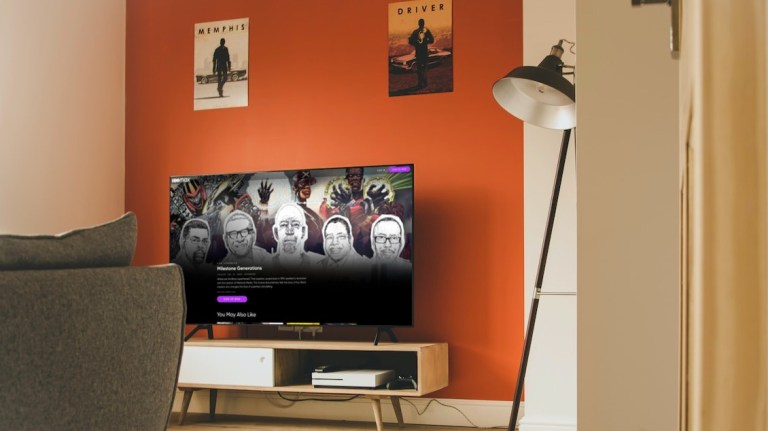
Milestone Generations (2022) was released recently on HBO. It is a documentary that asks, “Where are the Black superheros?” exploring the history of Milestone Media hosted by Method Man.
Jennifer: You’ve done it for yourself. You really are an expert who’s been on all of the national outlets, and in documentaries, on TV shows.
What was it like being in Milestone Generations? I know you’ve been on other TV spots before, but that was the one that just came out and I watched it.
Sheena: Oh, thank you.
Yeah, that was that cool. It’s always awesome to kind of get recognition like that, in my opinion. Because I get to reach more people. I get to help more people.
It was amazing. I got to go to New York. I was on set. It was during COVID, so we had to do multiple COVID-19 tests. But it was amazing.
It was a big honor and, to be honest, I worked hard to be able to get positioning like that without spending money on a publicist. I don’t pay publicists.
I do this all on my own by just really honing in on the things that I teach academics to do around leveraging their brand. And I’m focused. I’m just focused.
Once you get the media coverage and visibility, and you’re consistent for a period of time, you don’t have to pitch yourself anymore because you already have the online presence. When someone types in “black comics” or whatever, something about me is gonna come up. And so I’ll be able to kind of get to the top of the list of experts that can talk about black comics, the comic space, that kind of thing.
Anybody can do that with their educational backgrounds. This is really what I want people to understand. Anybody can get to that place, just a period of time that you have to do a specific set of activities until you can kind of sit back and kind of enjoy the fruits of your labor.
Jennifer: You just mentioned something that I’d like to ask about. Because I think a bunch of people are maybe going to have this question.
Sheena: Yeah.
Jennifer: Can you hire a publicist? And if so, how much does it cost? You teach people how to do it themselves, but hiring a publicist probably sounds more attractive to some people. So what does that actually look like? I think it’s really expensive, right?
Sheena: Hiring a publicist sounds more attractive because people actually have a misconception about what publicists do. I actually did a live video on this the other day.
“People think they’re going to hire a publicist, the publicist is going to do all the work for them. They’re going to put their content out there, they’re going to run their social medias, they’re going to get them media spots. That is not what a publicist is there for.”
You have to provide the publicist with the content. You need to come to the publicist with something for the publicist to put out into the world. A publicist doesn’t just work with you and then call up The New York Times and be like, “Hey, I got a client.” You have to be the publicist for things.
You have to work with the publicist for at least 3-6 months before you see any results because they have to build up to getting you that media coverage and visibility. But they also have to have something to build upon.
A publicist is like $3,000-$5,000 a month.
You’re not gonna see results for a while. You’ll probably get a couple of media spots. But you will have no idea what your brand is, who you’re trying to reach, or any of that.
I want to be clear that publicists are not scams or anything like what people might be thinking. Publicists are actually really good at their job, so they have to have something to work with.
I used a publicist one time. And I might use a publicist in the future. But there’s a very specific way you should go about this so that you’re not paying $3,000 to $5,000 a month. The 1st is to build your brand on your own. Have something for the publicist to build off of. So do the work.
The second is if there’s a high-end media outlet that you want to be on…Let’s take me for example. I was on The Breakfast Club, it’s a very high-end podcast known worldwide. You see politicians go on there all the time.
I did the work on that. I got in contact with Charlamagne tha God, who is the host, on my own. I got him to follow me on Twitter. Eventually, after about 6-8 months, I got the email address of the producer. I emailed the producer on my own. Then at that point, I hired a publicist to just go into the end zone and lead the rest of the way because that was high-end.
Instead of me having to pay $3,000 to $5,000 a month, I could pay a little bit less for a shorter period of time. Because I just wanted the publicist to really do that one thing. So, that’s a different way to go about getting a publicist. Save yourself some money.
But I mean for all the places I’ve been, I have not had a publicist with me—ABC, Good Morning America, Digital BBC, NPR—that was all me working working the systems that I teach.
Jennifer: Amazing! Well for everyone who’s listening, Power Your Research, is the program that’s going to teach you how to do that. You get to work with Dr. Sheena Howard and learn how to really control your own media. And reach out to people and actually make those connections yourself.
Dr. Howard, is there anything else you’d like to discuss before we wrap up?
Sheena: I want to say since I did mention the publicist that I worked with for a little bit, shout out to Sam Mattingly, the publicist that I did work with a few years ago. She was amazing, and believed in me, and believed in my mission, and believed in my message. But I came to her with things for her to use to promote my brand. I had been promoting my brand for years before I reached out to her for that limited period of time. Shout out to her.
Hopefully your listeners found this valuable. Hopefully there are some things in there they can take and implement right now. That is my goal: to empower all of my academics and educators.
Jennifer: Well thank you so much for coming on the show, Dr. Howard. Thank you so much!
Sheena C. Howard, is a Professor of Communication. She is an award-winning author, filmmaker, and scholar. In 2014, Sheena became the first Black woman to win an Eisner Award for her first book, Black Comics: Politics of Race and Representation. She is also the author of several critically acclaimed books and comics books on a range of topics. Sheena is a writer and image activist, with a passion for telling stories, through various mediums, that encourage audiences to consider narratives that are different than their own.
In 2014, Sheena published Black Queer Identity Matrix and Critical Articulations of Race, Gender and Sexual Orientation. Sheena is the author/editor of the award-winning book, Encyclopedia of Black Comics and the cowriter of the comic book Superb, about a teenage superhero with Down Syndrome. In 2016, through her company Nerdworks, LLC, Sheena directed, produced and wrote the documentary Remixing Colorblind, which explores the ways the educational system shapes our perception of race and “others.”