Tag: avoid

  • Duke Asked Some Faculty to Avoid Talking to Media

    Duke Asked Some Faculty to Avoid Talking to Media

    Duke University file photo

    As Duke University navigates a $108 million federal research funding freeze and multiple investigations by the Trump administration, administrators want faculty to avoid talking to the media about institutional operations, The Chronicle, Duke’s student newspaper reported Monday.

    According to an August email obtained by The Chronicle, Jenny Edmonds, associate dean of communications and marketing at Duke’s Sanford School of Public Policy, encouraged faculty to “continue to engage with the media to disseminate [their] research as [they] have always done,” while also cautioning that “media attention to institutions of higher education and discussions about institutional responses to policy changes have become more prominent than ever.”

    “In this moment in particular, questions about Duke and current events are being answered by Frank Tramble and his team,” Edmonds wrote. “If you are contacted by the media about overarching issues confronting the University, please forward the requests to [Sanford’s Senior Public Relations Manager Matt LoJacono] and me.”

    Although it wasn’t a universitywide directive, The Chronicle obtained emails that show some other departments also gave their faculty similar instructions to route media requests through the university’s central communications channels.

    At an Academic Council meeting in October, Duke’s president, Vincent Price, and council chair, Mark Anthony Neal, commended faculty members for not speaking to a New York Times reporter; the reporter had visited the campus while working on a story about the Trump administration targeting Duke’s diversity, equity and inclusion program.

    “It was pretty amazing that [the reporter] actually got no commentary from Duke officials and Duke faculty,” Neal continued. “Even if it wasn’t overtly communicated to the community, the community understood the stakes of that mode of inquiry.”

    At that meeting Price also called Trump’s higher education compact—which would allegedly give universities preferential funding in exchange for making sweeping institutional policy changes— “highly problematic,” according to The Chronicle. Despite public pressure, Duke hasn’t officially rejected the terms of the compact.

    Source link

  • How districts can avoid 4 hidden costs of outdated facilities systems

    How districts can avoid 4 hidden costs of outdated facilities systems

    Key points:

    School leaders are under constant pressure to stretch every dollar further, yet many districts are losing money in ways they may not even realize. The culprit? Outdated facilities processes that quietly chip away at resources, frustrate staff, and create ripple effects across learning environments. From scheduling mishaps to maintenance backlogs, these hidden costs can add up fast, and too often it’s students who pay the price. 

    The good news is that with a few strategic shifts, districts can effectively manage their facilities and redirect resources to where they are needed most. Here are four of the most common hidden costs–and how forward-thinking school districts are avoiding them. 

    How outdated facilities processes waste staff time in K–12 districts

    It’s a familiar scene: a sticky note on a desk, a hallway conversation, and a string of emails trying to confirm who’s handling what. These outdated processes don’t just frustrate staff; they silently erode hours that could be spent on higher-value work. Facilities teams are already stretched thin, and every minute lost to chasing approvals or digging through piles of emails is time stolen from managing the day-to-day operations that keep schools running.  

    centralized, intuitive facilities management software platform changes everything. Staff and community members can submit requests in one place, while automated, trackable systems ensure approvals move forward without constant follow-up. Events sync directly with Outlook or Google calendars, reducing conflicts before they happen. Work orders can be submitted, assigned, and tracked digitally, with mobile access that lets staff update tickets on the go. Real-time dashboards offer visibility into labor, inventory, and preventive maintenance, while asset history and performance data enable leaders to plan more effectively for the long term. Reports for leadership, audits, and compliance can be generated instantly, saving hours of manual tracking. 

    The result? Districts have seen a 50-75 percent reduction in scheduling workload, stronger cross-department collaboration, and more time for the work that truly moves schools forward.

    Using preventive maintenance to avoid emergency repairs and extend asset life

    When maintenance is handled reactively, small problems almost always snowball into costly crises. A leaking pipe left unchecked can become a flooded classroom and a ruined ceiling. A skipped HVAC inspection may lead to a midyear system failure, forcing schools to close or scramble for portable units. 

    These emergencies don’t just drain budgets; they disrupt instruction, create safety hazards, and erode trust with families. A more proactive approach changes the narrative. With preventive maintenance embedded into a facilities management software platform, districts can automate recurring schedules, ensure tasks are assigned to the right technicians, and attach critical resources, such as floor plans or safety notes, to each task. Schools can prioritize work orders, monitor labor hours and expenses, and generate reports on upcoming maintenance to plan ahead. 

    Restoring systems before they fail extends asset life and smooths operational continuity. This keeps classrooms open, budgets predictable, and leaders prepared, rather than reactive. 

    Maximizing ROI by streamlining school space rentals

    Gymnasiums, fields, and auditoriums are among a district’s most valuable community resources, yet too often they sit idle simply because scheduling is complicated and chaotic. Paper forms, informal approvals, and scattered communication mean opportunities slip through the cracks.

    When users can submit requests through a single, digital system, scheduling becomes transparent, trackable, and far easier to manage. A unified dashboard prevents conflicts, streamlines approvals, and reduces the back-and-forth that often slows the process. 

    The payoff isn’t just smoother operations; districts can see increased ROI through easier billing, clearer reporting, and more consistent use of unused spaces. 

    Why schools need facilities data to make smarter budget decisions

    Without reliable facilities data, school leaders are forced to make critical budget and operational decisions in the dark. Which schools need additional staffing? Which classrooms, gyms, or labs are underused? Which capital projects should take priority, and which should wait? Operating on guesswork not only risks inefficient spending, but it also limits a district’s ability to demonstrate ROI or justify future investments. 

    A clear, centralized view of facilities usage and costs creates a strong foundation for strategic decision-making. This visibility can provide instant insights into patterns and trends. Districts can allocate resources more strategically, optimize staffing, and prioritize projects based on evidence rather than intuition. This level of insight also strengthens accountability, enabling schools to share transparent reports with boards, staff, and other key stakeholders, thereby building trust while ensuring that every dollar works harder. 

    Facilities may not always be the first thing that comes to mind when people think about student success, but the way schools manage their spaces, systems, and resources has a direct impact on learning. By moving away from outdated, manual processes and embracing smarter, data-driven facilities management, districts can unlock hidden savings, prevent costly breakdowns, and optimize the use of every asset. 

    Latest posts by eSchool Media Contributors (see all)

    Source link

  • A decade getting teens to do something many avoid: Think

    A decade getting teens to do something many avoid: Think

    TikTok reels, attention grabbing headlines and AI that spits out instant answers. The way teens engage with the world today often lacks depth. 

    But at this age, where the teen brain is rapidly developing, deeper thinking — dubbed by psychologists as transcendent thinking — is vital not just for self-reflection and problem solving, but also self-esteem and better relationships in adulthood. 

    Many of us spend a lot of time in what researchers call “surface-level” thinking — reacting to what’s in front of us. Transcendent thinking, though, is when we go beyond concept descriptions, to wrestle with questions like, What does this say about justice? How do systems work? Where do I fit in all this? 

    “Young people get so much information fed to them through social media, influencers and podcasts and AI, and this is such a passive way of learning,” said Marcy Burstiner, News Decoder’s educational news director. “Dangerous, really, if they aren’t critically thinking about the information they are getting.”

    That’s why for 10 years News Decoder has used the lens of journalism to engage students in the process of learning. Through our educational programs, students are encouraged to ask big questions, identify problems they see around them and talk to people to get their questions answered — classmates, neighbours, family and experts. In doing this, they find out information themselves. 

    Spoon-fed learning

    This is more important than ever as the internet transforms from a place where people would lose themselves as they “surfed,” stumbling upon all kinds of new and interesting information along the way, into a place where an AI bot does that for them and spits out summarized results. 

    For 10 years, we’ve been asking teens to find real people to interview, to compare their different perspectives and from that to come up with their own original thoughts about complex topics where there isn’t a clear right and wrong, where there are layers of inequity. 

    Student Jack McConnel at The Tatnall School in the United States did this when he interviewed his state’s congressional representative, Sarah McBride, the nation’s first transgender representative in Congress.

    Through the research he did, and after interviewing McBride, McConnel came to the conclusion that voters in his district didn’t elect her because of gender identity, but because McBride pledged to help solve the more mundane issues they cared most about — protecting consumers from getting scammed, for example, or helping farmers to lower food prices. Gender identity wasn’t their most important concern.

    Students, like McConnel, who work with News Decoder often start with a “pitch” — a proposal for a news story. In the pitch, we have them ask a big question that their story will answer. McConnel’s asked three: “What role does identity play in our elected officials? Has this fixation from both sides made congressional and senatorial positions simply for show? Does it matter more who the person is or what the person does, and have we lost sight of what matters about our politicians?”

    Through his research and his one-to-one interview with McBride, he was able to answer all those questions. 

    Beyond facts

    Hannah Choo is a student at an international school in South Korea, and is working with News Decoder as a summer intern. As part of her work, she creates video content for social media based on articles published on News Decoder.

    Choo has found that through engaging with these stories, she’s forming a deeper connection with the issues the stories explore. She said the challenge is to go beyond merely summarizing the information. The goal is to connect with an audience. 

    “And that puts me in a position where I need to really focus on why this issue matters and why I should care,” Choo said. “And that gives a lot more of a sense of purpose.” 

    Choo remembers talking to a biology graduate student, who told her about apoptosis, a process whereby cells die off — a way our bodies get rid of unneeded cells. Alone, this concept feels meaningless, even dry. 

    But the grad student told Choo that when we’re initially formed in the womb, we have paddle-shaped hands with a webbing of skin connecting the fingers and toes. This webbing disappears as we form, due to this apoptosis. Choo remembers looking at her own hands in fascination.

    “And so later, when I actually got to learn biology and learn about the cell cycle, it was a lot easier for me to engage with the topic,” Choo said. “I wasn’t just studying science but I was studying my own body.” 

    From deep thinking to deeper relationships

    A five-year study, published in 2024 in the journal Scientific Reports, followed 65 teenagers aged 14-18 to see how transcendent thinking shapes their brains, and how this further shapes their lives.  

    The teens were shown emotionally rich mini-documentaries featuring real stories of adolescents around the globe — a method that triggers transcendent thinking. They then talked through what the stories meant: how they felt, why they mattered, and what bigger ideas they raised. 

    They found that teens who engaged in this deeper style of thinking showed stronger connections over time between two key brain networks — those involved in self-reflection and big-picture thought, and focus and problem solving. 

    Crucially, they also found that these teens went on to have a clearer sense of identity in late adolescence, which later linked to greater self-esteem and better relationships in young adulthood.

    One way News Decoder helps young people understand deeper meanings and broader implications is by having them look at societal problems and possible solutions. 

    Searching out solutions

    At News Decoder we ask students to identify a problem in their community and then see if they can find people working to solve that problem. 

    “In the process they see at first that a lot of problems seem to have no solution or the solutions are so far off,” Burstiner said. “But all the complications that prevent solutions are like protective layers around the problem. They are like the levels you need to surmount in a video game.”

    If a teen has the patience and persistence to work through those complications they can not only see the solutions but they can see what is preventing those solutions, Burstiner said. 

    One News Decoder student in India wondered what might happen when climate change causes massive migration. 

    “In exploring the topic she hit on the idea of lost languages — that a language is what often ties a community together and connects generations. But if a community is forced to disperse and the people end up integrating into other lands, the language that connected them could die out,” Burstiner said.

    Connecting dots 

    Another student at The Tatnall School played soccer, and began thinking about how much it cost his family for him to play at a competitive level. “In exploring this he realized how much of competitive sports is elitist and how much more difficult it is for someone to go into professional sports if they are poor,” Burstiner said. 

    When students conduct interviews with people who understand these topics in-depth or who are affected by these issues, they can further connect their sense of self with these stories. 

    Choo, during her internship, pitched a story about cancer, because a close family member was undergoing cancer treatment. She asked this question: “How does climate change affect the quality of healthcare for cancer patients?”  

    In doing the research, uncovering connections and conducting interviews, she connected the often-abstract issue of climate change to her own life. 

    “This was the first time I could really connect climate change to my own life and my own loved ones,” Choo said.

    Source link

  • Avoid Contact with Turning Point USA

    Avoid Contact with Turning Point USA

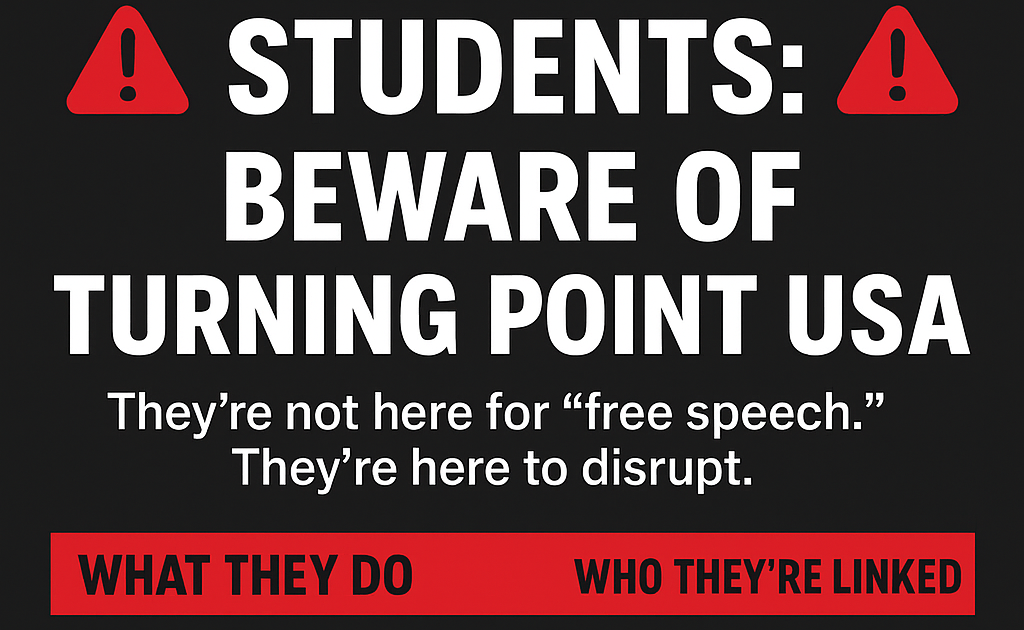
    Turning Point USA (TPUSA) brands itself as a conservative youth movement dedicated to free markets and limited government. In reality, a growing body of investigative reporting, watchdog research, and student testimony reveals an organization built on intimidation, manipulation, and close ties to extremists. Students should be aware of the risks before engaging with TPUSA in any capacity.

    From its inception, TPUSA has sought to be confrontational. One of its most notorious tools, the Professor Watchlist, publishes the names, photos, and alleged offenses of professors the group deems “anti-conservative.” This public shaming campaign has been condemned by educators and civil liberties advocates as a threat to academic freedom and personal safety. In more recent years, TPUSA has expanded its targets beyond individual professors, with initiatives like the School Board Watchlist, designed to stir distrust of public education and stoke fear around diversity, equity, and inclusion initiatives.

    These campaigns are paired with questionable political tactics. Investigations have shown that TPUSA has engaged in covert influence efforts on college campuses, including secretly funding student government elections and running coordinated online disinformation campaigns. Their political arm, Turning Point Action, has been compared to a troll farm for its use of deceptive social media operations.

    The group’s leadership and chapters have repeatedly been linked to white supremacist and far-right extremist figures. TPUSA events have hosted or associated with members of Nick Fuentes’ “Groyper” movement, Holocaust deniers, and other alt-right personalities. The Southern Poverty Law Center, Anti-Defamation League, and multiple journalists have documented these associations, which TPUSA leaders routinely downplay. Internal communications and leaked chapter messages have exposed racist, homophobic, and Islamophobic rhetoric from members. Charlie Kirk, TPUSA’s founder, once falsely claimed that a Black woman had “taken his place” at West Point, a statement criticized as both untrue and racially inflammatory.

    TPUSA’s messaging also extends beyond politics into science denial. The group has repeatedly dismissed the scientific consensus on climate change, framing environmental concerns as a hoax or left-wing scare tactic, and hosting events that platform climate change skeptics over credible experts. TPUSA has received significant funding from fossil fuel interests, including Koch network-affiliated donors, and from political megadonors such as Foster Friess and Rebekah Mercer, who are known for underwriting climate denial campaigns. Other key allies include right-wing think tanks like the Heritage Foundation and media figures such as Tucker Carlson, who have amplified TPUSA’s messaging to broader audiences. The organization has also benefitted from support by religious nationalist groups and political operatives who share its hardline positions on education, race, and gender.

    TPUSA’s confrontational model often invites chaos. At UC Davis, a TPUSA-sponsored event erupted into physical clashes involving Proud Boys. Across campuses, students and faculty report that TPUSA representatives deliberately provoke heated exchanges, record them, and circulate the footage to mobilize their base and fundraise off manufactured outrage. Former members have confirmed that such confrontations are not accidental, but rather part of the playbook.

    While TPUSA presents itself as a mainstream conservative voice, the evidence paints a darker picture: an organization willing to distort, harass, and align with extremists to achieve its goals. Students seeking honest political debate should look for groups that engage in respectful dialogue, value truth over theatrics, and reject intimidation as a tool.

    Sources:

    Southern Poverty Law Center – Turning Point USA: Case Study in the Hard Right

    Media Matters – Turning Point USA’s History of Racism and White Nationalist Ties

    The New Yorker – A Conservative Nonprofit That Seeks to Transform College Campuses Faces Allegations of Racial Bias and Illegal Campaign Activity

    Anti-Defamation League – Extremism in American Politics: Turning Point USA

    Wired – How Charlie Kirk Plans to Discredit Martin Luther King Jr. and the Civil Rights Act

    Chron – Texas A&M Turning Point Chat Exposes Racist and Homophobic Comments

    The Guardian – What I Learned When Turning Point USA Came to My Campus

    OpenSecrets – Turning Point USA Donors and Political Funding

    DeSmog – Turning Point USA and Fossil Fuel Industry Influence

    Source link

  • Careers services can help students avoid making decisions based on AI fears

    Careers services can help students avoid making decisions based on AI fears

    How students use AI tools to improve their chances of landing a job has been central to the debate around AI and career advice and guidance. But there has been little discussion about AI’s impact on students’ decision making about which jobs and sectors they might enter.

    Jisc has recently published two studies that shine light on this area. Prospects at Jisc’s Early Careers Survey is an annual report that charts the career aspirations and experiences of more than 4,000 students and graduates over the previous 12 months. For the first time, the survey’s dominant theme was the normalisation of the use of AI tools and the influence that discourse around AI is having on career decision making. And the impact of AI on employability was also a major concern of Jisc’s Student Perceptions of AI Report 2025, based on in-depth discussions with over 170 students across FE and HE.

    Nerves jangling

    The rapid advancements in AI raise concerns about its long-term impact, the jobs it might affect, and the skills needed to compete in a jobs market shaped by AI. These uncertainties can leave students and graduates feeling anxious and unsure about their future career prospects.

    Important career decisions are already being made based on perceptions of how AI may change work. The Early Careers Survey found that one in ten students had already changed their career path because of AI.

    Plans were mainly altered because students feared that their chosen career was at risk of automation, anticipating fewer roles in certain areas and some jobs becoming phased out entirely. Areas such as coding, graphic design, legal, data science, film and art were frequently mentioned, with creative jobs seen as more likely to become obsolete.

    However, it is important not to carried away on a wave of pessimism. Respondents were also pivoting to future-proof their careers. Many students see huge potential in AI, opting for careers that make use of the new technology or those that AI has helped create.

    But whether students see AI as an opportunity or a threat, the role of university careers and employability teams is the same in both cases. How do we support students in making informed decisions that are right for them?

    From static to electricity

    In today’s AI-driven landscape, careers services must evolve to meet a new kind of uncertainty. Unlike previous transitions, students now face automation anxiety, career paralysis, and fears of job displacement. This demands a shift away from static, one-size-fits-all advice toward more personalised, future-focused guidance.

    What’s different is the speed and complexity of change. Students are not only reacting to perceived risks but also actively exploring AI-enhanced roles. Careers practitioners should respond by embedding AI literacy, encouraging critical evaluation of AI-generated advice, and collaborating with employers to help students understand the evolving world of work.

    Equity must remain central. Not all students have equal access to digital tools or confidence in using them. Guidance must be inclusive, accessible, and responsive to diverse needs and aspirations.

    Calls to action should involve supporting students in developing adaptability, digital fluency, and human-centred skills like creativity and communication. Promote exploration over avoidance, and values-based decision-making over fear, helping students align career choices with what matters most to them.

    Ultimately, careers professionals are not here to predict the future, but to empower all students and early career professionals to shape it with confidence, curiosity, and resilience.

    On the balance beam

    This isn’t the first time that university employability teams have had to support students through change, anxiety, uncertainty or even decision paralysis when it comes to career planning, but the driver is certainly new. Through this uncertainty and transition, students and graduates need guidance from everyone who supports them, in education and the workplace.

    Collaborating with industry leaders and employers is key to ensuring students understand the AI-enhanced labour market, the way work is changing and that relevant skills are developed. Embedding AI literacy in the curriculum helps students develop familiarity and understand the opportunities as well as limitations. Jisc has launched an AI Literacy Curriculum for Teaching and Learning Staff to support this process.

    And promoting a balanced approach to career research and planning is important. The Early Careers Survey found almost a fifth of respondents are using generative AI tools like ChatGPT and Microsoft Copilot as a source of careers advice, and the majority (84 per cent) found them helpful.

    While careers and employability staff welcome the greater reach and impact AI enables, particularly in challenging times for the HE sector, colleagues at an AGCAS event were clear to emphasise the continued necessity for human connection, describing AI as “augmenting our service, not replacing it.”

    We need to ensure that students understand how to use AI tools effectively, spot when the information provided is outdated or incorrect, and combine them with other resources to ensure they get a balanced and fully rounded picture.

    Face-to-face interaction – with educators, employers and careers professionals – provides context and personalised feedback and discussion. A focus on developing essential human skills such as creativity, critical thinking and communication remains central to learning. After all, AI doesn’t just stand for artificial intelligence. It also means authentic interaction, the foundation upon which the employability experience is built.

    Guiding students through AI-driven change requires balanced, informed career planning. Careers services should embed AI literacy, collaborate with employers, and increase face-to-face support that builds human skills like creativity and communication. Less emphasis should be placed on one-size-fits-all advice and static labour market forecasting. Instead, the focus should be on active, student-centred approaches. Authentic interaction remains key to helping students navigate uncertainty with confidence and clarity.

    Source link

  • Limestone University needs $6M to avoid shutdown or going online-only

    Limestone University needs $6M to avoid shutdown or going online-only

    This audio is auto-generated. Please let us know if you have feedback.

    Dive Brief:

    • Limestone University, in South Carolina, may move to online-only classes or shut down entirely in the near future as it wrestles with a financial crisis, the 179-year-old institution announced Wednesday. 
    • To avoid closing or going exclusively online, the private nonprofit’s board of trustees said it would need an “immediate” infusion of $6 million in emergency funding, though it didn’t indicate where it might find the funds. 
    • Limestone attributed its financial woes to enrollment declines, rising costs and “long-standing structural pressures facing small, private institutions.”

    Dive Insight:

    Describing the current crisis as a “turning point,” Limestone’s announcement Wednesday listed multiple possible paths forward, and in doing so the university threw general uncertainty over its future. 

    While full closure remains a risk, the institution is considering a scenario that would discontinue all in-person academic operations and all other activities, including athletics, in Gaffney,” the university said. “The fully online model would effectively end the traditional college campus experience.”

    Limestone’s board is set to meet April 22 to discuss next steps.

    Many of the Christian university’s travails stem from a drop-off in students. Between 2018 and 2023, fall enrollment plummeted 27% to 1,782 students.

    Under financial pressure, Limestone has been leaning heavily on its endowment, the university’s financials show. In 2023, with approval from the state attorney general, the university suspended a policy of spending no more than 5% of the endowment’s total value. Between fiscal years 2023 and 2024, Limestone’s net assets fell by more than $12 million, to $61 million.

    With cash and investments dwindling, and amid persistent budget deficits — to the tune of $9.2 million in fiscal 2024, following an $11.4 million gap in 2023 — the university’s auditors warned that it may not be able to continue operating as a “going concern.”

    Limestone currently offers online courses in addition to in-person classes, but it trumpets what it said is $150 million economic impact on South Carolina’s Cherokee County from its campus. That sum would be imperiled with a move to online-only operations.

    “This potential shift to online-only instruction threatens not only the campus experience, but local jobs and the cultural presence Limestone has provided for nearly two centuries,” the institution said. 

    The $6 million emergency fund — which the university’s trustees proposed without detailing — would “stabilize operations and give the university the opportunity to pursue long-term solutions that preserve its on-campus identity,” Limestone said. 

    “Limestone remains committed to our students and we will work directly with current students to help them identify the best path to successfully complete their educational journey,” board Chair Randall Richardson said in a statement. 

    Other colleges in recent years have likewise sought emergency cash funding infusions to stay afloat in troubled times. 

    For example, Northland College, a private nonprofit in Wisconsin, last year announced a multimillion-dollar Hail Mary fundraising campaign. Without $12 million, the college said last spring, it would be forced to close. 

    Northland wound up falling well short of that goal, but pursued a turnaround on what it called “transformative” gifts and an initiative to pare back its programs. Despite those efforts, the college announced in February that it will close at the end of the current academic year. 

    Other similarly situated colleges, including Hampshire College, have had better luck after an existential fundraising blitz. After falling into financial distress, Hampshire launched a $60 million fundraising campaign that kept it afloat and helped it revamp its programs and operations.

    Source link

  • Are students fleeing to the south to avoid The Woke? Three possible answers.

    Are students fleeing to the south to avoid The Woke? Three possible answers.

    The three answers to the question in the title, in case you want to cut to the chase, are “Yes,” “No,” and “Maybe but we really can’t tell for certain.”

    This has been a point of discussion for some time.  The completely neutral publication Southern Living, with absolutely nothing to gain from publishing this piece, for instance, was convinced it was true back in 2022. 

    The American Thinker had similar observations, but made it about politics in this piece. And finally, among the articles I’ve seen, at least, is this one, in The Free Press where the money quote is “Even if I could have gotten into Harvard, I wouldn’t have gone,” an observation which seems like it was made for a gif.

    There are a lot of anecdotes in these articles, of course, and we all know that three anecdotes are more than enough to build a story upon: My lawyer’s neighbor’s son’s girlfriend is going to Alabama because she liked the rush videos, for instance, can be the basis for a whole research paper in sociology.  Or, of course, an article in a publication that pays by the word.

    I have a stubborn old-fashioned preference for data, however.  And–just to spoil the fun–even data won’t tell us everything we need to know to answer the question.  But it’s a good start, and it’s perhaps a bit more robust than political hit pieces described as documenting societal trends.

    And good news for all of you who don’t like to interact with Tableau visualizations: This one is just pictures.

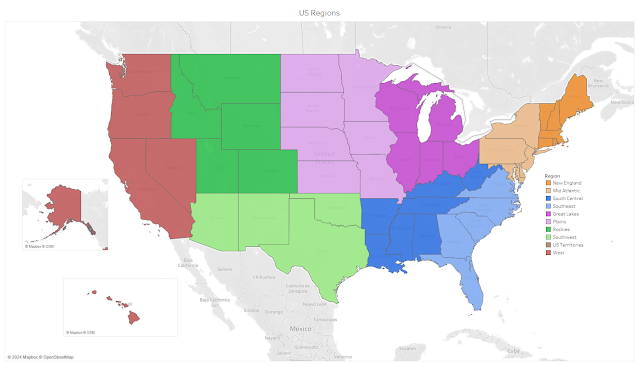
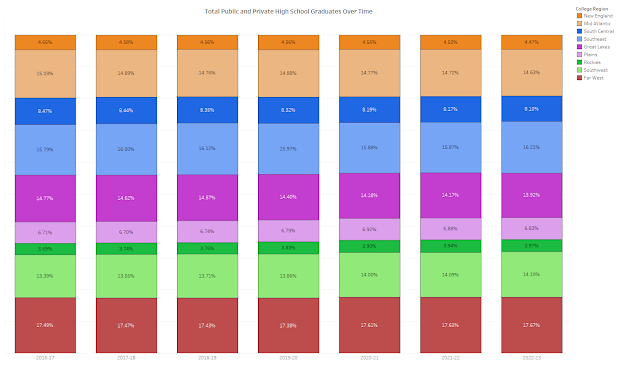
    First, let’s take a look at the shape of the market to have a place where we can put our feet down.  We’ll start with WICHE data, which I’ve found to be very reliable, but of course imperfect, showing high school graduates over time, with years after 2019 being projections.  For all of these views, I’ve broken things out by my own state regions, colored on this map. (Click it or any image to view larger).

    Here is the breakdown of high school graduates by these regions, showing the percentage of total in each year. Columns total to 100% in each year.

    If you know anything at all about higher education data, you already see a problem as we try to establish some framework: Each state and each region has different college going patterns.  In wealthier states, and states with higher educational attainment among parents, college-going rates are higher.  Within states, there are differences too: About 8% of all college students in the US attend community colleges in California, for instance, and almost all of those students are California residents.

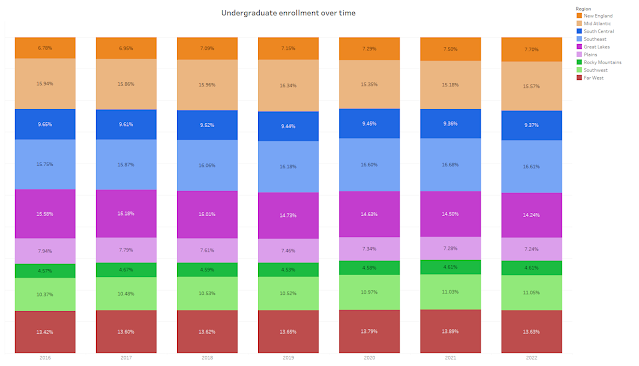
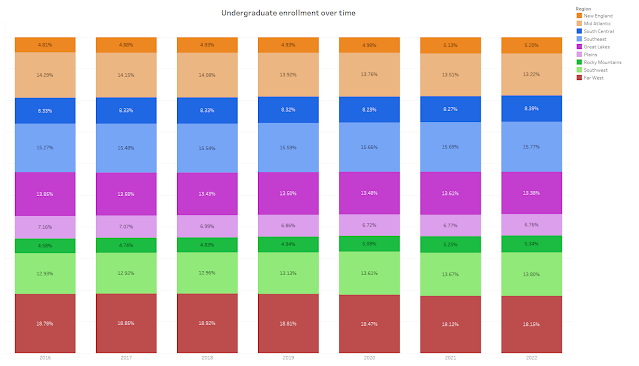
    Now, let’s take a look at undergraduate enrollment over this same period.  Because much of the national discussion is focused on first-time freshmen, I’ve limited this enrollment set to only those traditional, four-year institutions that enroll undergraduates and accept freshmen.  I’ll just call this The Filter Set going forward.

    You’ll probably notice that the patterns are about the same, but you see the effect of the California Community Colleges here: Many more students don’t attend four-year colleges in the state, which makes it different from other parts of the country.  For reference, here is the same visualization showing all undergraduate enrollment in all institutions (not just in The Filter Set).  You’ll note the re-balancing, which is a function of the vast majority of college students going to college close to home.
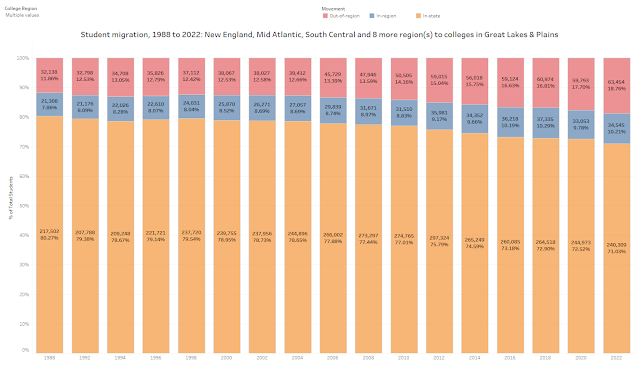
    Here is the historical pattern of first-year student migration, from 1988 to 2022.  As you can see, about seven of ten students stay in their own state for college, which means the number of students who cross state lines is small, making even big swings in those patterns hard to measure and describe as meaningful.  It’s also interesting to note that more students today are more mobile than in the past, for a lot of reasons I won’t go into here, but as always, you can start the finger pointing with Ronald Reagan. 

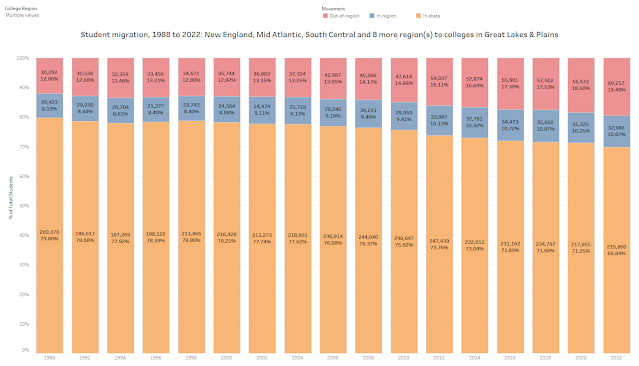
    For the sake of clarity (or confusion) here is the same data for The Filter Set.  Similar pattern, slightly different numbers.  More students cross state lines to attend these institutions with wider draws.

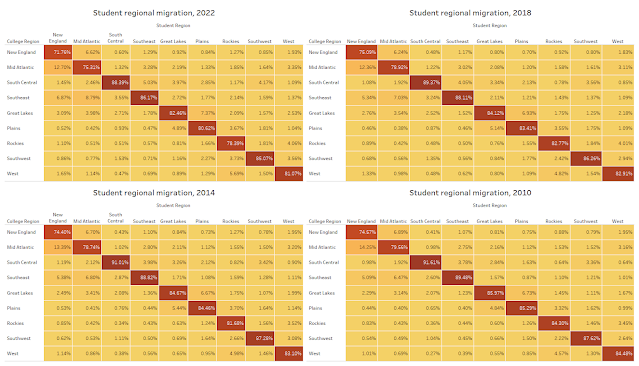
    And if you want to break it out a little bit, here is a view over time of The Filter Set and the migration patterns between regions in 2010, 2014, 2018, and 2022. 

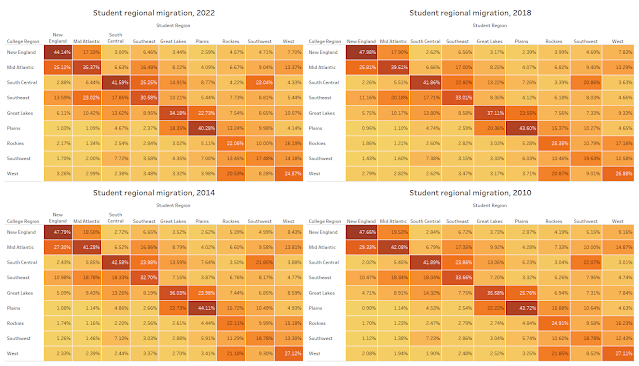
    And this data shows only those students who left their home state and who attended one of the colleges in the Filter Set, to help amplify the migration patterns. 

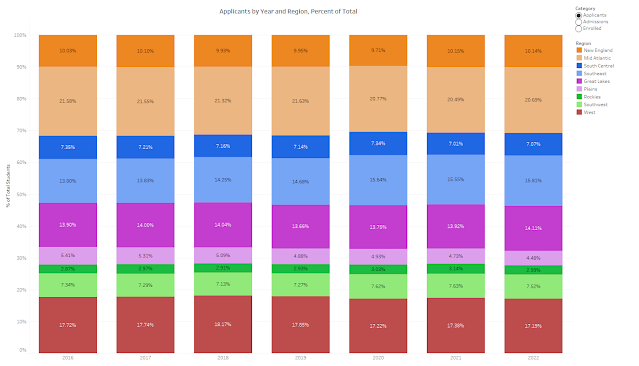
    Over time, the percentage of first-year applications submitted has grown in the Southeast, but not the Southcentral region.  Actually, what’s remarkable about this chart is the consistency over time.

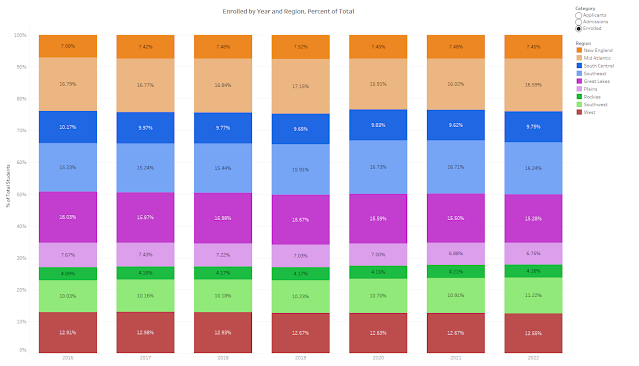
    The breakouts of enrolling first-year students by region?  Also stable and showing similar patterns.

    So, maybe there is a slight trend along the margins of college attendance.  But what’s causing it?  Most social scientists (going out on a limb here) would say it’s probably best when researching a problem like this to dive more deeply than interviews with a dozen students who fit the pattern you’re trying to demonstrate.  What I see in the overall patterns appears to follow population shifts, which is probably the biggest “duh” of all: If population in the Southeast is growing, you’d expect college enrollment to grow as well.  

    But let’s discount that obvious answer for a moment.

    Why would students be applying to more southern locations?  Well, first, they’re easier to get into, in general. 

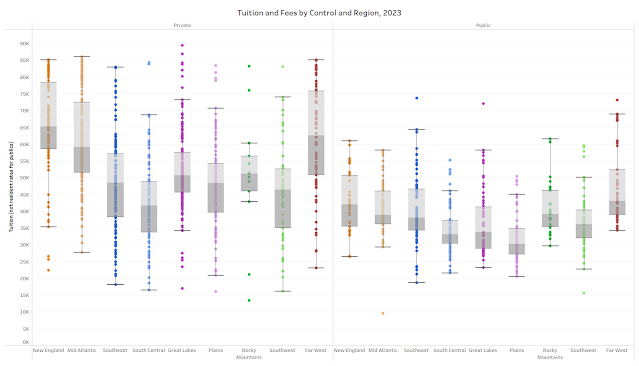
    For another thing, they cost a lot less, on average, based on sticker price.  Each dot represents one college, and the gray boxes cover the middle 50%, with the divider between dark gray and light gray showing the median.  You can see that for both public and (especially) private colleges, tuition seems to be much lower than other places. I’ve not tried to normalize this by Carnegie type or selectivity, to be clear.

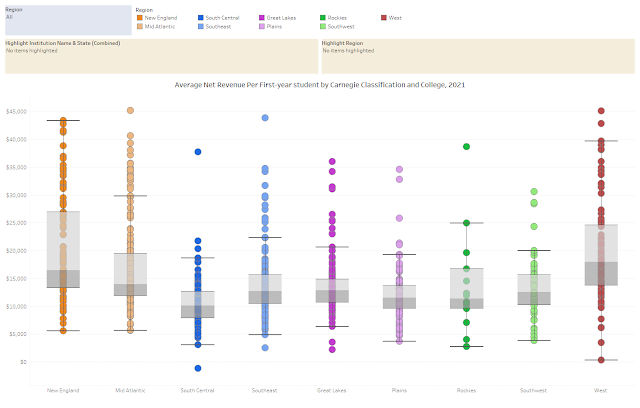
    Private colleges in the south net a lot less cash per freshman, too.  This does not always mean students pay less, but it’s a pretty sure bet in general it costs less after aid to go south as well. (I only calculate this for private institutions because discount rates at publics are fairly meaningless given different tuition levels and state funding models, in case you were wondering.)

    But the publics do a pretty good job of funding nonresidents, too. They recruit hard and roll out the welcome mat for students, especially on price.

    We don’t have 2023 data yet, and we won’t have 2024 data for about another 18 months, at least, so maybe we’ll wake up one morning and find that these small sample size stories are dead-on.  But I seriously doubt it.  For every student fleeing the north because of The Woke, there is probably a student fleeing the less Woke states below the Mason-Dixon Line.

    And yet, we know many–perhaps most–17-year-olds are afflicted with still-undeveloped prefrontal cortices that might keep them from being political, rational, and/or sophisticated when it comes to college choice.

    The answer to the headline?  You probably already knew the answer, didn’t you?  The lesson is that media pundits who look at a little bit of data and talk to a few people to confirm their perspectives often shape the narrative, which gets stuck in the collective consciousness of the American conversation.  It’s not something I can fix.  Maybe you can make a little dent if you share this with people.

    But it’s important, when we see increasing criticism of our institutions, and increased turmoil on campuses, that we–the people who work in higher education–provide the balanced and rational perspective we so often claim to impart to our graduates.

    Source link