
Tag: await

  • HBCUs Await Trump’s Pick to Lead White House Initiative

    HBCUs Await Trump’s Pick to Lead White House Initiative

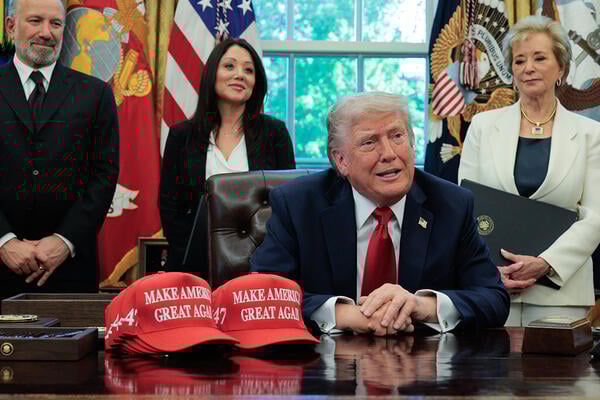
    President Donald Trump issued an executive order in April promising to “elevate the value and impact” of the country’s historically Black colleges and universities—in part by selecting an executive director for the White House Initiative on HBCUs and a President’s Board of Advisors on HBCUs.

    But four months later, eight months into his second term, these roles remain unfilled.

    Some HBCU advocates say months-long waits are business as usual for these positions, and they remain confident in Trump’s support for HBCUs. Others worry that HBCUs lack their most direct line of communication to the White House at a time of rapid-fire higher ed policy changes.

    Since the 1980s, the executive director of the HBCUs initiative, established by President Jimmy Carter, has been responsible for advocating for HBCUs’ federal policy interests. The President’s Board of Advisors offers guidance to government officials about how to better support and strengthen these institutions.

    Appointees serve as HBCUs’ “in-house advocates,” said Ivory A. Toldson, a professor of counseling psychology at Howard University and editor in chief of The Journal of Negro Education. He served as deputy director of the White House Initiative on HBCUs from 2013 to 2015 and as executive director from 2015 to 2016 under former president Barack Obama. The director and board have historically sought out federal funding and partnership opportunities for these institutions and “made sure that executive-level priorities were shaped in a way that understood the needs of HBCUs.”

    Toldson said there are likely to be “missed opportunities” for HBCUs during the limbo period before an executive director is chosen. He said it’s easy for federal agencies, like the National Science Foundation or the National Institutes of Health, to overlook smaller HBCUs for grants when no one is there to champion them.

    “By them not having representation within the federal government, it becomes difficult for them to advocate effectively for their needs,” he said.

    Robert Palmer, chair of the education department at Howard, said he worries HBCUs don’t have their “earpiece” to the Trump administration at a time when policy shifts, such as upcoming changes to the student loan program, will affect HBCU students.

    The unfilled roles are “quite concerning,” Palmer said. “It almost makes you wonder, is it a priority for him? Because that’s what it signals—that it’s not a priority.”

    Mixed Views

    Other HBCU advocates don’t see a problem. Lodriguez Murray, vice president of public policy and government affairs at the United Negro College Fund, which represents private HBCUs, said he isn’t troubled by the wait because organizations like his have still been able to have “high-power and high-level discussions” with the White House and Department of Education.

    “We’ve been able to get every concern addressed. We’ve been able to get every email returned. We’ve been able to get every meeting request handled,” he said. “The house is not burning down for us. And I have seen no lack of continuity and engagement on our issues at the highest levels.”

    He said it’s more meaningful to him that Trump issued an executive order reaffirming the White House Initiative on HBCUs within his first 100 days and fully funded HBCUs in his proposed budget. He’d also rather the administration take its time to pick “the right individuals” to fill these roles.

    “There have been many individuals who have had the role of executive director of the White House initiative on HBCUs [who] have fallen below what the expectations are of this community,” Murray said. “And so, if the White House is attempting to find the right person to meet a moment and to meet expectations, that’s fine with me.”

    Trump’s pick for executive director during his first term, speaker and consultant Johnathan Holifield, was met with mixed reactions by HBCU supporters because of his lack of prior experience with these institutions. Former president Obama also received criticism for some of his executive director choices, including multiple interim appointments between permanent directors.

    Murray said he’s hoping for someone “with the president’s confidence” who can help bring Trump’s plans to support HBCUs to fruition and who can simultaneously “speak truth to power and express to the president the concerns of HBCUs.”

    For Toldson, “institutional knowledge of HBCUs” and an “apolitical” approach will be critical to a new executive director’s success to avoid HBCUs getting mired in the anti-DEI crusade besieging other higher ed institutions.

    “Regardless of who’s in office, we need representation, and I think that the right representation would be able to balance the needs of the HBCU community with the broader direction of the government,” Toldson said.

    Mounting Anticipation

    Harry Williams, president and CEO of the Thurgood Marshall College Fund, which represents public HBCUs, said the amount of time it takes for presidents to fill these roles has varied historically. HBCUs have often waited months for these appointments, so the current timeline isn’t out of the ordinary, he said. Former president Joe Biden didn’t officially name an executive director until February 2022, a little over a year after his inauguration.

    Still, a long wait “creates uncertainty, and it creates anxiety,” Williams said.

    “We’ve gotten good information that this is something that will happen, but the timing of it has always been the challenge,” he added. TMCF is reassuring campuses that the administration plans to fill these positions, “but we don’t know exactly when.”

    David K. Wilson, president of Morgan State University, said he and other HBCU presidents are eager to get started on making the promises in Trump’s executive order a reality. They were glad to see the order call on federal agencies, businesses and foundations to partner with and invest more in HBCUs.

    Wilson said he hopes to see these positions filled soon “so that we can begin to express directly to the White House what some of the opportunities are for continued investment in these institutions.”

    “All of them will return unbelievable dividends to the nation,” he added.

    Wilson noted that Howard University recently regained Research-1 status, the coveted Carnegie Foundation classification for universities with very high research activity. Other HBCUs, including Morgan State, are poised to follow in the coming years. He wants to see appointees in place who can help maintain that momentum.

    “We can’t wait to see now what this next era of HBCU investments under the Trump administration will look like,” he said. “We were on a roll, and now the question is, can we roll faster?”
    Source link

  • Education Department staff anxiously await sweeping cuts

    Education Department staff anxiously await sweeping cuts

    It’s been a whirlwind week at the Department of Education, and some career staffers are anguished over its bleak, uncertain future.

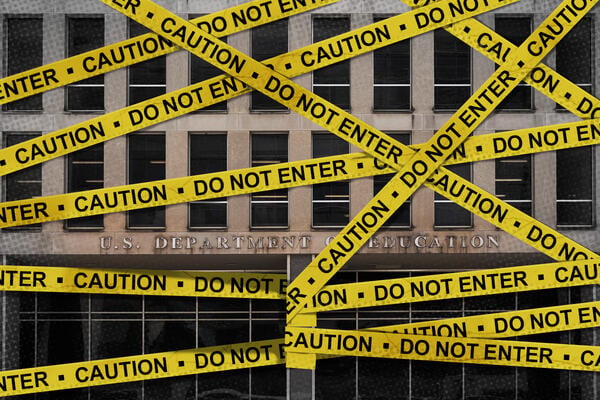
    On Monday, the Senate confirmed Linda McMahon as the new secretary of education, and shortly afterward, she released a memo laying out department personnel’s “final mission”: “the elimination of bureaucratic bloat here at the Department of Education.”

    The next day, department leaders scheduled a meeting to announce a major reduction in force, which current staffers say is rumored to include layoffs of nearly 50 percent of the workforce—but the meeting was canceled at the last minute, according to a department employee.

    Then, on Wednesday, media outlets, citing sources in the administration, reported that President Trump would sign an executive order to abolish the Education Department as soon as Thursday, sending frenzied staffers scrambling to prepare.

    When White House press secretary Karoline Leavitt announced Thursday morning on X that Trump wouldn’t be signing the order that day after all, one staffer said it felt like cruel misdirection.

    “It’s definitely feeling like whiplash,” they said. “Folks had steeled themselves for today … Everyone seems ready to rip off the Band-Aid, and the delay feels like a game to torture people.”

    Several current department employees, who spoke with Inside Higher Ed on background and on the condition of anonymity, offered a chaotic picture of upheaval and uncertainty within the department, with staff scrambling to prepare for the dissolution of their offices, even as the administration’s plans and timeline remain unclear.

    One current employee told Inside Higher Ed that McMahon’s memo announcing the administration’s plan to downsize the department was “insulting and antagonizing.”

    “The notion that we should be honored to undertake this ‘final mission’ is absurd,” they said. “It’s basically saying, ‘You should thank us for firing you.’”

    One career staffer who’s been with the department for more than a decade said most employees are anxiously waiting for the other shoe to drop. Over the past few weeks, they said, anger and indignation have turned to heartbreak.

    “Reality is sinking in everywhere … Folks are seriously depressed,” they said. “And yet, working to advance the goals of this administration may actually be worse than not having a job.”

    ‘Slash and Burn’

    Trump has advocated for eliminating the 45-year-old Education Department since the early days of his campaign. When he nominated McMahon as secretary, he said he hoped she would “put herself out of a job.” Still, many department employees were taken aback by the sudden escalation.

    The longtime staffer said that when Trump was inaugurated, they anticipated some serious changes at the department. But the speed and wantonness of the move to abolish it has surprised them.

    “I foolishly believed they’d try to take a studied approach to any changes, consult with seasoned career staffers with institutional knowledge and expertise,” they said. “Instead it’s slash and burn.”

    Last week, the Office of Management and Budget and the Office of Personnel Management directed all federal agencies to prepare for “large-scale reductions in force” and the elimination of “non-statutorily mandated functions,” which could be a precursor to the Trump administration’s plans to heavily reduce the head count at Education Department as much as possible without congressional approval.

    A draft of Trump’s forthcoming executive order, obtained by Inside Higher Ed, includes a two-paragraph guideline for winding down department activity and little else. James Kvaal, who served as under secretary of education under President Joe Biden, said the absence of a plan is revealing and concerning.

    “[The document] reflects a lack of clarity within the Trump administration about what they’re trying to do, or even disagreement among certain elements,” Kvaal said.

    Department staffers are concerned about the administration’s strategy for implementing its ambitious spending cuts. One employee who spoke with Inside Higher Ed was placed on administrative leave last month and said their experience was “chaotic and haphazard.” The staffer said cuts to programs, contracts and personnel have been largely left up to a small group of young Department of Government Efficiency employees, whose approach has been “like throwing spaghetti at the wall to see what they can get away with.”

    They said that if the Trump administration’s approach to cuts at the department so far is any indication how they will handle plans to gut the department, it could exacerbate the impact on students and educational institutions.

    “Nobody is going to know what’s happening, which means zero accountability,” they said. “It’s going to be a mess.”

    DOGE has already canceled hundreds of millions of dollars in department contracts, including some that are essential to the operation of the Free Application for Federal Student Aid. And sources within the department say that hundreds of Federal Student Aid staff have either taken a buyout or been placed on leave.

    A current department employee who specializes in higher education said they fear that the department’s closure—or the major cuts that precipitate it—will have a devastating impact on the sector, and on affordability and access in particular.

    “There’s going to be a huge setback in the progress we’ve made even just in terms of who gets to go to college,” they said. “Universities are being put on such a high alert on every front … it’s a wholesale attack on the sector.”

    Kvaal said that even under Biden, the department in general—and the student aid office in particular—were severely understaffed, a problem that he has said contributed to the bungled rollout of the new FAFSA last year. He added that further reductions could hobble agencies’ capacity to perform essential duties like student loan and aid disbursement.

    “The department was thinly staffed even prior to these cuts, and as a result it was difficult to run programs smoothly and deliver benefits that students needed,” he said. “If there are, in fact, hundreds of people leaving FSA, that could put our progress with FAFSA at risk and upend our efforts to prevent student loan defaults. If nothing else, asking senior managers to focus on nudging their staff out the door and preparing for legislation that will never come is a real distraction.”

    Both Kvaal and current employees are concerned that when the Trump administration does release concrete plans for distributing the department’s responsibilities, they will welcome the private sector into administering services like student loans and financial aid.

    “It seems like the longer-term goal here would be to privatize the FSA, like they’re doing with Social Security,” one staffer said. “That’s a mess waiting to happen and would take way longer than four years. In the interim, the damage could be enormous.”

    Source link