I have to hand it to CC Daily; its article on the recent round of FIPSE grants had a killer closing sentence.
The recent round of grants from the Fund for the Improvement of Postsecondary Education had focus areas in AI, accreditation and civil discourse. As CC Daily succinctly noted, “No community colleges received awards in the civil discourse category.”
None. Not one, out of over 1,000 institutions across the country. Zero.
I know it’s not for lack of applications.
They were well represented among the awards focused on workforce training but were shut out when it came to addressing larger social issues.
To be fair, FIPSE wasn’t alone in ignoring community colleges. As Karen Stout pointed out this weekend, The Chronicle’s quarter-century forecast drew on 50 experts from across higher education to talk about emerging trends; only one was from a community college. We have over 40 percent of the students in the country, but received 2 percent of the attention. Two is greater than zero, granted, but come on.
Who is at the table will affect what gets considered important. From the Chronicle group, for instance, you wouldn’t know that dual enrollment has quietly but steadily redefined the barriers between secondary and postsecondary education around the country and that the funding structures and academic policies in many states (cough Pennsylvania cough) haven’t kept up. That has consequences in myriad ways, ranging from faculty credential requirements to residency-based tuition to the impact on grad school applications for students who got B’s at age 14. Business models based on a previous reality struggle under the emerging one. That’s invisible to people at think tanks who focus on disciplining “the woke left,” but it’s real and it matters.
The civil discourse piece was just the latest in a long line of reminders that many policymakers see community colleges as workforce training centers and nothing else. Higher education, in their view, belongs to those who can afford it; our job is to produce skilled proles who will produce profit, do what they’re told and stay quiet.
Well, no. Community colleges are, among other things, colleges; they embody the belief that nothing is too aspirational for anybody, including people from lower-income backgrounds. Workforce training is a key component of the mission, but it isn’t the entire mission—and it shouldn’t be. Our students have just as much dignity, humanity and perspective as anyone else’s.
Last week I had the opportunity to see a new slate of officers of student government get sworn in. It’s always a happy occasion. Over the course of my career, though, I’ve seen the tone of those events shift. Twenty years ago, I heard students talk about making a difference. Ten years ago, I heard them talk about building their résumés. Now I hear them talk about making friends. That very human need for connection isn’t unique to four-year schools. Community colleges are, among other things, places where people from different backgrounds interact on equal footing, often for the first time. It’s where students learn to practice civil discourse on the ground. Interactions like those are crucial parts of educating a citizenry. That’s part of our mission, and I offer it without apology.
An old saying suggests that if you aren’t at the table, you’re on the menu. Community colleges deserve to be at the table. When we aren’t, the entire conversation is distorted.
The high cost associated with college is one of the greatest deterrents for students interested in higher education. A 2024 survey by Inside Higher Ed and Generation Lab found that 68 percent of students believe higher ed institutions charge too much for an undergraduate degree, and an additional 41 percent believe their institution has a sticker price that’s too high.
A recent study by the National College Attainment Network found that a majority of two- and four-year colleges cost more than the average student can pay, sometimes by as much as $8,000 a year. The report advocates for additional state and federal financial aid to close affordability gaps and ensure opportunities for low- and middle-income students to engage in higher education.
Methodology: NCAN’s formula for affordability compares total cost of attendance (tuition, fees, housing, etc.) plus an emergency reserve of $300 against any aid a student receives. This includes grants, federal loans and work-study dollars, as well as expected family contribution and the summer wages a student could earn in a full-time, minimum-wage job in their state. Housing costs vary depending on the student’s enrollment: Bachelor’s-granting institutions include on-campus housing costs, and community colleges include off-campus housing rates.
A graphic by the National College Attainment Network demonstrating how the organization calculated affordable rates for the average college student.
National College Attainment Network
Costs that outweigh expected aid and income are classified as an “affordability gap” for students.
A recent Inside Higher Ed and Generation Lab survey of 5,065 undergraduates found that 9 percent of respondents said an unexpected expense of $300 or less would threaten their ability to remain enrolled in college.
The total sample size covered 1,137 public institutions, 600 of which were community colleges.
Majority of colleges unaffordable: Using these metrics, 48 percent of community colleges and 35 percent of bachelor’s-granting institutions were affordable during the 2022–23 academic year. In total, NCAN rated 473 institutions as affordable.
Comparative data from 2015–16 finds slightly more community colleges were affordable then (50 percent) than in 2022–23 (48 percent), but that the average affordability gap, or total unmet need, has grown from $246 to $486.
Among four-year colleges, more public institutions were affordable in 2022–23 than in 2015–16 (29 percent) and the average affordability gap shrank slightly, from $1,656 to $1,554. The data indicates slight improvement in affordability metrics but highlights challenges for low-income students interested in a bachelor’s degree, according to the report.
NCAN researchers believe the $400 increase in the maximum Pell Grant in 2023 helped lower costs per student at bachelor’s-granting institutions, but community colleges appear less affordable due to the loss of HEERF funding and the increase in cost of attendance due to rising housing costs.
Affordability ranges by states: Access to affordable institutions is also more of a challenge for students in some regions than in others. NCAN’s analysis found that 14 states lacked a single institution with an affordable bachelor’s degree program for low-income students. In 27 states, 65 percent of public four-year colleges were unaffordable.
For two-year programs, five states lacked an affordable community college. Some states had a small sample (fewer than five) of community colleges analyzed; Delaware and Florida had no community colleges in NCAN’s sample.
In Kentucky, Maine and New Mexico, 100 percent of the two-year colleges analyzed were found to be affordable for students, along with at least 80 percent of the bachelor’s degree–granting institutions in those states.
Students pursuing a bachelor’s degree in New Hampshire ($8,239), Pennsylvania ($8,076) and Ohio ($5,138) had the largest affordability gaps. For community colleges, students in New Hampshire ($11,499), Utah ($7,689) and Pennsylvania ($4,508) had the greatest unmet need.
Conversely, some states had aid surpluses, which can help address other expenses associated with college, including textbooks and transportation.
Cost isn’t the only barrier to access, however. “For many students who live in rural or remote areas, far from the postsecondary institutions in their state, college may remain inaccessible,” the report noted.
Based on the data, NCAN supports additional funding for higher education at all levels, federal, state and local, to provide students with financial aid.
Get more content like this directly to your inbox. Subscribe here.
I recently stood before hundreds of young people in California’s Central Valley; more than 60 percent were on that day becoming the first in their family to earn a bachelor’s degree.
Their very presence at University of California, Merced’s spring commencement ceremony disrupted a major narrative in our nation about who college is for — and the value of a degree.
Many of these young people arrived already balancing jobs, caregiving responsibilities and family obligations. Many were Pell Grant-eligible and came from communities that are constantly underestimated and where a higher education experience is a rarity.
These students graduated college at a critical moment in American history: a time when the value of a bachelor’s degree is being called into question, when public trust in higher education is vulnerable and when supports for first-generation college students are eroding. Yet an affordable bachelor’s degree remains the No. 1 lever for financial, professional and social mobility in this country.
Related: Interested in innovations in higher education? Subscribe to our free biweekly higher education newsletter.
A recent Gallup poll showed that the number of Americans who have a great deal of confidence in higher education is dwindling, with a nearly equal amount responding that they have little to none. In 2015, when Gallup first asked this question, those expressing confidence outnumbered those without by nearly six to one.
There is no doubt that higher education must continue to evolve — to be more accessible, more relevant and more affordable — but the impact of a bachelor’s degree remains undeniable.
And the bigger truth is this: America’s long-term strength — its economic competitiveness, its innovation pipeline, its social fabric — depends on whether we invest in the education of the young people who reflect the future of this country.
There are many challenges for today’s workforce, from a shrinking talent pipeline to growing demands in STEM, healthcare and the public sector. These challenges can’t be solved unless we ensure that more first-generation students and those from underserved communities earn their degrees in affordable ways and leverage their strengths in ways they feel have purpose.
Those of us in education must create conditions in which students’ talent is met with opportunity and higher education institutions demonstrate that they believe in the potential of every student who comes to their campuses to learn.
UC Merced is a fantastic example of what this can look like. The youngest institution in the University of California system, it was recently designated a top-tier “R1” research university. At the same time, it earned a spot on Carnegie’s list of “Opportunity Colleges and Universities,” a new classification that recognizes institutions based on the success of their students and alumni. It is one of only 21 institutions in the country to be nationally ranked for both elite research and student success and is proving that excellence and equity can — and must — go hand in hand.
In too many cases, students who make it to college campuses are asked to navigate an educational experience that wasn’t built with their lived experiences and dreams in mind. In fact, only 24 percent of first-generation college students earn a bachelor’s degree in six years, compared to nearly 59 percent of students who have a parent with a bachelor’s. This results in not just a missed opportunity for individual first-generation students — it’s a collective loss for our country.
The graduates I spoke to in the Central Valley that day will become future engineers, climate scientists, public health leaders, artists and educators. Their bachelor’s degrees equip them with critical thinking skills, confidence and the emotional intelligence needed to lead in an increasingly complex world.
Their future success will be an equal reflection of their education and the qualities they already possess as first-generation college graduates: persistence, focus and unwavering drive. Because of this combination, they will be the greatest contributors to the future of work in our nation.
This is a reality I know well. As the Brooklyn-born daughter of Dominican immigrants, I never planned to go away from home to a four-year college. My father drove a taxi, and my mother worked in a factory. I was the first in my family to earn a bachelor’s degree. I attended college as part of an experimental program to get kids from neighborhoods like mine into “top” schools. When it was time for me to leave for college, my mother and I boarded a bus with five other students and their moms for a 26-hour ride to Vanderbilt University in Nashville, Tennessee.
Like so many first-generation college students, I carried with me the dreams and sacrifices of my family and community. I had one suitcase, a box of belongings and no idea what to expect at a place I’d never been to before. That trip — and the bachelor’s degree I earned — changed the course of my life.
First-generation college students from underserved communities reflect the future of America. Their success is proof that the American Dream is not only alive but thriving. And right now, the stakes are national, and they are high.
That is why we must collectively remove the obstacles to first-generation students’ individual success and our collective success as a nation. That’s the narrative that we need to keep writing — together.
Shirley M. Collado is president emerita at Ithaca College and the president and CEO ofCollege Track, a college completion program dedicated to democratizing potential among first-generation college students from underserved communities.
The Hechinger Report provides in-depth, fact-based, unbiased reporting on education that is free to all readers. But that doesn’t mean it’s free to produce. Our work keeps educators and the public informed about pressing issues at schools and on campuses throughout the country. We tell the whole story, even when the details are inconvenient. Help us keep doing that.
MUSCATINE, Iowa — The suspect moved menacingly toward her, but Elexiana Oliva stood her ground, gun drawn and in a half crouch as she calmly tried to talk him down.
The confrontation wasn’t real, and neither was the gun. But the lesson was deadly serious.
Oliva is a criminal justice major at Muscatine Community College in this largely agricultural community along the Mississippi River. She was in a simulation lab, with that scenario projected on a screen as classmates watched, spellbound.
Just 18, Oliva is determined to become a police detective, a plan that includes earning a bachelor’s degree after she finishes her associate degree here. But she’ll have to go somewhere else to do it — likely, in her case, to a university in Texas.
“It’s not our fault that we grew up in a place where there’s not a lot of big colleges and big universities,” Oliva said.
Related: Interested in innovations in higher education? Subscribe to our free biweekly higher education newsletter.
Iowa has joined a growing number of states that are considering letting community colleges like this one offer bachelor’s degrees, or where community colleges have already started adding them, as a way of filling these so-called rural higher education deserts and training workers in rural places for jobs in fields where there are growing shortages.
“It would be a big game-changer, especially for those who have a low income or a medium income and want to go and further our education,” Oliva said.
Downtown Muscatine, Iowa. About an hour from the nearest public university, Muscatine could benefit from a proposal to let community colleges offer bachelor’s degrees. Credit: Mike Rundle for The Hechinger Report
Abouthalf of states allow community colleges to offer bachelor’s degrees. In Iowa, which is among the half that don’t, lawmakers have commissioned a study to determine whether it should add bachelor’s degrees in some programs at the state’s 15 community colleges. An interim report is due in May.
A similar proposal in Illinois is backed by that state’s governor, JB Pritzker, who has said the move would make it easier and more affordable for residents to get degrees — “particularly working adults in rural communities.” Three-quarters of community college students in Illinois said they would pursue bachelor’s degrees if they could do it on the same campus, according to a survey released by Pritzker’s office.
And in Texas, Temple College will open a center in June where students at the two-year public institution will be able to earn bachelor’s degrees through partner Texas A&M University-Central Texas, including in engineering technology with a concentration in semiconductors.
“When you can offer university classes on community college campuses, that makes a world of difference” to rural students, said Christy Ponce, the president of Temple.
What’s been blocking many of these students from continuing their educations, Ponce said, “is the sheer distance. There’s not a public university option within an hour or more away. And affordability and transportation barriers are huge issues.”
Fewer than 25 percent of rural Americans hold bachelor’s degrees or higher, according to the National Center for Education Statistics, compared to the national average of 33 percent. And the gap is getting wider, the U.S. Department of Agriculture finds in its most recent analysis of this.
Significantly fewer students in rural places than in urban areas believe that they can get degrees, a Gallup survey for the Walton Family Foundation found, citing the lack of nearby four-year universities as a principal reason.
In those states that already allow community colleges to offer bachelor’s degrees, they’re often limited to certain high-demand fields, such as teaching and nursing. Even as this idea has spread, America’s 960 public community colleges collectively confer only about 1 percent of bachelor’s degrees each year, the American Association of Community Colleges reports.
In many places, what’s stopping them from giving out more is opposition from four-year universities and colleges, many of which are increasingly hard up for students as the number of 18-year-olds begins to fall — a phenomenon enrollment managers have dubbed the demographic cliff.
That Illinois proposal, for example, is stalled in committee after several public and private university presidents issued a statement opposing it. Negotiations are continuing.
While community colleges in California have been allowed since 2021 to offer bachelor’s degrees, several have been blocked from adding four-year programs that the California State University System contends it already offers. An independent mediator has been brought in to resolve the impasse.
And while the two-year, public College of Western Idaho will launch a bachelor’s degree in business administration in the fall, it’s doing so only over the objections of Boise State University, which said it “could hurt effective and efficient postsecondary education in Idaho, cannibalizing limited resources available to postsecondary education and duplicating degree offerings.”
Community colleges also need more students; their enrollment declined by 39 percent from 2010 to 2021, and they face that same impending demographic cliff. Those that add bachelor’s degrees increase their full-time enrollment from 11 percent to 16 percent, research conducted at the University of Michigan has found.
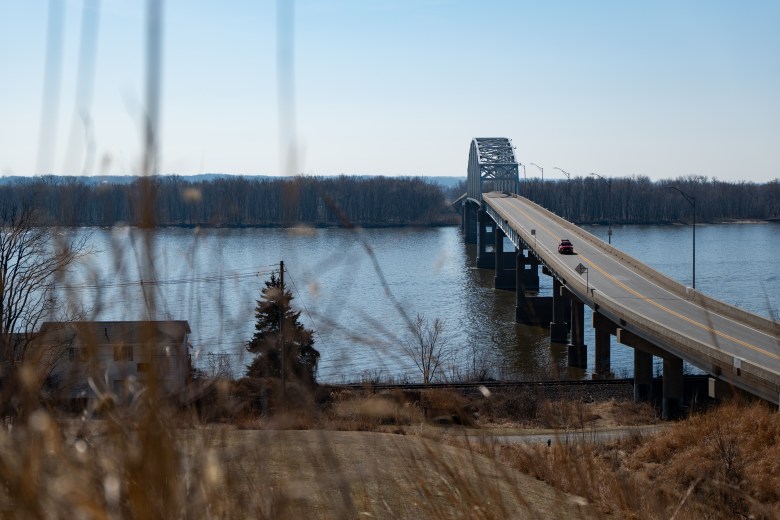
The Norbert F. Beckey Bridge, seen from the Mark Twain Overlook in Muscatine, Iowa, which links Muscatine with Rock Island County, Illinois, across the Mississippi River. Credit: Mike Rundle for The Hechinger Report
The principal impetus for the largely bipartisan push to offer bachelor’s degrees at community colleges, however, is to train more workers for those fields in which there are shortages.
“What I think is misunderstood is that, in general, these are not like the baccalaureates that conventional four-year institutions offer,” said Davis Jenkins, a senior research scholar at the Community College Research Center at Teachers College, Columbia University. (The Hechinger Report, which produced this story, is an independent unit of Teachers College.)
Bachelor’s degrees at community colleges, said Jenkins, “meet an economic need for bachelor’s degree graduates that isn’t being met by other institutions.”
That includes by helping rural workers move up in their jobs without leaving home. “It’s all about serving our workforce needs,” said Iowa state Rep. Taylor Collins, Republican chair of Iowa’s House Committee on Higher Education, who requested the study into whether bachelor’s degrees should be offered at community colleges in that state. “It’s a way to upskill our workforce.”
In his own district, south of Muscatine, “we’re kind of on an island where we only have the community college” — especially since the closing of nearby private Iowa Wesleyan University in 2023. “There are a lot of students who are place-bound. There are a lot of students who want to live locally” and not move away to get a bachelor’s degree.
That’s a focus of the ongoing study, said Emily Shields, executive director of Community Colleges for Iowa, which is conducting it. “Sometimes people have ties, responsibilities, jobs, family things, where moving to where there is a degree available isn’t an option for them,” Shields said.
Sure, she said, rural students can take courses online. But “you’re not getting the student services, you’re not getting activities, you’re not getting the other sort of enrichment support and belonging that a lot of our students, I think, are looking for.”
Many also say they’re looking for the kind of individual attention they get in their hometown and at a community college such as the one in Muscatine, which has an enrollment of 1,800.
Shiloh Morter stayed in his hometown of Muscatine, Iowa, to go to community college. Among the advantages, he says: “The sunsets here are pretty nice. I can tell you, there’s not a whole lot of other places that have clouds like we do.” Credit: Mike Rundle for The Hechinger Report
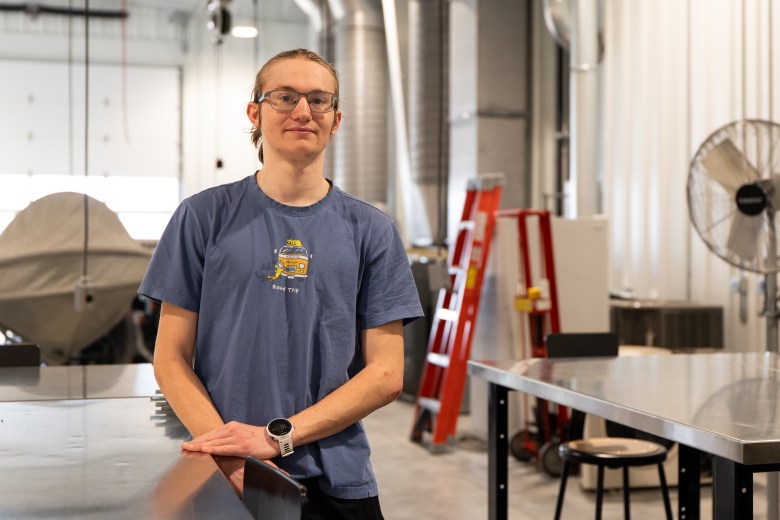
Shiloh Morter bikes to campus on all but the very coldest days. He plans to become an engineer, but “figured I would save the money and go to community college and try and branch out and develop better habits” first, said Morter, who is 20.
In the automotive technology garage off the main corridor of the small school, cars were lined up neatly with their hoods popped. Nursing students worked on anatomically correct crash test dummy-style “patients.”
Twenty-year-old Mykenah Pothoff enrolled at the college when it debuted a registered nursing program, saving herself money on tuition and a nearly hourlong drive, each way, to the University of Iowa. She also was worried about “just, like, finding my way around” the university, which has more than 30,000 students.
Jake Siefers is majoring in psychology at an Iowa community college. If he could stay and get his bachelor’s degree in the same place, “it would be huge,” he says. “There’s a lot of untapped human potential” in rural places that could benefit from more access to higher education. Credit: Mike Rundle for The Hechinger Report
Jake Siefers, 32, is a psychology major planning to go on to get bachelor’s and master’s degrees. Siefers said he hopes to help other people who, like him, are recovering from alcoholism, and for whom he said there are too few services in Iowa. So he came home to Muscatine to start working toward an associate degree at the community college.
“I could afford it, and it was close and I actually know a lot of people that work here,” said Siefers. “It’s great coming in here and being, like, ‘Hey, I went to high school with you, and you work in the office.’ I mean, that’s everyone in Iowa, right?”
If he could stay and get his bachelor’s degree in Muscatine, “it would be huge,” he said. “There’s a lot of untapped human potential” in rural places that could benefit from the kind of access to a higher education that is now more limited, said Siefers.
Letting students like them finish bachelor’s degrees near where they live “would make it easier for everybody,” said Jaylea Perez, 19, another psychology major who also plans to earn one.
Jaylea Perez is enrolled in community college in Iowa but eventually hopes to earn a bachelor’s degree in psychology. Adding bachelor’s degrees at community colleges “would make it easier for everybody,” she says. Credit: Mike Rundle for The Hechinger Report
Simply having bachelor’s degrees available would make rural students aspire to them who otherwise might not, said Naomi DeWinter, president of Muscatine Community College.
“Everything opens up to them,” said DeWinter, in a coffee shop across the highway from the Walmart.
She sees the most potential among people already working, such as paraprofessionals in schools who want to become teachers; a state job board lists nearly 1,000 vacancies in Iowa for teachers.
DeWinter recalled a graduate so exemplary that he was featured in a promotional video, who after earning his associate degree started substitute-teaching while commuting in his free time to the University of Iowa to get his bachelor’s degree — one course at a time.
“He said, ‘That’s how I’m juggling my work, my family and the affordability,’ ” she said. “His whole career is going to be over before he’s a [full-time] teacher. I feel as though we failed him.”
Like the substitute teacher, students said they want to stay in Muscatine, despite those limits. They like the peace and quiet compared to cities — hardly anyone ever honks, they noted — and the sense of community evident among the friends who run into each other at the Hy-Vee.
“We don’t have the best view of the Milky Way, but we for sure definitely don’t have a bad one,” said Shiloh Morter, ticking down a list of advantages to living on the sweeping plain carpeted with cultivated fields and dotted with barns and silos. “And, yeah, the sunsets here are pretty nice. I can tell you, there’s not a whole lot of other places that have clouds like we do.”
The Hechinger Report provides in-depth, fact-based, unbiased reporting on education that is free to all readers. But that doesn't mean it's free to produce. Our work keeps educators and the public informed about pressing issues at schools and on campuses throughout the country. We tell the whole story, even when the details are inconvenient. Help us keep doing that.
Illinois Governor JB PritzkerA legislative initiative backed by Illinois Governor JB Pritzker that would allow community colleges to offer four-year bachelor’s degrees in high-demand fields has temporarily stalled in the state’s General Assembly, with lawmakers raising concerns about potential impacts on minority-serving institutions.
The bill, which was one of Gov. Pritzker’s top legislative priorities announced in his February State of the State address, failed to advance from the House Higher Education Committee before Friday’s deadline for most non-spending bills.
Rep. Katie Stuart, who chairs the committee, declined to call House Bill 3717 for a vote, though she indicated the legislation may still have a path forward this session.
“I don’t think around here anything’s really ever dead, and I think there’s a path forward,” Stuart told reporters following last Wednesday’s committee hearing.
Stuart, whose district includes Southern Illinois University Edwardsville, expressed specific concerns about how the proposed expansion might affect institutions that primarily serve minority students, such as Northeastern Illinois University and Chicago State University.
“If we’re not careful about what programs are allowed, that it could collapse the existing programs in those institutions, collapse their student base, and just make them not able to be operational,” Stuart explained. “And then we wouldn’t have a four-year institution serving those communities.”
This sentiment reflects growing concerns in higher education about maintaining equitable access while expanding educational options, particularly when considering the vital role that historically minority-serving institutions play in providing educational pathways for underrepresented populations.
The governor’s proposal, introduced as House Bill 3717 by Rep. Tracy Katz Muhl, aims to make bachelor’s degrees more affordable and accessible, particularly in rural areas where four-year universities may not have a significant presence.
“With lower tuition rates and a greater presence across the state — especially in rural areas — community colleges provide the flexibility and affordability students need,” Pritzker said when introducing the initiative. “This is a consumer-driven, student-centered proposal that will help fill the needs of regional employers in high-need sectors and create a pathway to stable, quality jobs for more Illinoisans.”
The bill would allow community colleges to offer bachelor’s degrees in select fields, provided the college’s board of trustees demonstrates the program would address an “unmet workforce need” in their service area and that the institution possesses adequate resources and expertise to sustain the program.
Following last week’s committee hearing, a coalition of presidents from several public and private universities in Illinois, including Chicago State and Northeastern Illinois University, released a statement acknowledging their concerns while expressing willingness to find a compromise.
The university leaders noted they were concerned about “duplicating efforts and increasing costs at a time of limited resources,” but added they are “encouraged by negotiations and remain committed to working collaboratively to build a higher education ecosystem that serves all of our students and employers.”
Despite missing the committee deadline, both Rep. Stuart and the governor’s office expressed optimism about reaching a compromise that addresses the concerns of all stakeholders.
There has been a lot written about the death of the English degree in higher education. Is it true?
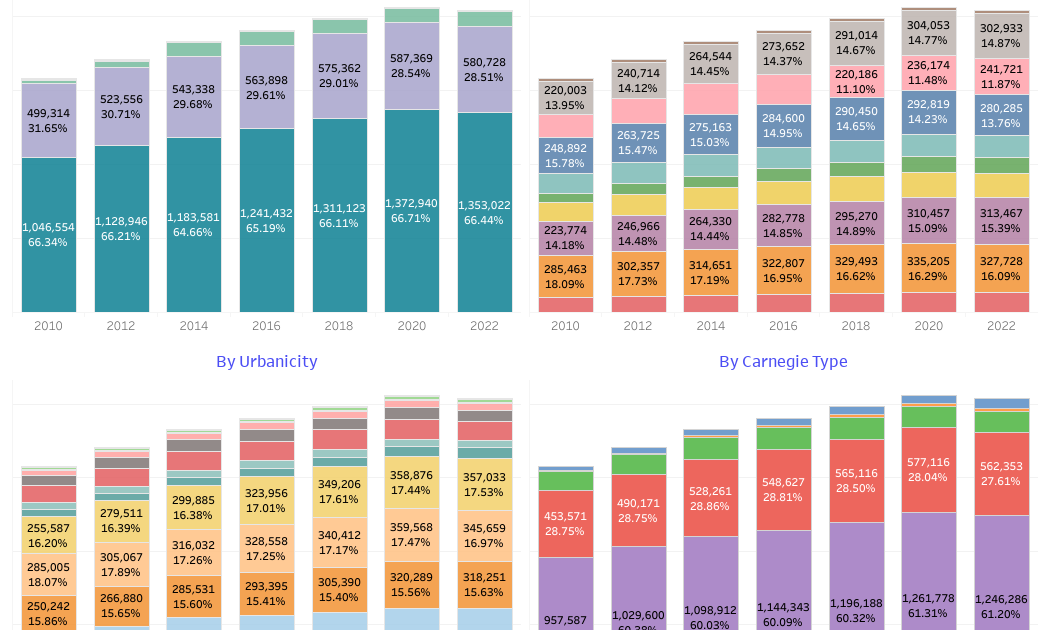
Sort of. But there are other interesting trends in patterns across the country in the past dozen years. I downloaded IPEDS data from 2010 to 2022 (even years) and created the visualization to show those changes and patterns in bachelor’s degrees awarded. There are six views, and some of them are interactive.
The first (using the tabs across the top) shows degrees by the institutions where they’re awarded. You can see the college or university sector, region, urbanicity, and Carnegie classification (rolled up into larger segments for clarity.) You’ll see little change: Most degrees are still awarded by public institutions, doctoral institutions, in larger cities. Hover for details.
Over the years, degrees (in first majors) increased about 29% and the second view allows you to see the changes by area (using 2020 CIP codes that cluster degrees in broad areas). You can see the growth in computer science, health professions, and engineering relative to the gray line: All career and professional focus areas; and you can see the drop in traditional degrees in liberal arts.
The third view is identical, but shows growth in second degrees, which increased about 19% over time.
The fourth view also focuses on second majors: Click a single year or the “All” button to drill down or summarize.
The fifth view is highly interactive and allows you to see just what you want to see in terms of the biggest producers of bachelor’s degrees in aggregate or for a specific academic area. Choose a year, academic area, Carnegie type, region and sector, and the filter to size using the slider filter. The view will update to show you wish institutions produce the most degrees in that area.
And finally, if you want to drill down to a single institution, try the last view. It starts showing Oregon State University and five academic areas, but you can change the institution using the filter at the top, and you can add or remove academic areas based on your interests. I recommend no more than five or six for the purpose of clarity, but you do what you want.
As is always the case, the Penn State data are problematic over time due to various names and IPEDS ID designations over time. My tech skills have not figured out a way to normalize this, and I’m not sure it’s worth the effort to do so anyway. You can look up their data on their site if you’re interested.
And one note: The increase in Military Science degrees is over 2000% (on a very small base) and for the sake of clarity, I took it out of the displays showing change over time).