

Tag: Banned

  • Catholic Briefly Banned Popular Social Media Site Reddit

    Catholic Briefly Banned Popular Social Media Site Reddit

    Illustration by Justin Morrison/Inside Higher Ed

    Students returning to the Catholic University of America Monday were outraged to discover that the university had blocked campus internet access to the popular social media site Reddit. But by Tuesday afternoon, administrators had reversed the ban, saying it had been automatically restricted by a third-party source that controls access to pornographic sites.

    The site had been available to students at the end of last semester, according to Felipe Avila, a nursing student and a member of the student government. But when students returned from break to the Washington, D.C., campus this week, they found they could no longer access the site. No other social media sites seemed to have been affected, he said, and administrators did not notify students or faculty of the change.

    When Avila discovered Reddit had been restricted, he submitted a ticket to the university’s Technology Services Support office to ask if it was a glitch or if the site had been blocked intentionally.

    “When I checked with our security they said that it was blocked because of certain content on the platform and also because of phishing and malicious links that are on that site,” a staff member responded in an email to Avila.

    The ban wasn’t entirely out of left field: In 2019, Catholic University banned access to the 200 most popular pornography websites after the student government passed a resolution advocating for such a ban. But Reddit isn’t a pornographic site; it’s a social media site with well over 100 million daily active users who can read and post in forums called subreddits dedicated to specific topics. According to Pew Research, 48 percent of individuals aged 18 to 29 surveyed in early 2025 said they use Reddit at least occasionally.

    Reddit is one of just a few social media sites that allow users to post sexually explicit material, although it must be labeled appropriately and explicit images appear blurred until a user opts to reveal them. Other social media platforms that allow such content, such as X, which has allowed users to post sexual content since 2024, remained accessible on Catholic’s campus.

    Restriction Reversal

    After two days without answers from administrators, Avila said, the university reversed the ban, attributing the situation to an automated system that restricts access to a list of pornographic sites, university spokesperson Karna Lozoya said in an emailed statement. That list is compiled by a third-party organization, she said, which recently added Reddit.

    “The site was flagged in accord with a policy established in 2019—at the recommendation of the Student Government Association—to block access to the top pornography sites from the University network. Student leaders at the time noted their concerns about the risks of these sites, including exploitation of individuals, addiction, and security risks,” she said.

    The sites that were previously banned were “almost exclusively dedicated to serving pornography,” Lozoya noted. The university decided to reverse the ban on Reddit because its primary purpose is not to share explicit content.

    “In the interest of allowing access to its legitimate uses, access to Reddit.com has been restored to the campus network,” she wrote. “However, the University is taking this opportunity to remind students of the need for prudence, and to avoid consuming exploitative and degrading content.”

    Avila said the short-lived ban sparked outrage among students, some of whom use the platform as an academic resource. Students can join subreddits dedicated to different academic disciplines, like r/StudentNurse, a community of over 180,000, where nursing students can connect with their peers at institutions worldwide to vent or ask for advice.

    Dominic Coletti, a program officer with the free speech advocacy organization the Foundation for Individual Rights and Expression, warned that preventing students and faculty from accessing certain sites infringes on freedom of expression and academic freedom.

    “We’re concerned about this censorship for two reasons: First, Catholic promises its students free speech. That should include the ability to communicate anonymously with others at the university and in their community about what’s happening. That includes not-safe-for-work content, to be sure, but it also includes a wide swath of discussions about topics core to the work of a university,” he wrote in an email to Inside Higher Ed. “Catholic also promises its faculty academic freedom. That includes the freedom to perform research online and to teach students using online resources. Banning social-media sites like Reddit infringe on faculty members’ ability to perform that research and to use these resources in teaching.”

    “The university did not have to promise its students and faculty members these expressive freedoms,” Coletti added. “Now that it has, it must protect those freedoms.”

    Before the ban was lifted, Avila and another student senator filed a resolution calling on the university to make its standards for web filtering more transparent and asking to be notified in advance of any new bans. Even though Reddit is now accessible again, they’re planning to move forward with the resolution.

    “Reversing the ban fixes the outcome, but not the oversight. We must codify protections for student expression to ensure that academic freedom is guaranteed by policy, not just public pressure,” he wrote in an email to Inside Higher Ed. “We look forward to working with the university to see this implemented.”

    Source link

  • Podcast: Banned algorithms, Schools curriculum, Wales student finance

    Podcast: Banned algorithms, Schools curriculum, Wales student finance

    This week on the podcast we examine the Office for Students’ (OfS) renewed scrutiny of degree classification algorithms and what it means for confidence in standards.

    We explore the balance between institutional autonomy, transparency for students and employers, and the evidence regulators will expect.

    Plus we discuss the government’s response to the Francis review of curriculum and assessment in England, and the Welsh government’s plan to lift the undergraduate fee cap in 2026–27 to align with England with a 2 per cent uplift to student support.

    With Alex Stanley, Vice President for Higher Education of the National Union of Students, Michelle Morgan, Dean of Students at the University of East London, David Kernohan, Deputy Editor at Wonkhe and presented by Mark Leach, Editor-in-Chief at Wonkhe.

    Algorithms aren’t the problem. It’s the classification system they support

    The Office for Students steps on to shaky ground in an attempt to regulate academic standards

    Universities in England can’t ignore the curriculum (and students) that are coming

    Diamond’s a distant memory as Wales plays inflation games with fees and maintenance

    What we still need to talk about when it comes to the LLE

    You can subscribe to the podcast on Apple Podcasts, YouTube Music, Spotify, Acast, Amazon Music, Deezer, RadioPublic, Podchaser, Castbox, Player FM, Stitcher, TuneIn, Luminary or via your favourite app with the RSS feed.

    Source link

  • Senator Who Banned DEI Set to Be Texas Tech Chancellor

    Senator Who Banned DEI Set to Be Texas Tech Chancellor

    In 2023, Texas became one of the first red states to institute a sweeping ban on diversity, equity and inclusion in public colleges and universities.

    Following pro-Palestinian protests and a police crackdown on an encampment at the University of Texas at Austin in 2024, the Texas Legislature this year passed another law restricting free speech on public campuses, including banning all expressive activities from 10 p.m. to 8 a.m.

    The Legislature also this year passed a wide-ranging bill that allows public college and university presidents to take over faculty senates and councils, prohibits faculty elected to those bodies from serving more than two years in a row, and creates an “ombudsman” position that can threaten universities’ funding if they don’t follow that law or the DEI ban.

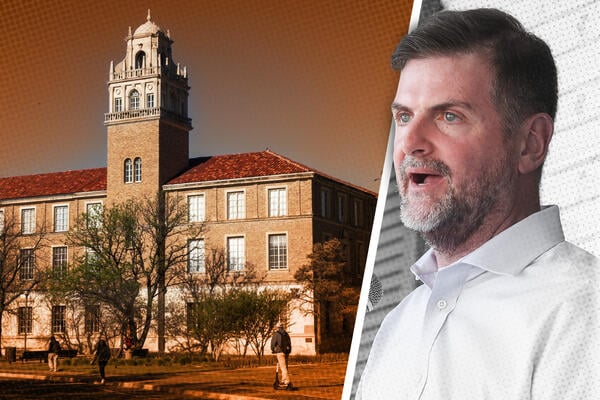
    The lead author listed on all three laws is Sen. Brandon Creighton, chair of the Texas Senate education committee. Having overhauled higher ed statewide, he’s about to get the chance to further his vision at one large university system: On Thursday, the Texas Tech University System plans to name Creighton the “sole finalist” for the system chancellor and chief executive officer job.

    His hiring by the system’s Board of Regents—whose members are appointed by the governor with confirmation from the Senate—marks another example of a Republican politician in a large red state, namely Texas and Florida, being installed as a higher ed leader. The trend reflects an evolution in how Republicans are influencing public universities, from passing laws to directly leading institutions and systems. For universities, having a former member of the Legislature in the presidency can help with lobbying lawmakers, but it could also threaten academic freedom and risk alienating faculty.

    Creighton wasn’t the only, or even the highest-ranking, politician considered for the position, which historically pays more than $1 million a year. As The Texas Tribune earlier reported, Rep. Jodey Arrington, chair of the U.S. House Budget Committee and shepherd of the One Big Beautiful Bill Act, which affected higher ed nationwide, was also in the running. Unlike Creighton, Arrington has worked in higher ed—specifically as a vice chancellor and chancellor’s chief of staff in the Texas Tech system. Arrington, who didn’t provide Inside Higher Ed an interview, issued a statement Sunday congratulating Creighton.

    Faculty leaders offered a muted response to Creighton’s impending appointment. Neither the president of the Faculty Senate at the main Texas Tech campus, the president of the university’s chapter of the American Association of University Professors nor the state AAUP conference publicly denounced Creighton. In an emailed statement, the state conference said, “We have concerns about the future of academic freedom and shared governance in the Texas Tech University System given the positions Sen. Creighton has taken in the legislature.”

    “We hope that Texas Tech’s strong tradition of shared governance and academic freedom continues so that Texas Tech can thrive,” the statement said.

    Cody Campbell, the system board chair, said Creighton is “a fantastic fit with our culture and is clearly the best person for the job.” He added that he likes the higher ed legislation Creighton has passed. (Creighton was also lead author of a new law that lets universities pay athletes directly.)

    “He shares the values of the Texas Tech University System,” Campbell said. Both the system and the wider community of Lubbock, where the main Texas Tech campus is located, are “conservative,” he said.

    “We do not subscribe to the ideas around DEI and are supportive of a merit-based culture,” Campbell said, adding that Creighton is well positioned to continue the system’s growth in research, enrollment and academic standing.

    For Creighton, the job could come with a big payout. Retiring Texas Tech system chancellor Tedd L. Mitchell made $1.3 million in 2023, ranking him the 12th-highest-paid public university leader in the country, according to The Chronicle of Higher Education’s database. The system didn’t respond to Inside Higher Ed’s open records request for Mitchell’s current contract in time for this article’s publication, and Campbell told Inside Higher Ed Creighton’s pay is “yet to be determined.”

    “The contract or the compensation were never part of the discussion with any of the candidates,” Campbell said.

    Creighton didn’t provide Inside Higher Ed an interview or answer written questions. But he appeared to accept the position in a post on X.

    “Over the past six years, no university system in Texas has taken more bold steps forward,” he wrote. “Serving as Chairman of the Senate Education Committee and the Budget Subcommittee has been the honor of a lifetime—especially to help deliver that success for Texas Tech and its regional universities. I feel very blessed to have been considered for the role of Chancellor. There is no greater purpose I would consider than working to make generational changes that transform the lives of young Texans for decades to come.”

    Cowing Faculty Senates

    Campbell said he doesn’t recall whether Creighton and Arrington initially expressed interest in the position to the board or whether the board reached out to them. Dustin Womble, the board’s vice chair, declined to comment. Campbell said the board “actively recruited” some candidates.

    “There wasn’t really a formal application process, necessarily,” he said. But dozens of candidates across the country expressed interest in the “high-paying position” leading a large system, he said.

    The system says it has more than 60,000 students across five institutions and 20 locations, including one in San José, Costa Rica. The five institutions are Texas Tech (which has multiple campuses), Texas Tech Health Sciences Center (which also has multiple campuses), the separate Texas Tech Health Sciences Center El Paso, Angelo State University and Midwestern State University.

    Asked about Creighton’s lack of higher ed work experience, Campbell said that wasn’t unusual for system chancellors, contrasting the position with those of the presidents who lead individual institutions on a day-to-day basis.

    “Our past chancellor was a medical doctor, the chancellor before him was a state senator, the chancellor before him was a former U.S. congressman and a state politician; we’ve had businessmen in that position, we’ve had all different types of people,” Campbell said.

    Aside from serving in the Senate for a decade and the state House for seven years before that, Creighton is an attorney.

    Andrew Martin, the tenured art professor who leads the Texas Tech University main campus’s AAUP chapter, noted that “our chapter has actively opposed some of the legislation that Sen. Creighton has authored.”

    “Our hope now is that Sen. Creighton, in apparently assuming the role of chancellor, will spend time learning more about the campuses in the TTU System and will meet as many students, faculty [and] administrators on our campuses as possible to see how these institutions actually operate day in and day out,” Martin said. “I’m not sure how clear that’s been from his perspective as a lawyer and legislator.”

    Martin—who stressed that he was speaking for himself and colleagues he’s spoken to, but not on behalf of his university—said the AAUP is concerned with maintaining academic freedom for faculty and students, upholding tenure protections, and preserving the faculty’s role in determining curriculum, conducting research and exercising shared governance.

    When the Legislature passed Senate Bill 37—the Creighton legislation that, among other things, upended faculty senates—Creighton issued a news release saying, “Faculty Senates will no longer control our campuses.” He said his legislation “takes on politically charged academic programs and ensures students graduate with degrees of value, not degrees rooted in activism and political indoctrination.”

    Among other things, SB 37 requires university presidents to choose who leads faculty senates. Ryan Cassidy, a tenured associate librarian, was elected to lead the Texas Tech University main campus’s Faculty Senate before SB 37 took effect, and the institution’s president has allowed him to stay in that role.

    Asked about Creighton being named chancellor, Cassidy said, “I haven’t really had time to reflect on it.”

    Creighton’s bio on the Legislature’s website touts his conservative values outside of higher ed, too. “He has relentlessly hammered excessive taxation, pursued ‘loser pays’ tort reform, passed drug testing for unemployment benefits, stood up for Texas’ 10th Amendment rights and effectively blocked Obamacare’s Medicaid expansion,” the bio says.

    Martin said Texas Tech aspires to become a member of the Association of American Universities, a prestigious group of top research universities, of which UT Austin and Texas A&M University are already members. That would be hard if faculty are “marginalized,” he said.

    “You can’t get there without the huge investment of faculty,” he said.

    Source link