
Tag: barring

  • Community College Instructor Quits Over Barring Noncitizens From Adult Ed

    Community College Instructor Quits Over Barring Noncitizens From Adult Ed

    Matthew Fowler/iStock/Getty Images

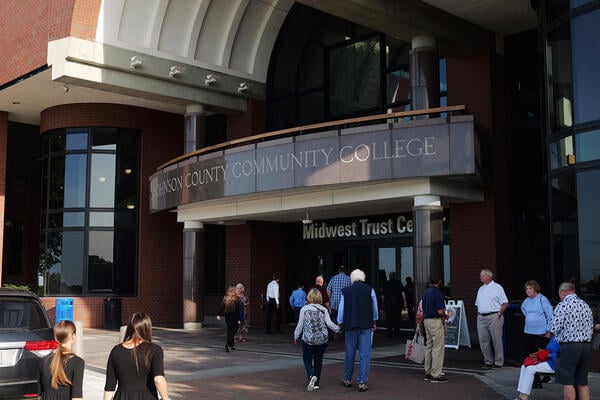
    An adult education instructor at Johnson County Community College in Kansas resigned after finding out the college would require proof of immigration status for adult ed programs in response to federal policy shifts, The Kansas City Star first reported.

    Daniel Tyx, previously a middle school Spanish teacher, started teaching English to adults part-time at the college last year. He told the Inside Higher Ed that he took the job because he has a passion for working with immigrant students, and he planned to stay if not for the new policy. He described the college’s English language learner program as thriving, with over 800 students.

    These students “always come to class. They’re always excited to be there. They’re full of questions. It’s just a dream job,” Tyx said.

    But Tyx quit his job last Friday after he was told that he would have to verify students’ immigration statuses.

    “That was not in alignment with my values,” Tyx said. “And I didn’t feel like, as a matter of conscience, that I was going to be able to continue.”

    The college’s decision came after a February executive order demanded “no taxpayer-funded benefits go to unqualified aliens.” The U.S. Department of Education then announced in July that, to comply with the order, it would end Clinton-era guidance that allowed undocumented students to participate in adult and career and technical education programs. The department insisted that institutions receiving federal funds for these programs begin verifying that students are eligible to benefit from them.

    “Under President Trump’s leadership, hardworking American taxpayers will no longer foot the bill for illegal aliens to participate in our career, technical, or adult education programs or activities,” U.S. Secretary of Education Linda McMahon said in the announcement. “The department will ensure that taxpayer funds are reserved for citizens and individuals who have entered our country through legal means who meet federal eligibility criteria.”

    Checking a student’s immigration status is not a typical practice for community colleges, which are now grappling with how to comply with the federal edicts and continue to serve students, and staffers are uncertain how to move forward. Another complication for community colleges and other public institutions is the Trump administration’s crackdown on policies that allow undocumented students to pay in-state tuition if they meet other requirements. After Texas overturned its policy, state officials asked universities to identify undocumented students. At least one Texas institution, the University of Texas at Austin, now requires students to submit proof of immigration status, as well, KVUE reported.

    The department’s guidance to bar undocumented students was the second blow to adult education programs after the Trump administration held up about $716 million in federal funds to these programs as part of a wider review of education-related grants in early July. The funds have since been released.

    Johnson County Community College now has a message on its website saying that, starting in late July, students are required to show a Real ID, birth certificate, U.S. passport or their most recent immigration documents when they register for adult education classes.

    Chris Gray, vice president of strategic communications and marketing at JCCC, said in an email to Inside Higher Ed that the college’s “compliance with federal requirements in this matter allows us to continue to serve qualified individuals” in adult education programs.

    Tyx said he felt that college administrators were trying to get ahead of the federal guidance, which he considers “cruel and unjust.” He’s worried for his students, who have been peppering him with questions about whether their documents will suffice.

    “My students make such sacrifices to come to class,” he said. “They have so many different reasons to want to learn English, and they’re all good ones. My students want to be able to connect better with their children or their children’s schools. They want to be able to employ the skills that they already have at work and progress in their work lives … It’s very weird that would be something that would be considered to be not desirable by our government.”
    Source link

  • White House barring AP from press events violates the First Amendment

    White House barring AP from press events violates the First Amendment

    A widening gulf has opened between the Trump administration and the Associated Press. 

    Which gulf?

    Precisely.

    On Tuesday, the AP said the White House blocked one of its reporters from attending an event in the Oval Office because the outlet continues to use the name Gulf of Mexico in its reporting. This, despite President Donald Trump’s recent executive order renaming it the Gulf of America.

    After Trump signed that order, the AP announced it would continue referring to the gulf by its original name “while acknowledging the new name Trump has chosen.” It did so in part because the gulf borders other countries that don’t recognize the name change. (The AP did update its Stylebook to reflect Trump’s separate decision to revert the name of North America’s highest mountain, which President Obama changed to the native moniker Denali, to Mount McKinley because that “area lies solely in the United States.”)

    In a Wednesday briefing, Press Secretary Karoline Leavitt confirmed the AP’s allegations:

    I was very up front in my briefing on day one that if we feel that there are lies being pushed by outlets in this room, we are going to hold those lies accountable. And it is a fact that the body of water off the coast of Louisiana is called the Gulf of America.

    The standoff continues — and has escalated beyond Oval Office events. Last night, the White House blocked the AP from an open press conference featuring Trump and Indian Prime Minister Narendra Modi. 

    FIRE issued a statement condemning the administration’s actions, which have drawn criticism from press freedom groupspundits, and politicians across the political spectrum.

    In a letter to White House Chief of Staff Susie Wiles, AP Executive Editor Julie Pace called the administration’s actions “viewpoint discrimination based on a news organization’s editorial choices and a clear violation of the First Amendment.” 

    She’s right.

    To be sure, the First Amendment does not require the White House to open its doors to the media or hold press conferences. Nor does the president have to do a one-on-one interview with CNN just because he did one with Fox News. But court decisions spanning decades make clear that once the government grants media access, it has to play by constitutional rules. 

    That doesn’t mean the White House has to allow every reporter in the world into the Oval Office or briefing room. Space constraints obviously make that impossible, and not every journalist will manage to secure a press pass. But the reason for denying access matters. When the government shuts out journalists explicitly because it dislikes their reporting or political views, that violates the First Amendment.

    As one federal court proclaimed, “Neither the courts nor any other branch of the government can be allowed to affect the content or tenor of the news by choreographing which news organizations have access to relevant information.”

    And because denying press access involves the potential deprivation of First Amendment rights, any decision about who’s in or out must also satisfy due process. That means the government must establish clear, impartial criteria and procedures, and reporters must receive notice of why they were denied access and have a fair opportunity to challenge that decision.

    The AP — a major news agency that produces and distributes reports to thousands of newspapers, radio stations, and TV broadcasters around the world — has had long-standing access to the White House. It is now losing that access because its exercise of editorial discretion doesn’t align with the administration’s preferred messaging. 

    That’s viewpoint discrimination, and it’s unconstitutional.

    This isn’t the first time the White House has sent a journalist packing for reporting critically, asking tough questions, or failing to toe the government line. During Trump’s first term, the White House suspended CNN reporter Jim Acosta’s press pass after he interrogated the president about his views on immigration. After the network sued, a federal court ordered the administration to restore Acosta’s pass.

    But court decisions spanning decades make clear that once the government grants media access, it has to play by constitutional rules.

    Democratic administrations have also unacceptably targeted disfavored outlets for exclusion. The Obama administration tried to exclude Fox News from a press pool because of displeasure with its coverage. Obama’s deputy press secretary Josh Earnest said at the time, “We’ve demonstrated our willingness and ability to exclude Fox News from significant interviews.”

    Similar attacks on press freedom happen at all levels of government. In 2022, FIRE filed an amicus curiae — “friend of the court” — brief in a First Amendment lawsuit challenging vague and arbitrary press pass rules that Arizona elections officials used to block a Gateway Pundit journalist from press conferences. The officials didn’t like the conservative journalist’s political views or negative coverage, including his “inflammatory and/or accusatory language.” After the U.S. Court of Appeals for the Ninth Circuit initially ruled in favor of The Gateway Pundit, the outlet received a $175,000 settlement.

    The current spat over naming conventions for a body of water may seem trivial. But it sends a chilling message to all journalists that White House access hinges on whether the president approves of their reporting. Left unchecked, such a precedent opens the door to broader efforts to manipulate public discourse and undermine press freedom. What other “lies” might the Trump administration hold media outlets “accountable” for? Could scrutiny of its immigration policies, economic performance, or claims about election integrity be next?

    The characterization of the AP’s editorial style choice as a “lie” shows the danger of empowering the state to police mis- or disinformation. The Chinese government might say the same about anyone who calls a certain territory “Taiwan” instead of the “Republic of China” or “Chinese Taipei.” To a government official with a misinformation hammer, every deviation from official messaging looks like a nail. We saw enough misguided attempts to police “misinformation” during the Biden administration. Let’s leave that behind. 

    In an executive order signed the same day as the one renaming the gulf, Trump promised to “ensure that no Federal Government officer, employee, or agent engages in or facilitates any conduct that would unconstitutionally abridge the free speech of any American citizen.” That’s a good policy, and the administration should stick to it — the First Amendment requires no less.

    Any government attempt to control the flow of information strikes a blow at the First Amendment. A free press performs a vital democratic function — gathering, curating, and delivering information, which we can then evaluate for ourselves. Without the Fourth Estate acting as a crucial check on government power, we’ll know less about what our elected officials are up to, and face greater difficulty holding them accountable.

    The beauty of this country’s ideologically diverse media landscape is that if you distrust a particular source, countless others are available offering different information and perspectives. Preserving this rich information ecosystem demands constant vigilance against any threats to free speech and a free press, regardless of who the target is. The alternative — no matter what name you give it — is censorship.

    Source link