Tag: Beautiful

  • How One Big Beautiful Bill Act Threatens Student Success

    How One Big Beautiful Bill Act Threatens Student Success

    Nearly 60 percent of all college students in the U.S. experience at least one form of basic needs insecurity, lacking stable housing and/or consistent access to food, according to national surveys.

    The One Big Beautiful Bill Act, which Congress passed in July, creates sweeping changes to higher education—including a new tax rate for university endowments and accountability metrics for student income levels after graduation. It also directly impacts college students, threatening their access to food assistance programs and their ability to pay for college, which experts warn could hamper their persistence and completion.

    Policy and higher education leaders convened during an Oct. 28 webinar hosted by the Hope Center for Student Basic Needs at Temple University to discuss how the new legislation threatens student financial wellness and success.

    “We are very, very worried that student basic needs insecurity will be increasing dramatically over the next few years,” said Bryce McKibben, senior director of policy and advocacy at the Hope Center.

    For current students, experts outlined three major shifts in federal financial supports.

    1. Cuts to SNAP Funding

    OBBBA includes $186 billion in cuts to the Supplemental Nutrition Assistance Program, which provides support obtaining food for nearly three million young adults, according to U.S. Census data. The bill places more requirements on SNAP recipients; at present, all funding for SNAP is at risk due to the government shutdown. Some states expect to run out of SNAP dollars as early as Nov. 1.

    “[SNAP] is our first line of defense against hunger. It reduces health care–related issues and it bolsters local economies,” said Gina Plata-Nino, interim director of the SNAP, Food Research & Action Center. “It also provides jobs; it provides federal income taxes. And all of this is going to be threatened.”

    Under the bill, all adults ages 18 to 64 must demonstrate they work at least 20 hours per week to be eligible for SNAP, Plata-Nino said.

    Approximately one in four college students experience food insecurity. SNAP resources are largely underutilized by college students, in part because of complicated enrollment processes. Instead, many rely on campus pantries, which are mostly privately funded by individual donors or campus budgets. Plato-Nino anticipates the changes to SNAP will impact funding and capacity for higher education institutions to provide resources, “because now they have to focus on these issues,” she said.

    The federal cuts could cause further damage to an already fragile system.

    “We have a threadbare social safety net that really hits students when they can least afford to meet what are pretty acute and deep costs as they’re trying to get through their degree program,” said Mark Huelsman, director of policy and advocacy at the Hope Center.

    Many colleges and universities expanded emergency grant funding for students during the COVID-19 pandemic to address sudden expenses that could threaten a student’s ability to remain enrolled. While supplemental funding can help ease this gap, it’s not sufficient, Huelsman said.

    “Campuses don’t often have the resources to help students meet what can be an acute financial emergency,” Huelsman said.

    An August 2025 Student Voice survey by Inside Higher Ed and Generation Lab found that 64 percent of respondents said they didn’t know whether their college provides emergency financial aid, and an additional 4 percent indicated that resource was not available at their institution. Only 12 percent of respondents said they knew how to apply for emergency aid at their college.

    2. Changes to Pell Grants

    The reconciliation bill also includes a variety of changes to student eligibility for the federal Pell Grant program, which provides financial aid to low-income students.

    Over one-third of Student Voice respondents indicated paying for college was a top source of stress while enrolled, second only to balancing family, academic, work and personal responsibilities.

    For the academic year 2026–27, those with a student aid index (SAI) over $14,790, as identified by the FAFSA, are no longer eligible for Pell Grants. Similarly, students who receive scholarships that meet the full cost of attendance (including books, housing, food, tuition and fees) are not eligible for Pell, regardless of their SAI.

    “We anticipate that this will affect a very small number of students,” said Jessica Thompson, senior vice president at the Institute for College Access and Success. “But this remains to be seen how this takes effect and what it looks like on the ground.”

    3. Limits on Graduate and Parent Borrowing

    OBBBA caps loans on professional degree programs (which include medical, law, veterinary and dentistry programs, among others) at $200,000, and other graduate programs at $100,000. It also eliminates Grad PLUS loans, which are unsubsidized federal loans with no borrowing limits. Students currently enrolled can borrow from Grad PLUS for three academic years or the remainder of their credential program, whichever is shorter.

    While these limits can be beneficial for keeping student borrowing down, there may be unintended consequences regarding who can access the programs, Thompson said. For example, students who enroll at historically Black colleges and universities or minority-serving institutions are more likely to utilize Parent PLUS loans to pay for college.

    “This has been a really big lifeline for accessing credit in order to cover college costs for people’s children, and there will be a disproportionate impact on these new caps on those types of institutions,” Thompson said.

    Thompson also noted that a lack of federal loan opportunities for graduate and professional students may cause a rise in private loan borrowing, which often has higher interest rates and fewer protections for borrowers.

    “We want to keep a really close eye on what it means for the availability of programs in general … but also access and looking at increasingly less diverse pipelines in terms of historically marginalized populations being able to access graduate and professional programs,” Thompson said.

    Similar to SNAP cuts, Thompson anticipates the loan caps will add significant financial pressure on colleges and universities due to loss of revenue and enrollment.
    Source link

  • Education Dept. Prepares for “Big, Beautiful Bill” Changes

    Education Dept. Prepares for “Big, Beautiful Bill” Changes

    The Education Department is moving quickly to carry out the higher ed changes in the recently passed One Big Beautiful Bill Act.

    The agency announced Thursday that it will convene two advisory committees to weigh in on changes to the rules and regulations for the federal student loan program, institutional and programmatic accountability, and the Pell Grant program. Officials wrote in the announcement that this round of rule-making was necessary to implement the changes in the One Big Beautiful Bill as well as “other administration priorities.”

    Many of the higher ed provisions in the legislation take effect July 1, 2026, and several experts have raised concerns about whether that’s enough time for the department to put in place the necessary regulations and guidance. Among other changes, the law ends the Graduate PLUS loan program, caps loans for graduate and professional students, and expands the Pell Grant to workforce training programs that run between eight and 15 weeks.

    To revise the regulations, the department is following its lengthy and complicated process known as negotiated rule making, which involves bringing together stakeholders to review proposed changes and then listening to public comment on the plan.

    One group, which the department is calling the Reimagining and Improving Student Education (RISE) Committee, will focus on the student loan regulations, including creating new repayment plans and giving colleges the ability to limit how much students can borrow. The RISE Committee will meet twice in September and November for week-long sessions to negotiate policy revisions. If the committee doesn’t reach a consensus, the department is free to move forward with its own proposal, which would still be subject to public comment.

    The other policy changes in the law will fall to the other panel, known as the Accountability in Higher Education and Access through Demand-driven Workforce Pell (AHEAD) Committee. That includes implementing the new earnings test, which requires programs to prove their graduates earn more than an adult with a high school diploma or risk losing their access to student loans, as well as revising the eligibility criteria for Pell grants to exclude students who get a full ride. The AHEAD committee will meet in December and January for week-long sessions.

    Both committees will include student borrowers, legal assistance organizations and representatives from various types of institutions, among other stakeholder groups. None specifically include the financial aid administrations who will play a key role in rolling out these changes on college campuses.

    To kick off the rule-making process, the department will hold a virtual public hearing from 9 a.m. to 4 p.m. Aug. 7. More information is available on the department’s website.

    Source link

  • One Big Beautiful Bill Is Big Betrayal of Students (opinion)

    One Big Beautiful Bill Is Big Betrayal of Students (opinion)

    In late June, House Republicans aired a promotional video about their budget reconciliation bill, the One Big Beautiful Bill Act, claiming it will “make the American dream accessible to all Americans again.” That dream—that anyone in this country can achieve prosperity and success through hard work and determination—is what leads people to come to America and stay. It’s no wonder that politicians invoke this promise as part of the reason for needed change.

    Higher education has long been seen as one of the surest paths to economic security in America—it is one foundation that dream rests on. It feels consequential, therefore, that President Trump and congressional Republicans are looking to undercut this vision of the American dream. The One Big Beautiful Bill Act will reshape federal student aid in ways that transform access to higher education and shut everyday Americans out.

    Forthcoming nationally representative survey data from New America, a nonpartisan think tank, shows Americans are clear-eyed about what it really takes to keep the dream alive: an affordable higher education. But they see college falling further out of reach. Nearly nine out of 10 believe college cost is the biggest factor that prevents families from attending college. And three-quarters of Americans agree that the federal government should spend more tax dollars on educational opportunities after high school to make them more affordable, including majorities of both Republicans and Democrats.

    Americans also believe in accountability for this investment. They want a system that rewards effort, responsibility and outcomes—basic values that align with the American dream. Majorities from both parties say colleges and universities should lose access to taxpayer support if their students don’t earn more than a typical high school graduate or if they struggle to pay down their student loan debt.

    Once enacted, the new law will trim the Pell Grant program, making some middle-income families ineligible who used to qualify for small amounts of the Pell Grant. Federal student loans will look vastly different, with big cuts to graduate, parent and lifetime borrowing limits and less generous repayment options for borrowers who fall on hard times. These changes will close one door for many low- and moderate-income Americans, the one that leads to an affordable associate or bachelor’s degree. At the same time, by expanding Pell Grants to short-term job training programs, the law opens another door to very short credentials as few as eight weeks long with little oversight and consumer protection. Our research has shown time and again that these very short credentials will not deliver economic stability nor improve employment prospects.

    And while the law will take meaningful steps toward accountability and will cut off from federal loans associate, bachelor’s and graduate programs that fail to give students an earning boost, those measures exclude all undergraduate short-term certificate programs, which tend to have the worst outcomes. It will also allow programs to continue to operate, even if most of their students struggle to repay their loans.

    Over all, these changes amount to a massive cut of close to $300 billion in critical funds that ensure students have access to a quality education after high school. It will increase dropout risk (which we know is a major predictor of student loan default), and will push families toward private financing products with fewer consumer protections.

    While the president and congressional Republicans say these cuts are necessary under the auspices of extending tax cuts, improving fiscal responsibility and reforming higher education, the truth is this law will achieve none of this. It will add at least $3 trillion to our deficit by expanding tax cuts to wealthy Americans, all while stripping funding from critical programs everyday Americans rely on like Medicaid, SNAP and student aid. It does nothing to fix the underlying problems that drive college costs. It ignores targeted solutions that would promote affordability and expand accountability. That type of thoughtful reform would require bipartisan reauthorization of the Higher Education Act, which is more than a decade overdue.

    Despite what Republicans in Washington say about making the American dream accessible again, this law will only put it further out of reach. The changes will fall hard on all students trying to obtain education after high school—from welders to electricians, nurses, teachers and medical doctors. These are not “elites,” but core constituents. They are working adults, veterans and parents looking to make a better life for their children, hoping that the American dream is still achievable. Instead, they will find that their own government has abandoned them.

    In his inaugural address in January, President Trump said, “The American dream will soon be back and thriving like never before.” But, in truth, it is being suffocated. It’s too late to change this new law, but moving forward Congress and the Trump administration must center everyday Americans and act cautiously before making such seismic cuts. This is not a partisan issue, but a matter of national interest and prosperity. Failing to think about future legislation that makes meaningful student-centered reform to higher education will have political and generational consequences for years to come. It sends a message to future students that only familial wealth will bring college opportunities, and it won’t matter how much hard work they put in or determination they have.

    Rachel Fishman is the director of the higher education program at New America.

    Source link

  • 3 things to know about school choice in the ‘One, Big, Beautiful Bill’

    3 things to know about school choice in the ‘One, Big, Beautiful Bill’

    This audio is auto-generated. Please let us know if you have feedback.

    The “One, Big, Beautiful Bill,” a major tax and spending package narrowly passed by Congress and signed by President Donald Trump on July 4, includes a Republican-led national school choice provision that public school advocates and some researchers say will disrupt the traditional public school K-12 model by driving more competition with public schools. 

    This controversial issue has been debated at the local, state and national levels for decades, but this is the first federally funded, nationwide private school choice program. While unknowns remain about how many students, schools and states will participate, reaction has been swift, with opponents calling the law harmful to public schools and supporters labeling it as a historic move for educational freedom. 

    “Parents should decide where their kids go to school. This bill helps them do that,” said Sen. Bill Cassidy, R-La., author of the Educational Choice for Children Act included in the “One, Big, Beautiful Bill” and chair of the Senate Health, Education, Labor and Pensions Committee, in a Thursday statement.

    Here’s what you need to know about the newly enacted measure:

    What the new school choice provision says

    The law provides a federal tax incentive to generate funds for families’ educational expenses, including private school tuition at secular and religious schools, as well as costs incurred for children at public and private schools such as fees, tutoring, educational therapies, transportation, technology and other expenses. It would also apply to homeschooling costs.

    To be eligible, families’ household incomes must not exceed 300% of the median gross income for their locality. The means, for example, students in Memphis living in households with incomes of up to $364,400 could be eligible, based on a median family income of $91,100. 

    States, however, can opt out of participating, meaning none of the students in that state would be eligible for the program. It was not immediately clear which state agency or leader decides this.

    Under the new school choice law, any taxpayer who donates up to $1,700 annually to a scholarship granting organization — a 501(c)(3) charity organization — would be eligible for a 100% federal income tax credit for their contribution, or the equal amount in a reduction of taxes owed. According to the Institute on Taxation and Economic Policy, there is no other charitable giving structure that allows this type of dollar-for-dollar tax incentive. 

    ITEP’s analysis of Internal Revenue Service data shows that more than 138 million people could use this tax credit in 2027 if they choose to. But some might not participate because of the paperwork involved or because they disagree with private school vouchers, ITEP said.

    If 43% of taxpayers — which would be about 59 million people — participate, the cost to the federal government would be $101 billion per year, according to ITEP.

    The law does not cap the program’s cost, despite earlier versions of the bill limiting it to $4 billion or $5 billion per year. In addition, the program is permanent with no expiration date. 

    The scholarship-granting organizations that will distribute tuition vouchers for education expenses must be independent entities and cannot be affiliated with a school, according to ACE Scholarships, a nonprofit scholarship-granting organization that has analyzed the law. The organization, in an FAQ, also said parents cannot direct their tax credit directly to their child’s education expenses. 

    Rather, the scholarship-granting organizations will be charged with independently determining students’ eligibility.

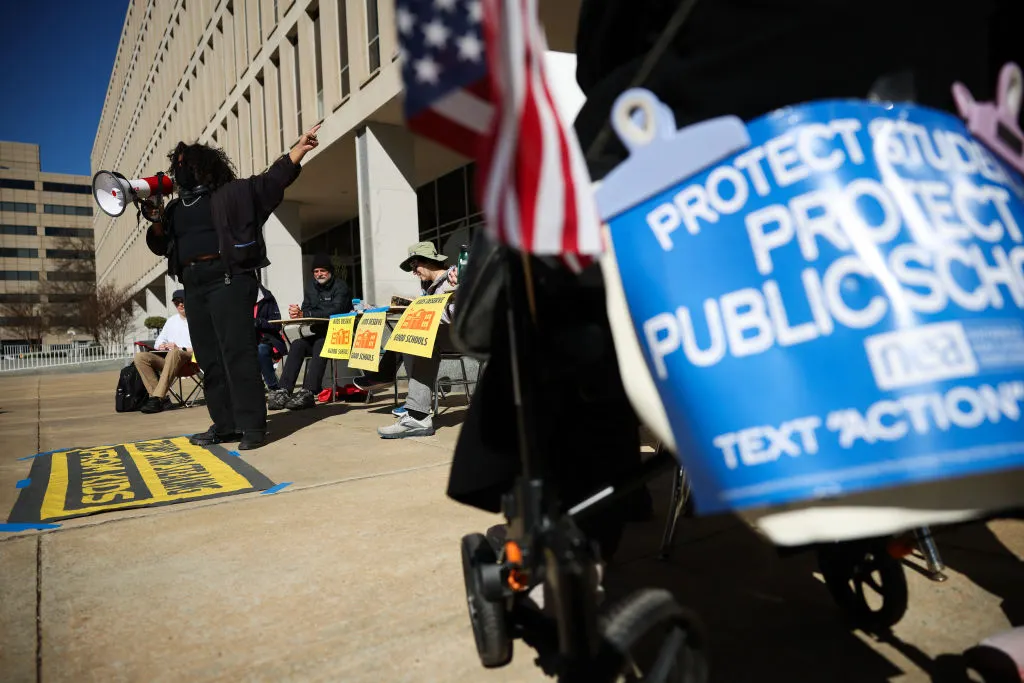
    Several people are seated at desks outside of the U.S. Department of Education. Some people are standing and there are signs on the ground and being held. One sign says "Protect Students. Protect Public Schools."

    Protestors participate in a “study-in” in front of the U.S. Department of Education on March 21, 2025, in Washington, D.C.

    Kayla Bartkowski via Getty Images


    What people are saying

    Reaction to the law was swift, with critics voicing concern about the impacts on public school budgets and supporters applauding what they call a significant step toward parental empowerment in K-12 education.

    Robert Kim, executive director of the Education Law Center, blasted the new program. Studies have shown private school vouchers “sweep aside civil rights protections, support segregation, decimate public school budgets, and do not improve student outcomes,” Kim said in a statement.

    He added, “Vouchers undermine public education, the cornerstone of our democracy, and have no place in federal policy.” 

    EdTrust, a nonprofit organization that works to improve outcomes for students of color, lambasted the law as an “extremely costly federal voucher program that will spend billions in public money to subsidize wealthy families accessing private schools.” and will operate with “little oversight.”

    EdTrust has nicknamed the law the “Great American Heist” for its private school choice provision and changes to Medicaid, food stamps and college loan repayment programs. The law “would dismantle the very programs that make education and economic advancement possible for students of color, first-generation college students, and low- and middle-income families,” EdTrust’s statement said.

    Rachel Laser, president and CEO of Americans United for Separation of Church and State, said in a statement that the school choice program “will divert billions of taxpayer dollars to private religious schools that indoctrinate and can discriminate against students and their families based on the schools’ beliefs.”

    Supporters of private school choice, however, struck a different note. They said parents have become frustrated at disappointing student academic performances in public schools and want more options for their children.

    “This is a huge victory for American families that have been praying and hoping for a financial lifeline to provide their children with the education they need to thrive,” said Anthony J. de Nicola, chairman of the board of Invest in Education Coalition, an organization that has promoted a federal school choice program, in a statement.

    Tommy Schultz, CEO of the American Federation for Children, a school choice advocacy organization, said the law’s passage will “supercharge” school choice across the country. 

    For a generation, our movement has fought to give all families, especially lower-income families, the freedom to choose the best K-12 education for their sons and daughters, and now President Trump has signed into law the single biggest advancement of that goal,” Schultz said in a statement.

    Even with the praise, however, some supporters urged caution. 

    In an interview with Catholic News Agency published July 3, John DeJak, executive director of the Secretariat of Catholic Education for the U.S. Conference of Catholic Bishops, applauded the law’s passage but also pointed to “unknowns” like how the program would address religious liberty protections.


    What happens next

    The tax incentive starts with the taxable years ending after Dec. 31, 2026, — and there’s a lot to work out before then. 

    For starters, the new law says that the U.S. secretary of education must draft regulations for how the program will operate, including recordkeeping and reporting, as well as enforcement of a state’s certification of scholarship-granting organizations. 

    The U.S. Department of Education did not provide a time frame for this by press time on Monday.

    Details such as state participation and how the national private school choice program would operate in conjunction with state-level choice programs also need to be worked out. According to EdChoice, an organization that advocates for school choice, 35 states, the District of Columbia and Puerto Rico have private school choice programs that together serve nearly 1.3 million students.

    It’s also unclear how this new school choice program will meld into Republican-led plans to close the Education Department.

    In the meantime, school choice advocates and supporters of public schools vow to continue advocating for and against the controversial law.


    Source link

  • ‘Big, Beautiful Bill’ Means Big Changes for Higher Ed

    ‘Big, Beautiful Bill’ Means Big Changes for Higher Ed

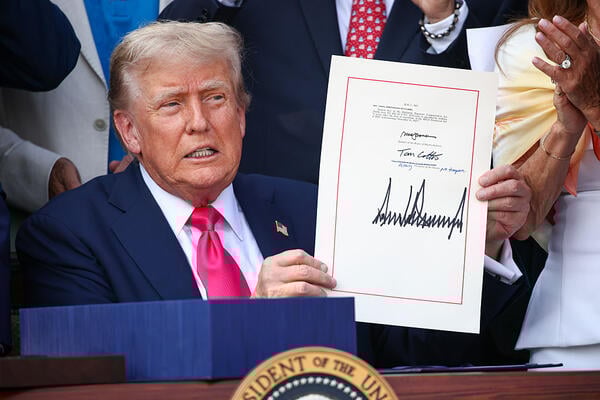
    Following a flyover by a B-2 bomber, President Donald Trump signed a sweeping policy bill into law Friday, celebrating the Fourth of July and commending congressional Republicans for meeting his self-imposed deadline.

    The legislation, which narrowly passed the House on Thursday, promises to significantly change how colleges operate. Higher education groups and advocates warned that the bill will hurt low-income families while proponents praised the changes as necessary reforms.

    Much of the debate over the bill dubbed the One Big Beautiful Bill Act centered on the nearly $1 trillion in cuts to Medicaid, as well as changes to the tax code that will benefit the very rich. But the 870-page piece of legislation also overhauls higher education policy to cap some student loans, eliminate the Grad PLUS program and use students’ earnings to hold colleges accountable. Taken together, higher education experts say, the legislation would transform the sector, hurt universities’ finances and hinder college access.

    But the legislation doesn’t include some of the proposals that most worried college leaders, such as cuts to the Pell Grant program and a 21 percent endowment tax rate. Wealthy private colleges will still face a higher tax rate on their endowments, up to 8 percent. (The current rate is 1.4 percent.)

    Some higher ed lobbyists commended Republicans for backing off some of the deeper cuts, but they are worried about a number of changes in the bill.

    Eliminating Grad PLUS loans could mean fewer students attend graduate school, which would be a hit to universities’ bottom lines, especially at institutions that rely heavily on graduate programs for tuition revenue. Similarly, capping Parent PLUS loans at $65,000 per student could hurt Black and Latino families, who disproportionately use the loans. The legislation also consolidates repayment plans, giving future borrowers two options. Consumer protection advocates worry the bill will exacerbate the student debt crisis and drive students to private loans.

    The student loan changes take effect July 2026.

    Catch Up on Our Coverage of the Bill

    Lawmakers also agreed to expand the Pell Grant to short-term job-training programs, achieving a long-sought goal for community colleges and other groups. In a last-minute change, the expansion excludes unaccredited providers.

    “While somewhat improved over its original version, [the bill] contains a mix of new taxes and spending cuts that will force even more difficult decisions on chief business officers and further strain revenue that helps make college affordable for students and families,” said Kara Freeman, president of the National Association of College and University Business Officers. “The long-term implications of this legislation for higher education and American innovation are likely to be profound.”

    Over all, the One Big Beautiful Bill Act will add about $3.3 trillion to the national debt over the next 10 years, according to the Congressional Budget Office. Republicans said they had hoped to curb spending and address the growing deficit with the legislation, and some conservatives balked at the price tag. Still, pressure from the president to deliver a legislative victory won out, even as some lawmakers waffled for hours over whether to support the bill. Politico reported that Trump called lawmakers and met with them in person to make his case.

    Republicans lawmakers and Trump administration officials praised the legislation, saying it would lower the cost of college and boost accountability. One of the major changes ties colleges’ access to federal student loans to students’ earnings. Programs that fail to show their graduates earn more than an adult with only a high school diploma could be cut off from loans. One rough analysis found that fewer than half of two-year degree programs would pass the earnings test, but community colleges are less reliant on loans.

    “Overall, the Senate’s ‘do no harm’ proposal would strengthen the higher education system,” wrote Preston Cooper, a senior fellow at the conservative American Enterprise Institute, who conducted the analysis. “But the current political environment presents a once-in-a-generation chance to fix the broken federal role in higher education. Lawmakers shouldn’t miss the opportunity to go further.”

    Another analysis from the Postsecondary Education and Economics Research Center at American University found that programs that would fail the earnings test enroll about 1 percent of students. But the test wouldn’t apply to certificate programs, where one in five students are pursuing a credential that doesn’t provide the necessary earnings boost, according to the PEER Center. Other experts have argued that the accountability plan should’ve taken into account the cost of programs and students’ debt loads.

    Colleges generally preferred the earnings-based accountability plan, which is similar to the Biden administration’s gainful-employment rule, though lobbyists had wanted lawmakers to make some changes. House Republicans had planned to make institutions pay an annual penalty based on students’ unpaid loans, which could’ve cost colleges billions.

    Jason Altmire, president of Career Education Colleges and Universities, the national trade association representing for-profit institutions, congratulated Congress in a statement Thursday for passing the “monumental legislation.”

    He praised the short-term Pell expansion as well as the “no tax on tips” policy, among other provisions. But he’s concerned about parts of the new accountability framework, though “we strongly support the fact that the measure applies equally to all schools in all sectors of higher education, a longtime CECU priority.”

    Altmire and CECU oppose the loan caps and eliminating Grad PLUS loans. “These cuts will negatively impact students and limit access for those who are most in need,” he said in the statement. “These provisions are ill-advised and we hope Congress will revisit them in the future. Overall, we are grateful that our voice was heard and so many of our longtime priorities were included in the final bill. We look forward to working with Congress to make improvements through future legislation.”

    Charles Welch, president of the American Association of State Colleges and Universities, said in a statement that the cuts to Medicaid and other programs will hurt regional public universities, which are typically “the first victim of tightened budgets.”

    “Never has the federal government divested itself of financial responsibility to such an extent, imperiling previously stretched state and local budgets as they seek to cover newly obligated burdens,” Welch said.

    Welch added that colleges in the association must put their “profound disappointment in the reconciliation bill aside” to focus on the appropriations process, which will kick into high gear this month. The appropriations bills in Congress set the spending limits and direct agencies how to dole out federal dollars. The Trump administration has proposed deep cuts to the Education Department’s budget, including zeroing out college-access programs like TRIO.

    “The American Association of State Colleges and Universities urges Congress to reassert its constitutionally endowed authority over government expenditures, eliminating executive overreach and fully funding the programs, grants, and institutions that serve our nation’s postsecondary students,” Welch said.

    Source link

  • Risk-Sharing: Trump’s “Big Beautiful Bill” — Implications for UK Higher Education

    Risk-Sharing: Trump’s “Big Beautiful Bill” — Implications for UK Higher Education

    • By Peter Ainsworth, a consultant and writer on higher education finance, known for advocating structural reform that aligns university incentives with real-world graduate outcomes.

    Trump’s “One Big Beautiful Bill” may sound absurd to British ears, but beneath the “very stable genius’s” promotional gloss lies a legislative change designed to reset the relationship between the US Higher Education sector and the state. The bill, which passed the U.S. House of Representatives on 22 May 2025, includes the Student Success and Taxpayer Savings Act (SSTSA) – which, if passed by the Senate, would be the world’s first statutory implementation of institutional risk-sharing in student loans.

    Historically, in both the US and UK, universities have been financially rewarded for their enrollment of students rather than for the practical benefits delivered to their customers. Success arises out of customer acquisition rather than service value-add. Students take out government-backed loans to pay tuition; institutions receive the money upfront regardless of whether or not their degrees lead to economic success. The result is a moral hazard: an incentive (payment) structure for universities that is not aligned with the employability gain that students want and taxpayers need. Systematically falling graduate premiums on both sides of the Atlantic reflect the impact of insulating universities from the employment risk their students face in a rapidly changing economy.

    The American reform seeks to realign incentives to better align risks and objectives. It introduces an Earnings-to-Price Ratio (EPR):

    EPR = (Median Value-Added Earnings) / (Median Total Price)

    Institutions with low EPRs – indicating poor graduate earnings relative to costs – will face a financial penalty in the form of an invoice from the US Treasury to cover the estimated student loan losses for the relevant cohort. If the Senate passes the reform, US universities will have a powerful incentive to transform their offer to ensure meaningful real-world earnings gains for their students.

    The SSTSA is an advance on the existing Cohort Default Rate (CDR) system, which merely threatened to deny access to federal loans to students of institutions with very high default rates. But there was no direct financial risk. Congress deemed it ineffective and so now proposes something more market-oriented.

    Meanwhile, the UK is two steps behind, only now looking to implement a version of the CDR model which the US is already moving away from. A recent Institute for Fiscal Studies (IFS) paper proposes regulating universities based on early-career graduate earnings proxies – like the CDR it is recognising the importance of career earnings outcomes but measuring them indirectly and using regulatory sanction rather than financial cost as the stick. The IFS proposes to use earnings in a three- to five-year window post-graduation to drive regulatory response. Like the CDR’s reliance on a technical definition of default, this short, near-term window will create heavily biased statistics, diminishing the value of professions with delayed earnings trajectories such as medicine and academia.

    Further, the IFS proposes to exclude from consideration graduates with very low earnings. This favours institutions whose graduates earn just below an arbitrary threshold level. They also rely on UK tax data which omits emigrants, undervaluing universities that succeed in preparing graduates for global careers.

    As Friedrich Hayek argued, complex systems cannot be centrally managed through proxies and aggregated metrics. Graduate career trajectories are dynamic, diverse, and unpredictable — precisely the kind of outcomes that defy simple measurement. Accepting that lifetime earnings are the relevant metric leads inevitably to the conclusion that no bureaucratic proxy will suffice.

    There is a cleaner alternative. Universities could be required to issue the loans themselves, something that Buckingham, for example, already does on a small scale. Where needed, to support cash flow, the government could lend to institutions rather than students. This would internalise the financial risk: institutions would have a direct, long-term stake in the earnings success of their graduates. Universities could be freed to set fees and loan terms based on the economic value they expect to deliver and would be incentivised to provide ongoing support — career services, retraining, alumni engagement — to minimise loan defaults over the full life of the loan.

    Such a model also addresses bigger challenges facing the higher education sector. Edward Peck, the new Chair of the Office for Students, recently argued that AI is making traditional assessment ineffective and universities must move from testing what students know to what they can do. Meanwhile, Diana Beech and André Spicer, writing for HEPI, have highlighted that universities now employ an average of 17.6 staff solely to handle regulatory compliance and warned that regulation is “multiplying and becoming less predictable.” In this context, risk-sharing offers a route back to institutional autonomy: tying funding to real-world success rather than the IFS’s proposal for even more bureaucratic box-ticking.

    Finally, political and fiscal realities support this innovation. A shift to institutionally issued loans would remove the student loan portfolio from the government’s balance sheet, reducing annual write-downs by around £15bn per annum – a present value of around £300bn. That would go a long way to address the various fiscal challenges faced by the Labour government. With less bureaucratic interference, more strategic freedom, and appropriate incentives, the sector should be able to make student loans pay, ensuring a sustainable and prosperous future, and letting British universities blow past their American rivals like nobody’s seen before.

    Source link

  • Senate HELP Committee Releases Big Beautiful Bill

    Senate HELP Committee Releases Big Beautiful Bill

    Kevin Dietsch/Getty Images

    Senate Republicans want to eliminate so-called “inflationary loans,” stop federal aid to degrees that leave students worse off and expand the Pell Grant to workforce training programs as part of a draft plan released late Tuesday evening to overhaul higher education policy. 

    The 71-page legislation is part of the Senate’s response to the One Big Beautiful Bill Act, which passed the House last month and is designed to fund President Donald Trump’s tax cuts, his crackdown on immigration and other top agenda items.

    The Senate Health, Education, Labor and Pensions committee drafted the higher education portion of the legislation. As expected, the plan mirrors the House bill in many ways as it calls for significant changes to the federal student loan system. For instance, both plans would end the Grad Plus loans and restrict the Parent Plus program.

    But the Senate has a different plan to hold colleges accountable, nixing the House’s proposed risk-sharing model, under which colleges would have to pay a fee for their graduates’ unpaid loans, for a measure like gainful employment. Under the Senate plan, colleges would have to report their average postgraduate income levels and could lose access to federal aid, depending on students’ earnings and debt. The Senate bill also omits a provision from the House bill that would exclude part-time students from the Pell grant. Overall, the changes in the Senate bill would save $300 billion over 10 years compared to the House bill, which would save $350 billion.

    “American higher education has lost its purpose. Students are graduating with degrees that won’t get them a job and insurmountable debt that they can’t pay back,” said Sen. Bill Cassidy, the Republican chair of the HELP committee, in a news release.  “We need to fix our broken higher education system, so it prioritizes student success and ensures Americans have the skills to compete in a 21st century economy. President Trump and Senate Republicans are focused on delivering results for American families and this bill does just that.”

    Lawmakers are using the process known as reconciliation to advance the legislation, so it only needs 51 votes to pass the high chamber instead of the typical 60 votes. But before senators can vote, the Senate Budget committee and then the parliamentarian will have to scrutinize the various provisions and ensure they adhere to the reconciliation rules. For example, the policy changes must have a budgetary impact and be within the jurisdiction of the committee that proposed it. 

    President Donald Trump has set an ambitious July 4 deadline to sign the measure into law, which would require quick action from the Senate.

    From the beginning of the Trump administration in January, House Republicans have been pushing a more radical plan with steep cuts to key welfare programs like Medicaid, the Supplemental Nutrition Assistance Program, and, most recently, student financial aid like the Pell Grant. Meanwhile, senators have talked about more modest, though still significant, spending cuts. 

    Now, Republicans from both chambers will have to get on the same page if they want to meet their deadline. All the while, lobbyists, policy analysts and political figures—including ex-Trump advisor, Elon Musk—are expected to come at the bill from every angle with critiques.

    Source link