Tag: Benefits

  • Benefits of Centralized Marketing in Higher Ed Institutions

    Benefits of Centralized Marketing in Higher Ed Institutions

    Why Centralized Marketing Matters for Online Programs in Higher Ed

    At Archer, we’ve onboarded hundreds of institutional partners to help them grow their online programs. And while every partner is unique, there’s one pain point we encounter time and again: decentralized school-level marketing that creates more friction than momentum. 

    In many institutions, individual colleges or schools manage their own marketing campaigns, budgets, and creative direction. While this siloed approach offers an initial promise of agility and autonomy, it often leads to deeper problems in the market, such as: 

    • Fragmented messaging 
    • Inconsistent branding 
    • Internal competition 
    • Wasted spend as schools bid against each other 
    • Missed opportunities for reach and impact at the brand and portfolio level

    The result? Confused students consuming competing voices from the same institution, and internal marketing teams scrambling to scale best practices and measure impact — often without apples-to-apples data and reporting for performance comparisons. 

    Universities need an integrated marketing strategy that balances a holistic brand and portfolio-level approach with maintaining individual school-level autonomy for certain decisions and activities. This hybrid model unlocks collaboration, reduces conflict, and lifts visibility for all programs within a portfolio. 

    With shared goals, aligned messaging, and coordinated tactics across all of their schools, universities can amplify their brand and stretch their budgets further — delivering clear, compelling stories across myriad channels to prospective students. 

    Risks of Decentralized Marketing

    In some models of governance, decentralization can be a strength — empowering local leadership and ensuring responsiveness to specific community needs. But when it comes to marketing online university programs in a highly competitive environment, decentralization alone as a strategy is more often a liability than an asset. 

    Having different departments, schools, or programs run their own campaigns and technology stacks may seem like a way to move faster, but in practice, it creates challenges that can hinder online program growth. Let’s explore some examples.

    Brand Confusion          

    As prospective students evaluate your institution’s online offerings, they are not concerned with the internal structures of your institution. They expect clarity and consistency in the information you provide. When each college or division presents a different tone, design style, and creative messaging approach, you’re left with a weakened institutional brand. 

    Mixed marketing across digital ads, program pages, email drips, and even tuition and scholarship messaging can erode the trust and credibility you’ve been building with prospective students. For example, inconsistent explanations of scholarships or conflicting tuition information (e.g., on program pages and via tuition calculators) can trigger frustration or skepticism. 

    In short: Your audience — the prospective student — sees one university. If your university is in conflict with its own marketing, the brand loses power. 

    Inefficiency and Internal Competition

    Without centralized marketing oversight, different teams often end up targeting the same audiences with overlapping campaigns — sometimes even bidding against each other in paid channels. This dilutes your paid marketing efficacy by driving up your cost per lead, wasting precious budget dollars, and undermining the collective impact of your institution’s marketing investments. 

    Inconsistent Student Experience and Success Metrics

    Perhaps the most concerning result of decentralized marketing is a fragmented and uneven student journey. One program might offer seamless inquiry-to-enrollment processes, while another loses momentum after the application process due to poor follow-up and disconnected systems. 

    When your programs use different customer relationship management (CRM) platforms, it becomes difficult to track leads accurately and measure outcomes with consistency. Reporting becomes murky. Success metrics vary. Problems get misdiagnosed. 

    Instead of addressing the root causes of problems, your teams might blame each other (e.g., the marketing team and the admissions team) for the other’s perceived performance issues, when the real problem is systemic disconnection. 

    The Case for Centralized Marketing 

    Centralization doesn’t mean turning every school or program into a cookie-cutter version of the institution’s mission statement, and it doesn’t mean taking any team’s autonomy away. It’s about aligning around a shared strategy — one that empowers individual teams to execute effectively within a cohesive, coordinated framework. 

    Unified Brand Messaging 

    A strong, centralized brand platform allows your university to speak with one clear voice about its online programs, telling the story of: 

    • What your programs offer 
    • Who your programs serve 
    • Why your programs matter 

    This shared narrative should be rooted in your institution’s values and designed to build trust with prospective students. When every program draws from the same story and messaging pillars, it strengthens your presence across every touchpoint — from digital ads and landing pages to nurture emails and program brochures. Each program’s value propositions may differ, but the institution’s story endures. 

    Additionally, a unified approach enables your institution to leverage the brand and portfolio-level marketing that raises visibility across all your programs. For example, some institutions have an integrated marketing program for their undergraduate experience but lack a cohesive approach for their online graduate programs. This is a missed opportunity to build a portfolio-level branded presence through channels that individual schools may not be able to afford on their own. 

    A robust YouTube presence that highlights the benefits of your online graduate education experience (program agnostic), showcases your alumni and graduate education outcomes, and forefronts your strategic organizational partnerships that span individual schools and programs increases the impact for the entire institution with one investment.

    Integrated Campaign Planning 

    Centralized marketing brings together your paid media, content marketing, email strategy, and organic social media into one master plan. 

    Gone are the days of multiple teams across your institution launching disconnected campaigns, as central calendars and shared audience strategies help ensure each tactic contributes to every team’s strategic goals. This means reduced duplication, avoidance of internal bidding wars, and maximization of every marketing dollar. 

    However, your individual schools can and should have decision-making authority over the key value proposition definitions, target personas, and positioning of programs within their fields. This requires a collaborative conversation in an integrated campaign-planning scenario. 

    And schools should continue to develop campaigns where the impact is greatest for them — for example, hosting prospective student events and webinars, offering ambassador programs for prospective student questions, and attending events meaningful to their specific program field, such as at conferences and exhibit halls. 

    Shared Data and Measurement 

    In a world of data, perhaps the greatest and most immediate impact of centralized marketing will be felt in how your institution tracks performance holistically. With unified key performance indicators (KPIs) and shared access to insights, marketing teams at all levels — central and within academic schools — can identify what’s working for them, pivot when needed, and scale successful tactics across programs. 

    Teams can review where the branded portfolio-level efforts are causing the greatest lift in impressions and leads and determine together how school-level marketing activities can make the most impactful use of funds.

    What Centralized Marketing Looks Like in Practice 

    At Archer, we’ve seen institutions achieve dramatic improvements simply by unifying their marketing strategy — even if execution remains shared and distributed. With a strong central foundation in place, teams tap into shared creative resources, coordinate campaigns across programs, and drive stronger performance through unified media buying and consistent messaging. 

    At its best, centralized marketing can: 

    • Empower programs to amplify one another rather than compete 
    • Allow creative strategy to be produced once then repurposed widely 
    • Create paid efforts that are smarter, more cost effective, and better targeted 

    In sum, when your institution implements an integrated marketing model that fosters collaboration among academic schools, it can result in performance that is greater than the sum of its parts. 

    Archer Education knows what it takes to bring siloed departments together. Our unique partnership-based approach allows us to truly understand your institution, then implement efficiencies to ignite your online programs’ potential through a centralized marketing strategy that is balanced with school autonomy and meaningful participation. Contact us today to learn more.

    Source link

  • Who Benefits Most From New Admission Tactic? (opinion)

    Who Benefits Most From New Admission Tactic? (opinion)

    I am not currently on a 12-step program of any kind, but recently I felt the need to seek forgiveness for a transgression committed 50 years ago. This summer is the 50th anniversary of the release of Jaws, the movie that redefined the definition of blockbuster and made a whole generation think twice before stepping into the ocean for a quick dip.

    I took my little sister to see Jaws that summer, having already seen it. As big brothers do, I waited until the exact moment when the shark leaps out of the water while Roy Scheider is casually ladling chum into the ocean behind the boat and either grabbed or pinched her. All to make the movie-watching experience more realistic, of course.

    A recent article in The Washington Post explored why, despite three sequels, Jaws never became a money-making franchise in the way that Star Wars or the Marvel movies have. The obvious reason is that Steven Spielberg elected not to be involved after the original movie. Thus, while I find myself humming John Williams’s simple but ominous theme music every time I read the latest news, the only thing I remember from any of the other three movies is the tagline for Jaws 2: “Just when you thought it was safe to go back in the water.”

    I thought about that tagline from a college admission perspective last week when I learned that Cornell College (the one in Iowa, not the Ivy) has launched what is either an innovative financial aid initiative or a gimmick.

    As detailed by several other publications, Cornell College emailed 16,000 soon-to-be high school seniors in its inquiry pool. Nothing unusual about that. What was different about this email was that it included a link to a personalized estimated financial aid package. Sending out financial aid offers/estimates to students who haven’t applied for financial aid or admission is the new twist in what Cornell calls its “Save Your Seat” initiative.

    If you are wondering how Cornell was able to send an estimated aid package to students who haven’t completed a FAFSA, the college started by mining ZIP code data for its inquiry pool. The nine-digit ZIP+4 code in student addresses provides precise information about where they live and allows Cornell to guesstimate a family’s economic circumstances. It might therefore be more accurate to say that the estimated financial aid package is individualized rather than personalized, because there is an element of geographic or ZIP code profiling taking place. The ZIP+4 information is supplemented by aggregated data provided by College Raptor, the consulting firm engaged by Cornell, along with historical internal data on financial aid packages.

    There are some kinks to work out and questions to be considered, of course. How will Cornell factor in Pell Grants and other governmental financial aid? Will the college make up the difference if the student’s Student Aid Index turns out to be higher than Cornell’s estimate? Apparently Cornell did some testing using applicants from last year and found that the estimates were reliable in the vast majority of cases.

    The Save Your Seat financial aid package for every student includes a $33,000 National Academic Scholarship covering nearly half of Cornell’s list price. To guarantee access to the aid, Cornell is asking students to apply by the end of this month and submit an enrollment deposit by Sept. 1. As The Chronicle of Higher Education explains, “students who apply by the end of July and submit a deposit by September 1 are guaranteed to receive the $33,000 scholarship, plus any institutional need-based grants for which they might qualify, based on their estimate. They will also get first dibs on housing and first-year seminars. (Those who deposit by November 8 will get the same deal, minus the guaranteed need-based grants and priority registration for the seminars.)”

    So what should we make of Save Your Seat? Is Cornell College on to something, or is this another marketing gimmick intended to differentiate Cornell from the mass of small liberal arts colleges? (Its one-course-at-a-time curriculum already distinguishes it.)

    I applaud Cornell for trying to introduce some transparency about cost up front. We know that affordability is both a major concern and a major impediment for many families in considering colleges, and particularly private colleges. Having a way to estimate cost early in the college search rather than at the very end is potentially a huge step forward for college admission. Cornell’s initiative might be thought of as an updated version of the net price calculator, with someone else doing the calculations for you. Save Your Seat might also be seen as the next iteration in the direct admission movement.

    But let us stop for a moment to acknowledge that Cornell’s new initiative, while more transparent, isn’t truly transparent. It does nothing to illuminate the high-cost, high-discount model that higher education relies on.

    There are good reasons for that. There have been several colleges that have tried to lead a movement to reset tuition, substantially reducing their sticker price but also substantially reducing discounts. They learned two things. The first was that they were willing to lead, but other colleges were not willing to follow.

    The bigger issue is that they learned that families are more than happy to pay lower tuition but are not happy to lose their “merit” scholarships. As it turns out, merit scholarships are among the least transparent and most misunderstood contrivances in college admission—perhaps deliberately so.

    Just last week, I spoke with someone who was surprised that a nephew had been admitted to college and then shocked when he received a merit scholarship. That conversation brought to mind a phone call I had with the mother of one of my students years ago. The son was a good kid but not a strong student, and he had just received merit scholarships to two different colleges. I finally figured out that the point of her call was to ask what was wrong with the two colleges that were awarding her son merit scholarships.

    The $33,000 National Academic Scholarships offered to every Save Your Seat email recipient might be thought of as the higher education equivalent of Oprah’s “You get a merit scholarship! You get a merit scholarship!” Cornell is far from alone in giving a discount to most or all students, but the potential pickle in which it finds itself is a situation where it tells students they are not admitted after already telling them they have won a merit scholarship.

    That is far from the biggest ethical issue raised by the new plan. If the move toward greater financial aid transparency, at least in theory, is a positive step, asking students to apply by the end of July and deposit by September is anything but.

    When the National Association for College Admission Counseling was forced to abandon key aspects of its code of ethics as part of a consent decree with the antitrust division of the U.S. Department of Justice, there were fears that college admission might deteriorate into a lawless Wild West, with colleges coming up with new strategies and incentives to coerce vulnerable students into decisions they weren’t ready to make. Thankfully that hasn’t happened to the degree predicted.

    Cornell’s decision to tie the Save Your Seat financial offers to an earlier application and enrollment deadline represents another leap forward in the acceleration of the college admission process. Who thinks that’s a good idea for students? It ignores the fact that many high school counseling offices are closed during the summer and won’t be able to send transcripts (perhaps Cornell will use self-reported grades). It is also significantly earlier than the provision in the now-defunct NACAC Statement of Principles of Good Practice prohibiting an application deadline before Oct. 15. Just when you thought it was safe to go back in the water.

    It’s not clear to me why the earlier deadlines are necessary for the program to work. It’s clear that there are benefits for Cornell, but students should be allowed to choose where to go to college thoughtfully and freely, without coercion or manipulation. Whose seat is being saved here?

    Jim Jump recently retired after 33 years as the academic dean and director of college counseling at St. Christopher’s School in Richmond, Va. He previously served as an admissions officer, philosophy instructor and women’s basketball coach at the college level and is a past president of the National Association for College Admission Counseling. He is the 2024 recipient of NACAC’s John B. Muir Excellence in Media Award.

    Source link

  • Offering student loan payment assistance a ‘no brainer,’ benefits manager says

    Offering student loan payment assistance a ‘no brainer,’ benefits manager says

    This audio is auto-generated. Please let us know if you have feedback.

    SAN DIEGO — Applied Materials’ student loan repayment program for employees reaped such rewards that the company more than doubled its annual contribution after the first year, Tes Fernandez, director of U.S. benefits for the company said during a panel discussion at the annual conference for SHRM, formerly known as Society for Human Resource Management.

    In year one, the manufacturing company contributed $2,000 per employee in direct repayment of workers’ student loans. In the years that have followed, Applied Materials now pays out $4,800 per employee and uses the benefit as both a way to support generally newer hires, recent graduates and some underrepresented groups and as a recruiting tool.

    “They had to go up to the CFO and ask for extra millions of dollars to add this benefit. A year later, they more than doubled the benefit amount, not because the CFO got generous, but because they were seeing the results of the benefits,” Chris Rinko, VP and student debt and health and wellness benefits administration account executive at Fidelity Investments, said during the panel, which he moderated.

    When it comes to student loan debt assistance, employers have two choices, Rinko explained. They can either provide a direct payment to student loan servicers to help pay down employees’ loans, or they can elect to offer matching contributions in the 401(k) plans of workers who demonstrate they are making student loan payments.

    The direct payment method can be targeted to only apply to certain groups — those who earn less or those in a specific job, for example — and can have a set end date, Rinko said, while matching contributions are tied to a company’s overall 401(k) plan offering and can’t exclude any workers.

    Tracey Gannon, a senior benefits manager at eBay, said it was “kind of a no-brainer” for the e-commerce company to offer matching funds after the passage of the SECURE 2.0 Act. The law gave employers the ability to match employee contributions to certain student loan payments.

    “We felt that this was just such an easy first step,” Gannon said.

    The company already budgets for all employees to get the full matching contribution in their retirement plans and has a 96% participation rate, Gannon said. That meant the new offering wasn’t a big budget item for the company but could provide support to some employees in need.

    Similarly, offering a matching contribution seemed like “an easy win” for The Walt Disney Co. and its workers, said Marianne Lynch, a senior manager of executive benefits and hypercare for the company.

    “It’s a huge, huge benefit to reduce that burden” of student loan debt, Lynch said. At Disney, 97% of employees already receive the full 401(k) match, but for those who don’t, it’s a way not to miss out on the matching funds to which they’re already entitled, she added.

    “The only change here is you’re giving them another way to earn that match by paying their student debt,” Rinko said.

    At companies where most employees already receive the full matching contribution, some leaders may ask, “Why bother?” with a student loan repayment match, Rinko said.

    “The reason is, if it’s just 1% or 2%, if you can find a path for that small number, for those people who are usually in the greatest need to earn the match, why not?” Rinko said.

    Source link

  • The Benefits of Professional Society Involvement (opinion)

    The Benefits of Professional Society Involvement (opinion)

    Back in 2001, when I first attended university, I didn’t join any student organizations, clubs or professional societies. I was busy with classes, after all, and didn’t know what benefit they could provide me anyway. What possible value would becoming a SACNAS member offer? Some clubs even required a membership fee!

    Now I know better. Professional societies are a critical, often overlooked way of building your network, strengthening your résumé and finding professional development opportunities outside classes. As discussed in a 2020 Developmental Biology article titled “Professional societies can play a vital role in career development,” professional societies offer conferences, workshops, virtual seminars and free resources to members and, in many cases, nonmembers.

    These resources provide learning opportunities across multiple categories, including professional development, career deep dives and leadership training. My own organization, the Genetics Society of America, offers the Leadership Dialogue Series organized by our early-career scientists, seminars in languages other than English and workshops on different types of careers and topics related to accessibility in STEM. Each of these events represents an opportunity not just for our community to learn about a new career, skill or research topic, but also provides CV and résumé boosts to our event organizers, whose volunteerism powers GSA’s ability to offer these resources.

    Speaking for myself, when I returned to school in 2010, I joined groups that aligned with my career and professional goals: building a support community via a Society for Advancement of Chicanos/Hispanics and Native Americans in Science membership, building a professional community via a Graduate Student Association and Association for Women in Science membership, learning more about science writing opportunities via a National Association of Science Writers membership, and connecting with fellow mycologists via a Mycological Society of America membership.

    As a transfer student with a previous degree, I was also inducted into the Tau Sigma National Honor Society. Now, as a career development professional, I am an active member and volunteer for the Graduate Career Consortium. All these memberships helped guide me to the career I have today and have opened numerous opportunities for collaborations, event organizing, volunteer work and personal career development. I can say without any hesitation that my membership with GSA, MSA and NASW led me directly to the position I have now, and collectively my society memberships keep me informed of current developments in higher education, professional development opportunities, and my own field of genetics.

    As you scan each professional society’s page, note the many conferences, professional development programs and job postings each of these memberships gives you access to. You may not be in a position to invest in more than one professional society, and that’s perfectly fine! Choosing one specific society as your “home” and focusing your volunteer efforts and involvement in this specific society is a wonderful way to build your network; connect with other like-minded professionals; collaborate in organizing high-value, marketed events; and learn the inner workings of a professional society.

    Choosing your society of interest might seem daunting. Here are some tips to help you navigate this choice and select the best society to fit your needs:

    • Cost: Determine how much you can budget each year for a membership. You may need to save up to afford this cost at a future date, so keep track of membership renewal times. Check with your adviser, lab or department to see if they would be able and willing to pay for one professional society membership as part of your graduate studies. Many societies offer lower rates for students. Also check for low-income waivers—many societies offer discounts or waivers due to economic hardship.
    • Field-specific societies: If you’re a physicist, the American Physical Society makes more sense to join than GSA. A social worker should join a society such as the National Association of Social Workers. Whatever your field, there’s a professional society that serves your community! If you’re not sure what your field’s societies are, ask your adviser and other faculty. You can also ask an AI tool to compile a list, with links to check sources, using this prompt: “Create a table for scientific societies based in the United States which serve [YOUR FIELD] academics. The columns should be society name, website, upcoming conferences and membership cost for a graduate student member.” For example, using this prompt with “history” as the field, I received the following results from OpenAI’s ChatGPT:

    Here is a table of prominent U.S.-based scientific societies that serve history academics, including their websites, upcoming conferences and graduate student membership costs:

    Society Website Upcoming Conference(s) Graduate Student Membership Cost
    American Historical Association (AHA) historians.org AHA 2026 Annual Meeting, Jan. 8–11, 2026, Chicago Not specified
    Organization of American Historians (OAH) oah.org 2025 OAH Conference on American History, April 3–6, 2025, Chicago $51/year
    American Catholic Historical Association (ACHA) achahistory.org 105th Annual Meeting, Jan. 3–5, 2025, New York, N.Y. $20/year
    Social Science History Association (SSHA) ssha.org 2025 Annual Conference, Nov. 20–23, 2025, Chicago $30/year
    Society for the History of Technology (SHOT) historyoftechnology.org 2025 Annual Meeting, Oct. 9–11, 2025, Esch-sur-Alzette, Luxembourg Not specified
    World History Association (WHA) thewha.org 34th Annual Meeting, June 26–28, 2025, Louisville, Ky. Not specified

    Please note that membership costs and conference details are subject to change. For the most accurate and up-to-date information, it’s best to visit the respective society’s official website.

    You can see that not every result includes a cost, but because I have the website, I can quickly check and find that the American Historical Association offers a one-year student membership for $42 and update my table accordingly. Since two of the conference dates listed on the table have already passed, I can also easily update the information for the Organization for American History and the American Catholic Historical Association to reflect the planned 2026 conference dates and locations.

    • Attend a conference: Talk to your adviser about attending a conference offered by the professional society you’re interested in. Many societies offer travel fund awards that you can apply for if your adviser is not able to support your attendance.
    • Check out the organization’s professional development opportunities: If the society has an early-career program or committee, apply to become a member! These programs are an excellent way to get your name out to a large number of colleagues and build your network, as the early-career students you work with will become your professional colleagues who step into academia, industry and beyond with you.
    • Be strategic in your involvement: Decide how much time you’re willing to invest each month in a volunteer opportunity and guard your time diligently. Burnout is a fast way to turn a positive experience into a negative drag on your time, so approach each opportunity as a large project and add more only if you have the time. You don’t want to become known for bailing out on multiple collaborative volunteer opportunities!

    When thinking about which professional society you should join, make sure you’re choosing the society that aligns with both your career goals and personal needs, and that offers you the best opportunities for your investment. Talk with your adviser to see if there’s a society they recommend and begin your professional society journey early to maximize this resource as you move forward in your career.

    Jessica M. Vélez is the senior manager of engagement, community building and professional development for the Genetics Society of America. She earned her Ph.D. in energy science and engineering from the University of Tennessee, Knoxville, in 2020, and was awarded the National GEM Fellowship during her graduate studies.

    Source link

  • Teacher stress levels have surpassed pandemic-era highs

    Teacher stress levels have surpassed pandemic-era highs

    Key points:

    America’s K-12 educators are more stressed than ever, with many considering leaving the profession altogether, according to new survey data from Prodigy Education.

    The Teacher Stress Survey, which polled more than 800 K-12 educators across the U.S., found that nearly half of teachers (45 percent) view the 2024-25 school year as the most stressful of their careers. The surveyed educators were also three times more likely to say that the 2024-25 school year has been the hardest compared to 2020, when they had to teach during the height of the COVID-19 pandemic.

    Student behavior challenges (58 percent), low compensation (44 percent), and administrative demands (28 percent) are driving teacher burnout and turnover at alarming rates. Public school teachers were more likely to report stress from unrealistic workloads, large class sizes, school safety concerns, and student behavior issues than their private school counterparts.

    “The fact that stress levels for so many teachers have exceeded those of the pandemic era should be a wake-up call,” said Dr. Josh Prieur, director of education enablement at Prodigy Education and former assistant principal in the U.S. public school system. “Teachers need tangible, meaningful, and sustained support … every week of the year.”

    Additional key findings include:

    • The vast majority of teachers (95 percent) are experiencing some level of stress, with more than two-thirds (68 percent) reporting moderate to very high stress. K-5 teachers were the most likely to feel extremely/very stressed (33 percent). Sixty-three percent of teachers report that their current stress levels are higher than when they first started teaching. 
    • Nearly one in 10 teachers surveyed (9 percent) are planning to leave the profession this year, while nearly one in four (23 percent) are actively thinking about it. One-third of teachers do not expect to be teaching three years from now, likely because nearly half (48 percent) of teachers don’t feel appreciated for the work that they do.
    • Teachers are finding ways to prioritize their well-being, but time limits and job pressures often get in the way. Seventy-eight percent of teachers say they actively make time for self-care, but nearly half (43 percent) feel guilty for spending time on self-care and 78 percent have skipped self-care due to work demands. Implementing school-provided self-care perks and mandatory self-care breaks would appeal to teachers, with 85 percent and 76 percent taking advantage of each benefit, respectively.
    • Top solutions that would reduce teachers’ stress include a higher salary (59 percent), a four-day school week (33 percent), stronger classroom discipline policies (32 percent), and smaller class sizes (25 percent). Public school teachers were more likely to prefer a shorter week, while private school educators opted for higher pay. 

    “Teacher Appreciation Week should serve as the starting point for building systems that show we value teachers’ time, talent, and well-being,” said Dr. Prieur. “Districts can do this by investing in tools that reduce the burden on teachers, prioritizing time for self-care and implementing policies that reinforce teachers’ value as an ongoing commitment to bettering the profession.”

    This press release originally appeared online.

    Laura Ascione
    Latest posts by Laura Ascione (see all)

    Source link

  • Students Lose Food Benefits Between High School and College

    Students Lose Food Benefits Between High School and College

    Fewer than half of low-income students retain their state food benefits in the transition from high school to college or the workforce, even though they might still be eligible, according to a new report from the California Policy Lab, a nonpartisan research group affiliated with the University of California, Berkeley, and UCLA.

    The report, released today, drew on data from 2010 to 2022 from five state agency partners: the California Departments of Education and Social Services, the California Student Aid Commission, the University of California Office of the President and the California Community Colleges Chancellor’s Office. It found that only 47 percent of high school seniors who participated in CalFresh were still enrolled in the state food assistance program two years after graduation.

    “That’s a significant drop-off, and our goal is to shed some light on the causes of that drop-off and if there are ways to address it,” co-author Jesse Rothstein, professor of public policy and economics at UC Berkeley and the faculty director of the California Policy Lab’s UC Berkeley site, said in a news release.

    Researchers estimated that 40 percent of those students were no longer eligible for CalFresh because of specific eligibility requirements for college students. But the remaining 60 percent were likely eligible.

    Researchers also found disparities in which students maintained their CalFresh benefits. Students who participated in CalFresh for longer in high school were more likely to continue to participate afterward. Students who attended University of California campuses were also more likely to continue participating in CalFresh than those attending community colleges. The report suggests this is because community college students are more likely to live at home with their parents, whose incomes are factored into the eligibility for CalFresh, which can prevent them from meeting the program’s income requirements.

    Some community college students, including Hispanic and Filipino students, were less likely than their peers to continue receiving food benefits. The report recommended targeted outreach to these students to help them stay enrolled in the program.

    Source link

  • Extracurricular activities have big benefits for students

    Extracurricular activities have big benefits for students

    Extracurricular activities have big benefits for both students and the university – but we could do more to get students involved.

    University life for students is busy these days, not just with lectures and assessments but for many students, also the need to work to fund their studies.

    Extracurricular activities can not only add value to the student experience and are a key offering of universities which have some surprising benefits for both.

    They have a demonstrative effect in reducing depression, boosting employability skills, giving students an opportunity to try new things without pressure of assessment – and participation in extracurricular activities is closely related to increasing alumni donations to the university, a clear sign of happy and successful graduates.

    However, in order for us to get the most out of them we need both the benefits, and the activities themselves, to be signposted better within the university as well as ensuring that some groups that would benefit most despite lower engagement are encouraged to get involved.

    Competition for student’s time is fierce, with coursework, exams, and projects, but also for those students who need to work in paid employment to fund their studies and living costs. But extracurricular activities have several benefits for the students, and whilst a small number of students find it harder than others to balance activities and academic work, outcomes are generally positive.

    The vast majority of studies around the world have found a general correlation between taking part in extracurricular activities and improved academic performance. There are a large range of activities that students could do – activities that complement the curriculum such as the MBA programme having a pitching competition or a weekend hackathon (often called cocurricular activities), whilst there are also activities from outside these boundaries such as sports which are unrelated to the student’s core subject.

    Regardless of the actual activity that they do, there are a range of positives. They improve employability skills and leadership skills – giving the student CV-worthy examples, and they are a way to show an employer that you are interested in a specific career.

    Employers have suggested extracurricular activities can help determine your cultural fit, and show examples of commitment and interpersonal skills. Involvement in social enterprise or charitable projects are looked upon favourably. Improving students’ employment prospects, especially with extracurricular activities having a “levelling up” effect for those from minority groups and those from lower socio-economic groups – this reflects well on the university and its mission.

    Extracurricular activities allow students the opportunity to try more hands-on and experiential activities without the risk and pressure of needing a good grade, or being creative using spaces such as makerspaces. It might also be a rare opportunity to work in a cross disciplinary manner and diversifies your group of friends.

    Residential courses and field trips are also valuable, with research showing that they stimulate a sense of togetherness with those on their courses, and with a chance to see their subject in action which helps them put it in context, encourages more enjoyment of it, and allows them to form career plans based on that subject, with those in late adolescence and early adulthood especially attuned for developing career self-efficacy in this way.

    These residential activities seem to disproportionally benefit poorer students and those from minority groups, resulting in higher marks, thus making them ideal activities for universities to support. With the Sutton Trust suggesting the number of students in the UK now living at home due to the cost of living to be 34 per cent, rising to 65 per cent from those in poorer socio-economic groups, it is a rare opportunity for some students to escape from living with parents.

    Extracurricular activities are seen as adding value by students, especially those overseas students who readily sign up for activities, as we have found with off campus opportunities we offer in entrepreneurship quickly booked up by enthusiastic overseas students, such as our “Enterprise School” in the Lake District with postgraduate groups from mixed subject areas working together late into the night (putting the staff to shame) – and keeping in touch when they return to Manchester and beyond, building a network they would never have otherwise met.

    What can we do to improve them?

    We can try to engage older and ethnic minorities more as these groups tend to spend less time on extracurricular activities at the university, and make them more friendly for those who may have carer commitments, for example not always having events in the evening.

    This might help other groups of students – I have also found as an academic adviser that many students in Manchester live with parents and commute from nearby cities such as Liverpool and Sheffield, with their notoriously bad rail lines – and these students are less likely to take part in extracurricular activities as they prioritise when they travel to university.

    Those from lower socio-economic groups also spend less time on extracurricular activities due to the pressure of paid employment, so encouraging them to consider at least some extracurricular activity would be beneficial.

    First year males could also be a target for engagement – whilst suicide rates for students overall are considerably lower than that of the general population, for first year males the rate was found to be 7.8 per 100,000 people, significantly higher than males of other years and female students as a whole, which has been attributed to social isolation, alcohol consumption and the general life change of moving to university.

    Involvement in extracurricular activities reduces suicidal tendencies by increasing the sense of belonging and lessening the sense of burden a student might feel, and are a relatively low cost option as part of the universities commitment to its duty of care. It has been suggested by the Office for Students that those students who are in several minority categories concurrently are particularly vulnerable from a mental health perspective, so being aware of these students is especially important.

    Students partaking in extracurricular activities reported having a depressive mood less often and report the development of a long-lasting social support network – which may well identify problems and help students before the university even becomes aware of anything wrong.

    Unfortunately, many that will benefit most from them won’t take part – so we need to encourage them to do so – especially students’ academic advisers who might have a broader picture on how well the student is getting on. Studies have found that female students are more likely than males to undervalue the skills they have gained from extracurricular activities – again academic advisers could reinforce this for all, especially when preparing for job applications.

    Alumni speakers could also reference what extracurricular activities they did to focus on how this helped them while at university, and examples of how it helped them find employment and fit into the workplace.

    Programme directors might also recommend what co-curricular activities might be useful for the student’s degree, and students themselves such as at the student’s union could communicate more on the benefits of extracurricular activities, especially to engage first years, throughout the year as well as during the whirlwind of welcome week – some students might need time to settle down before they can see how much spare time they can allocate to extracurricular activities.

    Ask students when they want activities to run – this might be different for city centre or out of town campuses – but we have found in Manchester a surprising number of students who are prepared to commit to a whole Saturday working on a hackathon, for example.

    Interestingly, there is a correlation between the number of extracurricular activities that a student partakes in and alumni donations, with a Wonkhe study suggesting that participation in extracurricular activities was a much stronger indicator of donation to their alma mater even than degree class obtained, showing extracurricular activities strengthen the relationship between students and their university.

    There is every reason for universities to provide a full range of opportunities – and to encourage students to get involved.

    Source link

  • 10 Benefits of an Online Admissions and Enrollment System

    10 Benefits of an Online Admissions and Enrollment System

    Reading Time: 8 minutes

    As a school administrator or marketer, you’re likely already familiar with the challenges of traditional admissions processes: manual paperwork, miscommunication, long timelines, and a lack of transparency. 

    Implementing an online enrollment system can revolutionize your institution’s operations. It can help you create a seamless experience for prospective students while significantly easing administrative burdens.

    At Higher Education Marketing, we’ve spent years partnering with institutions to understand their unique needs. Our Student Portal is designed specifically for education providers like you, offering an all-in-one solution to streamline admissions and enhance the student journey. 

    Let’s explore ten benefits of adopting an online admissions and enrollment system and how HEM’s Student Portal can help you transform your processes. You’ll see how much value you can add to your student experience and how a sophisticated CRM can boost enrollment.

    Simplify student management and boost recruitment efficiency!

    Transform your student portal experience. Get a FREE HEM-SP demo today.

    Understanding Online Enrollment Systems

    What does an enrollment system do? An online admissions and enrollment system is a digital platform that streamlines student recruitment, application management, and enrollment. By moving these processes online, institutions can eliminate manual paperwork, reduce processing times, and improve the overall experience for students and staff. 

    These systems typically include customizable application forms, real-time tracking, automated communication tools, and integration with other institutional systems like CRMs and financial platforms. Now, let’s get to the good part–the many benefits of enrollment system tools. 

    Want to know what our Student Portal System can do for your school? Let’s connect

    A Brief Overview of the Enrollment Process

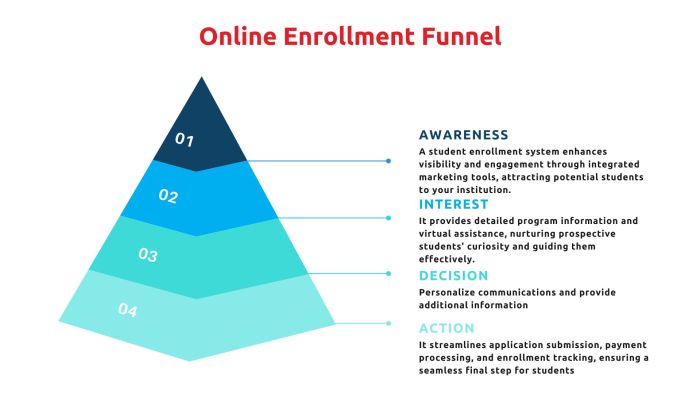
    To maximize the benefits of an online admissions and enrollment system, it’s important to understand the enrollment funnel. What is the process for enrollment? It’s a framework that outlines the four key stages prospective students go through when deciding to enroll at your institution. These include awareness, interest, decision, and action. 

    Awareness is the first stage, where students become familiar with your school through marketing efforts, social media, or word-of-mouth. During this phase, you aim to make a positive impression and highlight what sets your institution apart.

    Interest follows as students actively seek more information about your programs and offerings. At this stage, providing detailed program descriptions, virtual tours, and engaging content becomes crucial to capturing their attention.

    Decision is the third stage, where students weigh their options and determine if your institution aligns with their goals. Clear application processes, transparent cost estimates, and personalized communication can help sway their decision.

    Action is the final stage, where students commit by completing their application and enrollment. An intuitive and efficient online system, like HEM’s Student Portal, ensures this final step is seamless and stress-free, setting the tone for a positive student experience.

    HEM 1HEM 1

    Source: HEM

    1. Simplifying the Application Process

    An online admissions system allows you to simplify and accelerate the application process, providing a smoother experience for prospective students. Instead of requiring students to navigate complex paper forms or disjointed systems, you can offer them a centralized, user-friendly portal where they can complete their applications step-by-step.

    HEM’s Student Portal includes a customizable WYSIWYG (what you see is what you get) form builder, allowing you to tailor applications to your institution’s specific requirements. With options for e-signatures, document uploads, and guided prompts, your students can complete their applications quickly and confidently.

    For administrators, this streamlined process means less time spent tracking incomplete applications and more time focusing on strategic initiatives. You can view, manage, and update application statuses in real time, ensuring nothing slips through the cracks.

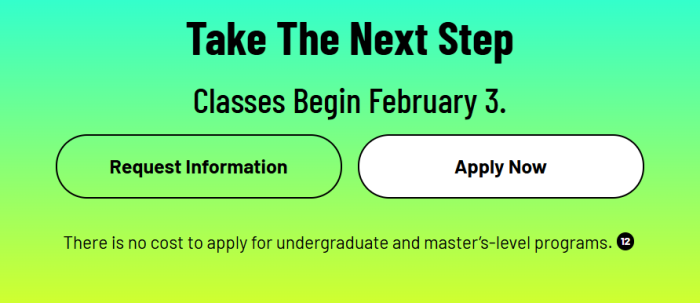
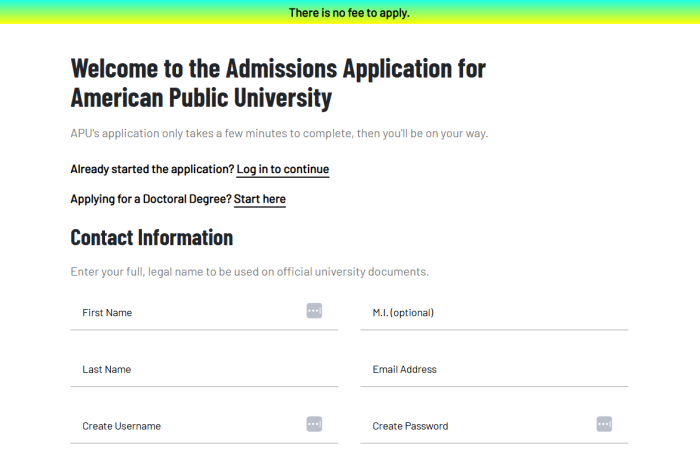
    Example: The key benefit of online enrollment systems regarding the student journey is convenience. Here, American Public University is the perfect example.

    HEM 2HEM 2

    At the click of a button, students can begin their applications.

    HEM 3HEM 3

    They are immediately led to a simple, free application form where they’ll provide vital information needed for the American Public University to determine whether admission into their program will be granted and allow them to track their journey. 

    Source: American Public University 

    2. Enhancing Recruitment Efforts

    With an online system, you can improve how you engage with prospective students from the beginning of their journey. HEM’s Student Portal integrates powerful marketing automation tools, allowing you to nurture leads with personalized communications at every stage of the admissions funnel. You can keep prospective students engaged and informed by sending timely emails, reminders, and updates, increasing their likelihood of completing enrollment.

    Furthermore, the system’s data insights enable you to identify trends in student inquiries, monitor which marketing campaigns are most effective, and adjust your strategies accordingly. This data-driven approach ensures your recruitment efforts are consistently targeted and impactful.

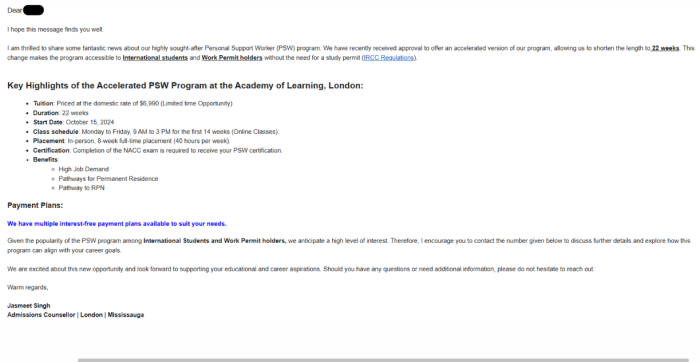
    Example: Once a prospect has filled out a contact form or inquired about a program, they should receive a personalized follow-up message that provides program details and prompts them to follow the next steps.

    Here, the Academy of Learning sends an automated email about its Accelerated PSW Program to a prospect who recently expressed interest. Our Student Portal integrates email and messaging services to facilitate and automate communication with prospects, a key part of the recruitment process.

    HEM 4HEM 4

    Source: Academy of Learning | Gmail

    3. Reducing Administrative Burden

    One of the most immediate benefits of implementing an online admissions and enrollment system is the reduction in administrative workload. Manual processes can be time-consuming and prone to errors, but with an online platform like HEM’s Student Portal, you can centralize all tasks in one intuitive interface. From managing inquiries to processing payments, every step is organized and automated.

    Staff members across departments can collaborate more effectively, ensuring seamless communication and reducing duplication of efforts. The result? A more efficient admissions team with more time to focus on higher-value tasks, such as building relationships with students and refining institutional strategies.

    4. Offering Real-Time Insights

    Making informed decisions is essential in a competitive education landscape, and real-time insights from your admissions system can give you a critical advantage. HEM’s Student Portal provides robust reporting and tracking tools, giving visibility into key metrics such as completed applications, outstanding payments, and enrollment trends.

    Imagine identifying bottlenecks in your process as they happen, enabling you to resolve issues before they escalate. With this level of visibility, you can forecast enrollment numbers more accurately, allocate resources efficiently, and continuously optimize your processes.

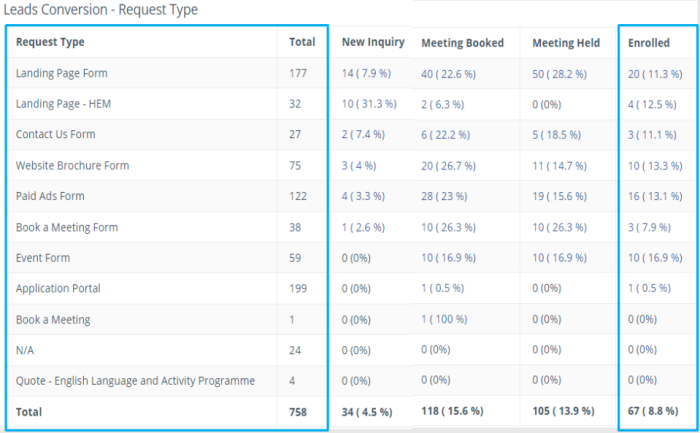
    Example: The Student Portal allows you to create comprehensive, updated CRM reports to track enrollment data. Find out what kind of requests are being made, what desired action has been taken, and what’s next.

    HEM 5HEM 5

    Source: HEM

    5. Improving Communication and Transparency

    A common frustration for both students and staff in traditional admissions processes is a lack of clarity. With an online system, communication becomes seamless and transparent. Students can log into their portal anytime to check their application status, access important updates, and even chat with a virtual admissions assistant for guidance.

    HEM’s Student Portal goes a step further with its integrated communication tools. From automated notifications to direct messaging capabilities, the platform ensures that every student feels supported and informed throughout their journey. This transparency fosters trust and builds a stronger connection between students and your institution.

    6. Enhancing the Student Experience

    Your admissions process is often the first interaction prospective students have with your institution, making it crucial to leave a positive impression. An online admissions and enrollment system demonstrates that your school values convenience, efficiency, and modern technology, which resonate with today’s tech-savvy students.

    HEM’s Student Portal includes features like virtual admissions assistance and a quote builder, which allows students to estimate program costs upfront. These tools empower students with the information they need to make confident decisions, enhancing their overall experience and reinforcing their trust in your institution.

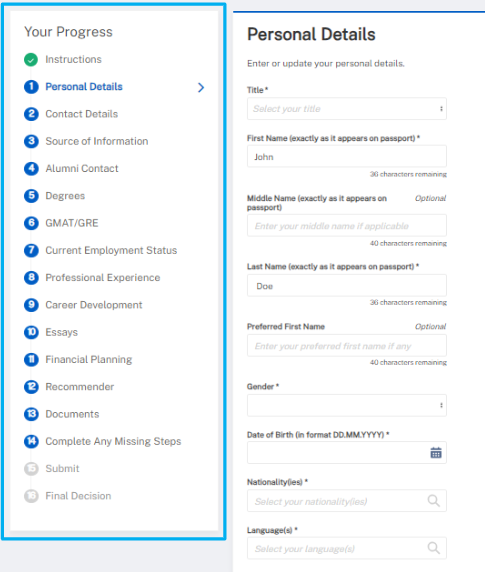
    Example: The Student Portal prioritizes a seamless experience for students, guiding them from step to step, making it easy to share important files, and providing a full picture of their enrollment journey.

    HEM 6HEM 6

    Source: HEM

    7. Facilitating Financial Planning

    Financial concerns are one of the most significant barriers prospective students face when considering enrollment. You can address these concerns head-on by incorporating tools like HEM’s quote builder and seamless payment gateway integration. The quote builder provides students and their families with transparent cost estimates for tuition and fees, enabling them to plan their finances effectively.

    The payment gateway integration simplifies the payment process, allowing students to make secure transactions directly through the portal. You can also track real-time payment statuses, ensuring that financial records are always current.

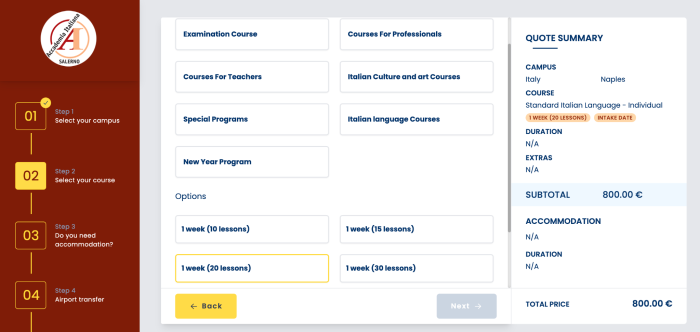
    Example: Accademia Italiana Salerno utilizes our Student Portal’s Quote Builder feature, which provides students with a close estimate of their school expenses. Your students will appreciate being able to plan when making a significant investment in their education.

    HEM 7HEM 7

    Source: HEM

    8. Supporting Institutional Flexibility

    Every institution is unique, with its own set of requirements and processes. That’s why customization is essential in any online admissions system. HEM’s Student Portal offers a flexible framework that adapts to your needs, whether you’re managing applications for a university, language school, or K-12 provider.

    You can customize application forms, workflows, and communications to align with your institutional goals. This flexibility ensures that the system serves as a seamless extension of your team rather than a one-size-fits-all solution.

    9. Boosting Efficiency with Integrated Tools

    Efficiency is at the heart of any successful admissions process; integrated tools can make a significant difference. HEM’s Student Portal combines essential functionalities like CRM systems, marketing automation, and data analytics into one centralized platform. This integration eliminates the need for multiple disconnected systems, streamlining your operations and improving collaboration across departments.

    For example, marketing teams can use the portal to track campaign effectiveness, admissions staff can manage inquiries and applications, and financial teams can monitor payments—all within the same system. This level of integration enhances productivity and ensures that every team member has access to the information they need.

    10. Preparing for the Future

    As the education sector evolves, embracing technology is no longer optional but essential! Implementing an online admissions and enrollment system positions your institution as a forward-thinking leader ready to adapt to changing student expectations and market demands.

    HEM’s Student Portal is built with the future in mind, incorporating scalable features that grow with your institution. Whether you want to expand your programs, attract international students, or enhance your digital presence, the portal provides the tools you need to succeed.

    Why Choose HEM’s Student Portal?

    At Higher Education Marketing, we consider ourselves your partners in success. Benefit from the advantages of enrollment system technology, from simplifying application management to enhancing communication and providing real-time insights. Our platform empowers you to transform your admissions process. Request a demo today and discover how HEM’s Student Portal can help you achieve your institutional goals while creating a superior experience for students and staff.

    Simplify student management and boost recruitment efficiency!

    Transform your student portal experience. Get a FREE HEM-SP demo today.

    Frequently Asked Questions

    What does an enrollment system do?

    An online admissions and enrollment system is a digital platform that streamlines student recruitment, application management, and enrollment.

    What is the process for enrollment?

    It’s a framework that outlines the four key stages prospective students go through when deciding to enroll at your institution. These include awareness, interest, decision, and action.

    Source link

  • New Might Not Always Mean Improved: The Benefits and Drawbacks of the New FAFSA

    New Might Not Always Mean Improved: The Benefits and Drawbacks of the New FAFSA

    Title: Chutes and Ladders: Falling Behind and Getting Ahead with the Simplified FAFSA

    Authors: Jonathan S. Lewis and Alyssa Stefanese Yates

    Source: uAspire

    Prior to the 2024-25 academic year, the Free Application for Federal Student Aid (FAFSA) underwent significant changes, mandated by Congress through the FAFSA Simplification Act. A recent uAspire survey of 274 students, parents, counselors, and financial aid administrators found the changes to the FAFSA entailed a number of “chutes,” or drawbacks, and several “ladders” that allowed for a more streamlined financial aid filing process.

    Key survey findings regarding the simplified FAFSA’s benefits and challenges include:

    Benefits:

    • Students appreciated the reduced number of questions within the new FAFSA form.
    • The office of Federal Student Aid improved help text and resources, which aided those accessing the form in answering common questions.
    • Some populations had easier experiences with FAFSA, such as those with relatively straightforward finances, and individuals without overwhelming extenuating circumstances.
    • Those with previous FAFSA experience noted a generally easier experience with the changes.
    • Students with access to high school or college counselors often found greater success with the changes, demonstrating the importance of accessibility to help during the process.

    Challenges:

    • More than half of those surveyed reported experiencing technical problems.
    • The delayed FAFSA timeline heightened stress among students and counselors.
    • Insufficient communication and customer service left approximately 4 million calls to the Department of Education’s call center between Jan. 1 and May 31 unanswered.
    • The issues above often compounded, forming intersecting challenges for students and counselors.
    • Individuals without a Social Security number and English language learners felt the challenges with FAFSA more severely, struggling in particular with technical problems and communication barriers, demonstrating that some populations had more difficult experiences than others.

    The authors conclude by recommending several additional changes to the FAFSA. To minimize the compounding negative effects of the chutes, financial aid processing should be completed faster; technical glitches should be fixed; and communication, wording, and form accessibility should be improved. The authors also recommend fortifying the ladders by finding additional opportunities to reduce the time spent and frustration felt by those filing.

    Overall, the survey highlights how the FAFSA changes produced diverse and polarizing effects. Many students found the process to be simple, securing their financial aid with just a few clicks; other students felt extreme stress caused by technical roadblocks and delays, which left them uncertain about how to pay for school.

    To read the full report from uAspire, click here. For additional information and to read about the Jan. 16 webinar with the authors of the report, click here.

    —Julia Napier


    If you have any questions or comments about this blog post, please contact us.

    Source link

  • Maximize Your Winter Break: College Class Benefits

    Maximize Your Winter Break: College Class Benefits


    Maximize Your Winter Break: College Class Benefits


    Source link