Tag: Benefits

  • 7 Essential Benefits of Interoperability in Higher Education

    7 Essential Benefits of Interoperability in Higher Education

    It is true that institutions trying to adapt, innovate, and provide excellent experiences to staff, teachers, and students now depend critically on their capacity to easily integrate and share data across many platforms! Interoperability in higher education—the ability of technologies to cooperate effectively—is not a luxury but rather a need for building responsive and efficient campuses. Particularly, the need for interoperability in student management systems is regarded as crucial for changing the higher education student experience. These seven main arguments explain why developing the university of the future depends on interoperability.


    Benefits of Student System Integration for Your Higher Education Team


    How to Integrate Systems for a Smarter Campus Environment?

    For a smarter campus, facilities, academic tools, and administrative systems must be seamlessly integrated. Interoperable technologies improve student and staff campus experiences via real-time data sharing, automated workflows, and resource management. Energy efficiency, security, and academic creativity can improve with smart buildings and IoT networks.


    Top 7 Benefits of Interoperability in Higher Education

    EDUCAUSE conducted a survey revealing that 74% of institutions utilizing integrated data systems reported significant enhancements in their monitoring of student performance and retention rates. Let’s split up the core benefits for you!


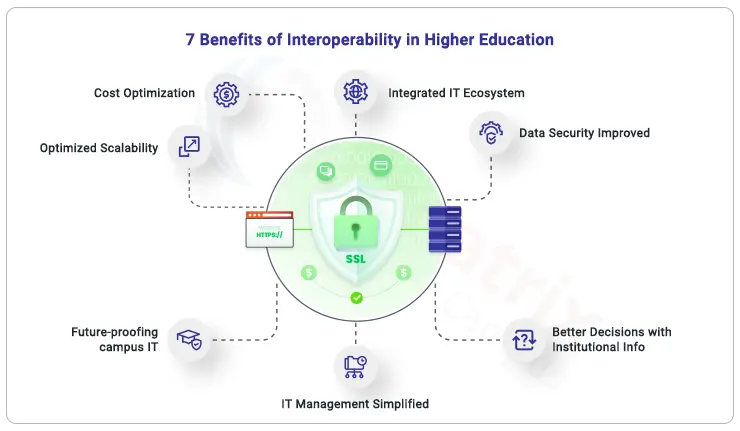
    7 benefits-of-interoperability-in-higher-education


    1. Optimized Scalability

    Swift transformations, such as the demand for enhanced online provisions, necessitate scalable systems. Interoperable solutions facilitate the integration of Learning Management Systems (LMS), Enterprise Resource Planning (ERP) technologies, and other systems into a cohesive digital platform. This guarantees that institutions can effectively expand operations, automate workflows, and incorporate new tools without interruption. A 2024 European Education Area finding figured out that HE’s interoperability can better student mobility and credit recognition by 5X times.


    2. Cost Optimization

    Historically, the implementation of new systems in isolation resulted in elevated expenses. A cloud-based, interoperable platform reduces costs through centralized management, streamlined processes, and minimized hardware needs. By leveraging real-time access to advanced tools, institutions may enhance their return on investment and save IT costs. It strengthens relationships and collaborations between students and educators.


    3. Cohesive IT Ecosystem

    An incoherent array of solutions represents an administrative burden. Interoperability, whether on-site or cloud-based, enhances a cohesive IT infrastructure suitable for hybrid configurations. This method guarantees harmonious functionality of all technologies and facilitates system integration.


    4. Enhanced Data Security

    Higher education emphasizes data security. Student and institutional data are protected through encryption and customized access controls across compatible platforms. Risks are alleviated and adherence to regulations is attained. Reducing duplicate systems lowers operational costs. The 2024 NASCIO research indicates that interoperable technology allows organizations to focus on strategic goals instead of fragmented systems.


    5. Better Decisions with Institutional Info

    Institutions can use integrated data by eliminating system silos. Leaders can use real-time data to plan enrollment, student progress, fundraising, and resource allocation. Automating operations dramatically improves efficiency.


    6. IT Management Simplified

    Interoperability in higher education simplifies system management. Cloud solutions enable streamlined IT staff to concentrate on strategic objectives by delegating technical upkeep. Real-time data can assist leaders in making informed decisions on enhancing engagement, supporting student success, generating revenue, and optimizing resource utilization. Automation significantly enhances operational efficiency.


    7. Future-proofing campus IT

    Security-focused interoperable systems protect sensitive data better. United data governance reduces breach risk, matching with cybersecurity principles in many higher education technology reports.


    Best Practices for Achieving Interoperability in Universities

    The best way to get systems in line with institutional goals is to set clear integration goals. 

    • Implement open standards for assured compatibility and nicer data interchange.
    • Remember, encryption and compliance with privacy legislation should be your top priorities when it comes to data security!
    • Set up a centralized system for managing data such that there is only one accurate source.
    • Ensure ongoing system integration and schedule ongoing training for your teammates.
    • Choose scalable solutions that can grow with the institution and a vendor with robust integrated campus management systems! 
    • Remember, partnering with the right vendor simplifies integration, service, and follow-up!


    Conclusion: Building a foundation for the future

    Understanding how to combine systems and data will become more important as higher education changes. Interoperable solutions provide the flexibility, security, and scalability institutions need to thrive in an ever-changing environment. Explore how Creatrix’s integrated campus management system can help you create the college of the future with a unified, cross-platform system created for higher education.


    Source link

  • Four Benefits of Attending InsightsEDU

    Four Benefits of Attending InsightsEDU

    Every year, EducationDynamics welcomes marketing, enrollment, admissions, and higher education leaders from across the nation for InsightsEDU—a higher education conference dedicated to uncovering emerging trends and innovative solutions that help colleges and universities enhance reputation and grow revenue. In 2025, InsightsEDU will be hosted in New Orleans, Louisiana at the Ritz Carlton from February 12-14, 2025.

    With 40+ subject matter experts, and 38+ sessions, InsightsEDU is designed to equip attendees with the knowledge, tools, and strategies necessary to successfully engage the Modern Learner. Discover key benefits you will experience by attending InsightsEDU 2025.

    Benefits of Attending a Higher Education Conference like InsightsEDU

    1. Gain Timely Insights into the Modern Learner

    There is no doubt that higher education is undergoing a shift. The Modern Learner, who increasingly values flexibility, personalization, and cost-effectiveness, is driving much of this transformation.  This year’s conference theme, “The Era of the Modern Learner,” reflects this pivotal moment in education.  

    InsightsEDU will help higher education marketers adapt strategies to meet the needs of these students, by equipping them with practical insights on how Modern Learners interact with enrollment teams, make decisions, and engage with content. Understanding these dynamics will allow higher ed professionals to tailor marketing and enrollment strategies to better address the demands of today’s students, while demonstrating value and personalization.

    2. Network with Fellow Institutional Leaders, Experts, and Professionals Nationwide

    InsightsEDU is more than a learning opportunity; it is also an unparalleled networking opportunity for the higher education community. With over 100 colleges and universities represented, InsightsEDU brings together a diverse group of higher education professionals, including institutional leaders, marketers, admissions professionals, and experts from across the nation and even abroad.

    Throughout the conference, attendees will experience everything from informative sessions and panels to networking events infused with New Orleans’ flair. These interactions will provide attendees with opportunities to build lasting connections with fellow professionals who share a commitment to advancing higher education initiatives. Additionally, attendees will be able to participate in discussion forums and stay connected to professional connections through the conference app, allowing attendees to stay engaged even after the conference ends.

    3. Access Tailored Strategies for All Student Demographics

    InsightsEDU is dedicated to helping professionals connect with today’s diverse student populations through targeted, practical strategies. For traditional students, attendees will explore ways to create personalized outreach and recruitment campaigns that highlight flexibility and value. Sessions focused on online students will uncover data-driven marketing methods and innovative enrollment strategies that address their desire for convenience and personalization. For graduate students, attendees will explore strategies that leverage career-focused messaging and a clear return on investment for advanced degrees.

    Attendees will leave InsightsEDU equipped with powerful, actionable strategies tailored to the unique needs of various student demographics—empowering them to drive success and lead in a changing higher education landscape.

    4. Experience Expert-Led Sessions Focused on Real-World Solutions

    At InsightsEDU, attendees will engage with a stellar line-up of speakers covering the latest trends and challenges in higher education. Our conference agenda features 38+ sessions from industry experts, each with unique and data-backed perspectives on topics such as personalized digital marketing, enrollment management, and student success. With expert perspectives from organizations like Google, Meta, Reddit, EY Parthenon and more, attendees will learn how to apply the latest trends and technologies to enhance their approach. Additionally, attendees will gain exclusive insights to groundbreaking tools and data, including the latest Online College Students Report, giving them a first look at critical insights into today’s students.

    Unlock the Future of Higher Education at InsightsEDU 2025

    InsightsEDU 2025 is the must-attend conference for higher education professionals who are committed to staying ahead of the curve and driving impact within education. Don’t miss the opportunity to be a part of this innovative event, designed to provide you with strategies and insights for success in higher education.   

    We look forward to seeing you at InsightsEDU from February 12-14! Register today and secure your spot.

    Source link

  • 10 Key Benefits of Using Fee Management Software in Higher Education

    10 Key Benefits of Using Fee Management Software in Higher Education

    Tune In To Our Audio Blog


    Higher Education institutions are increasingly moving towards an automated age of cloud, mobile, and big data analytics. There are many reasons institutions should implement the strategy of collecting payments through cloud and mobile-based fee management software. It would be desirable for any type of institution to automate billing/fee collection and drive greater revenue while saving greater hours of manual work.

    A fee management software solves many problems for higher education and helps parents to keep track of fee payments in real-time. No more manual records or calculations on sheets of paper. Using the fee accounting and financial management software, students and parents can use the latest technology tools to connect various departments such as admission, finance, transport, hostel, library, and more. This will result in wider engagement and improved efficiency in educational institutions with the synchronization of data on fee collections. Student fee collection and unpaid fee details can be accessed on mobile devices including iPhone and Android from anywhere and anytime, beyond the campus.


    Key Benefits of Using Fee Management Software


    Effortless Payment Integration

    Fee management software integrates effortlessly with most of the common payment gateway platforms, allowing students to select the payment options that best suit them, including digital wallets, bank transfers, and credit/debit cards, and pay in a click. To those in the finance team, the software ensures safe cash flow, timely payments, and streamlined financial operations, without spending too much time.


    Financial Data at the Fingertips

    Real-time financial insights can be obtained through the use of dynamic reporting technologies and real-time analytics of the finance module. Your team including key decision-makers and institutional heads can now make precise, data-driven decisions with this state-of-the-art capability, which guarantees precise financial forecasting and institutional strategic planning that helps you deal with tomorrow.


    100% Security on Finances

    Improve your institution’s financial security with cutting-edge encryption and AI-driven threat detection that most fee management software comes with. By using the most recent cybersecurity technologies integrated into the fee management systems, you can almost eliminate the risk of data breaches and fraud, providing rock-solid safety and total peace of mind for both the higher ed’s institution and its students.


    Personalized Payment Plans

    Transform student financial management with fully customizable payment alternatives that meet individual students’ needs. Whether it’s flexible installment plans, financial aid, or delayed payments, these specialized fee solutions increase student satisfaction and retention by giving the financial flexibility, empowerment, and assistance that every student deserves. The Mobile-first approach is another attractive feature of the fee management software that makes it a totally attractive package. 


    Laborsaving Fee Reconciliation

    Turbocharge your financial process with intelligent automation that promptly and accurately aligns invoices and payments, slashing administrative burdens and decreasing human errors so that employees can concentrate on key responsibilities.


    Mobile Access

    In a world where mobile devices are becoming more and more common, redefine payment management with a strong mobile platform that enables administrators and students to accept payments whenever and wherever they choose.


    Personalized Fee Structures

    Your higher education can execute a bunch of unique financial models and individualized solutions by utilizing flexible fee structures that are made to meet the unique requirements of different programs, courses, and students.


    Effortless Refund Automation

    Instill confidence in students with a cutting-edge, automated refund system that ensures rapid and precise disbursements, in no time. This benefit indeed reflects your institution’s dedication to transparency and superior financial stewardship.


    Seamless Regulatory Navigation

    Using state-of-the-art compliance tools, institutions can easily adhere to local and international financial regulations, protecting your institution from fines and legal trouble while maintaining the greatest levels of honesty and integrity.


    Strategic Financial Planning

    Make the most of cutting-edge analytics and comprehensive reporting to find insightful financial data, improve the distribution of resources, and create plans for strategic expansion that will help your higher education institution grow and prosper.


    Revolutionize Your Finances with Creatrix Fee Management Software Today

    In summary, putting in place strong fee management software is not just a contemporary comfort but also a tactical requirement for higher education institutions. Operational efficiency, financial correctness, and student satisfaction can all be significantly increased by integrating automated procedures, real-time financial information, and customized payment plans too!

    A recent research demonstrated the transformative power of such technology by showing that institutions that implemented advanced fee management systems witnessed a 75% reduction in administrative workload and a 30% rise in timely payments.

    If you wish to be one such institution, Creatrix Campus can help. Find out how the Creatrix Campus Fee Management System can improve security, expedite your billing procedures, and give you the real-time data you require to spur productivity and growth. To find out more and arrange a demo right away, click this link!

    Source link

  • The Benefits of Distant Learning

    The Benefits of Distant Learning

    What is distance learning?

    Distance learning refers to the education of students who may not always be physically present at a school. Historically, this involved correspondence between an individual and an academic institution by mail. Today, it involves learning through online tools and platforms. A distance learning program can take place entirely in online learning environments, or a combination of distance learning and traditional classroom instruction (called blended or hybrid). Massive open online courses (MOOCs), offering large-scale interactive participation and learning resources, are more recent developments in distance learning. During the COVID-19 pandemic and subsequent campus closures, educators and institutions relied heavily on distance learning methods to complete the semester.

    Types of distance learning

    Within the scope of distance education there are two very important concepts: synchronous and asynchronous learning.

    Synchronous learning

    Synchronous learning requires some form of communication during classroom time. It has a less flexible learning plan because the classes are conducted on a set schedule using videoconferencing or live online webinars.

    • Fixed-time online courses are the most common type of distance education. Students sign into their online educational portal to access distance learning resources, including live class video streams. Using this method, students and instructors make use of live chats and discussion boards for communication.
    • Video conferencing takes advantage of tools and platforms, like Zoom, that have expansive capabilities and can be used globally. Video conferencing provides learning opportunities for students by allowing them to see their instructors and peers in real time, creating a sense of community in the virtual classroom.

    Synchronous distance learning most closely mirrors the typical in-class experience. Delivering course content virtually in real time creates a sense of intimacy and timeliness that is particularly effective for increasing student engagement. Depending on supporting technology, such as learning management platforms, educators can also respond directly to questions and discussions, provide feedback and use interactive polling and click-on-target questions to gauge comprehension and ensure students are moving in the right direction. This includes the ability for attending students to access lecture slides, engage with their peers in discussion threads, and answer interactive questions.

    Synchronous learning provides opportunities to apply concepts and collaborate. It’s especially useful when teaching material that requires immediate feedback or clarification to keep students on track. There are important social benefits as well. Given the new normal students and faculty find themselves contending with, the opportunity to connect with peers, work together and see each other can go a long way in alleviating the sense of isolation many may feel when learning in a virtual environment.

    Asynchronous learning

    Asynchronous learning allows the student to work at their own pace, and normally has a very distinct syllabus, with weekly deadlines for homework and other assignments. Students have regular access to their peers and their instructors, although this is typically managed through email and discussion boards.

    • Open schedule online courses give students the greatest amount of freedom. All deadlines are pre-set and students are encouraged to be self-sufficient and complete their assignments on their own timelines. Without dedicated class time, students complete their coursework whenever they choose to allot the time to do so. Final exams normally occur at the end of the semester, and are open for several days to provide students with some flexibility as to when they choose to take it.
    • Hybrid distance education combines synchronous and asynchronous methods of online learning. Students must adhere to specific predetermined deadlines for assignment completion. The majority of the coursework is completed online, but in some cases, the student can physically speak with an instructor in person through live chats or video conferencing. Hybrid distance education may also include attending a physical classroom for certain periods of time. Conversely, it may involve covering specific modules and then returning to distance learning to complete additional modules and assignments.

    Asynchronous learning is particularly beneficial if students with varying levels of Internet access find it difficult to follow a specific schedule. Accessing all course materials, readings and assignments in a single place allows students to explore topics in detail and at their own pace. Discussion forums and one-to-one communications through email are simple ways to create engagement, even if much of the learning is self-directed. Asynchronous learning also provides the opportunity for instructors to promote peer collaboration, creating specific assignments that require students to work with each other or review each other’s work outside the confines of a class schedule.

    Without the benefit of live interaction, it’s especially important for students and instructors alike to communicate—or over-communicate —as the case may be. One of the disadvantages of asynchronous learning is student apathy and isolation. Taking time to set course expectations, provide clear assignment instructions and responding to student emails and discussion thread posts are essential.

    How distance learning impacts students

    There are many advantages to distance education. Online courses provide a more accessible learning experience for students. Accessibility in higher education means all students are provided with an equal opportunity to access course materials. This should be top of mind for educators in planning how to deliver their courses. It is no longer realistic to expect that all students have access to online materials outside of the traditional classroom, and even when they do, it’s important to take time to orient students properly. A Top Hat survey of more than 3,000 students found that 28 percent reported difficulty navigating and using online learning resources and tools. Accessibility goes hand-in-hand with flexibility: letting students choose how and where learning takes place can reduce barriers associated with finding success in higher ed.

    Forming an accessible course starts with giving careful consideration to ensuring all students can benefit from your teaching model.

    In online learning environments, students may feel isolated from their peers and campus communities. Participation has therefore become even more important with the shift to remote education. With in-person learning, instructors can gauge by a show of hands who understood your course material. In an online environment, opportunities for participation, such as discussion questions interspersed throughout lecture presentations, can help bridge the gap. Engagement in the classroom may start with icebreaker activities and diagnostic assessments. From here, instructors should consider introducing more collaborative activities such as case studies and debates to ensure students have ample opportunity to put theory into practice.

    Academic success isn’t the only concern students face. Stable housing facilities and regular access to food, along with physical and mental health resources are also top of mind for today’s college students. This is particularly in the midst of the coronavirus pandemic. Empathetic teaching practices, such as shortening lecture modules to provide students with key takeaways and making those lectures available for students to review on their own, are essential in creating supportive learning communities. Empowering students starts with respecting their individual needs and circumstances. It’s also important to dedicate time to connect with students beyond the actual class schedule. As part of the responsibilities of teaching in an online learning environment, instructors should set aside time to answer students’ questions, provide feedback and connect with them on a more personal level, similar to on a social media site.

    The future of distance learning

    Students were okay with “good enough” online education at the height of the pandemic and subsequent school closures, according to Top Hat’s COVID-19 State of Flux Survey results. But they will be less likely to put up with subpar learning in the coming semester. The good news is that many students see value in the flexibility of virtual learning. In fact, around a third of students would prefer a blended approach, with both in-person and online components. The key to success is improving the online experience and ensuring students see the return on their academic investment.

    It is clear that distance learning is here to stay. The fall semester is approaching and pressure on institutions to be ready to teach effectively is increasing. Regardless of what the situation on college campuses looks like in the fall, it is paramount to ensure students see the value of investing their time and effort in courses that may need to be delivered online.

    Even when institutions reopen their physical doors and life returns to ‘normal,’ the ability to teach online, in-person or some combination of the two will yield important benefits in terms of flexibility, as well as dimensionalizing the learning experience. As educators and students grow more comfortable and more confident with the virtual classroom, so do the opportunities to infuse learning with new experiences and new possibilities.

    Tagged as:

    Source link