Tag: Berkeley

  • In Defense of Berkeley Instructor Peyrin Kao

    In Defense of Berkeley Instructor Peyrin Kao

    Peyrin Kao, a University of California, Berkeley, computer science lecturer, was suspended from teaching for a semester after UC Berkeley decreed that Kao’s criticism of Israel had violated campus bans on “political advocacy” in class. There are two significant problems with this action: Kao didn’t engage in advocacy in his class, and Berkeley’s rules don’t restrict political advocacy.

    The suspension of Kao reflects two alarming possibilities: Either Kao is being targeted for his criticism of Israel and there is selective persecution of faculty for leftist political beliefs, or Kao’s suspension shows a new, broader ban on all political speech in the classroom.

    The fact that this repression is happening at UC Berkeley—a top university in a blue state legendary for the Free Speech Movement and liberal politics—indicates how widespread censorship is across the country today.

    As Kao noted, “The university loves to talk about how they are ‘the free speech university,’ ‘the home of the free speech movement’ … but when it comes to Palestine: ‘Sorry, we’re drawing the line, your free speech does not apply.’”

    In October, UC Berkeley executive vice chancellor and provost Benjamin Hermalin wrote a letter determining that Kao was guilty of violating Regents Policy 2301 in two incidents.

    In 2023, Kao, after dismissing class, spoke for four minutes about ethics and technology, and expressed criticism of the Israeli government. In 2024, Kao informed students that he was on a hunger strike (without explaining why).

    It’s shocking that such trivial examples of advocacy could ever justify such a severe punishment. In the first case, Hermalin makes a ridiculous argument that what happens after a class is over is in fact part of the class.

    He writes, “Nothing in Regents Policy 2301 can be read to indicate it doesn’t apply when a course goes into ‘overtime.’” While it’s true that the rules about behavior during classes apply when instructors extend a class beyond the normal time (“overtime”), those limits end when the class is over. The Provost even quotes Kao’s words: “It is 2pm so class is officially over.” Once Kao says that, there is no overtime. There is only after-class time, and that time is not regulated by the Policy 2301 for course content. Of course, Kao’s brief comments on ethics in technology should be fully protected during a computer science class, but the fact that they happened outside of class means they cannot be regulated by these rules about classroom speech.

    The second alleged violation is even more ridiculous. Kao is accused of breaking the rules by uttering 20 words: “I’m currently undergoing a starvation diet for a cause that I believe in. If that sounds interesting, there’s a link.”

    The provost concluded, “I find Mr. Kao to have misused the classroom for the purpose of political advocacy, an action that constitutes a violation of Regents Policy 2301.”

    No, he didn’t, and no, it isn’t. Telling students that you’re on a starvation diet isn’t “political advocacy”; if Kao was ill or dieting for health reasons, he would be fully entitled to warn students of this fact in case it affected him, and nothing about these words is “political advocacy.” The same logic applies to a medical condition induced for political reasons.

    But the provost is also wrong on a much deeper level: There is no prohibition on “political advocacy” in Policy 2301. The word “advocacy” never appears in Policy 2301. Yet the provost proceeds to wonder “whether the instructor’s intent is to advocate” and frequently quotes his interviews rather than focusing on what he said in class and what Policy 2301 says. Political advocacy in the classroom is fundamentally protected by academic freedom.

    Astonishingly, the provost even asked, “To what extent is a hunger strike an in-class advocacy activity precluded by Regents Policy 2301?” In what bizarro world could a hunger strike ever be deemed “in-class advocacy”? Refusing to eat during class is not “advocacy” at all. The suggestion that Regents Policy 2301 could be interpreted to require teachers to eat outside the classroom is insane.

    The provost noted, “His actions are no different from those of an instructor who repeatedly wore a t-shirt when teaching that had on it a very visible political symbol or a picture of a political candidate.” Wait, does the provost actually think that professors are banned from wearing T-shirts with symbols on them? Will a professor with a peace symbol T-shirt be hauled before the provost for dress code violations? Wait until the provost finds out that some professors wear crosses while teaching—I’m sure that will be quickly prohibited by any fair-minded ban on advocacy.

    Perhaps UC Berkeley professors need to start wearing T-shirts with the First Amendment on them to remind the provost why we must not allow political commissars to dictate what teachers wear, say or think.

    Zach Greenberg of the Foundation for Individual Rights and Expression argued, “If you’re going on tangents during class or expressing a political advocacy to students during class as a professor, you’re on company time.” But the whole concept of academic freedom is a rejection of “company time.” Academic freedom in the classroom means that the instructor, not the company, decides what is taught. The classroom is “professional time” where instructors must meet professional standards. But professional standards allow for wide leeway to go on tangents, discuss broader issues and even chat with students about nonprofessional topics. If there is a professor who has never uttered any words in any class unrelated to the course topic, I would love to meet that weirdo.

    If a professor is wasting half of every class on a tangent unrelated to the course, then that professor should be disciplined. But the reason for the discipline must be politically neutral and disconnected from any viewpoint discrimination. A professor who expresses political views in class is no different from a professor who expresses views about the football team or a professor who discusses the weather (in a class unrelated to it). All of them are engaging in speech not germane to the class.

    But no one can seriously argue that a four-minute statement after class about ethics in technology or a 20-word comment about being on a hunger strike could possibly describe an instructor who is failing to teach the content of the class by going on constant tangents.

    The fact that Kao’s words were repeatedly described as “political” is not evidence of Kao’s guilt, but proof of the administration’s guilt. By targeting Kao purely for his political speech, and applying standards that would never be used for similar noncontroversial speech, the Berkeley administration is confessing to its violation of the First Amendment and standards of academic freedom that protect faculty from retaliation for their views.

    Policy 2301 is a terrible policy, enacted in 1970 by the regents to suppress free speech, and it violates standards of academic freedom and the First Amendment by targeting “political indoctrination” (rather than all “indoctrination”) and therefore engages in viewpoint discrimination against disfavored political views.

    But even Policy 2301 does not allow the kind of repression demanded by the provost, which is why he doesn’t quote any of its specific provisions in claiming Kao’s alleged violation of it.

    The provost repeatedly accuses Kao of being “at odds with the spirit of Regents Policy 2301” but fails to quote anything in the policy he actually violated. Suspensions cannot be justified by “spirits”; they can only be legitimate if there is a clear violation of the rule.

    The provost’s report is so grossly incompetent—fabricating clauses about “advocacy” that don’t exist in a policy he apparently hasn’t read—that it shows how arbitrary this act of political retaliation was.

    Writing that the punishment was “up to you,” the provost gave his subordinates an implicit order to suspend Kao with only one other option: “I would have no objection if you wished to impose a more severe disciplinary action than the one I proposed.” Obviously, he would object to anything less than a suspension, and the resulting suspension is not surprising to anyone. It is highly unprofessional for a top administrator to personally intervene in a discipline case in order to manipulate the outcome and decree what punishment must be given.

    The repressive administrative overreaction at Berkeley is precisely why we must give enormous freedom to instructors to do things that we think are wrong. Unless you protect the right of faculty to say dumb and inappropriate things in their classes, people driven mad by the possession of administrative power will seek to fire professors for what they say and do outside of class.

    We should want professors who feel free to express their values and their ideas openly, even when it offends some people. We should reject a world where every professor must fear saying a disapproved word in a classroom where every utterance is monitored for wrongthink.

    I don’t agree with Kao’s goals of campus divestment from Israel. I don’t agree with Kao’s tactics of engaging in a hunger strike. And I don’t agree with Kao’s methods of discussing his views in or after his classes.

    But Kao did not violate any university rules, and it is fundamentally unjust to suspend him for purely political reasons. People are free to criticize him for his ideas, but not to censor him or punish him for expressing them.

    UC Berkeley administrators have violated Kao’s academic freedom and the First Amendment in their shameful punishment of him for his free speech, and they deserve condemnation not only for this unjust act against Kao but also for the much larger chilling effect this repression will cause across the University of California.
    Source link

  • Berkeley Suspends Lecturer for Pro-Palestinian Comments

    Berkeley Suspends Lecturer for Pro-Palestinian Comments

    lucentius/iStock/Getty Images Plus

    The University of California, Berkeley, suspended lecturer Peyrin Kao without pay for the spring semester because he made pro-Palestinian political comments during class. 

    Kao, a lecturer in the Electrical Engineering and Computer Science Department, participated in a 38-day hunger strike this fall to protest the use of technology in what he called Israel’s genocide in Gaza. He allegedly told students during class that he was undergoing a “starvation diet” and directed them to his website to learn more about why he was striking. 

    Also, last spring, Kao allegedly made “off-topic” remarks including about “the conflict in Israel and Gaza, an expression of solidarity with a protest happening outside the classroom, Google’s business dealings with Israel, UC’s investment in companies that themselves invest in companies that ‘supply bombs,’ and calls for solidarity with those in Gaza and to ‘Free Palestine,’” executive vice chancellor and provost Benjamin Hermalin wrote in his letter recommending that Kao be suspended. 

    Hermalin ultimately determined that Kao violated a Board of Regents policy requiring that instructors only discuss content relevant to the course in session during class time. With his comments and actions, Kao “misused the classroom for the purpose of political advocacy,” Hermalin wrote. Kao will be suspended for six months, starting Jan. 1. 

    “Mr. Kao drew attention to his hunger strike in class and informed the students how they could find out why he was engaging in it. In addition, the visible physical toll it presumably was taking and the adverse consequences it may have had on the quality of his instruction all represent a form of advocacy, albeit nonverbal,” Hermalin wrote. “In that sense, his actions are no different from those of an instructor who repeatedly wore a t-shirt when teaching that had on it a very visible political symbol or a picture of a political candidate.”

    Kao denied any wrongdoing and plans to appeal the decision. 

    “The timing of my punishment raises serious questions about whether it was a politically motivated decision by the university to appease the Trump administration. My suspension is the latest in a long line of faculty and students disciplined for taking a stance against occupation and genocide in Palestine,” Kao said in a statement distributed by the San Francisco Bay Area Council on American-Islamic Relations, which also denounced Kao’s suspension. “The university is trying to make an example out of me and suppress any conversation about Palestine, because those conversations would expose the university’s investment in genocide. I will not be deterred by this unconstitutional attack on free speech, and I intend to continue exercising my First Amendment right to advocate for a free Palestine.” 

    Berkeley officials declined to answer Inside Higher Ed’s questions about Kao’s suspension.

    “The university does not comment on confidential personnel matters,” a spokesperson wrote in an email. “Speaking generally regarding free speech policy, the university will always take a viewpoint-neutral approach when it comes to supporting freedom of expression and actions that align with policy.”

    Source link

  • ED Investigates Berkeley Over Protest Violence

    ED Investigates Berkeley Over Protest Violence

    Justin Sullivan/Getty Images

    The Department of Education is reviewing potential violations of the Clery Act at the University of California, Berkeley following violence at a campus protest.

    Fights broke out and four people were arrested at a Nov. 10 protest against an event for Turning Point USA, the conservative student group founded by Charlie Kirk, Cal Matters reported. The organization has received newfound attention after Kirk was shot and killed while speaking at Utah Valley University in September, exactly two months before the event at UC Berkeley.

    The Department of Education announced the launch of the investigation Tuesday.

    “Just two months after Turning Point USA founder Charlie Kirk was brutally assassinated on a college campus, UC Berkeley allowed a protest of a Turning Point USA event on its grounds to turn unruly and violent, jeopardizing the safety of its students and staff. Accordingly, the Department is conducting a review of UC Berkeley to ensure that it has the procedures in place to uphold its legal obligation to maintain campus safety and security,” U.S. Secretary of Education Linda McMahon said in a statement.

    ED also accused the university of having “a history of violating the Clery Act” in a news release announcing the investigation, citing a $2.4 million fine and settlement agreement in 2020 for UC Berkeley’s failure to properly classify 1,125 crimes on campus and insufficient record keeping.

    The Department of Justice previously announced a probe into the university earlier this month, claiming that “Antifa,” a decentralized, left-wing movement was involved in the Nov. 10 protests.

    UC Berkeley spokesperson Dan Mogulof told Inside Higher Ed by email that the university “has an unwavering commitment to abide by the laws, rules and policies that are applicable to the university” and “will continue to cooperate with governmental inquires and investigations.”

    Mogulof added that the university provided public reports about two violent crimes that occurred Nov. 10: a fistfight over an attempted robbery and someone being hit by a thrown object. He also highlighted efforts by administrators “to support the First Amendment rights of all by deploying a large number of police officers from multiple jurisdictions, and a large number of contracted private security personnel” and closing off parts of campus on the day of the protest.

    The investigation comes as the Trump administration has clashed with the University of California system in recent months as it sought to cut off federal research funding over alleged antisemitism and how administrators handled pro-Palestinian campus protests in spring 2024. The federal government has also demanded the University of California, Los Angeles, agree to a $1.2 billion fine and make a number of changes in response to the administration’s concerns.

    A federal judge recently ruled against the federal government and its “blanket policy of denying any future grants” to UCLA and determined that the Trump administration can’t demand payouts from University of California member institutions as it conducts civil rights investigations.

    Source link

  • UC Berkeley TPUSA Event Protests Spark Arrests, DOJ Probe

    UC Berkeley TPUSA Event Protests Spark Arrests, DOJ Probe

    Justin Sullivan/Getty Images

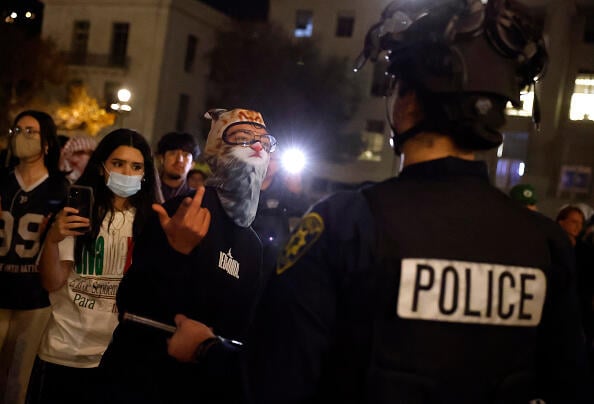
    Protests of a Turning Point USA event at the University of California, Berkeley, campus Monday sparked arrests and investigation announcements from top U.S. Department of Justice officials, who alleged “Antifa” involvement. The DOJ was already investigating the UC system over various allegations, and the Trump administration has demanded UCLA pay $1.2 billion and make other concessions.

    “Antifa is an existential threat to our nation,” Attorney General Pam Bondi posted on X Tuesday. “The violent riots at UC Berkeley last night are under full investigation by the FBI-led Joint Terrorism Task Force.”

    Harmeet K. Dhillon, the assistant attorney general supervising the DOJ’s Civil Rights Division, also said her division will investigate. “I see several issues of serious concern regarding campus and local security and Antifa’s ability to operate with impunity in CA,” she wrote on X.

    Dan Mogulof, a UC Berkeley spokesperson, told Inside Higher Ed Wednesday that there was only one reported incident of violence: A person with a ticket to the event was hit in the head by a glass bottle or jar thrown from a crowd of protesters. The victim was transported to Highland Hospital by ambulance but was “upright and conscious,” Mogulof said, adding that police are reviewing videos to see who might have thrown the object.

    In an incident that Mogulof said people mistakenly believed was connected to the protest, the City of Berkeley Police Department said its officers were monitoring the protest when they saw a fight between two men. Police determined one of them had stolen a chain from the other and the other was attempting to reclaim it, and the man who allegedly stole the chain was arrested on suspicion of robbery and battery resulting in injury.

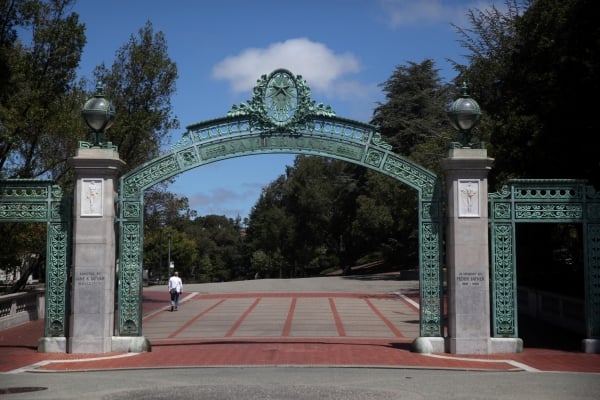
    Mogulof also said campus police arrested two people for allegedly failing to comply with directions and, the night before the protest, arrested four students for alleged felony vandalism for trying to hang something on the historic Sather Gate. At the protest itself, Mogulof said, there were people who “self-identified as Antifa,” but he didn’t know whether they were part of an organized group.

    In a statement, the university said, “There is no place at UC Berkeley for attempts to use violence or intimidation to prevent lawful expression or chill free speech. The University is conducting a full investigation and intends to fully cooperate with and assist any federal investigations.”

    Source link

  • Berkeley Law Dean Urges SCOTUS to Be “Guardrail” for Democracy

    Berkeley Law Dean Urges SCOTUS to Be “Guardrail” for Democracy

    Carlos Avila Gonzalez/The San Francisco Chronicle/Getty Images

    PHILADELPHIA—The final speech at the Association of Public and Land-grant Universities’ annual conference this week dissected the Trump administration’s “financial assault” on universities and urged the Supreme Court to be a check on a president whom Congress hasn’t reined in.

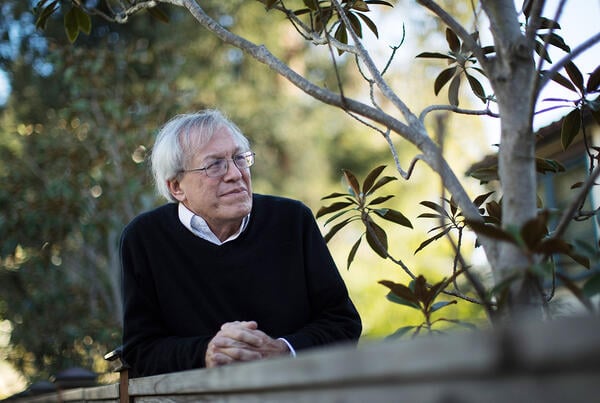
    Erwin Chemerinsky, dean of the University of California, Berkeley, School of Law and a constitutional scholar, also told the attendees of the APLU meeting that their institutions should be united against the administration’s attacks on higher ed.

    “The one thing we all learned on the playground is if you give in to a bully, it only makes it worse in the long term,” Chemerinsky said Tuesday, adding—to applause—that “it’s so important that institutions of higher education stand together at this moment and stand together for our shared missions.”

    The speech comes after multiple prominent universities, including a few public ones, refused to sign Trump’s proposed “Compact for Academic Excellence in Higher Education,” which asked them to give up significant autonomy in exchange for an unspecified edge in competitions for federal funds.

    It also follows legal victories against the administration’s grant cancellations. Litigation by UC researchers against Trump, the Department of Government Efficiency and other federal agencies and officials has restored more than $500 million in federal research grants, which the administration cut at UCLA after the Justice Department accused it of tolerating antisemitism during a spring 2024 pro-Palestinian protest encampment. Chemerinsky, who is Jewish, is representing the researchers in that litigation.

    Asked for comment, a White House official told Inside Higher Ed in an email, “UC Berkely clearly needs to make some changes – violence broke out on UC Berkeley’s campus just last night and they have failed to police antisemitism by tolerating an ‘unrelenting’ steam of antisemitic harassment toward Jewish students and faculty.”

    Even before the latest cuts, Chemerinsky estimated the Trump administration had already slashed close to $1 billion in funding for faculty and researchers across the UC system, a figure that he said was much higher than DOGE’s tally. The UC system didn’t confirm or deny this estimate or provide a more recent estimate Tuesday, saying the system was closed for Veterans Day.

    “I think the termination of grants that we’ve seen, whether it’s to researchers and faculty or to universities, is clearly illegal,” Chemerinsky said. But when it comes to “nonrenewal of grants in the future and funding in the future,” he added, the “government has far more discretion, and there it’s going to be much harder to bring legal challenges.”

    Chemerinsky also said federal funding cuts are just one of four financial vulnerabilities the administration has identified in universities: “they’re very dependent” on federal money, tuition, philanthropy and foreign students. Using his own institution as an example, he said Berkeley Law has an L.L.M., or master of laws, degree program that’s exclusively for foreign students and represents $20 million in its annual budget.

    He then expressed concern about how the Supreme Court has ruled on the administration’s actions, even beyond higher ed.

    “By my count, 39 matters have come to the Supreme Court since [Inauguration Day] Jan. 20, challenging actions of the Trump administration,” he said. “All are instances where the lower courts ruled against the Trump administration, and in 36 of 39, the Supreme Court has ruled in favor of the Trump administration.”

    Noting eight of the nine justices graduated from the law schools at either Harvard or Yale Universities (Amy Coney Barrett graduated from the University of Notre Dame), he said, “My optimistic self believes that the United States Supreme Court will stand up for higher education.” Chemerinsky added that since Congress hasn’t served as a check on the president, it’s up to the federal judiciary to uphold the laws and the Constitution.

    Fittingly, his speech took place at a Philadelphia hotel about a 15-minute walk from where the founders adopted the Constitution. APLU said more than 1,300 people attended this week’s three-day conference.

    “Ultimately, I believe the guardrail of our democracy has to be the courts and the Supreme Court,” Chemerinsky said. “If there is going to be a check on a president who has authoritarian impulses, it’s going to have to be from the restraints of the Constitution—and the only way we can enforce those is the courts.”

    Chemerinsky noted that “one characteristic of every authoritarian—or would-be authoritarian—rule is the way they go after universities. What we’ve seen in the last nine and a half months is unprecedented in American history.”

    He compared Trump’s actions to McCarthyism, the 1950s-era political persecution of faculty, government employees and others. But Chemerinsky pointed out that back then, “it wasn’t the president of the United States leading the attack on higher education,” and “there wasn’t the financial assault on universities.”

    “But the one thing that the McCarthy era should say to all of us is that history will judge us,” he said. “Twenty, 30, 50, 75 years from now, people will look back on us the way we look at university officials in the McCarthy era, and they will judge us as to whether we capitulated or whether we had courage.”

    Source link

  • UC Berkeley Scientist Wins Nobel Prize for Chemistry

    UC Berkeley Scientist Wins Nobel Prize for Chemistry

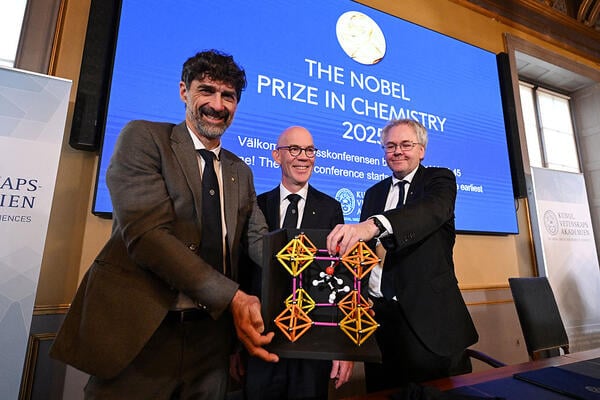
    A chemist from the University of California, Berkeley, was among the trio of scientists awarded the Nobel Prize for Chemistry on Wednesday.

    Omar Yaghi, the Berkeley professor; Susumu Kitagawa from Kyoto University in Japan; and Richard Robson from the University of Melbourne in Australia were recognized for their work since the 1990s to develop a new form of molecular architecture that combines metal ions and carbon-based molecules, according to a release from the Royal Swedish Academy of Sciences, which administers the Nobel Prize.

    The metal-organic frameworks can harvest water or store toxic gases. The release noted that the frameworks “may contribute to solving some of humankind’s greatest challenges.”

    The release says the frameworks are essentially “rooms” because of the large spaces that form in the structure. A Nobel committee member compared it to Hermione Granger’s magical bag in the seventh Harry Potter book, the Associated Press reported. Her small bag eventually contained a tent, books and other provisions. Likewise, the frameworks look small but can hold a lot.

    Since the trio’s discoveries, more than 100,000 metal-organic frameworks have been created, according to a news release from Berkeley.

    Source link

  • Berkeley Releases 160 Names, Complies With U.S. Investigation

    Berkeley Releases 160 Names, Complies With U.S. Investigation

    Justin Sullivan/Getty Images

    The University of California, Berkeley, told about 160 faculty, staff and students on Sept. 4 that their names appeared in documents officials gave to the Trump administration, which is investigating the university’s response to reports of campus antisemitism, The New York Times reported

    According to Berkeley, the 160 names provided to the Education Department in compliance with the investigation include people accused of or affected by antisemitic incidents, as well as those who filed complaints about antisemitism on campus.

    Berkeley is one of numerous higher education institutions the Trump administration is investigating for alleged antisemitism, including the University of California, Los Angeles. The UC system is also weighing Trump’s demands that UCLA pay the government a $1.2 billion settlement to restore $584 million in frozen federal research funding.  

    Berkeley’s decision to hand over the 160 names comes two months after House Republicans grilled Berkeley’s chancellor, Rich Lyons, and two other university leaders at a hearing about their alleged failures to protect Jewish students from discrimination and harassment. At the hearing, Lyons said the university has an “obligation to protect our community from discrimination and harassment” and uphold the First Amendment’s guarantee of free speech.

    While some alumni criticized Berkeley’s compliance with the Trump administration’s investigation, the UC system said in a statement to the Times that it’s “committed to protecting the privacy of our students, faculty, and staff to the greatest extent possible, while fulfilling its legal obligations.”

    Source link

  • UC Berkeley Faces Foreign Gifts Investigation

    UC Berkeley Faces Foreign Gifts Investigation

    The Education Department is investigating the University of California, Berkeley, regarding compliance with a federal law that requires colleges to disclose certain foreign gifts and contracts.

    It’s the first such review launched since President Trump signed an executive order Wednesday aimed at increasing transparency over the “foreign influence at American universities.”

    A notice of the investigation and corresponding records requests were sent to UC Berkeley on Friday morning after the department found that the university’s disclosures might be incomplete.

    “There have been widespread media reports over the last several years of Berkeley’s very substantial—in the hundreds of millions of dollars—receipt of money from foreign governments, in this case, particularly China,” a senior Education Department official said on a press call Friday. But while the development of “important technologies” has been shared with foreign nations, the funding that made it possible “has not been reported to the department, as it’s required by law,” in Section 117 of the Higher Education Act, the official added.

    Under Section 117, colleges and universities must report twice a year all grants and contracts with foreign entities that are worth more than $250,000. The department opened a similar review into Harvard last week.

    UC Berkeley administrators will have 30 days to respond with the requested records. From there, the Department of Education’s general counsel, in partnership with the Departments of Justice and Treasury, will “verify the degree to which UC Berkeley is or is not compliant.” (Unlike with Harvard, the Department of Education did not disclose the specific records it had requested from Berkeley.)

    “The Biden-Harris Administration turned a blind eye to colleges and universities’ legal obligations by deprioritizing oversight and allowing foreign gifts to pour onto American campuses,” Education Secretary Linda McMahon said in a news release. “I have great confidence in my Office of General Counsel to investigate these matters fully.”

    Trump and congressional Republicans have been trying to crack down on the enforcement of Section 117 since the first Trump administration. Already this year, House Republicans passed a bill, known as the DETERRENT Act, which would lower the general threshold required for reporting foreign donations from $250,000 to $50,000. Gifts from some countries, like China and Russia, would have to be reported no matter the value. The Senate has yet to move forward with the bill. 

    When asked how Trump’s executive order differentiates itself from the DETERRENT Act, the department official said the legislation would be “entirely consistent with the EO’s directives” and that the department is “very supportive” of congressional Republicans’ efforts.

    “The EO basically just says, enforce the law vigorously, return to enforcement of the law, stop the nonsense and work with other agencies to do it,” the official explained. “So whether the reporting requirement is for $250,000 or more per year or the lower threshold, our approach will be the same.”

    Inside Higher Ed asked the department if there would be more investigations but has not yet received a response.

    Source link