
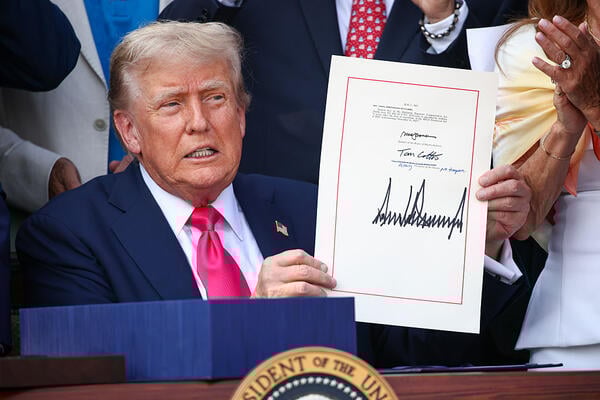
In late June, House Republicans aired a promotional video about their budget reconciliation bill, the One Big Beautiful Bill Act, claiming it will “make the American dream accessible to all Americans again.” That dream—that anyone in this country can achieve prosperity and success through hard work and determination—is what leads people to come to America and stay. It’s no wonder that politicians invoke this promise as part of the reason for needed change.
Higher education has long been seen as one of the surest paths to economic security in America—it is one foundation that dream rests on. It feels consequential, therefore, that President Trump and congressional Republicans are looking to undercut this vision of the American dream. The One Big Beautiful Bill Act will reshape federal student aid in ways that transform access to higher education and shut everyday Americans out.
Forthcoming nationally representative survey data from New America, a nonpartisan think tank, shows Americans are clear-eyed about what it really takes to keep the dream alive: an affordable higher education. But they see college falling further out of reach. Nearly nine out of 10 believe college cost is the biggest factor that prevents families from attending college. And three-quarters of Americans agree that the federal government should spend more tax dollars on educational opportunities after high school to make them more affordable, including majorities of both Republicans and Democrats.
Americans also believe in accountability for this investment. They want a system that rewards effort, responsibility and outcomes—basic values that align with the American dream. Majorities from both parties say colleges and universities should lose access to taxpayer support if their students don’t earn more than a typical high school graduate or if they struggle to pay down their student loan debt.
Once enacted, the new law will trim the Pell Grant program, making some middle-income families ineligible who used to qualify for small amounts of the Pell Grant. Federal student loans will look vastly different, with big cuts to graduate, parent and lifetime borrowing limits and less generous repayment options for borrowers who fall on hard times. These changes will close one door for many low- and moderate-income Americans, the one that leads to an affordable associate or bachelor’s degree. At the same time, by expanding Pell Grants to short-term job training programs, the law opens another door to very short credentials as few as eight weeks long with little oversight and consumer protection. Our research has shown time and again that these very short credentials will not deliver economic stability nor improve employment prospects.
And while the law will take meaningful steps toward accountability and will cut off from federal loans associate, bachelor’s and graduate programs that fail to give students an earning boost, those measures exclude all undergraduate short-term certificate programs, which tend to have the worst outcomes. It will also allow programs to continue to operate, even if most of their students struggle to repay their loans.
Over all, these changes amount to a massive cut of close to $300 billion in critical funds that ensure students have access to a quality education after high school. It will increase dropout risk (which we know is a major predictor of student loan default), and will push families toward private financing products with fewer consumer protections.
While the president and congressional Republicans say these cuts are necessary under the auspices of extending tax cuts, improving fiscal responsibility and reforming higher education, the truth is this law will achieve none of this. It will add at least $3 trillion to our deficit by expanding tax cuts to wealthy Americans, all while stripping funding from critical programs everyday Americans rely on like Medicaid, SNAP and student aid. It does nothing to fix the underlying problems that drive college costs. It ignores targeted solutions that would promote affordability and expand accountability. That type of thoughtful reform would require bipartisan reauthorization of the Higher Education Act, which is more than a decade overdue.
Despite what Republicans in Washington say about making the American dream accessible again, this law will only put it further out of reach. The changes will fall hard on all students trying to obtain education after high school—from welders to electricians, nurses, teachers and medical doctors. These are not “elites,” but core constituents. They are working adults, veterans and parents looking to make a better life for their children, hoping that the American dream is still achievable. Instead, they will find that their own government has abandoned them.
In his inaugural address in January, President Trump said, “The American dream will soon be back and thriving like never before.” But, in truth, it is being suffocated. It’s too late to change this new law, but moving forward Congress and the Trump administration must center everyday Americans and act cautiously before making such seismic cuts. This is not a partisan issue, but a matter of national interest and prosperity. Failing to think about future legislation that makes meaningful student-centered reform to higher education will have political and generational consequences for years to come. It sends a message to future students that only familial wealth will bring college opportunities, and it won’t matter how much hard work they put in or determination they have.