Tag: Bipartisan

  • Trump Team Weakens Bipartisan Law That Protects Students and Veterans From Predatory Colleges (David Halperin)

    Trump Team Weakens Bipartisan Law That Protects Students and Veterans From Predatory Colleges (David Halperin)

    On the eve of the 4th of July holiday, when they probably hoped no one was paying attention, the Trump Department of Education issued an Interpretive Rule that will make it easier for for-profit colleges to evade regulations aimed at protecting students, and especially student veterans and military service members, from low-quality schools.

    The Department’s 90-10 rule, created by Congress, requires for-profit colleges to obtain at least ten percent of their revenue from sources other than taxpayer-funded federal student grants and loans, or else — if they flunk two years in a row — lose eligibility for federal aid. The purpose is to remove from federal aid those schools of such poor quality that few students, employers, or scholarship programs would put their own money into them.

    For decades, low quality schools have been able to avoid accountability through a giant loophole: only Department of Education funding counted on the federal side of the 90-10 ledger, while other government funding, including GI Bill money from the VA, and tuition assistance for active duty troops and their families from the Pentagon, counted as non-federal. That situation was particularly bad because it motivated low-quality predatory schools, worried about their 90-10 ratios, to aggressively target U.S. veterans and service members for recruitment.

    After years of efforts by veterans organizations and other advocates to close the loophole, Congress in 2021 passed, on a bipartisan basis, and President Biden signed, legislation that appropriately put all federal education aid, including VA and Defense Department money, on the federal side of the ledger.

    The Department was required by the new law to issue regulations specifying in detail how this realignment would work, and the Department under the Biden administration did so in 2022, after engaging in a legally-mandated negotiated rulemaking that brought together representatives of relevant stakeholders. In an unusual development, that rulemaking actually achieved consensus among the groups at the table, from veterans organizations to the for-profit schools themselves, on what the final revised 90-10 rule should be.

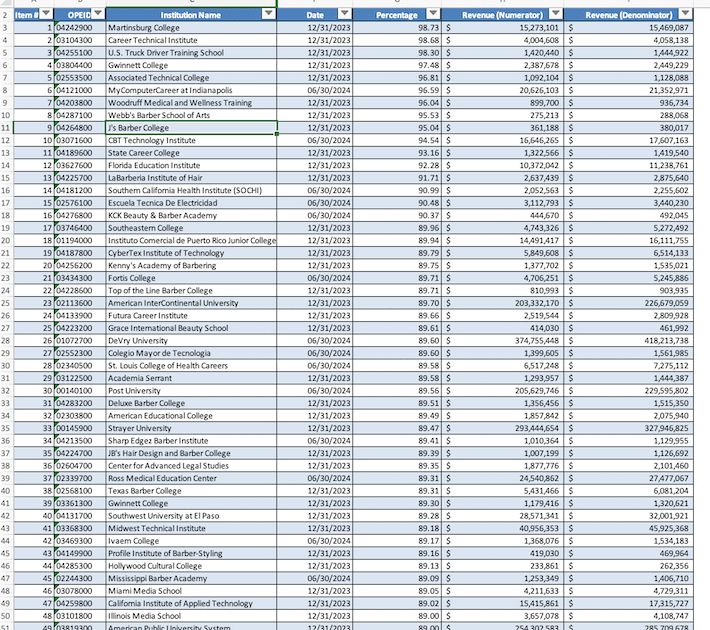
    The new rule took effect in 2023, and when the Department released the latest 90-10 calculations, for the 2023-24 academic year, sixteen for-profit colleges had flunked, compared with just five the previous year. These were mostly smaller schools, led by West Virginia’s Martinsburg College, which got 98.73 percent of its revenue from federal taxpayer dollars, and Washington DC’s Career Technical Institute, which reported 98.68 percent. Another 36 schools, including major institutions such as DeVry University, Strayer University, and American Public University, came perilously close to the line, at 89 percent or higher.

    The education department last week altered the calculation by effectively restoring an old loophole that allowed for-profit colleges to use revenue from programs that are ineligible for federal aid to count on the non-federal side. That loophole was expressly addressed, via a compromise agreement, after Department officials discussed the details with representatives of for-profit colleges, during the 2022 negotiated rulemaking meetings.

    All the flunking or near-flunking schools can now get a new, potentially more favorable, calculation of their 90-10 ratio under the Trump administration’s re-interpretation of the rule.

    In the lawless fashion of the Trump regime, the Department has now undermined a provision of its own regulation without going through the required negotiated rulemaking process. (The Department’s notice last week included a labored argument about why its action was lawful.)

    As it has done multiple times over its first six months, the Trump Department of Education, under Secretary Linda McMahon, has again taken a step that allows poor-quality predatory for-profit colleges to rip off students and taxpayers.
    Source link

  • House Introduces Bipartisan Paid Leave Legislative Proposal – CUPA-HR

    House Introduces Bipartisan Paid Leave Legislative Proposal – CUPA-HR

    by CUPA-HR | May 13, 2025

    On April 30, Representatives Stephanie Bice (R-OK-5) and Chrissy Houlahan (D-PA-6) introduced the More Paid Leave for More Americans Act, the result of more than two years of work by the House Paid Family Leave Working Group, which Bice and Houlahan co-chair. The package consists of two parts: the Paid Family Leave Public-Private Partnerships Act and the Interstate Paid Leave Action Network (I-PLAN) Act.

    The Legislation

    The first bill of the package — the Interstate Paid Leave Action Network (I-PLAN) Act — would create a national framework “to provide support and incentives for the development and adoption of an interstate agreement that facilitates streamlined benefit delivery, reduced administrative burden, and coordination and harmonization of State paid family and medical leave programs.” It is intended to help resolve the confusion and inconsistencies across the state programs, in particular for the distribution of benefits to workers who work across state lines. The network will also work to identify best practices from existing state paid leave programs, help states harmonize their policies and resolve conflicts with other states’ programs, and help employees access their benefits.

    The second bill — the Paid Family Leave Public-Private Partnerships Act — would establish a three-year pilot program in which the Department of Labor would provide competitive grants to states that establish paid family leave programs that meet certain criteria. To qualify, states would be required to partner with private entities via Public-Private Partnerships (PPP) and participate in I-PLAN. The state programs would be required to offer at least six weeks of paid leave for the birth or adoption of a new child and provide a wage replacement rate between 50% and 67% depending on the income of the individual. Individuals at or below the poverty line for a family of four must receive 67% of their wages, while individuals earning more than double the poverty line for a family of four must receive 50% of their wages. The maximum benefit a worker can receive is 150% of a state’s average weekly wage.

    Looking Ahead

    Bice and Houlahan are optimistic about the package’s prospects, as both bills do maintain bipartisan support and President Trump has indicated an interest in pursuing a federal paid leave program. That said, it is uncertain if and when the House and Senate labor committees would take up these bills for a markup, which is the first step in getting the bill to a floor vote. CUPA-HR will continue to keep members apprised of updates related to this bill and other paid leave proposals that emerge from Congress.


    Source link

  • House Passes Bipartisan Retirement Savings Bill – CUPA-HR

    House Passes Bipartisan Retirement Savings Bill – CUPA-HR

    by CUPA-HR | April 4, 2022

    On March 29, the U.S. House of Representatives passed H.R. 2954, the Securing a Strong Retirement Act of 2021, by an overwhelmingly bipartisan vote of 414-5. The bill includes many provisions to boost individual retirement savings and expand coverage to better access retirement savings programs.

    The bill includes several provisions that would impact employer-sponsored retirement programs. Notably, the bill would make enrollment in newly created 401(k) and 403(b) plans mandatory for eligible employees beginning in 2024. Employers with 10 or fewer employees or those that have been in business for fewer than three years would be exempt from this requirement, and employees would be able to opt out of the program. Additionally, the bill requires employers to allow part-time employees to participate in 401(k) plans if they work at least 500 hours per year after two years working for the employer — a decrease from the previously required three years.

    The bill will also allow employers to make matching contributions to the 401(k), 403(b) or SIMPLE IRA account of employees who are paying off student loans and do not contribute enough to their accounts to receive a full employer match.

    In addition to the provisions related to employer plans, the bill also has provisions for individual workers. The bill allows older workers to make bigger contributions to their retirement accounts than is currently allowed. Specifically, individuals aged 62-64 would be able to contribute an extra $10,000 for 401(k) plans and other programs and $3,000 for SIMPLE plans per year to such accounts beginning in 2024. These “catch-up” contributions would be required to be made after taxes.

    The bill now heads to the Senate where it will need to pass with 60 votes to overcome the filibuster. Given the bipartisan support in the House, the bill could receive similar support from both parties, but it is unclear when and how the Senate will vote.

    CUPA-HR will keep members apprised as this bill moves through the Senate.


    Source link