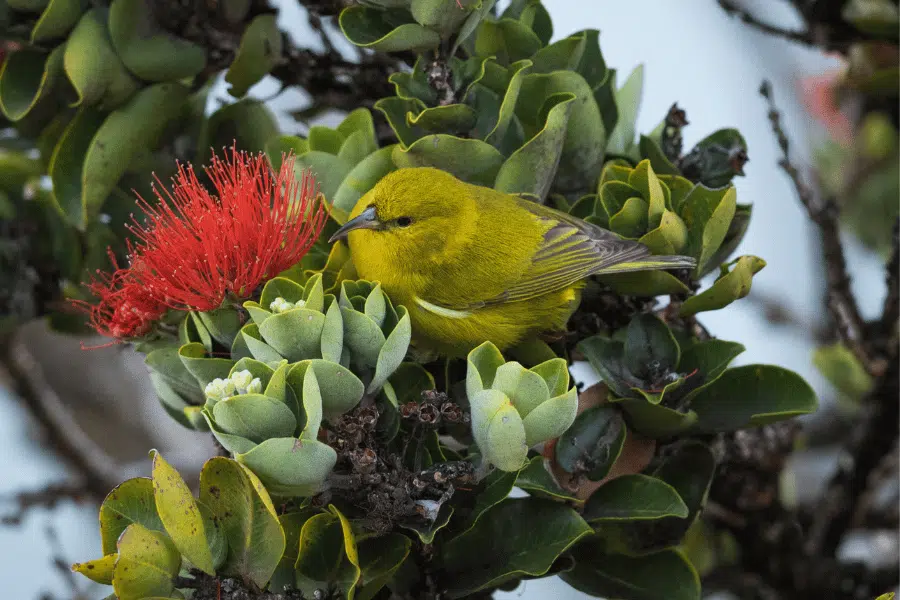
Vallocchia’s work has also taken her to Malta and Mexico. She’s been with Maui Forest Bird Recovery for four years. As avian research field supervisor, she works on honeycreeper surveys, counting the relatively few remaining birds from what was once a thriving bird paradise with more than 50 species of honeycreeper.
On Maui, Vallocchia says, six species of honeycreeper remain. Three of these are endemic to Maui, found nowhere else. Vallocchia and her colleagues track populations of Kiwikiu (Maui parrotbill) and ʻĀkohekohe (crested honeycreeper).
Vallocchia and her colleagues camp out in various locations on Maui, tracking birds and their activities at predetermined spots or transects on a specific line through a forest. This gives them a consistent scientific way to count the birds.
Right now, fewer than 150 kiwikiu remain, Vallocchia says.
“The native birds, you see how special they are here,” Hebebrand says. “When I saw a kiwikiu in the wild for the first time, I cried.”
The soundscape of Hawaii
Some native birds are spotted closer to the project’s home office. A Hawai’i ‘amakihi was spotted recently feeding on a hibiscus plant in the yard, delighting the staff.
Program manager Hanna Mounce describes the work of Maui Forest Bird Recovery Project as an investment in ecosystems, cultural connections and the next generation.
“I’m hopeful that our work today will help ensure these birds are still here for our children and grandchildren,” Mounce says. “Every day, I work alongside a team deeply committed to protecting something bigger than themselves.”
Hawai’ian birds often make the sounds of their names. The kiwikiu might screech keee-eee-eee or tree-tree or kiwi-kiwi-kiwi-kiwi.
“It’s so varied,” Vallocchia said.
What tourists don’t see or hear
These songs most likely won’t be heard by visitors coming to the islands on vacation. People relaxing at resorts may not know they’re missing the native wildlife and birds of the Hawai’ian islands.
“Millions of people visit Hawaiʻi every year,” says Chris Warren, forest bird program coordinator at Haleakalā National Park, “and only a fraction of those get a chance to see an ʻiʻiwi or other fabulous native birds. People can grow up here and never experience a native forest.”
Warren worked for MFBRP for more than a decade and continues to partner with the organization.
“The project has always been driven by passion and a deep desire to save these species from extinction,” Warren says. His own understanding of extinction dates back to his work at the Joseph Moore Museum of Natural History in Indiana. He encountered specimens of extinct birds like passenger pigeons and Bachman’s warblers.
“There is something profound about holding an animal in your hand that will never be seen alive again,” Warren says. “And to know that that extinction was preventable made a deep impact on me.”
Protecting without disturbing
Warren says one of the biggest challenges to forest bird recovery involves educating the public, who may not know these birds exist. People care more deeply about things that they’ve personally experienced, he says.
Vallocchia agrees. She invites visitors to explore accessible areas of Maui, hiking into its fragile forests with awareness and care.
“For people to want to protect something, they need to see it, experience it, understand the beauty of it,” Vallocchia says. “Being part of nature is not disturbing nature if it’s done in the right way.”
“You could wake up to the song of the honeycreeper,” Vallocchia says.
Recommended:
The award-winning documentary “Vanishing Voices” combines interviews with bird recovery workers and animation to explain the science being used to save birds from extinction.
Questions to consider:
1. What are some threats to the honeycreepers on Maui?
2. How are conservationists trying to restore the population of alalā?
3. What birds can you spot where you live?
Want to see and hear some honeycreepers? Check out the video below:
This week, I got to welcome Clarissa (Rissa) Sorensen-Unrue back to Teaching in Higher Ed. She’s been on a few times in the past, exploring critical pedagogy; intersectionality, power, and pedagogy; and about the wonderful learning made possible through the MYFest community. This time, Rissa was joined by her sister, Christy Albright. They both shared about their unique (and some shared) experiences with grief and how it has shaped and formed them.
Grief can be such a lonely experience. Yet there are opportunities to feel less alone through the power of community. I’ve witnessed the ways that networks have helped people with disabilities navigating difficulties with access or inclusion, grieving parents who have lost a child, and connecting those who are looking to advocate for chance in higher education. Harold Jarche quotes Ronald Burt, author of Neighbor Networks: Competitive Advantage Local and Personal, in this week’s reading:
It is not being in the know, but rather having to translate between different groups so that you develop gifts of analogy, metaphor, and communicating between people who have difficulty communicating to each other.
Getting Started with Mastodon
Jarche then invites us to set up and share our Mastodon profile, which we will be using throughout the workshop. I already had one set up on Mastodon.Social (a larger instance of Mastodon): bonni208, as usual, so this was relatively easy for me. Originally, Dave had set us up on a unique Mastodon instance. Ultimately, we decided that it wasn’t worth the expense for us to do so and now we’re both on a larger instance.
I’m still mourning the loss of community I used to experience on Twitter. First, I went radio silent and ultimately decided to delete my entire account. When discussing communities, that’s one of the things we’re warned against. If we put our metaphorical eggs in one basket and something happens to that basket, there’s no putting Humpty Dumpty back together again. I was able to move some the people I followed over to other platforms, but it isn’t at all the same as it once was.
Many people find themselves on newsletter and social media platforms that are misaligned with their values. Then, there’s all the work with how to navigate that cognitive dissonance. This is messy business. I would advocate holding yourself to high standards as you’re making decisions about where to farm and nurture your communities, but to be gentle with others who are in the process of making their own decisions about where to engage.
I know Harold and plenty of others aren’t a fan of Bluesky, for reasons of replicating the issues many of us faced when investing so much on Twitter back in the day. However, that’s been the closest experience I’ve had to some aspects of community I used to get to enjoy. I like that they have starter kits (thank you for all the bird starter kits, people of the internet) and that my feed has a mix of hard-to-read-yet-important stories, satire and humorous posts, and then there are the birds. Many, many birds.
Speaking of birds, when I was talking with Rissa and Christy, I mentioned something about not having fact checked an Instagram post, but enjoying the idea of when we listen to bird song, that the experience can be associated with positive health benefits. Before finishing the show notes for that episode, I figured I had better do my due diligence and assess the veracity of that claim. Using Mike Caulfield’s Deep Background: Fact Checks and Context GPT,
In the first round of fact checking, the GPT stated that a fact checker might say that this statement is “mostly true.”
Strong evidence shows short-term relaxation and mood benefits from hearing birdsong, including reduced anxiety/paranoia versus urban noise. Broader or lasting “health benefits” (physiological and clinical) are plausible but less well established for birdsong specifically and should be qualified.
Another Round
When I followed Caulfield’s advice and typed: “another round” in the text box, more nuance emerged. Note the parentheses in the following text, which indicates what is new in this follow up query:
What’s new here is marked (NEW).
What changed / what we learned this round
We found a credible conflicting lab study (Hedblom 2019) reporting no significant physiological stress-recovery benefit from bird-song masking in a traffic-noise context—suggesting that some of the stronger “health” claims (physiology) don’t always replicate when visuals and context are controlled.
Two different angles refine the claim: (1) not all birds are equal—e.g., crow calls lower restorativeness scores relative to other species; (2) the mix with urban noise matters—bird/stream sounds may reduce annoyance only when traffic noise isn’t perceptually dominant. These both caution against blanket statements and point to designable soundscapes (what species? what mix?).
Net effect: support for short-term mood/annoyance relief remains strong (Urban Mind; Stobbe; Buxton), but broad physiological or long-term clinical benefits from listening to birdsong alone remain unproven or context-dependent, and species/mixture effects are meaningful.
Pattern to note
Higher-quality, controlled lab studies split: some show physiological recovery with general nature sounds (often water + birds), while others show null effects for birdsong specifically—especially when traffic noise is present or visuals drive recovery. Reviews also warn about conflating “birdsong” with “being in nature.” This pattern suggests the moderate claim is well supported, while the strong claim needs tighter, preregistered trials parsing species, diversity, and noise context.
Context Report
Finally, I followed Caulfield’s guidance to type “context report” for a summary and can share the following results.
Core Context
The claim is often presented as “listening to birdsong relaxes people and produces other health benefits,” which can imply broad, causal, even physiological effects; reviews caution that many studies are short, context-dependent, or conflate “birdsong” with being in nature generally.
In real-time diary research using the Urban Mind app, moments when participants reported seeing or hearing birds were associated with higher mental wellbeing, with benefits persisting to the next check-in; this is strong evidence of association but not proof of causation.
A randomized online experiment (~6 minutes of audio) found that birdsong reduced anxiety and paranoia relative to traffic noise; depression decreased only with a higher-diversity birdsong track, and there were no cognitive gains—supporting short-term mood benefits rather than sweeping health effects.
Evidence syntheses indicate natural sounds overall improve affect and reduce stress/annoyance, with birdsong showing particularly strong links to stress/annoyance relief; these findings speak to psychological states more than durable clinical outcomes.
Not all studies find physiological benefits from birdsong: in a controlled lab study, masking traffic with birdsong did not improve physiological stress recovery versus traffic or silence, suggesting context and modalities matter.
Species and soundscape context shape effects: crow calls score low on perceived restorativeness, and the ability of birdsong to temper annoyance depends on how dominant traffic noise is in the mix—underscoring that “birdsong” is not a single, uniform stimulus.
I felt that note about crow calls hard. Real hard. 😅
Dr. Ludmila Praslova holds a copy of her book: The Canary Code
Until next time…
…and here’s a long list of sources, which I thought seemed appropriate, given what we’re fact checking in this post.
Bibliography
Alvarsson, J. J., Wiens, S., & Nilsson, M. E. (2010). Stress recovery during exposure to nature sound and environmental noise. International Journal of Environmental Research and Public Health, 7(3), 1036–1046. https://doi.org/10.3390/ijerph7031036
Annerstedt, M., Jönsson, P., Wallergård, M., Johansson, G., Karlson, B., Grahn, P., Hansen, Å. M., & Währborg, P. (2013). Inducing physiological stress recovery with sounds of nature in a virtual reality forest—Results from a pilot study. Physiology & Behavior, 118, 240–250. https://doi.org/10.1016/j.physbeh.2013.05.023
Buxton, R. T., Pearson, A. L., Allou, C., Fristrup, K., & Wittemyer, G. (2021). A synthesis of health benefits of natural sounds and their distribution in national parks. Proceedings of the National Academy of Sciences, 118(14), e2013097118. https://doi.org/10.1073/pnas.2013097118
Hammoud, R., Tognin, S., Burgess, L., Bergou, N., Smythe, M., Gibbons, J., Davidson, N., Afifi, A., Bakolis, I., & Mechelli, A. (2022). Smartphone-based ecological momentary assessment reveals mental health benefits of birdlife. Scientific Reports, 12, 17589. https://doi.org/10.1038/s41598-022-20207-6
Hedblom, M., Gunnarsson, B., Schaefer, M., Knez, I., Thorsson, P., & Lundström, J. N. (2019). Sounds of nature in the city: No evidence of bird song improving stress recovery. International Journal of Environmental Research and Public Health, 16(8), 1390. https://doi.org/10.3390/ijerph16081390
Methorst, J., Rehdanz, K., Mueller, T., Hansjürgens, B., Bonn, A., & Böhning-Gaese, K. (2021). The importance of species diversity for human well-being in Europe. Ecological Economics, 181, 106917. https://doi.org/10.1016/j.ecolecon.2020.106917
National Geographic. (2025, May 14). Listening to birds sing really does soothe your brain. Here’s how. National Geographic. https://www.nationalgeographic.com/health/article/birds-sing-brain-mental-health
Praslova, L. N. (2024). The canary code: A guide to neurodiversity, dignity, and intersectional belonging at work (1st ed.). Berrett-Koehler Publishers. https://www.oreilly.com/library/view/-/9781523005864/
Ratcliffe, E. (2021). Sound and soundscape in restorative natural environments: A narrative literature review. Frontiers in Psychology, 12, 570563. https://doi.org/10.3389/fpsyg.2021.570563
Stobbe, E., Sundermann, J. M., Ascone, L., & Kühn, S. (2022). Birdsongs alleviate anxiety and paranoia in healthy participants. Scientific Reports, 12. https://doi.org/10.1038/s41598-022-20841-0
Zhao, W., Li, H., Zhu, X., & Ge, T. (2020). Effect of birdsong soundscape on perceived restorativeness in an urban park. International Journal of Environmental Research and Public Health, 17(16), 5659. https://doi.org/10.3390/ijerph17165659