
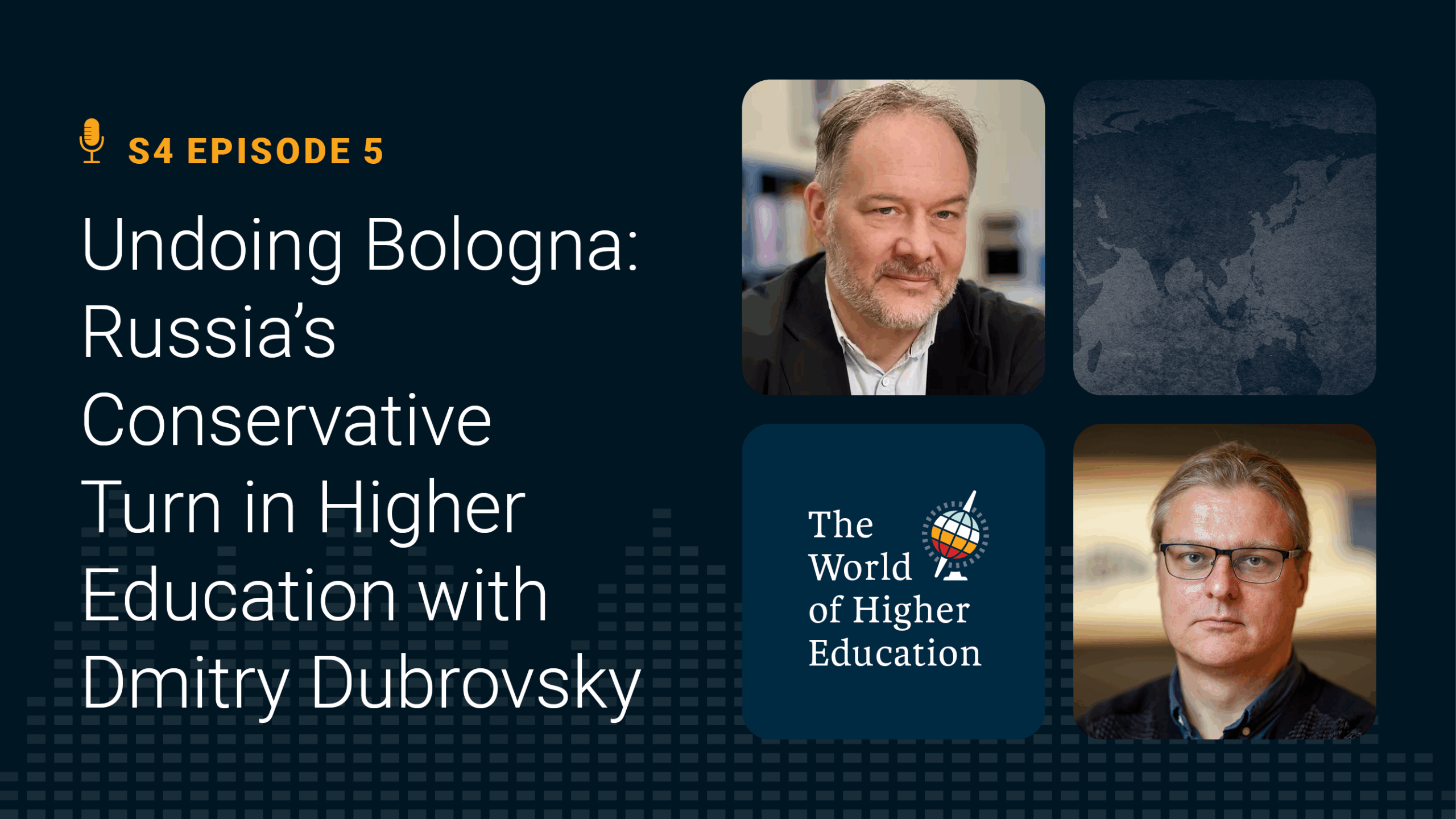
One of the consequences of Vladimir Putin’s invasion of Ukraine has been a vast reconfiguring of Russia’s academic and intellectual life. Universities, thought of as a potential hotbed of opposition since the White Ribbon movement of 2011, came under intense control and its personnel placed under even greater scrutiny.
Many faculty fled. Connections with international partners in the West were severed. And then to top it off, the Russian government announced that it would abandon the three degree bachelor’s, master’s doctoral system introduced when the country joined the Bologna Process 20 years earlier.
All this has combined to create what some have called a slow motion collapse in Russian higher education. But to understand what’s been happening in Russian Universities since February 2022, you really need to go back to the dawn of the Putin era in January 2000, and understand how ideological control of institutions has come to rest squarely inside the Kremlin.
Joining the podcast today is Dmitry Dubrovsky. He’s a scholar at the Institute for International Studies at Charles University in Prague, where he has taught ever since being designated as a foreign agent by the Putin regime in early 2022. And he writes primarily about the politics of academic freedom and civil society in Russia.
He’s with us today to talk about this slow motion collapse, the internal governance of Russian institutions, and how the country might one day be put back on a track to integration with European academia. Over to Dmitry.
The World of Higher Education Podcast
Episode 4.5 | Undoing Bologna: Russia’s Conservative Turn in Higher Education with Dmitry Dubrovsky
Transcript
Alex Usher (AU): Dmitry, I want to take us back to the year 2000. Vladimir Putin is the new president of the Russian Federation. What was the state of the higher education sector at the time, and how did Putin approach it? How did he view higher education as an instrument of state policy?
Dmitry Dubrovsky (DD): Well, the legacy of the 1990s left Putin with a serious challenge. The system faced underfunding and fragmentation. At the same time, scholars were eager to join the European system. There had been attempts in the 1990s, but the biggest problems were the lack of financing and the absence of international mechanisms or tools to fully integrate into the European system of higher education and science.
Putin saw higher education and science, first and foremost, as a tool to join Europe—to become part of the European family and a prominent member of the global market of ideas. That’s why Russia joined the Bologna Process in 2003 and actively pushed for internationalization.
AU: So in that sense, it’s probably not that different from most other countries in the former socialist bloc, like Poland or Romania—the idea that internationalization would bring about an improvement in higher education. Is that about right?
DD: It is right, with one very important difference. At first it might seem small, but it became a very serious issue. In higher education and science, everywhere in the world, there are always people who believe that their own system is highly advanced—at the very top.
The problem in the late Soviet Union and the Russian Federation was that a substantial number of people survived the collapse of the USSR still believing that Russian and Soviet science was the most advanced in the world. In some cases, for certain disciplines, that might have been true. But in most areas—especially the humanities and social sciences—it wasn’t.
By the late 1990s, there was a substantial group of people who were deeply disappointed in the results of democratic reforms and in what democracy had brought, both to the country overall and to higher education and science in particular.
AU: Okay, now, Putin was president until 2008, and then he switched places for four years with Prime Minister Medvedev. He returns to power as president in 2012. And as you say, it’s a different Putin—a much more authoritarian Putin. How did his approach to higher education change? If we think of “Putin 1.0” around 2000, what does “Putin 2.0” look like after 2012? How does he try to exert greater control over the system?
DD: It’s important to note that before Putin came back to power, there was a very significant period of reform in Russian higher education. Especially around 2007–2008, reforms were focused on improving quality and gaining international recognition. This was the era of what we call “managerialist modernization.”
The idea was to select flagship universities that would drive the rest of the system forward into a brighter future.
AU: And eventually that becomes the 5–100 Project.
DD: Yes, the 5–100, or “5–2020” project. The goal was that at least five Russian universities should appear in the world rankings. It was a very interesting period because it marked a serious transformation in the sociocultural landscape of Russian higher education.
For the first time, the so-called “effective managers” entered the system. From the mid-2000s onward, higher education began receiving serious investment from the state, making it appealing to a new managerial class and their approaches. Internationalization advanced, but it went hand in hand with growing managerial control over universities.
Even before Putin returned in 2012, higher education was already being used as a tool to demonstrate the effectiveness of Russian policy and as an instrument of soft power, particularly through supporting Russian universities in former Soviet countries like Armenia, Azerbaijan, and Tajikistan.
When Putin came back, however, the situation changed dramatically. What I call the “conservative shift” began—not just in politics broadly, but within higher education and science.
AU: And some of that has to do with the broader crackdown at the time. I remember there was a lot of pressure on foreign organizations, which made international cooperation more difficult. For example, the government targeted the Open Society Foundations, George Soros’ network that had been active in supporting the social sciences and humanities. There was also a crackdown on things like gender studies and spaces for LGBTQ students.
Masha Gessen wrote about this in her book The Future is History. Why did that happen at that moment? What was it about Putin that made him say, “This is an area I want to control and push in a more conservative direction”?
DD: First and foremost, we have to remember the protests of 2011–2012. That was the time of the so-called “white ribbon” movement. It came very close to a revolution, though in the end it never happened—we failed. I was a member of that movement myself.
The significant participation of scholars and students in those protests put higher education under special scrutiny from the security services and the political apparatus. They believed that control over the education system could restore their legitimacy and symbolic power in society.
And remember, these leaders were, in many ways, Soviet people. They genuinely believed, “This is how the Soviet Union ruled—through control, especially in education and ideology.” And to some extent, that was true. The Soviet Union consolidated its power in part through universities.
Putin believed the same could work for him—that restoring control over higher education would allow him to strengthen his government, which had been undermined by the events of 2011–2012.
AU: We’ve been talking about the relationship between institutions and the government, but the government also changed the way institutions were run a couple of times, right? How has the exercise of power within Russian universities changed? I’m pretty sure there’s been a change in the process of selecting university leaders. How has that affected Putin’s ability to control universities?
DD: The specificity of Russian universities in the 1990s was that there was an enormous amount of democracy. There was absolutely no money in the system, so it was extremely poor—but at the same time, it was a kind of “poor democracy.” There were numerous elections, and the whole system of university governance was very active in self-governance.
There were real political struggles. People fought for the position of dean, they competed for the position of rector. Even department chairs could be elected. Almost every administrative position within a Russian university could be filled through an election.
When Putin consolidated power, especially during the managerial reforms, there was pressure—particularly on the flagship universities in the 5–100 Project—to amend their charters and replace elections with government appointments.
The official explanation was simple: if the state was providing so much budget support, then the state should also assign the rector rather than leave it to an election.
Even now, some Russian rectors are still technically elected. But in Putin’s Russia, an “election” is not an election in the normal sense. The ministry proposes the candidate, people watch the process, and it ends up looking very much like the way Putin himself is “elected.”
AU: Dmitry, in the early days of the 2022 invasion of Ukraine, one thing that surprised a lot of people in the West—it seemed to come out of the blue—was a letter in support of the invasion signed by several hundred university rectors. Why did they do that? I mean, presumably they were ordered to by Putin, but why did Putin think that would be legitimizing?
DD: In post-Soviet societies there is a very high level of trust in higher education and science. The leaders of higher education were expected to officially support the so-called “hard decision” about the war.
But it’s important to remember—something some of our colleagues abroad seem to forget—that most of these rectors were never democratically chosen. They do not represent the voices of Russian scholars, lecturers, or faculty members. They mostly represent the vision of the presidential administration. Their role was to collect names for a list of support and then sign this shameful document.
And of course, this didn’t start in 2022. Under the “foreign agent” law of 2015, the government began a long anti-Western campaign—searching for “un-American” groups of influence, cutting connections with international centers, and declaring institutions like Central European University or Bard College in New York to be “undesirable organizations.”
This created a climate of fear and anxiety among the leaders of higher education. And there was direct blackmail: if you decided not to sign, that was your choice—but you had to think about your faculty, your team, your colleagues. They would probably be fired soon.
AU: What changed on university campuses after the invasion? Obviously, if I were in Putin’s position, I’d be worried about student unrest. So what happened in terms of surveillance on campus, and how did faculty react? I mean, you were a faculty member at the time, and you’re one of many who left fairly quickly after the invasion. How big a brain drain was there?
DD: Not as big as you might think, for different reasons. Academics can’t move as easily as other people—they need to be sure they’ll have a way to continue working, and for many there simply wasn’t anywhere to settle quickly.
My personal story was different. By coincidence, I had an invitation for a fellowship. Long story short, I relocated quickly from my home city of St. Petersburg to Prague. But for many others, leaving was far more difficult.
As for institutional surveillance—yes, it was there. It looks like Russia had been preparing for war for about two years beforehand. Around two years before the invasion, they started introducing special vice rectors responsible for “youth” whose actual role was to monitor and control loyalty.
At the same time, they established special departments within Russian universities with very long titles—things like “Promoting Civic Consciousness, Preventing Extremism, and Managing Interethnic Relations.” In practice, these were institutions embedded in higher education to control and discipline students and scholars.
Their real work was searching social networks, looking for so-called “betrayal” behaviors among students and faculty, and reporting them to the security services and police. Today, almost every region of the Russian Federation has one of these departments to oversee and report on improper behavior.
AU: After that rectors’ letter, Russia was suspended from the Bologna Process, and in retaliation Putin announced a return to the pre-Bologna system. So, getting rid of the bachelor’s, master’s, PhD framework and bringing back the old Russian model with the second PhD. How is this process unfolding? How easy is it to undo Bologna?
DD: That’s a good question. I don’t think Russia is really going to undo Bologna. They’re not planning a full reversal or trying to recreate the Soviet path.
From one side, there’s direct pressure on the Ministry of Higher Education and its bureaucrats to dramatically change a system that has been built over twenty years. But this system cannot simply be reversed. Legally, if students have already been admitted to a particular program, the state can’t just stop it midstream. At the very least, it would take four or five years to change. It can’t happen overnight.
Secondly, to me this feels like an exercise in mimicry or emulation from the old Soviet-style bureaucratic circles in higher education. I follow what’s happening closely—the statements from the Minister of Education—and they always try to explain what will be different, but they can’t. They have no clear idea what they’re trying to create.
Officially, they say, “This is not Bologna anymore. It has proved to be ineffective. Now we will collect the best achievements of the Russian system of education.” But what does that even mean? It’s absolutely impossible to understand. From my perspective, they are trying more to sabotage the process than to implement something substantial.
AU: Looking ahead, what do you think a post-Putin higher education system in Russia might look like? Is there a path back into the European higher education space, and what would it take to undo the damage that’s been done since 2012?
DD: That’s a good question. Currently, I would describe the situation as a “fourth deglobalization.” We’ve essentially gone back to the conditions of 2003, before joining the Bologna Process.
That doesn’t mean there’s no capacity—many faculty members still working in Russia earned their degrees in Western institutions. There is still substantial expertise within the system. But the fate of Russian higher education is very difficult to predict because it is so closely tied to the political fate of the Russian Federation itself.
If sanctions were to decrease and the war were to end, perhaps things could return to something like “normalcy.” But even that is debatable—what would “normalcy” mean in this context? At best, it might look like the Cold War era, perhaps similar to the late 1970s.
There are already serious restrictions in place: academic sanctions, boycotts, and bans on cooperation imposed by many institutions and countries. These severely limit Russia’s ability to develop visible academic exchanges with Europe. Instead, Russia is turning elsewhere—towards an “alternative globalization,” aligning more closely with countries like China, Iran, South Africa, and Brazil within the BRICS framework, [a political and economic bloc of major emerging economies that positions itself as an alternative to Western-led alliances].
AU: Dmitry, thank you so much for being with us today. It just remains for me to thank our excellent producers, Sam Pufek and Tiffany MacLennan, and you, our listeners, for joining us. If you have any questions or comments on this week’s episode, or suggestions for future ones, please don’t hesitate to get in touch at [email protected].
Join us next week when our guest will be Joshua Travis Brown from Johns Hopkins University’s School of Education. He’ll be joining us to talk about his fascinating new book from Oxford University Press, Capitalizing on College: How Higher Education Went from Mission-Driven to Margin Obsessed. Bye for now.
*This podcast transcript was generated using an AI transcription service with limited editing. Please forgive any errors made through this service. Please note, the views and opinions expressed in each episode are those of the individual contributors, and do not necessarily reflect those of the podcast host and team, or our sponsors.
