Tag: Boosts

  • Increased Sense of Belonging Boosts Student Graduation Rates

    Increased Sense of Belonging Boosts Student Graduation Rates

    New research from Wake Forest University shows that boosting a student’s sense of belonging in college can significantly increase their likelihood of earning a degree.

    The findings draw on nationally representative survey data from more than 21,000 undergraduates enrolled in two- and four-year colleges across the country.

    The survey measured belonging by asking students to rate their agreement with the statement “I feel that I am a part of [school]” on a five-point scale, where 1 means strongly disagree and 5 means strongly agree.

    Students who rated their sense of belonging in their second year one step higher on the five-point scale than they did in their first year—such as moving from neutral to agree—were 3.4 percentage points more likely to graduate within four years.

    That pattern held over time: Each one-step increase in a student’s reported sense of belonging was linked to a 2.7-percentage-point higher likelihood of earning a degree within six years.

    “What stood out to me was just how consistent the findings were,” said Shannon Brady, a Wake Forest University psychology professor and the study’s author. “We’re seeing this relationship hold across different kinds of students and institutions.”

    Students in the study began college during the 2011–12 academic year, and their graduation outcomes were measured four and six years later. That’s the most recent nationally representative data available, Brady explained.

    She said the findings send a clear message that fostering a sense of belonging is vital on campus, and that its impact on persistence and graduation rivals the effect of thousands of dollars in additional financial aid.

    “One of the things that’s nice about belonging is that it doesn’t have to cost a lot,” Brady said, adding that intentional support—such as structuring first-year seminars or addressing hurdles in registering for classes—can make a meaningful difference in creating a sense of belonging with relatively few resources.

    “It takes attention, and it takes people doing the work to make it happen,” she said.

    The findings: The study identified two statistically significant differences in how belonging related to graduation outcomes for specific student groups.

    The link between belonging and four-year graduation rates was stronger for students whose parents had attended college than for first-generation students. The report suggests this gap may be due to first-generation students being more likely to “face structural and psychological challenges that may, at times, weaken the benefits of belonging.”

    “These challenges can take many forms,” the report said, including limited guidance in navigating college systems, financial pressures that compete with academic engagement and systemic cultural mismatches between institutional and home environments.

    Belonging also had a weaker connection to six-year graduation rates for Asian students compared to non-Asian students. The report attributes this, in part, to the fact that Asian students are more likely to have “alternative supports that promote academic persistence.”

    Those supports can include family expectations that emphasize educational achievement, peer networks with strong academic norms and cultural orientations that prioritize sustained effort over socio-emotional connection to an institution.

    The authors caution that the broad “Asian” category includes considerable diversity across countries and regions of origin, generation status, and socioeconomic background; such diversity shapes both students’ access to support and their experiences of belonging and credential attainment.

    The implications: Brady pointed to the City University of New York’s Accelerated Study in Associate Programs as a “fantastic” model for fostering student belonging.

    The ASAP program works to remove everyday barriers, such as transportation costs, complicated scheduling and limited advising, and has been shown to improve graduation rates while also helping students feel connected to their campus.

    “If you can’t get the classes you need, it’s hard to feel connected to school,” Brady said. “And if transportation is complicated—if you’re dependent on buses or rides from friends because you can’t afford a bus pass—it’s hard to build the relationships you want.”

    Beyond individual programs, Brady recommended institutions adopt a standardized measure of student belonging across campuses.

    “Almost no cross-institution conversation happens on this because the measures that schools are using are different,” she said. “You can’t aggregate knowledge as well as we might if we had a more standardized measure.”

    Ultimately, Brady said, colleges have a responsibility to create environments where students feel they belong.

    “I don’t want to suggest that belonging is always inherently a good thing, but we want to create institutions where it is reasonable and positive to build a connection to them,” she said.

    Get more content like this directly to your inbox. Subscribe here.

    Source link

  • Uni boosts gender diversity by 30% in maths – Campus Review

    Uni boosts gender diversity by 30% in maths – Campus Review

    As the artificial intelligence (AI) and quantum computing industries explode, trained STEM professionals are in high demand. Mathematics is foundational to these fields.

    Please login below to view content or subscribe now.

    Membership Login

    Source link

  • UC Riverside Hopes Early Exposure to College Boosts IE Grad Rates – The 74

    UC Riverside Hopes Early Exposure to College Boosts IE Grad Rates – The 74


    Get stories like this delivered straight to your inbox. Sign up for The 74 Newsletter

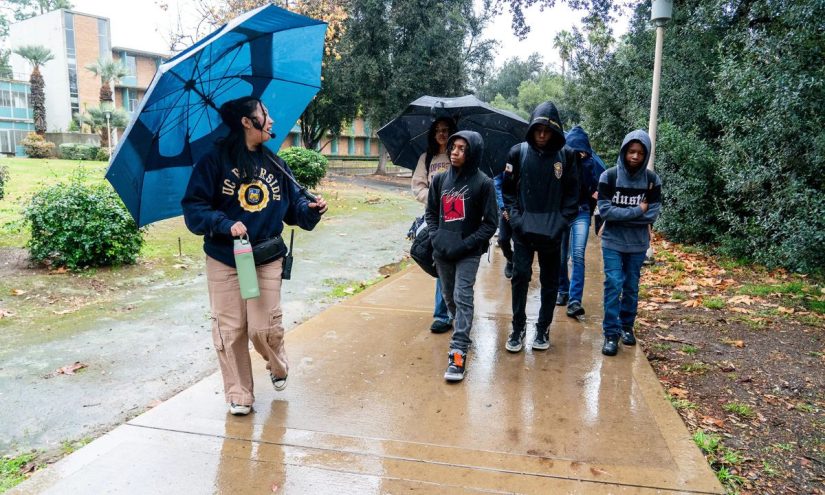
    On a recent rainy day, several dozen students sat in a UC Riverside classroom, planning their path to college.

    These weren’t high school seniors. They were seventh graders getting a jump-start on the competitive university application process. They’re part of a university program called the Middle School Initiative that aims to get Inland Empire students thinking about higher education long before they take their first AP class or submit an application.

    With a four-year college graduation rate about half the state average of 35%, the Inland Empire is falling behind in educating students for well-paid, professional jobs, limiting the economic prospects of the region’s youngest inhabitants. In an effort to raise that ceiling, educators are trying to get tweens to envision their potential for a college education and career. 

    The students from Riverside middle schools discussed how to write college application essays, toured the university campus and learned about admission standards for California universities. 

    “I like that there’s something you can do in middle school so you can do more in high school,” said 13-year-old Simone Reid, a seventh-grader at Villegas Middle School who wants to major in business. “I want to get started early so I have more opportunities.”

    UC Riverside Dean of Education Joi Spencer said she introduced the program this year to reach students who might not consider attending a university, or know how to prepare for it. Middle grades “are where kids get sorted into who’s going to go to college and who’s not,” she said.

    The initiative aims to change that pattern. With an annual budget of $15,200, the program launched has so far reached 500 students, including more than 300 who joined campus tours at UC Riverside.

    “Our first goal is to invoke a conversation across the Inland Empire related to university access and eventual success,” Spencer said. “First and foremost, too many youngsters do not even see university attendance as a possibility for them. This is our fault as adults and educators. We keep producing the same winners and losers in education and we need to break this cycle.”

    The Middle School Initiative is open to students throughout Riverside and San Bernardino counties, with Jurupa, Moreno Valley, Alvord and Riverside Unified school districts among the first participants. Any students in the Inland Empire can participate, but in the early days of the program, administrators have prioritized students who have fallen through the cracks in class.

    “Some of the students are high flyers, but are somehow overlooked in their school setting,” Spencer said. “Others may have average achievement, but high aspirations.”

    The program isn’t just an introduction to college readiness. Program administrators plan to follow students along their academic journey, meeting with them throughout middle and high school and during the transition to college. They will also track college enrollment of students who participate in a related summer program called the STEAM Academy, which increases exposure to the fields of science, technology, education, art and math.

    “This middle school period is the pivotal period to prepare for college,” said Elizabeth Benitez, Middle School Initiative coordinator.

    For instance, she said, many middle schools have foreign language options. Taking that early, in seventh or eighth grade, can pave the way for advanced placement language classes in high school, which boost students’ grade point averages and allow them to earn credits for college. 

    Some students may be a step ahead because of their family background, Frances Calvin, director of the university’s Early Academic Outreach Program, told the group. During the campus workshop she asked seventh graders to raise their hands if they spoke a second language. Several responded that they spoke Spanish, Portuguese or other languages at home.

    “If you speak a second language you are becoming marketable because the world is getting smaller and smaller,” Calvin said.

    Students at the campus event said they clearly heard the message about academic achievement and vowed to work on raising their grade-point averages.

    “I personally think I should focus more on my GPA,” said Dike Okeke, 12. “Then when I have that figured out I could find work to save for college.”

    Money matters loom large for many of the students, especially those hoping to be the first in their family to attend a university. The initiative offers instruction on how to fill out financial aid forms and tips on finding scholarships. Students can come back to the program later in high school to seek help with that process, Benitez said.

    “My family didn’t have the resources to experience college,” said Jeremiah Stinson, 12, who aims to study business and play college football. “I think I need to start saving money to afford this. I need to focus on a scholarship. Debt lasts forever. I don’t want to struggle with that.”

    Interestingly, the seventh graders also discussed personal discipline, and almost universally acknowledged that they needed to curtail electronics use and pay attention to school.

    “I also need to get rid of all my devices because I spend a lot of time on social media,” said Tatum Tobios, an aspiring fashion designer who favors Victorian Gothic styles and plans to go to art school.

    Her peers nodded in agreement. How will they scale back their TikTok and Instagram habits? 

    Some of their solutions: “Delete the apps,” “Lock them away,” “Give it to my mom,” “Hide it from myself.”


    Get stories like these delivered straight to your inbox. Sign up for The 74 Newsletter

    Source link

  • College of Western Idaho Boosts Enrollment and Retention with Data-Driven Solutions

    College of Western Idaho Boosts Enrollment and Retention with Data-Driven Solutions

    In late 2021, the College of Western Idaho (CWI) needed to address a consistent enrollment decline and improve student retention. With an ambitious vision to improve and optimize its technological infrastructure and student outreach, CWI sought to build a best-in-class system to enhance student engagement and elevate enrollment strategies. To ensure that data and technology were aligned with CWI’s growth objectives, the college partnered with Collegis Education to analyze their combined impact. Were its data and tech aligned for impact, or were gaps hindering progress and creating unnecessary burdens across the team?

    Key Takeaways

    • Six consecutive terms of YoY enrollment growth
    • Experienced the highest YoY increase in persistence in history of the college from Fall 2022 to Fall 2023
    • Consistent improvement in term-over-term retention

    CHALLENGES:

    • Declining enrollment
    • No established retention strategy
    • Lack of CRM
    • Underutilized LMS
    • Siloed technology and data systems

    SOLUTIONS:

    • Connected Core®
    • Advanced analytics + business intelligence
    • LMS support
    • Website optimization
    • Data-driven outreach and support for students identified as at-risk

    Strategy

    Collegis Education and CWI began collaborating on building a best-in-class student journey from the point of initial inquiry through graduation.

    A comprehensive evaluation of existing CWI systems allowed Collegis to assess the college’s digital readiness, technology infrastructure, and enrollment ecosystem to understand how they aligned with its growth objectives. The partnership quickly proceeded from consultation to implementation.

    Collegis prescribed a set of solutions to enhance student engagement from first contact and elevate the school’s enrollment strategies:

    • Connected Core® to unite siloed systems, data sets, and other enrollment technologies, providing more accurate, actionable, unified institutional intelligence with clear visualizations to support data-enabled decision-making at all levels.
    • Website optimization to improve conversion and deliver a student-centric digital experience that supports the objectives, goals, and mission.
    • Prospective student nurturing campaigns with a messaging protocol designed to drive conversion and prospective student engagement with CWI.

    Collaborating closely with CWI, Collegis developed a well-defined student retention strategy that established meaningful student-advisor relationships early on, ensuring students felt supported from their first interaction onward.

    • Enrollment conversation training gave student-facing staff the tools to drive positive experiences for CWI learners while embracing a liaison approach to student engagement.
    • Collegis student success coaches conducted proactive outreach to engage students while leveraging an at-risk alert system to drive intervention. This early alert system flags students needing support based on learning management system (LMS) data on attendance, current grades, and assignment completion.

    Results: Average YoY growth each semester since our partnership began has averaged 5%

    By working with Collegis, CWI could focus on its student journey and how it could better use data and technology to deliver superior student engagements and reach its growth targets. This has helped not only stop, but reverse historical enrollment declines. In 2024, CWI projected year-over-year growth for the sixth consecutive academic term. The school has achieved an average year-over-year term growth of 5%, with a trendline for fall 2024 of over 9% growth.

    “Our partnership with Collegis has provided expertise, speed, and flexibility in areas where we, as an institution of higher education, have been unable to improve so nimbly.  Where most consultants provide an analysis and leave, Collegis follows through with ‘and this is how we’ll make that happen for you’.  Trusting their recommendations is easy because I know they are signing themselves up to do the work with me.”

    Tyler Brown, Associate Vice President Enrollment & Student Services, College of Western Idaho

    Value-based conversations with prospective students have resulted in increased applications. Further, pre-start engagement from the advising and student success coaching teams has increased registrations from admitted students.

    By fostering a culture of meaningful interaction and support for students, CWI paved the way for improved student retention. The LMS-based at-risk model has driven 19,000+ proactive student engagements and interventions in one academic year.

    Within just one year of implementing these targeted strategies, CWI witnessed a remarkable in retention rates, all while alleviating the workload on faculty and staff.  Similar retention strategies deployed by other Collegis partner institutions have yielded term-over-term retention rates exceeding 90%, underscoring the effectiveness of our approach.

    Whenever we want to try something new or have a challenge we need help with, my first thought now is let’s call Collegis and see if this is something they can help us with.”

    Denise L. Aberle-Cannata, Provost, College of Western Idaho

    With a proven retention strategy and access to a proactive model, CWI can now build out its internal retention capabilities and plans to take over the student success coaching function.

    The Future

    CWI’s commitment to embracing change and being agile is demonstrated by the school’s evolving partnership with Collegis to exceed industry best practices and realize sustained growth. Ongoing services and incremental work are targeting LMS initiatives to stabilize, standardize, optimize, and transform CWI’s instance of Blackboard Learn and redesign its new student orientation, among other things.

    Source link