Tag: Borrower

  • Education Department seeks delay in landmark borrower defense settlement

    Education Department seeks delay in landmark borrower defense settlement

    This audio is auto-generated. Please let us know if you have feedback.

    Dive Brief: 

    • The U.S. Department of Education is asking a federal judge for an 18-month extension to decide borrower defense claims from students who were promised decisions by January — or automatic relief if their cases aren’t resolved by then. 
    • The nearly 200,000 borrowers still awaiting decisions are covered by a landmark 2022 settlement that promised automatic debt relief or timely decisions based on when borrowers filed claims and what institutions they attended.
    • The Project on Predatory Student Lending, a nonprofit legal firm representing the borrowers, urged the judge overseeing the case to reject the Education Department’s request for an extension. “It is time for the Department to hold to its commitments and move this Settlement to its final phase,” the group said in a Nov. 21 court filing

    Dive Insight: 

    The settlement in the Sweet v. McMahon case stems from a class-action lawsuit filed during the first Trump administration that accused the Education Department of stonewalling decisions on applications for borrower defense to repayment, a federal program that provides debt relief to students defrauded by their colleges. 

    The settlement divided borrowers into three groups. 

    It granted automatic relief to the first group, which was composed of roughly 200,000 borrowers who attended one of the 151 colleges listed by the department. The list was dominated by for-profit institutions, including both large chains that had shuttered and still-operating colleges. 

    The second group was promised timely decisions, or automatic relief if the Education Department didn’t meet certain deadlines. The agency told the court earlier this year it had resolved many of those cases, and will provide another update in December. 

    And the last group — which is now facing a potential delay — is composed of the 207,000 people who filed over 251,000 borrower defense claims after the settlement had been struck but before it received final court approval. 

    The Biden administration’s Education Department promised to make timely decisions on their cases — or else provide automatic relief to them by Jan. 28 of next year. Now, the department under President Donald Trump is requesting to move that deadline back to July 2027. 

    In a Nov. 6 court filing, the agency said it lacked the resources to quickly issue decisions on such a large pool of applications. 

    “The Department has not received the resources that are needed to adjudicate post-class applications — Congress repeatedly ignored requests for funding to increase staffing to the levels the Department deemed necessary to fully implement the settlement,” the agency said, adding that its Federal Student Aid office “has instead seen staffing dwindle at the time when resources for postclass adjudication are most needed.”

    Trump signed an order to close the Education Department to the “maximum extent appropriate and permitted by law” and has asked Congress to reduce its funding.  

    The Education Department has cut its staff roughly in half under Trump and moved to outsource its programs to other federal agencies without first seeking congressional approval — a move some say could be a violation of the law

    The department said it is now adjudicating about 1,500 borrower defense applications each month for the final settlement group. As of Oct. 31, it had issued decisions on almost 54,000 of the final group’s applications. 

    It projected that roughly 193,000 borrower defense applications covered by the settlement would still lack decisions by the January deadline. Those borrowers’ outstanding loan balances total $11.8 billion, the Education Department said in court documents. It also said about half of the group’s borrower defense claims have so far been denied. 

    In a statement Wednesday, Under Secretary of Education Nicholas Kent the Trump administration is requesting more time so taxpayers aren’t “burdened with discharges for ineligible borrowers.”

    “Although the Department has complied with the Court’s deadlines in good faith, the upcoming January deadline is unreasonable,” Kent said. “Without adequate time to review each outstanding borrower defense case, taxpayers could be forced to shoulder $6 billion in windfall discharges for ineligible borrowers, based on the Department’s current adjudication patterns.” 

    In response to the Education Department’s request, lawyers for the borrowers slammed the department’s request. 

    “Less than 12 weeks before the deadline, the Department reveals that not only is it behind schedule to meet that deadline, it never had a prayer of meeting the deadline,” they said. “Out of more than 251,000 Post-Class applications, it has adjudicated fewer than 54,000 — barely one-fifth.”

    Source link

  • American Financial Solutions and Borrower Defense to Repayment

    American Financial Solutions and Borrower Defense to Repayment

    [Editor’s Note: The Higher Education Inquirer has submitted a Freedom of Information Request F-2025-02034 for any Federal Trade Commission consumer complaints against American Financial Solutions. We expect student loan relief scams to grow over the next few years as federal government oversight is reduced.]

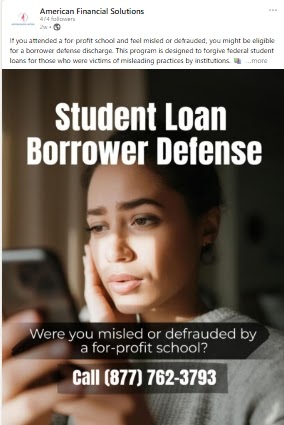
    American Financial Solutions (AFS) positions itself in social media as a lifeline for student loan borrowers, offering help with programs like Borrower Defense to Repayment (BDR), PSLF, closed-school discharge, teacher loan forgiveness, and income-driven repayment. They advertise a “95 percent success rate,” more than $25 million in loans discharged, and over 10,000 clients helped. AFS promotes a three-step approach: a free consultation, documentation collection, and federal application submission—with implied guarantees of approval. They even suggest that discharges can occur in as little as 12 to 36 months.

    Behind this polished marketing is a disturbing reality. When contacted directly, AFS quoted a $1,500 fee to file a Borrower Defense claim. The Department of Education provides this service for free, which makes the fee an unnecessary financial burden on people already struggling with debt. Worse still, AFS representatives falsely claimed that approval would be “guaranteed” because the borrower’s school was named in the Sweet v. Cardona settlement. That is not how the Sweet settlement worked, and no private company can guarantee outcomes in federal relief programs.

    AFS also collects a troubling amount of data from borrowers. According to its own disclosures, the company asks for names, contact information, educational histories, student loan details, financial information, and documentation of borrowers’ school experiences. It also stores communications and any additional information provided. Beyond that, the company automatically harvests website usage data, including IP addresses, device and operating system information, pages visited, time spent on the site, referring websites, and even search terms. This means that vulnerable borrowers are not only charged excessive fees but also exposed to unnecessary risks regarding their personal and financial data.

    While AFS presents itself as a nonprofit credit counseling agency with A+ BBB accreditation, consumer complaints suggest a lack of transparency and responsiveness. One unresolved 2024 complaint alleged billing issues, with the consumer insisting they were not liable for a debt and had no contract, while the company failed to respond. Independent review platforms show a mix of praise and criticism, with some clients reporting successful debt management experiences, but others raising questions about hidden costs, communication problems, and misleading claims.

    The bigger problem is that AFS fits a well-documented pattern of predatory practices in the student loan relief industry. Over the past decade, the Federal Trade Commission (FTC) and the Consumer Financial Protection Bureau (CFPB) have repeatedly shut down companies that charged for free government services, misrepresented their powers, and lied about forgiveness guarantees. In one case, the CFPB shut down Student Aid Institute, only to see its operator resurface under a new name and steal more than $240,000 from borrowers. In another, Monster Loans and its associates were sued for defrauding over 23,000 borrowers. The FTC has also acted against multiple operations that bilked millions of dollars from borrowers by pretending to be affiliated with the Department of Education. Even Navient, a major loan servicer, agreed in 2024 to pay $120 million after deceiving borrowers about repayment options.

    The risks to borrowers are increasing as federal oversight weakens. In 2025, reports revealed that the CFPB planned to scale back enforcement of student loan cases, leaving state regulators—who often lack resources—to fill the gap. Critics warned this would create “open season” for scammers. Against that backdrop, companies like AFS are free to charge high fees, collect sensitive data, and make deceptive promises while vulnerable borrowers remain unprotected.

    American Financial Solutions is not a solution. It is part of the problem, a business model that profits by charging people for free services, misrepresenting the law, and exposing them to new risks. Unless stronger oversight and enforcement are restored, borrowers will continue to be victimized first by predatory schools and then by predatory “relief” companies cashing in on their desperation.


    Sources

    American Financial Solutions marketing claims. amerifisolutions.com

    AFS data collection disclosure (website policy provided by user)

    Better Business Bureau profile. bbb.org

    BBB consumer complaint (2024). bbb.org

    Trustpilot reviews. trustpilot.com

    ConsumerAffairs reviews. consumeraffairs.com

    BestCompany review. bestcompany.com

    CuraDebt expert analysis. curadebt.com

    Federal Trade Commission. “American Financial Benefits Center Refunds.” ftc.gov

    Consumer Financial Protection Bureau. “CFPB Seeks Ban Against Operator of Student Loan Debt Relief Scam Reboot.” consumerfinance.gov

    Consumer Financial Protection Bureau. “CFPB Takes Action Against Operators of an Unlawful Student Loan Debt Relief Scheme.” consumerfinance.gov

    Federal Trade Commission. “FTC Acts to Stop Scheme that Bilked Millions out of Student Loan Borrowers.” ftc.gov, December 2024

    Federal Trade Commission. “Student Loan Debt Relief Scam Operators Agree to be Permanently Banned.” ftc.gov, May 2025

    Time Magazine. “Navient Settlement: Student Loan Borrowers to Receive Payments.” time.com, 2024

    The Guardian. “Brad Lander: CFPB Cuts Create Open Season for Fraudsters.” theguardian.com, May 2025

    Source link

  • Interest charges will restart for borrowers in SAVE forbearance (Student Borrower Protection Center)

    Interest charges will restart for borrowers in SAVE forbearance (Student Borrower Protection Center)

    Dahn,

    The Biden Administration’s Saving on a Valuable Education (SAVE) repayment plan promised to lower monthly student loan payments for millions of Americans. But legal attacks by the same conservative state attorneys general who exploited the courts to block President Biden’s original student debt relief plan resulted in a court injunction that has blocked borrowers from enrolling. Thus, borrowers have been trapped in a year-long, interest-free forbearance while their unprocessed Income-Driven Repayment (IDR) applications wait in limbo.

    But now, Trump and Education Secretary McMahon are saddling these borrowers with interest. Last week, the U.S. Department of Education (ED) announced that it will begin restarting student loan interest charges on August 1, 2025, for the nearly 8 MILLION borrowers stuck in this forbearance.

    McMahon voluntarily chose to do this—there was no state or federal court order forcing her hand. Read our Executive Director Mike Pierce’s statement on this below:

    Source link

  • Still Turning Borrowers into Political Pawns (Student Borrower Protection Center)

    Still Turning Borrowers into Political Pawns (Student Borrower Protection Center)

    Day 2 of the U.S. Department of Education (ED)’s Neg Reg aimed at weaponizing Public Service Loan Forgiveness (PSLF) was… just as damning as Day 1. Here’s the recap:

    Session Summary:

    The session got SPICY right off the bat. ED began the day by presenting their newly revised language. Here are some key moments:

    • Abby Shafroth, legal aid negotiator, stated CLEARLY for the record that this Neg Reg is not about protecting PSLF; it’s about the Department of Education (ED) using it as a tool to coerce nonprofits and universities to further the Trump Administration’s own goals. The government’s response was not convincing. Watch her remarks here.
    • Betsy Mayotte, the negotiator representing consumers, brought more fire: “When reading the statute of PSLF, I don’t see where the Education Secretary has the authority to remove employer eligibility definition from a 501(c)(3) or government organization…but my understanding of the regulations and executive order is that they cannot be contrary to the statute. There are no ifs, ands, or buts under government or 501(c)(3).” Watch the exchange here.
    • In a heated discussion on ED’s proposal to exclude public service workers who provide gender-affirming care to transgender minors, Abby further flagged that no one in the room had any medical expertise, so no one had qualifications to weigh in on medical definitions like “chemical and surgical castration.”
    • The non-federal negotiators held a caucus to talk about large employers that fall under a single federal Employer Identification Number. They are CONCERNED that the extreme breadth of this rule could potentially cut out thousands of workers only because a subset of people work on issues disfavored by this Administration—all without any right to appeal. Negotiators plan to submit language that would allow employers to appeal a decision to revoke PSLF eligibility by ED.
    • Borrowers and other experts and advocates came in HOT with public comment today—calling out ED for using this rulemaking to unlawfully engage in viewpoint discrimination and leave borrowers drowning in debt, unable to keep food on their tables, or provide for their families.

    Missing From the Table:

    Today, our legal director, Winston Berkman-Breen, who was excluded from the committee (but still gave powerful public comment yesterday!) has some thoughts on what was missing from the conversation:

    For two days now, negotiators have raised legitimate questions and important concerns about the Secretary of Education’s authority to disqualify certain government and 501(c)(3) employers from PSLF. And for two days now, ED’s neg reg staff—inlcuding the moderator!—have engaged in bad faith negotiations.

    Jacob, ED’s attorney, asserted that the Secretary has broad authority in its administration of the PSLF program—true, but only to an extent. The Secretary cannot narrow the program beyond the basic requirements set by Congress. When pushed for specific authority, Tamy—the federal negotiator—simply declined.

    It doesn’t stop there—ED representatives sidestepped, dismissed, or outright ignored negotiators’ questions and concerns. That’s because this isn’t a negotiation—it’s an exercise in gaslighting. ED is proposing action that exceeds the Secretary’s statutory authority and likely violates the U.S. Constitution—all the while telling negotiators to fall in line.

    The kicker? By pushing this proposal, ED itself is engaged in an activity with “substantial illegal purpose.” Let that sink in.

    Public Comment Mic  Drops:

    And Satra D. Taylor, a student loan borrower, Black woman, and SBPC fellow, who was also not selected by ED to negotiate, shared more thoughts during public comment:

    “I am disheartened and frustrated by what I have witnessed over the last few days… It has become clear that this Administration is intent on… making college once again exclusive to white, male, and wealthy individuals. These political attacks, disguised as rulemaking, are inequitable and target communities from historically marginalized backgrounds. The PSLF program has provided a vital incentive for Americans interested in serving our country and local communities, regardless of their political affiliation. The Department’s efforts to engage in rulemaking and to change PSLF eligibility are directly related to the goal of Trump’s Executive Order and exceed the Administration’s authority…”

    Source link

  • Trump’s Department of Education Continues to Drag Feet on Borrower Defense

    Trump’s Department of Education Continues to Drag Feet on Borrower Defense

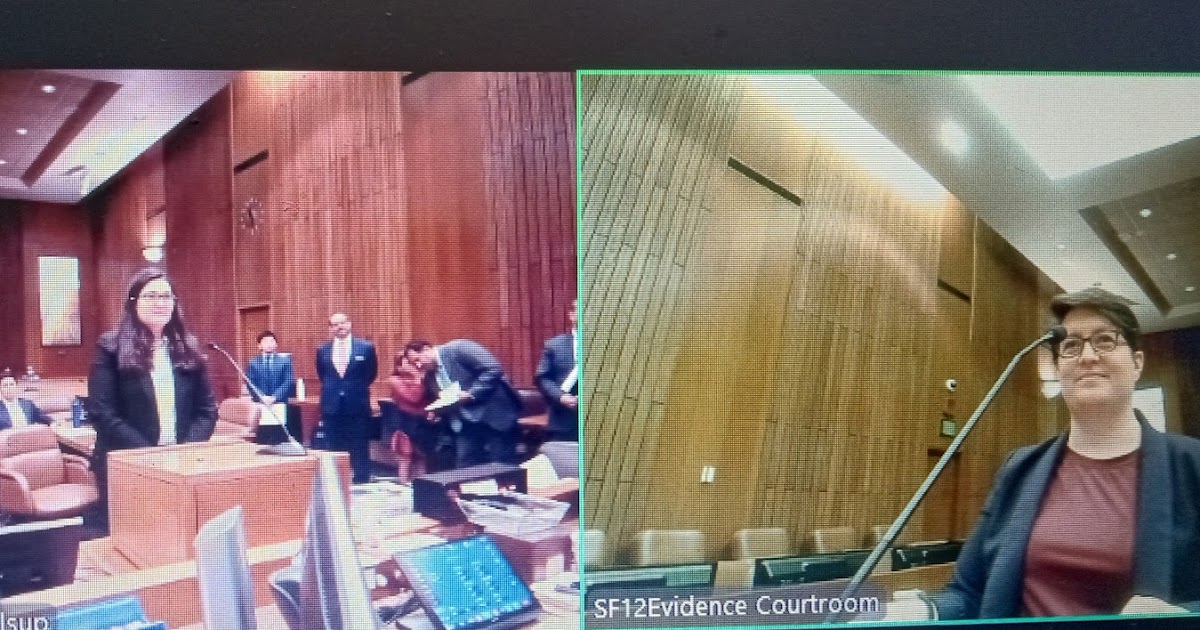
    On June 26th, the US Department of Education was brought to the Ninth District Court (and Judge Alsup) to show how many the Borrower Defense to Repayment cases that have been resolved per court order.  While we wait for a transcript of the latest episode of Sweet v McMahon, what we can tell you is that the Trump government continues to drag its feet in paying back debtors who have been defrauded.  

    Source link

  • TOMORROW 7 PM ET—join our emergency organizing call! (Brandon Herrera, Student Borrower Protection Center)

    TOMORROW 7 PM ET—join our emergency organizing call! (Brandon Herrera, Student Borrower Protection Center)

    This bill threatens to gut $350 BILLION in critical education programs to deliver $4.5 TRILLION in tax cuts to billionaires. House Republicans’ plan to slash the Pell Grant and other financial aid programs and eliminate basic protections for students—this will only make college more expensive and force millions of working families with student debt further into the red.

    So far, we have nearly 1,000 (!) RSVPs from all over the country planning to take part in this call. We will hear from policymakers, movement leaders, and affected students and borrowers on how this bill will harm our communities and how you can get more involved to protect students and working families—NOT billionaires.

    You won’t want to miss this—make sure to RSVP below and clear your calendar for TOMORROW at 7PM ET.

    Source link

  • Latest Borrower Defense to Repayment Numbers (US Department of Education)

    Latest Borrower Defense to Repayment Numbers (US Department of Education)

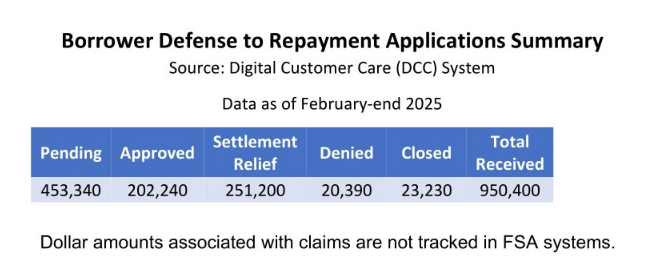
    The Higher Education Inquirer has received information today from the US Department of Education about Borrower Defense to Repayment claims.  Here are the results from ED FOIA 25-02047-F.  


    Source link

  • Agency Information Collection Activities; Submission to the Office of Management and Budget for Review and Approval; Comment Request; Borrower Defense to Loan Repayment Universal Forms

    Agency Information Collection Activities; Submission to the Office of Management and Budget for Review and Approval; Comment Request; Borrower Defense to Loan Repayment Universal Forms

    A Notice by the Education Department on 05/19/2025

    Department of Education[Docket No.: ED-2025-SCC-0002]

    AGENCY:

    Federal Student Aid (FSA), Department of Education (ED).

    ACTION:

    Notice.

    SUMMARY:

    In accordance with the Paperwork Reduction Act (PRA) of 1995, the Department is proposing a revision of a currently approved information collection request (ICR).

    DATES:

    Interested persons are invited to submit comments on or before June 18, 2025.

    ADDRESSES:

    Written comments and recommendations for proposed information collection requests should be submitted within 30 days of publication of this notice. Click on this link www.reginfo.gov/​public/​do/​PRAMain to access the site. Find this information collection request (ICR) by selecting “Department of Education” under “Currently Under Review,” then check the “Only Show ICR for Public Comment” checkbox. Reginfo.gov provides two links to view documents related to this information collection request. Information collection forms and instructions may be found by clicking on the “View Information Collection (IC) List” link. Supporting statements and other supporting documentation may be found by clicking on the “View Supporting Statement and Other Documents” link.

    FOR FURTHER INFORMATION CONTACT:

    For specific questions related to collection activities, please contact Carolyn Rose, 202-453-5967.

    SUPPLEMENTARY INFORMATION:

    The Department is especially interested in public comment addressing the following issues: (1) is this collection necessary to the proper functions of the Department; (2) will this information be processed and used in a timely manner; (3) is the estimate of burden accurate; (4) how might the Department enhance the quality, utility, and clarity of the information to be collected; and (5) how might the Department minimize the burden of this collection on the respondents, including through the use of information technology. Please note that written comments received in response to this notice will be considered public records.

    Title of Collection: Borrower Defense to Loan Repayment Universal Forms.

    OMB Control Number: 1845-0163.

    Type of Review: A revision of a currently approved ICR.

    Respondents/Affected Public: Individuals and Households.

    Total Estimated Number of Annual Responses: 83,750.

    Total Estimated Number of Annual Burden Hours: 217,750.

    Abstract: On April 4, 2024 the U.S. Court of Appeals of the Fifth Circuit granted a preliminary injunction against 34 CFR 685.400 et seq. (“2023 Regulation”) enjoining the rule and postponing the effective date of the regular pending final judgment in the case. The current Borrower Defense to Repayment application and related Request for Reconsideration are drafted to conform to the enjoined provisions of the 2023 Regulation. This request is to revise the currently approved information collection 1845-0163 to comply with the regulatory requirements of the borrower defense regulations that are still in effect, 34 CFR 685.206(e) (“2020 Regulation”), 34 CFR 685.222 (“2016 Regulation”), and 34 CFR 685.206(c) (“1995 Regulation”) (together, the “current regulations”). These regulatory requirements are distinct from the 2023 Regulation’s provisions. The revision is part of contingency planning in case the 2023 Regulation is permanently struck down. The Department of Education (“the Department”) is attaching an updated Borrower Defense Application and application for Request for Reconsideration. The forms will be available in paper and electronic forms on studentaid.gov and will provide borrowers with an easily accessible and clear method to provide the information necessary for the Department to review and process claim applications. Also, under the current regulations, the Department will no longer require a group application nor group reconsideration application.

    Dated: May 13, 2025.

    Brian Fu,

    Program and Management Analyst, Office of Planning, Evaluation and Policy Development.

    [FR Doc. 2025-08857 Filed 5-16-25; 8:45 am]

    BILLING CODE 4000-01-P
    Published Document: 2025-08857 (90 FR 21296)

    Source link

  • Having trouble keeping up with the chaos of the student loan system? (Student Borrower Protection Center)

    Having trouble keeping up with the chaos of the student loan system? (Student Borrower Protection Center)

    Are you having trouble keeping up with the chaos of the student loan system? Don’t worry; we got you. There’s a lot going on right now and we’re here to break it all down. Here are some of the most pressing things that happened this week.

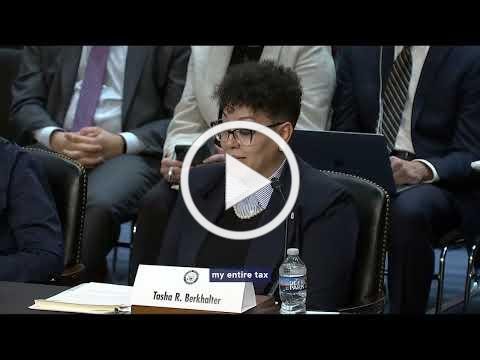
    On Tuesday, Senator Patty Murray (D-WA), the Ranking Member of the U.S. Senate Appropriations Committee and senior member of the Senate Health, Education, Labor and Pensions (HELP) Committee chaired an education forum to spotlight the Trump Administration’s radical effort to dismantle the U.S. Department of Education (ED). Tasha Berkhalter, a U.S. Army veteran and student loan borrower who had her debt discharged by the Biden Administration after being defrauded by a predatory for-profit college, gave powerful testimony at the hearing.

    Source link

  • AFT sues Dept. of Education for denying borrowers’ rights (Student Borrower Protection Center)

    AFT sues Dept. of Education for denying borrowers’ rights (Student Borrower Protection Center)

    Yesterday, President Trump signed an executive order ordering the shutdown of the U.S. Department of Education (ED). The order claims to ensure the “uninterrupted delivery of services, programs, and benefits on which Americans rely,” yet Trump and Secretary Linda McMahon have gutted the arms of ED that make those functions possible. Read our statement on yesterday’s executive order here. Last week, Trump announced a 50 percent reduction in the workforce at the Department. Now he plans to move student loans to the Small Business Administration?!?!

    The Trump Administration is intentionally breaking the student loan system and attacking borrowers and working families with student debt. But we’ve been fighting back.

    On Tuesday night, the 1.8 million-member AFT sued ED for denying borrowers’ access to affordable loan payments and blocking progress towards Public Service Loan Forgiveness (PSLF)—in violation of federal law.

    Three weeks ago, federal education officials eliminated access to Income-Driven Repayment (IDR) plans by removing the application from ED’s website and secretly ordering student loan servicers to halt processing all applications. These IDR plans provide millions of borrowers the right to tie their monthly payment to their income and family size, giving them the option to make loan payments they can afford.

    IDR plans are also the only way for public service workers to benefit from PSLF—a critical lifeline for teachers, nurses, first responders, and millions of other public service workers across the country.

    SBPC Executive Director Mike Pierce’s statement:

    Source link